
A strong maritime accident law firm is one that can act on the evidence, the experts, and the parallel proceedings within days, not just one that employs a skilled lawyer. After a serious vessel injury, the ship may sail, crew members may rotate off, recorder data may be overwritten, and the owner may start a limitation-of-liability case in federal court while the Coast Guard is still asking questions. This guide explains what to look for in a firm’s capacity to preserve the vessel, fund the experts, and manage several proceedings at once. It covers inspection and spoliation letters, expert teams, Coast Guard and NTSB investigations, multi-claimant and multi-state matters, trial readiness, co-counsel, staffing, fee and cost transparency, and how to read advertising. It is written for seriously injured mariners, passengers, and families who are comparing firms. The governing framework is U.S. maritime law, including the Jones Act seaman remedy, the Longshore and Harbor Workers’ Compensation Act, and general maritime tort law, and which one applies shapes the questions worth asking. It does not rank firms, promise results, or describe any particular firm.
What Does a Maritime Accident Law Firm Need for a Serious Vessel Injury?
Most advice about hiring counsel focuses on the individual lawyer: credentials, reputation, and personality. Those things matter. But a serious vessel injury isn’t the kind of matter that one person can carry alone, and the difference often shows up in the first few weeks, long before anyone talks about trial.
This page looks at the firm behind the lawyer. It asks what a team, a budget, and a set of working habits need to look like when a case involves a moving vessel, a corporate defendant, and several government agencies.
Why firm capacity is a separate question from a lawyer’s skill
A lawyer can know maritime law thoroughly and still be unable to act quickly if the office lacks the people and money to back that knowledge up. Capacity is the practical ability to turn legal knowledge into action while evidence is still available.
A firm is a team, a budget, and a set of habits
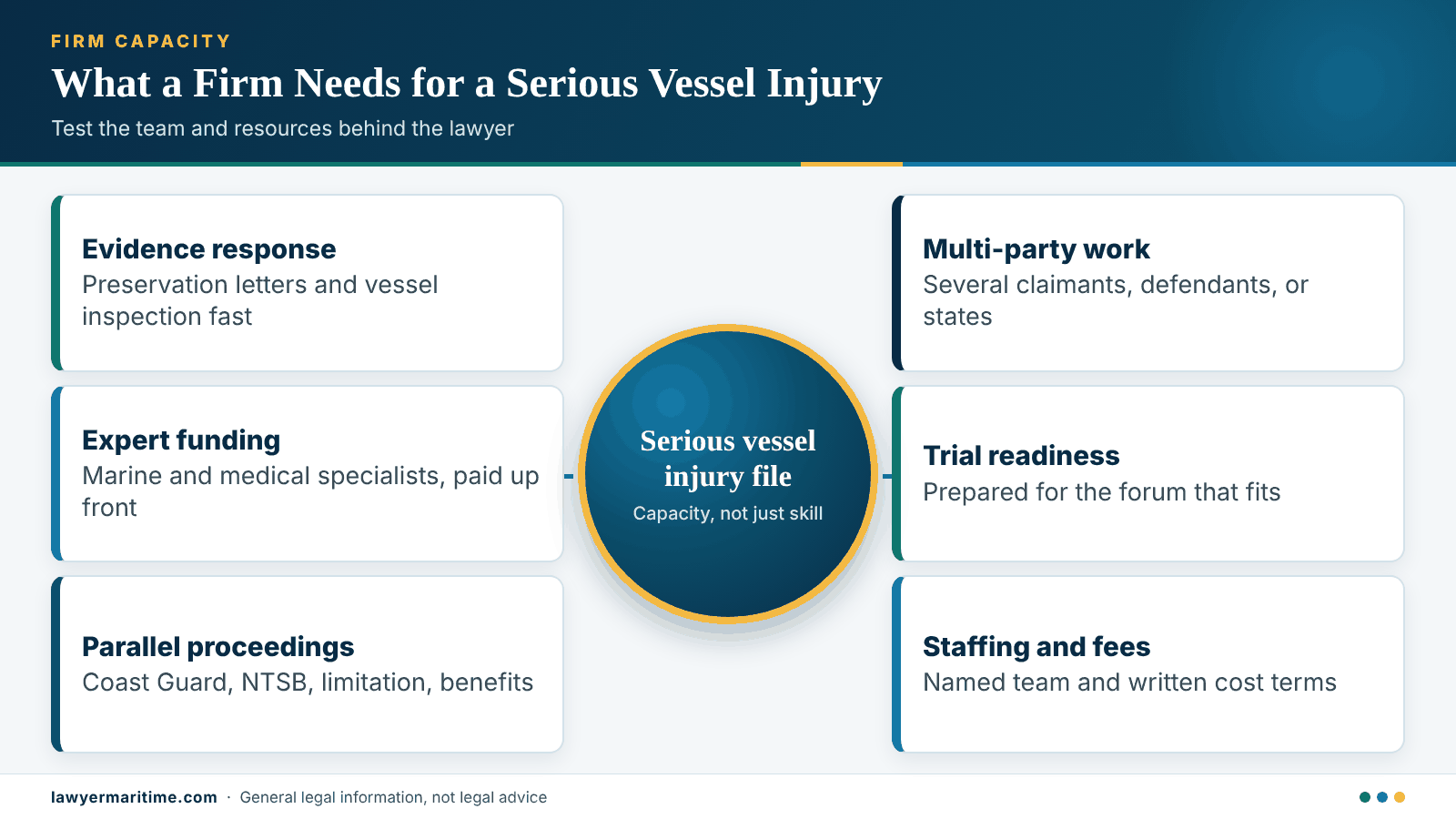
Think of capacity as three things working together. The team includes lawyers, paralegals, investigators, and sometimes nurse or records consultants who can gather and organize material quickly. The budget is the ability to pay for inspections, expert opinions, travel, and record retrieval without asking the client to carry those costs. The habits are the routines that make speed normal: a standard preservation letter, a list of vessel records to request, and a process for finding experts.
None of this requires a large firm. A small office with strong relationships and co-counsel can show real capacity, and a large one can lack it for a particular matter. The point is to test what the firm can do for your file rather than to assume that size, or the lack of it, answers the question.
If your main question is whether a lawyer’s experience fits your type of claim, how to evaluate the best maritime lawyer for a specific claim covers that. If geography is the worry, see choosing a maritime lawyer near you. Here we stay with the firm’s operating capacity.
What makes an injury “serious” for staffing purposes
No statute defines a “serious” vessel injury for the purpose of choosing a firm, so treat the term as practical. Features that usually increase the workload include permanent impairment or surgery, a death, several injured people, a disputed cause, a failed piece of equipment, and a defendant with insurers and investigators of its own.
Government attention adds more. A Coast Guard investigation, an NTSB inquiry, or a possible criminal review means the facts are being gathered by others at the same moment, and not always with your interests in mind. A minor sprain with a clear cause can be handled with modest resources. A crush injury during a crane lift with conflicting accounts usually cannot.
What a serious vessel injury file usually contains
The scale of the file explains why capacity matters. Even before a lawsuit exists, a firm may be sorting out who the defendants could be, which law applies, and which evidence is at risk.
Several possible defendants and several legal routes
A single accident can point to an employer, a vessel owner, an operator, a charterer, a contractor, an equipment manufacturer, or another vessel. The law that governs each relationship may differ. An injured seaman may have a Jones Act negligence claim against the employer, an unseaworthiness claim against the vessel owner, and a right to maintenance and cure. A covered longshore or harbor worker generally receives statutory compensation and may sue a negligent vessel under 33 U.S.C. § 905(b). A passenger or recreational boater generally proceeds under general maritime negligence law.
Which route fits depends on status and facts, and even the question of whether a craft or structure counts as a vessel can be contested. Our guides on who is covered by maritime law and how maritime negligence works explain the legal side. For the firm, the practical point is that several defendants and several statutes multiply the records, experts, and deadlines it must manage.
Evidence that changes or disappears quickly
Vessels are working machines. They load, sail, change crews, undergo repairs, and sometimes leave U.S. waters. Electronic systems can overwrite data on a schedule. Witnesses can be reassigned or leave the industry. A firm built for serious injuries plans around that churn from day one.
The next section looks at preservation in detail. For now, hold on to this: speed isn’t a luxury in this kind of case. It’s part of how the case is built.
| Capacity | What it looks like in practice | A question to ask |
|---|---|---|
| Rapid evidence response | Preservation letters, records requests, and an inspection plan within days | What would you do in the first week to protect the vessel evidence? |
| Expert access and funding | Established relationships with marine and medical specialists, and a budget to retain them | Which kinds of experts would you consult here, and who pays up front? |
| Parallel-proceeding management | Tracking Coast Guard, NTSB, limitation, benefits, and any criminal inquiry together | How do you monitor other proceedings that could affect my claim? |
| Multi-party coordination | Handling several claimants, defendants, or states without conflicts | Do you represent anyone else involved, and how are conflicts handled? |
| Trial readiness | Willingness and experience to try the case in the forum that fits | Who would try this case, and in which kinds of courts? |
| Staffing and communication | A named team, clear updates, and plain-English explanations | Who will work on my file, and how often will I hear from the team? |
| Cost and fee transparency | A written agreement that explains percentages, expenses, and what you owe if the case is lost | Which costs come out of a recovery, and which do I owe regardless? |
Can the Firm Preserve and Inspect the Vessel Before the Evidence Moves?
If one capacity separates serious-injury firms from the rest, it’s probably this one. The vessel, its records, and its electronic systems are the best proof of what happened, and they’re in the hands of the party you may be about to challenge. A firm that cannot reach that evidence early may spend the rest of the case trying to reconstruct what a single inspection could have shown.
What evidence sits on and around the vessel
Serious injuries leave traces in many places. Some are physical, some are digital, and some exist only in the memory of the people aboard.
Electronic data: recorders, navigation systems, and alarms
Some vessels carry a voyage data recorder, a shipboard device that stores navigation and bridge information, and whether a particular vessel has one depends on its size, type, and route. Many smaller vessels, towboats, and fishing boats do not. Other electronic sources may still exist: automatic identification system (AIS) position reports, radar and electronic chart displays, engine-room alarm and monitoring logs, security or deck cameras, and the crew’s phones and messaging apps.
Much of this data is time-limited. Systems may overwrite older information, equipment may be replaced during repairs, and phones get upgraded or lost. A capable firm asks early which systems the vessel had, who controls them, and how long the data is kept. For navigation and collision data in particular, see our guide to how maritime collisions are investigated.
Paper records and people: logs, maintenance files, and witnesses
Deck and engine logbooks, maintenance and repair histories, work orders, inspection records, safety management documents, crew lists, training records, and rest-hour records often show whether a hazard was known before the injury. Fatigue, for example, is a recurring theme in casualty investigations, and rest records can matter; our article on maritime fatigue accidents explains why. In fire and explosion cases, fire investigation methods add another layer of physical evidence.
People are evidence too. Coast Guard rules require a serious marine incident to trigger alcohol and drug testing of crew directly involved, generally within set time windows, and the paperwork documents who was on watch and what was done (46 CFR 4.06-3). Witnesses can scatter quickly, especially on vessels with rotating crews. A firm should ask who saw the event, who was on duty, and who can be located before they sign off.
How a firm locks the evidence down
Preservation is partly legal and partly logistical. The legal tools put the other side on notice. The logistical tools put someone in front of the evidence before it changes.
Preservation letters and the duty to preserve
A preservation letter (sometimes called a spoliation letter) tells the vessel owner, operator, employer, insurers, and other possible defendants what to keep: recorder data, logs, maintenance files, the failed component, photographs, and electronic messages. The letter doesn’t by itself force compliance, but it removes any claim of surprise and sets up the argument that evidence was lost despite notice.
Federal Rule of Civil Procedure 37(e) addresses lost electronically stored information that should have been preserved for litigation. If a party failed to take reasonable steps and the information cannot be restored or replaced, a court may order measures to cure prejudice. The most severe measures, such as an adverse-inference instruction or dismissal, require a finding that the party intended to deprive another of the information. Physical evidence is handled under other doctrines, and courts differ on the details, so treat the rule as an illustration rather than a guarantee.
Inspection, testing, and getting help from the court
Once a lawsuit is pending, Federal Rule of Civil Procedure 34 allows a party to request that another party permit inspection, measurement, testing, or sampling of property in its control. Before a lawsuit, inspections often happen by agreement, with a written protocol that says who attends, what may be photographed, and when any destructive testing may occur with notice to every interested party.
When the other side will not cooperate and the evidence is at risk, a firm may need to ask a court for relief. Possible tools include a temporary restraining order under Rule 65, or a petition under Rule 27 to preserve a witness’s testimony before suit when a would-be plaintiff cannot yet file. Rule 27 requires a verified petition and advance notice to expected opponents, so it isn’t a casual shortcut. The practical question for you is whether the firm has done this kind of emergency work and has the staff to do it on short notice.
| Evidence | Where it sits | Why it is at risk | What a prepared firm does |
|---|---|---|---|
| Recorder, AIS, and navigation data | Bridge systems, recorders, and service providers | Overwriting, repairs, and equipment replacement | Identifies the systems early and demands preservation and a verified copy |
| Engine, alarm, and monitoring logs | Machinery control systems and engine-room records | Automatic overwriting or routine resets | Requests exports and the system’s retention settings |
| Logbooks, safety, and maintenance files | Vessel, shore office, managers, and classification or inspection bodies | Revision, loss, or disposal after the incident | Sends letters to each custodian and lists records by category |
| Failed equipment or parts | Vessel, repair yard, or the manufacturer | Repair, scrapping, or destructive testing without notice | Negotiates a joint inspection and testing protocol |
| Scene and vessel condition | The vessel itself, which may sail or be altered | Cleanup, repairs, redeployment | Documents conditions by photo, video, and measurements as early as possible |
| Witness accounts | Crew, contractors, pilots, and passengers | Rotation off the vessel, fading memory, and pressure | Identifies and contacts witnesses while their availability is clear |
| Phones, video, and messages | Personal devices and company systems | Upgrades, deletions, and lost devices | Instructs the client on preservation and requests company copies |
Can the Firm Retain Experts and Fund an Expert-Heavy Case?
Serious vessel injury cases are rarely decided by lay testimony alone. Why did the winch fail, what did a reasonable mariner do, and what will this injury cost over a lifetime are questions that call for specialists. Retaining them takes relationships, judgment, and cash, and a firm that cannot do all three may settle for less proof than the case deserves.
Which experts a serious vessel injury case may need
The right team depends on the facts, so be wary of any firm that recites the same list for every case. What you want to hear is a reasoned plan: which questions need an expert and why.
Casualty and causation experts
Casualty experts explain what happened and why. Depending on the case, that can mean a naval architect for stability or structural questions, a marine surveyor for vessel condition, a marine engineer for machinery and systems, or a licensed deck officer or pilot to address navigation and seamanship. Failure-analysis specialists examine broken parts, and human-factors or fatigue experts address how schedules, staffing, and design contributed to an error.
Not every case needs all of them. A slip on a poorly maintained gangway may call for a surveyor and a safety expert. A collision with injuries may need a navigation expert and data analyst. The firm’s job is to match the specialist to the disputed question, not to hire a roster for show.
Medical and damages experts
On the injury side, treating physicians are often the best witnesses about diagnosis and treatment, and a firm may add independent medical specialists to address permanency, future care, or causation. Vocational experts can address what work is realistic after a permanent restriction. An economist can translate lost earning capacity into present-day terms, and a life-care planner can describe future medical needs.
The categories of damages that may be available depend on the legal route, and those details sit in our guides to maritime injury damages and unseaworthiness damages. For firm selection, what matters is that the firm understands which experts each category of loss requires and has budgeted for them.
Who pays, and how do you test a firm’s depth?
Expert-heavy litigation is expensive, and the way a firm handles that expense tells you a good deal about its resources and its candor.
Costs, funding, and the written fee agreement
ABA Model Rule 1.5(c) says a contingent fee agreement must be in writing and signed by the client. It must state how the fee is determined, including the percentages for settlement, trial, or appeal, and which expenses will be deducted from the recovery. It must also say whether expenses are deducted before or after the fee percentage is calculated, and it must make clear what the client will owe regardless of the outcome. State rules vary and may be stricter, so confirm the rule that governs your lawyer.
Use that framework to ask concrete questions. Does the firm advance expert and investigation costs as the case proceeds? Who approves large expenses? What happens to costs if the case does not succeed? Are there any charges you would be expected to pay along the way? A prospective client who gets a clear, written answer is better placed than one who hears “don’t worry about that.” Our guide to free maritime lawyer consultations covers how consultation and contingency-fee advertising work in general terms.
Expert quality: will the testimony hold up?
Retaining an expert isn’t the end of the task. In federal court, Federal Rule of Evidence 702 requires the party offering expert testimony to show the court that it is more likely than not that the testimony will help the fact-finder, rests on sufficient facts or data, is the product of reliable methods, and reflects a reliable application of those methods to the case. The Supreme Court described the judge’s gatekeeping role in Daubert v. Merrell Dow Pharmaceuticals, Inc., 509 U.S. 579 (1993). A rule amendment effective in 2023 emphasized that the proponent bears this burden.
For you, that means a firm should vet experts before relying on them: their methods, the data they used, and whether their opinions fit the facts. A strong firm will talk about how it tests an expert’s work early, not just about how impressive the résumé looks.
| Expert | Question it helps answer | Records the expert usually needs |
|---|---|---|
| Naval architect or marine surveyor | Was the vessel’s structure, condition, or stability a factor? | Drawings, survey and inspection reports, repair history |
| Marine engineer or failure analyst | Why did the equipment or part fail? | The failed component, maintenance files, manufacturer information |
| Mariner or navigation expert | Did those in charge act as a reasonably careful mariner would? | Logs, voyage and navigation data, procedures, crew records |
| Human-factors or fatigue specialist | Did schedules, staffing, or design contribute to the error? | Watch schedules, rest-hour records, staffing and workload information |
| Treating or independent physician | What is the injury, the treatment, and the prognosis? | Medical records, imaging, therapy and surgical notes |
| Vocational expert and economist | What has the injury done to earning capacity, in present-day terms? | Pay records, work history, restrictions, tax and benefit information |
| Life-care planner | What future care and support might be needed, and what might it cost? | Medical opinions, treatment plans, and functional assessments |
How Does a Firm Handle Investigations and Proceedings That Run in Parallel?
A serious vessel injury rarely produces just one legal event. The injured person may be receiving benefits, the Coast Guard may be investigating, the vessel owner may be preparing to ask a federal court to cap its liability, and prosecutors may be watching a fatal casualty. Each track has its own rules and clock, and a decision in one can change the value of another.
Government investigations running beside your claim
Government investigators and civil litigators ask different questions. Investigators look for safety lessons and, in some cases, violations. A claim lawyer needs evidence of fault, causation, and damages that will hold up in a courtroom.
What the Coast Guard and NTSB do, and what their reports cannot do
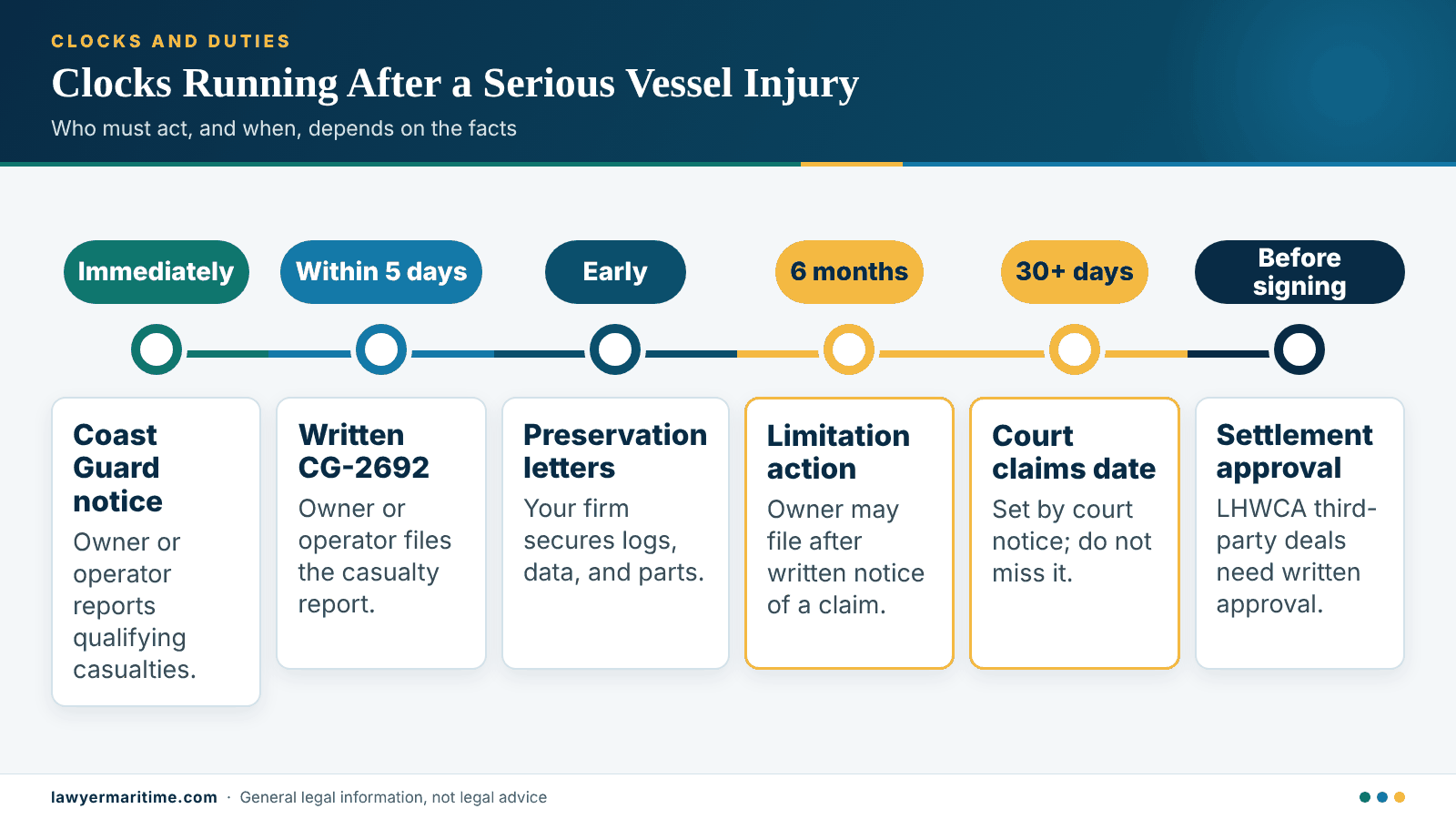
Under Coast Guard rules, the owner, agent, master, operator, or person in charge must give immediate notice of certain marine casualties. The list includes a loss of life and an injury that requires professional medical treatment beyond first aid and, for a crew member in commercial service, makes the person unfit for routine duties (46 CFR 4.05-1). A written report on Form CG-2692 is due within five days (46 CFR 4.05-10). That paperwork is created by the owner or operator, not by the injured person, and it can be an early window into the company’s version of events.
The reports that come out of government investigations have legal limits in civil cases. Under 46 U.S.C. § 6308, no part of a Coast Guard marine casualty investigation report is admissible as evidence or subject to discovery in civil or administrative proceedings, other than administrative proceedings conducted by the United States. Coast Guard investigators also cannot be deposed or made to testify about the investigation without the Secretary’s permission, although the statute says permission cannot be refused for testimony on purely factual matters that is unavailable elsewhere. For the NTSB, 49 U.S.C. § 1154(b) bars its reports from being admitted into evidence or used in a civil action for damages, and § 1154(a) restricts discovery of certain recordings that the NTSB has not made public. Our guide to reading an NTSB marine report explains how those documents are structured and what probable cause does and does not mean.
The practical lesson is that a government report is a lead, not a substitute for proof. A firm that plans to wait for the Coast Guard or NTSB to finish has chosen to rely on something that may never be admissible. Look for a firm that treats those investigations as sources of facts and leads while building its own record.
One more point surprises many families. In an NTSB investigation, the agency designates the “parties” that help gather technical facts, and its rules provide that a party representative cannot hold a legal position or represent claimants or insurers (49 CFR 831.11). A firm representing an injured person therefore generally is not inside the party process. It relies on the public docket, its own investigation, and discovery.
Statements, testing, and possible criminal exposure
After a serious marine incident, the marine employer must arrange alcohol and drug testing of the people directly involved, with time windows set by regulation: alcohol testing generally begins within two hours, and drug specimens are generally collected within 32 hours, subject to exceptions for safety concerns (46 CFR 4.06-3). The results can become evidence about the crew, and the paperwork can show whether the employer followed its own obligations.
Investigators may also ask crew members for interviews and written statements. Anything said or signed can be used later, and an injured person who is medicated, exhausted, or frightened may not give a complete or accurate account. A capable firm advises clients about these interviews before they happen, and it understands that its client’s interests may differ from those of the employer, the master, or other crew.
In fatal casualties, criminal review is a real possibility. The federal statute commonly called seaman’s manslaughter, 18 U.S.C. § 1115, covers deaths resulting from the misconduct, negligence, or inattention of a captain, engineer, pilot, or other person employed on a vessel, and it also reaches owners, charterers, inspectors, and public officers whose fraud, neglect, connivance, misconduct, or violation of law contributes to a death. A civil firm isn’t a criminal defense firm, and it should say so plainly. Ask whether the firm will coordinate with separate criminal counsel for any witness whose own conduct may be examined, and whether representing several people from the same vessel could create a conflict.
Civil proceedings that start or stall your claim
Alongside the investigations, two civil mechanisms often shape the timing and structure of a serious claim: the owner’s limitation-of-liability action and the interplay of statutory compensation with a third-party suit.
Limitation of liability: the owner’s countermove
Under 46 U.S.C. § 30529, a vessel owner may bring a civil action in federal district court to limit its liability. The action must be brought within six months after a claimant gives the owner written notice of a claim. The owner may deposit with the court the value of its interest in the vessel and pending freight, or approved security, and once the owner complies, related claims and proceedings against it stop. Supplemental Rule F of the Federal Rules of Civil Procedure sets out the mechanics, including a court notice that tells claimants to file their claims by a date at least 30 days after the notice issues.
That date matters. A claim filed in the limitation case must state the supporting facts, the items claimed, and the dates they accrued, and a claimant who wants to contest the owner’s right to limitation must also file an answer. Missing the court’s date can put a claimant at risk of being shut out of the fund, so the notice can’t be set aside. The Supreme Court has held that state courts may still hear claims like a deckhand’s against a vessel owner so long as the owner’s right to seek limitation is protected, as in Lewis v. Lewis & Clark Marine, Inc., 531 U.S. 438 (2001), where the claimant had given stipulations that safeguarded the owner’s rights.
What should a firm do about this? It should monitor mail and court dockets for notices, understand that the owner’s six-month clock runs from written notice of a claim, and treat the timing and wording of any claim letter as a strategic choice. For broader background, see our guides to admiralty law and to claims that call for specialized admiralty experience.
Compensation benefits and the third-party suit
For workers covered by the Longshore and Harbor Workers’ Compensation Act, benefits and a suit against a negligent outside party can coexist. Under 33 U.S.C. § 933(a), a worker entitled to compensation does not have to choose between accepting benefits and suing a third party. But the statute has traps. Accepting compensation under an award can operate as an assignment of the right to sue to the employer unless the worker files suit within six months, and § 933(g) provides that if a worker settles with a third party for less than the compensation the worker would receive, the employer and its carrier must approve in writing before the settlement is signed. Without that approval, the worker can lose the right to further compensation and medical benefits, even if benefits were already being paid.
The Supreme Court applied that rule firmly in Estate of Cowart v. Nicklos Drilling Co., 505 U.S. 469 (1992), holding that the forfeiture applied even though the employer was not paying compensation at the time. Seamen face a different set of issues, such as maintenance and cure continuing alongside a damages claim and releases that courts examine closely; our guides on the seaman’s remedy stack and maritime settlement releases go deeper. The firm-capacity point is simple: a firm must manage the whole picture, so that a settlement in one forum does not quietly cost you benefits in another.
| Proceeding | Who runs it | Why it matters to your claim | What the firm should be doing |
|---|---|---|---|
| Coast Guard casualty investigation | U.S. Coast Guard | Produces facts and leads, but the report itself is generally not admissible in civil proceedings | Tracks the investigation, requests public records, and builds independent proof |
| NTSB investigation | National Transportation Safety Board, for selected accidents | Public docket may hold useful facts; reports are not usable in civil damages actions | Reviews the docket and evidence and avoids relying on the final report |
| Possible criminal inquiry | Federal prosecutors, with agency investigators | Statements by crew or officers can create exposure and affect witnesses’ willingness to talk | Advises on interviews, coordinates with separate counsel, and watches for conflicts |
| Limitation of liability action | Vessel owner, in federal district court | Can stay other suits and set a deadline to file claims against a limited fund | Watches for notices, calendars the claims date, and evaluates forum options |
| LHWCA compensation claim | Employer or carrier, with U.S. Department of Labor oversight | Provides benefits but affects third-party settlements through approval and lien rules | Coordinates benefits and the third-party suit, and secures required approvals |
| Employer or insurer investigation | Employer, marine liability insurer, adjusters, or defense counsel | May collect recorded statements and records that support the defense | Advises on statements and sends its own preservation and records requests |
Can the Firm Coordinate Claimants, Forums, and a Trial?
Some serious vessel injuries involve one person and one employer. Many do not. When several people are hurt, when the vessel, owner, and crew are spread across jurisdictions, or when the case cannot be settled, the firm’s ability to coordinate and to try the case becomes central.
Multi-claimant and multi-state matters
The more people and places involved, the more a case resembles a project. Someone has to manage the moving parts, and someone has to keep the interests of different clients from colliding.
Several injured people and one limited fund
When an accident injures several people, a vessel owner’s limitation action can put them in the same proceeding. Under Supplemental Rule F, after liability is determined, the fund is divided pro rata among claimants in proportion to their proven claims, subject to any legal priorities. That means claimants can have competing interests: a larger share for one is a smaller share for another.
A firm that represents more than one claimant needs a clear approach to conflicts, including informed consent where permitted and separate counsel where needed. The conflict can be sharper still when the claimants include crew members, passengers, and an officer whose own conduct is in question. Ask whether the firm already represents anyone else connected to the incident, and how it will handle disagreements about strategy or allocation. Where several firms represent different claimants, ask whether they coordinate on shared discovery and experts, and how any costs would be shared.
Several states, courts, and defendants
Serious cases can touch several jurisdictions at once. The injured crew member may live in one state, the vessel may be owned in another, the incident may occur in a third, and the manufacturer of a failed component may be elsewhere. Defendants can be sued in different courts, and a plaintiff’s choice of forum can change the judge, the jury pool, and the pace.
The statute giving federal district courts original jurisdiction over admiralty and maritime cases, 28 U.S.C. § 1333, also contains the saving to suitors clause, which preserves other remedies that claimants may otherwise have, and that is why some maritime claims may be pursued in state court. An injured seaman may also elect a civil action at law with a right to trial by jury against the employer under 46 U.S.C. § 30104. Choosing among those paths is a strategic decision for counsel and client, and our admiralty jurisdiction guide explains how the courts’ reach works. What matters when you pick a firm is whether it is admitted, or can associate counsel admitted, in the courts where the case may need to proceed.
Trial readiness and co-counsel
Most cases settle, but the way a defendant values a claim is influenced by whether the plaintiff’s lawyers are ready and able to try it. Readiness is a capacity, not a slogan.
Jury or bench, and why that shapes the firm you need
The forum can decide who finds the facts. A seaman’s Jones Act claim carries a statutory jury right. A claim brought only under general admiralty jurisdiction in federal court is generally tried to a judge, and the details of how a claim is framed can affect whether a jury is available. Those rules vary with the claim and the court, so treat this as a general picture and ask counsel to explain your options.
A firm should be able to say who would try your case and what trial experience the team has in the kinds of courts involved. It doesn’t have to promise a verdict, and it shouldn’t. It should be able to explain what trial would require and whether its resources support that path, because a defendant that sees a prepared trial team may evaluate settlement differently than one that suspects the case will never be tried.
Co-counsel and referral arrangements
It is common, and often wise, for one firm to bring in another for a serious maritime matter. A local firm may associate with a firm that has deeper experience with vessel inspections or limitation actions, or a firm may share the work to meet a heavy expense load. These arrangements aren’t a red flag by themselves.
The ethics rules, however, set conditions. Under ABA Model Rule 1.5(e), lawyers in different firms may divide a fee only if the division is proportional to the work each performed or each assumes joint responsibility for the representation. The client must agree to the arrangement, including each lawyer’s share, and the agreement must be confirmed in writing. The total fee must remain reasonable. Ask any prospective firm who would be lead counsel, who bears responsibility if there is co-counsel, and whether the arrangement changes your fee or costs. State rules vary, so those answers should be in writing.
| Situation | What it demands of the firm | What to ask |
|---|---|---|
| One injured crew member and an employer | Early preservation, benefits management, and a clear claim strategy | How will you protect maintenance and cure while building the damages claim? |
| Several injured crew members | Conflict screening, coordinated evidence, and careful communication with each client | Do you represent others from the vessel, and how are conflicts handled? |
| Crew and passengers hurt together | Handling different legal regimes and competing interests in a shared fund | How would you protect my interests if the fund is limited? |
| A death on the vessel | Coordination with family, possible criminal review, and wrongful-death law | Do you work with separate criminal counsel for witnesses when needed? |
| Parties in several states or countries | Forum analysis, local counsel, and logistics for evidence and witnesses | In which courts can your team appear, and who would you associate locally? |
For the accident-type view of these situations, see our guide to maritime accident attorneys and claims by accident type.
How Should You Judge Staffing, Fees, and Advertising Claims?
Capacity is partly about what a firm can do and partly about how it treats you while it does it. Staffing, communication, fee clarity, and honest marketing are all visible before you sign anything, which makes them some of the most useful things to test.
Who will actually work on your file, and how will they communicate?
People often meet a senior lawyer at the first conversation and then deal with someone else for months. That isn’t necessarily a problem, but it shouldn’t be a surprise.
Staffing and responsibility
Ask who the responsible lawyer will be, who else will work on the file, and what each person does. A serious case may involve a lead lawyer, a second lawyer, a paralegal who tracks records, and an investigator or consultant. You should know who makes strategic decisions, who handles day-to-day questions, and who will be in the room if the case goes to trial.
It is also fair to ask about workload. A firm can’t always give a precise answer, but it should be able to explain how it assigns files and what happens if the lead lawyer is unavailable. A team that explains its structure openly is usually more reliable than one that offers “we’re always available.”
Communication you can reasonably expect
Good communication is a set of habits, not a personality trait. Ask how the firm will update you, whether it will explain developments in plain English, and how it handles questions between updates. If you are at sea, in rotation, recovering at home, or more comfortable in another language, ask how the firm will reach you and how it will share documents securely.
Remember too that major decisions, such as whether to accept a settlement, belong to you, and that a lawyer’s role is to advise. A firm that explains the options, risks, and trade-offs, rather than pushing a quick resolution, is showing the right instincts. If you are comparing how counsel can help seamen in particular, our guide on when an injured seaman should get legal help covers timing and triggers.
Fees, costs, and advertising claims
Money and marketing are where many prospective clients feel least equipped. Fortunately, they’re also where specific questions produce useful answers.
What a transparent fee and cost explanation covers
ABA Model Rule 1.5(b) says the scope of the representation and the basis or rate of the fee and expenses should be communicated to the client, preferably in writing, before or soon after the representation begins. For contingent fees, Rule 1.5(c) adds the written, signed agreement described earlier, and it requires a written statement at the end of the matter showing the outcome and, if there is a recovery, the client’s share and how it was calculated. These are model rules, and the rules that apply to your lawyer are the ones adopted in the relevant state.
Turn that into questions. What percentage applies at each stage? Are expenses deducted before or after the percentage? Which costs, if any, do I owe if there is no recovery? How are liens or reimbursement claims handled, for example by a health insurer or an employer that paid benefits? If another firm joins as co-counsel, will my share change? A firm that answers in writing before you sign is showing the transparency you want.
Reading advertisements and results claims
Lawyer advertising is regulated. ABA Model Rule 7.1 prohibits false or misleading communications about a lawyer’s services, and state rules govern the lawyers who practice there and are often stricter. That does not mean every ad is accurate or useful to you. A big number in an advertisement may tell you nothing about the facts, defendants, or legal route behind it.
Look for what advertising cannot show. It cannot show whether the firm will staff your file, fund your experts, move quickly on evidence, or handle parallel proceedings. It also cannot show whether the firm’s experience matches your type of claim. Treat marketing as a place to start asking questions, not as proof of capacity. Titles or certifications can sometimes be verified with the issuing body or the state bar; if a firm describes itself as a specialist, ask who awards the designation and check it yourself.
| Claim you may see | What it may tell you | What it cannot tell you | Better question |
|---|---|---|---|
| Large totals for past results | That the firm has handled some significant matters | Whether those cases resemble yours, or what the client actually received | Which past matters involved facts and legal issues like mine? |
| “Specialist,” “certified,” or “top” | A title the firm chooses or earns, depending on the source | Who awarded it, on what criteria, or whether it applies to your claim | Who grants this designation, and how can I verify it? |
| “Available 24/7” | That someone may answer a call at any hour | Whether the team can act on evidence the same week | Who responds, and what happens in the first week? |
| “No fee unless we win” | That the fee may be contingent on a recovery | Whether you owe costs if there is no recovery, or how expenses are repaid | Which costs, if any, do I owe regardless of the outcome? |
| “We handle cases nationwide” | Interest in cases beyond one region | Where the lawyers are admitted, or who would appear in your court | Which courts can your team appear in, and who would be local counsel? |
| Client testimonials | That some clients were satisfied | Whether outcomes are typical, or whether the client faced your issues | Can you explain how you would handle my particular facts? |
How Can You Test a Firm’s Capacity in One or Two Conversations?
You don’t have to be a lawyer to test a firm. You need a short list of questions, a few documents, and the patience to listen for specifics. The goal of the first conversation isn’t to be impressed. It’s to find out whether this team can do the work your case may require.
Before the first call
A little preparation changes what you learn. It also protects you from choosing on the basis of a polished website or a persuasive phone voice.
Check the license, the discipline record, and the fit
Start with the basics. Confirm through the relevant state bar that each lawyer you may work with is licensed and see whether any public discipline is listed. Ask whether the lawyers are admitted to the federal and state courts where your case may need to be filed, or whether the firm would associate local counsel. The lawyer should also be willing to say honestly whether your type of claim is one the firm handles regularly.
If you are unsure what type of claim you have, read about maritime law and the roles that determine your remedies, then compare your situation with the evaluation framework in our guide to the maritime lawyer’s role and when you may need one. A firm that routinely says yes to every claim, regardless of fit, deserves more questions, not fewer.
Gather what you have
Collect the documents that show who you worked for, what happened, and what the injury has meant. That generally includes the names of the employer and vessel, a short written timeline, photographs, medical records or discharge papers, pay records, anything you signed, and messages about the incident. Do not alter or reorganize original material, and keep copies of everything you hand over.
Our consultation preparation guide walks through what to bring and what an attorney is likely to ask. Prospective clients are generally owed confidentiality for what they share while deciding whether to hire a lawyer, a duty reflected in rules such as ABA Model Rule 1.18, though state rules differ.
During the consultation
The consultation is where you can compare firms on the same ground. A few well-chosen questions will reveal more than a long meeting.
Ask for a first-week plan
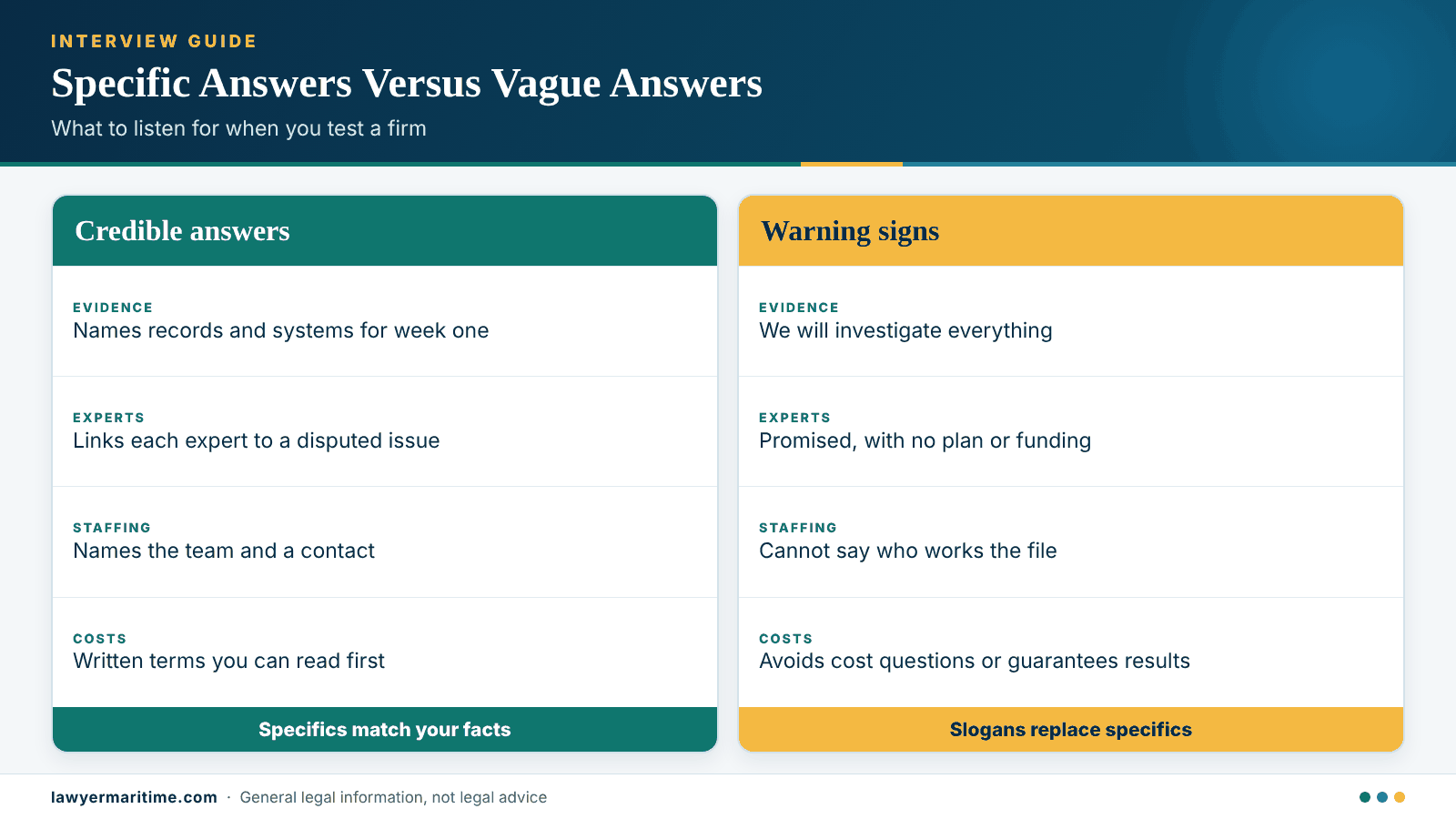
One of the most revealing questions is simple: if you were retained today, what would happen in the first seven days? A capable answer is concrete. It might include sending preservation letters, requesting vessel records, evaluating whether an inspection is needed, identifying early expert needs, advising you about statements to the employer and insurer, and checking whether benefits are being paid.
A weak answer is general: “We’ll get started right away and fight for you.” You’re not looking for a script or guarantees. You’re looking for evidence that the firm has done this before and has habits it can describe. If the firm needs more facts before it can be specific, a good lawyer will say what facts those are and why they matter.
Comparing two firms fairly
If you speak with more than one firm, ask each the same questions and write down the answers. Compare them on evidence response, experts and funding, parallel proceedings, staffing, and written fee terms rather than on who sounded most confident. Consider whether each firm was honest about weaknesses in your case, because a firm that only tells you what you want to hear is not helping you.
It’s acceptable to take time to decide, but remember that evidence and deadlines don’t pause while you do. Some deadlines, including notice requirements and the general three-year period for many maritime injury suits under 46 U.S.C. § 30106, depend on the facts and the claim. Our article on missed or possibly missed maritime injury deadlines explains how to think about timing without assuming the worst.
| Topic | A specific, credible answer sounds like | A warning sign sounds like |
|---|---|---|
| Evidence | Names the records, systems, and custodians it would target in the first week | “We’ll investigate everything” with no detail |
| Experts | Explains which disputed issues would need which specialists and how they are funded | Promises experts without saying who pays or how they are selected |
| Parallel proceedings | Describes how it tracks Coast Guard, NTSB, limitation, and benefits matters | Treats government reports as the plan, or ignores them |
| Staffing | Names the team, roles, and a contact for questions | Cannot say who will work on the file |
| Costs and fees | Offers a written agreement explaining percentages, expenses, and what you owe if there is no recovery | Avoids discussing costs, or insists on signing before you can read the terms |
| Promises | Explains uncertainty and says outcomes depend on facts | Guarantees a result or a dollar range at the first call |
What to Do Now: A Practical Checklist
If you or someone in your family has been seriously hurt on a vessel, you don’t need to solve everything at once. These steps protect your health, your evidence, and your options while you compare firms. They are general, and a lawyer who knows your facts may adjust them.
In the first days after a serious injury
The first priorities are medical and practical. Legal strategy can follow once you are safe and stable.
Protect your health and your paper trail
Get the medical care you need and follow the treatment plan. If you are a crew member, report the injury to the master or your employer, preferably in writing, and keep a copy of anything you submit. Write down the date, time, place, and what happened while your memory is fresh, along with the names of anyone who saw it.
- Keep copies of medical records, discharge instructions, receipts, and pay records
- Write a short timeline in your own words, and date it
- Note the names of the vessel, the owner, the operator, and your employer
- Save messages, photos, and videos in their original form
Preserve what you can, safely
Do not put yourself at risk to gather evidence. If you can do so safely, photograph the scene, the equipment involved, and any visible injuries. Keep the clothing, gear, or device involved in the injury in its current condition. Do not repair, clean, or discard it until a lawyer has advised you.
The vessel’s own records and systems are usually out of your reach, which is why a firm’s ability to preserve them matters. If someone offers you a copy of an incident report or a statement, keep it and note when and from whom you received it.
Common missteps while you compare firms
Several early mistakes can be hard to undo. Most come from understandable pressure, so it helps to know them in advance.
Statements and signatures
Employers and insurers often ask injured people for recorded statements, medical authorizations, and signed forms soon after an incident. Read anything before signing it, ask for a copy, and consider asking a lawyer to review it first. Settlement releases deserve special care, and our guide to maritime settlement releases explains what rights they may give up.
- Giving a recorded statement before you understand what it will be used for
- Signing a release or a broad medical authorization without review
- Posting about the accident, your injuries, or your activities on social media
- Discarding or altering damaged gear, messages, or photographs
Delay and assumptions
Waiting for the Coast Guard or NTSB report before acting can mean losing access to the vessel and the people who were aboard. Waiting for the employer to “do the right thing” can have a similar effect. Time limits differ by claim, notice rules can be short, and some deadlines may already be running, so it is sensible to speak with counsel soon rather than late.
That doesn’t mean rushing into the first offer to represent you. It means making a prompt, informed decision with the questions in this guide, and using a firm’s answers to protect the evidence that cannot be replaced. If your situation involves a possible denial of benefits, our guide on maintenance and cure denial may help you understand the next steps.
Frequently Asked Questions
These answers are general. Your facts, your role on the vessel, and the court may change the result.
Choosing a firm
Is a bigger maritime accident law firm always better?
No. Size can mean more staff and a larger budget, but it does not guarantee attention to your file or experience with your type of claim. A smaller firm that associates strong co-counsel and funds the right experts may show more real capacity. Judge the firm by the specifics of what it would do for your case.
How is this different from choosing the best maritime lawyer for my claim?
Choosing a lawyer for a claim type focuses on matching experience to your status and legal route. Choosing a firm focuses on whether the people and resources behind the lawyer can act quickly and sustain a long case. You usually need both, and our guide to finding the best maritime lawyer for a specific claim covers the first.
Does the firm need to be near the port where I was hurt?
Not necessarily. Federal maritime law is national, and many matters can be handled remotely, with local counsel where a court requires it. Local knowledge can help with courts, ports, and witnesses, but it is one factor among several; see our guide to choosing a maritime lawyer near you.
Evidence and investigations
Should I wait for the Coast Guard or NTSB to finish before hiring a firm?
Waiting is risky for the evidence. Federal statutes restrict how Coast Guard and NTSB reports can be used in civil damages cases, and the vessel and its data may change before any report is issued. A firm can gather facts and protect evidence while those agencies work.
Can a firm get the vessel’s data and records?
Often it can try, but access depends on what exists, who controls it, and whether the other side cooperates. Preservation letters come first, then agreed inspections or formal discovery after suit is filed, and sometimes court help when evidence is at risk. A firm should be able to explain which of those steps it would use for your case.
Will a government investigation report prove my case?
Probably not by itself. A report may contain useful facts and may point to causes, but the statutes discussed above limit how Coast Guard and NTSB reports can be admitted or used in civil damages actions. Your claim generally needs its own evidence.
Costs, timing, and process
Who pays for experts and investigation?
It depends on the fee agreement. Under the ABA Model Rules, a contingent fee agreement must be in writing and must explain which expenses come out of a recovery and which you owe regardless of the outcome. Ask the firm how it handles expert costs before you sign, and ask for the explanation in writing.
What happens if the vessel owner files a limitation action?
The court can stay other suits against the owner and issue a notice that sets a deadline to file claims in the limitation case. The deadline must be at least 30 days after the notice issues. A firm should watch for the notice and respond on time, and it should discuss forum options with you.
Can two firms work on my case together?
Yes, when the arrangement meets the ethics rules. Under ABA Model Rule 1.5(e), lawyers in different firms may divide a fee if it is proportional to their work or both take joint responsibility, the client agrees in writing, and the total fee is reasonable. Ask who the lead lawyer is and whether your costs or fee change.
Should I sign a settlement or release before choosing a firm?
It is wise to have the document reviewed before you sign. Releases can affect future medical care, benefits, and other claims, and courts treat releases by seamen with special scrutiny. Our guide to what determines a maritime accident settlement explains the factors that affect value.
Sources and Legal Authorities
The authorities below support the legal statements in this guide. Each should be checked against current text before you rely on it.
Statutes and regulations
Federal statutes
- 46 U.S.C. § 30104 – Jones Act personal injury and death of a seaman
- 46 U.S.C. § 30106 – Time limit on bringing maritime action for personal injury or death
- 46 U.S.C. § 30529 – Action by owner for limitation
- 46 U.S.C. § 6308 – Marine casualty investigation reports: admissibility and discovery limits
- 49 U.S.C. § 1154 – Discovery and use of NTSB reports and recordings
- 18 U.S.C. § 1115 – Misconduct or neglect of ship officers
- 28 U.S.C. § 1333 – Admiralty, maritime and prize cases
- 33 U.S.C. § 905 – Exclusiveness of liability; vessel negligence suits
- 33 U.S.C. § 933 – Compensation for injuries where third persons are liable
Regulations and court rules
- 46 CFR § 4.05-1 – Notice of marine casualty
- 46 CFR § 4.05-10 – Written report of marine casualty
- 46 CFR § 4.06-3 – Alcohol and drug testing after a serious marine incident
- 49 CFR § 831.11 – Parties to NTSB investigations
- Supplemental Rule F – Limitation of liability
- Federal Rule of Civil Procedure 37 – Failure to preserve electronically stored information
- Federal Rule of Civil Procedure 34 – Producing documents and permitting inspection
- Federal Rule of Civil Procedure 27 – Depositions to perpetuate testimony
- Federal Rule of Civil Procedure 65 – Injunctions and restraining orders
- Federal Rule of Evidence 702 – Testimony by expert witnesses
Cases and agency materials
Supreme Court decisions
- Estate of Cowart v. Nicklos Drilling Co., 505 U.S. 469 (1992) – forfeiture of LHWCA benefits after an unapproved third-party settlement
- Daubert v. Merrell Dow Pharmaceuticals, Inc., 509 U.S. 579 (1993) – judge’s gatekeeping role for expert testimony
- Lewis v. Lewis & Clark Marine, Inc., 531 U.S. 438 (2001) – saving to suitors clause and limitation of liability