
Maritime law is the body of federal rules that governs injuries, deaths, contracts, and disputes connected to vessels and navigable waters in the United States. If you were hurt on a boat, at a port, offshore, or aboard a cruise ship, maritime law may decide which claims you have, who you can hold responsible, which court can hear the case, and how long you have to act. Its foundation is federal: Article III of the Constitution, the admiralty statute at 28 U.S.C. § 1333, a judge-made tradition called general maritime law, and statutes such as the Jones Act, the Longshore and Harbor Workers’ Compensation Act (LHWCA), and the Death on the High Seas Act (DOHSA). The most important thing to know early is that your status and your location usually decide your remedies, not the severity of the injury alone. This guide is for injured workers, passengers, boaters, and families who want to understand the whole system before they talk with a lawyer. It maps the rules, the courts, the deadlines, and the evidence, and it points out where a lawyer’s input matters most.
What Is Maritime Law, and Where Does It Come From?
Maritime law is the set of legal rules that governs activity on navigable waters and the relationships that grow out of it: crew and employer, passenger and carrier, vessel and vessel, shipper and shipowner. In the United States it is primarily federal law, applied by federal and state courts alike. For someone with a possible claim, that matters because federal maritime rules can displace the ordinary state personal-injury rules you might expect.
The system can feel unfamiliar because it borrows from centuries of seafaring custom and adds modern statutes on top. Let’s cut through the legal jargon and look at what the system is, where its rules come from, and what it is not.
A federal body of law with its own vocabulary
Maritime law has its own courts’ powers, its own procedural rules, and its own names for familiar ideas. A negligence claim is still a negligence claim, but the standard of care, the defenses, and the damages can look different once maritime law applies.
Maritime law versus admiralty law
In everyday U.S. usage, “maritime law” and “admiralty law” are close to interchangeable. Lawyers sometimes use “admiralty” to describe the courts’ jurisdiction and procedure, and “maritime” to describe the substantive rules that decide who owes what to whom. The Constitution itself uses both words when it extends federal judicial power to “all Cases of admiralty and maritime Jurisdiction.”
The distinction is useful mainly when you read court decisions. A judge may say a case falls within “admiralty jurisdiction” and then apply “general maritime law” to decide it. If you want the procedural side in more depth, including in rem actions and the Supplemental Rules, our guide to admiralty law and federal maritime jurisdiction covers it in detail.
Why national uniformity matters to your claim
The Supreme Court has long treated maritime law as a national system that should not change every time a vessel crosses a state line. In Southern Pacific Co. v. Jensen, 244 U.S. 205 (1917), the Court held that state law cannot apply where it would work material prejudice to the characteristic features of general maritime law or interfere with its proper harmony and uniformity.
That principle still shapes cases today. Some state rules, such as certain wrongful-death remedies in state waters, can supplement maritime law. Others, such as a state rule that would bar a claim the federal system allows, may be displaced. Here is the practical takeaway: a lawyer evaluating your case has to ask both “what does maritime law say?” and “is any state rule allowed to add to it?”
The sources of U.S. maritime law
Maritime law draws on several layers at once. Knowing which layer supplies a rule helps you understand how firm that rule is and how it can change.
The Constitution and 28 U.S.C. § 1333
Article III, Section 2 of the U.S. Constitution extends federal judicial power to admiralty and maritime cases. Congress implemented that power in 28 U.S.C. § 1333, which gives federal district courts original jurisdiction over civil admiralty and maritime cases, “saving to suitors in all cases all other remedies to which they are otherwise entitled.”
That short saving clause is one of the most important phrases in the field. It is the reason many injured maritime workers and passengers can file in state court and still have federal maritime law decide the substance of the claim. We return to it in the section on which court hears a maritime claim.
General maritime law, federal statutes, and treaties
Courts built general maritime law case by case. Doctrines such as maintenance and cure and unseaworthiness come from that tradition, and the Supreme Court continues to shape them. Congress then layered statutes on top: the Jones Act at 46 U.S.C. § 30104, the LHWCA at 33 U.S.C. §§ 901-950, DOHSA at 46 U.S.C. §§ 30301-30308, the limitation-of-liability provisions, and many more.
International conventions and the navigation rules add another layer. The International Regulations for Preventing Collisions at Sea and the U.S. Inland Navigation Rules, published in part at 33 CFR Part 83, set standards for lookout, safe speed, and collision avoidance. When a statute speaks directly to an issue, courts generally follow the statute rather than create a conflicting judge-made rule.
| Source | Example | What it typically controls | How firm is it? |
|---|---|---|---|
| Constitution | Art. III, § 2 | The existence of federal admiralty power | Foundational |
| Jurisdiction statute | 28 U.S.C. § 1333 | Federal court power; the saving-to-suitors clause | Stable statutory text |
| General maritime law | Unseaworthiness; maintenance and cure | Core seaman remedies and many tort rules | Evolves through Supreme Court and circuit decisions |
| Federal statutes | Jones Act; LHWCA; DOHSA; limitation provisions | Specific remedies, benefits, deadlines, and caps | Controls where it speaks; amended from time to time |
| Regulations and navigation rules | 33 CFR Part 83; 46 CFR Part 4 | Conduct standards and reporting duties | Updated by agencies; check current text |
| State law | State wrongful-death statutes in state waters | Gap-filling where allowed | Applies only if consistent with federal maritime law |
What maritime law is not
A lot of confusion comes from terms that sound related but mean something else. Sorting them out early saves time and prevents bad assumptions.
The Jones Act seaman remedy is not the Jones Act shipping rule
“Jones Act” is a nickname for two different parts of the Merchant Marine Act of 1920. In this guide, it means the seaman’s personal-injury and death remedy in 46 U.S.C. § 30104. The other “Jones Act” is the coastwise trade, or cabotage, rule at 46 U.S.C. § 55102 and related sections, which generally limits shipping between U.S. points to qualifying U.S. vessels.
Not the law of the sea, and not just state injury law
U.S. maritime law is also different from the international “law of the sea,” which deals with how nations divide ocean areas and rights. And it is different from ordinary state tort law, even though a state court may be the place where a maritime claim is tried.
Recreational boating is a common source of confusion here. A boating injury on a navigable river can fall under federal maritime law even if no commercial vessel is involved, while state boating statutes and registration rules still apply to the operators. Which rules control a particular claim depends on the jurisdiction tests discussed next.
When Does Maritime Law Apply to an Injury or Dispute?
Being near water is not enough. Courts use specific tests to decide whether a dispute falls within admiralty jurisdiction, and those tests differ for torts, such as injuries, and contracts, such as charter parties or repair agreements. If the tests are met, federal maritime law generally supplies the substantive rules, wherever the case is filed.
The two-part test for maritime injury claims
For torts, the Supreme Court has settled on a location test plus a connection test. The leading modern statement is Jerome B. Grubart, Inc. v. Great Lakes Dredge & Dock Co., 513 U.S. 527 (1995), which built on Executive Jet Aviation, Inc. v. City of Cleveland, 409 U.S. 249 (1972), and Foremost Insurance Co. v. Richardson, 457 U.S. 668 (1982).
Location: navigable waters of the United States
The location test asks whether the tort occurred on navigable water, or whether an injury suffered on land was caused by a vessel on navigable water. “Navigable” in this sense has a long history. The Genesee Chief v. Fitzhugh, 53 U.S. 443 (1852), extended admiralty beyond tidewaters to navigable lakes and rivers, and The Daniel Ball framed the idea of waters that are navigable in fact as highways for interstate or foreign commerce.
In practice, the open ocean, coastal bays, major rivers, the Great Lakes, and many connecting waterways qualify. A landlocked lake entirely within one state, with no commercial link to other states, may not. Whether a particular body of water qualifies can be disputed, so this is a question to raise early rather than assume.
Connection: disruption of maritime commerce and traditional maritime activity
The connection test has two parts. First, a court looks at the general type of incident and asks whether it has a potentially disruptive impact on maritime commerce. Second, it asks whether the general character of the activity giving rise to the incident has a substantial relationship to traditional maritime activity.
The Court has applied the test broadly. In Foremost, a collision between two pleasure boats satisfied it, because navigation of any vessel on navigable waters can affect commercial shipping. In Grubart, the Court explained that the activity prong can be met when at least one alleged tortfeasor was engaged in traditional maritime activity that is claimed to be a proximate cause of the incident. By contrast, in Executive Jet, an airplane that crashed into Lake Erie after takeoff did not create admiralty jurisdiction, because flying a plane between U.S. cities was not traditional maritime activity.
Edge cases at the shoreline
Many injuries happen where land meets water: on docks, gangways, piers, and boat ramps. These are the cases where the location test is most often contested.
Injuries on land caused by a vessel
The Admiralty Extension Act, 46 U.S.C. § 30101, extends admiralty jurisdiction to injury or damage caused by a vessel on navigable waters even when the injury is suffered on land. A vessel that strikes a pier and injures a worker standing on it is the classic example.
The key word is “caused.” Courts generally look for a vessel, or its appurtenances such as gear or crew acting for the vessel, as the cause of the harm. A dockworker who trips over a land-based hose on a pier, with no vessel involvement, may be outside the statute. The same statute also contains special presentation rules when the United States owns or operates the vessel, which are discussed in the deadlines section.
Recreational boating and waters inside one state
Boating cases often fall within admiralty because Foremost held that the connection test does not require a commercial vessel. A collision on a navigable river between two private boats can therefore be a maritime case, governed by maritime rules on fault and damages.
That does not erase state law. States still regulate boater licensing, alcohol, and equipment, and state criminal or administrative findings can become evidence. For an overview of how operator conduct is investigated after a crash, see our guide to maritime collision investigations and navigation rules.
Maritime contracts
Contracts follow a different test. The question is not where the contract was signed or performed but whether the contract’s nature and character are maritime.
The nature-and-character test
In Norfolk Southern Railway Co. v. Kirby, 543 U.S. 14 (2004), the Supreme Court held that a contract is maritime when its primary objective is maritime commerce, and it applied federal maritime law to a bill of lading covering a shipment that traveled by sea and then by rail. Earlier, Exxon Corp. v. Central Gulf Lines, Inc., 500 U.S. 603 (1991), rejected a blanket rule that agency contracts are never maritime.
Typical maritime contracts include charter parties, bills of lading, contracts for vessel repair, marine insurance, and seamen’s employment agreements. A contract to build a new vessel has historically been treated differently, which is one of several quirks that lawyers check.
Why contract status matters to injured people
Contract questions show up in injury cases more than you might expect. Seamen’s employment contracts can contain arbitration or forum clauses. Cruise tickets are maritime contracts that may set notice periods and the place where suit must be filed. Indemnity agreements between offshore contractors can decide which company’s insurer ultimately pays.
If a contract is maritime, federal maritime law generally governs its enforceability. That can make a clause easier or harder to challenge than it would be under a state’s general contract law, and statutes such as 46 U.S.C. § 30526 limit some passenger-ticket terms.
| Question | Injury (tort) claims | Contract claims |
|---|---|---|
| Core test | Location on navigable water plus a connection to maritime commerce and activity | Whether the contract’s primary objective is maritime commerce |
| Leading authority | Grubart (1995), building on Executive Jet and Foremost | Kirby (2004); Exxon v. Central Gulf (1991) |
| Land-side events | Covered when a vessel on navigable water causes the injury (46 U.S.C. § 30101) | Place of signing or performance is not decisive |
| Recreational activity | Can qualify; no commercial vessel required | Depends on the contract’s subject matter |
| Common disputes | Navigability of the water; whether the activity is traditionally maritime | Mixed land-sea contracts; ship-construction contracts |
The insight from the comparison is that a single incident can raise both tests. A passenger hurt on a dinner cruise may have a tort claim governed by the location-and-connection test and a ticket contract governed by the nature-and-character test, and each can affect the case differently.
Who Is Covered: Seamen, Harbor Workers, Offshore Workers, and Passengers
Maritime law sorts injured people into categories, and each category comes with a different set of rights. The categories are legal conclusions drawn from facts, so two people injured in the same accident can land in different places. If you want a decision-oriented walk-through of coverage before hiring counsel, our page on who is covered by U.S. maritime law goes deeper; this section explains the tests that drive those answers.
Seamen and the vessels they serve
Seamen receive the broadest protection in maritime law, which is why employers and insurers often contest seaman status. Two questions matter: what makes a worker a seaman, and what counts as a vessel.
The Chandris test for seaman status
In Chandris, Inc. v. Latsis, 515 U.S. 347 (1995), the Supreme Court set out a two-part test. First, the worker’s duties must contribute to the function of a vessel or the accomplishment of its mission. Second, the worker must have a connection to a vessel in navigation, or to an identifiable fleet of vessels, that is substantial in both duration and nature.
The Court offered a rule of thumb: a worker who spends less than about 30 percent of working time in the service of a vessel in navigation generally should not qualify. It described that figure as a guideline, not a hard cutoff. The Court also stressed that land-based workers do not become seamen simply because they happen to be working aboard a vessel when they are hurt. Earlier, McDermott International, Inc. v. Wilander, 498 U.S. 337 (1991), held that a seaman need not aid in navigation, and Harbor Tug & Barge Co. v. Papai, 520 U.S. 548 (1997), emphasized the nature of the worker’s connection, including exposure to the perils of the sea.
What counts as a “vessel in navigation”
Seaman status requires a vessel. The Supreme Court in Stewart v. Dutra Construction Co., 543 U.S. 481 (2005), relied on the general federal definition in 1 U.S.C. § 3 and held that a vessel includes any watercraft practically capable of maritime transportation. A large dredge that carried equipment and workers across a harbor qualified, even though dredging was its main job and it was stationary at the moment of injury.
The Court narrowed the outer edge in Lozman v. City of Riviera Beach, 568 U.S. 115 (2013), holding that a floating home was not a vessel because a reasonable observer would not consider it designed to a practical degree for carrying people or things over water. Structures that are permanently moored, or withdrawn from navigation, may also fall outside the definition. Drilling platforms, jack-up rigs, work barges, and floating casinos have all produced litigation, so classification is often outcome-determinative.
Longshore, harbor, and offshore workers
Many maritime workers are not seamen. Instead, a federal workers’ compensation system may cover them, and in some offshore settings another federal statute extends that system or borrows state law.
LHWCA status, situs, and exclusions
The Longshore and Harbor Workers’ Compensation Act covers workers engaged in maritime employment, such as longshore work, ship repair, shipbuilding, and shipbreaking, who are injured on navigable waters or on adjoining areas customarily used for loading, unloading, repairing, or building vessels. Lawyers call these the status and situs tests. The Supreme Court addressed them in cases such as Northeast Marine Terminal Co. v. Caputo, 432 U.S. 249 (1977), and Director, OWCP v. Perini North River Associates, 459 U.S. 297 (1983).
The statute’s definition of “employee” in 33 U.S.C. § 902(3) excludes a master or member of a crew of any vessel, which is how the Act and the Jones Act divide the workforce. It also excludes several groups, such as certain clerical, recreational, marina, and aquaculture workers, when a state workers’ compensation law covers them. Those exclusions can push a worker into state compensation instead.
Offshore energy work and OCSLA
The Outer Continental Shelf Lands Act, at 43 U.S.C. § 1333, treats fixed structures on the outer Continental Shelf largely as federal enclaves. It adopts the law of the adjacent state as federal law where that state law is not inconsistent with federal law, and it extends LHWCA compensation to workers injured as a result of operations to explore for, develop, or produce shelf resources. Vessel crew members are excluded from that extension.
That produces a layered picture offshore. A worker on a fixed production platform may be covered by OCSLA and LHWCA benefits, with adjacent-state law governing a negligence claim against a third party. A worker assigned to a jack-up rig or a supply vessel may instead qualify as a seaman. In Herb’s Welding, Inc. v. Gray, 470 U.S. 414 (1985), the Court held that a welder on a fixed platform in state waters was not engaged in maritime employment under the LHWCA, which shows how fine the lines can be.
Passengers, visitors, and recreational boaters
People who are aboard a vessel but are not crew also have rights under maritime law. Their claims are usually negligence claims rather than claims under a special statute.
The reasonable-care duty owed to people lawfully aboard
In Kermarec v. Compagnie Generale Transatlantique, 358 U.S. 625 (1959), the Supreme Court held that a shipowner owes people lawfully aboard who are not crew members a duty of reasonable care under the circumstances of each case. The Court rejected the land-law distinctions between licensees and invitees for this purpose.
Cruise passengers, ferry riders, guests on charter boats, and visitors such as a repair technician’s helper may all rely on that duty. Proving a breach still requires evidence, and courts in many circuits have held that a cruise line’s liability for a dangerous condition can depend on whether it knew or should have known about the hazard.
Recreational boaters and guests
Recreational boaters injured by another operator, or guests hurt on a friend’s boat, usually proceed under general maritime negligence. Operators are judged by maritime standards of care, including the navigation rules, and fault can be shared among several people.
State law still plays a supporting role. State boating-under-the-influence statutes, accident-report obligations, and rental-company regulations can supply evidence and sometimes separate claims. If the injury involved a commercial passenger operation or a crew member, the analysis can change, which is why our guide to the worker, passenger, and boating claims a maritime personal injury lawyer handles separates these groups.
| Category | Controlling test or source | Usual legal route | Common dispute |
|---|---|---|---|
| Seaman (crew member) | Chandris two-part test; vessel per Stewart and Lozman | Maintenance and cure, Jones Act, unseaworthiness | Duration and nature of vessel connection |
| Longshore or harbor worker | LHWCA status and situs; 33 U.S.C. §§ 902-903 | LHWCA benefits; vessel-negligence suit under § 905(b) | Situs on adjoining areas; statutory exclusions |
| Offshore platform worker | OCSLA, 43 U.S.C. § 1333 | LHWCA benefits via OCSLA; adjacent-state law against third parties | Platform versus vessel; causal link to shelf operations |
| Passenger or visitor | Kermarec reasonable-care duty | General maritime negligence | Notice of the hazard; ticket terms |
| Recreational boater | Admiralty tort test; navigation rules | General maritime negligence, with state law in support | Navigability of the water; shared fault |
| Family after a death | DOHSA, Jones Act, general maritime law, or state law | Wrongful-death and survival claims | Where the death occurred and the decedent’s status |

The Maritime Law Remedy Map
Once you know who you are in the eyes of maritime law, the next question is what remedies exist. A remedy is a legal route to recovery: a benefit the law requires, or a claim for damages if someone is at fault. Maritime law offers more routes than most state systems, but each has its own elements and limits. For a closer look at the dollars themselves, our companion guide to which maritime injury benefits and damages may apply breaks down each category.
Remedies available to seamen
A seaman may hold three distinct remedies at once. They overlap in practice but rest on different legal theories, so a seaman can lose one and still win another.
Maintenance and cure
Maintenance and cure is the shipowner-employer’s ancient duty to support a seaman who falls ill or is injured while in the service of the vessel. Maintenance is a daily living allowance; cure is medical care. The duty does not depend on fault, and the Supreme Court has described it as an incident of the employment relationship in cases such as Calmar Steamship Corp. v. Taylor, 303 U.S. 525 (1938).
The duty generally continues until the seaman reaches maximum medical improvement, the point where further treatment is not expected to improve the condition, as discussed in Farrell v. United States, 336 U.S. 511 (1949). An employer that unreasonably refuses payment may face extra exposure: Vaughan v. Atkinson, 369 U.S. 527 (1962), allowed attorney’s fees for callous nonpayment, and Atlantic Sounding Co. v. Townsend, 557 U.S. 404 (2009), held that punitive damages may be available for willful failure to pay. Some circuits recognize a defense when a seaman intentionally concealed a relevant pre-existing condition during hiring, often called the McCorpen defense in the Fifth Circuit.
Jones Act negligence
The Jones Act, 46 U.S.C. § 30104, lets a seaman injured in the course of employment sue the employer for negligence, with the right to a jury trial. It incorporates the Federal Employers’ Liability Act (FELA), the statute that governs railroad worker injuries, including its rules on fault. Under 45 U.S.C. § 53, a seaman’s own negligence reduces damages proportionally rather than barring recovery, and under 45 U.S.C. § 54 assumption of risk is not a defense.
FELA’s causation standard is often described as relaxed. In CSX Transportation, Inc. v. McBride, 564 U.S. 685 (2011), a FELA case, the Court approved instructions asking whether the employer’s negligence played any part, even the slightest, in producing the injury. Lower courts apply that framework in Jones Act cases. The employer’s duty is still one of reasonable care, so a seaman must show negligence, not just an injury.
Unseaworthiness
Unseaworthiness is a claim against the vessel owner for failing to provide a vessel, equipment, and crew reasonably fit for their intended use. In Mitchell v. Trawler Racer, Inc., 362 U.S. 539 (1960), the Court treated it as a duty that does not depend on the owner’s negligence. A slippery deck coated with fish slime, a defective winch, or an undermanned crew can each make a vessel unseaworthy.
The doctrine has limits. Usner v. Luckenbach Overseas Corp., 400 U.S. 494 (1971), held that an isolated, personal negligent act by a fellow worker does not by itself render a vessel unseaworthy. And in Dutra Group v. Batterton, 588 U.S. 358 (2019), the Court held that punitive damages are not available on an unseaworthiness claim.
Remedies for workers who are not seamen and for other injured people
Non-seamen do not get maintenance and cure or Jones Act rights. They may still have strong remedies, but those remedies follow different rules.
LHWCA benefits and the vessel-negligence claim
Covered longshore and harbor workers receive no-fault benefits from their employer or its insurer: medical care and disability compensation calculated by statutory formulas, plus death benefits for survivors. In exchange, the employer is generally immune from a tort suit under 33 U.S.C. § 905(a). The U.S. Department of Labor administers the program and publishes current compensation rates, which change annually.
A covered worker may also sue a negligent vessel under 33 U.S.C. § 905(b), but not for unseaworthiness. Scindia Steam Navigation Co. v. De Los Santos, 451 U.S. 156 (1981), and Howlett v. Birkdale Shipping Co., 512 U.S. 92 (1994), describe the vessel’s limited duties to longshore workers, commonly summarized as the turnover duty, the active-control duty, and the duty to intervene. The statute also bars such suits in certain dual-capacity situations, such as shipbuilding or repair work for an employer that also owns the vessel.
General maritime negligence and product claims
Passengers, recreational boaters, visitors, and many third parties rely on general maritime negligence. The elements look familiar: a duty, a breach, causation, and damages. The standard is reasonable care under the circumstances, and fault is apportioned among those responsible.
Maritime law also recognizes product liability claims against manufacturers of defective vessels and equipment, as the Supreme Court acknowledged in East River Steamship Corp. v. Transamerica Delaval Inc., 476 U.S. 858 (1986), while limiting purely economic product claims. A longshore worker can bring a negligence claim against a third party other than the vessel, such as an equipment maker or a different contractor, under 33 U.S.C. § 933.
Remedies after a maritime death
Death claims are the most fragmented part of maritime law. The right answer depends on where the death occurred, who the decedent was, and which statute or doctrine applies.
The Death on the High Seas Act
46 U.S.C. § 30302 creates a cause of action when death is caused by wrongful act, neglect, or default on the high seas beyond three nautical miles from the shore of the United States. The personal representative brings the claim in admiralty for the exclusive benefit of the decedent’s spouse, parent, child, or dependent relative. Recovery is generally limited to pecuniary loss under § 30303, and Mobil Oil Corp. v. Higginbotham, 436 U.S. 618 (1978), held that general maritime law cannot add nonpecuniary damages such as loss of society on the high seas.
In Dooley v. Korean Air Lines Co., 524 U.S. 116 (1998), the Court added that general maritime law provides no survival action for the decedent’s pre-death pain and suffering when DOHSA applies. DOHSA does not apply on the Great Lakes or in waters within a state’s territorial limits, under § 30308. Section 30307 contains a special rule allowing certain nonpecuniary damages in commercial aviation accidents; it is a damages provision, not a filing deadline. For timing after a high-seas death, see our guide to the DOHSA claim deadline.
Seaman deaths and deaths in state waters
A seaman’s survivors can bring a Jones Act wrongful-death claim against the employer and, under Moragne v. States Marine Lines, Inc., 398 U.S. 375 (1970), a general maritime wrongful-death claim for unseaworthiness in waters where DOHSA does not apply. Miles v. Apex Marine Corp., 498 U.S. 19 (1990), held that a seaman’s survivors cannot recover loss of society in a general maritime wrongful-death action, keeping those damages in line with the Jones Act.
For nonseafarers killed in state territorial waters, Yamaha Motor Corp. v. Calhoun, 516 U.S. 199 (1996), held that state wrongful-death and survival remedies may supplement maritime law. That means a recreational boating death a mile offshore and one twenty miles offshore can follow very different rules.
| Remedy | Who may use it | Fault required? | Key limit |
|---|---|---|---|
| Maintenance and cure | Seamen | No | Ends at maximum medical improvement; concealment defense in some circuits |
| Jones Act (46 U.S.C. § 30104) | Seamen, against the employer | Employer negligence | Comparative fault reduces damages; no punitive damages |
| Unseaworthiness | Seamen, against the vessel owner | Unfit vessel, not negligence | No punitive damages (Batterton) |
| LHWCA benefits | Covered longshore, harbor, and OCSLA workers | No | Statutory formulas; no pain and suffering |
| § 905(b) vessel negligence | LHWCA-covered workers | Vessel negligence | No unseaworthiness; narrow vessel duties |
| General maritime negligence | Passengers, boaters, visitors, third parties | Negligence | Ticket terms and notice requirements may apply |
| DOHSA | Listed relatives, through the personal representative | Wrongful act, neglect, or default | Death beyond three nautical miles; pecuniary loss generally |
The pattern to notice is that no-fault remedies are narrower but faster, while fault-based remedies are broader but require proof. Many claims combine both, and a lawyer’s job is often to keep the no-fault benefits flowing while building the fault case.
Evidence, Casualty Reports, and Investigations
Maritime claims are won or lost on records that often sit in someone else’s hands. Vessels generate logs, maintenance histories, crew lists, and electronic data, and much of it can be overwritten or discarded in the ordinary course of business. Knowing what exists, and how official investigations interact with private claims, helps you protect a claim before the evidence fades.
The records that usually matter most
Evidence in a maritime case falls into two broad groups: what the vessel and employer keep, and what you can keep yourself. Both matter, and the second group is the part you control.
Vessel and employer records
Commercial vessels typically keep deck and engine logs, maintenance and repair records, safety-meeting and drill records, crew lists, and work-hour records. Many carry electronic systems such as the Automatic Identification System (AIS), electronic chart displays, and, on some ships, voyage data recorders that capture navigation and bridge audio. Employers often prepare an internal accident report and collect written statements shortly after an incident.
These records can prove what happened and what the vessel owner knew beforehand. A maintenance log showing repeated complaints about a winch can support both a Jones Act negligence claim and an unseaworthiness claim. Rest-hour records may matter when fatigue is a factor, a topic covered in our guide to maritime fatigue accidents and watch-schedule evidence.
Your own medical, wage, and incident records
Your side of the file starts with medical treatment. Records from the ship’s medic, the first clinic ashore, and every follow-up visit show the injury, its cause as reported at the time, and how it has progressed. Gaps in treatment are often used to argue that an injury was minor or unrelated.
Wage records matter for every remedy that pays for lost income: pay stubs, tax returns, crew agreements, day-rate contracts, and documentation of overtime or bonuses. Keep photos you took, the names and phone numbers of coworkers who saw what happened, and a short written timeline prepared while your memory is fresh. Store copies outside work systems that you may lose access to.
Coast Guard and NTSB investigations
Serious marine casualties often trigger official investigations. Those investigations produce valuable facts, but the law limits how their reports can be used in private litigation.
Marine casualty reporting duties
Under 46 CFR 4.05-1, the owner, agent, master, operator, or person in charge must notify the Coast Guard immediately after addressing resulting safety concerns when a covered vessel is involved in certain casualties. The list includes a loss of life, an injury requiring professional medical treatment beyond first aid that makes a person working on a commercial vessel unfit for routine duties, loss of propulsion or steering, groundings, and property damage above a dollar threshold set in the regulation.
A written report on Form CG-2692 must generally follow within five days under 46 CFR 4.05-10, with addenda for personnel casualties and witnesses. These reports are made by the company, not by the injured person, but asking whether one was filed and what it says can be an early step in a claim. Coast Guard investigation reports and data are searchable through the agency’s CGMIX incident investigation reports portal.
How official reports can and cannot be used
The National Transportation Safety Board investigates major marine accidents and publishes reports and safety recommendations on its investigations page. By statute, 49 U.S.C. § 1154(b), no part of an NTSB report related to an accident may be admitted into evidence or used in a civil action for damages arising from matters mentioned in the report. Courts have generally drawn a line between the board’s conclusions and underlying factual material, which is a question for counsel.
Coast Guard marine casualty investigation reports are restricted too. Under 46 U.S.C. § 6308, those reports, including findings of fact, opinions, recommendations, and conclusions, are not admissible as evidence or subject to discovery in civil or administrative proceedings, other than administrative proceedings initiated by the United States. The underlying physical evidence, witnesses, and company records remain available through ordinary discovery. Our article on lessons from the NTSB Safer Seas Digest shows how investigation findings can still guide what to look for.
Preserving evidence before it disappears
Some maritime evidence has a short life. Electronic data can be overwritten in days, damaged equipment can be repaired or scrapped, and crew members can rotate to other vessels or countries.
Preservation steps that protect a claim
A written preservation request, often called a litigation-hold letter, asks the vessel owner or employer to keep specific records and equipment. Lawyers commonly send one early, naming the vessel, the date, and categories such as logs, electronic data, photographs, maintenance records, and the equipment involved. When a party destroys evidence after it should have anticipated litigation, courts may impose sanctions.
You can also preserve your own materials. Save texts and emails about the incident, back up photos with their original metadata, and keep damaged personal gear such as boots or gloves. Write down the names of the vessel, the captain, and the crew on duty. For incidents involving fire, where physical evidence is especially fragile, see our guide to maritime fire investigations and origin-and-cause evidence.
Recorded statements, accident reports, and what you sign
Employers and insurers often ask injured workers to give a recorded statement or sign a written account. You may have a duty to report an injury to your employer, and reporting promptly is usually wise. But a statement drafted by someone else, signed while you’re in pain or on medication, can be used later to suggest you caused the accident or that the injury is not serious.
Read anything before signing it, correct inaccuracies in writing, and keep a copy. If the form asks you to agree that the injury was your fault, or to describe your medical condition beyond what you know, you can decline to sign that part. Here is the practical takeaway: report the facts, avoid guesses, and don’t sign a release or settlement document without independent advice.
| Evidence | Who usually holds it | Why it matters | Risk of loss |
|---|---|---|---|
| Deck and engine logs | Vessel owner or operator | Weather, operations, and events at the time of the incident | Moderate; can be revised or archived |
| AIS, ECDIS, and voyage data | Owner; some AIS data held by third parties | Position, speed, course, and bridge activity | High; may be overwritten quickly |
| Maintenance and repair records | Owner or manager | Prior complaints and known defects | Moderate |
| Company accident report and CG-2692 | Employer; Coast Guard | The company’s first account of events | Low; usually retained |
| Medical records | Providers; ship’s medic | Diagnosis, causation, and recovery path | Low, if requested promptly |
| Witness contact details | You and coworkers | Independent accounts of what happened | High; crews rotate and scatter |
| Pay and tax records | You; employer payroll | Proof of lost earnings and earning capacity | Low |
The pattern in the table is that the evidence most at risk is electronic and human: data that can be overwritten and witnesses who can disappear. Those are the items to prioritize in the first days.
Which Court Hears a Maritime Claim?
Maritime law is federal, but that doesn’t mean every maritime case goes to federal court. The choice of forum affects whether a jury hears the case, which procedural rules apply, how fast the case moves, and sometimes which party has leverage. It is one of the earliest strategic decisions in a maritime case, and it is often contested.
The two main doors: federal admiralty and the saving-to-suitors clause
Section 1333 gives federal courts original jurisdiction over admiralty cases but saves to suitors “all other remedies to which they are otherwise entitled.” Courts read that phrase to preserve common-law remedies, including suits in state court and suits on the law side of federal court when another basis for jurisdiction exists.
Filing in federal court in admiralty
A claimant can file in federal district court and invoke admiralty jurisdiction. Under Federal Rule of Civil Procedure 9(h), a party whose claim fits admiralty and another jurisdictional basis may designate it as an admiralty or maritime claim, which brings special procedures with it. Traditionally, admiralty claims are tried to a judge rather than a jury.
Admiralty designation has practical consequences. It can affect the right to a jury, the availability of the Supplemental Rules for vessel arrest and attachment, and interlocutory appeals under 28 U.S.C. § 1292(a)(3). Some claimants prefer a bench trial for technical cases; others want a jury. That choice should be made deliberately, not by accident of pleading.
Filing in state court or on the federal law side
Under the saving clause, an injured person can usually sue in state court, where a jury is typically available, and the state court must apply federal maritime law to the substance. A plaintiff can also file on the law side of federal court if there is diversity of citizenship or federal-question jurisdiction.
The Jones Act matters here. In Romero v. International Terminal Operating Co., 358 U.S. 354 (1959), the Court held that general maritime claims do not by themselves arise under federal law for purposes of 28 U.S.C. § 1331, while a Jones Act claim does supply an independent federal basis. And in Fitzgerald v. United States Lines Co., 374 U.S. 16 (1963), the Court held that a seaman who joins a Jones Act claim with a maintenance and cure claim arising from the same facts is entitled to a jury on both. That is why seamen’s cases are commonly pleaded together.
When the forum itself is the fight
Defendants often prefer a different court than the one the claimant chose. Removal, forum-selection clauses, and arbitration agreements are the usual tools.
Removal from state court
Jones Act claims filed in state court are generally not removable to federal court. The Jones Act incorporates FELA, and 28 U.S.C. § 1445(a) bars removal of FELA actions filed in state court. A defendant may still argue that the Jones Act claim was fraudulently pleaded, for example by contending that the plaintiff obviously is not a seaman, and a federal court may look past the pleadings to decide that question.
Whether general maritime claims filed in state court can be removed without diversity or another independent basis is more contested. For many years courts treated them as non-removable under the saving clause. After Congress amended the general removal statute in 2011, some federal district courts allowed removal of maritime claims and others did not. Your forum may therefore depend on where you file and how the claims are pleaded.
Forum-selection clauses and arbitration
Cruise tickets commonly require suit in a particular federal court. In Carnival Cruise Lines, Inc. v. Shute, 499 U.S. 585 (1991), the Supreme Court enforced a ticket’s forum-selection clause, while noting that such clauses in form passage contracts are subject to judicial scrutiny for fundamental fairness. Passengers should read the ticket contract early, because it may also set a notice period and a shortened time to sue, within the limits of 46 U.S.C. § 30526.
Arbitration is another forum fight. The Federal Arbitration Act’s first section states that it does not apply to “contracts of employment of seamen,” which limits employers’ ability to compel domestic seamen into arbitration under that statute. Foreign seafarers’ employment contracts are a different matter: courts have often enforced arbitration clauses in those contracts under the international arbitration convention, sometimes with significant effects on the remedies available.
Claims against the vessel itself
Maritime law allows something most legal systems don’t: a lawsuit against a ship as a defendant. These in rem proceedings rest on maritime liens and special procedural rules.
Maritime liens
A maritime lien is a property interest in a vessel that secures certain claims. It arises by operation of law, follows the vessel even if ownership changes, and can be enforced by arresting the vessel. The Commercial Instruments and Maritime Liens Act lists claims that qualify as preferred maritime liens in 46 U.S.C. § 31301(5), including damage arising out of a maritime tort, wages of the crew, certain stevedore wages, general average, and salvage.
For an injured person, a tort lien can matter when the vessel’s owner is a thinly capitalized company, a foreign entity, or otherwise hard to reach. Arresting the vessel can force the owner to post security so the vessel can sail again. Lien priority rules, and the effect of preferred ship mortgages, can affect how much is actually recoverable.
The Supplemental Rules and vessel arrest
The Supplemental Rules for Admiralty or Maritime Claims govern these special proceedings. Rule C covers in rem actions to enforce maritime liens, Rule B allows attachment of a defendant’s property when the defendant cannot be found in the district, Rule E supplies common procedures for arrest, attachment, and security, and Rule F governs limitation-of-liability actions.
These tools are powerful but technical. Wrongful arrest can expose the arresting party to damages, and the vessel must be within the court’s district. A lawyer weighing an arrest will consider where the vessel is going next, whether insurance is in place, and whether security can be negotiated without a court order. Our admiralty law guide explains these procedures further.
| Forum | Jury available? | Main advantage | Common risk |
|---|---|---|---|
| Federal court, admiralty side (Rule 9(h)) | Usually not | Admiralty tools such as arrest and attachment; experienced maritime bench | No jury unless joined with a jury-triable claim |
| Federal court, law side (diversity or Jones Act) | Yes | Jury plus federal procedure | Requires an independent jurisdictional basis |
| State court under the saving clause | Yes, typically | Claimant’s chosen local forum; Jones Act claims generally not removable | Removal disputes for non-Jones Act claims |
| Contractual forum (cruise ticket) | Depends on the court named | Predictable venue | May be far from home; short contractual deadlines |
| Federal limitation proceeding (Rule F) | Generally not, on limitation issues | One proceeding for all claimants | Other suits stayed; claims must be filed by a court-set date |
The takeaway is that the forum a claimant starts in is not always the forum where the case ends. Planning for removal, ticket clauses, and a possible limitation action at the outset avoids surprises later. If you are deciding how much local knowledge your counsel needs, our guide to choosing a maritime lawyer near you discusses when location matters.
Limitation of Liability: How Vessel Owners Try to Cap Claims
One of the most distinctive features of U.S. maritime law is a statute that lets a vessel owner ask a federal court to cap its total liability. The Limitation of Liability Act dates to 1851 and was designed to encourage investment in shipping. For injured people and families, it can mean that a case filed in a local court is suddenly frozen and moved into a single federal proceeding.
How a limitation action works
The Act now appears in chapter 305 of Title 46. Congress renumbered and amended several sections in December 2022, so older cases and articles often cite different section numbers for the same rules.
The cap: value of the vessel and pending freight
Under 46 U.S.C. § 30523, formerly § 30505, the liability of a vessel owner for covered claims generally may not exceed the value of the vessel and pending freight. Pending freight means the money the owner earns for the voyage. Covered claims include losses from collisions and other acts done or losses incurred without the owner’s privity or knowledge, and the cap does not apply to wage claims.
The value is measured after the casualty, so a vessel that sank or burned may be worth very little. That is what makes limitation so significant. An owner whose vessel is valued at a small figure may try to confine every claim from a serious casualty to that amount, unless the claimants can defeat limitation.
The six-month filing window and the concursus
Under 46 U.S.C. § 30529, formerly § 30511, the owner must file its limitation action in federal district court within six months after a claimant gives the owner written notice of a claim. The owner must deposit the value of its interest in the vessel and pending freight, or approved security, or transfer its interest to a court-appointed trustee. Once the owner complies, other claims and proceedings against the owner arising from the voyage must cease.
Supplemental Rule F then sets the procedure. The court issues a notice requiring claimants to file their claims by a specific date and enjoins other suits. The result is a concursus, meaning a single proceeding where the court decides whether the owner is liable at all, whether it may limit, and how to distribute the fund. Missing the court’s claim-filing date can jeopardize a claim even though the general limitations period has not run.
How claimants respond to limitation
A limitation filing is not the end of a claim. Claimants have several ways to contest it or to return to the forum they chose.
Returning to state court: Lewis and claimant stipulations
The tension between the saving clause and the limitation statute is real. In Lewis v. Lewis & Clark Marine, Inc., 531 U.S. 438 (2001), the Supreme Court held that a district court may dissolve the injunction and let a claimant proceed in state court when the owner’s right to seek limitation is adequately protected. Courts have generally allowed that where there is a single claimant, or where the total claims do not exceed the limitation fund.
Protection usually comes through stipulations. A claimant may agree that the federal court retains exclusive jurisdiction over limitation issues, that the claimant will not seek to enforce a judgment above the fund until those issues are decided, and that any state-court ruling on limitation will not be binding. With multiple claimants, all generally must agree, including on how competing claims will be prioritized. The Lewis case is also a reminder that the saving clause protects more than juries: it protects the claimant’s choice of remedies.
Defeating limitation and the personal-injury fund
The main way to defeat limitation is to show the owner had privity or knowledge of the cause of the casualty. Typical evidence includes known maintenance problems, inadequate training or manning decisions made at the management level, or company policies that encouraged unsafe operation. Claimants also sometimes argue that the owner’s filing was untimely or that the deposited value is too low.
For seagoing vessels, 46 U.S.C. § 30524 may increase the part of the fund available for personal injury and death claims to $420 per gross ton when the ordinary fund is inadequate. Many vessel types are excluded from that provision, including tugs, towboats, fishing vessels, barges, and pleasure yachts. After the 2022 amendments, § 30502 also provides that the limitation chapter does not apply to covered small passenger vessels, with an exception for § 30526. Those vessels are defined in § 30501 by passenger counts and other criteria.
| Stage | What the owner does | What claimants can do | What to verify |
|---|---|---|---|
| Written notice of claim | Six-month filing window may begin | Send notice deliberately and keep proof | Whether a letter counts as written notice |
| Limitation complaint and security | Files in federal court; deposits vessel value or security | Challenge timeliness and valuation | Post-casualty value; pending freight |
| Injunction and monition | Other suits stayed; claim deadline set | File a claim and answer by the court’s date | Missing the monition date risks the claim |
| Return to chosen forum | May oppose dissolving the injunction | Offer Lewis-type stipulations | Single claimant versus multiple claimants |
| Merits of limitation | Must show it is entitled to limit | Prove privity or knowledge; seek § 30524 fund increase if applicable | Vessel type exclusions; 2022 small passenger vessel changes |
Maritime Law Deadlines and Notice Rules
Deadlines are where maritime claims most often fail for reasons that have nothing to do with the merits. There is no single maritime deadline. Instead, a general rule covers many injury and death suits, and a collection of shorter clocks applies to particular defendants, workers, and contracts. Treat everything below as a map of the questions to ask, not as a calculation of your own deadline.
The main limitations periods
A limitations period is the time within which a lawsuit must be filed. Missing it usually ends the claim, no matter how strong it is.
The general three-year rule for maritime torts
46 U.S.C. § 30106 provides that, except as otherwise provided by law, a civil action for damages for personal injury or death arising out of a maritime tort must be brought within three years after the cause of action arose. That covers many general maritime negligence and unseaworthiness claims, whether filed in state or federal court.
Jones Act claims carry a three-year period too, because the Act incorporates FELA’s limitations provision at 45 U.S.C. § 56. Death claims under DOHSA are generally treated as subject to the § 30106 period as well. Note the qualifier in § 30106 itself: “except as otherwise provided by law.” That phrase is the door through which shorter periods enter.
Claims involving government vessels
When the United States owns or operates the vessel, the rules change. Admiralty claims against the government generally proceed under the Suits in Admiralty Act or the Public Vessels Act, and 46 U.S.C. § 30905 sets a two-year period to bring a civil action under the Suits in Admiralty Act chapter, which the Public Vessels Act chapter generally incorporates.
There’s a further wrinkle for land-side injuries caused by a government vessel. Under the Admiralty Extension Act, 46 U.S.C. § 30101, a claim against the United States must first be presented in writing to the federal agency that owns or operates the vessel, and suit generally cannot be filed until six months after presentation, unless the agency denies the claim sooner. Those rules can shorten the effective time to act, so identifying a government-owned or government-operated vessel early is essential.
Shorter clocks that catch people off guard
Some deadlines are measured in days or months, not years. They tend to apply in exactly the situations where people assume they have plenty of time.
LHWCA notice and claim periods
Under 33 U.S.C. § 912, written notice of an injury or death generally must be given to the employer and the district director within 30 days after the injury or death, or within 30 days after the employee or beneficiary knows, or reasonably should know, of the link between the injury and the employment. Occupational diseases follow a longer notice period tied to awareness of the connection.
Under 33 U.S.C. § 913, a claim for compensation generally must be filed within one year after the injury or death, with the same awareness rule. If the employer has voluntarily paid compensation without an award, the one-year period runs from the last payment. A separate § 905(b) suit against a vessel is a maritime tort and generally falls under the three-year rule, but the two clocks run independently.
Passenger-ticket notice and suit periods
Cruise and passenger tickets often shorten the time to give notice and to sue. Federal law sets floors. For seagoing passenger vessels covered by 46 U.S.C. § 30526, a contract may not require notice of a personal-injury or death claim in less than six months, or require suit in less than one year, after the injury or death. For covered small passenger vessels, the floor for each is two years.
The statute also pauses a contractual notice period for minors, mentally incompetent claimants, and wrongful-death claims until a legal representative is appointed or three years pass, whichever is earlier. A ticket clause that meets those floors may be enforceable, which means a passenger could have one year, not three, to file. Read the ticket contract as soon as you can.
When the clock starts and what can pause it
Knowing the length of a period is only half the question. The other half is when it begins and whether anything stops it from running.
Accrual, latent injuries, and occupational disease
For a traumatic injury, the cause of action usually accrues on the date of the accident. Illnesses that develop over time are different. In Urie v. Thompson, 337 U.S. 163 (1949), a FELA case involving silicosis, the Supreme Court held that the claim accrued when the accumulated effects of exposure manifested themselves, not at the first exposure. Courts have applied similar discovery principles in Jones Act and maritime cases involving hearing loss, toxic exposure, and repetitive trauma.
Discovery rules are applied cautiously. Courts often ask when a reasonable person would have known both of the injury and of its likely cause. Waiting for a definitive diagnosis or a lawyer’s opinion is not always enough to delay accrual, so documenting when symptoms began and when you learned their cause can matter later.
Laches, tolling, and contractual claims
Some maritime claims are governed by the equitable doctrine of laches rather than a fixed statute. Laches asks whether a delay was unreasonable and whether it prejudiced the defendant. Maintenance and cure claims are often analyzed that way, and courts frequently look to the three-year tort period as a benchmark when deciding whether delay was unreasonable.
Equitable tolling can pause a limitations period in narrow circumstances, such as when a defendant’s misleading conduct caused the delay. Filing in the wrong court does not always stop the clock. Here is the practical takeaway: don’t rely on tolling or laches to save a late claim. Plan around the shortest clock that might apply.
| Claim or step | General period | Source | Caveat |
|---|---|---|---|
| Maritime tort injury or death suit | 3 years | 46 U.S.C. § 30106 | “Except as otherwise provided by law”; contracts and other statutes may shorten |
| Jones Act suit | 3 years | 45 U.S.C. § 56 via § 30104 | Accrual and discovery rules vary |
| DOHSA death claim | Generally 3 years | 46 U.S.C. § 30106 | Confirm in your circuit; § 30307 is not a deadline |
| Suit involving a U.S. government vessel | 2 years | 46 U.S.C. § 30905 | Shorter period; presentation rules may apply |
| LHWCA notice of injury | 30 days | 33 U.S.C. § 912 | Runs from awareness of the work connection; exceptions exist |
| LHWCA claim for compensation | 1 year | 33 U.S.C. § 913 | Runs from last voluntary payment if benefits were paid |
| Passenger ticket notice and suit | As short as 6 months notice and 1 year to sue | Ticket contract; 46 U.S.C. § 30526 floors | Tolling for minors, incompetents, and death claims is limited |
| Owner’s limitation action | 6 months from written notice of claim | 46 U.S.C. § 30529 | Claimants must also meet the court’s claim-filing date |
The table shows why the general three-year rule is a starting point rather than an answer. The shortest clock that could apply to your facts is the one to plan around, and for families after a high-seas death our guide to DOHSA timing issues goes further.
Damages, Defenses, and Releases
Every maritime remedy ends in a question about money: what can be recovered, what can reduce it, and what happens when a claim is resolved. This section gives the system-level view. It explains the categories and the main defenses without estimating what any claim is worth, because no honest source can do that without the full facts.
What maritime damages can include
Damages are the money a court awards, or the parties negotiate, to compensate for a legal wrong. In maritime law, the categories depend heavily on which remedy is being used.
Compensatory damages and their limits
In fault-based claims such as Jones Act negligence, unseaworthiness, and general maritime negligence, compensatory damages can generally include past and future medical expenses, past lost wages, loss of future earning capacity, and pain and suffering, including mental anguish. A passenger or boater proving negligence can typically claim the same broad categories.
No-fault benefits are narrower. Maintenance and cure covers living costs and medical care, and LHWCA compensation follows statutory formulas without pain and suffering. Death claims are narrower still in some settings: DOHSA generally limits recovery to pecuniary loss, and Miles limits nonpecuniary recovery for seamen’s survivors under general maritime law. For a category-by-category breakdown, see our guide to maritime injury compensation.
Punitive damages in maritime cases
Punitive damages punish especially bad conduct rather than compensate for a loss. The Supreme Court has drawn their maritime boundaries case by case. Townsend allowed them for willful failure to pay maintenance and cure, while Batterton rejected them for unseaworthiness, and the Jones Act’s FELA framework has been read not to allow them against the employer.
Outside the seaman context, punitive damages may be available in some general maritime claims, but they are limited. In Exxon Shipping Co. v. Baker, 554 U.S. 471 (2008), arising from the Exxon Valdez oil spill, the Court held that on those facts punitive damages should not exceed the compensatory award, describing a one-to-one ratio as a fair upper limit in such maritime cases. Whether punitive damages are available to passengers or other non-seamen depends on the claim and the court.
How fault is shared and proven
Maritime law abandoned all-or-nothing fault rules long ago. In most claims, each party’s share of fault is measured and damages are adjusted accordingly.
Comparative fault for seamen and others
A seaman’s own negligence reduces Jones Act damages in proportion to the seaman’s share of fault under 45 U.S.C. § 53, and courts apply the same comparative approach to unseaworthiness. The Supreme Court held in Socony-Vacuum Oil Co. v. Smith, 305 U.S. 424 (1939), that assumption of risk is not a defense against a seaman. So an employer can argue that a seaman was careless in how a task was done, but not that the seaman accepted the danger by taking the job.
The same proportional idea applies in collisions and many other maritime cases. In United States v. Reliable Transfer Co., 421 U.S. 397 (1975), the Court replaced the old rule of dividing damages equally with liability allocated according to comparative fault. DOHSA has its own comparative-fault provision at 46 U.S.C. § 30304. Some circuits apply a seaman’s duty of ordinary prudence under the circumstances, as the Fifth Circuit did en banc in Gautreaux v. Scurlock Marine, Inc., 107 F.3d 331 (5th Cir. 1997).
Statutory violations and the Pennsylvania Rule
Under The Pennsylvania, 86 U.S. 125 (1874), when a vessel involved in a collision was violating a statutory rule intended to prevent collisions, the burden shifts to that vessel to show that its violation could not have been a cause of the collision. Courts have extended similar burden-shifting reasoning to some other safety regulations, though the scope varies.
In seaman cases, violation of a Coast Guard safety regulation can also support negligence per se under FELA principles, which may limit the effect of the seaman’s own fault in some circumstances. These doctrines are technical, and they make regulatory compliance records, such as navigation rules and inspection requirements, valuable evidence. For more on how lookout, speed, and navigation-rule violations are reconstructed, see our page on investigating maritime collisions.
Settlements and releases
Most maritime claims resolve by settlement. The document that ends a claim, the release, deserves as much care as any court filing.
Seamen’s releases receive special scrutiny
Courts have long described seamen as “wards of admiralty,” a phrase traced to Justice Story’s opinion in Harden v. Gordon (1823). In Garrett v. Moore-McCormack Co., 317 U.S. 239 (1942), the Supreme Court held that the party relying on a seaman’s release bears the burden of proving it was executed freely, without deception or coercion, and with full understanding of the seaman’s rights. Courts look at factors such as whether the seaman had independent advice and understood the medical prognosis.
That scrutiny is not a guarantee that a release can be undone. A release signed with counsel and a clear understanding of the injury will often be enforced. Our guides to what a maritime settlement release may give up and confidentiality terms in maritime settlements go further into the documents themselves.
LHWCA settlements, liens, Medicare, and taxes
LHWCA settlements are different. Under 33 U.S.C. § 908(i), a compensation settlement generally requires approval by the district director or an administrative law judge, who must find it adequate and not procured by duress. And when a covered worker recovers from a third party, the employer or insurer that paid benefits may have rights to reimbursement or credit under § 933.
Other payers may also have claims on a settlement. Medicare’s secondary-payer rules, under 42 U.S.C. § 1395y(b)(2), can require that Medicare’s interests be considered when Medicare paid or may pay injury-related care. Damages received on account of personal physical injuries are generally excluded from income under 26 U.S.C. § 104(a)(2), but interest, punitive damages, and some wage components can be treated differently, so a tax adviser should review a significant settlement.
| Defense raised | Where it applies | Typical claimant response |
|---|---|---|
| “Not a seaman” | Jones Act, unseaworthiness, maintenance and cure | Evidence of vessel assignment, time aboard, and sea-based duties under Chandris |
| “Not a vessel” | Seaman status; LHWCA coverage; limitation | Show practical capability of maritime transportation under Stewart and Lozman |
| Comparative fault | Most fault-based claims | Show employer or vessel fault and any safety-rule violations |
| Limitation of liability | Vessel owners | Prove privity or knowledge; challenge timeliness and valuation |
| Concealed pre-existing condition | Maintenance and cure, in some circuits | Show no intentional concealment, immateriality, or no causal link |
| Time bar or contractual deadline | All claims | Accrual, discovery, tolling, or § 30526 floors |
| Prior release | Settled claims | Garrett burden on the party relying on a seaman’s release |
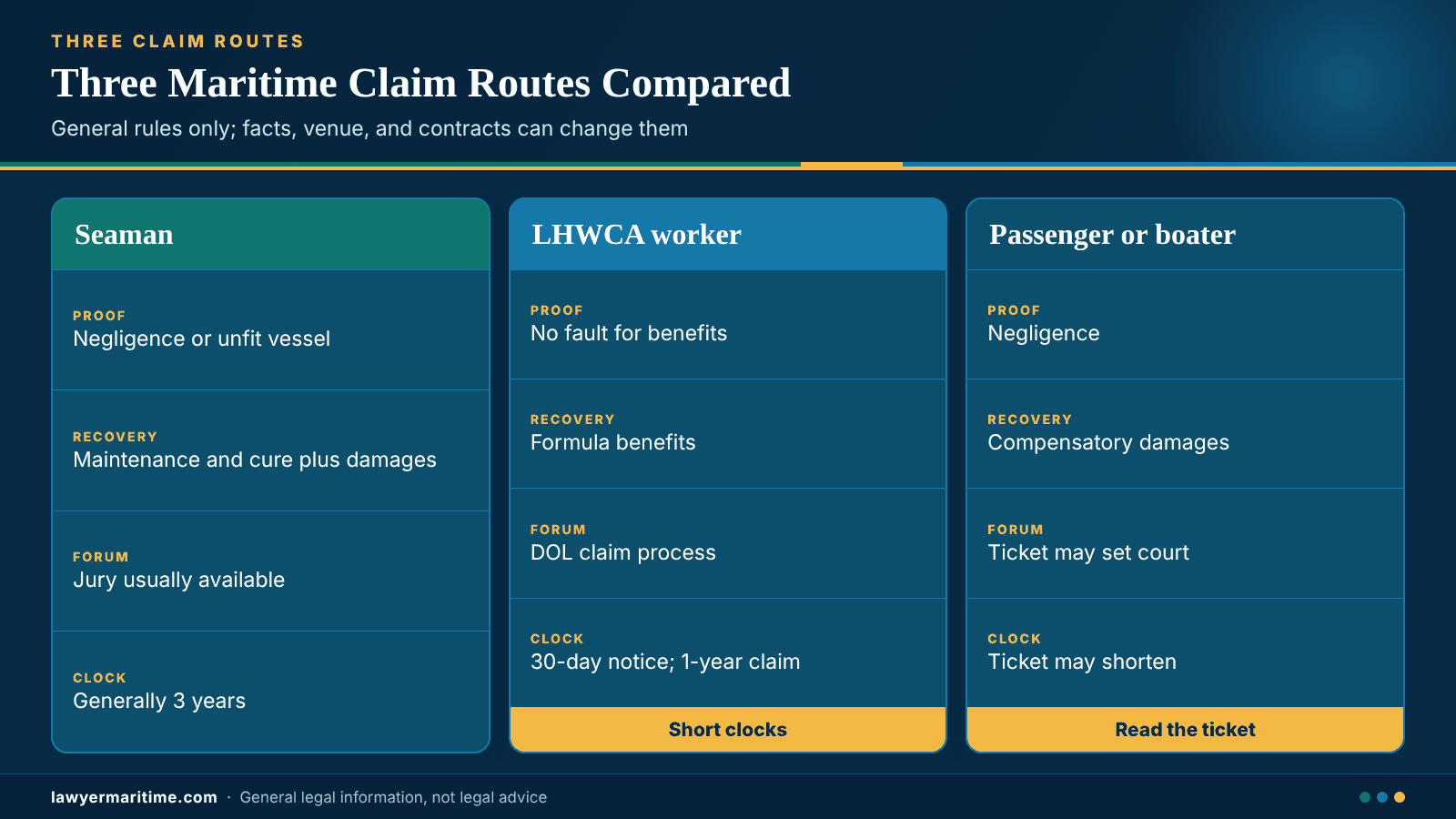
What to Do Now: A Practical Plan
Understanding the system is only useful if it shapes what you do next. The steps below are general and safe for most situations. They’re designed to protect your health, your evidence, and your options while you figure out which part of maritime law fits your facts.
First steps after a maritime injury or death
The first days set the record that everyone will rely on later. Small, careful actions now can prevent large problems later.
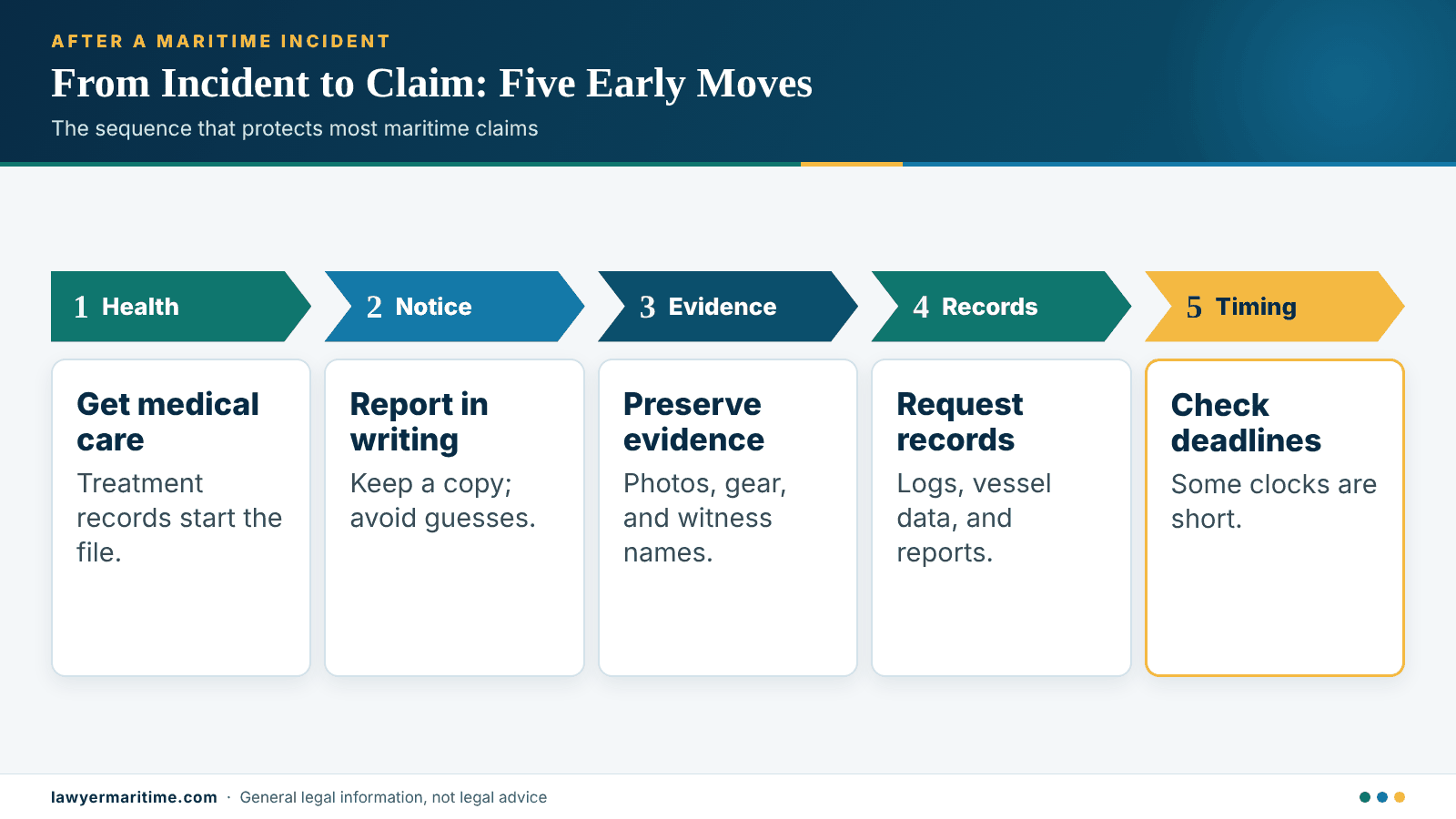
Get care and report the incident
Medical care comes first, both for your health and because treatment records are the backbone of any claim. Tell every provider how the injury happened, in plain words, so the cause is recorded consistently. If you are a seaman, ask your employer in writing about maintenance and cure, and keep copies of any medical bills and proof of daily living costs.
Report the incident to your employer, the vessel’s master, or the cruise line in writing, and keep a copy or a photo of what you submitted. Stick to facts you know: where, when, what you were doing, and what you felt. If you’re a longshore or harbor worker, remember that LHWCA notice rules run on a short clock.
- Get treatment and follow it Keep every appointment, discharge note, and work restriction.
- Report in writing Give a factual account and keep a copy.
- Write your own timeline Record the sequence of events, conditions, and who was present.
- Find your documents Pay stubs, crew agreement, ticket contract, and any forms you signed.
- Identify the deadline questions Note whether a government vessel, LHWCA coverage, or a ticket could shorten your time.
Preserve what you control and request what you don’t
Photograph the scene, the equipment, and your injuries if you can do so safely. Keep damaged clothing and gear. Save texts, emails, and social-media messages about the incident, but avoid posting new descriptions of the accident or your recovery publicly, because posts are routinely collected in litigation.
For records you don’t control, such as logs, maintenance histories, and electronic navigation data, a written preservation request is the usual tool. Counsel can send it, but you can also ask the employer in writing to preserve evidence about your incident. Note the names of the vessel, its owner or operator if you know them, and the crew on duty.
Mistakes that commonly hurt maritime claims
Many problems in maritime claims are self-inflicted and avoidable. Most come from assuming that maritime cases work like ordinary injury cases.
Statements, releases, and early settlements
Recorded statements and early settlement offers are the two most common traps. An adjuster’s question about whether you “were careful” or “had back problems before” may seem harmless, but the answer can shape a comparative-fault or concealment defense. A quick check offered before you know your medical prognosis may come with a release that ends future claims.
- Signing a release or “full and final” receipt before you understand your diagnosis and prognosis
- Giving a recorded statement while medicated, in pain, or without reviewing the facts
- Guessing about speeds, distances, or causes you didn’t actually observe
- Posting about the accident or your activities while the claim is pending
Wrong assumptions about status, forum, and time
The other common mistake is applying the wrong framework. A worker who assumes state workers’ compensation applies may miss a seaman’s maintenance and cure rights or a Jones Act claim. A passenger who assumes three years to sue may be bound by a one-year ticket clause. A family that files a state-law wrongful-death claim for a death far offshore may find that DOHSA controls.
Don’t assume the label on your job, the location of the hospital, or the state where you live decides which law applies. What matters is the actual work, the vessel, the water, and the documents. When those facts are unclear, that is precisely when a status and deadline review is worth doing early.
| Common mistake | Why it hurts | Better action |
|---|---|---|
| Assuming state workers’ compensation applies | May overlook seaman or LHWCA rights | Ask whether you meet seaman or LHWCA tests before filing anything |
| Waiting to see a doctor | Creates a gap that defendants use to dispute causation | Get evaluated promptly and describe how the injury happened |
| Relying on a verbal report | No proof of notice or of what you said | Report in writing and keep a copy |
| Assuming three years to sue | Ticket clauses, LHWCA rules, and government-vessel claims can be shorter | Identify the shortest clock that could apply |
| Ignoring a limitation filing | Missing the court’s claim date can jeopardize recovery | Calendar the monition date and respond through counsel |
| Signing an early release | Can end claims for future care and earnings | Get independent advice before signing anything final |
Getting the right help
Not every maritime injury requires a lawyer, but the system’s overlapping regimes and short clocks make an early, informed review valuable when an injury is serious, a death has occurred, or your status is disputed.
What a maritime lawyer typically evaluates first
A lawyer reviewing a maritime matter usually starts with three questions: what is your status, where did the incident happen, and who are the potential defendants. Those answers point to the remedies, the forum options, the limitation risk, and the deadlines. Counsel then looks at the evidence available, the insurance involved, and whether benefits such as maintenance and cure or LHWCA compensation are being paid properly.
For an explanation of what that work involves, see our guide to what a maritime lawyer does and when you may need one. If you are weighing claim types that call for particular admiralty experience, such as limitation actions, vessel-status disputes, or OCSLA choice-of-law problems, our page on claims that require specialized admiralty experience covers them, and our guide to maritime accident claims by accident type connects common incidents to the legal routes they tend to raise.
Choosing and meeting with counsel
When you compare lawyers, look at relevant experience with your type of claim, clear communication about fees and costs, and honest discussion of risks. Our guide to evaluating the best maritime lawyer for your specific claim offers criteria rather than rankings, and our article on questions to ask during a maritime lawyer consultation explains what to bring and what to ask.
Location can matter for local courts, ports, and industries. If your claim arises on the Gulf Coast, our pages on Houston maritime injury claims and New Orleans maritime injury claims describe the local courts and maritime economies. Because maritime law is largely federal, though, experience with the governing law often matters as much as a nearby office.
Frequently Asked Questions About Maritime Law
These answers summarize how the rules usually work. Your facts, your location, and the court involved can change the answer.
Basics of maritime law
Is maritime law federal or state law?
It is primarily federal. The Constitution and 28 U.S.C. § 1333 give federal courts admiralty jurisdiction, and federal statutes and general maritime law supply most rules. State courts can hear many maritime cases under the saving-to-suitors clause, but they must apply federal maritime law, and state rules apply only where they don’t conflict with it.
What is the difference between maritime law and admiralty law?
In everyday use, the terms mean nearly the same thing. “Admiralty” often refers to federal court jurisdiction and procedure, while “maritime” often refers to the substantive rules about injuries, contracts, and vessels. Courts use both words, sometimes in the same sentence.
Does maritime law apply on rivers and lakes?
It can. Admiralty jurisdiction reaches waters that are navigable in fact and used, or capable of being used, as highways of interstate or foreign commerce, which includes many rivers and the Great Lakes. A lake entirely within one state without a commercial connection to other states may not qualify, so navigability is sometimes disputed.
Workers and status
How do I know if I’m a seaman?
Courts apply the Chandris test: your duties must contribute to a vessel’s function or mission, and your connection to a vessel or fleet in navigation must be substantial in duration and nature. Spending less than about 30 percent of your time in vessel service generally weighs against seaman status, but that figure is a guideline. Your job title doesn’t decide it.
Can I have a Jones Act claim and an LHWCA claim at the same time?
Generally not for the same injury, because the LHWCA excludes masters and members of a vessel’s crew. When status is uncertain, though, claimants sometimes pursue both routes while the question is decided, and benefits paid under one system may be credited against recovery under the other. That overlap is a reason to get status reviewed early.
I work on an offshore platform. Which law applies to me?
It depends on the structure and your work. Workers on fixed platforms on the outer Continental Shelf often fall under OCSLA, which extends LHWCA benefits and adopts adjacent-state law against third parties. Workers assigned to vessels, including some mobile drilling units, may qualify as seamen. Classification of the structure is frequently contested.
Claims, courts, and timing
How long do I have to file a maritime claim?
Many maritime injury and death suits are subject to a general three-year period under 46 U.S.C. § 30106, and Jones Act claims have a three-year period through FELA. But LHWCA notice and claim periods, claims involving government vessels, and passenger ticket clauses can be much shorter. Confirm your deadline with a lawyer early rather than relying on a general rule.
Can I sue in state court for a maritime injury?
Often, yes. The saving-to-suitors clause preserves many state-court remedies, and Jones Act cases filed in state court are generally not removable. A defendant may still try to move the case through removal arguments, a forum-selection clause, an arbitration agreement, or a federal limitation action.
What happens if the vessel owner files a limitation action?
The federal court usually stays other lawsuits and sets a date by which all claimants must file their claims in that proceeding. Claimants can contest the owner’s right to limit, often by showing privity or knowledge, and in some cases can return to state court with stipulations that protect the owner’s limitation rights. Missing the court’s claim deadline can be serious.
Sources and Legal Authorities
The authorities below support the legal statements in this guide. Check each against its current text before relying on it, because statutes, regulations, and case law change.
Constitution, statutes, and rules
Jurisdiction, remedies, and deadlines
- U.S. Constitution, Article III, Section 2 – admiralty and maritime jurisdiction
- 28 U.S.C. § 1333 – Admiralty, maritime and prize cases (saving to suitors clause)
- 28 U.S.C. § 1445 – Nonremovable actions (FELA)
- 46 U.S.C. § 30101 – Admiralty Extension Act
- 46 U.S.C. § 30104 – Personal injury to or death of seamen (Jones Act)
- 46 U.S.C. § 30106 – Time limit on bringing maritime action for personal injury or death
- 46 U.S.C. § 30302 – Death on the High Seas Act, cause of action
- 46 U.S.C. § 30905 – Period for bringing action (Suits in Admiralty Act chapter)
- 46 U.S.C. § 55102 – Transportation of merchandise (coastwise cabotage rule)
- 45 U.S.C. § 53 – FELA, contributory negligence
- 45 U.S.C. § 56 – FELA, limitation of actions
- 46 U.S.C. § 31301 – Definitions, including preferred maritime liens
- 9 U.S.C. § 1 – Federal Arbitration Act, seamen’s employment exception
Limitation of liability, LHWCA, OCSLA, rules, and regulations
- 46 U.S.C. § 30502 – Application of limitation chapter
- 46 U.S.C. § 30523 – General limit of liability
- 46 U.S.C. § 30524 – Limit of liability for personal injury or death
- 46 U.S.C. § 30526 – Provisions requiring notice of claim or limiting time for bringing action
- 46 U.S.C. § 30529 – Action by owner for limitation
- 33 U.S.C. § 902 – LHWCA definitions
- 33 U.S.C. § 905 – Exclusiveness of liability; vessel negligence
- 33 U.S.C. § 912 – Notice of injury or death
- 33 U.S.C. § 913 – Filing of claims
- 43 U.S.C. § 1333 – OCSLA, laws and regulations governing the outer Continental Shelf
- 46 U.S.C. § 6308 – Information barred in legal proceedings
- Federal Rule of Civil Procedure 9(h) – Admiralty or maritime claims
- Supplemental Admiralty Rule C – In rem actions
- 46 CFR 4.05-1 – Notice of marine casualty
- 46 CFR 4.05-10 – Written report of marine casualty
- 33 CFR Part 83 – Inland Navigation Rules
Cases and agency materials
Supreme Court decisions
- Southern Pacific Co. v. Jensen, 244 U.S. 205 (1917) – limits on state law in maritime matters
- Garrett v. Moore-McCormack Co., 317 U.S. 239 (1942) – burden on party relying on a seaman’s release
- Urie v. Thompson, 337 U.S. 163 (1949) – accrual for occupational disease under FELA
- Romero v. International Terminal Operating Co., 358 U.S. 354 (1959) – maritime claims and federal-question jurisdiction
- Kermarec v. Compagnie Generale Transatlantique, 358 U.S. 625 (1959) – reasonable-care duty to non-crew aboard
- Fitzgerald v. United States Lines Co., 374 U.S. 16 (1963) – jury trial of joined maintenance and cure claims
- United States v. Reliable Transfer Co., 421 U.S. 397 (1975) – proportional fault
- Carnival Cruise Lines, Inc. v. Shute, 499 U.S. 585 (1991) – cruise ticket forum-selection clauses
- Jerome B. Grubart, Inc. v. Great Lakes Dredge & Dock Co., 513 U.S. 527 (1995) – admiralty tort jurisdiction test
- Chandris, Inc. v. Latsis, 515 U.S. 347 (1995) – seaman status
- Dooley v. Korean Air Lines Co., 524 U.S. 116 (1998) – no survival action for pre-death pain where DOHSA applies
- Lewis v. Lewis & Clark Marine, Inc., 531 U.S. 438 (2001) – limitation actions and the saving clause
- Chao v. Mallard Bay Drilling, Inc., 534 U.S. 235 (2002) – OSHA and uninspected vessels
- Stewart v. Dutra Construction Co., 543 U.S. 481 (2005) – definition of a vessel
- Exxon Shipping Co. v. Baker, 554 U.S. 471 (2008) – maritime punitive damages ratio
- Atlantic Sounding Co. v. Townsend, 557 U.S. 404 (2009) – punitive damages for willful nonpayment of maintenance and cure
- Also referenced without links: The Genesee Chief v. Fitzhugh, 53 U.S. 443 (1852); The Daniel Ball, 77 U.S. 557 (1871); The Pennsylvania, 86 U.S. 125 (1874); Calmar S.S. Corp. v. Taylor, 303 U.S. 525 (1938); Socony-Vacuum Oil Co. v. Smith, 305 U.S. 424 (1939); Farrell v. United States, 336 U.S. 511 (1949); Mitchell v. Trawler Racer, Inc., 362 U.S. 539 (1960); Vaughan v. Atkinson, 369 U.S. 527 (1962); Moragne v. States Marine Lines, Inc., 398 U.S. 375 (1970); Usner v. Luckenbach Overseas Corp., 400 U.S. 494 (1971); Executive Jet Aviation, Inc. v. City of Cleveland, 409 U.S. 249 (1972); Northeast Marine Terminal Co. v. Caputo, 432 U.S. 249 (1977); Mobil Oil Corp. v. Higginbotham, 436 U.S. 618 (1978); Scindia Steam Navigation Co. v. De Los Santos, 451 U.S. 156 (1981); Foremost Ins. Co. v. Richardson, 457 U.S. 668 (1982); Director, OWCP v. Perini North River Associates, 459 U.S. 297 (1983); Herb’s Welding, Inc. v. Gray, 470 U.S. 414 (1985); East River S.S. Corp. v. Transamerica Delaval Inc., 476 U.S. 858 (1986); Miles v. Apex Marine Corp., 498 U.S. 19 (1990); McDermott Int’l, Inc. v. Wilander, 498 U.S. 337 (1991); Exxon Corp. v. Central Gulf Lines, Inc., 500 U.S. 603 (1991); Howlett v. Birkdale Shipping Co., 512 U.S. 92 (1994); Yamaha Motor Corp. v. Calhoun, 516 U.S. 199 (1996); Harbor Tug & Barge Co. v. Papai, 520 U.S. 548 (1997); Norfolk Southern Ry. Co. v. Kirby, 543 U.S. 14 (2004); CSX Transp., Inc. v. McBride, 564 U.S. 685 (2011); Lozman v. City of Riviera Beach, 568 U.S. 115 (2013); Dutra Group v. Batterton, 588 U.S. 358 (2019)
- Circuit decisions referenced: Harden v. Gordon, 11 F. Cas. 480 (C.C.D. Me. 1823); McCorpen v. Central Gulf S.S. Corp., 396 F.2d 547 (5th Cir. 1968); Gautreaux v. Scurlock Marine, Inc., 107 F.3d 331 (5th Cir. 1997) (en banc); Sanchez v. Smart Fabricators of Texas, L.L.C., 997 F.3d 564 (5th Cir. 2021) (en banc)
Agency and official sources
- U.S. Department of Labor, Division of Longshore and Harbor Workers’ Compensation – LHWCA program information and current compensation rates
- U.S. Coast Guard CGMIX – Incident Investigation Reports
- National Transportation Safety Board – Investigation reports
- OSHA – Maritime industry overview