
The Jones Act is the federal law that lets an injured seaman sue an employer for negligence, and it is codified at 46 U.S.C. § 30104. If you work on a vessel and you were hurt because your employer, or someone the employer answers for, failed to use reasonable care, this statute may give you the right to a jury trial and to damages. It borrows its rules from the Federal Employers’ Liability Act (FELA), the railroad-worker statute, which is why causation is easier to prove than in most injury cases and why a seaman’s own mistakes reduce a recovery instead of ending it. The Jones Act is only one of three seaman remedies, and it is not the cabotage law that headlines call the Jones Act. This guide is for injured crew members, their families, and anyone trying to understand how the statute works. It explains who counts as a seaman, who the defendant is, what negligence means here, what evidence matters, how defenses and damages work, which courts hear these cases, and which deadlines and mistakes deserve attention.
What Is the Jones Act, and Which One Is This Guide About?
Two very different federal laws share the nickname “Jones Act,” and the overlap trips up readers, reporters, and sometimes injured workers. This guide covers the one that protects people: the seaman’s personal-injury and wrongful-death remedy. We’ll start with what the statute says, then separate it from the shipping law that dominates the news.
The seaman’s negligence remedy
The remedy is short on its face and long in its consequences. A few sentences of statute sit on top of more than a century of case law about who is covered and what must be proven.
What 46 U.S.C. § 30104 actually says
Section 30104 provides that a seaman injured in the course of employment, or the personal representative of a seaman who dies from the injury, may elect to bring a civil action at law against the employer. The statute preserves the right to a jury trial. It also says that the laws of the United States regulating recovery for personal injury to, or death of, a railway employee apply to the action. You can read the current text on the Cornell Legal Information Institute page for 46 U.S.C. § 30104.
That last clause is the engine of the whole claim. It pulls in the Federal Employers’ Liability Act, codified at 45 U.S.C. §§ 51-60, so the rules for negligence, causation, fault, and timing come from a railroad statute enacted in 1908. Later sections of this guide walk through those rules one at a time.
Where the claim sits among seaman remedies, and a 2022 change
The Jones Act claim is one of three remedies that commonly arise from a seaman’s injury. The other two are maintenance and cure, which is a no-fault duty to pay living expenses and medical care, and unseaworthiness, which is a claim against the vessel owner. They are compared in detail later, because choosing among them or combining them is one of the most consequential decisions in a case.
The statute was also amended in December 2022. A new subsection excludes certain aquaculture workers, as the statute defines that term, from the definition of “seaman” for purposes of the Jones Act claim, and the change applies to injuries on or after December 23, 2022. If you work in fish or shellfish farming, the exact wording and its conditions matter, so read the text itself or ask counsel how it applies to your job.
The Jones Act is not the cabotage law
Most “Jones Act” news stories have nothing to do with injured seamen. They concern a shipping rule that protects the U.S. maritime industry, and the two laws are administered by different agencies, argued about by different people, and enforced in different ways.
What the cabotage provision does, and what a waiver means
The cabotage rule is found at 46 U.S.C. § 55102. In general terms, it restricts the carriage of merchandise by water between U.S. points to vessels that meet U.S. ownership, build, and coastwise-endorsement requirements. The U.S. Maritime Administration describes it in those terms on its domestic shipping page.
A “Jones Act waiver” refers to a decision to let a vessel that doesn’t meet those requirements carry cargo between U.S. ports for a limited time. Congress has authorized waivers of navigation and vessel-inspection laws for national defense under 46 U.S.C. § 501, and that statute sets conditions, including vessel-by-vessel treatment and time limits. None of that changes a seaman’s right to sue an employer for negligence.
Why the confusion matters to an injured worker
Searching for “Jones Act” after an injury can bury you in articles about fuel prices, tankers, and trade policy. It can also lead people to think the law is about a company’s shipping rights, when it is really about a worker’s right to sue. Both laws are commonly traced to the Merchant Marine Act of 1920, which is how the shared nickname arose.
The practical point is simple. If a news story says a waiver was granted or a vessel was exempted, that story is about cargo. It doesn’t alter your claim, your status, your damages, or your deadline. The table below keeps the two ideas apart, and the rest of this guide uses “Jones Act” to mean the seaman’s remedy.
| Question | Seaman’s injury remedy | Cabotage (coastwise shipping) law |
|---|---|---|
| Main citation | 46 U.S.C. § 30104 | 46 U.S.C. § 55102 and related coastwise provisions |
| What it governs | Negligence claims by injured seamen, or by the representatives of seamen who died | Which vessels may carry merchandise between U.S. points |
| Who it affects | Crew members, their families, and their employers | Vessel owners, shippers, and cargo interests |
| Where “waivers” appear | Not a concept in this remedy | Limited national-defense waivers under 46 U.S.C. § 501 |
| Where this guide covers it | Throughout | Only in this section |
How the Jones Act differs from workers’ compensation
Readers often assume that any job injury leads to workers’ compensation. For seamen, the structure is different, and the difference explains both the strengths and the burdens of the Jones Act claim.
Fault, jury, and damages instead of fixed benefits
Workers’ compensation systems generally pay statutory benefits without regard to fault and, in exchange, generally protect the employer from a negligence suit. The federal compensation law for many shoreside maritime workers, the Longshore and Harbor Workers’ Compensation Act, works that way, but it excludes “a master or member of a crew of any vessel.” A seaman instead holds a right to sue the employer at law, before a jury, for the harm that the employer’s negligence caused.
The trade-off is real. A seaman must prove negligence, and the benefits do not arrive automatically on a schedule. In return, the claim is for compensatory damages measured by the individual’s losses, not by a fixed benefit formula, and fault by the employer can be established through the relaxed standards described below.
Why the trade-off shapes the other seaman remedies
Because the Jones Act claim depends on fault, the law gives seamen a no-fault floor in maintenance and cure, which is the duty to pay living expenses and medical care while the seaman recovers. The two remedies work together: one provides support during recovery, the other provides damages if negligence is proven. A broader look at how negligence works across maritime claims is available in our guide to maritime negligence.
Who Qualifies as a Seaman Under the Jones Act?
No Jones Act claim exists unless the injured worker is a seaman. Congress didn’t define the word in the statute, so the Supreme Court has built the definition case by case. The tests below come from those decisions, and they turn on what you actually did for a living, not on what your employer called you. For the broader picture of how seamen, harbor workers, and passengers fit into the larger system, our complete guide to U.S. maritime law maps the whole terrain.
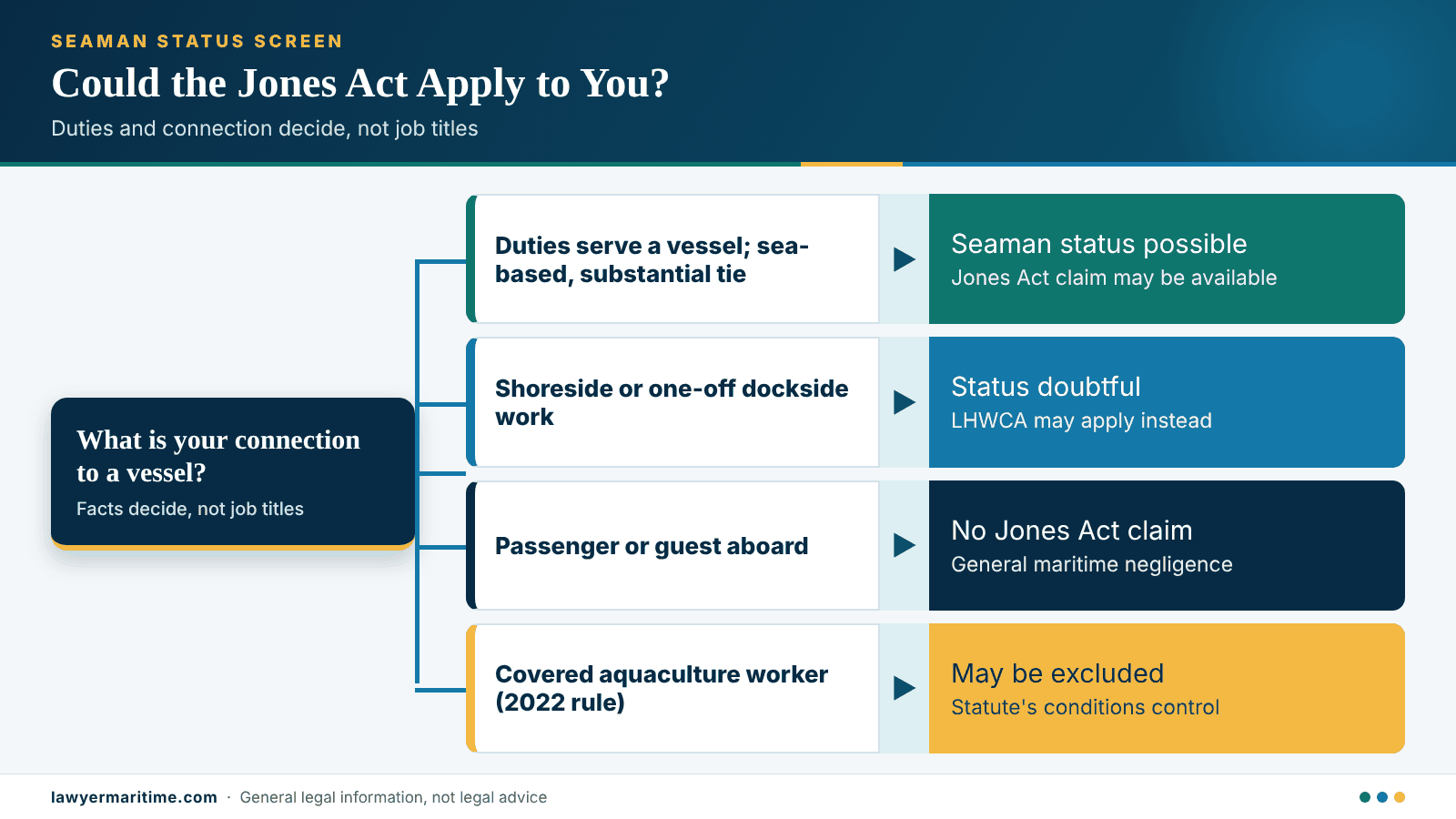
The two-part test for seaman status
The modern test has two elements: what your work does for a vessel, and how deeply you are tied to that vessel or to a fleet. Each element has its own case behind it.
Contributing to a vessel’s function or mission
In McDermott International, Inc. v. Wilander, 498 U.S. 337 (1991), the Court held that a worker doesn’t have to aid in navigation to be a seaman. It is enough that the worker’s duties contribute to the function of the vessel or to the accomplishment of its mission. The Court framed the idea as doing the ship’s work, and it ruled for a paint foreman who worked aboard a paint boat.
The practical result is that cooks, engineers, deckhands, welders working aboard, and many other crew roles can satisfy the first element. Masters and officers can too, since the statute’s focus is the connection to the vessel and not rank. The test is broad on purpose, so most disputes in real cases are about the second element.
A connection that is substantial in duration and nature
The second element comes from Chandris, Inc. v. Latsis, 515 U.S. 347 (1995). The worker must have a connection to a vessel in navigation, or to an identifiable group of vessels, that is substantial in terms of both its duration and its nature. The Court described the inquiry as separating sea-based maritime employees from land-based workers who happen to spend some time on a boat.
On duration, the Court offered a rule of thumb: a worker who spends less than about 30 percent of his time in the service of a vessel in navigation generally should not qualify. It called that figure a guideline, not a fixed line. A worker with a strong connection by percentage can still lose on the nature of the work, and a worker slightly under the number can still raise a jury question.
Status is also not decided by what you were doing at the moment of injury. The Court described seaman status as a status, based on the overall connection, so a seaman hurt while resting in a bunk is as much a seaman as one hurt on deck. The reverse is also true: a land-based worker who happens to be hurt aboard a vessel does not become a seaman because of where the accident occurred.
Fleets, reassignments, and sea-based work
Real careers don’t fit neatly into one vessel and one job. Two decisions explain how courts handle workers who move between boats, employers, and assignments.
The identifiable-fleet rule and changes in assignment
In Harbor Tug & Barge Co. v. Papai, 520 U.S. 548 (1997), the Court held that a connection to an “identifiable group” of vessels requires common ownership or control. Work on boats owned by several unrelated employers, even through the same union hiring hall, doesn’t add up to a fleet connection. The Court also said that seaman status depends on actual duties, not job titles or union classifications.
Papai and Chandris together say something else that is easy to miss. If your essential duties change, a court may look at the new assignment instead of your whole history. A shoreside worker reassigned to a regular seagoing job can become a seaman, and a deckhand moved to a desk job can stop being one.
The Fifth Circuit’s three questions in Sanchez
Courts in different circuits phrase the “nature” inquiry in different ways. In the Fifth Circuit, the en banc decision in Sanchez v. Smart Fabricators of Texas, L.L.C., 997 F.3d 564 (2021), distilled three questions from the Supreme Court cases. Does the worker owe allegiance to the vessel rather than only to a shoreside employer? Is the work sea-based or does it involve seagoing activity? Is the assignment limited to a discrete task after which the connection ends, or does it include sailing with the vessel from place to place?
Applying them, the court held that a land-based welder who spent most of his time aboard two vessels doing discrete repair jobs, one of them jacked up beside a dock, was not a seaman. The decision is binding only in the Fifth Circuit, which covers Texas, Louisiana, and Mississippi, and other circuits may frame the inquiry differently. Still, the questions are a useful way to think about your own facts anywhere.
What counts as a vessel in navigation
Even a worker with a close tie to a floating workplace has no Jones Act claim unless that workplace is a vessel. The word has a statutory definition, and the cases are more practical than you might expect.
The statutory definition and the practical-possibility standard
Under 1 U.S.C. § 3, a vessel includes watercraft used, or capable of being used, as a means of transportation on water. In Stewart v. Dutra Construction Co., 543 U.S. 481 (2005), the Court applied that definition to a dredge with limited self-propulsion and held it was a vessel. The question is whether transportation on water is a practical possibility or only a theoretical one, and a craft doesn’t have to be moving at the moment of injury.
The same decision makes a point that readers often miss. A vessel is not the same thing as a seaman. Being aboard a vessel doesn’t make someone a seaman, and the worker still has to satisfy both parts of the Chandris test.
Houseboats, rigs, barges, and other edge cases
In Lozman v. City of Riviera Beach, 568 U.S. 115 (2013), the Court held that a floating home was not a vessel. The standard it described asks whether a reasonable observer, looking at the structure’s physical characteristics and activities, would consider it designed to a practical degree for carrying people or things over water. A structure that floats but has no means of steering or propulsion, and that is moored in place, may fail that test.
That test makes classification fact-heavy. Tugs, towboats, supply boats, and fishing vessels are usually easy. Barges, dredges, jack-up units, floating platforms, and work flats can be argued either way, and permanently moored or taken-out-of-service structures may not qualify. Don’t treat a structure as a vessel or a non-vessel on appearance alone, because the answer can decide the entire claim.
Who falls outside the Jones Act
Plenty of maritime workers are covered by something other than the Jones Act. Knowing where the boundary lies helps you see why status gets litigated so hard.
Longshore and harbor workers, and the Gizoni point
The Longshore and Harbor Workers’ Compensation Act (LHWCA) provides no-fault benefits to many shoreside maritime workers. But the statute’s definition of covered employee, at 33 U.S.C. § 902(3), excludes “a master or member of a crew of any vessel.” Seamen and LHWCA workers therefore fall on opposite sides of a statutory line.
The line isn’t set by job title. In Southwest Marine, Inc. v. Gizoni, 502 U.S. 81 (1991), the Court held that a worker in a job the LHWCA lists, such as ship repairman, may still be a Jones Act seaman if the facts support it. Receiving voluntary LHWCA payments didn’t bar the later Jones Act claim in that case, and the LHWCA credits Jones Act payments against what it owes so there is no double recovery. If you are unsure which side you’re on, our LHWCA benefit-rates guide shows what the other system provides.
Passengers, guests, and other non-crew
Passengers, recreational boaters, and guests aboard a vessel aren’t seamen and have no Jones Act claim. They may still have general maritime negligence claims against vessel owners and operators. Workers on fixed offshore platforms are another group where the answer depends on what the structure is and what the worker does, and the statutes that govern those platforms differ from the Jones Act.
The 2022 aquaculture exclusion described earlier is a different kind of boundary, one drawn by Congress for a particular industry. Taken together, the boundaries mean that nobody can reliably tell you your status from a job title. A maritime attorney will ask about your duties, your time on each vessel, and who owned and controlled the vessels. Our guide to what a maritime lawyer does explains how that review usually works.
| Question | Facts that may help | Facts that may hurt |
|---|---|---|
| Do your duties serve the vessel’s work? | Deck, engine, galley, or mission-related tasks aboard | Purely shoreside office or yard work |
| How much of your time is on vessels? | A large share of working time over your assignment, well above the 30 percent guideline | Occasional or one-off time aboard, well below the guideline |
| Is the work sea-based? | Sailing with the vessel from place to place; living aboard | Discrete repair jobs at a dock, with the connection ending afterward |
| Is the group of vessels under common control? | A fleet owned or controlled by one employer or affiliated owners | Boats owned by unrelated companies connected only by a hiring hall |
| Is the structure a vessel in navigation? | Self-propelled or regularly towed, capable of practical transport | Permanently moored, out of service, or built for a fixed purpose |
Who Is the Employer, and What Must a Seaman Prove?
Once status is settled, a Jones Act claim has three working parts: a defendant who qualifies as the employer, negligence by that employer or the people it answers for, and a link between the negligence and the injury. This section takes them in that order. The statute that supplies most of the rules is the Federal Employers’ Liability Act, so you will see its section numbers throughout.
The Jones Act employer is not always the vessel owner
The statute authorizes suit against “the employer.” That wording separates the Jones Act from unseaworthiness, which runs against the vessel owner, and it explains why the first question in many cases is a corporate-structure question.
Whose enterprise was the vessel?
In Cosmopolitan Shipping Co. v. McAllister, 337 U.S. 783 (1949), the Supreme Court held that a general agent handling shoreside business for a government-owned vessel was not the Jones Act employer. The Court looked past labels to the question of whose enterprise the operation of the vessel was. The government kept possession, management, and navigation of the ship, the master was the government’s employee, and the agent’s role was limited to shoreside duties.
Courts since then have used the same practical lens. They ask who hired the crew, who paid them, who directed the work, and who controlled the vessel’s operation. Your pay stub is evidence, but it’s not the end of the inquiry.
Charters, staffing arrangements, and foreign-flag vessels
Modern vessel operations are layered. A vessel may be owned by one company, chartered to another, operated by a third, and crewed through a staffing or management company. Each layer raises the question of whether the entity that controlled your work was your employer for Jones Act purposes, and the answer can differ from the answer on unseaworthiness. When more than one company may qualify, naming the right defendants early matters.
Foreign vessels and foreign crews add a choice-of-law step. In Lauritzen v. Larsen, 345 U.S. 571 (1953), the Court declined to apply the Jones Act to a Danish seaman hurt aboard a Danish ship in Cuban waters, weighing factors such as the flag, the seaman’s allegiance, and the place of contract. Hellenic Lines Ltd. v. Rhoditis, 398 U.S. 306 (1970), later stressed that the analysis is not mechanical and added the shipowner’s base of operations as a factor, holding the Act applied to a Greek seaman on a Greek ship with substantial U.S. operations. The lesson for a foreign-flag crew member is that the Act is not automatically out of reach, and it is not automatically available either.
The FELA machinery behind the claim
The Jones Act is brief because it borrows. Understanding the borrowed rules is the fastest way to see why these cases are different from ordinary personal-injury suits.
How 45 U.S.C. § 51 supplies the liability rule
FELA makes a covered employer liable in damages for injury or death resulting in whole or in part from the negligence of its officers, agents, or employees, or from defects in its equipment caused by its negligence. The statute names “boats” among the equipment it covers. You can read the text at 45 U.S.C. § 51.
Two features stand out. First, the employer answers for the negligence of its other employees, so a captain’s bad order or a fellow deckhand’s careless act can be the employer’s negligence. Second, the focus is the employer’s fault. A seaman who is hurt by a freak event with no negligence behind it has no Jones Act claim, though other remedies may exist.
“In whole or in part”: the relaxed causation standard
The statutory phrase “in whole or in part” is the basis for FELA’s lighter causation burden. In Ferguson v. Moore-McCormack Lines, Inc., 352 U.S. 521 (1957), a Jones Act case about a ship’s baker who was injured chipping ice cream with a knife because the ship supplied no proper tool, the Court asked whether employer negligence played “any part, even the slightest” in producing the injury. It also said the employer didn’t need to foresee the exact chain of events that led to the harm.
In CSX Transportation, Inc. v. McBride, 564 U.S. 685 (2011), a FELA case, the Court confirmed that the statute doesn’t incorporate common-law proximate cause. A jury may find liability if the employer’s negligence played a part in bringing about the injury. The Court also acknowledged that reasonable foreseeability of harm remains an element of FELA negligence, so the relaxed standard applies to causation, not to whether negligence existed at all. Lower federal courts routinely apply this framework in Jones Act cases.
Breach, scope of employment, and the shape of an injury
Proving negligence means identifying what the employer should have done and didn’t. Proving scope means placing the injury inside the job.
Reasonable care and statutory violations
An employer’s basic obligation is reasonable care under the circumstances, including a reasonably safe place to work. In practice, claims often rest on inadequate or defective equipment, poor training, short crewing, unsafe work methods, ignored hazards, bad orders from a supervisor, or weather and operational decisions that put the crew at risk. Fatigue from long watches and short rest can be one of those facts, and our guide to fatigue-related maritime accidents covers how it is investigated.
A statutory or regulatory violation can change the proof. In Kernan v. American Dredging Co., 355 U.S. 426 (1958), a Jones Act case in which a seaman died after a fire ignited by a lamp mounted lower than a Coast Guard rule required, the Court held that a violation of a statutory duty causing the death created liability without separate proof of negligence. The Court said the nature of the violated rule was not controlling. That doctrine has limits, and it doesn’t reach every safety rule, so the specific regulation and the facts matter.
“Course of employment,” cumulative injuries, and illness
The statute covers injuries “in the course of employment.” Most injuries on deck, in the engine room, or during assigned tasks plainly qualify. Harder cases involve injuries on shore leave, during travel to or from a vessel, or in off-duty settings, where the answer depends on the facts and courts do not always agree.
Not every Jones Act injury is a single accident. Repetitive strain, exposure to harmful substances, and similar conditions develop over time. In Urie v. Thompson, 337 U.S. 163 (1949), a FELA case about an occupational disease, the Court held that the injury accrues when its effects manifest, not at first exposure. That principle shapes both whether a gradual injury is covered and when the clock starts, a point the deadlines section takes up.
Where employer negligence tends to show up
Negligence is a theory about conduct, and the same legal rule fits many different workdays. The settings below aren’t a list of what the law covers, and they say nothing about how often any of them occurs. They are examples of how a reasonable-care argument is built.
Deck work, line handling, and lifting
Much of a crew’s work involves lines and wires under tension, heavy gear, ladders and gangways, hatches, winches, and wet or oily steel. Negligence arguments in these settings usually concentrate on the setup of the job. Was there enough lighting and non-skid surface? Was the equipment inspected and maintained? Were enough people assigned to the lift? Did the crew follow, and was it trained in, the employer’s own procedures?
A short example shows the logic. A deckhand is told to move a heavy fitting alone because the vessel is running short-handed, and he hurts his back. The question isn’t only whether lifting is risky. It’s whether a reasonable employer would have assigned more hands or a mechanical aid, and whether the short staffing played any part in the injury.
Transfers, weather, fatigue, and exposure
Other claims arise at transitions and under pressure. Moving people between a vessel and a platform, a dock, or another boat, working in heavy weather, standing long watches on little rest, and handling chemicals or breathing fumes all create risks that a reasonable employer has to manage. Orders to continue work in conditions that a prudent operator would have stopped are a recurring theme in negligence arguments.
Some events also trigger separate investigations. Fires, collisions, and groundings often produce official reports that can help establish what happened, and our explainers on maritime fire investigations and collision investigations describe how those inquiries work. Illness from exposure may involve cumulative-injury accrual rules covered later in this guide.
| Possible defendant | Main theory | What the claimant must generally show |
|---|---|---|
| Jones Act employer | Negligence under 46 U.S.C. § 30104 | An employment relationship, employer negligence, and a link between that negligence and the injury |
| Vessel owner or operator | Unseaworthiness | That the vessel, equipment, or crew was not reasonably fit, and that the condition caused the injury |
| Employer (shipowner) | Maintenance and cure | That the seaman was injured or fell ill in the service of the ship; fault is not required |
| Outside companies | General maritime negligence or another theory | That the third party owed a duty, breached it, and caused the harm; other claims may exist depending on the facts |
| Provision | Plain-English rule | Effect on a seaman’s claim |
|---|---|---|
| 45 U.S.C. § 51 | Liability for injury resulting in whole or in part from employer negligence, including that of officers, agents, and employees | Lowers the causation burden; makes the employer answer for crew and supervisor negligence |
| 45 U.S.C. § 53 | Contributory negligence doesn’t bar recovery; damages are reduced in proportion to the employee’s fault | Comparative fault reduces, not eliminates, recovery; a safety-statute exception applies |
| 45 U.S.C. § 54 | Employee isn’t treated as having assumed the risks of employment where employer negligence or a safety-statute violation contributed | “You knew the job was dangerous” is not a defense to negligence |
| 45 U.S.C. § 55 | Contracts or devices meant to exempt the employer from FELA liability are void to that extent; some employer-funded payments may be set off | Limits waivers; may allow credit for certain employer-funded benefits for the same injury |
| 45 U.S.C. § 56 | Three-year limitation period; concurrent state and federal jurisdiction | Frames timing and forum, subject to other rules discussed later |
| 45 U.S.C. § 59 | A right of action survives the injured person’s death and passes to the personal representative | Allows a survival claim and a death claim for specified beneficiaries |
What Evidence Supports Employer Negligence?
A Jones Act case is built from three kinds of proof: what the employer did or failed to do, how you were hurt, and who you were to the vessel. Vessel evidence tends to disappear faster than anything else, because crews rotate, equipment is repaired, and logs are overwritten. The notes below describe what such proof often looks like, not what any particular case requires.
Proving what the employer did wrong
Because the causation burden is relaxed, the strongest evidence usually targets the breach: the moment a reasonable employer would have acted differently.
Equipment, training, staffing, and work methods
Physical and documentary records show whether the workplace was reasonably safe. Useful items include maintenance and inspection logs, work orders for the equipment involved, safety management or job-hazard documents, training and drill records, crew lists and watch schedules, and the vessel’s rest-hour records. A broken winch with a repair request that sat unanswered, or a task assigned to too few people, can describe negligence in a single page.
Photographs and video of the scene, the damaged equipment, and your injury are valuable when they are taken early. If you can safely do it, note the date, the location, and the conditions such as weather, sea state, lighting, and deck surface. Don’t alter or repair anything, and don’t remove an item from the vessel, because your own handling can become an argument against you.
Witnesses, messages, and the employer’s own account
Crew members who saw the event or who had raised the hazard earlier are central. Write down their names, positions, and contact details while you remember them, since crew often scatter after a crew change. Text messages, emails, and radio or logbook entries that record warnings, complaints, or instructions can show that the employer knew about a hazard.
The employer’s incident report, any internal investigation, and statements by supervisors are also evidence, and they sometimes describe the event differently from the injured seaman’s account. Ask for copies of anything you are given to sign, and keep your own dated notes in a separate place from the company’s systems.
Proving the injury and your connection to the vessel
Medical and employment records answer different questions, but both are needed. One shows the harm, the other shows that the claim belongs under the Jones Act.
Medical evidence
Treatment records connect the event to the injury and describe the course of recovery. They also matter for maintenance and cure and for damages, so a gap in care or a vague account of how you were hurt can cause problems later. Tell each provider how the injury happened, in plain terms, and mention every symptom, not just the one that hurts most.
Prior injuries deserve special care. Employers and insurers will look for earlier complaints, and accuracy on medical history forms matters in the seaman’s remedies, as the maintenance and cure discussion later explains. Accurate disclosure is almost always safer than leaving something out.
Work history and vessel records
Seaman status depends on documents that show what you did and where. Pay records, assignments, crew lists, discharge papers, schedules, and merchant mariner credential records can establish how much of your time was on a vessel, which vessels, and who owned or controlled them. A union dispatch record or a contract may name the employer, but as the earlier discussion of Cosmopolitan shows, the label isn’t the end of the question.
If your work moved between employers or vessels, assemble a rough timeline now. Even an imperfect chronology helps counsel apply the fleet and assignment rules from Papai and Chandris.
Official reports, deadlines to notify, and your protections
Government reporting duties and workplace-retaliation rules sit alongside the private claim, and each affects how evidence is created and used.
Coast Guard casualty reports and what a court may use
Under 46 CFR § 4.05-1, the owner, agent, master, operator, or person in charge of a covered vessel must notify the Coast Guard immediately after addressing resulting safety concerns when a reportable marine casualty occurs. Reportable casualties include an injury requiring professional medical treatment beyond first aid and, on commercial vessels, leaving the person unable to perform normal duties. A written report on Form CG-2692 follows under 46 CFR § 4.05-10, generally within five days. The duty belongs to the vessel side, not to you, but the resulting paperwork can be useful to request.
One limit is worth knowing. Federal law, at 46 U.S.C. § 6308, generally bars a Coast Guard marine casualty investigation report from being used as evidence or subject to discovery in civil proceedings, with a narrow exception for administrative proceedings conducted by the United States. So the underlying facts and witnesses matter more than any official conclusion. For how serious accidents are investigated, see our explainers on reading NTSB marine reports and on collision investigations.
Reporting an injury safely and keeping your evidence
Reporting a work injury promptly is usually wise, and federal law protects it. Section 2114 of Title 46 bars a person from discharging or discriminating against a seaman for listed protected activity, which includes notifying the owner or the responsible federal Secretary of a work-related injury or illness, reporting certain safety-law violations, and cooperating with a safety investigation. The statute sends complaints through a government process, so ask counsel about the procedure and timing instead of assuming a lawsuit is the only route. The text is at 46 U.S.C. § 2114.
Keep your evidence organized and backed up. Photograph documents instead of relying on the company’s systems, store copies somewhere the employer can’t reach, and avoid posting about the injury or your activity on social media. If you retain counsel, a written preservation demand can ask the employer to hold the vessel’s logs, data recorders, and equipment.
| Evidence | What it can show | Practical note |
|---|---|---|
| Photos and video of the scene and equipment | Hazard, defect, or unsafe condition at the time of injury | Take them early and safely; don’t alter the equipment |
| Maintenance, inspection, and repair records | Whether the employer knew of or should have found a defect | Often held by the employer; a preservation request may be needed |
| Crew list, watch and rest-hour records | Staffing levels, fatigue, and who witnessed the event | Request them promptly; crews rotate |
| Incident report and internal investigation | The employer’s own account and any admitted hazards | Ask for a copy; compare it with your account |
| Texts, emails, and logbook entries | Prior warnings, complaints, and instructions | Back them up outside company systems |
| Medical records and bills | Diagnosis, causation, treatment, and recovery | Describe the event accurately to every provider |
| Pay, assignment, and credential records | Seaman status, employer identity, and time on vessels | Build a timeline of employers, vessels, and dates |
Comparative Fault and Common Defenses
An employer facing a Jones Act claim rarely argues that nothing happened. It argues about who is to blame, whether the worker qualifies, and how much the injury is worth. Knowing the usual arguments in advance helps you see why a clear record of the facts matters. The FELA rules also take some of the traditional defenses off the table, which is an important and often surprising feature of the claim.
How a seaman’s own fault is handled
FELA’s design is why a seaman’s fault is allocated between the parties instead of being used as an all-or-nothing bar.
Comparative negligence reduces damages
Under 45 U.S.C. § 53, an employee’s contributory negligence doesn’t bar recovery. The jury instead reduces the damages in proportion to the employee’s share of the fault. If a jury finds a seaman 20 percent at fault for an injury worth a given amount, the award is reduced by that 20 percent.
The statute also contains a safety-statute exception: where the employer’s violation of a statute enacted for the safety of employees contributed to the injury, the employee’s negligence is not used to reduce damages. Whether a particular regulation or statute qualifies is a legal question that depends on its wording and purpose.
The standard of care a seaman is held to
Employers often argue that the injured seaman should have done something differently. The Fifth Circuit addressed the standard in the en banc decision Gautreaux v. Scurlock Marine, Inc., 107 F.3d 331 (1997), holding that a seaman’s own conduct is judged by ordinary prudence under the circumstances, not by the lesser “slight care” standard some earlier cases had used. Other circuits may describe the standard differently, so this point is worth confirming for the court in your case.
“Under the circumstances” matters. A seaman who followed a supervisor’s order, who was told to hurry, or who had no safer equipment to use is in a different position from one who ignored a clear instruction. These are fact questions, and they are usually for the jury.
Defenses the law removes, and defenses that remain
Some defenses are closed by the statute. Others are fully available, and they aim at the elements the seaman must prove.
No assumption of risk, and no contract waivers of FELA liability
Assumption of risk is the argument that a worker accepted the dangers of the job. Under 45 U.S.C. § 54, an employee isn’t treated as having assumed the risks of employment where the injury resulted in whole or in part from the employer’s negligence, or where a safety-statute violation contributed. The Jones Act’s incorporation of FELA carries that rule to seamen. “You knew what the job was” does not answer a negligence claim.
Section 55 adds that any contract, rule, or device whose purpose is to exempt the employer from FELA liability is void to that extent, though the employer may set off certain amounts it paid or funded for the same injury. A clause in an employment paper that tries to disclaim negligence liability is therefore worth showing to a lawyer, not simply accepting.
Defenses aimed at status, scope, causation, and proof
The usual defenses attack an element. The employer may argue that you aren’t a seaman or that the structure is not a vessel, that it was not your employer, that the injury did not occur in the course of employment, or that its conduct met the standard of care. It may argue that something other than its negligence caused the harm, that the injury is smaller than claimed, or that a pre-existing condition explains your symptoms.
The relaxed causation standard blunts some of these. If the employer’s negligence played any part in the injury, an additional cause, such as your own conduct or an earlier condition, goes to how damages are divided and not to whether the employer is liable. Timing is also a defense: a claim brought after the limitation period can fail regardless of its merits, which is why the deadline discussion later in this guide deserves attention.
Pre-existing conditions and the aggravation question
Many seamen have worked for years in physically demanding jobs, so prior back, knee, shoulder, or hearing problems are common in the medical record. Employers use that history to argue that the current symptoms come from an older condition. The usual response is to separate what was present before from what the event changed, because a worsened condition can be the harm the employer’s negligence helped bring about.
The evidence for that argument is mostly medical: earlier records, imaging, and a treating doctor’s explanation of what changed after the incident. Honesty about the history matters here. A seaman who discloses and explains an earlier problem is usually in a stronger position than one whose records contradict a later account. Accurate disclosure of prior injuries helps your credibility and can protect other remedies, especially maintenance and cure.
| Defense argument | What it targets | What usually answers it |
|---|---|---|
| “You are not a seaman.” | Eligibility for the Jones Act | Pay, crew, and assignment records showing vessel work; the Chandris and Papai facts |
| “That is not a vessel.” | Whether a vessel in navigation was involved | Evidence of design, movement, and practical capability under Stewart and Lozman |
| “We are not your employer.” | The identity of the Jones Act defendant | Proof of who hired, paid, directed, and controlled the work |
| “You caused your own injury.” | Fault and the size of the award | Evidence of instructions, pressure, and unsafe conditions; the comparative-fault rule |
| “You assumed the risk.” | The negligence claim as a whole | 45 U.S.C. § 54, which rejects the defense |
| “The claim is late.” | Timing | The actual accrual date and any tolling or discovery facts |
How the Jones Act Fits With Maintenance and Cure and Unseaworthiness
An injured seaman often has more than one source of recovery, and the Jones Act is the one that requires proof of fault. Understanding the other two keeps you from treating a denied benefit as the end of the matter, or from assuming that a Jones Act claim will cover everything. This section gives the shape of each remedy and points to the guides that cover them in depth. For a broader overview of benefits and damages across all maritime claims, see our guide to maritime injury compensation.
Three remedies, three different questions
Each remedy asks a different question and runs against a different party. That’s the reason a seaman can lose one and still succeed on another.
Maintenance and cure: a no-fault duty of care
Maintenance is a daily living allowance, and cure is the medical care needed to treat a seaman who is injured or falls ill in the service of the ship. The duty is an incident of the employment relationship and does not depend on the employer’s fault, as the Court explained in Aguilar v. Standard Oil Co., 318 U.S. 724 (1943), which also held that injuries on shore leave can be within it. The seaman’s ordinary negligence doesn’t defeat it; only willful misbehavior or deliberate misconduct does.
The duty generally continues until the seaman reaches maximum medical improvement, the point where further treatment isn’t expected to improve the condition. An employer that unreasonably withholds payment can face added exposure, and a seaman who knowingly conceals a relevant prior condition can face a defense. In the Fifth Circuit that defense is known as the McCorpen defense, after McCorpen v. Central Gulf Steamship Corp., 396 F.2d 547 (5th Cir. 1968), and other circuits vary. If payments have stopped or never started, our guide to denied maintenance and cure explains the options.
Unseaworthiness: a claim against the vessel owner
Unseaworthiness is a claim that the vessel, its equipment, or its crew was not reasonably fit for its intended use. In Mitchell v. Trawler Racer, Inc., 362 U.S. 539 (1960), the Court treated the duty as one that doesn’t depend on the owner’s negligence. A defective winch, a slippery deck, or an undermanned crew can each support the claim, if the condition is shown to have caused the injury.
The doctrine has limits. Usner v. Luckenbach Overseas Corp., 400 U.S. 494 (1971), held that an isolated negligent act, such as a one-time mistake by a coworker, doesn’t by itself make a vessel unseaworthy. The remedy also belongs to the vessel owner side, not necessarily to the employer, which is one reason defendants are chosen with care. Damages are covered in our unseaworthiness damages guide.
Using the remedies together
Seamen commonly plead the Jones Act claim with the other two when the facts support them. Combining them raises procedural and damages questions that are easy to overlook.
One injury, one jury, and no double recovery
In Fitzgerald v. United States Lines Co., 374 U.S. 16 (1963), the Supreme Court held that a maintenance and cure claim joined with a Jones Act claim from the same facts must be tried to the jury. The Court reasoned that splitting one accident’s claims between a jury and a judge unduly complicates a trial. As a result, the jury right that comes with the Jones Act commonly extends to the companion seaman claims.
Combining remedies does not allow the same loss to be paid twice. Courts guard against double recovery, and the FELA provisions allow certain employer-funded payments for the same injury to be set off. How credit is given for maintenance and cure or other payments is therefore a damages question worth tracking from the start.
Punitive damages: where each remedy stands
The remedies differ on punitive damages. Atlantic Sounding Co. v. Townsend, 557 U.S. 404 (2009), held that a seaman may seek punitive damages for an employer’s willful failure to pay maintenance and cure. Dutra Group v. Batterton, 588 U.S. 358 (2019), held that punitive damages are not available on an unseaworthiness claim.
For the Jones Act itself, the Court in Batterton noted that lower courts have uniformly held punitive damages unavailable, and it declined to reopen the question. Treat punitive damages as a maintenance-and-cure issue, not a Jones Act one. That distinction affects how a case is pleaded and what employers weigh when deciding whether to pay benefits on time.
When the remedies point in different directions
The remedies don’t always rise and fall together, which is why it helps to keep their questions separate. Three patterns come up often enough to describe, although each depends entirely on its facts.
Benefits owed, but no proven negligence
A seaman may be hurt in a way that no one did wrong, such as a sudden medical event or a fall on a well-kept deck. The Jones Act claim may fail for lack of negligence, yet maintenance and cure can remain owed because it doesn’t depend on fault. The lesson is that a weak negligence case does not end the employer’s obligation to pay for care and support while the seaman recovers.
The reverse can also happen. If the employer pays maintenance and cure on time, that payment doesn’t answer a negligence claim. Accepting benefits generally doesn’t waive the other remedies, although releases and settlement terms can change that, as a later section explains.
A coworker’s mistake and a fit vessel
Suppose a crew member drops a load because of a careless act and a deckhand below is hurt. The employer answers for that coworker’s negligence under the Jones Act, since FELA reaches the negligence of employees. But Usner suggests the same isolated lapse may not make the vessel unseaworthy if the equipment and crew were otherwise fit.
Now change the facts: the load fell because a lifting point was defective. The claim can then involve both the employer’s negligence in maintenance and an unseaworthy condition. Because the legal tests differ, lawyers examine each fact for how it fits each remedy and don’t assume that one story carries all three.
| Feature | Jones Act negligence | Maintenance and cure | Unseaworthiness |
|---|---|---|---|
| Runs against | The employer | The employer (shipowner) | The vessel owner |
| Fault required? | Yes, employer negligence | No | No negligence required, but a defect must be shown |
| Main relief | Compensatory damages | Living allowance and medical care; extra exposure for willful nonpayment | Compensatory damages |
| Punitive damages | Lower courts have held them unavailable | Possible for willful nonpayment (Townsend) | Not available (Batterton) |
| Reduced by seaman’s fault? | Yes, proportionally | Generally no, except for willful misconduct | Generally apportioned under comparative-fault principles |
Jones Act Damages, Wrongful Death, and Survival Claims
Damages in a Jones Act case are compensatory: they are meant to make up for proven losses, not to punish the employer. What can be recovered depends on the injury, the evidence, and the court, and no outcome is guaranteed. If a seaman dies, the claim changes shape, and the statutes decide who may bring it and what can be recovered. A separate guide on maritime injury damages covers the categories in more depth, so this section concentrates on how they work under the Jones Act.
What a living seaman may be able to recover
A Jones Act recovery is built from the losses that can be tied to the employer’s negligence. The categories look familiar from other injury cases, but the proof often turns on a seaman’s unusual work pattern.
Common categories of compensatory damages
In general, injury damages can include past and future medical expenses not already covered by cure, lost wages up to the trial date, loss of future earning capacity, and compensation for pain, suffering, and mental anguish. The amounts depend on medical evidence about permanency, on vocational evidence about what work the seaman can still do, and on economic evidence about income. A seaman who earned seasonal or rotational pay will often need a careful earnings history, because averages can mislead.
Future loss can be the largest and least certain item. A 45-year-old deckhand who can no longer do heavy deck work faces a different earnings picture from a 60-year-old captain with a similar injury. Jurors and judges look for specific, documented evidence, not for estimates offered after the fact.
What is not recoverable
Punitive damages are not part of the Jones Act claim, as the earlier discussion of Batterton explained. Attorney’s fees are generally not recoverable from the employer on the negligence claim itself, with the narrow exception of fees for willful withholding of maintenance and cure that the Court recognized in Vaughan v. Atkinson, 369 U.S. 527 (1962). A seaman should not assume that every cost will be shifted to the other side.
Nothing in the statute sets a minimum or maximum award, and no figure can be predicted from the injury label alone. Be cautious about any source that quotes a “typical” Jones Act payout, because the range depends on facts that vary too widely to average.
What reduces or offsets a recovery
The headline number and the net number are different. Several rules narrow the gap between what a jury finds and what the seaman keeps or what the employer pays.
Fault allocation and credit for payments
Comparative fault under 45 U.S.C. § 53 reduces damages by the seaman’s share of the blame. Section 55 allows an employer to set off amounts it paid or funded for the same injury, such as certain insurance or benefit payments, though the precise scope of the credit depends on who funded the payment. Maintenance and cure payments also raise credit questions, since they cover some of the same medical and living expenses.
Careful records of every payment matter on both sides. Keep a running list of what was paid, by whom, for what period, and under what label.
Taxes, Medicare, and liens
A settlement or judgment can interact with other systems, and mistakes here are expensive. Medicare or other health programs may have payment interests that must be addressed, tax treatment of different damage categories can vary, and medical providers or insurers may claim reimbursement. These issues sit outside the Jones Act itself, but they affect how much a seaman actually receives.
Get independent tax and benefits advice before accepting a settlement. A lawyer can identify the issues, and a tax professional can answer questions about your own return.
When a seaman dies: wrongful death and survival
The Jones Act extends to the families of seamen who die from workplace injuries. The statute gives the right to the personal representative of the estate, and FELA’s rules say who benefits.
Who may bring the claim and who benefits
Section 30104 allows the personal representative of a seaman who dies from the injury to sue. Under FELA, the wrongful-death claim is brought for the benefit of the surviving spouse and children, then parents, and then dependent next of kin, as 45 U.S.C. § 51 provides. A separate survival action under 45 U.S.C. § 59 preserves the claim the injured person had before death and passes it to the personal representative, with a limit of one recovery for the same injury.
The practical point is that an estate may need to be opened before suit, and the person who serves as representative matters. That is a state-law task, and the timing of filing and appointing can matter given the limitation period.
Pecuniary loss only, and the wider maritime picture
In Miles v. Apex Marine Corp., 498 U.S. 19 (1990), the Supreme Court held that there is no loss-of-society recovery in a Jones Act wrongful-death action, which is limited to pecuniary loss. The Court also barred loss-of-society damages in the general maritime wrongful-death claim for a seaman and held that a general maritime survival action can’t recover the decedent’s lost future earnings. The Court extended the wrongful-death cause of action recognized in Moragne v. States Marine Lines, Inc., 398 U.S. 375 (1970), to seamen but kept its damages in line with the Jones Act.
Deaths on the high seas can bring in the Death on the High Seas Act, which has its own rules and timing, covered in our DOHSA deadline guide. Because the available remedies for a family differ by where the death occurred and who the decedent was, a family should have counsel review all the routes together.
| Category | Injured seaman’s claim | Death claim |
|---|---|---|
| Medical expenses | Possible, beyond what cure covers, if proven | Possible as pecuniary loss, depending on the claim and proof |
| Lost wages and earning capacity | Possible; needs earnings and vocational evidence | Pecuniary losses to beneficiaries; survival is limited to the period before death |
| Pain, suffering, and mental anguish | Possible in an injury case if proven | Survival recovery is tied to the decedent’s lifetime losses |
| Loss of society or companionship | Not the focus of a seaman’s own claim | Not recoverable in a Jones Act death action (Miles) |
| Punitive damages | Lower courts have held them unavailable | Same position under the Jones Act |
| Reduction for fault | Proportional reduction under § 53 | Proportional reduction applies to the decedent’s share of fault |
Courts, Jury Rights, and Filing Deadlines
A Jones Act claim has two procedural features that distinguish it from many maritime claims: a statutory right to a jury, and a strong presumption that a case filed in state court stays there. Timing, by contrast, is where careful reading matters most, because several different periods can apply to the same injury. For the wider map of how admiralty cases move through federal and state courts, see our admiralty law guide and the explainer on maritime jurisdiction.
Where a Jones Act case can be filed
The statute says a seaman “may elect” to bring a civil action at law. That election is the source of most of the forum choices that follow.
The election, the jury, and state or federal court
Section 30104 preserves the right to a jury trial. A seaman can generally choose between state and federal court, and in either court the Jones Act claim is tried to a jury. Because Fitzgerald sends joined maintenance and cure claims to the same jury, the choice of forum often decides who hears the whole dispute.
Choosing a forum is a strategic decision, not a formality. Local jury pools, procedural rules, and the speed of the docket vary, and so does the way courts treat disputed status questions. A maritime attorney will weigh those factors before filing.
Non-removal and the fraudulent-pleading exception
Under 28 U.S.C. § 1445(a), a civil action in state court against a railroad under the listed FELA sections may not be removed to federal court. Because the Jones Act incorporates FELA, courts have generally treated Jones Act cases as non-removable too. In the Fifth Circuit’s decision in Hufnagel v. Omega Service Industries, Inc., 182 F.3d 340 (1999), the court described that as the general rule.
There is an exception for claims that are pleaded fraudulently to block removal. In Hufnagel, the court said defendants may pierce the pleadings, and that a court may use a summary-judgment-like procedure, denying remand only if, resolving disputed facts in the plaintiff’s favor, there is no reasonable possibility of establishing a Jones Act claim. Where undisputed facts showed that the plaintiff wasn’t a seaman, remand was properly denied. Courts outside the Fifth Circuit may phrase the test differently, but the practical lesson holds: a thin seaman-status record can cost a plaintiff the state court they chose.
Limits on the choice of forum
The election isn’t unlimited. Contracts, the employer’s own filings, and the identity of the defendant can all change where the case ends up.
Venue, forum-selection clauses, and arbitration
Venue and personal-jurisdiction rules still apply, and an employer may point to a forum-selection clause in an employment contract or crew agreement. Whether a clause is enforceable against a particular seaman, and in which court, can be contested. Arbitration is a similar question. The Federal Arbitration Act’s definition section, 9 U.S.C. § 1, says the Act does not apply to contracts of employment of seamen, but employers have sometimes pointed to other legal routes, especially for foreign crews, so these clauses deserve a lawyer’s review before you sign or assume anything.
If you have signed an employment contract, a crew agreement, or a union agreement that mentions disputes, keep a copy. The wording often decides whether a forum fight is worth having.
Limitation of liability actions
A vessel owner can ask a federal court to limit its liability. Under 46 U.S.C. § 30529, the owner must file within six months after a claimant gives written notice of a claim, and once the owner deposits security, other proceedings related to the matter must stop. A limitation action can therefore freeze a state-court case that a seaman chose carefully.
The interaction between limitation actions and the right to choose a forum has produced its own body of law, including Lewis v. Lewis & Clark Marine, Inc., 531 U.S. 438 (2001). Because a Jones Act employer is often a vessel owner, a seaman should expect the possibility of this filing and seek advice on how to respond, including how and when written notice of a claim is given.
The clocks that can end a claim
The most common mistake in maritime injury matters isn’t a legal misunderstanding. It’s a missed deadline. Several periods may apply, and they can start at different moments.
The three-year period and when it starts
FELA’s limitation provision, 45 U.S.C. § 56, says no action may be maintained unless it’s commenced within three years of the day the cause of action accrued, and the Jones Act incorporates it. The general maritime period at 46 U.S.C. § 30106 is also three years for maritime-tort injury and death claims, “except as otherwise provided by law.” Under those provisions, a three-year period is a common starting point for a Jones Act case.
Accrual isn’t always the day of the accident. For injuries that develop over time, Urie v. Thompson treats the claim as accruing when the effects manifest. That doesn’t mean waiting is safe. Courts can disagree about when a particular condition manifested, and an employer will argue for the earliest date.
Shorter and different clocks
Some routes have shorter periods. A suit against the United States under the Suits in Admiralty Act, for example, must generally be filed within two years under 46 U.S.C. § 30905, is tried without a jury under 46 U.S.C. § 30903, and may involve separate administrative procedures. Contract provisions, union rules, and the employer’s own notice requirements can add further steps, and a worker whose status is uncertain may need to protect rights under more than one statute.
The most useful habit is to work from the earliest plausible deadline, not the latest one. For related timing questions, see our guide to maritime injury deadlines. Confirm every date with counsel, because the answer depends on your facts and your forum.
| Route or event | Period or trigger | Caveat |
|---|---|---|
| Jones Act claim (FELA) | Three years from accrual, 45 U.S.C. § 56 | Accrual can be contested, especially for gradual injuries |
| General maritime tort claims | Three years, 46 U.S.C. § 30106 | Applies “except as otherwise provided by law” |
| Claims against the United States | Two years, 46 U.S.C. § 30905, for Suits in Admiralty Act claims | Different procedure; no jury; administrative steps may apply |
| Owner’s limitation action | Six months after written notice of a claim, 46 U.S.C. § 30529 | Can pause other suits; this is the owner’s deadline, triggered by your notice |
| Contract or union notice terms | Varies by document | Check employment, crew, and union paperwork |
How a Jones Act case moves from filing to resolution
This is the short version. The step-by-step claim process, including what to expect at each stage, belongs to our Jones Act claim guide, so the notes here only give you enough to read the rest of this article in context.
Pleadings and discovery
A case begins with a complaint that identifies the plaintiff, the employer, the vessel, the facts, and the claims, often alongside maintenance and cure and unseaworthiness. The defendant answers and raises its defenses, which commonly include status, comparative fault, and timing. Discovery follows: document requests, written questions, and depositions of the seaman, coworkers, supervisors, and company representatives.
The employer may also ask for a medical examination by its own doctor. The rules of civil procedure generally allow a court-ordered exam when a party’s physical condition is in controversy, so treat that exam as part of the case, not as a courtesy visit.
Experts, settlement talks, and trial
Most injury cases involve medical experts, and many also use vocational and economic experts to describe lost earning capacity. Safety or maritime-operations experts may address what a reasonable employer would have done. Settlement discussions and mediation can happen at any stage, and they often intensify after key depositions and expert reports.
If a case isn’t resolved, the jury decides negligence, causation, comparative fault, and damages. Either side may seek post-trial relief or appeal, and appeals can take considerable time. None of this predicts how long any particular case will take, because the pace depends on the court, the docket, and the complexity of the dispute.
Releases, Settlements, and Costly Mistakes
Most injured seamen never reach a verdict. They reach a document, usually one that offers money for a signature. Many of the decisions that shape a Jones Act claim are made in the first weeks, long before a lawsuit, through statements, signatures, and silences. This section covers the paperwork and the habits that most often cause avoidable harm.
Settlements and releases
A release is a contract in which the seaman gives up claims in exchange for payment. Maritime law has a long tradition of looking closely at those contracts when the signer is a seaman.
The Garrett rule on releases
In Garrett v. Moore-McCormack Co., 317 U.S. 239 (1942), the Supreme Court held that the party relying on a seaman’s release must prove that it was executed freely, without deception or coercion, and with full understanding of the seaman’s rights. The adequacy of the payment and the medical and legal advice available to the seaman were relevant to that question. Courts sometimes describe seamen as “wards of admiralty,” which is shorthand for this protective tradition.
The rule helps a seaman who signed unfairly, but it is not a reason to sign casually. A court fight over whether a release was valid takes time and money, and the outcome isn’t certain. The better protection is to understand a release before you sign it.
What to check before you sign anything
Read what the release covers. Does it release only the Jones Act claim, or also unseaworthiness, maintenance and cure, and future medical care? Does it recite a medical condition that you haven’t been told about, or call your injury minor when your doctor hasn’t said so? Does it include confidentiality or non-disparagement terms that limit what you can say?
Ask whether the amount reflects your medical future, your earning capacity, and the fault allocation, and whether you have had time to get advice. Our guides to maritime settlement releases and to settlement confidentiality terms go through the clauses one at a time. A signature given to receive overdue benefits can still release larger claims, so read the title and the scope, not just the payment line.
Mistakes that quietly weaken a claim
Most of these are ordinary human reactions to pressure. Knowing them in advance is the cheapest protection a seaman has.
Statements, records, and medical history
Early statements are often recorded, informal, and made while you are in pain or on medication. An adjuster or company representative who asks for a recorded statement is building a file, and the statement can be used later to argue that your account changed. You can give accurate basic information about the injury and still decline to give a detailed recorded statement before getting advice.
Inconsistency with medical history is another trap. If you’ve had a prior injury to the same body part, tell your providers and be ready to explain it. Incomplete answers on pre-employment or medical forms can be used against a seaman later, particularly on maintenance and cure.
Delay, assumptions, and status shortcuts
Waiting to see whether the injury gets better is understandable, but it can let evidence disappear and deadlines run. Assuming that the company’s insurer will take care of you, or that an employer’s friendly tone means a fair offer is coming, is another common assumption that proves costly. Insurers and employers have their own interests, even when the people involved are sympathetic.
Status shortcuts matter, too. Assuming that you can’t have a Jones Act claim because your title says “technician,” or assuming you must have one because you work near water, can send you down the wrong path. As the status section explained, the answer depends on your actual duties and your connection to vessels. When in doubt, have the facts reviewed by someone who handles these cases, as our overview of working with a maritime lawyer describes.
| Common mistake | Why it hurts | Better action |
|---|---|---|
| Giving a detailed recorded statement right away | Early, informal accounts can be used to challenge your later account | Give basic facts accurately; get advice before a detailed statement |
| Signing a release to get overdue benefits | It may give up larger claims, including future care | Read the scope; ask what is released and what you receive |
| Leaving out prior injuries | Concealment can become a defense and undermines credibility | Disclose accurately and explain the history |
| Waiting to act | Evidence and deadlines can slip away | Document early and confirm the earliest deadline |
| Assuming status from a job title | You may miss a claim, or file under the wrong law | Collect records of actual duties and vessel time |
| Posting about the injury online | Posts can be read as inconsistent with your claim | Keep accounts private and share them only with advisers |

What to Do Now: A Practical Plan
If you were hurt on a vessel, the next few weeks matter more than any legal theory. The list below puts the guide into an order you can follow. It’s general information, so adapt it to your circumstances and your doctors’ advice.
The first days and weeks
Early steps protect your health first and your claim second. They’re also the steps that are hardest to repair later.
Health, reporting, and records
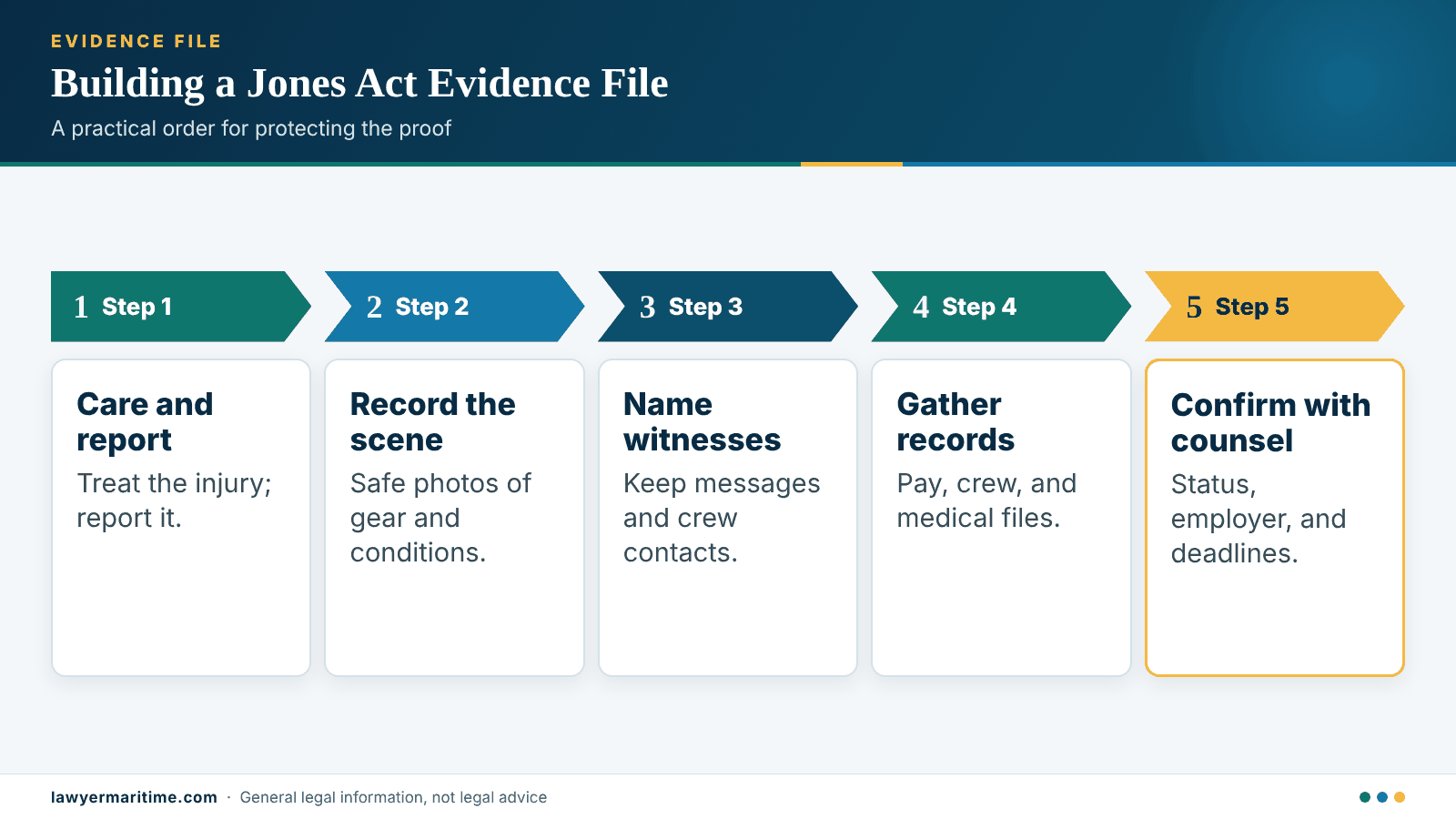
- Get medical care. Follow treatment advice, describe how you were hurt, and keep every record and receipt.
- Report the injury. Tell your supervisor or the master as soon as you safely can, and ask for a copy of any report that is written.
- Record the scene. Photograph equipment and conditions if you can do so safely, and write down names of witnesses.
- Back up your evidence. Keep messages, schedules, pay records, and your own dated notes in a place the employer doesn’t control.
- Hold off on releases. Don’t sign settlement papers or give a detailed recorded statement until you understand what they do.
- Confirm your deadline. Ask a maritime attorney for the earliest date that could apply to your situation, not the latest.
Keeping a clear account
- Write a one-page timeline of the injury, the treatment, and your work history on vessels
- List every employer, vessel, and date you worked in the last several years
- Note who has paid what, including wages, maintenance, and medical bills
- Keep the documents you were asked to sign, even if you think they don’t matter
Questions to settle about your own facts
- Was the vessel I worked on a vessel in navigation, and who owned and controlled it?
- Who was my employer for Jones Act purposes, and who else may have shared responsibility?
- What did the employer, a supervisor, or a coworker do or fail to do that played a part in the injury?
- Which of the three seaman remedies could apply, and has any been paid or denied?
- What is the earliest deadline that could apply, and has anyone sent or received a written notice of claim?
- Have I signed anything, and what exactly did it release?
Getting informed help
A maritime claim has many moving parts, and the right help depends on what you need to know first.
What counsel will usually evaluate
A maritime attorney will typically look at your status, the vessel, the identity of the employer, the evidence of negligence, the benefits you have received, and the deadlines. They’ll also ask about prior injuries and your work history, and they’ll want any documents you signed. The point of the first conversation is to decide which remedies fit, not to commit you to anything.
This page does not state where any firm is based or whom it serves, and it makes no promise about results. Fee arrangements and consultation terms vary by lawyer and by state, so ask each firm directly and compare.
Where to read next in this cluster
Four sibling guides take narrower angles on the same topic. The Jones Act claim guide follows how a claim moves from report to resolution. The Jones Act lawyer guide and the Jones Act attorney guide cover the professional side, including what to ask and how to compare options. The seaman injury lawyer guide looks at representation after a crew member is hurt.
For wider questions about how to evaluate counsel or what a lawyer can do for an accident claim, see our maritime injury attorney guide and the overview of maritime accident representation.
Frequently Asked Questions About the Jones Act
These answers summarize how the rules generally work. Your facts, your forum, and the court involved can change the outcome, so treat each answer as a starting point for a conversation with counsel.
Basics and eligibility
Is the Jones Act the same as the shipping law I read about in the news?
No. The shipping rule is the cabotage law at 46 U.S.C. § 55102, which governs which vessels may carry cargo between U.S. ports. The seaman’s injury remedy is at 46 U.S.C. § 30104. News about “Jones Act waivers” concerns cargo carriage and doesn’t change an injured seaman’s right to sue.
Does the Jones Act apply only to U.S. citizens on U.S.-flag vessels?
Not automatically in either direction. For foreign-flag vessels and foreign crew members, courts apply a multi-factor choice-of-law analysis from Lauritzen v. Larsen and Hellenic Lines v. Rhoditis, looking at the flag, the seaman’s allegiance, the place of contract, and the shipowner’s base of operations. The outcome depends on how those factors line up on your facts.
Can I use the Jones Act if I was injured through no one’s fault?
The Jones Act requires employer negligence, so a freak event with no negligence behind it won’t support a Jones Act claim. Maintenance and cure, however, doesn’t depend on fault and may still be owed to a seaman who is injured or falls ill in the service of the ship. That is one reason seamen consider all three remedies together.
Proof, remedies, and damages
What counts as negligence by an employer?
Negligence means failing to use reasonable care under the circumstances. Examples include unsafe equipment, inadequate training, short crewing, unsafe work methods, and ignoring known hazards. Because of FELA’s “in whole or in part” language, the employer’s negligence need only have played a part in the injury, though the claimant must still prove negligence.
Does a Jones Act claim replace maintenance and cure or unseaworthiness?
No. They are separate remedies with different defendants and different rules, and a seaman can often pursue them together. Maintenance and cure supplies living expenses and medical care without regard to fault, and unseaworthiness is a claim against the vessel owner about the vessel’s condition.
Can I recover punitive damages under the Jones Act?
Generally not. The Supreme Court noted in Dutra Group v. Batterton that lower courts have uniformly held punitive damages unavailable under the Jones Act, and it did not reopen the question. Punitive damages can be sought for willful failure to pay maintenance and cure under Atlantic Sounding Co. v. Townsend.
Courts, deadlines, and protection
How long do I have to file a Jones Act claim?
FELA’s limitation provision, incorporated through the Jones Act, sets a three-year period running from when the claim accrued. Other routes, such as claims against the United States, have different periods, and contracts or union rules can add notice steps. Confirm your own date with counsel early rather than relying on a general rule.
Can the employer move my state-court Jones Act case to federal court?
Usually not. Courts have generally treated Jones Act cases as non-removable, relying on the FELA removal bar in 28 U.S.C. § 1445(a). An employer can argue that the Jones Act claim was fraudulently pleaded, for example because the plaintiff clearly isn’t a seaman, and a court may then allow removal.
Can I be fired or punished for reporting a work injury?
Federal law protects seamen against discharge or discrimination for certain protected activity, including notifying the owner or the responsible federal Secretary of a work-related injury. The enforcement route for that statute is a government complaint process with its own procedures and timing. If you believe you were retaliated against, ask counsel about 46 U.S.C. § 2114 quickly.
Sources and Legal Authorities
The authorities below support the legal statements in this guide. Statutes, regulations, and case law change, so check each source against its current text before relying on it.
Statutes and regulations
Jones Act, FELA, and related federal statutes
- 46 U.S.C. § 30104 – Personal injury to or death of seamen (the Jones Act seaman remedy)
- 45 U.S.C. § 51 – FELA, liability of common carriers for injuries to employees
- 45 U.S.C. § 53 – FELA, contributory negligence and comparative fault
- 45 U.S.C. § 54 – FELA, assumption of risks of employment
- 45 U.S.C. § 55 – FELA, contracts exempting liability, and set-off
- 45 U.S.C. § 56 – FELA, limitation of actions and jurisdiction
- 45 U.S.C. § 59 – FELA, survival of right of action
- 28 U.S.C. § 1445 – Nonremovable actions
- 1 U.S.C. § 3 – Definition of “vessel”
- 33 U.S.C. § 902 – LHWCA definitions, including the exclusion of masters and crew members
- 9 U.S.C. § 1 – Federal Arbitration Act definitions and seamen’s employment exclusion
Maritime statutes, deadlines, and regulations
- 46 U.S.C. § 30106 – Time limit on bringing maritime action for personal injury or death
- 46 U.S.C. § 30529 – Action by owner for limitation of liability
- 46 U.S.C. § 30903 – Suits in Admiralty Act, civil actions against the United States
- 46 U.S.C. § 30905 – Suits in Admiralty Act, period for bringing action
- 46 U.S.C. § 55102 – Transportation of merchandise (coastwise cabotage rule)
- 46 U.S.C. § 501 – Waiver of navigation and vessel-inspection laws for national defense
- 46 U.S.C. § 2114 – Protection of seamen against discrimination
- 46 U.S.C. § 6308 – Information barred in legal proceedings (Coast Guard casualty investigations)
- 46 CFR § 4.05-1 – Notice of marine casualty
- 46 CFR § 4.05-10 – Written report of marine casualty (Form CG-2692)
Cases and agency materials
Supreme Court and federal appellate decisions
- McDermott International, Inc. v. Wilander, 498 U.S. 337 (1991) – contribution to a vessel’s function or mission
- Chandris, Inc. v. Latsis, 515 U.S. 347 (1995) – two-part seaman test and the 30 percent guideline
- Harbor Tug & Barge Co. v. Papai, 520 U.S. 548 (1997) – identifiable fleet and common ownership or control
- Sanchez v. Smart Fabricators of Texas, L.L.C., 997 F.3d 564 (5th Cir. 2021) (en banc) – Fifth Circuit seaman-status inquiries
- Stewart v. Dutra Construction Co., 543 U.S. 481 (2005) – vessel definition and practical capability
- Lozman v. City of Riviera Beach, 568 U.S. 115 (2013) – floating home not a vessel; reasonable-observer standard
- Southwest Marine, Inc. v. Gizoni, 502 U.S. 81 (1991) – LHWCA-listed worker may still be a Jones Act seaman
- Cosmopolitan Shipping Co. v. McAllister, 337 U.S. 783 (1949) – identity of the Jones Act employer
- Lauritzen v. Larsen, 345 U.S. 571 (1953) – choice of law for foreign seamen
- Hellenic Lines Ltd. v. Rhoditis, 398 U.S. 306 (1970) – Jones Act and foreign-flag vessels with substantial U.S. operations
- Ferguson v. Moore-McCormack Lines, Inc., 352 U.S. 521 (1957) – causation standard in a Jones Act case
- CSX Transportation, Inc. v. McBride, 564 U.S. 685 (2011) – FELA causation and “in whole or in part”
- Kernan v. American Dredging Co., 355 U.S. 426 (1958) – statutory violation and Jones Act liability
- Urie v. Thompson, 337 U.S. 163 (1949) – accrual for occupational disease under FELA
- Gautreaux v. Scurlock Marine, Inc., 107 F.3d 331 (5th Cir. 1997) (en banc) – seaman’s standard of ordinary prudence in the Fifth Circuit
- Hufnagel v. Omega Service Industries, Inc., 182 F.3d 340 (5th Cir. 1999) – Jones Act non-removal and fraudulent pleading in the Fifth Circuit
- Fitzgerald v. United States Lines Co., 374 U.S. 16 (1963) – jury trial of joined maintenance and cure claims
- Aguilar v. Standard Oil Co. of New Jersey, 318 U.S. 724 (1943) – maintenance and cure and shore leave
- McCorpen v. Central Gulf Steamship Corp., 396 F.2d 547 (5th Cir. 1968) – concealment defense to maintenance and cure in the Fifth Circuit
- Mitchell v. Trawler Racer, Inc., 362 U.S. 539 (1960) – unseaworthiness duty
- Usner v. Luckenbach Overseas Corp., 400 U.S. 494 (1971) – isolated negligent act and unseaworthiness
- Vaughan v. Atkinson, 369 U.S. 527 (1962) – attorney’s fees for willful withholding of maintenance and cure
- Atlantic Sounding Co. v. Townsend, 557 U.S. 404 (2009) – punitive damages for willful nonpayment of maintenance and cure
- Dutra Group v. Batterton, 588 U.S. 358 (2019) – no punitive damages for unseaworthiness
- Miles v. Apex Marine Corp., 498 U.S. 19 (1990) – damages in a seaman’s death case
- Moragne v. States Marine Lines, Inc., 398 U.S. 375 (1970) – general maritime wrongful-death action
- Garrett v. Moore-McCormack Co., 317 U.S. 239 (1942) – burden on the party relying on a seaman’s release
- Lewis v. Lewis & Clark Marine, Inc., 531 U.S. 438 (2001) – limitation actions and the saving-to-suitors clause