
A Jones Act trial is the courtroom stage of a seaman’s injury lawsuit, where a jury, guided by a judge, decides whether the employer’s negligence played a part in the injury and what damages follow. The right to a jury comes from 46 U.S.C. § 30104, which lets an injured seaman bring a civil action at law against the employer, and the same jury usually hears any unseaworthiness and maintenance and cure claims joined with it. Much of the outcome is shaped before opening statements, through rulings on seaman status, evidence, and expert testimony. This guide walks through the choice of court, the questions a jury answers, pretrial motions, each stage of the courtroom process, the evidence and experts that carry weight, the verdict and post-trial steps, and how a seaman can prepare to testify. It is written for injured crew members and their families, and it covers the seaman’s injury remedy, not the Jones Act cabotage rules for shipping cargo. For the whole life of a case from filing to judgment, see our guide to the Jones Act lawsuit.
Where Is a Jones Act Trial Held, and Who Gets a Jury?
Most seamen’s injury claims are settled or resolved on motion, but the possibility of trial shapes every step before it. Knowing what a trial involves helps you weigh offers, understand your lawyer’s advice, and avoid surprises. Two questions come first: who decides the case, and in which courtroom.
Why a seaman can ask for a jury
The statutory right to a jury trial
Traditionally, admiralty cases are tried to a judge without a jury. The Jones Act is a deliberate exception. Under 46 U.S.C. § 30104, a seaman injured in the course of employment may elect to bring a civil action at law, with the right of trial by jury, against the employer. The “at law” wording is what separates this claim from an ordinary admiralty case.
A right to a jury isn’t self-executing in federal court. Under Federal Rule of Civil Procedure 38, a party generally waives a jury unless a written demand is properly served and filed, and the default window is 14 days after the last pleading directed to the issue. Your lawyer will normally handle this in the complaint, but it is a good example of how a procedural step can protect a substantive right.
Joined claims and the single-jury rule of thumb
Seamen rarely bring only one claim. A typical complaint pleads Jones Act negligence, unseaworthiness, and maintenance and cure, which are three different remedies arising from one injury. In Fitzgerald v. United States Lines Co., 374 U.S. 16 (1963), the Supreme Court held that a maintenance and cure claim joined with a Jones Act claim, arising out of the same facts, goes to the jury. Courts commonly apply the same practical approach to joined unseaworthiness claims, so one jury hears the whole story.
Standing alone in federal court, a maintenance and cure or unseaworthiness claim is an admiralty claim, and Rule 38(e) confirms that the civil rules don’t create a jury right for claims designated as admiralty claims under Rule 9(h). That is why the way a complaint is framed matters. Confirm with counsel how your claims are pleaded and which issues are meant for the jury.
Federal court or state court
Trying the case in federal court
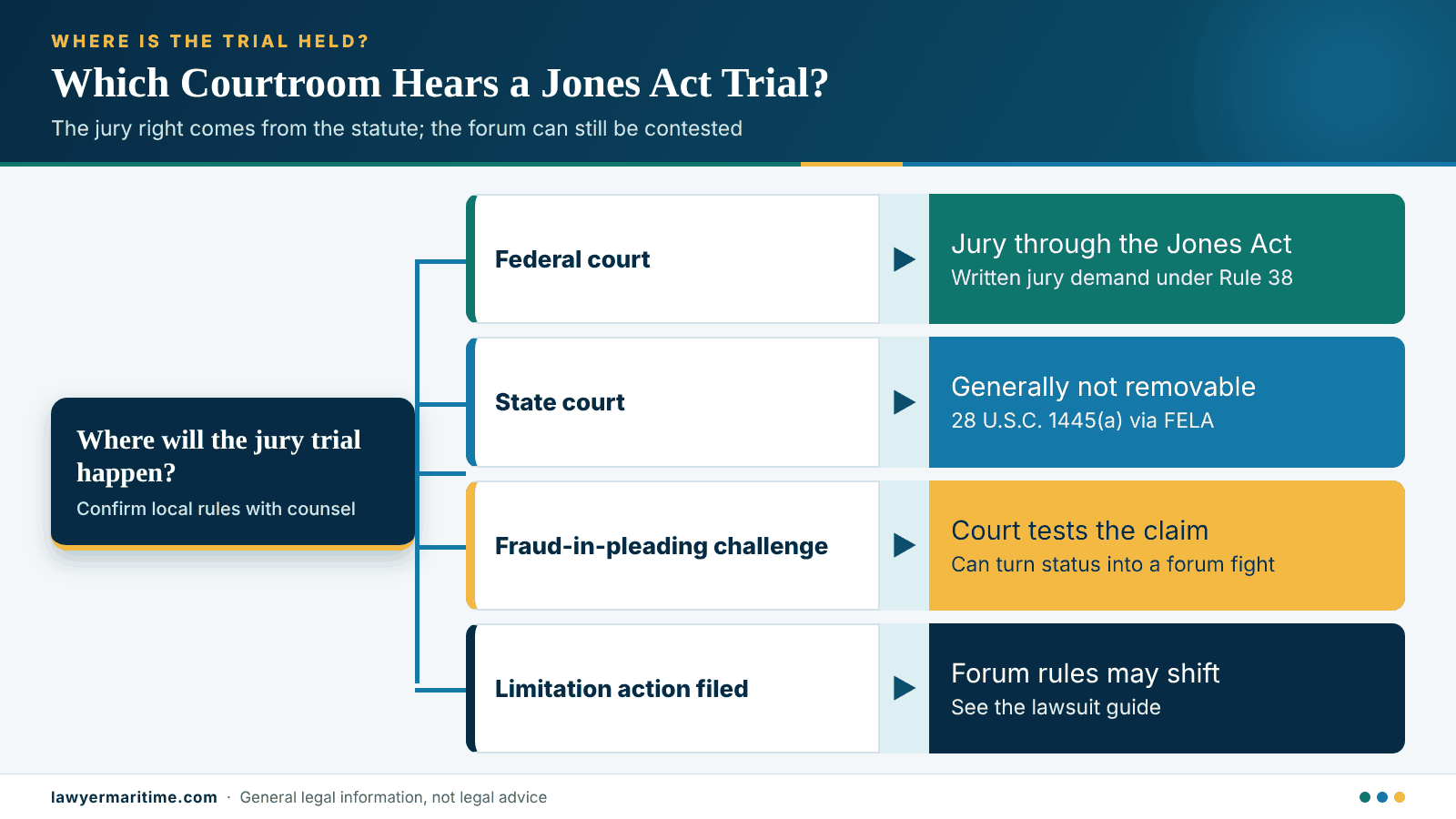
Federal district courts have original jurisdiction over admiralty and maritime cases under 28 U.S.C. § 1333, and because the Jones Act is a federal statute, a seaman can also file there on that basis. A federal civil jury starts with between six and twelve members, and under Rule 48 the verdict must be unanimous and returned by at least six jurors unless the parties stipulate otherwise.
Federal courts also bring a familiar structure: scheduling orders, written expert reports, and a final pretrial order. The tradeoff is a docket that may be crowded with other cases, so the trial date can move. Local rules and individual judges’ standing orders vary, so the details of your own courtroom matter more than any general description.
Trying the case in state court
The saving to suitors clause in § 1333 preserves other remedies to which suitors are otherwise entitled, and courts have long read it to let seamen bring Jones Act claims in state court. In state court, the state’s own procedure governs jury selection, jury size, unanimity, and trial mechanics, while federal substantive law, including the Jones Act, still controls the seaman’s rights. Those procedural differences can matter, so ask what the local rules are.
State cases also raise the removal question. The Jones Act borrows provisions of the Federal Employers’ Liability Act, and 28 U.S.C. § 1445(a) bars removal of certain FELA actions. In Hufnagel v. Omega Service Industries, Inc., 182 F.3d 340 (5th Cir. 1999), the Fifth Circuit described the general rule that Jones Act cases aren’t removable, while allowing defendants to show that a Jones Act claim was fraudulently pleaded. That exception can turn a status dispute into a forum fight. A vessel owner can also file a federal limitation of liability action, which may change where and how claims are heard. Our guide to the seaman status test is a useful companion on the first point, and the Jones Act lawsuit guide covers both in more depth.
What Questions Does the Jury Decide?
A Jones Act jury doesn’t decide whether the employer was a bad actor or whether the injury was a tragedy. It answers a defined set of factual questions, usually on a verdict form, and the judge supplies the legal rules that frame them. Sorting those questions out in advance explains why trials often turn on a handful of disputed facts.
Threshold questions: status, employer, and vessel
Seaman status as a mixed question of law and fact
Only a seaman can sue under § 30104, so status can be the first fight. The Supreme Court’s test asks whether the worker’s duties contribute to the function or mission of a vessel, and whether the worker’s connection to a vessel in navigation, or an identifiable fleet, is substantial in duration and nature. Chandris, Inc. v. Latsis, 515 U.S. 347 (1995), adds a guideline that a worker who spends less than about 30 percent of his time in vessel service generally should not qualify, though it isn’t a rigid rule.
Status is a mixed question of law and fact. In McDermott International, Inc. v. Wilander, 498 U.S. 337 (1991), the Court explained that the judge defines the legal standard and the jury decides when reasonable persons applying that standard could differ. If the facts and law support only one conclusion, the court may decide the question itself. Our guide to the seaman status test covers the factors in depth.
Who the employer is and what counts as a vessel
The Jones Act claim runs against the seaman’s employer, not against every company connected to the voyage. In practice, that raises real fact questions when a crew member is paid by one company, supervised by another, and working on a vessel owned or chartered by a third. Jurors may hear evidence about who hired, paid, directed, and could fire the worker, and the judge decides which of those disputes are for the jury.
The vessel question can matter too. Under Stewart v. Dutra Construction Co., 543 U.S. 481 (2005), a vessel is a watercraft practically capable of maritime transportation, and Chandris treats the “in navigation” question as fact-intensive. A structure’s label should never be assumed, because classification can turn on its design, use, and condition at the time of the injury.
Liability questions: negligence, causation, and fault shares
Employer negligence and the “in whole or in part” causation standard
The jury asks whether the employer, through its officers, agents, or employees, failed to use reasonable care under the circumstances, and whether that failure caused the injury. Typical theories include unsafe work methods, inadequate crew or training, poor equipment maintenance, and ignored hazards. The Fifth Circuit’s en banc decision in Gautreaux v. Scurlock Marine, Inc., 107 F.3d 331 (5th Cir. 1997), frames the standard as ordinary prudence under the circumstances, and other courts use their own instruction wording.
Causation is where the Jones Act is most favorable to seamen. In CSX Transportation, Inc. v. McBride, 564 U.S. 685 (2011), a FELA case, the Supreme Court held that the statute’s causation language doesn’t import ordinary proximate-cause tests, and the jury asks whether negligence played a part, even a small one, in producing the injury. That is a lower bar than most tort claims, but it still requires proof of negligence and a causal link.
Comparative fault and the end of assumption of risk
The employer can argue that the seaman was partly at fault. Under 45 U.S.C. § 53, which the Jones Act incorporates through FELA, a seaman’s own negligence doesn’t bar recovery; the jury reduces damages in proportion to the seaman’s share of fault. That section also contains an exception where a violation of a federal safety statute contributed to the injury.
The employer can’t argue assumption of risk. Section 54 provides that an employee isn’t held to have assumed the risks of employment where the injury resulted wholly or partly from the employer’s negligence or from a safety-statute violation. The practical result is that “he knew the job was dangerous” isn’t a complete defense, though it may still shape the fault percentage.
Companion claims: unseaworthiness and maintenance and cure
Unseaworthiness questions
Unseaworthiness is a separate general maritime claim against the vessel owner. The owner owes a duty to provide a vessel and crew reasonably fit for their intended use, and that duty doesn’t depend on negligence. Mitchell v. Trawler Racer, Inc., 362 U.S. 539 (1960), is the foundation, while Usner v. Luckenbach Overseas Corp., 400 U.S. 494 (1971), holds that an isolated negligent act doesn’t by itself make a vessel unseaworthy.
At trial, the jury is typically asked whether a condition made the vessel unfit, such as defective gear, an undermanned crew, or inadequate training, and whether that condition was a sufficient cause of the injury. Courts generally describe that causal link as more demanding than the Jones Act standard. Our unseaworthiness elements guide covers the proof in detail.
Maintenance and cure at trial
Maintenance and cure is a no-fault obligation to pay a seaman’s living expenses and medical care until maximum medical improvement. At trial, the contested questions may include whether the seaman was injured or fell ill in service, when maximum medical improvement was reached, whether the employer paid or investigated in good faith, and what remains unpaid. Our guides to maintenance payments and maximum medical improvement explain those concepts.
When a seaman alleges that maintenance and cure was withheld willfully, the case can add questions about punitive damages and attorney’s fees under Atlantic Sounding Co. v. Townsend, 557 U.S. 404 (2009), and Vaughan v. Atkinson, 369 U.S. 527 (1962). How those issues are presented to the jury varies by court, which is another reason to ask counsel about local practice. See punitive damages for withholding maintenance and cure for the standard.
| Question | Usually decided by | What to know |
|---|---|---|
| Whether a claim is legally sufficient to reach the jury | Judge | Through summary judgment and motions for judgment as a matter of law, based on whether a reasonable jury could find for the party. |
| Seaman status | Jury or judge | The jury decides if reasonable persons applying the legal test could differ; the judge decides if only one conclusion is possible. |
| Employer negligence and causation | Jury | The judge instructs on the standard, including the lower FELA causation threshold. |
| Seaman’s share of fault | Jury | The jury reduces damages by that share; assumption of risk isn’t a defense. |
| Unseaworthiness and joined maintenance and cure | Usually the same jury | Joined claims from the same facts generally go to the jury; local practice affects some sub-issues. |
| Amount of damages | Jury | Based on the evidence and instructions; the judge can review excessive or inadequate awards after trial. |
| Admissibility of evidence and experts | Judge | Decided before or during trial under the Federal Rules of Evidence or the state equivalent. |
| Jury instructions and verdict form | Judge | Lawyers propose language and object on the record to preserve issues for appeal. |
What Happens Before a Jones Act Trial Begins?
Trial is the visible part of a case, but the months before it do much of the sorting. By the time a jury is seated, the judge has usually decided which claims survive, which experts may testify, and what the jury won’t hear. Understanding that pretrial phase is the best way to understand what the trial will and won’t be about.
Narrowing the case before the jury
Summary judgment and what it can decide
Under Rule 56, the court grants summary judgment when there’s no genuine dispute as to any material fact and the moving party is entitled to judgment as a matter of law. In Jones Act cases, the common targets are seaman status, the existence of any negligence evidence, and whether a claimed condition counts as unseaworthy. A party can also seek partial summary judgment, and the court may treat undisputed facts as established for trial.
Timing depends on the scheduling order, but the rule’s default lets a party file until 30 days after the close of discovery unless a local rule or order says otherwise. Because the Jones Act causation standard is lenient, a defendant often has a harder time winning on causation alone than on status. A denied motion doesn’t decide the case; it means a jury, not the judge, will resolve the disputed facts.
The pretrial conference and final pretrial order
Rule 16 lets the court use pretrial conferences to narrow issues, obtain stipulations about facts and documents, rule in advance on admissibility, limit unnecessary or cumulative expert testimony, and set time limits for presenting evidence. The judge then issues an order recording what was agreed and decided. After the final pretrial conference, the rule allows that order to be modified only to prevent manifest injustice, so what goes into it generally controls the trial.
The pretrial order is also where each side lists its witnesses, exhibits, and contested issues. Under Rule 26(a)(3), pretrial disclosures are due at least 30 days before trial unless the court orders otherwise, and objections are due within 14 days afterward. A witness or exhibit left off the list may be excluded under the court’s order, which is why pretrial deadlines should be treated as firm.
Evidence rulings before opening statements
What motions in limine do
A motion in limine asks the judge to decide, before the jury hears anything, whether a particular piece of evidence or line of argument is allowed. The goal is to avoid the problem of an unfair statement being made in front of jurors and then struck, because jurors can’t easily forget it. Rule 16 expressly contemplates advance rulings on admissibility.
Judges handle these motions differently. Some rule on most of them before trial, others defer certain rulings until they see how the evidence unfolds, and some issue conditional rulings that depend on the foundation laid at trial. Your lawyer will track those rulings closely, because they dictate what questions can be asked and which witnesses are worth calling.
Common targets in seaman injury cases
Several categories come up repeatedly. Employers may seek to limit evidence of the vessel’s safety improvements after the accident, the plaintiff’s prior injuries or claims, or references to insurance or financial resources. Either side may seek to exclude official investigation reports, opinions that stray into legal conclusions, or speculative theories that lack a medical or factual basis.
Two federal rules often matter. Federal Rule of Evidence 407 generally keeps out later safety fixes when offered to prove negligence or culpable conduct, with exceptions for purposes such as impeachment or, if disputed, ownership, control, or feasibility of precautions. Section 6308 of Title 46 generally bars the use of a Coast Guard marine casualty investigation report as evidence in civil proceedings. Both are covered in the evidence section below.
Why many cases are resolved before a verdict
The pressures that push toward resolution
Trial is expensive, slow, and uncertain for both sides. A seaman risks an adverse finding on status or a jury that credits the employer’s version, and an employer risks a verdict that includes lost earning capacity and pain and suffering. As pretrial rulings arrive, each side learns how strong its theory really is, and that new information often drives negotiations.
Many cases are therefore resolved by settlement or by rulings on motions rather than a verdict. It would be misleading to attach a percentage to that, because outcomes depend on the court, the injury, and the evidence. The practical point is that preparing for trial and preparing to settle aren’t opposites, because a case that is credibly ready for trial tends to receive more serious offers. See our guides to Jones Act mediation and Jones Act settlement for those stages.
What a firm trial date changes
A firm date focuses everyone. Expert reports and disclosures need to be complete, medical records should be current, and any outstanding discovery disputes must be resolved. Many judges encourage or require a settlement conference or mediation before trial, and the closing weeks are when many offers materialize.
Trial dates also move. Crowded dockets, conflicts with other trials, or ongoing medical treatment can lead to continuances, and the time between filing and trial varies widely by court. For the seaman, the practical advice is to keep following medical care and keep records current, because the case may be decided on the medical picture at the time of trial, not the one that existed when it was filed. Our case value guide explains how that picture affects how a claim is framed.

How Does a Jones Act Trial Unfold in the Courtroom?
Once the pretrial work is done, trial follows a recognizable sequence. Individual judges adapt it, and state courts may differ from federal ones, but the broad shape is consistent: choose the jurors, tell them what to expect, present the evidence, explain the law, and ask for a verdict.
Jury selection and opening statements
Jury selection (voir dire)
Jury selection starts with a panel of prospective jurors. Depending on the judge, the court, the lawyers, or both ask questions meant to uncover bias or hardship. In a seaman’s case, the questions often explore work in the maritime or energy industries, prior workplace injuries, experience with insurance claims, and attitudes toward lawsuits.
Challenges for cause, which argue that a juror can’t be fair, are decided by the court. Each party in a federal civil case also receives peremptory challenges, which remove a juror without stating a reason. Under 28 U.S.C. § 1870, each party is entitled to three, although several plaintiffs or defendants may be treated as one party and the court may allow more. State courts set their own numbers.
Opening statements
Each side then gives an opening statement, usually plaintiff first. An opening is a roadmap, not evidence: lawyers describe what they expect the witnesses and exhibits to show, and jurors are told that what lawyers say isn’t proof. A good opening tells a clear, accurate story, and a weak one promises more than the evidence delivers.
Time limits are common. Rule 16 allows courts to set reasonable limits on presenting evidence, and many judges apply similar limits to openings and closings. For the seaman, the main point is that the jury hears the first version of the dispute here, so consistency between the opening and the live testimony matters.
Presenting the evidence
The plaintiff’s case
The plaintiff presents evidence first because the plaintiff carries the burden of proof on the elements of the claim, generally by a preponderance of the evidence. Witnesses may include the injured seaman, crewmates who saw the accident or the conditions, supervisors or company representatives, treating physicians, and retained experts. Documents, photographs, and recorded statements are introduced through those witnesses or by agreement.
Testimony can be live or, for witnesses who are unavailable or by agreement, presented by recorded deposition, depending on the rules that apply. Many seamen’s cases have witnesses scattered across ports or offshore, so scheduling is part of the strategy. The plaintiff’s lawyer usually calls the seaman early or late in the case, depending on how the story is best told.
Cross-examination, the defense case, and motions during trial
After each plaintiff witness testifies on direct examination, the defense may cross-examine. Cross is where inconsistencies are tested, such as a medical history that differs from earlier records or a description of the accident that changed between the incident report and the deposition. Our guide to the Jones Act deposition explains why those earlier statements matter so much.
When the plaintiff rests, the defense may move for judgment as a matter of law under Rule 50(a), arguing that a reasonable jury wouldn’t have a legally sufficient basis to find for the plaintiff. If the judge denies the motion, the defense presents its own witnesses, which may include vessel officers, company safety personnel, a defense medical examiner, and a vocational or economic expert. The plaintiff may then call rebuttal witnesses.
Instructions, deliberations, and timing
Closing arguments and jury instructions
After the evidence closes, the lawyers give closing arguments, connecting the evidence to the legal questions. Under Rule 51, a party may file written requests for jury instructions at the close of evidence or earlier if the court sets a time, and the court must tell the parties its proposed instructions before they argue and before it instructs the jury. Objections must be made on the record, stating the specific matter and the grounds.
That objection requirement isn’t a technicality. A party generally can challenge an instruction on appeal only if it objected, with a narrow plain-error exception for errors that affect substantial rights. The instructions typically cover the burden of proof, negligence, the FELA causation standard, comparative fault, unseaworthiness, maintenance and cure, and each category of damages.
Deliberations and the verdict form
Jurors then deliberate privately. Many courts give them a verdict form, a written series of questions that tracks the claims: was the plaintiff a seaman, was the employer negligent, did that negligence play a part in the injury, what percentage of fault belongs to the plaintiff, and what amount of damages applies to each category. Federal civil juries must be unanimous unless the parties stipulate otherwise, and a party can ask the court to poll the jurors individually after the verdict is read.
State courts may follow different rules on unanimity, so a seaman who sues in state court should ask what the local requirement is. If jurors have questions during deliberations, they usually submit them in writing, and the judge decides with input from counsel how to respond.
How long a Jones Act trial takes
There is no standard length. A single-plaintiff case with a few liability witnesses and two or three experts may be tried in a matter of days, while a case with multiple defendants, contested status, or extensive damages evidence can take much longer. Judges control the pace, and many cap each side’s time.
The time from filing to trial also varies by court and docket. Be wary of anyone who predicts a trial date or length without knowing the judge and the case. The most useful planning question for you is how many days to keep available, which your lawyer can estimate once the pretrial order is in place.
| Stage | What happens | What the jury hears |
|---|---|---|
| Jury selection | Prospective jurors are questioned; cause and peremptory challenges are exercised. | Questions about background and attitudes, not the evidence. |
| Opening statements | Each side previews its case, usually plaintiff first. | Lawyers’ roadmaps, which aren’t evidence. |
| Plaintiff’s evidence | Witnesses and exhibits support status, negligence, causation, and damages. | Direct testimony from the seaman, crew, doctors, and experts. |
| Defense evidence | The employer presents its witnesses; the plaintiff may offer rebuttal. | Defense witnesses, cross-examination, and competing experts. |
| Instructions and closings | The judge explains the law after counsel argue, subject to recorded objections. | The legal standards the jury must apply. |
| Deliberation and verdict | Jurors deliberate, complete the verdict form, and may be polled. | The jury’s answers to the verdict-form questions. |
What Evidence and Expert Testimony Matter at a Jones Act Trial?
Jurors decide on what they see and hear, and they can only consider what the judge allows. Fact evidence shows what happened on the vessel, while expert testimony explains what the facts mean for the injury, the future, and the safety standards in play. The strongest presentations connect the two so that each exhibit answers a question the jury will actually be asked.
Fact evidence: records, objects, and people
Records, photographs, and physical evidence
The documents in a seaman’s case usually come from three places: the vessel, the employer, and the medical providers. Vessel and company records may include logs, incident and injury reports, maintenance and inspection histories, safety meeting minutes, crew lists, and training files. Medical and financial records show treatment, work restrictions, earnings history, and what the employer paid.
Photographs, video, and the equipment itself can be especially persuasive because jurors can see them. A worn rung, a missing guard, or a deck surface in poor condition tells a story that a description may not. Evidence has to be preserved long before trial, so the exhibits at trial often reflect decisions made in the first weeks after the injury.
Witness testimony and prior statements
Witnesses supply the narrative that ties the documents together. Crewmates can describe conditions, practices, and complaints that never made it into a report. Supervisors and company representatives can explain procedures, staffing, and why decisions were made. Treating physicians explain what they found and how the injury affects the seaman’s ability to work.
Prior statements matter because they can be used to test credibility. Statements by the employer’s agents about matters within their job are often admissible against the employer, and the seaman’s own earlier statements, such as an incident report or deposition testimony, can be used to challenge a story that has shifted. The rules are technical, so the judge decides in each instance what the jury hears.
Expert witnesses
Medical, vocational, and economic experts
Medical experts address the diagnosis, whether the accident caused or aggravated the condition, whether the seaman has reached maximum medical improvement, and what future care may be needed. Vocational experts evaluate what work the seaman can still do, given physical limits, education, and local labor markets. Economists translate lost earnings and future costs into present dollars, using assumptions the jury can evaluate.
Federal experts who are retained to testify generally must provide a written report under Rule 26(a)(2)(B), containing all opinions, their basis and reasons, the facts or data considered, qualifications, prior testimony, and compensation. Disclosure is due at least 90 days before trial unless the court sets another schedule. Drafts of reports and most communications between a lawyer and the expert are protected under Rule 26(b)(4), with exceptions for compensation, facts or data supplied, and assumptions relied on.
Maritime safety experts and reliability challenges
Some cases also use a maritime safety, seamanship, or engineering expert. These witnesses can speak to industry practice, vessel operations, manning, maintenance standards, or regulations the jury would otherwise not know. A good expert ties opinions to the specific vessel and task, instead of offering general criticism.
Judges act as gatekeepers. Under Federal Rule of Evidence 702 and Daubert v. Merrell Dow Pharmaceuticals, Inc., 509 U.S. 579 (1993), the party offering an expert must show that the testimony is more likely than not helpful, based on sufficient facts or data, the product of reliable methods, and a reliable application of those methods to the case. Courts also commonly limit experts from telling the jury what the law requires, because that is the judge’s role. Challenges to expert testimony can reshape the case, so they are typically resolved before trial.
Evidence limits that often surprise injured workers
Official investigation reports
Many seamen assume a Coast Guard or NTSB report will be a centerpiece at trial. Federal law often points the other way. 46 U.S.C. § 6308 generally provides that a Coast Guard marine casualty investigation report, including its findings and conclusions, can’t be used as evidence or obtained through discovery in civil proceedings, and it limits testimony by investigators without the Secretary’s permission. 49 U.S.C. § 1154(b) contains a similar bar on using NTSB accident reports in civil damages actions.
That doesn’t mean the underlying facts disappear. Company records, photographs, crew testimony, and expert analysis are separate evidence, and the rules don’t necessarily shield them. The statutes are detailed, so confirm how they apply to a particular report with counsel.
Later repairs, prior injuries, and other restricted evidence
Federal Rule of Evidence 407 generally excludes evidence of a safety measure taken after the injury when offered to prove negligence, culpable conduct, or a defect. Exceptions allow the court to admit it for other purposes, such as impeachment, or, if disputed, to show ownership, control, or the feasibility of precautionary measures. Even then, the court can exclude it if the risk of unfair prejudice substantially outweighs its value.
Prior injuries and medical history raise a different balance. They can be relevant to causation and damages, because the jury must decide what the accident caused, and they can also support defenses based on concealment. Honest disclosure to your lawyer and doctors is the best protection, since the defense will usually find prior records through discovery.
| Evidence type | What it can show | What to watch |
|---|---|---|
| Incident and injury reports | How the employer first described the event and who was told. | Wording may differ from later accounts; official casualty reports may face statutory limits. |
| Vessel maintenance and inspection records | Whether equipment problems were known or ignored. | Gaps in records can matter as much as entries; later repairs raise Rule 407 issues. |
| Photographs, video, and the equipment | Physical conditions at the time of the injury. | Authenticity, timing, and chain of custody. |
| Crew and supervisor testimony | Work practices, staffing, training, and prior complaints. | Credibility, bias, and availability of witnesses who work offshore. |
| Medical records and treating physicians | Diagnosis, causation, restrictions, and future care. | Consistency of history across providers; gaps in treatment. |
| Wage and employment records | Past earnings and earning capacity. | Variable earnings on rotation schedules; economist assumptions. |
| Maintenance and cure payment records | What was paid, when, and what remains unpaid. | Timing of payments and any basis the employer gave for stopping them. |
| Expert reports | Opinions on medicine, work capacity, economics, or safety. | Rule 702 reliability challenges and Rule 26 disclosure deadlines. |
What Happens After the Jury Returns a Verdict?
A verdict is rarely the last word. The judge enters a judgment, either side may ask the trial court to revisit the result, and an appeal may follow. Understanding what comes next prevents unrealistic expectations, in both directions, about what a single jury decision settles.
How damages reach the jury
Categories of damages and how they are proven
If the jury finds liability, it moves to damages. Categories commonly presented in a seaman’s case include medical expenses not covered by cure, past and future lost earnings, loss of earning capacity, and pain, suffering, and mental anguish related to the physical injury. Our guide to Jones Act damages explains each category, and this page focuses on how they are shown to a jury.
Proof usually combines the seaman’s own testimony, treating physicians, and experts. An economist may present the earnings the seaman could have expected, a vocational expert may explain what work remains possible, and a physician may describe future care. Family members or coworkers sometimes describe how daily life has changed, which can make an abstract category concrete without turning the trial into a sympathy contest.
Separate remedies and avoiding double recovery
Jones Act damages, unseaworthiness damages, and maintenance and cure are different remedies for the same injury. The jury may be asked to answer questions for each, but the court is responsible for ensuring that the judgment doesn’t compensate the same loss twice. Maintenance and cure payments already made, for example, are typically accounted for so that the seaman isn’t paid twice for the same medical bill.
Costs and interest are generally handled when the judgment is entered, under rules that differ by court and by claim. Ask your lawyer which items the judge will decide after the verdict, since the jury isn’t usually asked to resolve all of them. The point of the verdict form is to give the court clear answers it can turn into a legally enforceable judgment.
Post-trial motions and appeal
Motions after the verdict
Within a short window, the losing side can ask the trial judge to change the result. Under Rule 50(b), a party that moved for judgment as a matter of law at trial may renew the motion within 28 days after entry of judgment, and may join an alternative request for a new trial. Under Rule 59, a new trial may be granted after a jury trial for any reason that has historically justified one in federal courts, and the motion is due 28 days after entry of judgment.
Both rules set high bars in practice, because judges are reluctant to overturn a jury that heard the evidence. A judge who finds an award excessive or inadequate may, depending on the court and the claim, have options short of a complete retrial. Because the deadlines are short and the rules differ in state court, this is a stage where having counsel already engaged is especially valuable.
Filing an appeal
Under Federal Rule of Appellate Procedure 4(a)(1)(A), a notice of appeal in a civil case must be filed within 30 days after entry of the judgment or order being appealed, with a 60-day period when the United States or certain officers are parties. A timely Rule 50(b) or Rule 59 motion pauses the appeal clock, and the time runs from the order disposing of the last such motion.
Appeals look for legal error, not a second trial. Appellate courts generally review preserved objections, such as to evidence rulings and jury instructions, and give significant deference to what a jury could reasonably find. That is why the objections made at trial under Rule 51 matter so much. State appellate deadlines and standards differ, so don’t assume the federal timeline applies to a state-court judgment.
Reading a verdict realistically
Partial and mixed verdicts
Juries don’t always give an all-or-nothing answer. A jury might find the employer negligent but assign a share of fault to the seaman and award a lower amount, or reject the negligence claim while still finding that maintenance and cure is owed. Because the verdict form separates the claims, each answer has its own consequences, and the judge enters a judgment that reflects all of them.
A defense verdict is also possible. If a jury concludes that the employer was not negligent, or that the seaman was not a seaman, the claim can fail even though the injury was real. Candid conversations before trial about both possibilities help seamen decide whether an offer is better than the risk.
After the judgment: collection, liens, and taxes
A judgment is a legal right to payment, not payment itself. Collection may depend on the defendant’s insurance and finances, and an appeal can delay it. Health insurers, other benefit payers, and Medicare may assert reimbursement rights against a recovery, and these claims should be identified early rather than discovered at the end.
Tax treatment of an award also depends on how it is characterized and on the individual’s circumstances, so a qualified tax adviser should review it. For help comparing a verdict, a settlement, and what you would actually keep, see our guide to maritime injury case value.
| Step | Default federal timing | Caveat |
|---|---|---|
| Renewed motion for judgment as a matter of law (Rule 50(b)) | No later than 28 days after entry of judgment | Generally requires an earlier Rule 50(a) motion at trial. |
| Motion for a new trial (Rule 59) | 28 days after entry of judgment | Can be combined with a Rule 50(b) motion as an alternative request. |
| Notice of appeal (FRAP 4(a)(1)(A)) | 30 days after entry of judgment in most civil cases | Sixty days when the United States or certain officers are parties. |
| Effect of timely post-trial motions (FRAP 4(a)(4)) | Appeal time runs from the order disposing of the last motion | Late motions don’t restart the clock. |
| State-court judgments | Different rules apply | Deadlines, motion names, and standards vary by state; check the local rules. |
How Can a Seaman Prepare for Trial and Testimony?
Your testimony is often the most important evidence in the courtroom, and also the part you control most. Preparation doesn’t mean memorizing a script. It means knowing your records, telling the truth plainly, and understanding what the process will feel like so that stress doesn’t do the talking.
Preparing yourself as a witness
Be truthful, consistent, and complete
Jurors forgive uncertainty far more readily than they forgive shifting stories. Review your incident report, medical records, and deposition transcript with your lawyer before trial, and correct any real mistakes early rather than on the stand. Our deposition guide explains why that earlier testimony is a reference point for everything you say later.
Disclose prior injuries, claims, and medical conditions to your lawyer, even ones you think are irrelevant. Employers often look for concealed history, and in some courts, such as the Fifth Circuit under McCorpen v. Central Gulf S.S. Corp., 396 F.2d 547 (5th Cir. 1968), willful concealment of a pre-existing condition can affect maintenance and cure. A fact your lawyer knows about can be explained; a fact the defense uncovers first looks like hiding something.
Courtroom habits that help
Listen to the whole question before answering, and answer only that question. If you don’t understand it, say so. If you don’t know or don’t remember, say that, but only when it is true, and never guess to fill a silence. When cross-examination turns sharp, stay calm and courteous; jurors notice who is respectful.
Speak clearly, describe what you personally saw, felt, and did, and avoid exaggeration in either direction. Do not discuss the case with jurors, and follow the judge’s rules about talking to witnesses during trial. Posts, photos, and messages on social media can be used as evidence of your activities, so talk to your lawyer before posting or changing anything, because deleting content can create its own problems.
Keep your medical picture accurate
Keep attending appointments, follow treatment advice, and report symptoms honestly, including improvement. A gap in care can be read by a jury as evidence that the injury isn’t as limiting as claimed, and exaggeration can damage credibility on every issue. Your records are the baseline against which your testimony is measured.
Working with your lawyer before trial
Exhibits, witnesses, and logistics
Trial preparation includes reviewing the exhibit list, rehearsing direct and cross-examination, and arranging witnesses’ travel and schedules. Many injured seamen live far from the courthouse or are between hitches, so planning where you will stay and how you will get paid during trial is part of readiness. Ask whether the case is likely to need your presence every day or only when you testify.
If you are receiving maintenance and cure, confirm with your lawyer what happens to those payments before and during trial, and keep records of every payment and medical bill. For background on the benefit itself, see our guide to maintenance payments for seamen. Medical documentation near the trial date also needs to be current.
Questions worth asking
A good lawyer welcomes questions, and some are worth asking directly. What are the main disputed issues, and what does the other side say about each? Which witnesses and experts will carry the case, and what are the risks on cross-examination? What are the possible outcomes, including a defense verdict, and what would an appeal involve?
Also ask how settlement fits in. The decision whether to accept an offer generally belongs to you, and a lawyer should give you the information to make it. If you are still looking for counsel, our guides to the Jones Act lawyer and seaman injury lawyer describe what to look for and what to ask.
| Common mistake | Why it hurts | Better approach |
|---|---|---|
| Guessing at dates or details | Errors can look like dishonesty when compared with records. | Say you don’t remember, then rely on documents if available. |
| Leaving out a prior injury | Concealment can damage credibility and create a defense. | Tell your lawyer everything and let counsel decide how to present it. |
| Posting about activities online | Photos and comments can be used to challenge your limits. | Ask your lawyer before posting, and don’t delete anything without advice. |
| Skipping treatment before trial | Gaps can suggest improvement or lack of seriousness. | Follow medical advice and keep records current. |
| Arguing with the cross-examiner | Jurors may see defensiveness instead of the facts. | Answer calmly and let your lawyer object or follow up. |
| Assuming an offer will always come later | Offers can change as the trial approaches or evidence rulings arrive. | Discuss each offer and its risks with your lawyer as it arrives. |
- Review your incident report, medical records, and deposition with your lawyer.
- Tell your lawyer about prior injuries, claims, and treatment.
- Keep every medical appointment and keep records of bills and payments.
- Ask what social media activity is safe, and don’t delete anything without advice.
- Arrange travel, lodging, and time away from work for the trial days.
- Practice answering questions out loud, including tough cross-examination questions.

Frequently Asked Questions About a Jones Act Trial
These answers summarize how the rules generally work. Your facts, your court, and the claims actually pleaded can change the answer.
The jury and the court
Do I have a right to a jury in a Jones Act case?
Yes, if you qualify as a seaman and bring the claim under the statute. Section 30104 gives the seaman the right to elect a civil action at law with a jury trial against the employer. In federal court you generally have to demand the jury in writing on time, so make sure your lawyer has done so.
Is a Jones Act trial about cabotage or shipping rules?
No. This page covers the seaman’s personal injury remedy. The Jones Act cabotage rules, found in 46 U.S.C. § 55102 and related sections, deal with coastwise transportation of merchandise and are a separate subject. The shared name causes confusion, so check which meaning a source intends.
How long do I have to file before any trial can happen?
There can be no trial unless a complaint is filed first. FELA, which the Jones Act borrows, generally requires an action to be commenced within three years after the claim accrued, but accrual disputes and exceptions exist. Our guide to the Jones Act statute of limitations explains how the clock works, and the safest course is to confirm your date with a lawyer early.
Evidence and testimony
Will I have to testify at trial?
Most injured seamen do, because the seaman is usually the central witness on how the accident happened and how the injury has affected life and work. Your lawyer decides with you how and when to present your testimony. Preparation sessions help you know what to expect on direct and cross-examination.
Can the other side use my past injuries and medical history?
Often, to the extent the judge finds them relevant to causation, damages, or credibility. Prior injuries don’t automatically defeat a claim, and a worsened pre-existing condition can still be part of the case. Being open with your lawyer early lets counsel decide how to present that history in the best honest light.
What happens if my employer says I am not a seaman?
The employer can raise status in a motion before trial and again at trial. If the facts are disputed and reasonable people could differ, the jury may decide. Our guide to the seaman status test and the broader Jones Act overview explain the factors, and maritime law context helps if another remedy such as the Longshore Act might apply instead.
Verdict and what follows
What if the jury says I was partly at fault?
Your damages are reduced by your percentage of fault, but they aren’t barred. That comes from the comparative negligence provision in 45 U.S.C. § 53, which the Jones Act incorporates. If the employer violated a federal safety statute that contributed to the injury, the statute provides an exception.
Can a Jones Act verdict be appealed?
Yes. Either side may ask the trial judge to revisit the result with post-trial motions and may appeal, but both steps run on short deadlines. In federal court, the notice of appeal in most civil cases is due 30 days after judgment, and timely post-trial motions can pause that clock. State-court deadlines differ.
Do most Jones Act cases go to a verdict?
We can’t give a percentage, and be skeptical of anyone who does. Many cases are resolved by settlement or by rulings on motions before a jury decides, but each case turns on its own facts, the court, and the evidence. Treat every offer as a decision to make with your lawyer, informed by both the risks and the costs of trial.
Sources and Legal Authorities
The authorities below support the legal statements in this guide. Check each against its current text before relying on it, because statutes, rules, and case law change.
Statutes and court rules
Federal statutes
- 46 U.S.C. § 30104 – Personal injury to or death of seamen (Jones Act), including the right to a jury trial
- 28 U.S.C. § 1333 – Admiralty and maritime jurisdiction; saving to suitors clause
- 28 U.S.C. § 1445 – Nonremovable actions
- 28 U.S.C. § 1870 – Challenges in civil cases
- 45 U.S.C. § 53 – FELA, contributory negligence and comparative fault
- 45 U.S.C. § 54 – FELA, assumption of risk
- 45 U.S.C. § 56 – FELA, limitation of actions
- 46 U.S.C. § 6308 – Marine casualty investigation reports
- 49 U.S.C. § 1154 – NTSB reports in civil actions
- 46 U.S.C. § 55102 – Coastwise transportation of merchandise (cabotage, distinct from the seaman’s remedy)
Rules of procedure and evidence
- Fed. R. Civ. P. 9(h) – Admiralty or maritime claims
- Fed. R. Civ. P. 16 – Pretrial conferences and orders
- Fed. R. Civ. P. 26 – Disclosures, including expert reports and pretrial disclosures
- Fed. R. Civ. P. 38 – Right to a jury trial; demand
- Fed. R. Civ. P. 48 – Number of jurors; verdict; polling
- Fed. R. Civ. P. 50 – Judgment as a matter of law
- Fed. R. Civ. P. 51 – Instructions to the jury; objections
- Fed. R. Civ. P. 56 – Summary judgment
- Fed. R. Civ. P. 59 – New trial; altering or amending a judgment
- Fed. R. Evid. 407 – Subsequent remedial measures
- Fed. R. Evid. 702 – Testimony by expert witnesses
- Fed. R. App. P. 4 – Appeal as of right; when taken
Cases and agency materials
Supreme Court and federal appellate decisions
- Fitzgerald v. United States Lines Co., 374 U.S. 16 (1963) – maintenance and cure joined with a Jones Act claim goes to the jury when both arise from the same facts
- McDermott International, Inc. v. Wilander, 498 U.S. 337 (1991) – seaman status as a mixed question of law and fact
- Chandris, Inc. v. Latsis, 515 U.S. 347 (1995) – two-part seaman status test and the 30 percent guideline
- Stewart v. Dutra Construction Co., 543 U.S. 481 (2005) – meaning of “vessel”
- CSX Transportation, Inc. v. McBride, 564 U.S. 685 (2011) – FELA causation standard
- Mitchell v. Trawler Racer, Inc., 362 U.S. 539 (1960) – unseaworthiness duty
- Usner v. Luckenbach Overseas Corp., 400 U.S. 494 (1971) – isolated negligent act and unseaworthiness
- Vaughan v. Atkinson, 369 U.S. 527 (1962) – attorney’s fees for withheld maintenance and cure
- Atlantic Sounding Co. v. Townsend, 557 U.S. 404 (2009) – punitive damages for willful failure to pay maintenance and cure
- Daubert v. Merrell Dow Pharmaceuticals, Inc., 509 U.S. 579 (1993) – judge’s gatekeeping role for expert testimony
- Hufnagel v. Omega Service Industries, Inc., 182 F.3d 340 (5th Cir. 1999) – removal of Jones Act cases and fraudulent pleading
- Gautreaux v. Scurlock Marine, Inc., 107 F.3d 331 (5th Cir. 1997) (en banc) – standard of care in Jones Act negligence in the Fifth Circuit (no link verified)
- McCorpen v. Central Gulf S.S. Corp., 396 F.2d 547 (5th Cir. 1968) – concealment of pre-existing conditions and maintenance and cure in the Fifth Circuit (no link verified)