The seaman status test is the two-part legal inquiry courts use to decide whether an injured maritime worker counts as a “seaman” and can therefore sue under the Jones Act. Your job title does not answer the question; your duties and your connection to a vessel do. Under the framework the Supreme Court set out in McDermott International, Inc. v. Wilander and Chandris, Inc. v. Latsis, a worker must (1) contribute to the function of a vessel or the accomplishment of its mission and (2) have a connection to a vessel in navigation, or an identifiable group of vessels, that is substantial in both duration and nature. The 30 percent rule of thumb, the fleet doctrine, the meaning of “vessel,” and the Fifth Circuit’s en banc decision in Sanchez v. Smart Fabricators all feed into that analysis. This guide explains the doctrine itself, the evidence that matters, and how judges and juries decide close cases. It is for crew members, offshore and shipyard workers, and families who want to understand the legal standard. It covers the seaman’s injury remedy under 46 U.S.C. § 30104, not the cabotage rules that share the Jones Act name.
What Is the Seaman Status Test, and Why Does It Matter?
Almost every Jones Act dispute begins with a threshold question that has nothing to do with how the injury happened: was the injured worker a seaman at all? Courts answer it with a structured test built by the Supreme Court over several decades. This section explains what rides on the answer and how the test is put together, so the later sections on each element make sense.
Why does seaman status come first?
What the label unlocks
The Jones Act, codified at 46 U.S.C. § 30104, lets a seaman injured in the course of employment elect to bring a civil action at law against the employer, with the right to a jury trial. If the seaman dies, the personal representative may bring the action. The statute applies the federal laws that govern recovery for injuries to railway employees, which is why seamen litigate negligence under the Federal Employers’ Liability Act (FELA) framework.
Status also affects remedies beyond that one statute. Seamen are generally the workers who may claim maintenance and cure from the employer and may bring unseaworthiness claims against a vessel owner, subject to the facts of each case. A worker who isn’t a seaman is usually steered toward other systems, such as the Longshore and Harbor Workers’ Compensation Act (LHWCA), a state compensation program, or a negligence claim against a third party.
That is why status fights get so much attention. The same accident can lead to very different benefits, different defendants, and a different forum depending on how a court classifies the worker. For a plain-language look at who typically qualifies, see our guide to the Jones Act seaman; this page focuses on the legal test itself.
Which “Jones Act” this page covers
Two unrelated bodies of law carry the Jones Act name. The seaman’s personal-injury remedy is 46 U.S.C. § 30104. The cabotage rules, which restrict domestic waterborne cargo carriage to qualifying U.S. vessels, begin at 46 U.S.C. § 55102 and the sections around it.
News about a “Jones Act waiver” nearly always concerns the cabotage law. A waiver of those shipping rules does not add to or subtract from an injured worker’s right to sue an employer under § 30104. Everything in this article concerns the injury remedy and the question of who may use it. For the statute’s broader picture, start with our Jones Act overview.
How is the test built?
From Wilander to Chandris
The Jones Act doesn’t define “seaman.” The Supreme Court filled the gap in McDermott International, Inc. v. Wilander, 498 U.S. 337 (1991), which held that a seaman need not aid in the navigation of a vessel. The Court approved language asking whether the worker’s duties contribute to the function of the vessel or the accomplishment of its mission, and it said the worker must be doing the ship’s work.
Four years later, Chandris, Inc. v. Latsis, 515 U.S. 347 (1995), added the second piece. It required an employment-related connection to a vessel in navigation, or an identifiable group of vessels, that is substantial in terms of both duration and nature. Together, the two cases supply the framework that lower courts still apply, including the elements summarized in the table below.
A mixed question of law and fact
Chandris described membership in a vessel’s crew as a mixed question of law and fact. The judge supplies the legal standard, and the jury applies it to the facts when reasonable people could reach different conclusions. The jury may consider all circumstances bearing on either element.
The practical result is that outcomes rarely hinge on one dramatic fact. They turn on a pattern of ordinary details such as where you slept, what you did on a typical day, which vessels you worked, and how long the pattern lasted. We return to that point in the sections on evidence and on how courts decide.
| Element | Question courts ask | Main authority | What usually matters |
|---|---|---|---|
| Duties | Do your duties contribute to the vessel’s function or the accomplishment of its mission? | Wilander; Chandris | The work you actually do, not navigation skills or a job title |
| Vessel in navigation | Is the craft a vessel, and was it in navigation when you worked on it? | 1 U.S.C. § 3; Stewart; Lozman | Design, use, and practical capacity to carry people or things over water |
| Duration | Is your connection to the vessel substantial in time? | Chandris (30 percent guideline) | Share of work time in the service of a vessel in navigation |
| Nature | Is the connection sea-based, exposing you to the perils of the sea? | Chandris; Papai; Sanchez | Whether your duties take you to sea or leave you dockside |
| Fleet | Can an identifiable group of vessels count as one connection? | Chandris; Papai | Common ownership or control of the vessels |
| Change of assignment | Did your basic assignment change before the injury? | Chandris | Your activities in the new position |
What Does the First Element Require?
The first element is the easier one to satisfy, and it is the one most people misunderstand. Many workers assume they must prove they help run the ship. The law asks for much less, and then asks for much more on the second element. Getting this balance right keeps you from spending energy on the wrong question.
How broad is the duties requirement?
You don’t have to navigate or steer
Before Wilander, some courts required a seaman to aid in a vessel’s navigation. The Supreme Court rejected that requirement. It said a seaman need not aid in navigation or contribute to the transportation of the vessel, and it approved the formulation that a seaman’s duties contribute to the function of the vessel or the accomplishment of its mission.
The worker in Wilander was a paint foreman on a chartered paint boat, hardly a navigator. The case confirms that cooks, engineers, deckhands, galley staff, and other crew can all satisfy the first element. If the work keeps the vessel running, supplied, maintained, or doing its commercial job, the element is usually met.
Job titles and classifications don’t decide it
Courts look at what you actually do, not what your employer calls you. In Harbor Tug & Barge Co. v. Papai, 520 U.S. 548 (1997), the Court stressed the connection a worker had “in actual fact” to vessel operations rather than what a union agreement or classification said. The same logic applies to payroll codes, safety-orientation labels, and insurance classifications.
The reverse is also true. In Southwest Marine, Inc. v. Gizoni, 502 U.S. 81 (1991), the Court held that a worker in an occupation the LHWCA lists, such as ship repair, can still be a Jones Act seaman. A title that sounds like longshore work doesn’t close the door, and a title that sounds like a deckhand doesn’t open it.
Where does the first element still filter people out?
The requirement to do the ship’s work
Wilander also said that a necessary element of the connection is that a seaman perform the work of a vessel. In the Court’s words, a seaman must be doing the ship’s work. That phrase ties the worker’s duties to the vessel’s enterprise rather than to some separate business that happens to touch the water.
Think of a maintenance employee whose job is the landside upkeep of a terminal. The work may involve ships in a loose sense, but it serves the terminal, not a vessel’s mission. Cases at the edges are fact-driven, and the first element rarely ends a dispute by itself. It sets the stage for the connection analysis that follows.
Why the second element usually decides the case
The Chandris Court described the first requirement as a fairly broad threshold. The second requirement, a connection that is substantial in duration and nature, is what separates sea-based maritime employees from land-based workers who happen to be working on a vessel at a given time. That is where most contested cases are won or lost.
The practical takeaway is to treat the first element as a short checklist and the second as the main event. When you gather records, concentrate on how much of your work time was spent in the service of vessels and what kind of work it was. The next section explains how courts measure both.

How Do Courts Measure a Substantial Connection?
The second element has two halves, and a worker must satisfy both. Duration asks how much of your working life is tied to a vessel in navigation. Nature asks what kind of work that is. A worker can pass one half and fail the other, which is exactly what happened in the Fifth Circuit’s most prominent recent seaman-status decision.
How does the duration requirement work?
The 30 percent guideline
In Chandris, the Supreme Court offered a rule of thumb: a worker who spends less than about 30 percent of his time in the service of a vessel in navigation should not qualify as a seaman. The Court called the figure a guideline and said departures are justified in appropriate cases. It isn’t a statute, a regulation, or a bright line.
The guideline works mainly as a filter in one direction. Falling well below it makes a strong defense argument that the connection is not substantial. Clearing it doesn’t guarantee status, because the nature half still has to be met, and a court can look past the number when the overall circumstances warrant.
Which time counts, and over what period
Chandris says the total circumstances of an individual’s employment must be weighed. In ordinary cases courts look at the worker’s overall employment with the current employer rather than a single day, week, or voyage. That approach protects a worker whose recent weeks were unusual, and it equally protects an employer when one atypical trip aboard a vessel does not change the picture.
Papai adds a limit. The Court declined to fold in the worker’s earlier jobs with other, independent employers, noting the unpredictability that would create for employers and workers trying to know where Jones Act coverage begins. On that record, past engagements that were sporadic and not seagoing did not help the claim. The practical lesson is that the current employment relationship is the main frame, with an important exception for changed assignments, covered in the next section.
What does the nature requirement ask?
Sea-based work versus land-based work
The nature half asks whether the connection exposes the worker to the perils of the sea that the Jones Act was designed to address. Chandris contrasts sea-based maritime employees with land-based workers who have only a transitory or sporadic connection to a vessel in navigation. Papai put it as a focus on whether the employee’s duties take him to sea.
A deckhand on a towboat that works the river system is a typical sea-based worker, even if the “sea” is a river. A contractor who boards a docked vessel for a day to paint or weld is typically a land-based worker visiting a vessel. Real jobs fall between those poles, and the nature inquiry exists to sort them.
The Fifth Circuit’s Sanchez inquiries
In Sanchez v. Smart Fabricators of Texas, L.L.C., 997 F.3d 564 (5th Cir. 2021) (en banc), the full Fifth Circuit refined how it analyzes the nature element. It framed three inquiries: whether the worker owes allegiance to the vessel rather than simply to a shoreside employer; whether the work is sea-based or involves seagoing activity; and whether the assignment is limited to a discrete task after which the connection ends, or includes sailing with the vessel from place to place.
The plaintiff was a land-based welder employed by a contract welding firm who worked on jack-up barges. The court found he satisfied the duration element overall but not the nature element, affirmed summary judgment, and held he was not a seaman. Other circuits are not bound by Sanchez, though the Supreme Court’s Chandris and Papai decisions frame the analysis everywhere. Because so many offshore and Gulf Coast cases are filed in or reviewed by the Fifth Circuit, the decision has had an outsized practical effect.
| Inquiry | Question | Facts that may support status | Facts that may cut against it |
|---|---|---|---|
| Allegiance | Does the worker owe allegiance to the vessel or to a shoreside employer? | Takes orders from the master or vessel officers; part of the crew roster; works under vessel schedules | Reports to a shoreside supervisor; hired for a trade task; leaves when the task ends |
| Sea-based work | Is the work sea-based or does it involve seagoing activity? | Work performed while the vessel is underway or working at sea; duties tied to operations | Work done while the vessel sits alongside a dock, jacked up, or out of service |
| Discrete task or voyage | Is the assignment a discrete task, or does the worker sail with the vessel? | Moves with the vessel from port to port or location to location; open-ended assignment | Assignment ends with a repair, a project, or a single job |
How Do Fleets, Reassignments, and Short Jobs Change the Answer?
Few maritime jobs fit the textbook picture of one worker permanently assigned to one vessel. Crews rotate, employers manage groups of boats, and workers move between shoreside and shipboard roles. Three doctrines handle those realities: the fleet concept, the rule on changed assignments, and the treatment of discrete tasks.
When can a group of vessels count as one connection?
The identifiable-group rule
The substantial connection can be to a single vessel or to an identifiable group of vessels. Chandris recognized that a worker who moves among the boats of one operation may still have a sustained connection to the operation as a whole, even though no single boat accounts for 30 percent of the time. The Court described the group as a finite fleet of vessels under common ownership or control.
This is the doctrine behind many relief crew, rotating deckhand, and fleet mechanic cases. A worker for a towing company who steps onto whichever tug needs a hand, but always within the company’s own fleet, is the classic example. Time across the fleet can be added together when the common-control link is established.
Why a hiring hall does not create a fleet
The link isn’t loose. In Papai, the Supreme Court rejected a theory that a union hiring hall supplying workers to many unrelated vessel owners created a fleet. It said the fleet concept requires a requisite degree of common ownership or control and that the mere use of the same hiring hall drawing from the same pool of employees does not establish it.
For a worker, the evidence question is whether the vessels share an owner, operator, or manager who controls assignments and operations. Charter arrangements, affiliate relationships, and who directs the work can matter. Without that common control, the days a worker spends with unrelated employers are generally treated as separate connections rather than one fleet.
What happens when your job changes?
A new assignment can change status
Seaman status isn’t a permanent tattoo. Chandris stated that when a maritime worker’s basic assignment changes, his seaman status may change as well. A worker who receives a new assignment with different essential duties is entitled to have the substantiality of vessel-related work judged on his activities in the new position, not by averaging in the old one.
The Court gave illustrations. A shoreside worker reassigned to a regular seaman’s job on a vessel may qualify as a seaman, while a longtime seaman moved to a land-based office job may not. Hypothetically, an apprentice welder in a shop who is promoted to a standing engine-room position on a tugboat would be assessed on the tugboat work, not the years in the shop.
Timing and records of the change
Because the assessment follows the new assignment, the date and character of the change become evidence. Reassignment letters, schedule changes, pay-rate changes, and changes in where you reported each day can show when the “basic assignment” shifted. A short stretch after reassignment can matter if the new work is clearly sea-based and ongoing.
Disputes arise when an injury happens soon after a move or when the employer calls a temporary loan of a worker a “reassignment.” Courts then ask whether the change reflected a genuinely new basic assignment or a short detour. The answer depends on the documents and on how the work was actually organized.
Do short and one-time assignments qualify?
One-day and one-task assignments
The shorter and more self-contained the assignment, the harder the connection is to call substantial. In Papai, the worker had been hired for one day to paint a vessel at dockside and was not going to sail. The Court said the nature inquiry concentrates on whether duties take the worker to sea and held he could not be a seaman on that record.
Sanchez reflects the same instinct for a longer but still discrete job. The welder’s assignment to the vessels was limited to repair tasks after which his connection would end. When the assignment is defined by a specific task, the assignment tends to look like a visit rather than membership in a crew.
Specialty trades and offshore contractors
Shipyard trades, offshore contractors, and service technicians are the groups most often caught in this analysis. Their employers are frequently shoreside companies, their tasks are discrete, and their time aboard is real. There’s no categorical rule. Gizoni shows that a ship repairman can be a seaman where the facts support it, and the question then goes to the jury.
What separates these cases is the detail: whether the worker lived and worked aboard, whether the vessel moved while the worker was on it, whether the worker answered to the vessel’s chain of command, and how the engagement ended. Those facts are the raw material for the Sanchez inquiries in the previous section.
What Counts as a Vessel in Navigation?
Seaman status needs a vessel. A worker with a perfect pattern of duties still falls outside the Jones Act if the structure they worked on is not a vessel, or was not in navigation when the work occurred. The Supreme Court has addressed both ideas, and the answers are more practical than many workers expect.
What is a “vessel” for status purposes?
The statutory definition and Stewart v. Dutra
Federal law defines the word “vessel” to include every description of watercraft or other artificial contrivance used, or capable of being used, as a means of transportation on water (1 U.S.C. § 3). In Stewart v. Dutra Construction Co., 543 U.S. 481 (2005), the Supreme Court applied that definition and held that a dredge, the Super Scoop, was a vessel. Its main job was dredging, but it moved itself through the harbor and was used to transport equipment and workers.
Stewart arose under the LHWCA, but the definition it applied is the general federal one, and courts apply it in Jones Act status disputes. The decision rejects the idea that a craft must be designed primarily for transportation or be moving at the moment of injury. A working craft can be a vessel even when carrying people or cargo is not its chief purpose.
Practical, not merely theoretical, capacity
The Court also said the test asks whether water transportation is a practical possibility, not a merely theoretical one. A craft that has been permanently moored or otherwise rendered incapable of moving is not a vessel, and a structure withdrawn from the water for an extended period can lose the status. A craft that’s only temporarily stationary doesn’t.
In Lozman v. City of Riviera Beach, 568 U.S. 115 (2013), the Court held that a floating home was not a vessel. It asked whether a reasonable observer, looking at the object’s physical characteristics and activities, would consider it designed to a practical degree for carrying people or things over water. The home had no steering mechanism, no self-propulsion, and living quarters that looked like ordinary land dwellings, and it had been towed only a few times in several years.
What does “in navigation” add?
Not voyaging does not mean out of navigation
A vessel doesn’t stop being a vessel in navigation just because it isn’t under way. Chandris said a vessel does not cease to be a vessel when she is not voyaging but is at anchor, berthed, or at dockside. A worker hurt on a tug tied to a dock between jobs may still be working on a vessel in navigation.
Repairs and drydock stays are harder. The Court said the focus should be on the status of the ship and the pattern of repairs, and it held that whether the ship in that case was in navigation during a drydock period was a jury question. A short, routine maintenance stay differs from a major overhaul that takes the vessel out of service for an extended period.
Rigs, barges, platforms, and floating structures
Labels don’t control. Calling a structure a “rig,” “barge,” or “platform” doesn’t answer the vessel question, and no label settles it in the worker’s favor either. Courts look at the structure’s design, its history of movement, whether it is permanently attached to the seabed or shore, and what a reasonable observer would conclude from its physical features.
Some floating work platforms are vessels and some are not, and the same type of structure can fall on different sides depending on its facts. If your claim depends on a rig, barge, or floating platform, gather its movement history, ownership records, and descriptions of how it is moored and operated. Vessel status is a legal conclusion that follows from those facts, not a starting assumption.
Who Decides Seaman Status, and How?
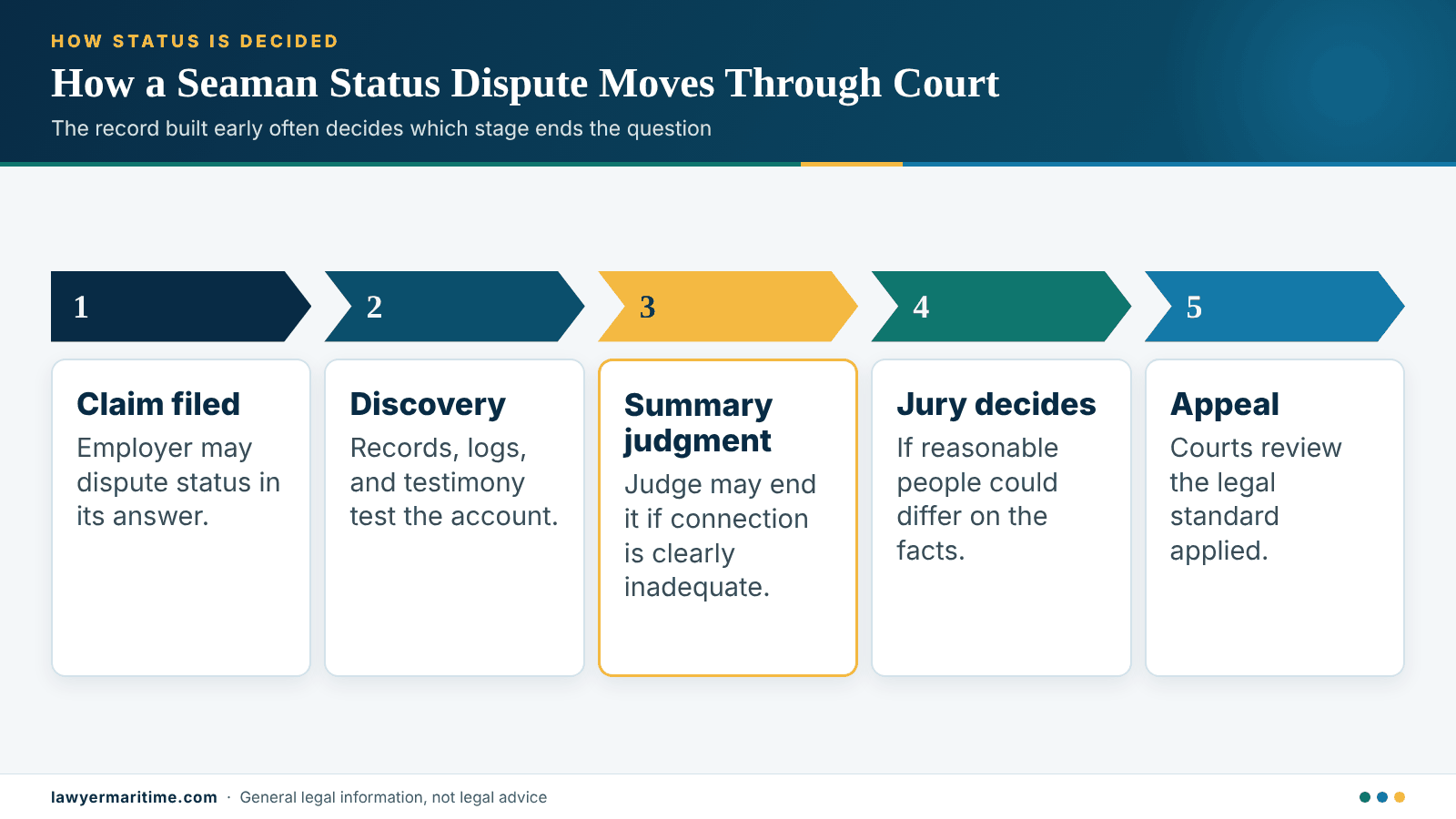
Understanding the test is half the picture. The other half is procedural: who applies it, at what stage, and what happens if the facts are disputed. A status case can end before trial on a motion, or it can become the central question a jury answers.
Judge or jury?
A mixed question and the reasonable-persons standard
The Supreme Court has repeatedly said that seaman status is a mixed question of law and fact. In Chandris and again in Gizoni, the Court explained that when reasonable persons applying the legal standard could differ on whether the worker is a member of a vessel’s crew, the question goes to the jury. The jury considers all relevant circumstances bearing on both elements.
This allocation is why seaman status lawsuits can survive a motion even when the employer presents strong evidence. If the worker’s evidence on duties, time, and the nature of the work creates a genuine dispute, a judge isn’t supposed to resolve it by choosing sides.
When a judge can decide the question early
The same decisions recognize a limit. Chandris said that where the undisputed facts show a connection to a vessel so limited that no reasonable jury could find the worker a crew member, the court may take the question from the jury through summary judgment or a directed verdict. Gizoni cautioned in the other direction: a judge can’t rule on job title alone, and disputed facts about vessel status or the worker’s connection make early dismissal inappropriate.
Sanchez illustrates the first path. The district court granted summary judgment for the employer, and the en banc Fifth Circuit affirmed because the worker had not created a genuine issue of material fact on the nature element. For workers, the lesson is that the record built before a summary judgment motion often decides whether a jury ever hears the case.
What does a status dispute look like in practice?
Pleadings and discovery
Status often becomes the first battleground once a lawsuit is filed. An employer that disputes status may raise it in its answer, then use discovery to test the worker’s account: employment records, assignment histories, time and attendance data, vessel records, and the worker’s own sworn testimony. Workers should expect detailed questions about a typical day, how often they boarded which vessels, and who gave the orders.
Depositions are central. Testimony about duties and time commitments is compared with the documents, and inconsistencies get noticed. Our guide to the Jones Act deposition covers what to expect, and the broader Jones Act lawsuit page explains where status fits in the litigation timeline.
Summary judgment, trial, and appeal
After discovery, either side may ask the court to resolve status as a matter of law. If the motion is denied, status becomes a jury question, usually tried together with the negligence and damages issues, as described in our Jones Act trial guide. If the motion is granted, the worker generally cannot proceed under the Jones Act and may be left with other remedies, and an appeal can follow.
Appellate courts apply the Supreme Court’s framework, but circuits express the nature inquiry in their own words, and the Fifth Circuit’s Sanchez inquiries are not binding elsewhere. Where the case was filed, and in which circuit, can therefore matter to how the evidence is framed.
How Does the Test Apply to Real Fact Patterns?
Doctrine is easier to grasp when you watch it sort workers. The patterns below are illustrations of how the factors tend to point, not predictions about any real case, and none comes from a client matter. Each outcome could change with one additional fact, which is the central lesson of a fact-intensive test.
Which patterns tend to support seaman status?
Crew who work aboard vessels that go to sea
The clearest pattern is a worker employed to serve on a vessel that actually operates on navigable waters: a deckhand on a towboat, an engineer on a supply vessel, a cook on a fishing boat, a mate on a work barge that is moved from site to site. The duties serve the vessel’s mission, the work is sea-based, and most of the working time is spent on the vessel.
Even here, nothing is automatic. The vessel must meet the legal definition, and the time and nature elements still have to be shown with records. But a crew member’s description of a typical week usually lines up with the test without much strain, which is why disputes in this group tend to center on vessel status or on the employer’s claim that the worker was not truly crew.
Workers tied to one operator’s fleet
A second supportive pattern is the worker whose employer owns or controls a group of vessels and moves the worker among them. Time on any single boat may be modest, yet the worker’s sustained connection to the fleet can satisfy the duration element when the vessels are under common ownership or control.
Hypothetically, a relief deckhand for a regional towing company might work on five of the company’s boats in a year, never more than a few weeks on any one. Combined, the time on the fleet can show a substantial connection, provided the nature of the work is sea-based. The same worker bouncing among unrelated employers would face the Papai problem.
Which patterns tend to cut against it?
Shoreside and dockside work
At the other end are workers whose duties are performed on land, on piers, or alongside docked vessels without going to sea. Terminal operators, dock hands who never leave the pier, and landside maintenance staff fit here. Their work may support vessels in the loose sense, but the connection is the transitory or land-based kind that Chandris and Papai describe.
These workers may fall under the LHWCA or a state compensation program instead. If you are in this group and also spent real time aboard vessels that sailed, that time deserves to be documented, because it can change the analysis for the portion of the job that was sea-based.
Discrete-task visitors
The other pattern that cuts against status is the specialist who boards a vessel for a defined task. Contract welders, inspectors, technicians, and painters often do real work on real vessels, sometimes for long stretches. When the engagement is tied to the task and ends with it, courts applying Sanchez are likely to treat the worker as a land-based employee visiting a vessel.
The exception is the visitor who is really a member of the working complement: living aboard, taking the master’s orders, sailing with the vessel, and staying beyond the specific task. The table below shows how a few facts can move the same job from one side to the other.
| Illustrative worker | How the test may point | Facts that could change the answer |
|---|---|---|
| Deckhand on a towboat working inland waterways | Status likely supported | Employer disputes that the worker was on the crew roster, or the craft’s vessel status is contested |
| Relief deckhand rotating through one company’s tugs | Status likely supported if the fleet is commonly owned or controlled | The boats belong to unrelated owners, so time cannot be combined |
| Welder hired for one repair job on a docked vessel | Status unlikely | The worker lived aboard, sailed with the vessel, or stayed on after the repair |
| Shipyard repair worker who occasionally goes out on sea trials | Depends on the facts | Share of work time aboard vessels in navigation and whether the work took the worker to sea |
| Shoreside mechanic reassigned to a standing vessel engine-room post | Depends on the facts; the new assignment is the focus | Duration of the new post and its sea-based character |
| Worker on a floating structure with no propulsion, moored long term | Vessel status in doubt | Movement history, design features, and whether it is practically capable of transportation |
What Evidence Proves or Defeats Seaman Status?
Because status is decided on facts, the quality of your records often matters more than the strength of your legal argument. The relevant facts are usually ordinary: where you worked, with which vessels, and for how long. The challenge is that many of those facts sit in the employer’s files.
Which records show the connection?
Time, pay, and assignment records
Duration is a numbers question, and the best proof comes from records created before any dispute. Time sheets, payroll stubs, hitch or rotation schedules, dispatch and crew-change records, and daily work assignments can show how many days you spent on vessels. Crew lists, shipping articles where they apply, and safety orientation sign-in sheets help show you were counted as part of the complement.
Pay classifications deserve a careful reading. A “deckhand” classification supports a seaman account, but a shoreside classification doesn’t defeat it if the actual work was sea-based. Courts look past the label, though the label can still be evidence that a jury weighs.
Vessel and operations records
The second category proves what the vessel was and what it was doing. Voyage or deck logs, movement histories, charter or operating agreements, ownership and management documents, and the vessel’s descriptions can answer whether it was a vessel in navigation and whether several vessels were under common control. They also show whether the vessel was underway or in repair when you worked on it.
You may not have these documents, but you can identify them by name and date. Writing down the vessel names, locations, and dates you recall gives a lawyer and, later, the discovery process a map of what to ask for.
| Evidence | What it helps show | How to preserve or obtain it |
|---|---|---|
| Time sheets, payroll records, rotation schedules | Duration of your connection to vessels | Keep your own copies; photograph pay stubs and schedules; request records in writing |
| Crew lists, assignment or dispatch records | That you were part of a vessel’s working complement | Note vessel names and dates; ask supervisors or the company for crew-change records |
| Vessel logs and movement histories | Vessel in navigation; sea-based work; sailing between locations | Identify the log by vessel and period; likely obtained in discovery |
| Ownership, charter, and management documents | Common ownership or control of a group of vessels | Gather company names on pay stubs, orientation papers, and vessel placards |
| Job descriptions, contracts, and training records | Your duties and their relation to the vessel’s mission | Keep offer letters, contracts, and safety certificates |
| Photos, messages, and calendars | Where you slept, worked, and reported each day | Save dated photos and work messages; write down details while memory is fresh |
How do testimony and your own account fit?
Co-workers, captains, and supervisors
Witnesses describe what records can’t: who gave orders, what a normal day looked like, whether a worker stayed aboard, and how the crew treated a worker’s role. Captains, mates, engineers, and co-workers who saw the daily pattern are valuable because they can connect the paper trail to actual work. Keep a list of names, vessels, and contact details.
Be cautious about how those conversations happen. Informal chats are fine, but anything that could look like pressure on a witness can backfire, and a lawyer can often arrange interviews and statements more safely.
Describing your job accurately and consistently
Your own account is evidence, and it will be compared with everything else you have said. Injury reports, medical histories, insurance forms, recorded statements, and social media posts may describe your job in different words. Small differences, such as “I was on the boat most days” versus “I worked in the yard,” can become major disputes.
How Does Seaman Status Compare With LHWCA Coverage?
For many maritime workers, the real question is not “seaman or nothing” but “seaman or longshore worker.” Congress drew a line between the two systems, and a worker usually falls on one side of it. Knowing how the line works helps explain why courts take the status test so seriously.
How do the two systems divide workers?
The crew exclusion and mutual exclusivity
The LHWCA defines a covered “employee” as a person engaged in maritime employment, such as a longshore worker or a harbor worker like a ship repairman or shipbuilder, and then lists exclusions. One of them is “a master or member of a crew of any vessel” (33 U.S.C. § 902(3)(G)). Because a seaman is a member of a vessel’s crew, the Supreme Court has described the Jones Act and the LHWCA as mutually exclusive, a point it repeated in Wilander and Gizoni.
Coverage under the LHWCA also depends on where the injury happened. The statute reaches injuries on the navigable waters of the United States, including adjoining piers, wharves, docks, terminals, and similar areas customarily used in loading, unloading, repairing, dismantling, or building a vessel (33 U.S.C. § 903(a)). A worker must meet both the status and situs requirements, and a seaman is outside the system.
Why a job title cannot settle the question
Gizoni is the key authority for workers who sit near the line. A ship repairman is in an occupation the LHWCA names, but the Court held that such a worker may still be a seaman if the facts show the required connection to a vessel. Whether a worker is limited to LHWCA remedies depends on whether a genuine factual issue about crew membership exists.
That is why employers and workers often argue about status in both directions. A worker injured while repairing a vessel at a dock may face an employer who says the LHWCA governs, and the worker’s ability to show a sea-based, substantial connection can decide which regime applies. The table below summarizes the major differences.
| Feature | Jones Act seaman | LHWCA employee |
|---|---|---|
| Governing law | 46 U.S.C. § 30104, general maritime law | 33 U.S.C. §§ 901-950 |
| Who is covered | Seamen: crew members who meet the two-part test | Maritime employees such as longshore and harbor workers who are not crew members of a vessel |
| Core status question | Duties serve the vessel; connection substantial in duration and nature | Maritime employment status plus injury at a covered location |
| Main claim against the employer | Negligence action with right to a jury; maintenance and cure | Compensation benefits through the LHWCA program, generally without proof of fault |
| Claim against the vessel owner | Unseaworthiness and, depending on the owner’s role, other maritime claims | Vessel negligence suit under 33 U.S.C. § 905(b), within its limits |
| Effect of job title | Does not decide status; the facts of the connection do | A listed occupation does not make a crew member a covered employee |
What if your status is unclear?
Benefits already received
Workers sometimes receive LHWCA or state benefits while their status is still unsettled and then wonder whether that forecloses a Jones Act claim. In Gizoni, the Supreme Court held that accepting LHWCA benefits does not by itself bar a later Jones Act suit and declined to force an election of remedies. It noted that voluntary payments without a formal award generally do not prevent Jones Act relief and that the LHWCA gives a credit for Jones Act payments against its own liability.
The details depend on the benefits and procedures involved, so this isn’t a reason to ignore paperwork. If you receive a benefits form, a claim denial, or a request to sign something that characterizes your job, get it reviewed before you respond.
Why the rules and clocks differ
The two systems have separate notice and filing rules. A Jones Act suit borrows the three-year period in the FELA (45 U.S.C. § 56), and maritime personal-injury actions generally face a three-year period under 46 U.S.C. § 30106, though other law can change the picture. Treating the wrong system’s clock as your own can cost a claim. Our guides to the Jones Act statute of limitations and maritime injury deadlines explain how timing varies, and the maritime injury compensation overview compares what each route can provide.
Because status is unsettled, careful practitioners often evaluate both tracks at once and protect deadlines in each. That is a decision for you and a lawyer, based on your facts, and it is a good reason to ask early rather than assume.
Which Mistakes Hurt a Status Case, and What Should You Do Now?
Most status problems are created by assumptions and paperwork, not by bad law. The mistakes below come up often enough to deserve their own section, followed by a practical set of steps that fits any worker whose status is uncertain.
What mistakes weaken a seaman status claim?
Assuming a label settles the question
Workers sometimes assume they are seamen because they work on boats, and sometimes assume they are not because a form says “contract laborer” or “yard employee.” Neither assumption’s safe. The law looks at duties, vessels, time, and the sea-based nature of the work, and a label is only one piece of evidence.
The same caution applies to employers’ statements. A claims adjuster who says “you’re covered under the longshore system” or “you’re not a seaman” is offering an opinion that may serve the employer’s interests, not a legal determination. Courts decide status, and the decision follows the test, not the adjuster’s characterization.
Paperwork and statements that undercut the facts
Forms completed in a hurry can say things a worker later wishes they had not. Describing your role as “shop welder” on a benefits form when you spent most of your time on a vessel, or signing a statement that you “only went aboard when needed,” creates evidence a defense lawyer will use. Recorded statements to an insurer can have the same effect.
Release papers deserve special mention. A document that characterizes your job or waives claims could affect your rights, and seamen receive special protection in how releases are scrutinized. Our guide to the Jones Act claim process covers statements and releases in more detail.
| Common mistake | Why it hurts | Better action |
|---|---|---|
| Relying on a job title or pay classification | Courts look at duties and connection, so a title can mislead in either direction | Write down your actual duties, vessels, and dates |
| Signing forms that mischaracterize your role | Inaccurate descriptions can be quoted against you later | Describe your work accurately and ask for review before signing |
| Giving a recorded statement without preparation | Offhand estimates of time aboard can contradict records | Say what you know, flag uncertainty, and consider legal review first |
| Waiting to collect records | Logs, schedules, and messages can be lost or overwritten over time | Save pay stubs, schedules, photos, and messages now |
| Assuming benefits from one system close off the other | The rules are more nuanced than that, and decisions made on assumptions can cost options | Ask a maritime attorney how benefits you receive interact with a possible Jones Act claim |
What should you do now?
A practical records checklist
If your status may be disputed, start by building a simple record while memory is fresh. You don’t need legal knowledge for this, only a notebook or a document and a few photos. The goal is to capture facts a lawyer can later check against the employer’s files.
- List every vessel you worked on, with names, owners if known, and approximate dates.
- Describe a typical day and a typical week, including where you slept, reported, and worked.
- Save pay stubs, schedules, crew-change messages, orientation papers, and photographs of your work.
- Note who gave you orders and who worked beside you, with contact details.
- Keep copies of every injury report, benefits notice, and form you were asked to sign.
When a legal review makes sense
If you have been hurt and your status is unclear, a review by a maritime attorney early on can sort the Jones Act and LHWCA questions while records are still available. Many people also want to understand the next layer of the process, including what a lawyer does in a Jones Act case and how the full set of seaman remedies fits together in our seaman injury lawyer guide.
If maintenance and cure has been denied or stopped because someone questions your status, our guide to maintenance and cure denial explains that dispute, and unseaworthiness damages covers the vessel-condition claim that is tied to crew status. Nothing here predicts any result, and your facts may lead to a different conclusion.

Frequently Asked Questions About the Seaman Status Test
These answers are general. Your facts, your vessel, and the court where a case is filed can change the analysis.
Questions about the test itself
Do I have to work on the open ocean to be a seaman?
No. The test asks about a connection to a vessel in navigation, and inland and coastal waters can qualify. A towboat deckhand on a river can have the sea-based connection the law looks for. What matters is that your duties expose you to the hazards of working on a vessel on navigable waters, not how far from shore you work.
Is the 30 percent rule a requirement?
It is a guideline from Chandris. The Court said a worker who spends less than about 30 percent of his time in the service of a vessel in navigation should generally not qualify, and it allowed departures in appropriate cases. Reaching 30 percent doesn’t prove status by itself, because the nature of the connection must also be substantial.
Can a cook, engineer, or other non-deck worker be a seaman?
Yes. After Wilander, a worker needn’t aid in navigation. Cooks, engineers, and other crew who do the ship’s work can satisfy the first element, and the question then becomes the duration and nature of the connection.
Questions about specific situations
Can my status change over time?
Yes. Chandris said that when a maritime worker’s basic assignment changes, seaman status may change as well. Courts look at the substantiality of vessel-related work in the new position, so a move to or from a vessel can matter.
Are offshore workers seamen?
Some are and some are not. An offshore worker’s status depends on whether the structure is a vessel and on the worker’s connection to it. A crew member on a supply vessel is a different case from a contractor who visits a fixed platform or a jack-up unit for a discrete task, and the Fifth Circuit’s Sanchez decision illustrates that second pattern.
If I received LHWCA benefits, can I still claim seaman status?
It may still be possible. In Gizoni, the Supreme Court held that accepting LHWCA benefits does not necessarily bar a Jones Act claim and that voluntary payments without a formal award generally do not. The specifics matter, so have any benefits paperwork reviewed.
Questions about process and proof
Who decides whether I am a seaman?
It is a mixed question of law and fact. A judge sets the legal standard, and a jury decides if reasonable people could differ on the facts. A judge may decide the question earlier if the connection is clearly inadequate or the facts are undisputed.
Does the Sanchez decision apply everywhere?
Sanchez is a Fifth Circuit en banc decision, binding in that circuit’s federal courts. Courts elsewhere apply the Supreme Court’s framework and may phrase the nature inquiry differently. A lawyer can tell you how courts in your forum treat the issue.
What is the best evidence of seaman status?
Contemporaneous records that show how much of your work was tied to vessels and what the work was: time sheets, assignment records, crew lists, vessel logs, and consistent descriptions of your duties. Witnesses who saw your daily work also help. Start collecting now, and keep copies.
Where can I read more about who typically qualifies?
Our guide to the Jones Act seaman covers who typically qualifies and gives examples, while our pillar on working with a maritime lawyer explains how a legal review fits into the process. For the broader legal setting, see our overviews of maritime law and admiralty law.
Sources and Legal Authorities
The authorities below support the legal statements in this guide. Each should be checked against current text before you rely on it.
Statutes and regulations
Federal statutes
- 46 U.S.C. § 30104 – Jones Act personal injury and death of a seaman
- 46 U.S.C. § 30106 – Time limit on bringing maritime action for personal injury or death
- 45 U.S.C. § 56 – FELA, limitation of actions
- 1 U.S.C. § 3 – Definition of “vessel”
Longshore and Harbor Workers’ Compensation Act
- 33 U.S.C. § 902 – Definitions, including “employee” and the crew-member exclusion
- 33 U.S.C. § 903 – Coverage and situs requirements
Cases and agency materials
Supreme Court and federal appellate decisions
- McDermott International, Inc. v. Wilander, 498 U.S. 337 (1991) – seaman status does not require aiding navigation
- Southwest Marine, Inc. v. Gizoni, 502 U.S. 81 (1991) – LHWCA-listed occupations, benefits already received, and the jury question
- Chandris, Inc. v. Latsis, 515 U.S. 347 (1995) – two-part test, 30 percent guideline, fleets, and reassignment
- Harbor Tug & Barge Co. v. Papai, 520 U.S. 548 (1997) – common ownership or control of a fleet and the nature of the connection
- Stewart v. Dutra Construction Co., 543 U.S. 481 (2005) – what counts as a vessel
- Lozman v. City of Riviera Beach, 568 U.S. 115 (2013) – floating home not a vessel; reasonable-observer perspective
- Sanchez v. Smart Fabricators of Texas, L.L.C., 997 F.3d 564 (5th Cir. 2021) (en banc) – Fifth Circuit inquiries on the nature of the connection
Agency and official data
- U.S. Department of Labor, Division of Longshore and Harbor Workers’ Compensation – background on the separate longshore compensation program