
Unseaworthiness damages are the compensation an injured seaman may recover when the vessel itself was not reasonably fit for its intended use and that condition played a real part in the injury. The claim comes from general maritime law, not from the Jones Act statute, and it is aimed at the vessel owner or operator rather than at the employer as such. Liability does not depend on proving that anyone was careless, which sets the claim apart from negligence, but you still have to prove an unfit condition and a causal link to your harm. The recovery is compensatory: medical costs, lost wages and earning capacity, and pain and suffering may be available, while punitive damages are not, under the Supreme Court’s decision in Dutra Group v. Batterton. This guide explains who can bring the claim, what counts as an unseaworthy condition, how the claim differs from a Jones Act negligence claim, which damages and reductions apply, and what evidence matters. It is written for injured crew members, their families, and anyone trying to get their bearings before speaking with a maritime lawyer. It describes general rules, not predictions about any case.
What Is Unseaworthiness, and What Does a Vessel Owner Owe?
Unseaworthiness is a doctrine of general maritime law that makes a vessel owner answerable when the vessel, its equipment, or its crew was not reasonably fit for the work it was doing. It exists to protect the people who live and work aboard. Because it does not ask whether the owner was careless, lawyers often plead it next to a negligence claim, and the two rise or fall on different proof.
What is the duty, exactly?
The duty is easy to state and harder to apply. It runs from the owner to the seamen aboard, and it attaches to the vessel as a whole rather than to any one decision made by any one person.
The rule from Mitchell v. Trawler Racer
Frank Mitchell was a crew member on a fishing trawler. After the crew unloaded the catch, he stepped onto the ship’s rail to reach a ladder on the pier, and his foot slipped on slime and fish residue left on the rail. The jury found for the owner, but the Supreme Court sent the case back for a new trial on unseaworthiness.
The Court called the owner’s duty “absolute” and described it as completely independent of the duty of reasonable care that the Jones Act imposes on the employer. It also held that the owner’s actual or constructive knowledge of the condition is not required, and that a temporary condition arising mid-voyage can count. An owner can be liable for a condition it never knew about.
What “reasonably fit” does and does not demand
Mitchell is just as clear about the limit. The Court said the duty is not one to furnish an accident-free ship. It is a duty to furnish a vessel and appurtenances reasonably fit for their intended use, which is a standard of reasonable fitness rather than perfection.
That limit does real work in practice, so don’t skip over it. A deck that is wet at sea may still be fit for its purpose, while a deck coated in grease that no one cleaned during the shift may not be. The question is whether the condition, in context, fell below what the intended use required.
What can make a vessel unseaworthy?
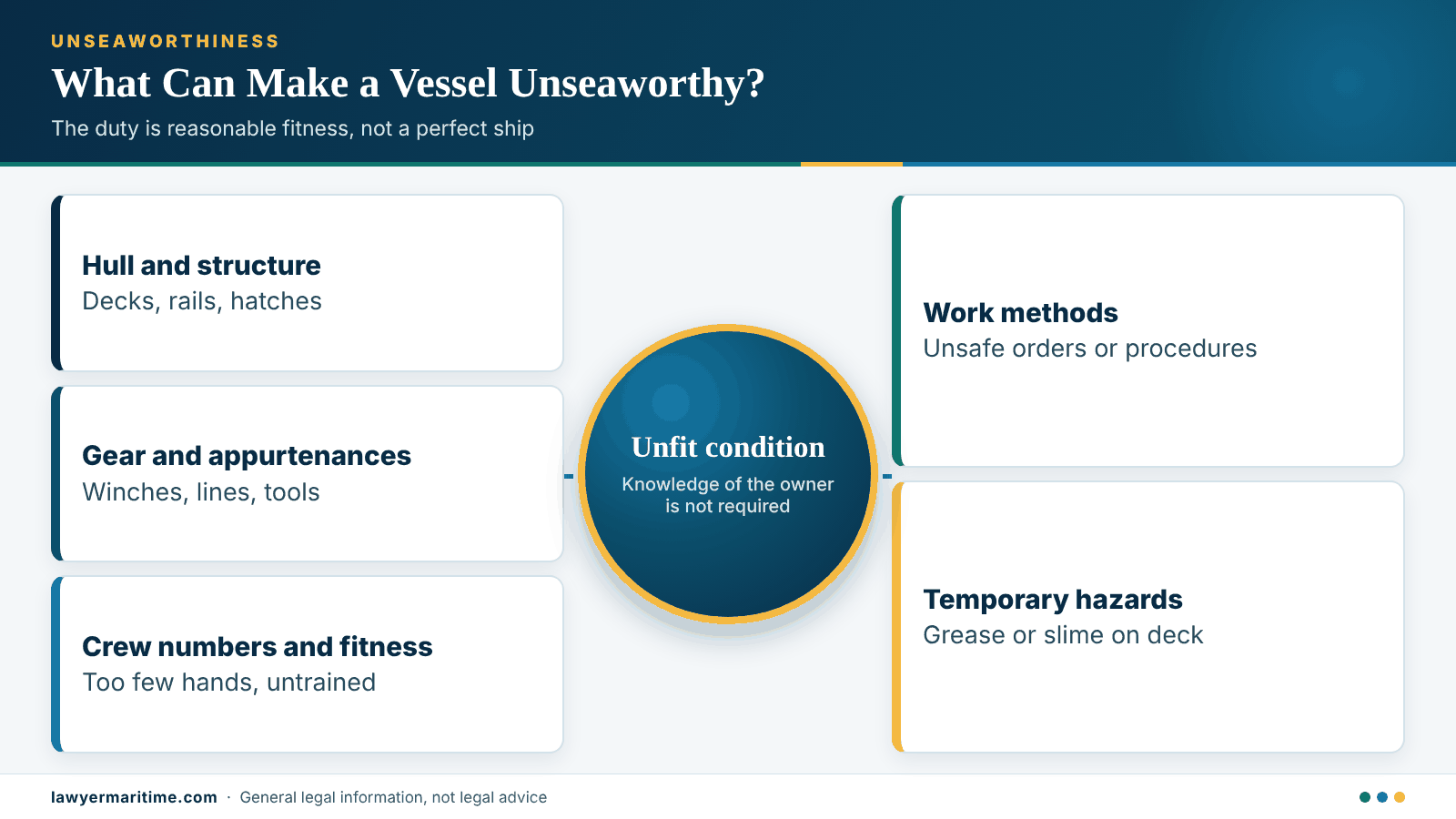
Courts don’t treat the word as a synonym for “damaged hull.” The doctrine reaches anything that bears on whether the vessel can safely do its job, and decades of decisions have filled in the list.
Hull, equipment, and appurtenances
The most familiar category is physical. Defective winches, frayed lines, missing guards, faulty hatch covers, broken ladders, poorly maintained deck surfaces, and inadequate lighting are the kinds of conditions that raise unseaworthiness questions. An appurtenance is simply an item that belongs to the vessel’s operation, such as rigging, tools supplied for the job, or safety equipment the vessel is expected to carry.
Where an item came from can matter. Equipment that the owner supplied is easier to tie to the vessel than a tool a visiting contractor brought aboard, and courts examine those facts closely. A lawyer will ask who supplied the item, who controlled it, and whether it was part of the vessel’s working equipment on the day of the injury.
Crew, manning, and methods of work
Unseaworthiness is not limited to things. In Waldron v. Moore-McCormack Lines, Inc., 386 U.S. 724 (1967), the third mate ordered two crew members to carry a heavy mooring line a long distance, and an expert said safe seamanship called for more hands. The Supreme Court held that the case should go to a jury on unseaworthiness, reasoning that a ship’s crew is not separate from the ship’s equipment and that assigning too few people to a task at the time and place it is done can make the vessel unfit.
The same logic reaches an incompetent or unfit crew member, inadequate training, and an unsafe method of doing a job. These are often the most contested theories, because the owner will argue that the real problem was one person’s momentary judgment rather than a lasting condition. The next subsection explains where that line falls.
Where does the doctrine stop?
No-fault liability sounds sweeping, but the Supreme Court has kept it tied to the condition of the vessel. Two limits matter most to anyone sizing up a claim.
Isolated negligence: the line drawn in Usner
In Usner v. Luckenbach Overseas Corp., 400 U.S. 494 (1971), a longshoreman was struck when a winch operator lowered a sling too far and too fast. Nothing about the equipment, the cargo, or the crew’s staffing was defective. The Court held that one isolated, momentary act of carelessness did not make the vessel unseaworthy.
The lesson is a distinction of kind. A defective winch brake is a condition. A competent operator’s single slip with a sound winch is an act. If the story of your injury is only the second kind, a negligence claim is usually the better fit than an unseaworthiness claim. Usner involved a longshoreman, but the condition-versus-act distinction it draws is a general feature of the doctrine, and how courts apply it to particular facts varies.
No-fault liability is not guaranteed recovery
Because the owner’s knowledge and fault are not elements, readers sometimes assume the claim is easy. It isn’t. You must still prove that an unseaworthy condition existed, that it played a substantial part in causing your injury, and that you suffered losses as a result.
Your own conduct can also reduce the award, and several other rules discussed later can narrow it. Think of unseaworthiness as removing one obstacle, the need to prove the owner was careless, while leaving the others in place.
Who Can Bring an Unseaworthiness Claim, and Against Whom?
Two questions decide whether an unseaworthiness claim is even on the table. The first is whether the injured person belongs to the class of workers the warranty protects. The second is whether the company you want to sue owns or controls the vessel in the way the doctrine requires.
Who holds the right to sue?
The warranty of seaworthiness protects seamen. Beyond that bare statement, the answer turns on status, and status turns on facts that are easy to get wrong without a careful look.
Seamen and the status question
The Supreme Court’s test for seaman status appears in Chandris, Inc. v. Latsis, 515 U.S. 347 (1995), building on McDermott International, Inc. v. Wilander, 498 U.S. 337 (1991). In general terms, the worker’s duties must contribute to the function or mission of a vessel, and the worker’s connection to a vessel, or an identifiable fleet of vessels, in navigation must be substantial in both duration and nature. Chandris described a rule of thumb of about 30 percent of working time on vessels as a guideline, not a hard line.
Vessel status matters too. Under Stewart v. Dutra Construction Co., 543 U.S. 481 (2005), a vessel is a watercraft practically capable of maritime transportation, while Lozman v. City of Riviera Beach, 568 U.S. 115 (2013), held that a floating home was not a vessel. Our guides on the Jones Act and on seaman injury claims walk through status in more detail, and courts in different circuits apply these tests with their own refinements.
Why most longshore and harbor workers can’t assert it
There was a time when longshore workers could sue vessels for unseaworthiness. The Supreme Court recognized that protection in Seas Shipping Co. v. Sieracki, 328 U.S. 85 (1946), but Congress ended it for covered workers in 1972 by amending the Longshore and Harbor Workers’ Compensation Act (LHWCA).
The current text of 33 U.S.C. § 905(b) lets a covered worker sue a vessel for negligence, makes that remedy exclusive against the vessel, and provides that the vessel’s liability “shall not be based upon the warranty of seaworthiness.” If you are covered by the LHWCA, the unseaworthiness damages described here are generally not available to you, though a vessel-negligence claim and statutory benefits may be. The distinction between those worlds is why our overview of maritime injury compensation starts with status.
Who answers for an unseaworthy vessel?
The duty rests on the owner of the vessel, or whoever stands in the owner’s shoes. That’s not always the company that hired you, and the difference shapes strategy.
The owner and the operator in possession
The default defendant is the vessel owner. Courts also hold liable an owner pro hac vice, a phrase for someone who takes over a vessel completely, such as a bareboat charterer that crews, supplies, and navigates the vessel as if it owned it. Whether a particular arrangement is a bareboat charter or something looser, such as a time charter, is a fact-heavy question that often decides who can be sued.
Because unseaworthiness is a claim against the vessel’s condition, it can often also be pursued against the vessel itself in an action in rem, meaning against the ship as security. The availability and mechanics of that route depend on the facts and on admiralty procedure, so it is a conversation for counsel rather than a do-it-yourself step.
When the employer and the owner are different companies
Many crews work for a manning company, a contractor, or an affiliate rather than the entity that owns the vessel. The Jones Act claim runs against the employer, while the unseaworthiness claim runs against the owner or operator in possession. If the same company wears both hats, one defendant answers to both claims.
This is one reason to collect your crew agreement, pay records, and any vessel documents early. They show who employed you and who controlled the vessel, and both answers feed the case. We discuss claim-building in more depth in our guide to the Jones Act claim process.
How Does Unseaworthiness Differ From a Jones Act Negligence Claim?
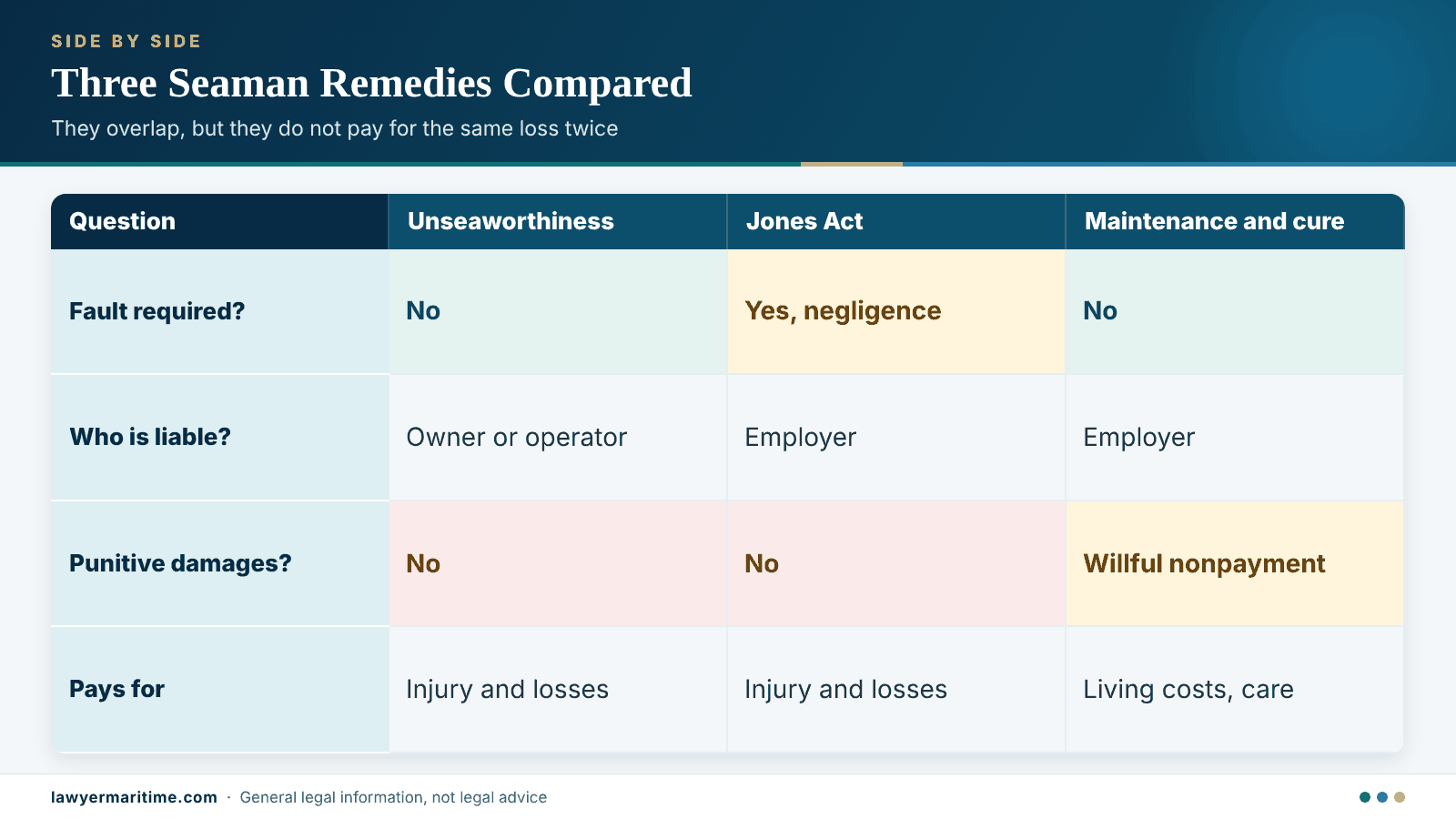
An injured seaman rarely has one claim. The Jones Act, unseaworthiness, and maintenance and cure usually travel together, and the differences among them decide which one carries a given case. Knowing those differences also keeps you from expecting one claim to do another claim’s job. For the negligence side in depth, see our guide to the Jones Act, and for the no-fault benefits side, see maintenance and cure disputes.
How do the liability standards compare?
The most important difference is what you must show about the defendant’s conduct. One claim asks about fault, and the other asks about the condition of the vessel.
Fault, notice, and knowledge
The Jones Act, 46 U.S.C. § 30104, gives an injured seaman a negligence action against the employer and borrows the federal railway injury statute, the Federal Employers’ Liability Act (FELA), for its rules. Negligence means the employer failed to use reasonable care. In the Fifth Circuit, as the court of appeals summarized in Luwisch v. American Marine Corp., No. 19-30499 (5th Cir. Apr. 15, 2020), Jones Act liability generally requires that the employer had actual or constructive notice of the dangerous condition.
Unseaworthiness is different. The same decision describes unseaworthiness liability as not resting on fault or negligence, and it repeats the Supreme Court’s point from Mitchell that the owner’s knowledge is not essential. That difference is the main reason to plead unseaworthiness when no one can show that the employer knew about the hazard.
Causation: two different formulations
For Jones Act claims, the causation standard comes from FELA, which the Supreme Court addressed in CSX Transportation, Inc. v. McBride, 564 U.S. 685 (2011). The Fifth Circuit in Luwisch phrased the Jones Act question as whether the employer’s negligence was the cause “in whole or in part” of the injury.
For unseaworthiness, the same court used a different formulation: the condition must have played a substantial part in bringing about or actually causing the injury, and the injury must be a direct result or reasonably probable consequence of the unseaworthiness. On their face the two formulations ask for different things. Whether the gap changes an outcome depends on the facts and the circuit, so treat both as links you must be able to prove.
How do defendants, remedies, and forums differ?
The two claims also point at different parties and can end up in front of the same decision-maker.
Who is sued and how the case is tried
A Jones Act claim is brought against the employer, and the statute lets either party demand a jury. An unseaworthiness claim is brought against the owner or the operator in possession, and it is a general maritime claim rather than a statutory one. When a seaman sues in a court at law and pleads both, the claims are commonly tried together, though procedure varies with the court, the choice of federal or state forum, and how the case is pleaded.
Our overview of admiralty law explains how the federal courts’ admiralty jurisdiction and the saving-to-suitors clause shape those choices. For a deeper look at the negligence concept itself, see our guide to maritime negligence.
Why lawyers usually plead both
The claims cover each other’s gaps. If a hazard was a lasting condition that no manager knew about, unseaworthiness may succeed where negligence struggles. If the injury came from a supervisor’s careless order or a single slip, negligence may fit where unseaworthiness does not, as Usner suggests.
The claims also differ in who pays and when. A Jones Act judgment runs against the employer, while an unseaworthiness judgment runs against the owner or operator. When they are the same company the distinction fades, and when they are different companies it can affect insurance, funds available, and settlement dynamics.
| Feature | Unseaworthiness | Jones Act negligence | Maintenance and cure |
|---|---|---|---|
| Source of the duty | General maritime law warranty owed by the vessel owner | 46 U.S.C. § 30104, incorporating FELA | General maritime law, tied to the employment relationship |
| Is fault required? | No; an unfit condition and causation are required | Yes; employer negligence, usually with notice of the hazard | No; owed regardless of fault, subject to defenses such as willful concealment |
| Who is the defendant? | Owner or operator in possession; sometimes the vessel in rem | The seaman’s employer | The employer |
| Causation focus | Condition played a substantial part in the injury | Negligence played a part, “in whole or in part” | Illness or injury in the service of the ship |
| What it pays | Compensatory damages for the injury and resulting losses | Compensatory damages for the injury and resulting losses | Living expenses and medical care until maximum medical recovery |
| Punitive damages? | Not available (Batterton) | Not available | Possible for willful nonpayment (Townsend) |
How Do You Prove an Unseaworthy Condition and Causation?
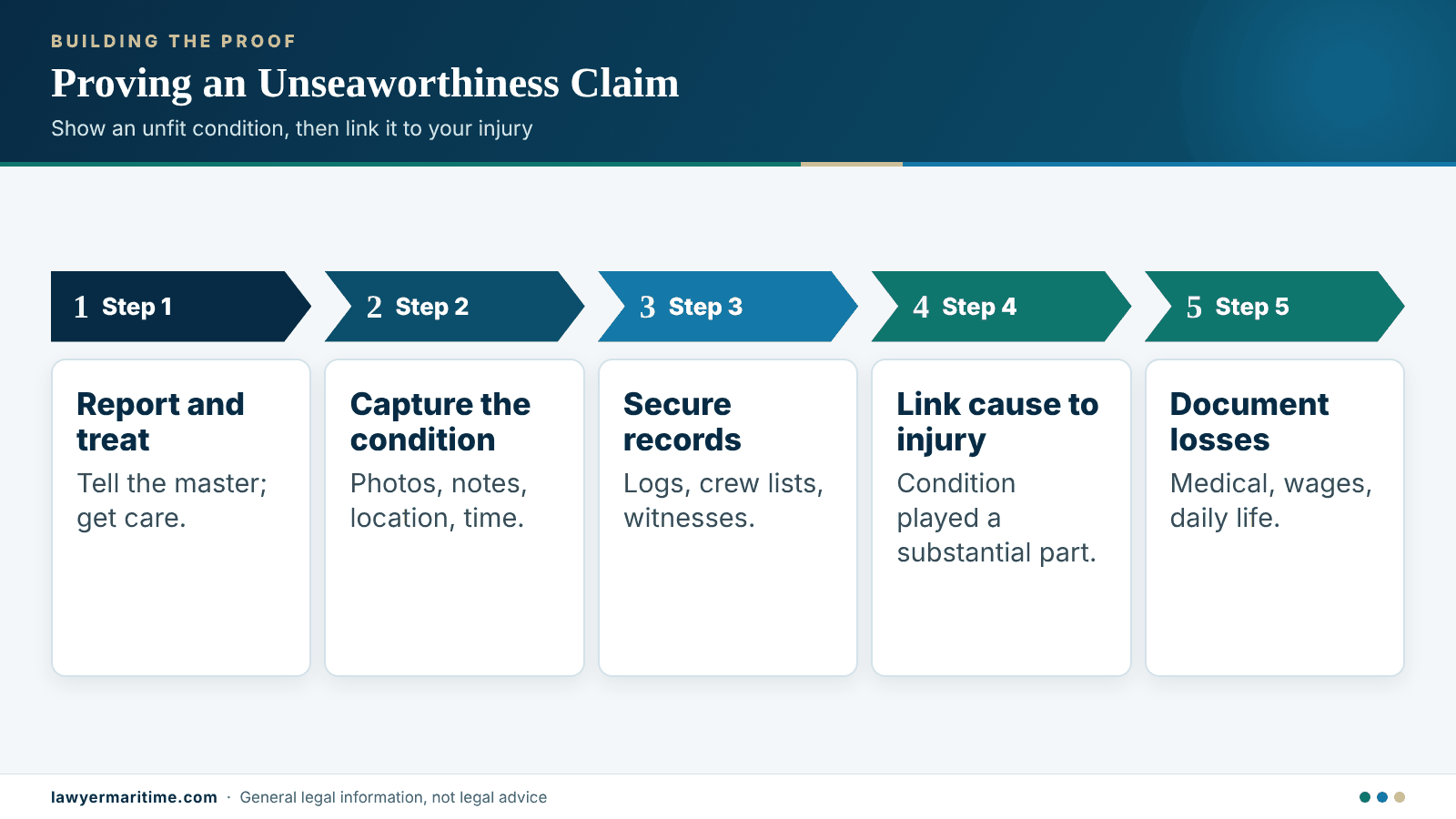
A no-fault claim still has to be proven, and the proof has two halves. You show that something about the vessel was not reasonably fit, and you show that this condition played a substantial part in your injury. Most disputes in these cases are about one half or the other.
How do you prove the vessel was unfit?
The proof usually comes from the physical scene, the vessel’s own records, and the people who worked there. What you need depends on whether the theory is about things or about people.
Equipment, deck conditions, and temporary hazards
Start with what the condition was, where it was, and how long it had been there. Mitchell is the model: slime and fish residue on a rail created an unfit condition even though it arose during the trip and might have been temporary. A court can find unseaworthiness from a hazard that existed only for part of a shift, so photographs and witness accounts of the moment matter.
In Luwisch, the Fifth Circuit affirmed a bench-trial finding that the placement of a rope on an upper deck made the vessel unseaworthy, and it upheld the trial court’s fault allocation between the company and the injured chief engineer. The ruling shows how an ordinary-looking item, in the wrong place, can become the centerpiece of a claim. It doesn’t mean every misplaced object will do the same, because outcomes depend on the evidence that was actually presented.
| Fact pattern | Possible unseaworthy condition | What the owner may argue |
|---|---|---|
| A winch brake slips while a line is under load | Defective gear or inadequate maintenance of equipment | The gear was inspected, the failure was sudden, or the operator misused it |
| A deckhand slips on a coating of grease near a work area | A hazardous deck surface that made the vessel unfit for the task | The condition was trivial, was cleaned, or did not cause the fall |
| Two crew members are told to move a very heavy load that usually takes more | Too few crew assigned to the task, as in Waldron | Two people were enough, or the crew chose an unsafe approach on their own |
| A crew lifts a heavy part by hand because the lifting device is out of service | An unsafe work method or missing equipment | The method was routine, the worker agreed to it, or the injury had another cause |
Crew size, competence, and methods of work
For manning and method theories, the evidence shifts from objects to organization. Look for crew lists, watch schedules, the number of people assigned to a job, the complexity of the task, training records, and any written procedures. Waldron turned on the idea that how many hands were assigned, at the time and place the work was done, can make a vessel unfit.
Fatigue can belong in this category when scheduling left a crew too depleted to work safely, and our article on fatigue and maritime accidents explains how that evidence is built. The owner’s usual answer is that the problem was one person’s lapse, not a lasting condition, which returns us to the Usner distinction.
How do you prove causation and preserve the evidence?
Even a clearly unfit condition doesn’t carry the case unless it links to your injury. This is also the stage where time works against you, because vessels sail and equipment gets repaired.
Linking the condition to the injury
The Fifth Circuit’s formulation, as described in Luwisch, asks whether the condition played a substantial part in bringing about the injury and whether the injury was a direct result or a reasonably probable consequence of it. In practice, that means a plausible account of how the condition caused the mechanism of injury, backed by witnesses, the physical evidence, and medical opinion.
Expect the defense to offer alternatives: your own carelessness, a pre-existing condition, or a different cause of the fall. A good presentation explains why those alternatives fit the evidence worse. The causation story should be consistent across your first report, your medical history, and your later testimony.
What to gather and what to preserve
Under Coast Guard rules, the owner, agent, master, operator, or person in charge must file a written marine casualty report on Form CG-2692 within five days after a reportable casualty, as 46 C.F.R. § 4.05-10 provides. Which injuries are reportable depends on the casualty criteria in § 4.05-1, so it is worth asking whether a report was filed and requesting a copy. For an overview of how official investigations are used, see our guide to the NTSB marine report.
Evidence also disappears in quiet ways. A broken fitting is replaced, a log is overwritten, and crew members scatter to new assignments. A lawyer can send a preservation demand and, if needed, seek an inspection, but you can help by writing down names and details while memories are fresh.
| Evidence | What it may show | Where it may come from |
|---|---|---|
| Photos and video of the condition | The hazard as it existed, its location, and its size | Your phone if permitted, coworkers, vessel cameras |
| Maintenance and repair records | Whether equipment was inspected, defective, or repaired afterward | Vessel logs, owner records, requests through counsel |
| Incident and casualty reports | The owner’s own account and any Coast Guard filing | Employer, owner, Coast Guard, requests through counsel |
| Crew lists and watch schedules | Staffing level and workload when the injury occurred | Crew agreement, scheduling records, coworkers |
| Training and safety records | Whether the crew was prepared for the task and the method | Safety meeting logs, orientation records |
| Witness names and accounts | What others saw and whether the condition was known | Coworkers, supervisors, medical responders |
| Medical records and work restrictions | The mechanism of injury and its effect on work | Treating providers, pharmacies, your own notes |
What Damages May an Unseaworthiness Claim Recover?
An unseaworthiness claim is designed to compensate, not to punish. The Supreme Court has described unseaworthiness and Jones Act claims as compensating a seaman for the injury itself and the losses that flow from it, in contrast to maintenance and cure, which supplies food, lodging, and medical care during recovery regardless of fault. The categories below are general, and the dollar amounts depend entirely on the proof in a particular case. For a wider view of how these damages sit alongside other maritime benefits, see our guides to maritime injury damages and maritime accident settlements.
What compensatory damages may be available?
Compensatory damages try to put the injured person in the position they would have occupied without the injury, as nearly as money can. They usually fall into economic and non-economic groups.
Medical expenses and lost earnings
The economic category typically includes past and future medical costs and the wages the injury has cost or will cost. Past wages are the simplest to prove, using pay records and employer statements. Future loss is harder, because it asks how the injury will affect the ability to work over time.
Loss of earning capacity is not the same as lost pay to date. It addresses the diminished ability to earn, which can matter for a deckhand or engineer who can’t return to the same duties or must take lower-paying work. Proof often includes medical opinions about restrictions and, in larger cases, vocational or economic experts. Unearned wages, generally a separate seaman’s remedy tied to the voyage or contract period, are a different item and should not be confused with these damages.
Pain, suffering, and other non-economic harm
Non-economic damages address harm that doesn’t come with a receipt: physical pain, emotional distress tied to the injury, and the lasting effect on daily life. There’s no formula, so factfinders weigh the evidence of how the injury has changed the person’s life. Courts and juries look at the nature of the injury, the course of treatment, and testimony from the injured person and the people around them.
Because no number is guaranteed and no honest source can predict one, this article doesn’t offer ranges. What you can control is the quality of the record: consistent medical care, accurate descriptions to providers, and a plain account of what you can and can’t do now. Our guide to maritime injury compensation explains how these categories compare across the different worker groups.
| Category | What it covers | Typical proof | Caveat |
|---|---|---|---|
| Past medical expenses | Treatment already received for the injury | Bills, records, proof of payments and what was covered | Amounts paid by others may raise offset or lien questions |
| Future medical care | Treatment reasonably expected later | Physician opinions and cost evidence | Must be reasonably certain, not speculative |
| Past lost wages | Pay lost between injury and trial or settlement | Pay records, tax records, employer statements | Overlap with unearned wages and maintenance needs care |
| Loss of earning capacity | Reduced ability to earn in the future | Restrictions, work history, vocational or economic opinions | Depends on medical outcome and job market evidence |
| Pain and suffering | Physical pain and emotional harm from the injury | Testimony, medical records, accounts from family and coworkers | No formula; the fact finder decides |
| Punitive damages | Punishment of the defendant | Not applicable | Not available for unseaworthiness |
What does the claim not pay?
The limits on an unseaworthiness recovery are as important as the categories. Two of them come from the Supreme Court and one from how death claims are structured.
No punitive damages after Dutra Group v. Batterton
In Dutra Group v. Batterton, 588 U.S. 358 (2019), a deckhand’s hand was caught when a hatch blew open on a scow, and the Ninth Circuit had allowed punitive damages on his unseaworthiness claim. Six Justices reversed. The Court reasoned that admiralty courts look to Congress for guidance and prefer uniform rules, that punitive damages are unavailable on Jones Act claims, and that there was no historical practice of awarding them for unseaworthiness.
The Court distinguished Atlantic Sounding Co. v. Townsend, 557 U.S. 404 (2009), which allowed punitive damages for willful failure to pay maintenance and cure, because that remedy has a long history. So punitive damages are off the table for unseaworthiness, though they remain a possibility for willful nonpayment of maintenance and cure. We discuss that separate claim in our guide to denied maintenance and cure.
Death claims and the Miles limits
If a seaman dies, the family’s remedies depend on the setting. In Moragne v. States Marine Lines, Inc., 398 U.S. 375 (1970), the Court recognized a general maritime wrongful-death action for deaths caused by unseaworthiness, and in Miles v. Apex Marine Corp., 498 U.S. 19 (1990), it extended that action to seamen. Miles held that loss of society is not recoverable in that action and that the estate could not recover the decedent’s lost future earnings in a survival claim. The Court did not decide whether general maritime law recognizes a survival action at all.
A death more than three nautical miles from the U.S. shore falls under the Death on the High Seas Act, 46 U.S.C. § 30302, where the personal representative sues for the benefit of a spouse, parent, child, or dependent relative, and, under Mobil Oil Corp. v. Higginbotham, 436 U.S. 618 (1978), damages are limited to pecuniary loss. The Jones Act also provides a death claim through the personal representative. These overlapping regimes are a good reason for families to get individualized advice quickly rather than relying on general rules.
How Do Comparative Fault and Overlapping Remedies Affect the Recovery?
A verdict or settlement is rarely the number on a damages worksheet. Two forces reshape it: the share of fault, if any, that the law assigns to the injured seaman, and the overlap among the several remedies that a seaman may hold at once. Understanding both helps you judge what an offer actually represents.
How does the seaman’s own fault matter?
Maritime law treats an injured seaman generously on fault. The rule is a reduction in damages, not a loss of the claim.
Comparative fault reduces damages but does not bar them
The Jones Act’s incorporation of FELA includes a comparative-fault rule, found in 45 U.S.C. § 53, under which an employee’s negligence reduces damages in proportion to the employee’s share. In Socony-Vacuum Oil Co. v. Smith, 305 U.S. 424 (1939), a Jones Act case that relied on the older admiralty rule, the Supreme Court said a seaman’s contributory negligence is not a bar to recovery but only mitigates damages.
The same principle applies to unseaworthiness. In Luwisch, the Fifth Circuit repeated that contributory negligence, however gross, does not bar recovery under either theory but only reduces the award, and it affirmed an allocation of 80 percent of the fault to the defendant company and 20 percent to the injured chief engineer. That example is a description of one case, not a typical split, and no percentage can be assumed for yours.
Assumption of risk is not a defense
Owners sometimes argue that a seaman knew about a hazard and kept working. The Supreme Court rejected assumption of risk as a defense for seamen in Socony-Vacuum, and Congress eliminated it for FELA claims in 45 U.S.C. § 54, which the Jones Act incorporates. Knowing about a hazard may still feed the owner’s comparative-fault argument, but it doesn’t defeat the claim by itself.
The Court in Socony-Vacuum left open situations where a seaman violates orders or acts off duty. If you knew of a danger and had a safe alternative, expect the other side to say so, and be ready to explain what the job and your supervisors actually required. Reporting a hazard to the officer in charge before an injury can help show that you acted responsibly and that the owner was on notice.
How do the overlapping remedies fit together?
A seaman can hold Jones Act, unseaworthiness, and maintenance and cure rights from the same event. They are separate claims, but the law doesn’t let them pay for the same thing twice.
Maintenance and cure alongside damages
Maintenance and cure comes first in time. It is owed regardless of fault, covers living expenses and medical care while the seaman recovers, and ordinarily runs until the seaman reaches maximum medical improvement. Damages for lost earning capacity and pain and suffering look backward and forward at the injury’s overall effect.
How a court treats maintenance paid for a period when the seaman also claims lost wages for that period can vary, and lawyers on both sides pay attention to it. If you are receiving maintenance and cure, don’t assume it cancels or satisfies your damages claim, and don’t assume the reverse either. Our guide to maintenance and cure that has been denied or cut off explains that separate track.
One loss, one recovery, and the effect of a release
The rule against double recovery means a jury or judge allocates each element of loss once, even when the evidence supports more than one legal theory. A seaman who proves both negligence and unseaworthiness doesn’t collect twice for the same medical bills or the same lost year of work. The practical value of pleading both lies in having more than one route to liability, not in multiplying the damages.
Settlement documents deserve the same care. A release can end claims on every theory at once, including claims not yet fully valued. In Garrett v. Moore-McCormack Co., 317 U.S. 239 (1942), the Supreme Court held that the shipowner bears the burden of showing that a seaman’s release was executed freely and with full understanding of the seaman’s rights. Our article on maritime settlement releases explains what to look for before signing.
What Defenses, Limitation Actions, and Time Limits Can Change the Outcome?
A strong liability case can still stall on a defense, a court-supervised cap on the owner’s exposure, or a missed date. This section covers the points that most often surprise injured seamen and their families. Every deadline described here comes with caveats, because timing rules vary by claim, court, and contract.
How do vessel owners defend these claims?
Owners have two broad strategies. They can contest the claim on the merits, or they can invoke a statutory procedure that limits how much they may have to pay.
Contesting the condition and the cause
On the merits, the first defense is that nothing was wrong with the vessel. The owner points to Mitchell’s reasonable-fitness standard and argues that the equipment, staffing, and methods were adequate for the task. The second defense is the Usner argument that the injury came from an isolated act, not a condition.
The third is causation. An owner may argue that your injury came from something else: a pre-existing condition, an unrelated misstep, or your own choices. Owners may also challenge seaman or vessel status, which would undercut the claim before it reaches the condition at all. A thorough claim anticipates each of these before the other side raises it.
Limitation of liability
Under the Limitation of Liability Act, 46 U.S.C. § 30523, a vessel owner’s liability for covered claims can be limited to the value of the vessel and its pending freight if the loss occurred without the owner’s privity or knowledge. For personal injury and death claims on seagoing vessels, 46 U.S.C. § 30524 sets a minimum amount tied to the vessel’s tonnage, excludes several vessel types such as tugs, towboats, fishing vessels, and barges, and attributes to the owner the knowledge of the master or a managing agent at or before the start of each voyage. Those provisions were renumbered and amended in 2022, so current text matters.
An owner starts the process by filing a limitation complaint in federal court, generally within six months after receiving a written claim, under Supplemental Rule F. The court then issues a notice setting a deadline for claimants to file their claims, at least 30 days out, and other lawsuits against the owner on the matter can be stopped while the court sorts out limitation. If you receive a limitation notice, treat the claim deadline in it as a real date and get legal advice immediately. The Supreme Court addressed how limitation actions interact with a claimant’s right to choose another forum in Lewis v. Lewis & Clark Marine, Inc., 531 U.S. 438 (2001), and the details can be technical. Our admiralty law overview explains the forum concepts behind it.
What time limits and forum rules apply?
Timing is the area where general guidance is most likely to mislead, so read this as a map of the questions to ask, not a calculation of your own deadline.
The general three-year rule and its caveats
Congress set a default period for maritime tort suits in 46 U.S.C. § 30106: except as otherwise provided by law, a civil action for personal injury or death arising out of a maritime tort must be brought within three years after the cause of action arose. The Jones Act borrows the FELA period in 45 U.S.C. § 56, which is also three years from when the claim arose. Those statements describe the general framework, and they don’t guarantee that three years is your deadline.
Other rules can matter. A limitation action can set a much shorter claim deadline inside that proceeding. Claims involving public vessels, claims governed by a contract, and claims under other statutes may follow their own rules. Courts may also address when a claim accrued, which is not always the day of the accident. A seaman who is still treating shouldn’t wait for the medical picture to settle before asking a lawyer about timing. Our article on maritime injury deadlines explores this topic in depth.
| Question | General framework | Caveat |
|---|---|---|
| How long to sue on a maritime injury tort? | 46 U.S.C. § 30106: generally three years after the cause of action arose | “Except as otherwise provided by law”; other statutes and contracts can change it |
| How long for a Jones Act claim? | 45 U.S.C. § 56 as incorporated: three years from when the claim arose | Accrual can be disputed when injuries develop over time |
| What if the owner files a limitation action? | The court’s notice sets a claim deadline, at least 30 days after notice issues | A missed claim deadline can put a claim at risk even within the general period |
| What about a death claim? | Often the same general period, but the statute depends on the type of claim | DOHSA, Jones Act, and general maritime death claims need individualized review |
Choosing a forum and a jury
A seaman may usually choose to sue in federal court under its admiralty or diversity jurisdiction or in state court under the saving-to-suitors clause of 28 U.S.C. § 1333. Jury rights depend on the route. The Jones Act statute gives either party a right to a jury, and a claim joined with it is commonly tried before that jury, while a purely admiralty claim in federal court is traditionally tried to a judge unless a jury right applies by another route.
Forum choices affect procedure, the jury pool, and how a limitation action may proceed. Anyone weighing them should do so with a lawyer who knows the local courts. For broader background, see our maritime law hub and our guide to working with a maritime lawyer.
What to Do Now: A Practical Checklist
If you were hurt on a vessel and suspect that a defective condition played a part, a few early steps protect both your health and your options. None of them requires a legal theory, and none promises a result. They’re the habits that make a later claim easier to prove.
What should you do in the first days after the injury?
The first priority is care, followed closely by a record. What you write down and report early often carries more weight than a detailed account assembled months later.
Medical care and reporting
Get treated and tell the provider how the injury happened, including the condition of the deck, gear, or task if you can describe it. Report the injury in writing to the master or your supervisor, and keep a copy or note the time and name of the person you told. Ask for the incident report to be filed, and ask whether a Coast Guard casualty report is required.
- Follow the treatment plan and keep every appointment, so the record shows a consistent course of care.
- Keep copies of work restrictions, prescriptions, bills, and pay records.
- Write a short, dated account of what happened while your memory is fresh.
Document the vessel condition
If it is safe and allowed, photograph or video the condition that you think contributed to the injury, along with its surroundings. Note the date, time, location on the vessel, weather, who was present, and who assigned the task. Write down the names and contact details of coworkers who saw the condition or the incident.
Do not move, repair, or remove equipment, and do not take items that belong to the vessel. If a lawyer is involved, they can arrange a proper inspection and send a preservation demand. A simple request to leave the area as it is for now is reasonable to make in writing.
What should you avoid before talking to an insurer or signing anything?
Once an injury is reported, the owner’s insurer or the employer’s claims staff may reach out. Their questions are often routine, but the answers become part of the record.
Statements and releases
You aren’t required to guess about how a condition arose or to describe your injuries beyond what you know. Recorded or written statements should be accurate and complete, and many injured seamen prefer to have a lawyer review the request first. Documents that end claims, release the vessel, or describe the cause of the accident deserve a careful read before signature.
- Do not sign a release, a settlement, or a statement you have not read and understood.
- Do not guess about causes, speculate about fault, or minimize symptoms.
- Do not post about the injury or the vessel on social media.
- Do not assume that receiving maintenance and cure resolves the damages claim.
Questions to ask a maritime lawyer
A first conversation is easier when you arrive with questions. These are the ones that tend to shape the case, and our guide to preparing for a maritime law consultation offers a fuller list.
- Am I a seaman? Ask how your work history on vessels fits the status test.
- Who owns and operates the vessel? The answer tells you who the unseaworthiness claim runs against.
- Which claims fit my facts? Ask about Jones Act negligence, unseaworthiness, and maintenance and cure together.
- What deadlines apply to me? Include any limitation action, contract term, or notice rule.
- What evidence should be preserved now? Ask whether a preservation demand or an inspection makes sense.
Frequently Asked Questions
These answers are general. They show how the rules usually work, and your facts, your court, and your contracts may change the result.
The basics
What are unseaworthiness damages?
They are the compensatory damages a seaman may recover when the vessel was not reasonably fit for its intended use and that condition played a substantial part in the injury. They can include medical expenses, lost earnings, loss of earning capacity, and pain and suffering. Punitive damages are not available.
Does the vessel owner have to know about the defect?
No. The Supreme Court held in Mitchell v. Trawler Racer that the owner’s actual or constructive knowledge is not required for unseaworthiness liability. Knowledge matters in other settings, though, including Jones Act negligence in many courts and the owner’s privity or knowledge in a limitation action.
Can a longshore or harbor worker bring an unseaworthiness claim?
Generally not if the worker is covered by the LHWCA. Section 905(b) allows a negligence claim against the vessel but says the vessel’s liability is not based on the warranty of seaworthiness. Whether you are a seaman or an LHWCA worker is a fact-specific question that deserves a careful answer.
Damages, fault, and family claims
Can I get punitive damages for unseaworthiness?
No. Dutra Group v. Batterton held that punitive damages are not recoverable on an unseaworthiness claim. A different rule applies to willful failure to pay maintenance and cure, where Atlantic Sounding Co. v. Townsend allowed punitive damages.
Can I recover under both the Jones Act and unseaworthiness?
You can usually plead both, and many seamen do. A court will not award the same loss twice, so the practical benefit is having two routes to liability, not two payments for the same harm. Maintenance and cure is a third, separate right.
What if I was partly at fault for my injury?
Your damages may be reduced in proportion to your share of fault, but your claim is not barred. Assumption of risk is not a defense for seamen. How a court allocates fault depends on the evidence and can’t be predicted from a general rule.
Can my family bring a claim if a seaman dies?
It depends on the facts and the location. A general maritime wrongful-death action exists for deaths caused by unseaworthiness, the Jones Act provides a death claim through the personal representative, and the Death on the High Seas Act can apply beyond three nautical miles. Each regime limits damages differently, so individualized advice is important.
Timing and next steps
How long do I have to file?
A general three-year period applies to many maritime injury suits, and the Jones Act uses its own three-year FELA period. Other rules, contracts, and a limitation action’s court-set claim deadline can change your situation. Confirm your deadline with a lawyer early rather than relying on a general statement.
Does a limitation action end my claim?
Not by itself. It’s a procedure that lets the owner ask a federal court to cap its liability, and it usually pauses other suits while the court sorts things out. Claimants can respond, and the deadline to file a claim in that proceeding is a date you shouldn’t miss.
Can anyone tell me what my case is worth?
Not at the start; it’s too early for anyone to know. Liability, the medical outcome, wage records, and fault allocation all stay uncertain until they are developed. Be cautious about anyone who offers a number before reviewing your records.
Sources and Legal Authorities
The authorities below support the legal statements in this guide, and statutes and rules can change, so check current text before you rely on any of them.
Statutes, rules, and regulations
Federal statutes
- 46 U.S.C. § 30104 – Jones Act personal injury and death of a seaman
- 46 U.S.C. § 30106 – Time limit for maritime action for personal injury or death
- 46 U.S.C. § 30302 – Death on the High Seas Act, cause of action
- 46 U.S.C. § 30523 – General limit of liability
- 46 U.S.C. § 30524 – Limit of liability for personal injury or death
- 33 U.S.C. § 905 – LHWCA exclusiveness of liability and vessel negligence
- 45 U.S.C. § 53 – FELA contributory negligence
- 45 U.S.C. § 54 – FELA assumption of risk
- 45 U.S.C. § 56 – FELA limitation of actions
- 28 U.S.C. § 1333 – Admiralty and maritime jurisdiction, saving to suitors
Regulations and rules
- 46 C.F.R. § 4.05-10 – Written report of marine casualty (Form CG-2692)
- Supplemental Rule F – Limitation of liability
Cases and agency materials
Supreme Court and federal appellate decisions
- Socony-Vacuum Oil Co. v. Smith, 305 U.S. 424 (1939) – contributory negligence and assumption of risk in a seaman’s Jones Act claim
- Garrett v. Moore-McCormack Co., 317 U.S. 239 (1942) – burden on the shipowner regarding a seaman’s release
- Seas Shipping Co. v. Sieracki, 328 U.S. 85 (1946) – historic background on unseaworthiness for longshore workers
- Mitchell v. Trawler Racer, Inc., 362 U.S. 539 (1960) – the unseaworthiness duty
- Waldron v. Moore-McCormack Lines, Inc., 386 U.S. 724 (1967) – crew assignment and unseaworthiness
- Moragne v. States Marine Lines, Inc., 398 U.S. 375 (1970) – general maritime wrongful-death action
- Usner v. Luckenbach Overseas Corp., 400 U.S. 494 (1971) – isolated negligence does not make a vessel unseaworthy
- Mobil Oil Corp. v. Higginbotham, 436 U.S. 618 (1978) – DOHSA damages limited to pecuniary loss
- Miles v. Apex Marine Corp., 498 U.S. 19 (1990) – seaman wrongful-death damages
- McDermott International, Inc. v. Wilander, 498 U.S. 337 (1991) – seaman status
- Chandris, Inc. v. Latsis, 515 U.S. 347 (1995) – seaman status test
- Lewis v. Lewis & Clark Marine, Inc., 531 U.S. 438 (2001) – limitation actions and the saving-to-suitors clause
- Stewart v. Dutra Construction Co., 543 U.S. 481 (2005) – meaning of vessel
- Atlantic Sounding Co. v. Townsend, 557 U.S. 404 (2009) – punitive damages for willful nonpayment of maintenance and cure
- CSX Transportation, Inc. v. McBride, 564 U.S. 685 (2011) – FELA causation
- Lozman v. City of Riviera Beach, 568 U.S. 115 (2013) – floating home not a vessel
- Dutra Group v. Batterton, 588 U.S. 358 (2019) – no punitive damages for unseaworthiness
- Luwisch v. American Marine Corp., No. 19-30499 (5th Cir. Apr. 15, 2020) – Fifth Circuit description of unseaworthiness and Jones Act standards, comparative fault
Agency and official materials
- U.S. Coast Guard marine casualty reporting rule, 46 C.F.R. § 4.05-10 – written report requirements for reportable casualties