Maritime settlement confidentiality is mostly a matter of contract: a confidentiality or non-disparagement clause binds you only to what it says, and what it says is usually negotiable. This guide explains what a confidentiality term in a maritime injury settlement may require, which carve-outs normally matter, and where federal rules limit how private a settlement can be. Even a tightly drafted clause generally can’t keep the deal from your attorney, your tax adviser, or Medicare, and a compromise under the Longshore and Harbor Workers’ Compensation Act (LHWCA), 33 U.S.C. § 908(i), has to go to a government adjudicator for approval. The page is written for injured crew members, longshore and harbor workers, passengers, and families who have been handed a draft agreement with a secrecy term in it. Read the confidentiality clause before you focus on the dollar figure, because the fine print can carry penalties that outlast the payment. This is general information, not advice about your agreement, and a lawyer who has your actual draft should review it before you sign.
What Confidentiality Means in a Maritime Injury Settlement
A settlement agreement is a contract. The injured person agrees to give up some or all claims, and the paying side agrees to pay and, often, to protect itself in other ways. Confidentiality is one of those protections, and it can be written narrowly or so broadly that ordinary life becomes risky.
This guide stays on one question: what a confidentiality term may require of you, and what limits apply. It doesn’t re-examine what a release gives up, which our guide to the maritime settlement release covers. For the wider picture of what a claim can be worth, see maritime injury compensation.
Which clauses count as confidentiality terms?
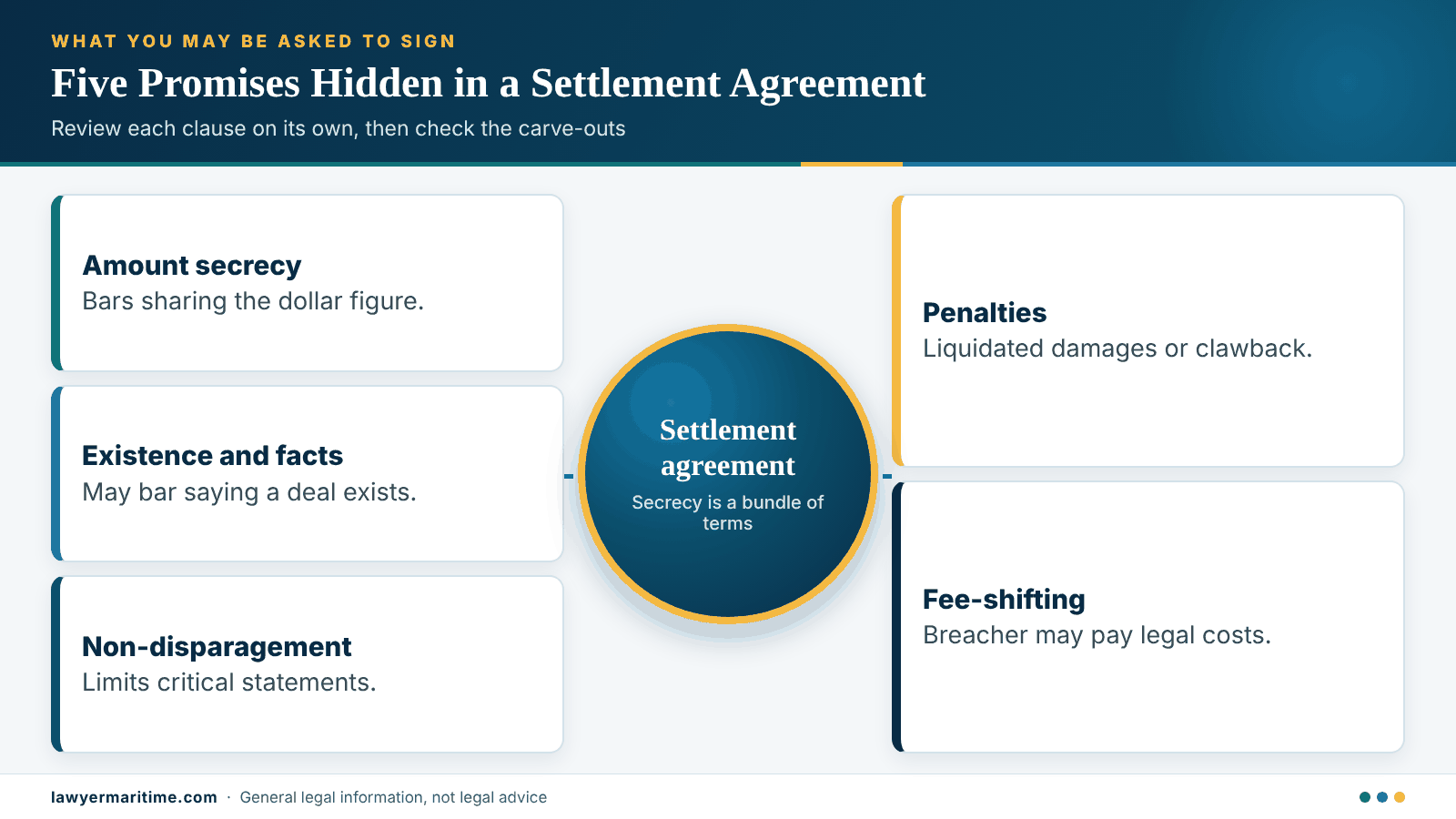
Drafters rarely use a single clause. A typical proposal bundles several promises, each with its own reach and its own penalty. Sorting them is the first job.
Confidentiality of the amount and the terms
The core clause bars you from disclosing the settlement amount, its other terms, or both. Many drafts go further and cover the negotiations, the existence of the settlement, or the facts behind the claim. Those are different things, and the difference matters.
A promise not to reveal the amount is easy to live with. A promise not to reveal that a settlement exists can be awkward, because you may need to explain why a lawsuit ended, why your employment ended, or why you now receive no maintenance payments. Ask for the narrowest version that meets the other side’s real concern.
Non-disparagement and “no comment” provisions
A non-disparagement clause prohibits negative statements about the employer, the vessel owner, the operator, or the insurer. It differs from confidentiality because it can reach statements that have nothing to do with the settlement, and some versions apply even to statements that are true.
Look at who is protected, how “disparage” is defined, and whether the clause is mutual. A one-way clause that protects a whole corporate family, its officers, and its insurers is much broader than one that protects the named employer. A “no comment” clause is milder, since it requires only that you decline to discuss the matter.
Liquidated damages, clawback, and fee-shifting terms
These terms put a price on breach. Liquidated damages are a sum the parties agree in advance that you will pay if you break the clause. A clawback requires you to return some or all of the settlement. A fee-shifting term makes you pay the other side’s legal costs to enforce the agreement.
Any of these can turn a careless comment into a large financial loss. We return to how they work in the enforcement section below, because the trigger language (any disclosure, or only a material one) often matters more than the dollar figure.
| Clause | What it usually restricts | Question to ask |
|---|---|---|
| Confidentiality of amount | Sharing the dollar figure | Can I tell my spouse, lawyer, and tax adviser? |
| Confidentiality of existence and facts | Saying a settlement happened or describing the incident | Can I say the matter was resolved? |
| Non-disparagement | Negative statements about the other side, sometimes including true ones | Is it mutual, and who counts as protected? |
| Liquidated damages or clawback | Sets a penalty or repayment if the clause is broken | What exactly triggers it, and is there a cure period? |
| Fee-shifting | Makes the breaching party pay enforcement costs | Does it apply to both sides? |
Why do employers and insurers ask for it?
Understanding the motive helps you propose a substitute. Most requests come from a handful of concerns, and several can be met with something less restrictive than a gag.
The business reasons behind the request
A vessel operator or insurer may worry that a published figure will invite other claims, set expectations among crew members hurt in similar circumstances, or affect how future cases are valued. Others want to avoid public criticism of a vessel, a fleet, or a terminal. Some simply use a standard form that includes the clause by default.
None of that is improper in itself. Companies settle to end a dispute, and finality includes some control over what happens next. The question is whether the clause goes beyond that purpose.
Why it is a negotiable term, not a legal requirement
No provision of the Jones Act seaman remedy or the LHWCA requires a private settlement. The only requirement is that the agreement be fair, informed, and, in the LHWCA setting, approved. That leaves the confidentiality clause to bargaining like any other term.
Courts have long looked closely at agreements signed by seamen. In Garrett v. Moore-McCormack Co., 317 U.S. 239 (1942), the Supreme Court placed the burden on the party relying on a seaman’s release to show it was made freely and with full understanding of the seaman’s rights. That case concerned a release, not a confidentiality clause, but the same caution reasonably applies to any one-sided term in the package.
Carve-Outs: Who You Can Still Tell
A carve-out is an exception written into a clause. It says, in effect, that the promise of secrecy doesn’t apply to certain people or situations. In practice, carve-outs decide whether a confidentiality clause is workable or a trap, because real life requires some disclosure.
Most reasonable agreements already include a few. Others leave them out, and a reviewing lawyer will usually ask for them. The list below describes the exceptions that normally matter, not any particular firm’s form.
Which people should the clause let you tell?
Start with the people who need information to help you or to keep you safe and solvent. If the draft doesn’t name them, ask for them by role, not by name.
Your attorney and your tax or financial advisers
You can’t get legal advice about a settlement without telling your lawyer the terms, so a clause that doesn’t allow it is unusual and worth questioning. The same is true of the accountant or tax preparer who must report the payment, and of any financial planner or structured-settlement professional who helps you manage it.
Ask for the carve-out to cover attorneys, accountants, tax preparers, and financial advisers by role, and to say that these advisers are expected to keep the information private. That protects you and satisfies the other side’s goal of limiting spread.
Doctors, family members, and benefits contacts
Your treating providers may need to know that a claim has resolved, particularly if maintenance and cure payments, or employer-arranged care, will stop. A narrow carve-out for providers lets you explain who is paying for future treatment without discussing the amount.
Spouses and household members raise another problem. A clause that omits them makes a normal conversation at the kitchen table a technical breach. Many agreements allow disclosure to immediate family on the condition that they agree to keep it private, and that is a reasonable thing to request.
Government benefit programs you receive may also ask about a settlement. The Medicare section below explains why that one can’t be waived by a private agreement.
What about government agencies and legal process?
The second group of carve-outs protects you from being caught between a private promise and a public duty. These exceptions are the ones people forget to ask for.
Reports to the Coast Guard, the NTSB, and other agencies
Federal law protects seamen who report safety problems and cooperate with official investigations. Under 46 U.S.C. § 2114, a person may not discharge or discriminate against a seaman for protected activities, including a good-faith report to the Coast Guard or another federal agency of a maritime safety violation, cooperating with a safety investigation by the Coast Guard or the National Transportation Safety Board (NTSB), and furnishing information about a marine casualty to those bodies or another public official.
A settlement resolves your private claims against the other side. It shouldn’t be read, or drafted, to stop you from truthfully answering an investigator. Ask for an express carve-out for communications with government agencies, and be wary of any clause that requires notice to the company before you respond to an official inquiry.
Subpoenas, court orders, and disclosures required by law
The standard carve-out for legal compulsion allows disclosure when a court order, subpoena, or law requires it. A fair version lets you comply without first getting permission, although it may ask you to give the other side notice when that is lawful and practical.
The phrase “required by law” should also cover things you must do routinely, such as report income on a tax return, answer a Medicare inquiry, or submit an LHWCA settlement for approval. Without it, an overly literal clause could put legal compliance and contract compliance at odds.
| Carve-out | Why it exists | What to check in the draft |
|---|---|---|
| Attorney and advisers | Legal and tax advice require the terms | Named by role, with a request that they keep it private |
| Spouse and immediate family | Ordinary household finances | Whether it requires them to sign or promise secrecy |
| Treating providers | Care continuity after benefits end | Limited to the fact of resolution, not the amount |
| Government agencies | Safety reports, investigations, and required filings | Express wording, with no prior-notice condition on agency contact |
| Legal process | Subpoenas, court orders, and statutes | No consent requirement, notice only where lawful |
| Medicare and tax reporting | Mandatory federal processes | Covers both you and the paying side |
Medicare, Government Reporting, and Taxes
Some of the information in a settlement reaches the government no matter what the agreement says. Two federal systems matter most: the Medicare Secondary Payer rules and the federal income tax. Neither is a reason to avoid settling, but both are reasons to make sure the confidentiality clause leaves room for them.
How does Medicare fit into a confidential settlement?
Medicare is the federal health insurance program for people 65 and older and for some younger people with disabilities. If you’re enrolled, or expect to be, it has legal interests in your injury settlement that a private promise can’t erase.
Medicare as secondary payer and conditional payments
Under 42 U.S.C. § 1395y(b)(2), Medicare generally may not pay for an item or service when payment has been made, or can reasonably be expected to be made, under a workers’ compensation law or plan or under liability insurance, including self-insurance. If Medicare pays anyway because the other payer hasn’t paid promptly, the payment is conditional and must be reimbursed. The statute also says a judgment, or a compromise, waiver, or release of claims, can demonstrate that the other payer was responsible.
The Centers for Medicare & Medicaid Services (CMS) says its recovery contractor does not issue a formal recovery demand until there is a settlement, judgment, award, or other payment. CMS also says it may recover from a beneficiary, provider, supplier, physician, attorney, state agency, or private insurer, according to its guidance for attorneys. The practical lesson is that nobody gets to treat the settlement as invisible to Medicare.
For LHWCA cases, the Department of Labor’s Office of Administrative Law Judges (OALJ) has posted a notice on the Medicare Secondary Payer Act and Section 8(i) settlements. It asks that submitted settlements show the parties considered Medicare’s interests in future medical expenses and in repayment of conditional payments.
Insurer reporting under Section 111
Section 111 of the Medicare, Medicaid, and SCHIP Extension Act of 2007 requires certain insurers to report claims involving Medicare beneficiaries. CMS’s reporting guide describes the “responsible reporting entity” as the insurer that provides liability coverage, including self-insurance, no-fault coverage, or workers’ compensation coverage. It reports after taking on ongoing responsibility for medical care or after paying the total payment obligation to the claimant, and it does so regardless of whether liability was admitted.
The duty belongs to the insurer, not to you. You are the person whose information is reported, which is why a confidentiality clause should expressly allow the paying side to make required reports and should allow you to give them the identifying information they need.
Do set-asides and future medical care change the picture?
When a settlement covers future medical care for someone on Medicare, the parties must think about who pays for that care. One tool used for that purpose is a set-aside, and it works differently depending on the kind of claim.
What a set-aside is and what CMS reviews
A Medicare set-aside is an amount from a settlement reserved to pay for future injury-related medical care that Medicare would otherwise cover. CMS publishes a reference guide for workers’ compensation set-aside arrangements. The July 2025 version, version 4.4, says no statute or regulation requires submitting a proposal to CMS for review. It lists review thresholds, including a Medicare beneficiary with a total settlement above $25,000, and a person who reasonably expects Medicare enrollment within 30 months with a total settlement above $250,000. It also says claimants must always protect Medicare’s interests, even below those thresholds.
The guide describes a process for workers’ compensation. LHWCA benefits are workers’ compensation benefits, which is why the OALJ notice above speaks to Section 8(i) settlements.
Jones Act and liability settlements: an open question to raise with counsel
A Jones Act claim or a passenger negligence claim is a liability claim, not a workers’ compensation claim. CMS’s workers’ compensation set-aside guide doesn’t address set-asides in liability settlements, so this article doesn’t say what, if anything, CMS reviews for them. That is a question for your attorney, who should know the current CMS position.
What does carry over is the principle that Medicare’s interests are not waived by silence. If you’re on Medicare or may be soon, the settlement documents should show how future treatment and past conditional payments are being handled. Confidentiality shouldn’t be a reason to skip that discussion.
Is settlement money taxable?
Often the answer is no for part of the payment and yes for others, and the allocation matters. This article describes the federal rule in general terms only. A tax professional must apply it to your facts.
The physical-injury rule in Section 104(a)(2) and its limits
26 U.S.C. § 104(a)(2) excludes from gross income damages, other than punitive damages, received on account of personal physical injuries or physical sickness, whether by suit or agreement, and whether as a lump sum or periodic payments. The statute adds that emotional distress is not treated as a physical injury or sickness, with an exception for amounts that don’t exceed what was paid for medical care. It also keeps an exclusion from applying to amounts previously deducted as medical expenses.
Separately, Section 104(a)(1) excludes amounts received under workers’ compensation acts as compensation for personal injuries or sickness. That is a separate rule from the damages exclusion, and a settlement that mixes categories may need to be analyzed in pieces. Punitive damages, such as those the Supreme Court allowed for willful failure to pay maintenance and cure in Atlantic Sounding Co. v. Townsend, 557 U.S. 404 (2009), are outside the Section 104(a)(2) exclusion.
Allocation language and why advisers must see the agreement
Because the rule distinguishes physical injury, emotional distress, punitive damages, and other categories, the way a settlement allocates its payments can matter. A single undifferentiated sum leaves the question open. Specific allocation language is something to discuss with a tax professional before signing, not after the check clears.
This is the concrete reason to preserve the tax-adviser carve-out. If your clause bars you from sharing the agreement, your accountant can’t give advice about it. The IRS also discusses court awards and damages in Publication 525, a general reference for taxpayers.
| Settlement type | Who reviews or approves | Medicare angle | Tax angle (general) |
|---|---|---|---|
| Jones Act or general maritime injury claim | Generally the parties, or a court if a case is pending and approval is required | Conditional payments and insurer reporting; ask counsel about future care | Section 104(a)(2) analysis by component |
| LHWCA Section 8(i) compromise | District director or administrative law judge under 33 U.S.C. § 908(i) | OALJ notice asks parties to show Medicare was considered | Workers’ compensation rule in Section 104(a)(1) may apply; confirm |
| Third-party vessel claim while receiving LHWCA benefits | Written employer and carrier approval in some cases under 33 U.S.C. § 933(g) | Both liability and compensation payments may be in play | Separate rules may apply to each payment |
| Passenger or recreational boater claim | Generally the parties, or a court if a case is pending | Liability insurer reporting and conditional payments | Section 104(a)(2) analysis by component |
LHWCA Approval, Court Filings, and Public Records
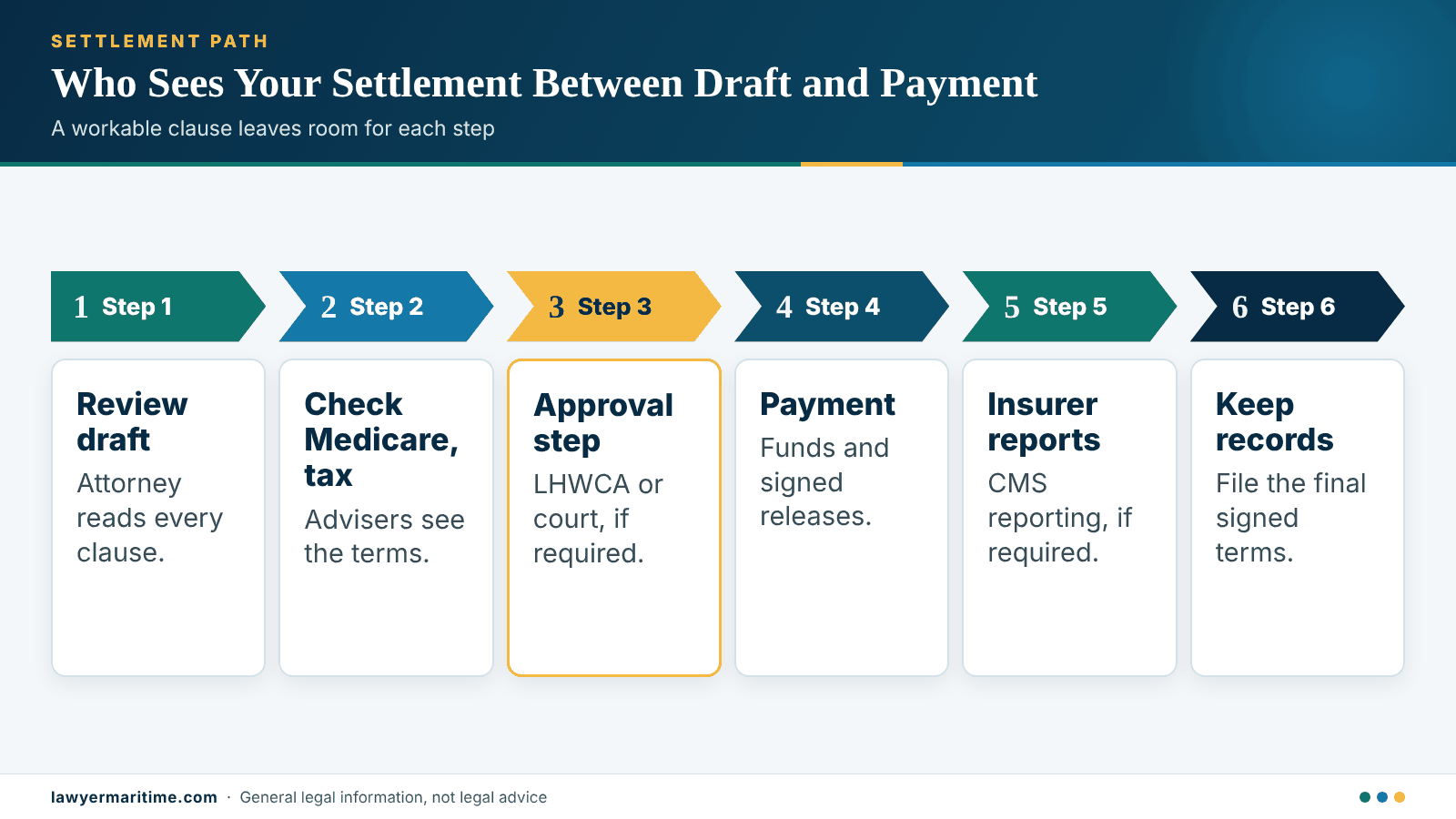
Not every settlement is purely private paperwork between two sides. Some pass through a government adjudicator, a court clerk, or both, and each step creates a record. Knowing which path your claim is on tells you how much privacy a confidentiality clause can actually deliver.
How does LHWCA settlement approval affect privacy?
The LHWCA, 33 U.S.C. §§ 901-950, is the federal workers’ compensation system for many longshore, harbor, shipyard, and related workers. Unlike most injury settlements, a compromise of LHWCA benefits generally has to be approved before it takes effect.
What the adjudicator reviews under Section 8(i)
Under 33 U.S.C. § 908(i), when the parties agree to settle a compensation claim, the deputy commissioner or administrative law judge must approve the settlement within thirty days unless it is found to be inadequate or procured by duress. If the parties have counsel, the agreement is deemed approved unless specifically disapproved within thirty days after submission. If a settlement is disapproved, the decision-maker must give written reasons, and a party may request a hearing before an administrative law judge.
The implementing regulation, 20 C.F.R. § 702.243, says the employer’s or carrier’s liability isn’t discharged until the settlement is specifically approved by a compensation order or, with counsel, deemed approved. It also lists what the adjudicator weighs when judging adequacy: the claimant’s age, education, and work history; the degree of disability or impairment; the availability of suitable work; and, where medical benefits are included, the cost and necessity of future treatment.
What the settlement application must disclose
The regulation at 20 C.F.R. § 702.242 requires the application to be a stipulation signed by all parties and to be self-sufficient, meaning it can be evaluated without the claim file. It must summarize the incident, the injury, the medical care to date, and the compensation paid, and it must itemize the settlement terms, including representative’s fees. It also calls for the reason for settling, the claimant’s work status and employability, a current medical report, and a statement explaining why the amount is adequate.
That is a lot of personal and financial detail, and none of it can be withheld from the adjudicator because of a private promise. A confidentiality clause in an LHWCA settlement can restrict what you say to others, but it can’t change what the application has to show.
One scope point is worth knowing. Under 20 C.F.R. § 702.241, settling disability or medical benefits doesn’t settle survivors’ claims or affect their right to file them. A family member can therefore have separate rights that the claimant’s agreement doesn’t touch.
Whether the approval order becomes public
The answer isn’t uniform, and the official sources reviewed for this article don’t resolve it. The OALJ’s administrative notices say decisions in LHWCA cases are transmitted to the OALJ website five business days after the judge issues them, and that after a 2009 court ruling the full name of the claimant appears in judges’ orders and decisions. The page doesn’t say whether orders approving settlements are posted, or whether a district director’s order is treated the same way.
The safe approach is not to assume privacy. Ask your attorney who will issue the order, what it will contain, whether it will be published, and whether the parties can limit what the settlement application reveals.
What happens when you settle with a third party while receiving LHWCA benefits?
Some injured longshore and harbor workers also have a claim against someone other than the employer, such as a vessel owner whose negligence contributed to the injury. Settling that claim can affect the compensation benefits, and the LHWCA has its own rules about it.
Written approval when the settlement is less than compensation owed
Under 33 U.S.C. § 933(g), if a person entitled to compensation settles with a third party for less than the compensation to which the person would be entitled, the employer and carrier are liable for compensation only if they approved the settlement in writing before it was executed. The approval must be filed with the deputy commissioner within thirty days after the settlement. If the approval is not obtained and filed, the statute provides that rights to compensation and medical benefits are terminated.
That is a severe consequence, and it is a reason to treat the sequence of steps as critical. A confidentiality clause in the third-party deal doesn’t excuse you from seeking that approval first.
Notice duties a confidentiality clause can’t override
The same section requires the employee to notify the employer of a settlement or judgment against a third party, and failing to do so can also end benefits. So the third-party agreement needs a carve-out that allows you to notify the employer, the carrier, and the Department of Labor, and allows your attorney to do the same on your behalf.
Without it, you could face an unhappy choice between a contractual promise to the third party and a statutory duty to the employer. Raise it before you sign, not after.
Do court filings make a settlement public?
When a lawsuit has been filed, the court’s records follow federal court rules, and the privacy a private contract can promise stops at the courthouse door. The details turn on how the case ends and what the parties ask the judge to do.
Dismissals, dockets, and when a judge reviews a deal
In federal court, Rule 41(a)(1)(A) lets the parties end a case without a court order by filing a stipulation of dismissal signed by everyone who has appeared. A short stipulation of that kind usually doesn’t attach the settlement agreement, so the amount may never reach the docket. The case number, the parties’ names, and the fact of dismissal still appear.
Different rules apply when a judge must approve a deal. That can include some settlements involving minors or people who lack capacity, and some wrongful-death settlements under state or court rules. The seaman’s special status in admiralty can also lead courts to look carefully at an agreement, as discussed above. Ask your lawyer whether the court in your case requires approval and what would be filed.
Sealing, protective orders, and the public-access presumption
Sealing is not something the parties can simply agree to. The Supreme Court wrote in Nixon v. Warner Communications, Inc., 435 U.S. 589 (1978), that courts recognize a general right to inspect and copy public records and documents, that the right isn’t absolute, and that access decisions rest in the sound discretion of the trial court on the facts of each case.
Federal Rule 26(c) lets a court enter a protective order for good cause, which can limit disclosure of discovery material, but it governs the discovery process and doesn’t by itself seal a settlement. Rule 5.2 separately requires redaction of certain identifiers in filings, such as all but the last four digits of a Social Security number and all but the year of a birth date. Standards for sealing vary by court and circuit, so ask your lawyer what the judge hearing your case requires.
| Path | Who reviews | Record created | How private it can realistically be |
|---|---|---|---|
| LHWCA Section 8(i) compromise | District director or administrative law judge | Application plus approval order | Limited: the application is detailed, and the order may be posted |
| Third-party settlement while on LHWCA benefits | Employer and carrier (written approval); the deputy commissioner receives the filing | Approval form and notices | Private as to the public, but not as to the employer and carrier |
| Settlement of a filed maritime lawsuit | Often no judge; sometimes a court if approval is required | Docket entries and a dismissal filing | Terms can often stay out of the docket; the case history can’t |
| Pre-suit private settlement | Generally the parties and their insurers | The agreement, plus insurer and Medicare reporting | Most flexible, but still subject to required reporting |
Breach, Liquidated Damages, and Employer Pressure
A confidentiality clause matters most when something goes wrong: a comment gets back to the company, a post is shared, or a coworker repeats a rumor. This section explains how enforcement tends to work, how ordinary situations become disputes, and what to do when the pressure to sign comes from the paying side.
What can happen if you break a confidentiality clause?
The consequences are set mostly by the agreement itself and by the contract law of whatever jurisdiction it chooses. Two features deserve a close read: the remedies the clause lists and the point at which they apply.
Contract remedies: damages, injunctions, and fees
If the other side believes you breached, it can generally bring a breach-of-contract claim. It may seek money damages, a court order to stop further disclosure, or repayment of part of the settlement if the agreement provides for a clawback. If the agreement includes a fee-shifting term, the loser may owe the winner’s legal costs.
Look for the governing-law and forum clauses. They decide which state’s or country’s law applies and where a dispute would be heard, which can make enforcement expensive for an individual far from that forum. A one-way fee clause deserves particular attention, since it can make a modest dispute costly for you and cheap for the other side.
Liquidated damages: when the penalty is written in advance
Liquidated damages clauses set a fixed amount for breach, which spares the other side from proving its losses. Courts generally ask whether the amount is a reasonable estimate of probable harm or a penalty, and the answer depends on the jurisdiction and the facts. You shouldn’t count on a court to reduce an unreasonable figure after the fact.
Before signing, ask four questions. What conduct triggers the payment, any disclosure or only a material one? Is the amount per breach or capped in total? Who decides whether a breach occurred? And does the clause give you written notice and a chance to correct a mistake?
How do everyday situations turn into breaches?
Most breaches are not dramatic. They happen in casual conversation, online, or when someone is simply trying to answer a fair question. The more precisely the clause defines what counts, the less risk those moments carry.
Social media, coworkers, and tight-knit crews
Maritime workplaces are small worlds. Crews rotate between a handful of operators, and word travels along docks, hiring halls, and group chats. A coworker who asks, “Did you settle?” puts you on the spot.
A well-drafted clause permits a short neutral answer, such as “the matter has been resolved.” If yours doesn’t, ask for that language. And remember that a post that never mentions money can still violate a non-disparagement clause if it criticizes the company.
Future employers, references, and later legal proceedings
You may need to explain to a prospective employer why you left a job or were off work. A clause that bars any discussion of the incident makes that difficult. Ask for permission to describe your work history, your medical restrictions, and the fact that the matter was resolved.
Also consider later proceedings. If you’re subpoenaed in another crew member’s case, or asked to testify in a regulatory matter, the legal-process carve-out discussed earlier is what allows you to comply without fear of breach.
| Situation | Risk under a broad clause | Safer request |
|---|---|---|
| A coworker asks whether you settled | Any answer may reveal the existence of the deal | A permitted statement that the matter has been resolved |
| You post about the incident online | Non-disparagement can apply even without mentioning money | Limit it to false or misleading statements, and make it mutual |
| A new employer asks why you left | The facts of the incident may be covered | A carve-out for describing work history and medical restrictions |
| A Coast Guard or NTSB investigator contacts you | A notice-first requirement could delay or chill your answer | An express carve-out for agency communications |
| Your accountant prepares your tax return | Usually fine if advisers are carved out | Named adviser roles and a duty on them to keep it private |
| You are subpoenaed in another case | Complying could breach if there is no legal-process exception | A required-by-law carve-out that doesn’t need consent |
What if the employer or insurer pressures you to sign?
Pressure is common and rarely labeled as such. It tends to arrive as a deadline, a limited offer, or a hint that benefits depend on cooperation. Your best protection is time and a lawyer who has read the whole draft.
Sign-by dates and the leverage of ongoing benefits
A “sign by Friday” deadline doesn’t change what the agreement says, and it doesn’t pause the law’s limits on your own claims. Many maritime personal-injury actions are subject to a general three-year period under 46 U.S.C. § 30106, which applies “except as otherwise provided by law,” so a negotiation that drags on can still run the clock. Our guide to the DOHSA claim deadline explains related timing issues for deaths on the high seas.
Be cautious if you’re told that medical care or ongoing payments depend on signing a secrecy promise. For seamen, the law has long scrutinized arrangements that disadvantage them, and the Supreme Court has recognized remedies for willful failure to pay maintenance and cure: attorney’s fees in Vaughan v. Atkinson, 369 U.S. 527 (1962) and punitive damages in Atlantic Sounding Co. v. Townsend, 557 U.S. 404 (2009). Whether your facts fit is a question for a lawyer.
Retaliation and who to call
If you believe you’re being treated worse because you reported an injury or a safety concern, tell your lawyer promptly. Section 2114 lists protected activity, including notifying the vessel owner of a work-related injury or illness, and it provides a complaint process through a cross-reference to 49 U.S.C. § 31105.
Keep a simple written record of what was said, by whom, and when. Retaliation questions are separate from the settlement, but the facts often overlap, and an agreement that releases claims could affect them. Get advice before you sign anything that mentions them.
Negotiating the Confidentiality Terms
Once you know what each clause does, the next step is deciding what to ask for. Most proposals are drafted for the paying side, so you shouldn’t be surprised when a first draft is broader than necessary. A reasonable counter-proposal is routine, and a good lawyer will usually make one.
No article can tell you which changes the other side will accept, and nothing here predicts an outcome. What follows are the levers that are commonly available and the reasoning behind them.
What can you realistically ask to change?
Start with the structure of the clause, then deal with consequences. A narrow clause with sensible exceptions is much safer than a broad one with a small penalty.
Mutuality, scope, and duration
Ask whether the promise runs both ways. If you are barred from discussing the matter, the company and its insurer can be asked to follow similar limits about public statements. A mutual clause also makes the other side think harder about how broad it should be.
Then narrow the subject. Confidentiality of the amount is far less intrusive than confidentiality of the underlying facts. Consider a fixed duration instead of a permanent gag, and a clear definition of “confidential information” that excludes anything already public or independently known to you.
In a death case, add one more question: who is bound? The estate’s representative, each statutory beneficiary, and each adult family member may be different people, and a clause that binds all of them without their signatures may not do what the drafter intends. Families should ask who has to agree to what, and what happens if one person later breaches.
Carve-outs, notice, and remedies
Next, add the carve-outs discussed above: advisers, immediate family, treating providers, government agencies, legal process, and Medicare, tax, and LHWCA obligations. Ask that an accidental or minor disclosure not trigger the penalty unless it is material, and that you receive written notice and a cure period.
On remedies, consider whether liquidated damages or a clawback is needed at all. If it stays, ask for a cap, a reasonable-fees clause that works both ways, and a requirement that the other side prove actual disclosure by you. Each change reduces the chance that a good-faith slip turns into a financial disaster.
Is confidentiality worth a price, and what are the alternatives?
People often ask whether secrecy has a dollar value. The honest answer is that it may in some negotiations and not in others, and an article can’t tell you how much. What you can do is raise the question deliberately instead of giving the term away.
How confidentiality can affect value
Some paying parties treat privacy as a meaningful term and may consider it when pricing an offer. Others treat it as a routine form clause that carries no bargaining weight. Ask your lawyer whether the offer would change if the clause were narrowed, mutual, or removed.
The opposite is also true. If you agree to broad restrictions, ask whether that was reflected in the number or simply added to the paperwork. Understanding how the terms fit together lets you judge the offer as a whole. For general background on how claim value is analyzed, see our overview of maritime injury compensation.
Alternatives that can meet the other side’s concerns
If the other side’s real worry is a public statement, you may be able to offer something narrower than silence. Options include an agreed short statement that both sides may use, a non-disparagement clause limited to false or misleading statements, confidentiality of the amount only, or a defined term of years. A limited clause that protects the company’s stated interest may be easier to accept than an open-ended one.
If a court filing is involved, remember that the parties can ask a judge to seal or restrict a document, but the decision belongs to the court. Plan your negotiation around what the other side can deliver, and don’t assume a judge will approve what you both want.

Checklist: What to Do Before You Sign
Reviewing a settlement shouldn’t feel like cramming for an exam. A short, orderly routine is enough: gather the documents, ask the right questions, and stay out of a few common traps. The steps below apply whether you are a crew member, a harbor worker, a passenger, or a family member.
How should you prepare for the review?
Preparation saves time with your lawyer and keeps the focus on the terms that matter most.
Documents to gather
Put the draft agreement and every earlier version in one folder, along with any cover letters or emails from the insurer or employer. Add your medical records and bills, your benefit and payment history, any Medicare or other insurance correspondence, and your pay records. If an LHWCA claim exists, include the claim file number and any orders you’ve received.
- The full draft agreement, every exhibit, and any earlier drafts
- Letters or emails explaining the offer and any deadline
- Medical records, bills, and Medicare or insurance notices
- Pay, benefit, and maintenance records
- Any LHWCA orders, notices, or claim numbers
Questions to bring to your attorney
Your lawyer can use the same questions to test the draft against your facts. The list is intentionally short.
- What exactly must stay private? Ask whether the clause covers the amount, the existence of the deal, the facts, or all three.
- Who may I tell? Confirm the carve-outs for advisers, family, providers, agencies, and legal process.
- What happens if I slip? Identify the trigger, the penalty, the cure period, and who decides.
- Does any government step apply? Ask about LHWCA approval, employer consent under Section 933(g), Medicare, and court filings.
- Have the tax questions been answered? Make sure an adviser has seen the allocation language.
- What is my deadline? Confirm the limits on my claim and the sign-by date, and ask for more time if needed.
What common mistakes should you avoid?
Most settlement regrets come from a small number of avoidable decisions. They tend to share one feature, which is acting before the facts are clear.
Signing before the Medicare and tax questions are answered
Once the agreement is signed and the money is paid, changing its structure is difficult. If Medicare has paid for any injury-related care, or may pay for future care, raise it before you sign. If the payment has different components, ask for a tax review of how they’re described.
Those steps are routine for experienced counsel, so they shouldn’t be treated as obstacles. A short delay for them is cheaper than a repayment demand or a tax surprise later.
Assuming the agreement, the order, or the docket will stay private
A confidentiality clause binds the people who signed it. It doesn’t bind a court clerk, a Department of Labor website, a Medicare contractor, or an insurer’s required reports. Assume that any government step leaves a record, and ask your lawyer exactly what that record will show.
- Signing a draft you haven’t read in full, including the exhibits
- Accepting a sign-by date without asking for time to review
- Telling coworkers or posting online before you know what the clause allows
- Settling with a third party while on LHWCA benefits without checking Section 933(g)
- Letting a confidentiality negotiation run past your own filing deadline
Frequently Asked Questions
These answers are general. They show how the issues usually work, and your agreement and facts may change the result.
Questions about the clause itself
Do I have to agree to confidentiality to settle a maritime injury claim?
Generally no. Confidentiality is a term that the paying side requests, and like most terms it can be negotiated, narrowed, or declined. Whether the other side will settle without it depends on the case, so ask your lawyer how firmly it is being insisted on.
Can I tell my spouse or family about the settlement?
Only if the clause allows it. Many agreements permit disclosure to immediate family on the condition that they keep it private, and if yours doesn’t, you can ask for that exception. Don’t assume that a conversation at home is outside the clause.
What does a non-disparagement clause stop me from saying?
It depends on the definition. Some clauses cover only false statements, while others cover any negative statement about a defined group of companies and people, whether true or not. Read who is protected, what counts as disparagement, and whether the clause runs both ways.
Can the clause stop me from talking to the Coast Guard or another agency?
Federal law protects a seaman’s good-faith reports and cooperation with safety investigations under 46 U.S.C. § 2114, but how a private clause interacts with that protection is a legal question. The safest course is to ask for an express carve-out for agency communications and to talk with a lawyer before you assume anything.
Questions about government, Medicare, and records
Will Medicare find out about my settlement?
If you’re a Medicare beneficiary, assume yes. Insurers that cover liability claims, including self-insured companies, have reporting duties, and Medicare has recovery rights for conditional payments. A confidentiality clause between you and the other side doesn’t alter those federal rules.
Is my settlement taxable?
It may be partly taxable and partly not. Federal law excludes damages for personal physical injuries or physical sickness, other than punitive damages, and treats emotional distress differently, so the components of the payment matter. Have a tax professional review the allocation before you sign.
Will an LHWCA settlement be public?
Not necessarily fully, but you shouldn’t assume it will be private. The settlement application must give the adjudicator a detailed account of the injury and the money, and the OALJ posts many judges’ decisions with claimants’ full names. Ask your attorney who will issue the approval and whether it will be posted.
Does filing a lawsuit make the settlement public?
It makes the case history public, but not always the terms. Parties can often end a case by a short dismissal filing without attaching the agreement, though a judge may need to approve some settlements, and sealing is for the court to decide. Compare the paths in our table above and ask your lawyer which one applies.
Questions about breach and negotiation
What if I accidentally break the clause?
Tell your lawyer right away and don’t make it worse by explaining it to others. The consequences depend on the wording, including the trigger, any cure period, and the remedies. A well-drafted clause distinguishes a minor slip from a deliberate disclosure.
Are liquidated damages clauses enforceable?
It depends on the governing law and the facts. Courts generally look at whether the amount is a reasonable estimate of harm or a penalty, but the standards differ by jurisdiction. Treat the figure as real until a lawyer tells you otherwise.
Can I get more money in exchange for staying quiet?
Sometimes parties treat privacy as a term with value, and sometimes they don’t. There is no formula, and no article can promise a result. Ask your lawyer whether the offer would change if the clause were narrowed or removed.
Who can help me review a confidentiality clause?
A maritime attorney who has read your actual draft is the right person, since the answers turn on the exact wording and your claim type. Our guides to the maritime accident attorney role and to the release you may be asked to sign may help you prepare questions.
Sources and Legal Authorities
The authorities below support the legal statements in this guide. Each should be checked against current text before you rely on it.
Statutes and regulations
Federal statutes
- 46 U.S.C. § 30104 – Jones Act personal injury and death of a seaman
- 46 U.S.C. § 30106 – Time limit on bringing maritime action for personal injury or death
- 46 U.S.C. § 2114 – Protection of seamen against discrimination
- 33 U.S.C. § 908 – LHWCA compensation, including subsection (i) settlements
- 33 U.S.C. § 933 – LHWCA compensation for injuries where third persons are liable
- 42 U.S.C. § 1395y – Medicare exclusions and secondary payer provisions
- 26 U.S.C. § 104 – Compensation for injuries or sickness
Regulations and rules
- 20 C.F.R. § 702.241 – LHWCA settlements, definitions and supplementary information
- 20 C.F.R. § 702.242 – LHWCA settlements, information needed for a complete application
- 20 C.F.R. § 702.243 – LHWCA settlements, approval criteria
- Fed. R. Civ. P. 41 – Dismissal of actions
- Fed. R. Civ. P. 26 – Discovery and protective orders
- Fed. R. Civ. P. 5.2 – Privacy protection for filings
Cases and agency materials
Supreme Court decisions
- Garrett v. Moore-McCormack Co., 317 U.S. 239 (1942) – burden on the party relying on a seaman’s release
- Nixon v. Warner Communications, Inc., 435 U.S. 589 (1978) – general right of access to public records and documents, within the trial court’s discretion
- Vaughan v. Atkinson, 369 U.S. 527 (1962) – attorney’s fees for willful failure to pay maintenance and cure
- Atlantic Sounding Co. v. Townsend, 557 U.S. 404 (2009) – punitive damages for willful failure to pay maintenance and cure
Agency and official materials
- U.S. Department of Labor, OALJ – Medicare Secondary Payer Act and Longshore Section 8(i) settlements
- U.S. Department of Labor, OALJ – Longshore administrative notices – website posting and claimant names
- Centers for Medicare & Medicaid Services – Attorney services and conditional payments
- CMS – Workers’ Compensation Medicare Set-Aside Arrangement Reference Guide, version 4.4
- CMS – Section 111 mandatory insurer reporting quick reference guide – an April 2018 revision; confirm current guidance
- Internal Revenue Service – Publication 525, Taxable and Nontaxable Income – general reference