A maritime accident lawyer settlement is not calculated from a chart or a multiplier. It is a negotiated judgment about how likely the claim is to succeed, how much a fact-finder might award if it does, and how much of that award the defendant can actually pay. This guide explains the factors that drive that judgment under U.S. maritime law: which legal regime governs, who was at fault, how serious and permanent the injury is, what the economic losses look like, what insurance stands behind the defendant, where the case is filed, and which offsets and liens reduce the net result. It is written for injured seamen, offshore and longshore workers, passengers, boaters, and families who want to understand how lawyers and insurers think before any number is discussed. The same injury can be worth very different amounts under different regimes and facts, so this page offers no averages, ranges, or promises, only the reasoning that sits behind them.
How Is the Value of a Maritime Accident Claim Set?
Readers often arrive hoping for a number. The honest answer is that no statute, schedule, or public database sets one for a maritime injury claim, and the reasoning behind a settlement is more useful than any average. This section explains what “value” means to the people on each side of the table and why it moves.
What does “case value” actually mean?
The phrase sounds like a fixed property of the claim, as though the injury carried a price tag. In practice it is a forecast, built from several uncertain judgments that each side makes and then tests against the other.
Value is a risk-adjusted forecast, not a price list
Three questions sit underneath almost every evaluation. First, how likely is it that the claim succeeds on liability, meaning that someone legally responsible is found at fault? Second, if it does succeed, what damages might a judge or jury award for this particular person? Third, can the responsible party pay, and what will it cost in time, expense, and delay to get there?
A strong liability case with modest damages and a weak liability case with enormous damages can end up in a similar place, because each factor discounts the other. Value rises and falls with liability strength, damages proof, and collectability together, weighed against cost and time. Nothing in the law turns that into arithmetic, which is why two careful evaluators can reach different conclusions from the same file.
Why a reliable average does not exist
Online “average settlement” figures mix claims that have almost nothing in common: a deckhand’s knee injury under the Jones Act, a longshore worker’s third-party claim, a passenger’s fall, and a family’s wrongful death claim. Each is governed by different rules and different damages, and the categories overlap in ways the headline number hides.
Many settlements are also confidential, so the public record is a skewed sample at best. We don’t publish figures on this site for that reason, and you should treat any promised range with caution. The practical takeaway is to ask what assumptions sit behind a number, not what number a stranger received. If confidentiality terms affect what you can say or learn, our guide to confidentiality clauses in maritime settlements covers that separately.
Who evaluates the claim, and how?
Maritime claims are usually valued twice, once by the side that pays and once by the side that receives. The two evaluations start from the same documents and often end far apart, and the gap between them is what negotiation is for.
How insurers and defense counsel look at it
On the defense side, a claims professional or defense lawyer typically reviews the incident report, witness statements, medical records, pay records, and any vessel or equipment documentation. They look for weaknesses in liability, alternative explanations for the injury, gaps in treatment, and evidence that the person could return to work. They also consider how a local judge or jury may react, since an unsympathetic defendant can raise exposure and a thin factual record can lower it.
The defense usually sets internal expectations for the claim based on that review and revises them as discovery, medical updates, or depositions change the picture. You won’t see those internal numbers, but you will often see their effect in the pace and tone of the offers.
How the injured person’s lawyer looks at it
The claimant’s side asks the same questions from the opposite direction and adds a few of its own. What treatment will this person realistically need in five or ten years? Can they return to the same work, and if not, what does the lost earning capacity look like over a career? What does the evidence show about who controlled the unsafe condition?
A good evaluation also looks honestly at the claimant’s weaknesses, such as a prior injury, a delay in reporting, or an inconsistent statement. A lawyer who ignores those risks can’t give you a realistic picture, and a realistic picture is what you need when an offer arrives. If you’re comparing counsel, our overview of what a maritime injury attorney evaluates explains the status and coverage questions that come first.
| Value driver | Question it answers | What typically moves it |
|---|---|---|
| Governing regime | Which damages and fault rules apply? | Seaman status, vessel facts, location, and who employed the worker |
| Liability and fault | Who was legally responsible, and was the injured person partly to blame? | Logs, procedures, witness accounts, inspection and maintenance records |
| Causation and medical proof | Did the event cause the injury and its consequences? | Treating-physician opinions, imaging, prior-condition records |
| Severity and permanency | How serious is the harm, and will it last? | Maximum medical improvement, impairment findings, work restrictions |
| Economic loss | What has the injury cost, and what will it cost? | Pay records, tax returns, vocational and economic evidence |
| Collectability | Who can actually pay? | Insurance coverage, policy limits, solvency, limitation-of-liability issues |
| Venue and posture | Where will the case be decided, and by whom? | Court choice, jury availability, discovery stage, trial setting |
| Offsets and liens | What reduces the net recovery? | Employer credits, compensation benefits, health-plan and Medicare claims |

Which Legal Regime Governs, and Why Does It Change Value?
Before anyone argues about fault or injuries, the law that applies sets the boundaries of the claim. Maritime law is a patchwork of statutes and judge-made doctrine, and the remedies depend heavily on who the injured person is. One note on terms: this article uses “Jones Act” to mean the seaman personal-injury remedy in 46 U.S.C. § 30104, not the separate cabotage rules that start at 46 U.S.C. § 55102.
How do remedies differ for seamen?
A seaman, meaning a worker whose duties and connection to a vessel in navigation meet the legal test, may have several overlapping sources of recovery against different parties. Status itself can be contested, and it isn’t something a job title settles. Our guide to the Jones Act covers the test in depth.
Jones Act negligence and the lighter causation standard
The Jones Act lets an injured seaman sue the employer in a civil action at law with a right to a jury trial, and it borrows the Federal Employers’ Liability Act (FELA) framework for railroad workers. Under that framework, the employer’s negligence need only play a part, even a small one, in producing the injury. The Supreme Court described that standard in CSX Transportation, Inc. v. McBride, 564 U.S. 685 (2011), as asking whether the employer’s negligence played any part in bringing about the injury.
That lower threshold often matters for value, because it makes liability easier to establish than in an ordinary negligence case. It doesn’t eliminate defenses. An injured seaman’s own negligence reduces damages in proportion to the seaman’s share of fault, and assumption of risk is not a defense.
Unseaworthiness and maintenance and cure as separate pieces
Unseaworthiness is a claim against the vessel owner or operator that the ship, its equipment, or its crew was not reasonably fit for its purpose. It doesn’t depend on proving negligence, but it does require proof that the unfit condition caused the harm, and an isolated negligent act generally doesn’t make a vessel unseaworthy. Punitive damages are not available on an unseaworthiness claim after Dutra Group v. Batterton, 588 U.S. 358 (2019). Our article on unseaworthiness damages explains what is recoverable.
Maintenance and cure is different again. It is the employer’s no-fault duty to pay a living allowance and medical care while the seaman recovers, and it generally continues until the seaman reaches maximum medical improvement. A willful failure to pay can expose the employer to additional damages, as discussed below and in our guide to maintenance and cure denials.
What about longshore workers, passengers, and families?
Workers who are not seamen, and people who were never employed on the vessel, face a different map. The routes are narrower in some respects and wider in others.
Longshore Act workers: compensation plus a third-party claim
Covered land-based maritime workers generally receive no-fault benefits under the Longshore and Harbor Workers’ Compensation Act (LHWCA), 33 U.S.C. §§ 901-950. The employer’s liability is generally exclusive, so the worker can’t sue the employer for negligence. The worker may, however, sue a negligent vessel as a third party under 33 U.S.C. § 905(b), and the statute bars a claim based on the vessel’s warranty of seaworthiness.
That structure has a direct effect on value. The third-party claim is a negligence claim that requires proof of a vessel’s fault, and the compensation the worker has already received interacts with any recovery, as the offsets section below explains. Annual benefit rates are published by the Department of Labor, and our page on LHWCA rates points to them.
Passengers, boaters, and wrongful death claims
A passenger or recreational boater generally sues under general maritime negligence, where the question is whether the defendant failed to use reasonable care under the circumstances. Our article on maritime negligence walks through duty, breach, and causation by type of defendant. Contract terms in a passage ticket can also matter, particularly on forum and notice, which is a topic for a separate review.
Wrongful death adds another layer. For a death on the high seas, the Death on the High Seas Act limits recovery to “fair compensation for the pecuniary loss sustained,” according to 46 U.S.C. § 30303, which is narrower than what some other death remedies allow. Which statute or doctrine applies depends on the location of the death and the decedent’s status, so deadlines and damages should be confirmed with counsel, and our page on the DOHSA claim deadline addresses timing.
| Regime | Who it generally covers | Fault standard | What tends to drive value |
|---|---|---|---|
| Jones Act (46 U.S.C. § 30104) | Seamen suing their employer | Employer negligence, with a relaxed causation test; comparative fault reduces damages | Strength of the negligence evidence, medical proof, earning capacity, jury availability |
| Unseaworthiness | Seamen suing the vessel owner or operator | Unfit vessel, crew, or gear; no negligence needed; causation required | Condition of equipment or procedures, causation, and the absence of punitive damages |
| Maintenance and cure | Seamen who fall ill or are hurt in service | No fault required | Medical status, maximum medical improvement, and any wrongful denial |
| LHWCA plus third-party claim | Covered longshore, harbor, and shipyard workers | Compensation is no-fault; the vessel claim requires negligence | Compensation already paid, the employer’s rights, and proof of vessel fault |
| General maritime negligence | Passengers, boaters, and others on navigable waters | Reasonable care under the circumstances; comparative fault | Duty and breach evidence, severity, insurance, and venue |
| DOHSA | Beneficiaries after certain deaths on the high seas | Statutory cause of action | Pecuniary-loss proof and the identity of the beneficiaries |
How Do Liability and Fault Shape the Number?
Liability is the first discount or multiplier on every claim. A serious injury with murky fault can settle for less than a modest injury caused by an obvious violation, because the person paying is pricing the chance of losing at trial. The questions here are who owed the duty, what the evidence shows, and how much blame lands on the injured person.
How strong is the proof that the other side was at fault?
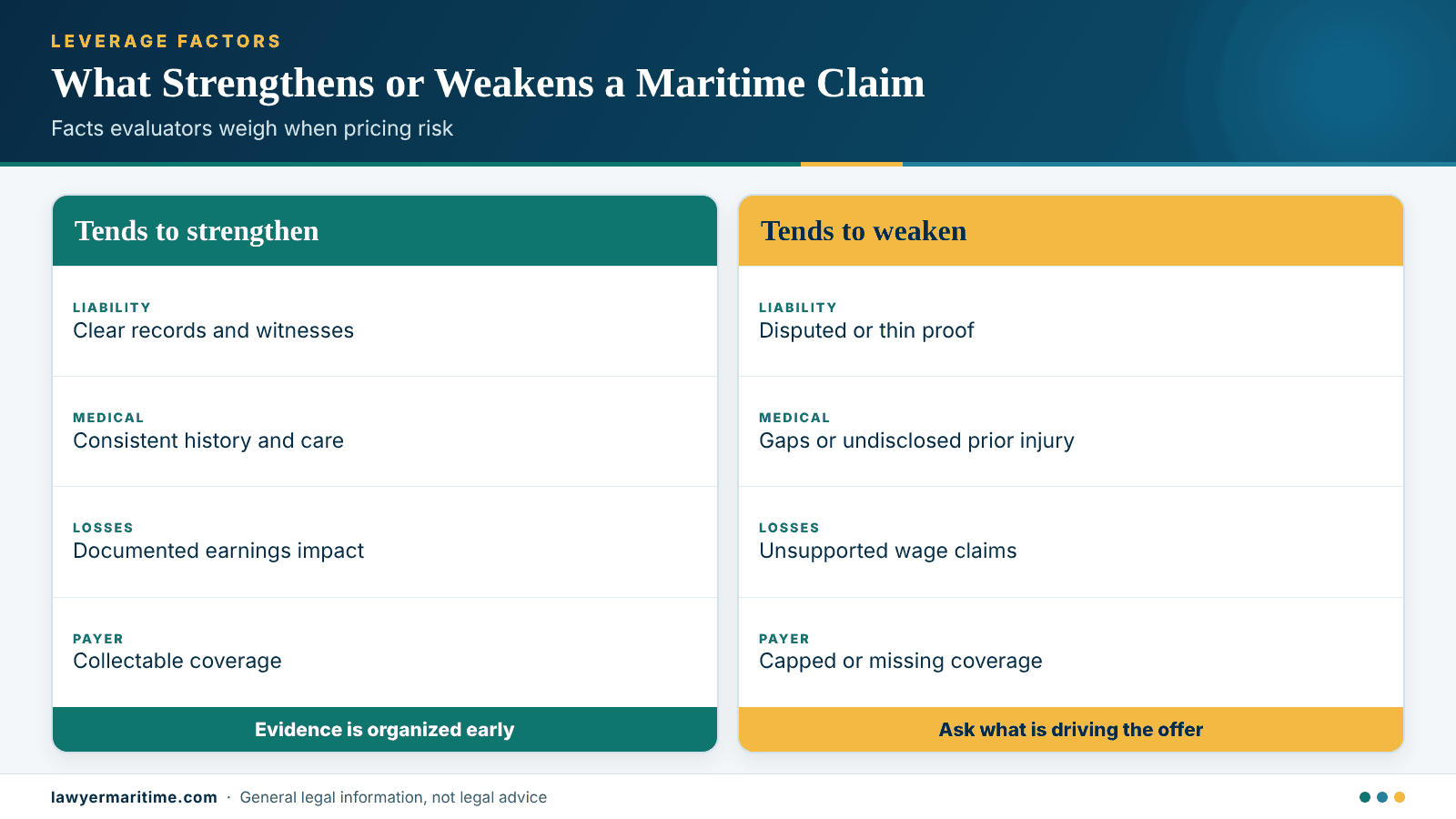
Strong liability evidence changes how both sides approach negotiations. It tends to produce earlier, more serious offers, and it limits the arguments available to the defense. Weak evidence invites a lower offer and a longer fight.
Duty, breach, and the documents that prove them
Fault usually turns on ordinary documents. Logbooks, job safety analyses, written procedures, maintenance and inspection histories, crew lists, training records, and text messages with supervisors can show what the employer or vessel knew and what it did about it. Photographs and video of the scene taken soon after the event often matter more than later recollections.
A regulation or safety rule that applies to the situation can help, too. Under The Pennsylvania, 86 U.S. (19 Wall.) 125 (1874), a violation of a statutory rule meant to prevent the kind of accident that occurred shifts the burden of showing the violation was not a cause to the violator. Our article on maritime negligence explains how duty varies by defendant, and our collision investigation guide covers navigation-rule evidence in vessel crashes.
Causation: linking the event to the harm
Proving that something went wrong isn’t the same as proving it caused the specific injury. The defense will look for another explanation, such as degenerative changes, an earlier injury, or an off-duty event. Treating physicians and sometimes retained experts have to connect the mechanism of the accident to the diagnosis.
Aggravation of an existing condition is a common issue. A worker with a prior back problem may still recover for a work event that made it worse, but the claim then depends on separating what existed before from what changed. Candid medical history helps here, since an undisclosed prior condition is a favorite defense argument. The causation standard also differs by regime, which is one reason the same medical evidence can carry different weight in a Jones Act case than in a passenger case.
How does shared fault reduce what is recoverable?
Few accidents have exactly one cause. The law accounts for that by dividing responsibility rather than awarding everything to one side or none.
Comparative fault and the reduction in damages
In a Jones Act case, FELA’s comparative-fault rule means the seaman’s own negligence does not bar recovery but reduces the damages in proportion to the seaman’s share of fault, as 45 U.S.C. § 53 describes. Assumption of risk is not a defense for seamen, a principle the Supreme Court discussed in Socony-Vacuum Oil Co. v. Smith, 305 U.S. 424 (1939). In general maritime cases, courts also apportion damages according to fault, an approach reflected in United States v. Reliable Transfer Co., 421 U.S. 397 (1975).
In negotiation, the practical question is how a fact-finder would divide blame. Defendants often point to a hurried shortcut, a missed safety step, or a decision to work through pain. Claimants respond with evidence about production pressure, staffing, training, and unsafe equipment. Both sides usually negotiate in the shadow of that likely division.
Multiple defendants and who else may share responsibility
A single accident can involve the employer, a vessel owner, a contractor, a terminal operator, or a manufacturer of faulty gear. Each has different duties, and a lawsuit against only one may leave recoverable losses uncovered or invite the defendant to blame a party who is absent. Longshore workers, for example, generally cannot sue the employer for negligence but may have a claim against a vessel or another third party.
For vessel owners, duties to longshore workers follow the framework from Scindia Steam Navigation Co. v. De Los Santos, 451 U.S. 156 (1981), which examines the turnover of the ship, active control, and the duty to intervene in certain circumstances. Identifying every party early affects both the evidence available and the insurance policies that may respond.
| Evidence | What it shows | How it tends to affect leverage |
|---|---|---|
| Incident report and logs | The employer’s or vessel’s contemporaneous account | Consistent accounts help; gaps or inconsistencies with later testimony can undercut either side |
| Photos, video, and scene condition | The hazard as it existed at the time | Strong on liability when taken early, since conditions are often changed or repaired |
| Maintenance and inspection records | Whether the defendant knew of, or should have found, a defect | Can support unseaworthiness or negligence theories and show notice |
| Witness statements and crew lists | What others saw and who was present | Independent witnesses add credibility; crew who still work for the defendant may be cautious |
| Training and safety-meeting records | What the worker was told and how the task was supposed to be done | Cuts both ways on comparative fault depending on what the records show |
| Electronic data and messages | Schedules, instructions, and pressure to work | Can reveal staffing or timing issues; may be lost if not preserved early |
How Do Injury Severity, Medical Proof, and Economic Loss Affect Value?
Damages are the other half of the equation. A clear liability case still produces a modest result if the injury heals fully, and a disputed liability case can carry real weight if the harm is lasting. This section covers what lawyers and insurers look at when they size up the harm itself.
Why does medical status drive timing and value?
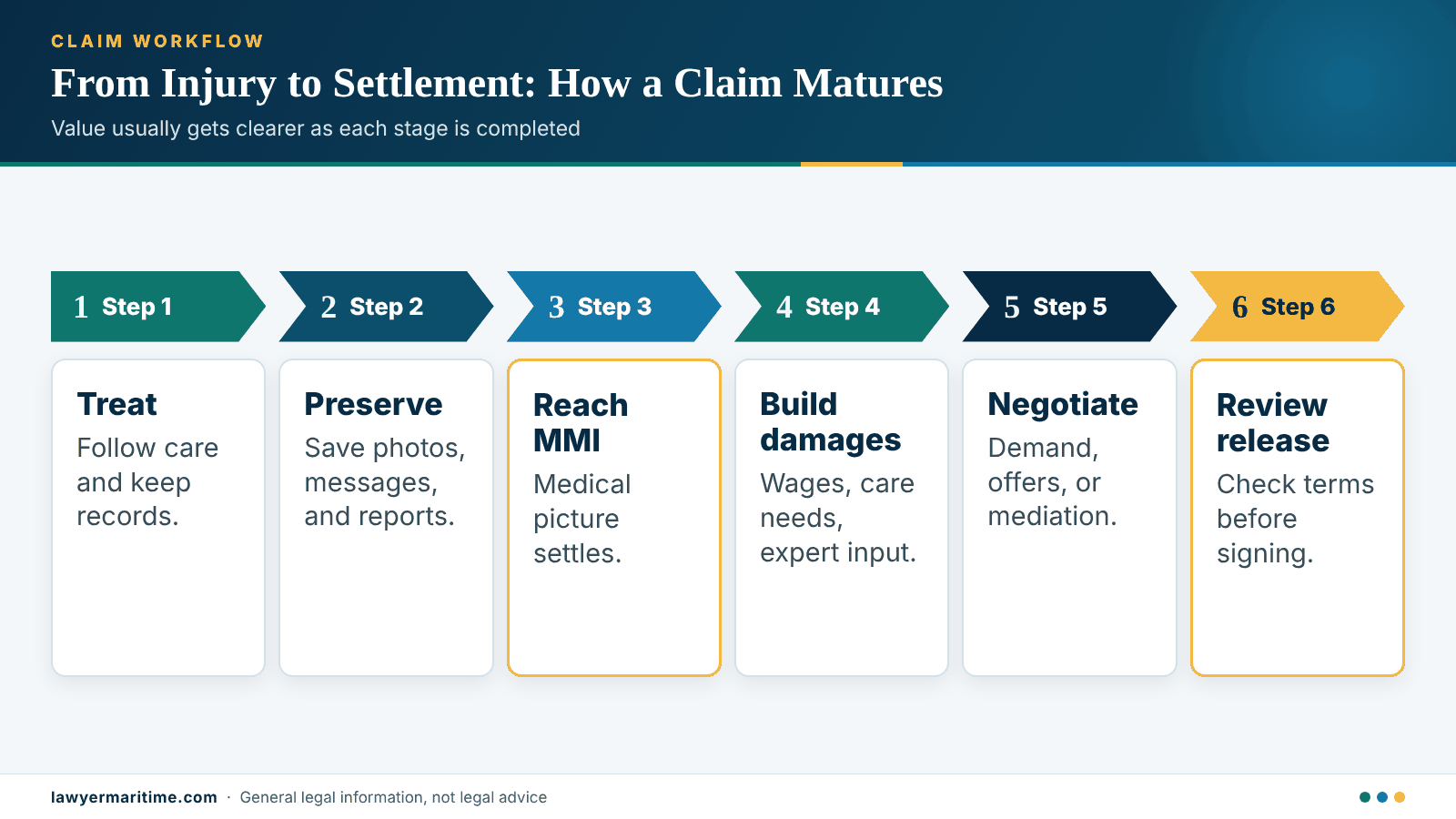
The medical record is the foundation for almost every damages argument. It also controls when a claim can be priced responsibly, which is a separate question from when someone would like it resolved.
Maximum medical improvement and the risk of settling early
Maximum medical improvement (MMI) is the point at which a treating physician concludes that an injury has plateaued and further treatment is not expected to improve it materially. It is a medical conclusion, not a legal one, and it is a milestone in several maritime contexts. Maintenance and cure, for example, generally runs until the seaman reaches MMI.
Before MMI, future care and lasting limitations are guesses, which makes any lump sum a bet. A settlement that closes a claim before the medical picture settles may leave later surgery, injections, or restrictions uncompensated. An early offer is not automatically a bad offer, but it deserves a hard look at what is still unknown. Our guide to maritime settlement releases explains what a signed release can waive.
Permanency, impairment, and future care
Once a condition has plateaued, the questions become what remains. Physicians may assign an impairment rating, describe permanent work restrictions, and outline future care such as therapy, medication, devices, or procedures. A life-care planner, who is a professional that projects long-term medical needs and their costs, may assemble those needs into a plan for the case.
Defense evaluators often challenge the necessity or frequency of projected treatment and may request an independent medical examination. A claimant with consistent treatment, clear physician opinions, and a documented link between the restrictions and the job duties tends to be in a stronger position than one with sporadic care. Missed appointments and unexplained gaps are routinely raised as signs that the problem is not as serious as claimed.
How are economic and non-economic losses measured?
Damages fall into measurable financial losses and harder-to-measure human ones. The evidence is different for each, and so is the extent to which the governing law allows them.
Lost wages, earning capacity, and benefits
Past wage loss is usually the easiest to prove, using pay stubs, tax returns, and employer records. Future earning capacity is harder, because it depends on whether the person can return to the same work, a lighter job, or nothing at all. Vocational experts and economists often translate restrictions and career history into a long-term loss, and a fact-finder generally adjusts future losses to their value today.
For seamen, unearned wages and the employer’s maintenance and cure obligations form their own, narrower categories, so the same period of lost income should not be counted twice. Our article on maritime injury damages covers each category and how it’s proved, and our comparison of maritime injury compensation by regime maps benefits by legal route.
Pain, suffering, and what the governing law allows
For many maritime injury claims, compensation can include pain, suffering, and loss of enjoyment of life. The right to them depends on the cause of action, though. In a Jones Act or general maritime negligence claim for a living plaintiff, such damages are generally part of the picture. In a death case, the available categories can be narrower, and DOHSA, as noted above, speaks of pecuniary loss.
Punitive damages are also limited. The Supreme Court allowed them for a willful failure to pay maintenance and cure in Atlantic Sounding Co. v. Townsend, 557 U.S. 404 (2009), but not for unseaworthiness after Batterton. Because non-economic losses are subjective, they usually depend on testimony from the injured person, family, coworkers, and treating providers about how daily life changed.
| Milestone | What is usually known | What remains uncertain | Effect on settlement readiness |
|---|---|---|---|
| Emergency care and diagnosis | The nature of the initial injury | Whether surgery or long treatment will follow | Too early to price; focus is on care and preserving evidence |
| Active treatment | Treatment plan, work restrictions, and progress | Final result and permanency | Negotiation is premature unless there are urgent reasons to resolve |
| Surgery recommended but not done | That a procedure has been proposed | Whether it will occur and how well it will work | Large swing in value; both sides argue over necessity and cost |
| Maximum medical improvement | Plateau, restrictions, and future care outline | Long-term earnings and care costs | Common point when a claim can be evaluated more fully |
| Post-MMI follow-up | How the person functions with restrictions | Whether symptoms change over time | Settlement possible with better information, and a release closes the claim |
What Can Actually Be Collected: Insurance and Limitation of Liability
A favorable judgment is only as useful as the ability to collect it. Defense evaluators weigh coverage and finances from the first day, and an informed claimant should too. Two separate issues matter here: who stands behind the defendant financially, and whether federal law lets a vessel owner cap what it owes.
Who stands behind the defendant?
Most claims are paid by insurers rather than by the named defendant, so the structure of the coverage shapes both the speed and the size of a deal. That is why lawyers ask early about policies, not only about fault.
P&I coverage, employer policies, and policy limits
Protection and indemnity (P&I) insurance is a form of marine liability coverage that commonly responds to claims by crew members and others hurt aboard a vessel. Employers may also carry other policies, such as workers’ compensation, marine employer’s liability, or excess coverage that sits above a primary layer. Which policy applies, and how much it provides, is a fact question that varies widely from one defendant to another.
A policy limit is a ceiling on what the insurer must pay under that policy. When a claim approaches or exceeds the available coverage, the negotiation can change character, with attention shifting to excess carriers, additional defendants, or the defendant’s own assets. Coverage disputes between an insurer and its insured can also slow a settlement even when liability is clear.
When the defendant is uninsured, underinsured, or insolvent
Some defendants carry little or no coverage, operate through thinly capitalized companies, or face financial trouble. A judgment against a company with no assets can be hard to collect, and a bankruptcy filing can freeze or reorder claims. In those cases a modest, collectible offer may look different from a larger judgment that exists only on paper.
Collectability is one reason lawyers look beyond the first obvious defendant. A vessel owner, a charterer, a contractor, or an equipment maker may each have separate coverage, and the right mix of defendants can change what is realistically available. Evaluating that is routine work in a thorough case review, and it is difficult to do from the outside.
How does limitation of liability affect a claim?
Federal law allows many vessel owners to ask a court to limit their liability for an incident to the value of the vessel and its pending freight. The rules are technical, and the 2022 amendments renumbered and revised parts of the statute, so current text matters.
What a limitation action is and when it applies
Under 46 U.S.C. § 30523, an owner’s liability for covered claims generally may not exceed the value of the vessel and pending freight, where the loss happened without the owner’s privity or knowledge. The statute does not apply this cap to wage claims. An owner starts the process by filing a civil action in federal court, generally within six months after receiving written notice of a claim, under 46 U.S.C. § 30529. Filing and securing the fund can stop other proceedings over the same matter, which is why a pending lawsuit sometimes freezes.
The chapter has important limits. It does not apply to covered small passenger vessels as defined in the statute, and a separate provision, 46 U.S.C. § 30524, addresses a minimum fund for personal injury and death claims on certain seagoing vessels, with some vessel types excluded. Whether any of this helps or hurts depends on the vessel type, the facts, and the court, so a claimant should not assume a cap applies, or does not.
How claimants still proceed: stipulations and the saving clause
A limitation action doesn’t always force a claimant out of the court they chose. Under the “saving to suitors” clause in 28 U.S.C. § 1333, a claimant may preserve other remedies, and in Lewis v. Lewis & Clark Marine, Inc., 531 U.S. 438 (2001), the Supreme Court said state courts may adjudicate claims against vessel owners so long as the owner’s right to seek limitation is protected. That protection often comes through stipulations, such as an agreement that the claim will not exceed the fund’s value.
Those stipulations can limit what a claimant may later seek, so they deserve careful review before anyone signs. When several claimants compete for a single limited fund, the process generally stays in federal court. For settlement value, the practical question is how large the fund is relative to the claims, and whether the owner can prove it lacked privity or knowledge. Our admiralty law hub explains how federal maritime courts and state courts share this territory.
How Do Venue, Timing, Offsets, and Liens Change the Net Result?
Two claims with the same gross value can leave the injured person with very different amounts. Where a case is heard and how far along it is affect leverage, and credits and reimbursement claims affect what is left once the case resolves. This section separates the two ideas.
Where and when the case is decided
Both sides price the forum and the calendar. Neither is a number on its own, but each can raise or lower the odds and the cost of getting a result.
Choice of court and jury availability
A seaman suing under the Jones Act has a statutory right to a civil action at law with a jury trial under 46 U.S.C. § 30104. A general maritime claim is different. Federal courts have original jurisdiction over admiralty cases under 28 U.S.C. § 1333, but a plaintiff who designates the claim as an admiralty claim under Rule 9(h) generally is not entitled to a jury on it, because Federal Rule of Civil Procedure 38(e) says the rules do not create a jury right for such claims.
The saving-to-suitors clause lets many claimants use state court with a jury instead, and other jurisdictional routes may carry their own jury rights. Judges and juries in different places can see the same facts differently, and experienced lawyers factor that in without needing to rank courts. For the basics of why admiralty cases can land in either system, see our guide to admiralty jurisdiction.
Procedural posture and the clock
Where the case stands matters. Before suit, both sides have less information and often more room to compromise. After discovery, expert reports, and depositions, each side knows more about the evidence, and the offers usually reflect it. A firm trial date or a ruling on a key motion can move the numbers more than any argument made in a letter.
Time limits also shape leverage. Maritime personal injury and wrongful death actions are generally governed by the three-year period in 46 U.S.C. § 30106, “except as otherwise provided by law,” and the Jones Act incorporates FELA, which carries its own limitations provision, so the date to calendar depends on the claim. Contract terms, notice requirements, and other statutes can shorten the window in some situations. See our guide on maritime injury deadlines and confirm your own dates with counsel.
What reduces the amount you actually keep?
Gross value is only the beginning of the arithmetic. Several third parties may have rights to part of a recovery, and some of those rights depend on steps taken before a settlement is signed.
Maintenance and cure, employer credits, and the Longshore Act
When an employer has already paid maintenance and cure, it may argue that those payments should be credited against a later award for the same period or losses, because the law doesn’t allow a double recovery. How that credit is handled in a given case depends on what was paid, for what, and under which claim. Ask about it explicitly rather than assuming it will be addressed.
The Longshore Act adds a rule that needs close attention. Under 33 U.S.C. § 933, a covered worker need not choose between compensation and a third-party suit, but the employer or its carrier generally has rights to recover what it paid from a third-party recovery. If the worker settles with a third party for less than the compensation otherwise due, subsection (g) requires written approval from the employer and carrier before the settlement is executed, filed within the statutory period. The statute states that failing to get approval, or failing to notify the employer, can end the worker’s rights to compensation and medical benefits. Settlements of the compensation claim itself are a separate matter, governed by 33 U.S.C. § 908(i), which calls for approval by the responsible Labor Department official or an administrative law judge.
Health insurers, Medicare, and what comes out of the gross figure
Health plans that paid for treatment may assert reimbursement rights under their own terms and the law that governs them, so the plan documents and the type of plan matter. Medicare has its own statutory rule. Under 42 U.S.C. § 1395y(b)(2), Medicare may make conditional payments when another payer, such as a liability insurer, has not paid, and those payments are conditioned on reimbursement. A liability settlement can trigger that repayment duty, and the government can pursue recovery from those who received the proceeds in certain cases.
Unpaid medical bills, case costs, and fees under your own fee agreement also come out of a recovery, depending on their terms. None of this means a settlement is a bad idea. It means the useful number is the net one, and a lawyer should be able to walk you through the expected deductions before you decide.
| Party | Basis for the claim | Where it commonly arises | What to ask |
|---|---|---|---|
| Employer paying maintenance and cure | Credit for amounts paid for the same period or losses | Seamen’s claims | Which payments are being credited, and against which damages? |
| Employer or carrier under the Longshore Act | Reimbursement and credit under 33 U.S.C. § 933; approval rules for third-party settlements | Covered longshore, harbor, and shipyard workers | Has written approval been obtained, and has the employer been notified? |
| Private health plan | Plan terms and applicable law | Anyone whose care was paid by a plan | What does the plan document say, and what has been paid? |
| Medicare | Medicare Secondary Payer rules, 42 U.S.C. § 1395y(b)(2) | Beneficiaries whose care Medicare paid conditionally | What conditional payments exist, and how will they be resolved? |
| Medical providers | Unpaid balances or provider liens, depending on the arrangement | Care received on credit or under a letter of protection | What is owed, and can balances be reduced or resolved? |
| Your own attorney | Fee and cost terms in your written agreement | Every represented claim | How are fees and costs computed, and when are they deducted? |
How Do Negotiation, Mediation, and Settlement Structure Work?
Most maritime injury claims that end without a verdict end through negotiation. The mechanics are less mysterious than they appear, and knowing them helps you judge whether an offer reflects the facts or just the opening position.
How does a negotiation usually unfold?
Settlement talks aren’t a single event. They are a series of exchanges in which each side tests the other’s evidence, and the offers tend to follow the information.
Demands, responses, and the information that moves offers
A claimant’s side commonly sends a demand package that explains liability, summarizes the medical history, documents wage loss, and projects future care. The defense responds with an offer, often lower than expected, along with questions or requests for more records. Offers tend to move when new information changes the risk: a favorable expert opinion, a witness who contradicts the employer’s account, or a surgery recommendation.
The reverse also happens. A surveillance video, a prior injury record, or an inconsistent statement can move an offer down. Staying consistent and candid across medical history, social media, and statements to the employer protects your position more than any negotiating tactic.
Mediation and settlement conferences
Mediation is a confidential, structured negotiation led by a neutral person who doesn’t decide the case but helps each side evaluate risk. Courts often encourage or require it, and many maritime cases resolve at or shortly after a mediation. The mediator typically meets with each side separately and carries proposals back and forth.
A mediated agreement usually isn’t binding until it is put in writing and signed, so what is said in the room is only the beginning. It helps to attend with the key records organized, a clear understanding of any liens, and a decision-maker on your side who understands the stakes. The defense side should bring someone with authority to settle, and it is reasonable to ask in advance whether that will happen.
What weakens leverage, and how is a deal structured?
Evaluators discount for weaknesses, so it helps to know what they look for. Once the amount is agreed, the structure and paperwork determine what the deal means in practice.
Credibility and the weak points that discount value
Credibility is a quiet driver of value. A fact-finder who believes the injured person is candid and consistent is likely to credit their account of symptoms and limitations. Defense lawyers look for contradictions between the claimed limitations and activity shown elsewhere, undisclosed prior injuries or claims, delays in reporting, and gaps in treatment.
Concealing a prior condition can also create a separate defense to maintenance and cure in some courts. In the Fifth Circuit, for example, McCorpen v. Central Gulf S.S. Corp., 396 F.2d 547 (5th Cir. 1968), recognizes a defense when a seaman willfully concealed a pre-existing condition that is causally linked to the later injury. Other courts may handle the issue differently. Being open about your medical history from the start is the best protection against this defense.
Why courts look closely at a seaman’s release
Seamen have long been described as “wards of admiralty,” a phrase the Supreme Court repeated in Garrett v. Moore-McCormack Co., 317 U.S. 239 (1942). In that case, the Court held that the party relying on a seaman’s release must show it was given voluntarily, without fraud or pressure, and with an understanding of the seaman’s rights. Whether the seaman had adequate advice and fair consideration is part of the inquiry.
This protection can shape value, because a release signed without advice, or for a payment that looks thin next to the injury, may face a challenge later. It isn’t a reason to assume a signed release can be undone, though, and challenging one is costly and uncertain. The safer course is to review the document before signing, not to count on reopening it afterward.
Lump sums, structured settlements, and tax questions
Most settlements are paid as a lump sum. A structured settlement pays part or all of the value over time, often through an annuity purchased by or for the defendant, and it can suit a person who needs steady income or protection from poor early decisions. The tradeoff is less flexibility, and the terms of any structure deserve independent review by a lawyer and a financial professional.
Taxes are a separate question. Under 26 U.S.C. § 104(a)(2), damages received on account of personal physical injuries or physical sickness are generally excluded from gross income, but punitive damages and certain other amounts are treated differently. Whether any piece of your settlement is taxable depends on how it is described and on your circumstances, so speak with a tax adviser. The paperwork that finalizes any deal, including what a release covers, is explained in our guide to maritime settlement releases.
| Common mistake | Why it hurts | Better approach |
|---|---|---|
| Settling before the medical picture is clear | Future care and permanent limits may be unpriced, and a release can close the claim | Ask what is still unknown, and whether waiting for further treatment or a physician’s opinion is practical |
| Comparing your offer with a stranger’s story | Facts, regimes, and insurance differ, so the comparison misleads | Ask what factors the offer reflects and what evidence supports them |
| Ignoring liens and credits | The net amount may be far lower than the headline figure | Identify employer credits, health-plan claims, and Medicare issues before you accept |
| Signing quickly under pressure | Courts have long scrutinized seamen’s releases because of the imbalance of knowledge and power | Read the whole document, ask questions, and get independent legal review first |
| Posting about the injury or claim online | Statements and photos can be used to challenge credibility | Keep communications consistent and limit public posts while a claim is open |
| Assuming collectability | A strong claim against an uninsured or capped defendant may yield less than expected | Ask early about coverage, policy limits, and any limitation-of-liability filing |
What Should You Do Before Discussing a Settlement?
Good preparation doesn’t guarantee a better result, but it reduces avoidable mistakes. The steps below are general, and your situation may call for different ones, so treat them as a starting point for a conversation with counsel rather than a script.
What should you gather and protect first?
Value is built from documents, and documents are easiest to collect early. Gathering them also shows you where the claim is strong and where it is thin.
Records and evidence to organize
- Medical records, imaging, and bills from every provider, including any care before the injury for the same body part
- Pay stubs, tax returns, and employer records that show earnings before and after the injury
- The incident report you filed or were given, plus photos, messages, schedules, and crew or witness names
- Records of maintenance and cure payments, benefits received, and any letters from the employer or an insurer
- A simple log of symptoms, missed work, and out-of-pocket expenses kept as events happen
If you are early in the process, our step-by-step guide to the Jones Act claim process walks through the first weeks in order.
Communications and care to handle carefully
Follow your treatment plan and keep your appointments, because gaps in care are a common reason for lower offers. Be cautious with recorded statements, social media posts, and forms that ask you to describe your injury or sign something you haven’t read. Anything you say or sign while a claim is open can be used later, including to question your credibility.
What should you ask before you accept an offer?
An offer is a number plus a set of terms. Both deserve questions, and it is reasonable to ask for time to get answers.
Questions for your lawyer
- What assumptions does this offer reflect? Ask which liability, medical, and earnings assumptions are driving the number and which you think are most open to challenge.
- Are we at maximum medical improvement? If not, ask what could change and whether waiting makes sense.
- What deductions come out? Ask for a written estimate of fees, costs, liens, and credits so the net figure is clear.
- Who else could be responsible? Confirm that other parties and insurance policies have been considered.
- What are the alternatives? Ask about mediation, filing suit, or a limitation-of-liability issue if one has been raised.
If you are still choosing counsel, our page on preparing for a maritime law consultation explains what to bring and ask, and our overview of the maritime lawyer role gives wider context.
Questions about the release and the terms
Read the release closely before agreeing. Ask exactly which claims it covers, whether it includes future maintenance and cure or unseaworthiness, how medical care will be handled, and whether anything is confidential. These are paperwork questions with real financial effect, and they are covered in detail in our guides to settlement releases and settlement confidentiality.
A calm, unhurried review is a sign of a careful process. If someone pushes you to sign the same day without time to read or consult anyone, that pressure is itself information worth taking seriously. For the wider legal landscape, see our maritime law overview.
Frequently Asked Questions About Maritime Settlements
These short answers pull together the points above. They’re general information, and individual facts can change them.
Value and expectations
What is the average maritime accident settlement?
There isn’t a reliable average. Claims differ by legal regime, injury, fault, insurance, and forum, and many settlements are confidential. Any single figure blends cases that share little, so it’s better to ask what factors would move your own claim up or down.
Does a maritime accident lawyer settlement depend mostly on the injury?
The injury matters a great deal, but it’s only one input. Liability strength, causation, the governing regime, collectability, and offsets all shape what a claim is worth in practice. A serious injury with weak proof or a defendant that can’t pay can resolve for less than expected.
Can I be sure a settlement offer is fair?
Nobody can be certain, but you can test it. Ask what assumptions the number rests on, whether you’ve reached maximum medical improvement, and what will be deducted. Independent legal review of the offer and the release is the most direct check.
Process and timing
When is the right time to settle a maritime injury claim?
It depends on the medical picture, the evidence, and your circumstances. Many claims are easier to evaluate once the treating physician says the condition has plateaued, but financial pressure and deadlines can complicate waiting. Counsel can help weigh those tradeoffs.
Does mediation mean my case is almost over?
Not necessarily. Mediation is a negotiation with a neutral, and some cases settle there while others don’t. Nothing is binding until a written agreement is signed.
What if the vessel owner files a limitation action?
A limitation action asks a federal court to cap the owner’s liability at the vessel’s value plus pending freight, under rules that have exceptions. Claimants can often respond with stipulations or other procedural steps, and the outcome depends on the facts. It’s a technical issue to review with counsel early.
Money, paperwork, and rights
Will I owe money out of my settlement to my insurer or Medicare?
Possibly. Health plans and Medicare may have reimbursement rights for treatment they paid, and Longshore Act employers or carriers may have rights against a third-party recovery. The terms differ by plan and case, so identify them before you agree to a settlement.
Are maritime settlements taxable?
Damages received on account of personal physical injury or physical sickness are generally excluded from income under federal tax law, with exceptions such as punitive damages. How a particular settlement is treated depends on its terms, so consult a tax adviser.
Can I undo a release after I sign it?
Seamen’s releases receive special scrutiny, and the party relying on the release has the burden of showing it was fairly obtained. Even so, challenging a signed release is uncertain and expensive. Review the document before you sign instead.
Sources and Legal Authorities
The authorities below support the rules described in this article, and the statutes are best read in their current official text.
Statutes and rules
Federal statutes
- 46 U.S.C. § 30104 – Jones Act personal injury and death of seamen
- 46 U.S.C. § 30106 – Limitations period for maritime personal injury and death actions
- 46 U.S.C. § 30303 – Death on the High Seas Act: amount and apportionment of recovery
- 46 U.S.C. § 30502 – Application of the limitation-of-liability chapter
- 46 U.S.C. § 30523 – Limitation of liability: general limit
- 46 U.S.C. § 30524 – Limitation of liability: minimum liability for personal injury and death
- 46 U.S.C. § 30529 – Action by owner for limitation
- 45 U.S.C. § 53 – Contributory negligence and damages under FELA
- 33 U.S.C. § 905 – Longshore Act: exclusiveness of liability and vessel negligence
- 33 U.S.C. § 908 – Longshore Act compensation, including settlements in subsection (i)
- 33 U.S.C. § 933 – Longshore Act compensation for injuries inflicted by third persons
- 42 U.S.C. § 1395y – Medicare exclusions and secondary payer rules
- 26 U.S.C. § 104 – Compensation for injuries or sickness
- 28 U.S.C. § 1333 – Admiralty, maritime, and prize cases
Regulations and rules
Cases and agency materials
Supreme Court and federal appellate decisions
- CSX Transportation, Inc. v. McBride, 564 U.S. 685 (2011) – causation standard under FELA
- Dutra Group v. Batterton, 588 U.S. 358 (2019) – no punitive damages for unseaworthiness
- Atlantic Sounding Co. v. Townsend, 557 U.S. 404 (2009) – punitive damages for willful failure to pay maintenance and cure
- Lewis v. Lewis & Clark Marine, Inc., 531 U.S. 438 (2001) – limitation of liability and the saving-to-suitors clause
- Garrett v. Moore-McCormack Co., 317 U.S. 239 (1942) – burden on the party relying on a seaman’s release
- Socony-Vacuum Oil Co. v. Smith, 305 U.S. 424 (1939) – assumption of risk and comparative negligence
- United States v. Reliable Transfer Co., 421 U.S. 397 (1975) – proportionate fault in maritime cases
- Scindia Steam Navigation Co. v. De Los Santos, 451 U.S. 156 (1981) – vessel duties to longshore workers
- The Pennsylvania, 86 U.S. (19 Wall.) 125 (1874) – statutory violation shifts the burden on causation
- McCorpen v. Central Gulf S.S. Corp., 396 F.2d 547 (5th Cir. 1968) – concealment defense to maintenance and cure in the Fifth Circuit