
Maritime negligence is the failure to use reasonable care on or around navigable waters, and an injured person wins on it only by proving four things: a duty of care, a breach of that duty, a causal link between the breach and the harm, and measurable damages. Those elements come from ordinary tort law, but U.S. maritime law changes how each one works depending on who you are and who you’re suing. A seaman suing an employer under the Jones Act benefits from a relaxed causation standard borrowed from the Federal Employers’ Liability Act. A longshore worker suing a vessel owner works within the three duties set out in Scindia. A passenger or guest aboard a vessel is owed reasonable care under the circumstances. The relationship between the parties sets the duty, so the label on the claim matters less than who owed what to whom. This guide is for injured mariners, harbor and shipyard workers, passengers, recreational boaters, and families who want to understand how duty, breach, causation, and damages are proved under federal admiralty law, and how shared fault changes the result.
What Is Maritime Negligence and When Does Maritime Law Apply?
Negligence means carelessness that falls below the standard a reasonable person or company would meet in the same situation. Maritime negligence is that same idea applied to accidents on navigable waters, under the body of federal law known as admiralty law. Before you can talk about duty and breach, you need to know whether maritime law governs your accident at all.
When does federal maritime law govern a negligence claim?
A court asks two questions before treating a tort as a maritime one. The answers decide which rules apply, which court may hear the case, and which defenses are on the table.
The location and connection tests
In Jerome B. Grubart, Inc. v. Great Lakes Dredge & Dock Co., the Supreme Court said a tort claim needs both a location and a connection to fall within admiralty jurisdiction. The location test is met when the tort occurred on navigable water, or when an injury on land was caused by a vessel on navigable water. The Admiralty Extension Act, now codified at 46 U.S.C. § 30101, supports that second path.
The connection test has two parts. The incident must have a potential to disrupt maritime commerce, and the activity behind it must bear a substantial relationship to traditional maritime activity. The Court looks at the general character of the incident and the activity, not the details of your particular injury. If you want the full jurisdictional analysis, our guides on admiralty jurisdiction and maritime jurisdiction cover it in depth.
Why the answer matters for your claim
If maritime law applies, federal substantive rules shape the claim even when the case is filed in state court. The saving-to-suitors clause in 28 U.S.C. § 1333 generally preserves a plaintiff’s ability to bring certain in personam claims in state court, but a state court still applies federal maritime law to the merits. Maritime law also brings its own doctrines, such as the Jones Act for seamen, the Longshore and Harbor Workers’ Compensation Act (LHWCA) for many harbor workers, and proportionate fault for many injured plaintiffs.
Recreational accidents can qualify too. In Foremost Insurance Co. v. Richardson, the Court held that a collision between two pleasure boats on navigable waters fell within admiralty jurisdiction. So a weekend boating accident can raise the same duty and breach questions as a commercial one, though the specific rules that apply may differ.
What are the four elements of a maritime negligence claim?
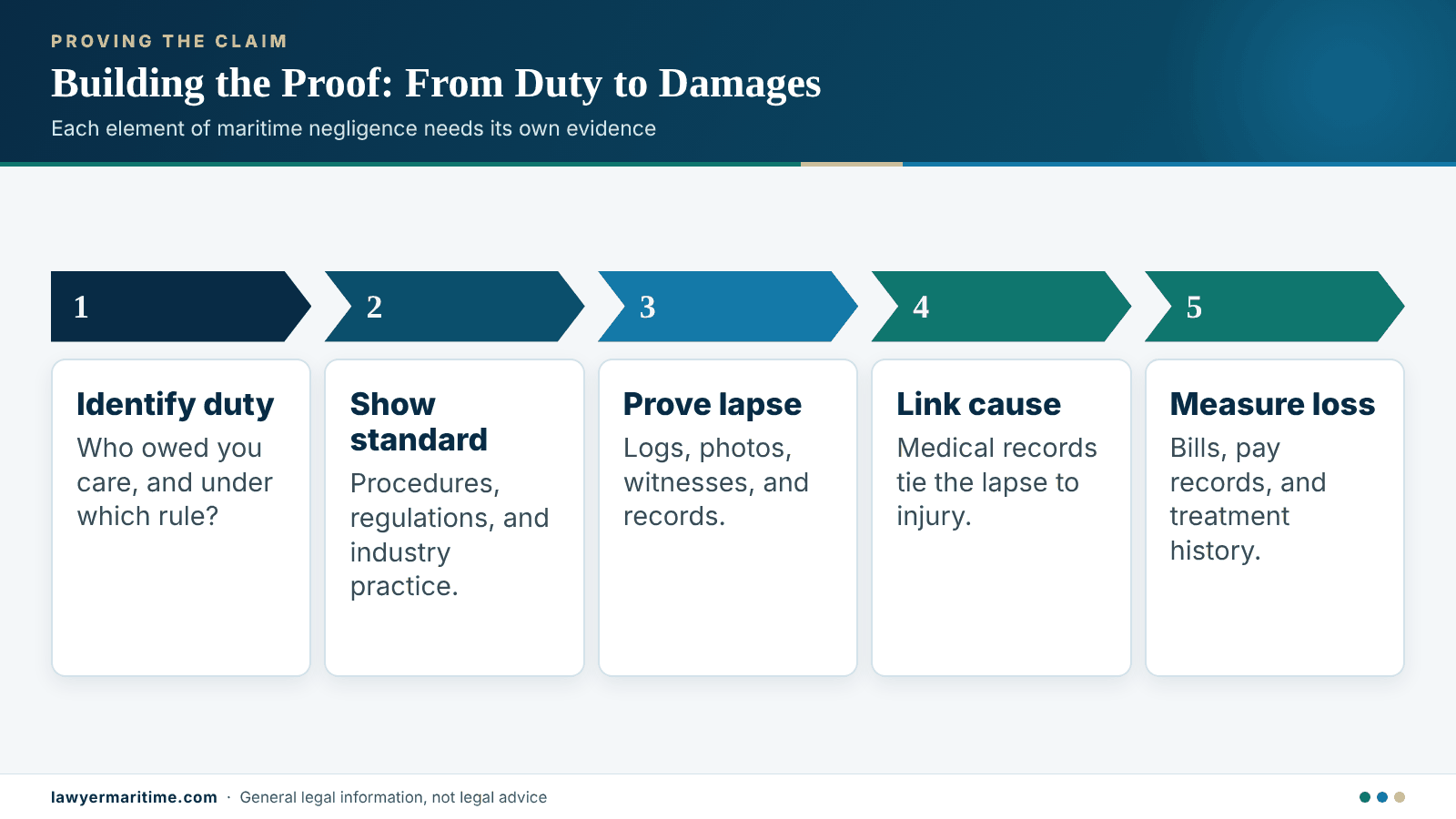
Federal courts generally describe maritime negligence with the same four elements as other negligence law. Each one is a separate hurdle, and a weakness in any of them can sink the claim.
Duty and breach
A duty is a legal obligation to act with a certain level of care toward a particular person. A breach occurs when the defendant’s conduct falls short of that obligation. Duty is a question of law, because it comes from the relationship between the parties and the rules that govern it. Breach is usually a question of fact, which means it turns on what was done, what was known, and what a careful operator would have done instead.
Here is the practical takeaway: you can’t prove breach until you know which duty you are measuring against. A deckhand’s employer, the owner of a vessel docked at a terminal, and the operator of a rented skiff each answer to a different yardstick.
Causation and damages
Causation asks whether the breach actually produced the harm. Damages are the measurable losses that followed, such as medical bills, lost income, and pain and suffering. A defendant can be careless without paying anything if that carelessness didn’t cause the injury, and an injury without proof of loss produces little to recover.
These two elements also carry the biggest differences between legal regimes. The causation burden for a seaman is lighter than for most other plaintiffs, and the available damages shift with the type of claim. We’ll take each element in turn, starting with the question that comes first.

Who Owes You a Duty of Care at Sea and in Port?
Duty is where maritime negligence diverges most from a typical car-crash case. There isn’t one maritime duty; there is a baseline rule and several specialized ones that attach to particular relationships. Getting the right duty is the first job in any claim.
What is the baseline duty under general maritime law?
The starting point is a single, flexible standard of care. Most of the specialized duties below are variations on it, or statutory replacements for it.
Reasonable care under the circumstances for those aboard
In Kermarec v. Compagnie Generale Transatlantique, decided in 1959, the Supreme Court held that a shipowner owes those lawfully aboard a duty of reasonable care under the circumstances of each case. Mr. Kermarec was a social visitor who fell on a defective stairway. The Court refused to import the land-based labels of invitee and licensee, which it described as rooted in property law concepts that don’t fit admiralty, and applied one standard to everyone aboard for purposes consistent with the owner’s interests.
The Court also noted that a plaintiff’s own negligence should reduce the recovery rather than bar it. That point comes back in the section on shared fault.
What “under the circumstances” means in practice
Reasonable care is not a fixed list of required precautions. A court weighs what the defendant knew or should have known about a hazard, how likely and how serious the harm was, how easy it would have been to fix or warn, and the setting. A rolling deck in heavy weather calls for different precautions than a dock in calm water.
The standard also scales with the vessel and the work. A towboat crew moving heavy rigging faces different foreseeable risks than a cruise ship’s guests on a wet stairway. Our discussion of maritime law generally shows why that flexibility is built into the doctrine.
What duty does an employer owe a seaman under the Jones Act?
A clarification first: in this article, “Jones Act” means the seaman personal-injury statute at 46 U.S.C. § 30104, not the cabotage rules about coastwise shipping in 46 U.S.C. § 55102 and following. The statute gives a seaman injured in the course of employment a negligence action against the employer and incorporates the federal law governing railroad worker injuries. For the whole claim, see our Jones Act guide.
The employer’s duty of reasonable care
Through the Federal Employers’ Liability Act (FELA), the employer is liable when its officers, agents, or employees were negligent in whole or in part, and also for defects in equipment that result from its negligence (45 U.S.C. § 51). Courts commonly describe the practical duties as providing a reasonably safe place to work, adequate equipment, a competent crew, proper training, and sensible supervision. The Fifth Circuit, sitting en banc in Gautreaux v. Scurlock Marine, Inc., held that the employer’s standard is ordinary prudence under the circumstances, the same as in other negligence cases.
The Supreme Court’s decision in Ferguson v. Moore-McCormack Lines shows how this works. A ship’s baker lost fingers chipping hard ice cream with a knife because no proper tool had been supplied. The Court held that a jury could find the employer negligent for not providing an adequate tool, and that the employer did not have to foresee the exact chain of events.
The seaman’s own duty and who can be sued
A seaman has a duty to act with ordinary prudence too. In the Fifth Circuit, Gautreaux rejected the old “slight care” standard and took the seaman’s experience, training, and education into account in measuring that prudence. Other circuits state the rule in their own words, so the exact formulation depends on where the case is heard.
The Jones Act claim runs against the employer, which is not always the vessel owner. A seaman may also have claims against other parties, such as the owner of a different vessel that caused a collision, under general maritime negligence. And whether you count as a seaman at all turns on legal tests, not on whether you work near water.
What duties does a vessel owe longshore and harbor workers?
Workers covered by the LHWCA receive no-fault benefits from their employers, and the Act generally makes that compensation their exclusive remedy against the employer. A covered worker injured by a vessel’s negligence may sue the vessel, but 33 U.S.C. § 905(b) limits the case to negligence and bars any claim based on the vessel’s warranty of seaworthiness.
The three Scindia duties
The Supreme Court mapped the vessel’s duties in Scindia Steam Navigation Co. v. De Los Santos and restated them in Howlett v. Birkdale Shipping Co.. The turnover duty concerns the condition of the ship and its equipment when the stevedore’s work begins. The active control duty requires reasonable care in areas and equipment the vessel still controls once work is underway. The duty to intervene can apply when the vessel knows its gear is malfunctioning and the stevedore’s decision to keep using it is obviously improvident.
Why these duties are narrower
The vessel may generally rely on the stevedore, the cargo-handling employer, to protect its own workers, and it has no general duty to supervise or inspect the stevedore’s operations. In Howlett, the Court described the duty to warn of latent hazards as narrow: it covers dangers a skilled stevedore wouldn’t see or anticipate, and only those the vessel knew or should have known about. Those limits explain why harbor-worker cases hinge on who knew what about a hazard, and when.
What duties apply to passengers and recreational boaters?
Passengers and boaters fall outside both the Jones Act and the LHWCA, so they usually rely on general maritime negligence. The baseline from Kermarec does most of the work, with a few wrinkles.
Cruise lines, ferries, and other carriers
Courts generally apply a reasonable-care standard to carriers of passengers, and in many courts a passenger must also show the carrier knew or should have known of the dangerous condition. A ticket can set conditions, but federal law limits them on covered voyages: 46 U.S.C. § 30527 voids contract terms that limit liability for negligence-caused injury or death, and 46 U.S.C. § 30526 sets minimum periods for claim notice and suit. The Supreme Court did enforce a forum-selection clause in a passage ticket in Carnival Cruise Lines, Inc. v. Shute, so the fine print can still affect where a case is heard.
Private boats, rentals, and guests
A recreational boat operator owes reasonable care to passengers, swimmers, and other boats. Owners who lend or rent a boat may face their own questions about maintenance, equipment, and instructions. The Navigation Rules, codified for inland waters at 33 CFR Part 83, inform what careful operation looks like, and our collision investigation guide covers them so this article doesn’t have to.
| Scenario | Who owes the duty | Governing standard | Question that often decides it |
|---|---|---|---|
| Deckhand hurt by unsecured rigging on a tug | Employer, under the Jones Act | Ordinary prudence under FELA principles | Was the hazard one a careful employer would have fixed or warned about? |
| Longshore worker injured by a defect in a cargo hold | Vessel owner, under 33 U.S.C. § 905(b) | Scindia turnover, active control, and intervene duties | Did the vessel know, or should it have known, of a hazard the stevedore couldn’t be expected to see? |
| Cruise passenger slips on a wet stairway | Carrier | Reasonable care under the circumstances | Did the carrier know of the condition, or should it have, and did it act? |
| Social guest falls aboard a private yacht | Vessel owner | Reasonable care under the circumstances (Kermarec) | Was the defect or practice one a careful owner would have corrected? |
| Rented boat strikes another boat | Operator, and possibly the owner or renter | General maritime negligence, informed by the Navigation Rules | Who was keeping a proper lookout and following the rules? |
| Crew member hurt when another company’s vessel collides with the crew member’s vessel | The other vessel’s owner or operator | General maritime negligence | Which vessel’s conduct departed from the rules of the road, and by how much? |
How Is a Breach of the Duty of Care Proved?
Once the duty is clear, the next question is what the defendant should have done and whether it did it. Breach isn’t proved by pointing to the injury alone. You show it with evidence of the standard and evidence of the lapse, and some rules can shift part of that burden onto the defendant.
What evidence shows the standard of care and the lapse?
The most persuasive proof usually comes from the defendant’s own paperwork and from the rules it was required to follow. That evidence can disappear quickly, which is why timing matters.
Logs, procedures, and company records
Vessel logs, maintenance and inspection records, job hazard analyses, written safety procedures, training files, crew lists, and incident reports can all show what the company knew and what it did about it. A procedure the crew didn’t follow, or a hazard flagged in an earlier report and left unfixed, is often the heart of a breach argument. Hours-of-work and rest records can also matter when exhaustion is part of the story, as we explain in our guide to maritime fatigue accidents.
Electronic data deserves a mention. Depending on the vessel, engine logs, alarm histories, and navigation or voyage data may exist, and they can be overwritten or lost on a routine schedule. A prompt written request to preserve them, sent through counsel, is a common first step.
Regulations, industry practice, and expert testimony
Federal and industry rules help define what reasonable care looks like. Coast Guard regulations govern many vessels, and OSHA’s maritime standards in 29 CFR Parts 1915, 1917, and 1918 cover shipyards, marine terminals, and longshoring. In Chao v. Mallard Bay Drilling, Inc., the Supreme Court held that OSHA may regulate working conditions on uninspected vessels where the Coast Guard has not exercised its own authority over those conditions.
Courts treat a regulatory violation as strong evidence of a lapse, but its exact legal effect depends on the rule, the claim, and the court. Marine surveyors, experienced mariners, and safety engineers often testify to explain what the standard required and how the defendant fell short. Reports from the Coast Guard or the NTSB may supply facts, though limits can apply to using them in a civil case, as we note in our guide to NTSB marine reports.
| Evidence | What it can show | Risk to watch |
|---|---|---|
| Vessel logs and incident reports | Conditions, orders, prior problems, and what the crew recorded at the time | Entries can be incomplete or revised, so get copies early |
| Safety procedures, job hazard analyses, and training files | The company’s own stated standard and whether it was followed | Procedures may be updated after an accident |
| Maintenance and inspection records | Whether a known defect was repaired and how quickly | Gear may be repaired or discarded before anyone examines it |
| Photos, video, and the physical equipment | The hazard as it existed, including lighting, spills, guards, and lashings | Conditions change within hours, so photograph before cleanup |
| Witness names and statements | Who saw what, and what they heard about earlier complaints | Crews rotate off the vessel and become hard to find |
| Regulations and industry standards | The benchmark of care for the equipment, task, or vessel | Not every rule applies to every vessel or task |
| Electronic data and communications | Alarms, alerts, schedules, and messages around the event | Automatic overwriting and routine deletion |
How do statutory violations affect proof of breach?
Two doctrines make a rule violation more powerful than ordinary evidence. One comes from collision law and the other from the Jones Act, and neither is automatic.
The Pennsylvania rule and its burden shift
In The Pennsylvania, the Supreme Court dealt with a fog collision in which one vessel had violated a statutory navigation rule. The Court held that when a vessel breaks a statute meant to prevent collisions, the law presumes the violation contributed to the accident. The violating vessel then carries the burden of showing that its fault could not have been a cause, which is a heavier burden than showing that its fault probably wasn’t.
That burden shift can change the course of a collision case. Courts have applied the rule in some settings beyond the original collision statutes, but its reach and the exact wording of the burden differ across circuits and regulations. Treat it as a doctrine to check against local authority, and see our maritime collision investigation guide for the navigation rules themselves.
Statutory violations under the Jones Act, and their limits
The Jones Act uses a related but different idea. In Kernan v. American Dredging Co., a fire killed a seaman after an open-flame lamp on a scow, hung lower than a Coast Guard lighting requirement allowed, ignited vapors on the river. The Court held the seaman’s dependents could recover under the Jones Act, through FELA, without proof of ordinary negligence, because the violation contributed to the death. It rejected the argument that the rule was meant only to prevent collisions and so didn’t cover a fire.
The reach of that principle depends on whether the violated provision is the kind of statute or regulation that FELA principles treat this way. Not every internal company rule or industry guideline qualifies, and the plaintiff still has to connect the violation to the injury. Counsel will usually decide early whether a violation theory is available or whether the case rests on ordinary negligence.
What Does Causation Require in a Maritime Negligence Claim?
Proving that someone was careless is not enough. The carelessness has to have produced the injury, and the legal test for that link is not the same across maritime claims. This is the element where a seaman’s case most clearly differs from everyone else’s.
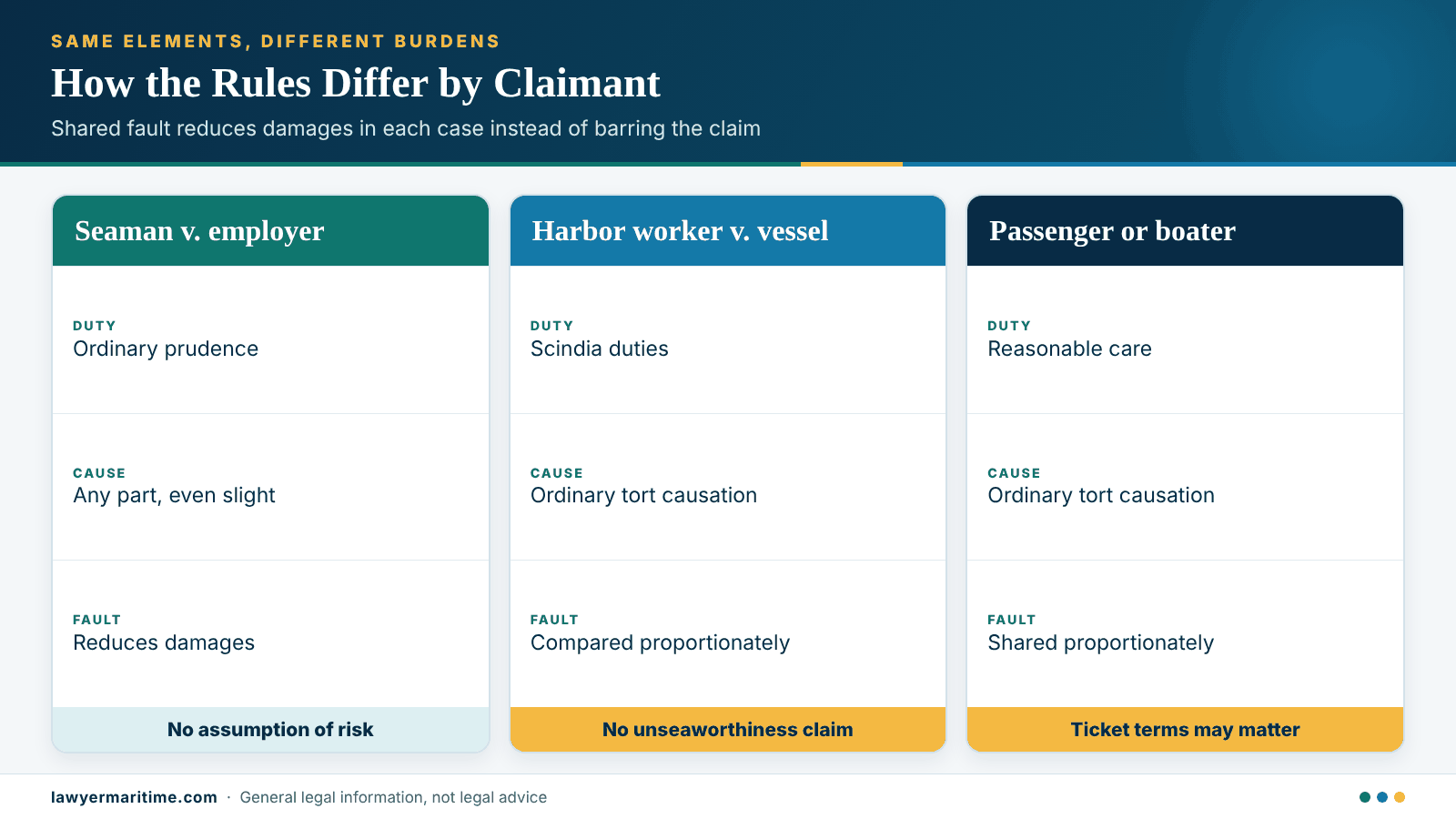
Which causation standard applies to which claim?
Think of causation as a dial rather than a switch. For most plaintiffs it is set at ordinary tort causation, and for seamen it is turned down by statute.
Ordinary causation in general maritime negligence
In general maritime negligence, such as a passenger’s claim or a harbor worker’s suit against a vessel, courts draw on ordinary tort principles. The plaintiff must show the breach was a legal cause of the harm, which usually means the harm was a foreseeable result of the carelessness and not too remote from it. The Supreme Court tied the vessel’s duties to general tort principles in Howlett, and in Grubart it read the Admiralty Extension Act’s “caused by a vessel” language as requiring proximate cause.
In practice, that means asking whether the injury is the kind of harm that the missing precaution was meant to prevent. A passenger who slips on an unmarked wet stairway shows a plain link. A passenger who trips on his own luggage a deck away would have a harder time pointing to the stairway.
The relaxed Jones Act causation standard
The Jones Act borrows FELA, and FELA makes the employer liable for injuries resulting “in whole or in part” from its negligence. In CSX Transportation, Inc. v. McBride, a FELA case decided in 2011, the Supreme Court held that the test is whether the employer’s negligence played any part, even the slightest, in producing the injury. The Court said FELA does not import the common-law proximate cause formulations, and the same idea appears in Ferguson, a Jones Act case, decided decades earlier.
The relaxed test does not erase causation. The seaman still has to connect the employer’s negligence to the injury, and foreseeability still matters to whether the employer was negligent at all. What the standard removes is the argument that the negligence, while real, was too remote to count as the legal cause.
What complicates causation in real cases?
Maritime accidents rarely have a single cause. Weather, equipment, crew decisions, and the injured person’s own health all feed in, and each one affects who pays and how much.
Multiple causes and multiple defendants
More than one party’s negligence can contribute to the same injury. A seaman hurt in a collision may have a Jones Act claim against the employer and a general maritime negligence claim against the other vessel, and a harbor worker may have a claim against a vessel and another against a contractor. Fault is then divided among the responsible parties, as the next section explains.
The presence of other causes doesn’t excuse a negligent defendant. A defendant whose negligence was one cause among several is generally still responsible for its share, and under the Jones Act’s relaxed standard even a minor contribution can support liability.
Pre-existing conditions and aggravated injuries
Many mariners and harbor workers carry older injuries, such as a bad back or worn knees. A defendant that makes a prior condition worse can still be responsible for the added harm, and the question becomes how much of the present disability the accident caused. Medical evidence that separates the earlier baseline from the new damage is usually essential, and it is one reason complete treatment records matter.
Separate rules apply to maintenance and cure, which can be affected by a seaman’s concealment of a prior condition at hiring. That is a different question from negligence causation, and it is covered in our guide to denied maintenance and cure.
| Claim | Causation standard | Main authority | Practical effect |
|---|---|---|---|
| Seaman v. employer (Jones Act) | Employer negligence played any part, even the slightest | 46 U.S.C. § 30104; 45 U.S.C. § 51; CSX v. McBride; Ferguson | A lighter burden than most plaintiffs face; remote-cause arguments are weaker |
| Harbor worker v. vessel (LHWCA § 905(b)) | Ordinary tort causation tied to a Scindia duty | 33 U.S.C. § 905(b); Scindia; Howlett | The injury must flow from a breach of a specific vessel duty |
| Passenger or guest v. carrier or owner | Ordinary tort causation under general maritime law | Kermarec | The plaintiff links the unsafe condition or conduct to the harm |
| Boater v. another operator | Ordinary causation, with a possible burden shift for rule violations | The Pennsylvania | A proven rule violation can force the violator to disprove causation |
How Does Shared Fault Change a Maritime Negligence Claim?
Defendants rarely accept all the blame. They argue the injured person carried some of it, and maritime law has a more forgiving answer to that argument than many state rules. It reduces damages in proportion to fault instead of ending the claim, and it takes away one defense completely for seamen.
How does comparative fault work for seamen?
Seamen get two layers of protection against fault arguments. One reduces how far the employer can shift blame, and the other removes a classic defense.
Damages are reduced, not barred
FELA’s contributory negligence section, applied through the Jones Act, says the employee’s own negligence doesn’t defeat recovery. Instead, the damages are diminished in proportion to the employee’s share of the fault (45 U.S.C. § 53). A seaman found 25 percent at fault would, in a simple hypothetical, see the award cut by that share.
The same section contains an exception. When the employer violated a federal safety statute meant to protect employees and the violation contributed to the injury, the employee’s negligence isn’t held against them. That exception is one reason a rule violation can be valuable to a seaman’s case.
No assumption of risk for seamen
Assumption of risk is the argument that the worker knew the danger and accepted it. In Socony-Vacuum Oil Co. v. Smith, a seaman used a defective step in an engine room even though a safer route was available. The Supreme Court held that assumption of risk didn’t bar recovery and that his carelessness only reduced his damages, reasoning that seamen are wards of the admiralty who work under discipline and have limited ability to weigh safety choices.
FELA says it directly: when the employer’s negligence contributed to the injury, the employee is not held to have assumed the risks of the job (45 U.S.C. § 54). A seaman who works despite a known hazard because the boss ordered it hasn’t lost the claim by doing so. The Fifth Circuit’s Gautreaux decision confirms the comparative-fault question is judged by ordinary prudence under the circumstances, including the seaman’s experience.
How does shared fault work for other plaintiffs?
Passengers, harbor workers, and boaters aren’t covered by FELA, so their fault rules come from general maritime law. The result is similar in spirit but built on different authority.
Proportionate fault under general maritime law
In United States v. Reliable Transfer Co., the Supreme Court replaced the old divided-damages rule, which split property damage equally in a mutual-fault collision. It adopted proportionate allocation instead, so each party bears the share its fault deserves, with an equal division only when fault is equal or can’t fairly be measured. That case involved property damage in a collision, but proportionate fault is now the general approach across maritime negligence.
The Court had already signaled the same approach for injured people in Kermarec, noting that a plaintiff’s own negligence should mitigate damages and not bar recovery. A court or jury therefore assigns percentages, and the damages are reduced by the plaintiff’s share.
What fault arguments look like for passengers, harbor workers, and boaters
Defendants typically argue the plaintiff ignored a visible warning, disregarded an instruction, or took an unnecessary risk. A harbor worker’s own carelessness is generally weighed in the same proportionate way, though the vessel’s Scindia duties set the baseline for what the vessel had to do first. Boaters face fault arguments about speed, lookout, alcohol, and equipment such as life jackets, with the Navigation Rules supplying the benchmark.
What counts as fault varies with the facts. A plaintiff who followed a crew member’s instruction stands in a different position than one who ignored a posted barrier. For timing on those boating claims, our boating injury claim deadline guide covers the clock.
Can a vessel owner cap its liability?
One defense isn’t about fault at all. Federal law lets some vessel owners ask a court to limit the total they owe, and it can reshape a negligence claim even when liability is clear.
What the Limitation of Liability Act does
Under 46 U.S.C. § 30523, an owner’s liability for covered claims is generally limited to the value of the vessel and pending freight when the loss occurs without the owner’s privity or knowledge. The cap doesn’t apply to wage claims. A separate section, 46 U.S.C. § 30524, addresses limits for personal injury and death, and the sections were renumbered in 2022, so older cases and articles cite different numbers.
Because the statute turns on what the owner knew, it is contested. Claimants challenge whether the owner had the required privity or knowledge, and the value of the vessel can be a disputed question as well.
How a limitation action can affect where and how your claim is heard
An owner who invokes the statute typically files in federal court, which can pause other suits and gather every claim against the owner into one proceeding. In Lewis v. Lewis & Clark Marine, Inc., the Supreme Court addressed how that process interacts with a claimant’s saving-to-suitors rights to pursue other remedies. If an owner files, you will want counsel quickly, because the filing carries its own deadlines and procedures.
None of this means a cap will apply to your case. The statute does not reach every defendant, and its availability depends on facts that are not known at the start. Treat a limitation filing as a procedural event to respond to, not as proof that your recovery is capped.
| Claimant | Effect of the claimant’s own negligence | Assumption of risk | Main authority |
|---|---|---|---|
| Seaman suing under the Jones Act | Damages reduced in proportion to fault; not a bar | Not a defense when employer negligence contributed | 45 U.S.C. §§ 53, 54; Socony-Vacuum; Gautreaux (Fifth Circuit) |
| Harbor worker suing a vessel | Generally compared under proportionate-fault principles | Depends on the facts and the court | 33 U.S.C. § 905(b); general maritime law |
| Passenger or guest | Mitigates damages; not a bar | Depends on the facts and the court | Kermarec |
| Boater in a collision | Fault allocated among the parties | Depends on the facts and the court | Reliable Transfer |
What Damages Can Maritime Negligence Support?
Damages are the fourth element, and they’re also where expectations tend to run ahead of the law. A negligence finding does not set a dollar figure, and the categories open to you depend on your status and the claim you bring. This section gives the outline; our maritime injury damages guide goes deeper on each category.
What categories of damages may a negligence claim include?
Negligence claims are compensatory, meaning they aim to make up for proven losses. The same broad categories appear across regimes, with important differences in what is allowed.
Economic and non-economic losses
Economic losses can include medical expenses, lost wages, and reduced earning capacity if the injury limits the work you can do in the future. Non-economic losses can include pain and suffering and the loss of enjoyment of life. Seamen with a Jones Act claim and passengers with a general maritime claim can generally pursue both kinds, subject to proof.
Harbor workers receive scheduled benefits under the LHWCA that don’t compensate for pain and suffering. A § 905(b) suit against a negligent vessel is the route to damages beyond those benefits, which is why the vessel’s Scindia duties matter so much to that group.
How fault, benefits, and offsets shape the final number
The figure you actually recover is rarely the figure a jury might first place on your losses. Your share of fault reduces it, as the last section explained. Benefits already paid, such as maintenance and cure, workers’ compensation, or health insurance, can create credits, liens, or repayment rights that vary by claim and by court.
Settlements and verdicts also raise tax and benefit-program questions, including how they interact with Medicare. A tax adviser and your lawyer should look at those before you sign anything, and honest advisers won’t promise a result at the start.
What limits does maritime law place on negligence damages?
Maritime law restricts some categories even when negligence is clear. Knowing the limits early keeps expectations realistic.
Death claims and non-pecuniary damages
When a negligence claim involves a death, the available damages depend on where the death occurred and who the decedent was. The Death on the High Seas Act applies to deaths beyond three nautical miles from the shore of the United States and, as the Supreme Court held in Mobil Oil Corp. v. Higginbotham, limits recovery to pecuniary loss. In Miles v. Apex Marine Corp., the Court held that a seaman’s wrongful-death claim under general maritime law does not include damages for loss of society.
Different rules may apply to deaths in state waters and to non-seamen, and the Jones Act has its own death provisions. These are specialized questions that turn on exact facts, so a family should have counsel review them.
Punitive damages and other categories that are generally unavailable
Punitive damages, which punish conduct instead of compensating loss, are the exception in maritime negligence cases. The Supreme Court allowed them for willful failure to pay maintenance and cure in Atlantic Sounding Co. v. Townsend but rejected them for unseaworthiness in Dutra Group v. Batterton. Courts have generally not allowed them on Jones Act negligence claims.
The practical lesson is to match expectations to the claim. A negligence claim is built to compensate proven losses, and aggressive or promised figures from any source deserve skepticism.
How Do the Elements Play Out in Common Fact Patterns?
Doctrine is easier to hold onto when you watch it work. The scenarios below are hypothetical illustrations, not client stories or predictions, and real cases turn on facts and evidence that no summary can supply.
How do the elements apply to workplace accidents?
Workplace cases show most clearly how the duty changes with the plaintiff’s status. The same slippery deck can lead to different claims depending on who was hurt.
A deckhand, an oily deck, and a missing procedure
If he qualifies as a seaman, the employer’s duty is ordinary prudence, and the earlier reports and the skipped procedure speak to breach. Causation is relaxed: if the oil played any part in the fall, the link is likely satisfied. His own conduct, such as hurrying across the area, goes to comparative fault and reduces damages without defeating the claim.
The same facts can raise other issues, including an unseaworthiness claim and the employer’s maintenance and cure obligation, which don’t require negligence. Our seaman injury hub covers how those claims fit together.
A longshore worker, a cargo hold, and what the vessel knew
Here the worker’s suit is against the vessel under § 905(b). The turnover duty is the natural frame, because the hazard existed when the work started, and the question becomes whether the vessel knew or should have known of a danger the stevedore couldn’t reasonably be expected to see. Unseaworthiness is off the table by statute, and the employer’s exclusive-remedy protection generally keeps it out of the lawsuit.
If instead the vessel’s own crew operated the winch that caused the injury, the active control duty comes into play. A single accident can therefore shift between duties depending on who controlled the equipment at the critical moment.
How do the elements apply to passengers and boaters?
Passenger and recreational cases tend to turn on notice, warnings, and operator conduct. The Jones Act and LHWCA don’t apply, so general maritime negligence carries the case.
A passenger, a wet stairway, and a ticket contract
The carrier’s duty is reasonable care under the circumstances, and how long the condition existed bears on whether the carrier knew or should have known about it. Photographs, witness names, and the carrier’s cleaning logs go to breach. The ticket terms matter too, but federal law limits them on covered voyages, so read them early and have a lawyer review the notice and forum provisions.
A boating collision and the rules of the road
The operators’ duty is reasonable care, and the Navigation Rules describe what a careful operator does about lookout and speed. If the fast boat broke a rule meant to prevent collisions, the Pennsylvania rule may shift the burden of proving the violation wasn’t a cause. The guest could have claims against both operators, and the court would assign fault to each, with the guest’s own conduct, such as not wearing available safety gear, also considered if relevant.
Collision facts are often documented by official reports and electronic evidence. If you’re weighing when to involve counsel, see our page on the maritime accident attorney role.
What Should You Do Now to Protect a Negligence Claim?
Most of the elements above depend on evidence that is easiest to collect in the first days after an accident. These steps are general, they don’t replace advice about your situation, and they work best alongside a conversation with a lawyer who handles maritime cases. Our overview of what a maritime lawyer does is a good place to start.
What should you do in the first days after an accident?
The goal in the first days is to get care, put the event on record, and keep proof from slipping away.
Medical care, notice, and the incident record
- Get medical care and follow the advice. Tell each provider exactly how the injury happened, because early records become the baseline for causation.
- Report the injury in writing. A seaman should notify the master or supervisor, and others should report to the vessel, terminal, or operator, keeping a copy.
- Request your own copy of the incident report. Employers and carriers often prepare reports, and what they write can differ from what you recall.
- Note the deadlines that apply. Notice and filing periods differ by regime and by contract, so ask a lawyer early.
Photos, witnesses, and records to keep
- Photos or video of the hazard, the equipment, and the area before cleanup, if you can safely take them
- Names and contact details for witnesses, including crew who may rotate off the vessel
- Pay records, schedules, medical bills, and a log of symptoms and missed work
- Your ticket, contract, or crew agreement, plus any messages about the incident
- A written list of earlier complaints or near misses you know about
Preservation letters sent by counsel can ask the other side to keep logs, data, and physical evidence.
What mistakes weaken a negligence claim?
Some missteps are about timing and some are about words. Most are avoidable if you know to watch for them.
Statements, forms, and early offers
Be accurate and consistent when you describe the accident to your employer, insurer, or doctors. Guessing about speed, distance, or your own fault can be used later, and “I think” is better than a confident error.
Assuming the label controls, and waiting too long
Don’t assume your job title tells you which law applies. A deckhand on a barge, a worker on a pier, and a contractor on a platform may land in different regimes, and the answer comes from the facts of the work. Waiting to find out can cost you evidence as well as time.
| Common mistake | Why it hurts | Better action |
|---|---|---|
| Skipping or delaying medical care | Creates gaps that weaken the causation link | Get treated promptly and describe the mechanism of injury |
| Not reporting the injury in writing | Makes notice and the timeline harder to prove | Report in writing and keep a copy |
| Giving a recorded statement without guidance | Offhand remarks about fault can be quoted back | Stick to facts you know and consider talking to counsel first |
| Signing a release quickly | May give up claims before the injury is fully understood | Have the document reviewed before signing |
| Assuming job title decides the law | Leads to filing the wrong claim or missing a deadline | Let a lawyer analyze status and the governing regime |
| Letting evidence go stale | Logs, data, and equipment change or disappear | Photograph early and ask counsel about preservation letters |
Frequently Asked Questions
These answers are general. They show how the rules usually work, and your facts may change the result.
The basics of maritime negligence
What is maritime negligence in simple terms?
It is carelessness that causes injury on or around navigable waters and is judged under federal maritime law. The injured person must show a duty, a breach, causation, and damages. Which duty applies depends on whether you were a seaman, a harbor worker, a passenger, or a boater.
How is maritime negligence different from regular negligence?
The four elements are the same, but the rules around them differ. Maritime law offers the Jones Act for seamen, the LHWCA framework for harbor workers, proportionate fault, and a relaxed causation standard for seamen. Federal maritime law also governs even when the case is filed in state court.
Is a vessel owner always responsible for an accident on the vessel?
No. Liability requires a duty owed to you, a breach of it, and a causal link to your injury. An owner who acted with reasonable care, or whose conduct didn’t cause the harm, may not be liable even though the accident happened aboard.
Proving a negligence claim
What evidence helps prove a maritime negligence claim?
Logs, incident reports, maintenance records, safety procedures, training files, photos, witness names, and medical records usually carry the most weight. Evidence of a rule violation can be especially useful. Preserve what you can early, because equipment, data, and crews change quickly.
What is the Pennsylvania rule?
It is a presumption from collision law. When a vessel violates a statute meant to prevent collisions, it is presumed that the violation contributed to the accident, and the violator must show its fault could not have been a cause. Its reach varies, so ask a lawyer how courts in your area apply it.
Do I have to prove negligence to get maintenance and cure?
No. Maintenance and cure is a no-fault obligation that an employer owes an injured seaman, so it doesn’t depend on negligence. It is separate from a Jones Act negligence claim, and a seaman may have both.
Shared fault and defenses
Can I still recover if I was partly at fault?
Often yes. For seamen, FELA principles reduce damages in proportion to fault, and for other maritime plaintiffs courts generally apply proportionate fault. The percentage assigned to you reduces the award rather than ending the claim.
Can my employer argue that I assumed the risk?
Not as a defense to a seaman’s Jones Act claim where the employer’s negligence contributed to the injury. Federal law removes assumption of risk in that setting. Your own carelessness can still be weighed as comparative fault.
Can a shipowner limit what it owes me?
Some owners can ask a federal court to limit liability under the Limitation of Liability Act. Whether a cap applies turns on facts such as the owner’s privity or knowledge and the vessel’s value. If an owner files, get legal advice promptly.
Timing, damages, and next steps
How long do I have to file a maritime negligence claim?
A general three-year period applies to many maritime tort suits under 46 U.S.C. § 30106, but another law can set a different one. Tickets, harbor-worker claims, and claims involving government vessels can have shorter or different periods. Treat any date you read online as a reason to check, not as your own deadline.
What damages can I recover?
Depending on the claim, compensatory damages may include medical expenses, lost earnings and earning capacity, and pain and suffering. Your share of fault, benefits already paid, and legal limits can reduce the amount. No honest source can promise a figure at the start.
When should I talk to a maritime lawyer?
As early as you can, particularly if the claim could involve seaman status, a harbor-worker injury, a death, or a limitation filing. Early advice helps with deadlines, evidence, and releases. It doesn’t commit you to anything, and many questions can be answered before you decide how to proceed.
Sources and Legal Authorities
The authorities below support the legal statements in this guide. Check each against current text before you rely on it, and note that statutes and cases can change after the date shown on this page.
Statutes and regulations
Federal statutes
- 46 U.S.C. § 30104 – Jones Act personal injury and death of a seaman
- 46 U.S.C. § 30106 – Time limit on maritime personal injury or death actions
- 46 U.S.C. § 30101 – Extension of jurisdiction to cases of injury or damage on land caused by a vessel
- 28 U.S.C. § 1333 – Admiralty and maritime jurisdiction; saving to suitors
- 45 U.S.C. § 51 – FELA, liability of common carriers
- 45 U.S.C. § 53 – FELA, contributory negligence
- 45 U.S.C. § 54 – FELA, assumption of risks of employment
- 46 U.S.C. § 30523 – General limit of liability
- 46 U.S.C. § 30524 – Limit of liability for personal injury or death
- 46 U.S.C. § 30526 – Provisions requiring notice of claim or limiting time for bringing action
- 46 U.S.C. § 30527 – Provisions limiting liability for personal injury or death
- 33 U.S.C. § 905 – LHWCA, exclusiveness of liability and vessel negligence suits
Regulations and rules
- 33 CFR Part 83 – Inland Navigation Rules
- OSHA – Maritime industry laws and regulations (29 CFR Parts 1915, 1917, 1918, and 1919)
Cases and agency materials
Supreme Court and federal appellate decisions
- Kermarec v. Compagnie Generale Transatlantique, 358 U.S. 625 (1959) – reasonable care under the circumstances for those aboard
- Scindia Steam Navigation Co. v. De Los Santos, 451 U.S. 156 (1981) – vessel duties to longshore workers
- Howlett v. Birkdale Shipping Co., 512 U.S. 92 (1994) – turnover duty and the Scindia framework
- Ferguson v. Moore-McCormack Lines, Inc., 352 U.S. 521 (1957) – Jones Act negligence and causation
- CSX Transportation, Inc. v. McBride, 564 U.S. 685 (2011) – FELA causation standard
- Kernan v. American Dredging Co., 355 U.S. 426 (1958) – statutory violations under the Jones Act
- The Pennsylvania, 86 U.S. (19 Wall.) 125 (1873) – burden shift after a statutory violation
- Socony-Vacuum Oil Co. v. Smith, 305 U.S. 424 (1939) – assumption of risk and comparative negligence for seamen
- United States v. Reliable Transfer Co., 421 U.S. 397 (1975) – proportionate fault
- Jerome B. Grubart, Inc. v. Great Lakes Dredge & Dock Co., 513 U.S. 527 (1995) – location and connection tests
- Foremost Insurance Co. v. Richardson, 457 U.S. 668 (1982) – admiralty jurisdiction over recreational boat collisions
- Chao v. Mallard Bay Drilling, Inc., 534 U.S. 235 (2002) – OSHA and uninspected vessels
- Lewis v. Lewis & Clark Marine, Inc., 531 U.S. 438 (2001) – limitation actions and the saving-to-suitors clause
- Carnival Cruise Lines, Inc. v. Shute, 499 U.S. 585 (1991) – forum-selection clauses in passage tickets
- Usner v. Luckenbach Overseas Corp., 400 U.S. 494 (1971) – isolated negligence and unseaworthiness
- Mobil Oil Corp. v. Higginbotham, 436 U.S. 618 (1978) – DOHSA damages limited to pecuniary loss
- Miles v. Apex Marine Corp., 498 U.S. 19 (1990) – no loss of society in a seaman’s wrongful death claim
- Atlantic Sounding Co. v. Townsend, 557 U.S. 404 (2009) – punitive damages for willful nonpayment of maintenance and cure
- Dutra Group v. Batterton, 588 U.S. 358 (2019) – no punitive damages for unseaworthiness
- Gautreaux v. Scurlock Marine, Inc., 107 F.3d 331 (5th Cir. 1997) (en banc) – ordinary prudence standard for seamen and Jones Act employers in the Fifth Circuit
Agency and official data
- U.S. Department of Labor, Division of Longshore and Harbor Workers’ Compensation – LHWCA program information and claim procedures