The best maritime lawyer for you is not the one with the loudest advertising or the longest row of badges. It is the lawyer whose real experience matches your type of claim, whose credentials you can verify, whose fee terms are clear in writing, and who communicates in a way you can rely on. This guide teaches you to evaluate counsel yourself, because no honest source can crown one lawyer best for everyone, and that includes this website and the firm behind it. U.S. maritime law is a specialized federal body of law, and a crew member’s Jones Act and unseaworthiness claim, a longshore worker’s LHWCA claim, a cruise passenger’s negligence claim, and a family’s death claim each call for different knowledge. You will see how to match counsel to claim type, check licenses and specialist claims, test experience and resources, read a contingent-fee agreement, spot red flags, and handle the timing pressure that deadlines create. It is written for injured maritime workers, passengers, and families who are comparing lawyers, and it offers general information, not a ranking or a promise of any result.
What Makes Someone the Best Maritime Lawyer for Your Claim?
People searching for the best maritime lawyer usually want a shortcut: a name, a ranking, a badge. The honest answer is less tidy, and it’s worth hearing. The right lawyer is the one whose training, track record, resources, and working style fit the kind of claim you actually have.
That answer matters more in maritime law than in many fields. U.S. maritime law is not one body of rules. It is a set of separate regimes, with different statutes, different defendants, and different courts, and picking counsel who knows your regime is the single most useful decision you can make.
Why no list can name one best lawyer for everyone
Every ranking answers a question, but rarely the question you are asking. Understanding what a list measures tells you how much weight it deserves.
What rankings, directories, and “top” lists actually measure
Lawyer lists are built from a handful of inputs: peer surveys, client surveys, editorial research, self-nominations, and, in some cases, paid advertising or sponsorship. Some methods are rigorous. Others mainly reward visibility. A badge can mean “colleagues respect this lawyer,” or it can mean “this lawyer completed an application and paid a fee,” and the badge itself rarely tells you which.
The same caution applies to search results. A page that ranks first on Google for a maritime query reflects marketing investment and technical optimization as much as legal skill. Before you give a list any weight, find out who runs it, how lawyers qualify, whether they pay to appear, and whether the list covers maritime work at all.
Why this guide will not rank lawyers, including the firm that publishes it
Lawyer advertising is regulated by each state. The American Bar Association’s Model Rule 7.1, which many states have adopted in some form, says a lawyer may not make a false or misleading communication about the lawyer or the lawyer’s services, and a communication can mislead by omitting a fact needed to keep it from being misleading as a whole. Superlatives that nobody can substantiate sit close to that line, and state rules vary.
So this guide does not name a best lawyer or firm. Apply every test in it to the firm that publishes this page, too. A firm that welcomes verification, written terms, and hard questions is showing you something useful, and one that resists them is showing you something as well.
How your type of claim sets the skill set you need
Before you compare any two lawyers, name your own claim as precisely as you can. The label you choose will steer which questions are worth asking.
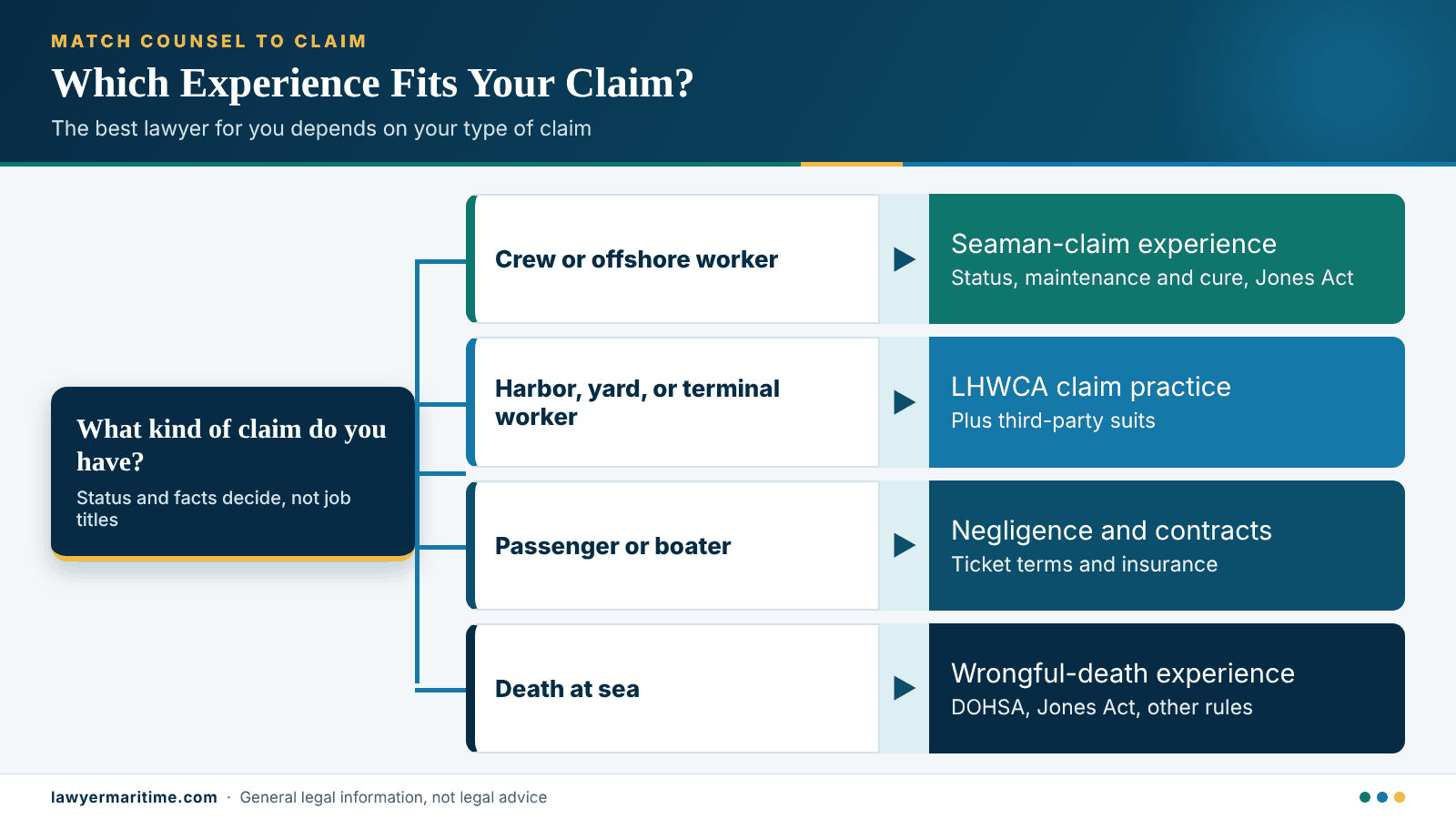
Crew, offshore, and workboat injury claims
Workers who may qualify as seamen, such as deckhands, mates, engineers, tugboat and towboat crews, fishing crews, and some offshore workers, often have several remedies at once. These can include maintenance and cure, a Jones Act negligence claim against the employer, and an unseaworthiness claim against the vessel owner. Whether you are a seaman at all can be hotly contested, and courts apply the test from Chandris, Inc. v. Latsis, 515 U.S. 347 (1995), with circuit-specific refinements such as the Fifth Circuit’s en banc decision in Sanchez v. Smart Fabricators of Texas, L.L.C., 997 F.3d 564 (5th Cir. 2021).
For these claims, look for a lawyer who talks fluently about seaman status, vessel status, maintenance and cure disputes, and the choice between state court, federal court, and a jury. The employer’s insurer will often contact you early, so a lawyer who can explain how to handle that contact is worth a lot. For a fuller map of the remedies, see our guide to maritime injury compensation.
Harbor, shipyard, passenger, boating, and fatal claims
Longshore, shipyard, and terminal workers generally proceed under the Longshore and Harbor Workers’ Compensation Act (LHWCA), a federal workers’ compensation system run largely through administrative proceedings at the U.S. Department of Labor. The skills are different: strict notice and claim periods, medical-benefit disputes, administrative hearings, and sometimes a separate suit against a negligent vessel or other third party. A lawyer comfortable only with jury trials may not be the best fit for the first stage of that process.
Cruise and passenger claims turn on negligence law and on the fine print of the ticket. Recreational boating and collision claims often involve state law, insurance coverage, and sometimes a shipowner’s attempt to limit liability. Deaths raise a further set of questions about which statute applies, who may sue, and what may be recovered. Our page on the DOHSA claim deadline covers one of those regimes in depth.
| Type of claim | Core legal questions | Experience worth looking for | Where it may be heard |
|---|---|---|---|
| Seaman or offshore crew injury | Seaman status, vessel status, maintenance and cure, Jones Act negligence, unseaworthiness | Seaman-status analysis, maintenance and cure disputes, jury trials, vessel investigation | State or federal court, depending on the claim and strategy |
| Longshore, shipyard, or terminal injury | LHWCA coverage, notice and claim periods, medical benefits, third-party claims | Department of Labor claim practice, administrative hearings, vessel-negligence suits | Administrative process first, with later review and possible separate suits |
| Cruise or passenger injury | Negligence, ticket terms, notice, forum clauses | Passenger-vessel claims, contract analysis, claims against large operators | Often controlled by the ticket’s forum clause |
| Recreational boating or collision | Operator fault, navigation rules, insurance, limitation of liability | Collision and boating cases, insurance coverage, expert reconstruction | State or federal court, depending on facts |
| Death at sea or on the water | Which statute applies, eligible beneficiaries, available damages | Wrongful-death claims under DOHSA, the Jones Act, and general maritime law | Depends on location and status of the person who died |
How Do You Verify a Maritime Lawyer’s Credentials?
Verification is the least glamorous step in choosing counsel and one of the most protective. It takes an hour or two, costs nothing, and removes a surprising number of problems before you ever sit down for a consultation.
Checking the basics: license, discipline, and court admission
Start with the questions every client should be able to answer about every lawyer: is the person licensed, in good standing, and allowed to appear in the court that matters?
License status and disciplinary history
Lawyers are licensed state by state, and state bars generally publish license status and public discipline in an online lookup. Search the bar of every state in which the lawyer says they are licensed, and check the spelling of the name against the firm’s website. A lawyer whose license is inactive, suspended, or limited should say so, and you should hear that from the lawyer rather than discover it.
A clean record is not a measure of skill, and a past sanction needs context. What was the conduct, how long ago, and what did the lawyer do afterward? What is public also varies from state to state, so treat the lookup as a floor, not a full background check.
Admission to the court where your claim would be heard
Federal courts admit lawyers individually. A lawyer licensed in one state doesn’t automatically practice in every federal court, and a lawyer who is not licensed where a case is filed may need permission for that case, often with local counsel. Maritime claims can be brought in different courts, so ask where the lawyer is admitted and which court is likely to hear your claim.
Specialist labels, memberships, and awards
This is where marketing and credentials blur together. Reading the labels carefully is part of the evaluation.
Board certification and what “specialist” may and may not claim
Under ABA Model Rule 7.2(c), a lawyer may not state or imply being certified as a specialist in a field of law unless the certifying organization has been approved by an appropriate state or territorial authority, or accredited by the American Bar Association, and the organization’s name is clearly identified in the communication. State versions of the rule differ, but the idea is the same: a “certified specialist” claim should be checkable.
The Florida Bar, for example, offers board certification in admiralty and maritime law, and its published requirements include years of practice, a minimum share of practice in the field, continuing legal education, peer review, and a written exam. Other states have different programs and different fields, and many states do not certify maritime specialists at all. Absence of certification doesn’t mean a lawyer is unqualified, and phrases like “focused on” or “limits practice to maritime” describe a practice, not a certification.
Memberships, publications, speaking, and awards
The Maritime Law Association of the United States is a bar association devoted to maritime law whose membership is open to lawyers, judges, law professors, and maritime industry professionals. Membership shows engagement with the field. It isn’t a credential, and you shouldn’t read it as a measure of courtroom ability.
Articles, speaking engagements, and continuing-education talks show knowledge and a willingness to teach, which is helpful. They don’t show how the lawyer performs in front of a jury or an administrative law judge. Peer-review and client-survey awards deserve the methodology questions from earlier: who votes, what is measured, and whether anyone pays to appear.
| Signal | What it can tell you | What it cannot tell you | How to check it |
|---|---|---|---|
| State bar license and discipline record | The lawyer is licensed and in what standing | Skill, maritime experience, or case outcomes | The state bar’s online lookup, for every state claimed |
| Board certification in admiralty or maritime law | The lawyer met a state-approved program’s requirements | Whether the lawyer suits your particular claim | The certifying body’s own directory; confirm the organization is named and approved |
| Admission to a federal or state court | Whether the lawyer can appear in that court | Trial skill or results there | The court’s attorney roster, or ask the lawyer directly |
| Bar association or MLA membership | Engagement with the maritime bar | Competence or experience level | The association’s member information, if it publishes any |
| “Top lawyer” awards and badges | That some selection process occurred | Whether the process measured quality or involved payment | The publisher’s published methodology |
| Online reviews and ratings | Client experience with service and communication | Legal quality; reviews can be sparse, selective, or solicited | Read several sources and look for specifics, not star averages |
What Experience and Resources Should Counsel Have?
Credentials open the door, but a consultation is where you learn how deep the experience runs. The goal is not to quiz a lawyer like an examiner. It’s to hear whether the lawyer sees your facts the way a seasoned maritime practitioner would.
Does the lawyer actually handle your kind of claim?
“Maritime” is a broad label, and some firms use it for a modest slice of their work. Specific questions get specific answers.
Ask about case types, courts, and outcomes without expecting guarantees
Ask what share of the practice involves your type of claim, which courts the lawyer regularly appears in, and whether the lawyer has handled a dispute over the same issue you face, such as a contested seaman status or a maintenance and cure denial. Ask who at the firm would actually work your file day to day.
Past results are a harder subject. A lawyer can honestly describe the kinds of matters handled, but results depend on facts that will differ from yours, and a presentation that implies you will get the same outcome can mislead. Confidentiality terms may also stop a lawyer from naming a settlement, a point we cover in our guide to maritime settlement confidentiality. A lawyer who explains that limit calmly is more credible than one who recites numbers.
Test the lawyer’s issue-spotting on your facts
In a good first conversation, the lawyer listens, then asks questions that show an understanding of what drives the claim. For a worker, that usually means who the employer is, what the vessel does, how much of your work was on the water, who owned or controlled the equipment, and what medical care and pay you have received. For a passenger, it means the ticket terms, the date, and where the incident happened.
The lawyer should also be able to tell you, in plain English, which legal regimes might apply, what the earliest deadlines could be, and what you should do or avoid in the meantime. You don’t need final answers on day one. You do want to see that the right questions are on the table.
Resources: investigation, experts, and willingness to litigate
Maritime claims are evidence-heavy and often expensive to develop. A lawyer’s ability to fund and manage that work affects what is possible for you.
Investigation and expert support
The evidence in a maritime case often sits with the vessel owner or operator: logs, maintenance records, crew lists, safety management documents, photographs, electronic data, and sometimes official investigation files. Marine casualties may also be examined by the U.S. Coast Guard or the National Transportation Safety Board. Our overview of maritime collision investigations explains how those records can come into play.
A well-resourced lawyer knows how to request an inspection, preserve electronic data, and retain the right experts, which may include marine surveyors, naval architects, safety professionals, medical specialists, vocational experts, and economists. Ask who the lawyer has worked with before and how those costs are handled, a topic picked up in the fee section below.
Readiness to file, to try the case, and to say no
Seamen have a statutory right to a jury trial on Jones Act claims under 46 U.S.C. § 30104, and maritime claims can often be brought in state or federal court under the saving-to-suitors clause of 28 U.S.C. § 1333. Shipowners can also try to freeze or limit exposure through limitation-of-liability proceedings under chapter 305 of Title 46. A lawyer should be able to explain these choices without hiding behind jargon and tell you which seem relevant to your facts.
Look for a lawyer who is prepared to take a case to trial when that is warranted. Insurers and defendants tend to assess whether the other side will really try the case. Look just as carefully for a lawyer who will tell you plainly when a claim is weak, when the benefits route is the better route, or when you would be better served by someone else.
| Question to ask | A strong answer sounds like | A weak answer sounds like |
|---|---|---|
| How much of your practice involves claims like mine? | Specific kinds of matters, courts, and recent examples without breaching confidentiality | “We handle everything” or vague references to being experienced |
| Which legal framework do you think applies, and why? | A reasoned view with stated uncertainty and the facts that will decide it | An instant, certain answer with no mention of what could change it |
| What deadlines might apply to me? | Names the likely clocks, says which is earliest, and notes they must be confirmed | “You have plenty of time” without discussing your facts |
| Who will work on my file, and who will I speak with? | Names the responsible lawyer and the support staff, and explains how updates happen | Intake staff only, with no commitment about lawyer contact |
| How do you investigate and fund experts? | Describes preservation steps, inspection requests, and how expert costs are advanced | Does not discuss evidence or experts until after you sign |
| Have you taken cases like this to trial, and would you here? | Honest account of experience and a view of when trial is realistic | Promises that the case will settle quickly |
| What are the weaknesses in my claim? | Identifies risks calmly and explains how they might be addressed | Tells you only good news |
How Do Maritime Lawyer Fees and Case Costs Work?
Money questions are among the most uncomfortable to ask, and among the most revealing. Terms vary by lawyer and by type of claim, so ask for the details rather than assuming that what a friend or a website described applies to you.
How lawyers get paid in maritime injury cases
Two different payment systems matter here. Most court claims use a contingent fee, while longshore claims run through an approval process that changes the picture.
Contingent fees in injury claims
In a contingent-fee arrangement, the lawyer’s fee depends on the outcome, usually as a percentage of the recovery. Under ABA Model Rule 1.5(c), such an agreement should be in writing and signed by the client, and it should state how the fee is determined, including the percentage that applies if the matter settles, goes to trial, or is appealed. It should also say which expenses will be deducted from the recovery and whether they come out before or after the fee is calculated. When the matter ends, the lawyer should give you a written statement showing the outcome and how your share was determined.
The before-or-after question can change what you take home, so don’t compare percentages in isolation. Two agreements with the same headline rate can produce different net amounts depending on how expenses are treated. Ask the lawyer to walk through an illustration using round, hypothetical numbers.
Why longshore fees work differently
Under the LHWCA, 33 U.S.C. § 928 provides that a fee for a claimant’s attorney must be approved by the appropriate agency official, the Benefits Review Board, or a court. In some circumstances, the employer or its insurer may be ordered to pay a reasonable fee, for example after it declines to pay within 30 days of written notice of a claim and the claimant then successfully pursues it with a lawyer. In other circumstances the approved fee may be paid out of the compensation awarded.
The statute also prohibits receiving a fee or other consideration for representing a claimant unless it has been approved. If you are a longshore, shipyard, or terminal worker, ask the lawyer how the approval process works for your claim, and never pay a lawyer in an LHWCA matter outside that process.
Costs and what the written agreement should cover
The fee is only part of the cost of a maritime claim. Expenses and unwritten expectations cause a large share of client disputes.
Case expenses: who advances them and when you repay
Maritime cases can generate substantial expenses: medical record fees, expert reports, depositions, filing costs, and travel to ports or vessels. Ask whether the lawyer advances these costs, whether you owe them if there is no recovery, and how they are repaid if there is one.
Model Rule 1.5(c) calls for the agreement to tell the client clearly about any expenses the client must pay whether or not the client prevails. If that sentence is missing from your agreement or unclear, ask for it to be added or explained before you sign.
Other terms worth reading before you sign
Scope matters. A good agreement says which claims the lawyer will handle, such as maintenance and cure, Jones Act and unseaworthiness claims, an LHWCA claim, or a claim against a third party, and which are outside the engagement. It should also make clear that the decision to settle belongs to you.
Other terms to read closely include how liens on a recovery are handled (for example, medical providers, health insurers, or Medicare), how you can end the relationship, what happens to your file, and whether any other firm will share in the fee. Our guide to maritime lawyer free consultations explains what to expect from a first meeting, while our page on the role of a maritime injury attorney describes what the work looks like day to day.
| Term | What to ask | Why it matters |
|---|---|---|
| Fee percentage and triggers | What rate applies at settlement, at trial, and on appeal? | The rate can change as the case moves, which changes your net recovery |
| Expenses before or after the fee | Are costs subtracted before or after the fee is calculated? | The order can change the amount you receive even when the headline rate is identical |
| Expenses if there is no recovery | Do I owe anything if the case does not succeed? | Some agreements make clients liable for costs, and the agreement should say so clearly |
| Scope of the engagement | Which claims and proceedings are covered? | Seamen and longshore workers can have several claims, and gaps in scope can leave one unhandled |
| Settlement authority | Who decides whether to accept an offer? | The decision to settle should be yours, made with the lawyer’s advice |
| Liens and reimbursement | Who deals with medical providers, insurers, and Medicare? | Reimbursement claims can reduce what you keep |
| Ending the relationship | What happens if I change lawyers? | Fee and expense claims by a former lawyer can affect a later recovery |
| Referral and fee sharing | Will another firm share the fee or work on the case? | You should know who is responsible, and whether the arrangement changes your costs |
How Do You Build a Shortlist and Run the Consultation?
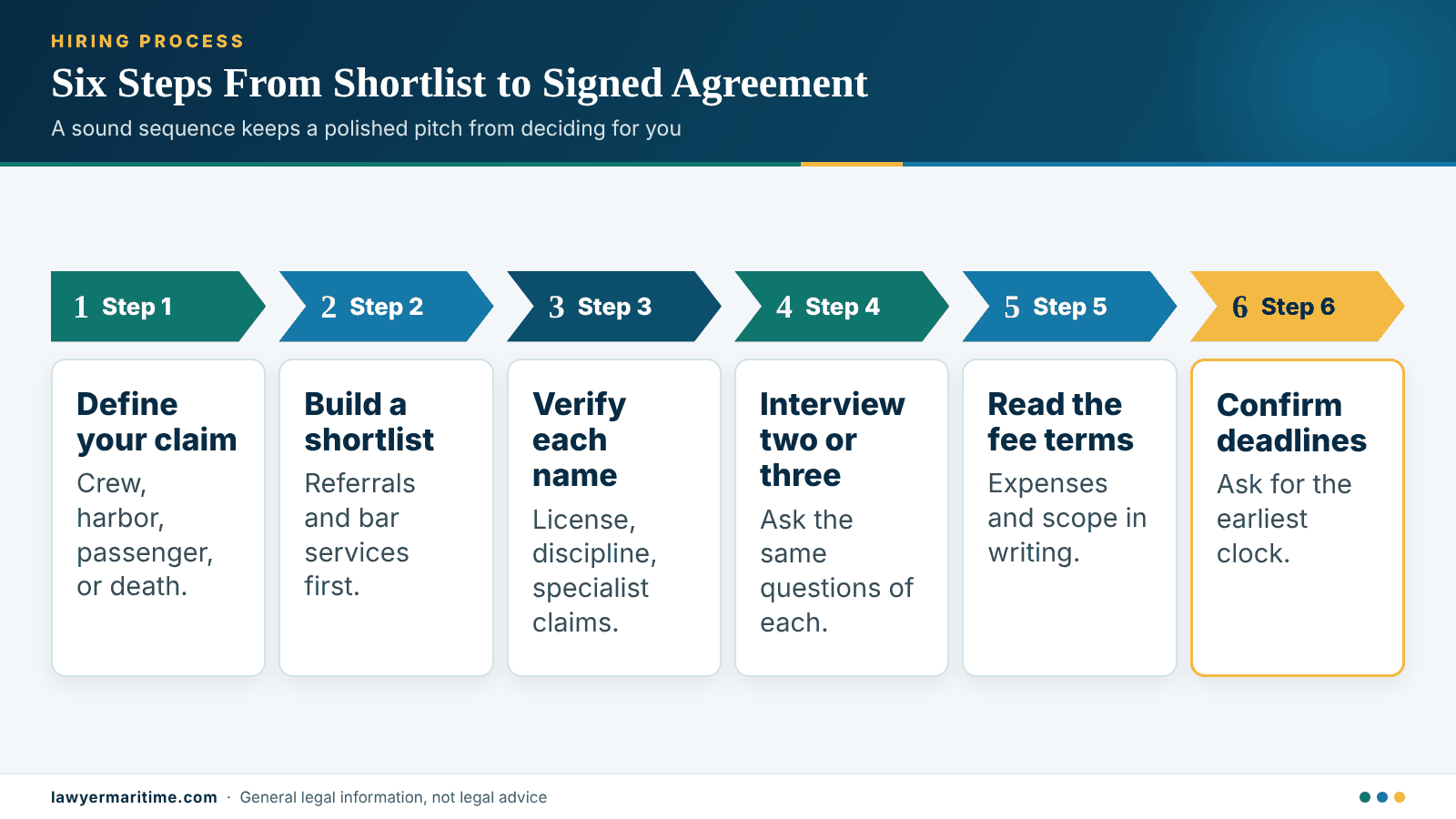
Once you know your claim type and how to verify a lawyer, the process itself is simple: build a short list, check each name, meet two or three candidates, and compare what you learned. Doing it in that order keeps a polished pitch from deciding the matter for you.
Build a shortlist from sources that fit
Where a name comes from affects how much you should trust it. Every source below has a place, and every one has a limit.
Referral sources and how to weigh them
Personal referrals from crewmates, union representatives, or a trusted family lawyer can be valuable, because the person has seen the lawyer’s work. A general practice lawyer you already know may also refer you to a maritime specialist, and such a referral is often more reliable than a search result. Lawyer referral services run by bar associations can help you find candidates, though they typically don’t endorse one lawyer over another.
Advertising, directories, and lead-generation websites can also be useful for finding names, but treat them as marketing. Ask whether the website is operated by a law firm or a marketing company, whether the intake person is a lawyer, and whether your information might be sent to several firms. If you want to focus on local options, our guide to finding a maritime lawyer near me goes through that search in more detail.
Unsolicited contact after an accident
If a lawyer or a “representative” calls, texts, or shows up at your home or hospital soon after an injury, be careful. ABA Model Rule 7.3(b) generally bars a lawyer from soliciting prospective clients through live person-to-person contact when a significant motive is financial gain, with exceptions for other lawyers, people with a family or prior professional relationship, and some business clients. State rules differ and may be stricter.
The LHWCA has its own provision. Section 928(e) prohibits making a business of soliciting employment for a lawyer or for oneself in connection with a longshore claim. An unprompted approach isn’t proof of misconduct, but it is a reason to slow down, check the license, and compare the caller against lawyers you found on your own.
| Source | Strength | Limit | How to vet it |
|---|---|---|---|
| Referral from a crewmate, union, or trusted lawyer | First-hand knowledge of the lawyer’s work | May reflect one case in a different claim type | Ask what kind of claim the person had and how the lawyer communicated |
| Bar association lawyer referral service | Screening by a bar-run program | Typically does not recommend one lawyer over another | Ask whether lawyers are screened for maritime experience |
| Law firm website or advertisement | Shows how the firm describes itself | It is marketing, not independent evidence | Verify license, claims of specialization, and any results shown |
| Online directory or review site | Easy comparison of many names | Placement may be paid and reviews may be selective | Read the directory’s methodology and look for specific, recent reviews |
| Lead-generation site or call center | Quick connection to a firm | Your details may go to several firms and the intake person may not be a lawyer | Ask who operates it and where your information will go |
| Unsolicited call, text, or visit | Rarely any advantage to you | May violate solicitation rules | Do not commit; verify the person independently |
Running the consultation
A consultation is an interview in both directions. The lawyer is judging your claim, and you are judging the lawyer.
What to bring and what to hold back
Bring a one-page timeline of what happened, medical and treatment records, pay records and crew or employment papers, any incident or accident reports, photographs, and messages with your employer, vessel operator, or insurer. If you have received settlement papers, a medical form, or a recorded-statement request, bring those too, and don’t sign anything until a lawyer you chose has reviewed it. For a deeper look at what happens in a first meeting, see our page on maritime lawyer consultations.
Keep your account factual and avoid speculation about blame. Many states give prospective clients confidentiality protections under rules modeled on ABA Model Rule 1.18, but those rules vary, so confirm with the lawyer that your conversation is confidential before you share sensitive details.
Compare two or three lawyers side by side
Take notes right after each meeting, while the details are fresh. Record the lawyer’s view of your claim type, the questions asked, what was said about deadlines and risks, the fee terms offered, and who would work on your file. Then compare the notes, not the sales pitches.
Pay attention to how you felt in the room. A lawyer who explains tradeoffs, including the unattractive ones, and who treats your questions as reasonable is usually a better partner than one who makes everything sound easy. You will be working with this person for months or years, so communication style matters.
Which Red Flags Should Make You Walk Away?
Most red flags are not dramatic. They are small signals that a lawyer or firm cares more about signing you than serving you. The signs fall into two groups: how the lawyer markets and approaches you, and how the lawyer handles a matter once it begins.
Warning signs in marketing and first contact
The first few contacts show you how a firm thinks about its clients. They also show how seriously it takes the rules that govern lawyer communications.
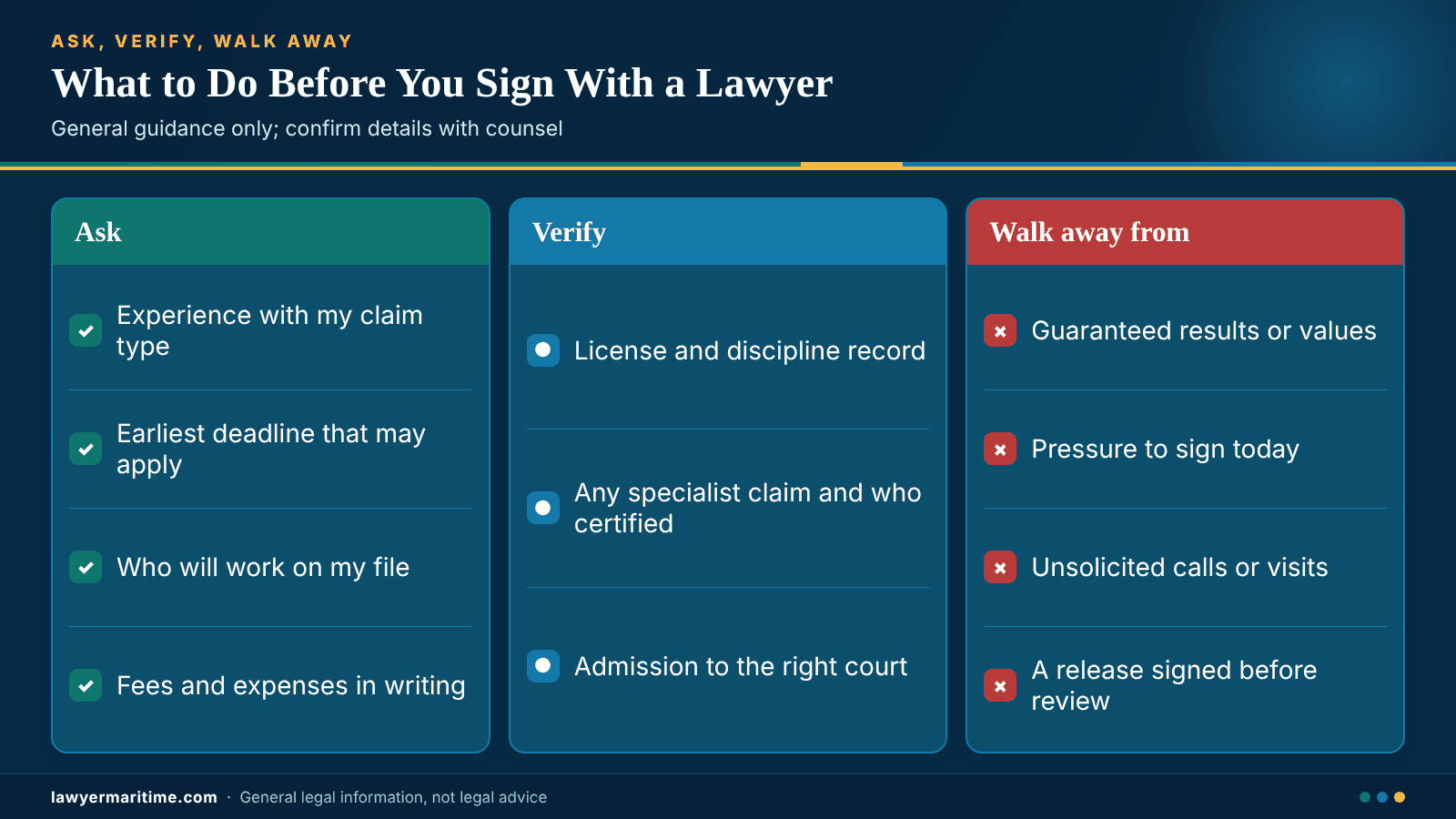
Guarantees, value promises, and unsupported superlatives
No honest lawyer can promise a result or name a dollar value before reviewing medical records, pay history, and the facts of how you were hurt. A promise of the highest possible payout, a guaranteed outcome, or a quick settlement figure on the first call is a statement the lawyer cannot support. It also falls squarely within the type of expectation-setting that advertising rules, including ABA Model Rule 7.1, are meant to discourage.
Superlatives deserve the same suspicion. “Best,” “top,” and “leading” mean little without a stated basis. If a lawyer or website relies on them, ask what the claim rests on, who made the evaluation, and whether the lawyer paid to be included.
Pressure, secrecy, and shortcuts
Be wary of anyone who pushes you to sign today, discourages you from speaking with other lawyers, or asks you to sign blank or incomplete forms. A careful lawyer gives you time to read the agreement and doesn’t treat a second opinion as an insult.
Be equally cautious if the first move proposed is a quick settlement. An early offer from an employer or insurer may be reasonable or may leave out future medical needs and lost earning capacity. Because releases can end rights permanently, and because courts have long examined a seaman’s release closely, as in Garrett v. Moore-McCormack Co., 317 U.S. 239 (1942), get any release reviewed before signing. Our guide to maritime settlement releases explains why.
Warning signs in how the lawyer handles your matter
Some problems only show up after you have hired someone. You can look for early signals of them before you sign.
Communication and capacity
ABA Model Rule 1.4 expects a lawyer to keep the client reasonably informed, promptly respond to reasonable requests for information, and explain matters well enough for the client to make informed decisions. If the lawyer can’t be reached before you hire, the problem is unlikely to improve afterward. Notice whether calls are returned, whether you speak to the lawyer or only to staff, and whether the lawyer explains things in language you can follow.
High-volume practices can be perfectly competent, and a large firm may have deep resources. The question is not size but attention. Ask who will handle your matter, how many people will touch it, and how often you can expect an update.
Conflicts and misaligned incentives
Lawyers owe loyalty to their clients, and conflict-of-interest rules restrict a lawyer from representing clients whose interests are directly adverse. In maritime practice, the question may come up when a firm also represents vessel owners, employers, or insurers in other matters. Ask directly whether the firm represents your employer, its insurer, or the vessel owner in any matter.
Be careful with any lawyer who comes recommended by the party you are making a claim against. That doesn’t make the lawyer unqualified, but it is worth asking why the recommendation was made and whether anyone is paying for the referral. The answer should be clear and documented.
| Red flag | Why it matters | Better sign |
|---|---|---|
| Guarantees a result or a dollar value | No one can know before records and facts are reviewed; such promises can mislead | Explains categories of recovery and the factors that raise or lower value |
| Calls or visits you soon after the accident | Solicitation rules restrict live contact in many settings | You contacted the lawyer after your own research |
| Demands that you sign immediately | You cannot evaluate terms under pressure | Gives you the agreement to take home and read |
| Pushes an early settlement or release | A release may end claims you have not yet valued | Reviews your medical status and wage losses before discussing any offer |
| Cannot say who will handle your file | Poor continuity and slow communication follow | Names the responsible lawyer and explains update practices |
| Fee terms are vague or oral only | Disputes arise over percentages and expenses | Provides written terms that address expenses and the closing statement |
| Dismisses deadlines or says there is no hurry | Some clocks are short and cannot be repaired later | Identifies likely deadlines and the earliest one |
| Relies on superlatives with no stated basis | Unsupported comparisons can be misleading | Describes experience in verifiable terms |
Local Counsel, Co-Counsel, and Changing Lawyers
Two practical questions come up after the first round of research. Does the lawyer need to be local, and what happens if you already hired someone and the relationship is not working? Both have answers that depend on the facts.
Local counsel, national firms, and referral co-counsel
Maritime law is federal, but your case will still be heard somewhere, and the place affects procedure, timing, and practical strategy.
When local knowledge matters
A lawyer who regularly appears in the court that would hear your case knows its judges, local rules, and typical pace. A lawyer near the port or yard where you worked may also know the employers, the vessel operators, and the kinds of equipment involved. That familiarity can be useful for finding witnesses and understanding workplace practices.
It does not follow that distance disqualifies a lawyer. Many maritime lawyers handle matters in several districts, often with local counsel, and remote consultations are common. What matters is who will appear in court and how the work is divided. For examples of how local forums shape claims, see our pages on a maritime injury lawyer in Houston and a maritime injury lawyer in New Orleans.
Referral and co-counsel arrangements
Some firms take a case and then bring in another firm to share the work and the fee. These arrangements are common and can benefit clients when each firm adds something real, such as trial experience or a local presence. Many states require disclosure to the client and the client’s agreement, and some restrict how fees are divided.
Ask in writing who will be responsible for the case, who will communicate with you, and whether the arrangement changes the total fee or your costs. If no one can explain the arrangement clearly, treat that as a reason to keep asking.
Switching lawyers after you have started
Changing lawyers mid-claim is allowed in most situations, but it has consequences. It is worth thinking through before you act.
Good reasons, weak reasons, and a second opinion
Reasonable grounds for concern include repeated failures to return calls, missed deadlines, no progress or explanation, a loss of trust, or advice that conflicts with the facts. A weaker reason is disappointment with realistic advice, such as a lawyer telling you the claim is less valuable than you hoped. Hard truths are part of the job.
If you are unsure, a second-opinion consultation with another lawyer can help you decide without ending the first relationship. Be open about the fact that you already have counsel. A careful lawyer will not push you to switch without a good reason.
What switching can mean for fees, files, and deadlines
You generally have the right to end a lawyer’s representation, but a former lawyer may assert a claim for fees or expenses against any eventual recovery. Ask the new lawyer how that works, and how the two lawyers’ fees will be handled so your total costs are clear. Request your file in writing, and keep copies of medical records, correspondence, and the original fee agreement.
Deadlines do not pause while you change lawyers. Ask the new lawyer to confirm every filing date as soon as possible, and keep attending medical appointments in the meantime.
How Do Deadlines Affect Your Choice of Lawyer?
Deadlines shape the hiring process in two ways. They create pressure to choose quickly, and they give you a concrete test of a lawyer’s knowledge. A lawyer who can say which clocks may apply to your claim, and which is earliest, is doing the job you are hiring for.
Deadlines that make early conversations sensible
No single deadline fits every maritime claim. The rules below are general, and the facts of your case decide which ones actually apply.
The general three-year period, and why it is not a plan
Under 46 U.S.C. § 30106, a civil action for damages for personal injury or death arising out of a maritime tort generally must be brought within three years after the cause of action arose, unless the law provides otherwise. Many readers hear “three years” and relax. That’s a mistake, because the statute begins with an exception and other laws, contracts, and claim types can change the picture.
Waiting also has practical costs even when a deadline is distant. Witnesses scatter, vessels change crews and routes, records get overwritten, and memories fade. Treat the three-year period as the outer limit of one possible clock, not as a target.
Shorter clocks that can bite
Longshore claims have much shorter periods. Under 33 U.S.C. § 912, notice of an injury generally must be given within 30 days, measured from the injury or from when you knew or should have known it was work-related, with several exceptions. Under 33 U.S.C. § 913, a claim generally must be filed within one year after the injury or death, again with a knowledge-based start and exceptions.
Passengers face ticket terms. For covered passenger vessels, 46 U.S.C. § 30526 bars a ticket or contract from setting a notice-of-claim period shorter than six months or a suit-filing period shorter than one year for seagoing vessels, with different minimums for covered small passenger vessels and exclusions for certain vessel types. Other contracts, including employment and insurance documents, can contain their own notice rules. Deaths on the high seas under DOHSA, 46 U.S.C. § 30302, are generally subject to the same three-year period in § 30106, and our page on the DOHSA claim deadline explains how to treat that point cautiously.
| Claim or step | Main source | General rule | Caveat |
|---|---|---|---|
| Maritime personal injury or death suit | 46 U.S.C. § 30106 | Generally three years after the cause of action arose | “Except as otherwise provided by law”; accrual and tolling depend on facts |
| Jones Act claim by a seaman | 46 U.S.C. § 30104 and the incorporated FELA | Generally governed by a three-year period | Confirm the correct source and any contract or notice terms |
| Death on the high seas (DOHSA) | 46 U.S.C. §§ 30302, 30106 | Generally the three-year period | Confirm with counsel; see the DOHSA deadline page |
| LHWCA notice of injury | 33 U.S.C. § 912 | Generally 30 days | Start date depends on knowledge; exceptions exist |
| LHWCA claim filing | 33 U.S.C. § 913 | Generally one year | Start date, payment history, and tolling can change it |
| Passenger ticket notice and suit periods | 46 U.S.C. § 30526 and ticket terms | Contract periods cannot be shorter than statutory minimums for covered vessels | Coverage depends on vessel type and route; other claims may differ |
Balancing careful hiring with the clock
You can be both careful and quick. The goal is to make a solid choice in days, not months, and to avoid letting indecision use up time you may need.
A sensible vetting timeline
Many people can shortlist, verify, and interview two or three lawyers over a few days to a couple of weeks, depending on their health and circumstances. If you are recovering from surgery or offshore without reliable phone access, a family member can help collect names and make calls. The point is to create momentum, not to rush.
Tell every lawyer when you were injured and when anything was last said or filed, and ask for the earliest deadline in writing. Hiring a lawyer doesn’t stop a clock by itself. The lawyer must act, so ask what will be done and by when.
Evidence that may not wait
Some evidence is time-sensitive in a way that argues for earlier action. Vessels sail, crews rotate, equipment is repaired or replaced, and electronic data can be overwritten under routine practices. A lawyer who understands this will talk about sending preservation requests to vessel owners and employers, and about seeking an inspection where appropriate.
You can help by keeping your own records: photographs, names of witnesses, medical documents, and messages. Don’t try to retrieve company records yourself in ways that could create problems. Leave that to counsel.
What to Do Now: A Hiring Checklist
If you are still deciding, this checklist turns the guide into actions. You can work through it in an afternoon, and it keeps the hiring decision grounded in facts instead of advertising.
This week: protect your claim while you search
Searching for a lawyer should not put your health or your rights at risk. These steps help on both fronts.
Protect your health, records, and rights
- Get medical care and follow treatment instructions, and keep every record, bill, and prescription receipt.
- Report the injury through the channel your employer, vessel, or operator requires, and keep a copy of the report.
- Write a short timeline while your memory is fresh, with dates, places, names of witnesses, and equipment involved.
- Keep photographs, messages, pay records, and crew or employment documents together in one folder.
- Hold off on signing releases, medical authorizations, or recorded statements until a lawyer you chose has reviewed them.
Narrow the list to two or three candidates
- Name your claim type. Decide whether you are a crew member, a harbor or shipyard worker, a passenger or boater, or a family member after a death.
- Collect four to six names. Use personal referrals, a bar referral service, and your own research, and skip anyone who contacted you first.
- Verify each name. Check the license, the discipline record, any specialist claim, and court admission.
- Book two or three consultations. Ask each lawyer the same questions so the answers are comparable.
Before you sign: confirm the final details
The signing stage is where good research can still go wrong. Slow down for the last few checks.
Last verification steps
- Re-check the license status of the lawyer who will sign your agreement.
- Ask for the names of everyone who will work on your file, and the responsible lawyer.
- Ask for the earliest deadline the lawyer sees in your claim and what will be done to protect it.
- Confirm how conflicts were checked, including whether the firm represents your employer, its insurer, or the vessel owner.
Put the important terms in writing
- Fee percentage at each stage, and how expenses are treated before or after the fee.
- Whether you owe expenses if there is no recovery.
- Which claims and proceedings the engagement covers, and which it does not.
- How liens, referral fees, and the end of the relationship are handled.
Frequently Asked Questions
These answers are general. They show how the rules usually work, and your facts, your state, and your type of claim may change the result.
Choosing and comparing lawyers
Is there an official list of the best maritime lawyers?
No. There is no government or court list that ranks maritime lawyers. Private lists use different methods, and some include paid placements, so read each list’s methodology before relying on it. State bars can confirm that a lawyer is licensed and whether public discipline exists, but they do not rank lawyers by quality.
Do I need a lawyer who handles only maritime cases?
Not necessarily, but you’ll need real maritime experience in your type of claim. A lawyer with a broader practice may be well qualified if maritime injury claims are a regular part of the work. Ask what share of the practice involves claims like yours and which courts the lawyer appears in.
Should I hire a local lawyer or a national firm?
Either can work. A local lawyer may know the court and the port, while a larger or national firm may have more resources. What matters is who will appear in court, who will answer your calls, and how the work is divided if more than one firm is involved.
How many lawyers should I talk to before deciding?
Two or three is a sensible range for most people. That is enough to compare approaches and fee terms without letting time slip away. Ask each one the same questions and write down the answers right after each meeting.
Fees, consultations, and agreements
How much does a maritime lawyer cost?
It varies. Many injury claims are handled on a contingent-fee basis, where the fee depends on the outcome, while longshore fees follow an approval process under 33 U.S.C. § 928. Ask for the percentage, the treatment of case expenses, and what you owe if there is no recovery, all in writing before you sign.
Is the first consultation free?
Policies differ from firm to firm, and this page can’t say what any particular firm charges. Ask before you book whether there is a charge, how long the meeting lasts, and whether the discussion is confidential.
Should I take the first settlement offer instead of hiring anyone?
There is no rule that fits every case, but an early offer deserves review before you sign, especially if your treatment is ongoing. A release can end claims you have not yet fully valued. A short consultation with a lawyer you have vetted can help you understand what you would be giving up.
Credentials, reviews, and trust
What does “board certified in admiralty and maritime law” mean?
It means a lawyer has completed a certification program run by an organization the state or the ABA has approved, and the claim should name that organization. Programs differ by state, and some states do not offer one for maritime law. A lawyer without certification may still be highly qualified.
How can I check whether a maritime lawyer has been disciplined?
Use the online lookup for each state bar where the lawyer says they are licensed. Public information varies by state, so treat it as a first check. If you see a sanction, ask the lawyer about it directly and judge the explanation.
Can I trust online reviews of maritime lawyers?
Use them as one input, not as a verdict. Reviews can be sparse, selective, or encouraged by the firm, and clients usually cannot judge the quality of the legal work. Look for specific comments about communication, honesty, and follow-through.
What if I already hired a lawyer and I am unhappy?
You generally may change lawyers, but do it carefully. Consider a second-opinion consultation first, ask the new lawyer how fees and costs would be handled, request your file in writing, and confirm that no deadline is about to pass. Don’t assume a clock stops while you decide.
Sources and Legal Authorities
The authorities below support the legal statements in this guide. Check each against its current text before you rely on it.
Statutes and regulations
Federal statutes
- 46 U.S.C. § 30104 – Jones Act personal injury and death of a seaman
- 46 U.S.C. § 30106 – Time limit on bringing maritime action for personal injury or death
- 46 U.S.C. § 30302 – Death on the High Seas Act, cause of action
- 46 U.S.C. § 30526 – Provisions requiring notice of claim or limiting time for bringing action
- 46 U.S.C. § 30527 – Provisions limiting liability for personal injury or death
- 33 U.S.C. § 912 – LHWCA notice of injury or death
- 33 U.S.C. § 913 – LHWCA filing of claims
- 33 U.S.C. § 928 – LHWCA fees for services
Professional conduct rules
- ABA Model Rule 7.1 – Communications concerning a lawyer’s services
- ABA Model Rule 7.2 – Advertising and specialist certification claims
- ABA Model Rule 7.3 – Direct contact with prospective clients
- ABA Model Rule 1.5 – Fees
- ABA Model Rule 1.4 – Communications
- Also referenced without a link: ABA Model Rule 1.18 (duties to prospective clients) and the lawyer-advertising, solicitation, and fee rules of the firm’s home state, which may differ from the Model Rules.
Cases and agency materials
Supreme Court and federal appellate decisions
- Chandris, Inc. v. Latsis, 515 U.S. 347 (1995) – seaman status test
- Garrett v. Moore-McCormack Co., 317 U.S. 239 (1942) – scrutiny of a seaman’s release
- Sanchez v. Smart Fabricators of Texas, L.L.C., 997 F.3d 564 (5th Cir. 2021) (en banc) – Fifth Circuit seaman-status analysis (no link)
Agency and professional organization materials
- U.S. Department of Labor, Division of Longshore and Harbor Workers’ Compensation – LHWCA program information and claim procedures
- The Florida Bar – Admiralty and maritime law board certification requirements
- Maritime Law Association of the United States – membership and purpose
- National Transportation Safety Board – marine investigation reports