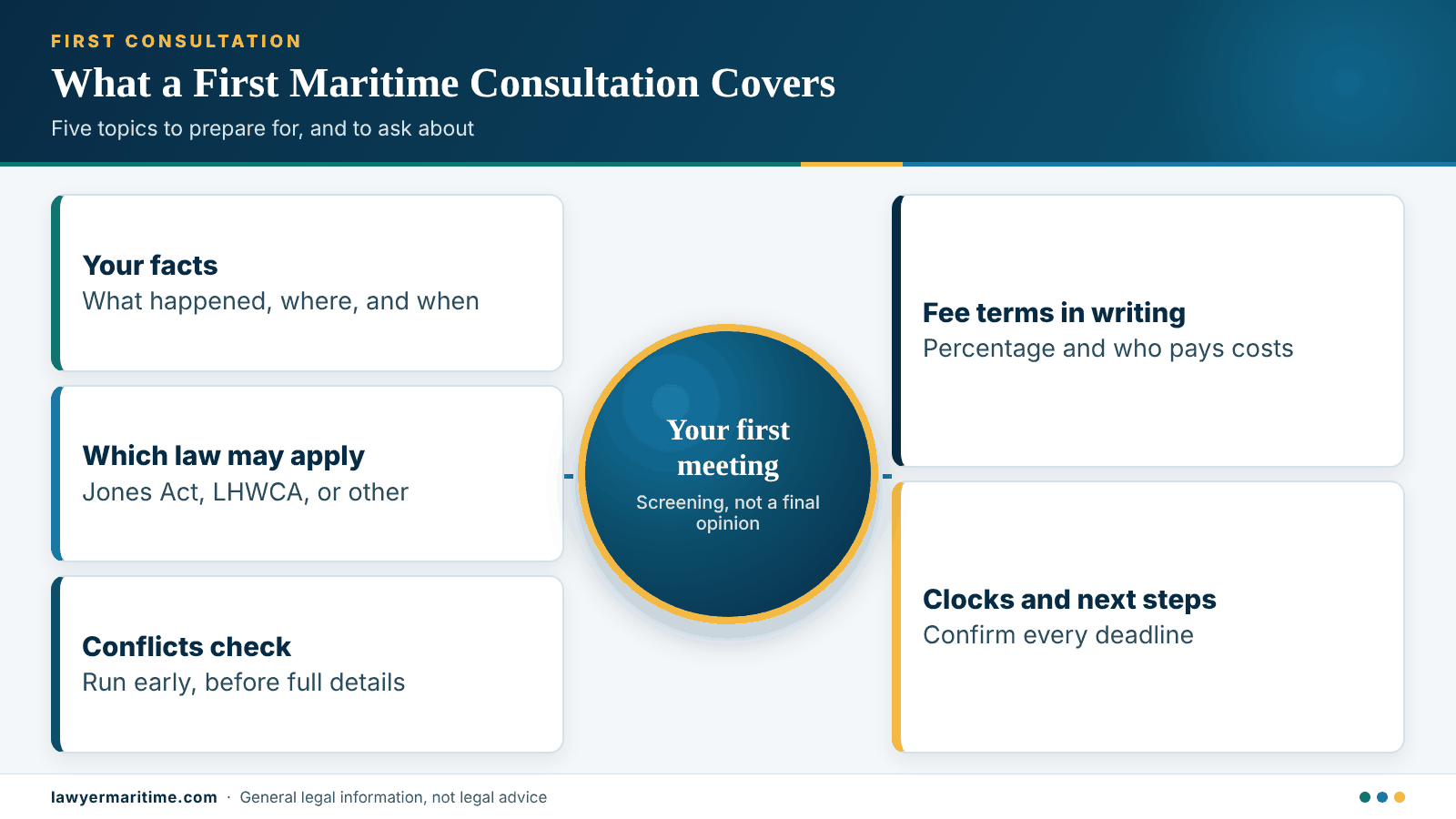
A maritime lawyer free consultation is usually a no-charge first meeting where a lawyer listens to what happened, screens the claim, and explains the fee terms before you commit to anything. The meeting itself is simple. The harder part is knowing what “free” really covers, what to bring, what to ask, and what to leave unsigned. This guide is for injured crew members, offshore and harbor workers, passengers, boaters, and families who are comparing maritime counsel. It draws on federal maritime law, including the Jones Act seaman remedy at 46 U.S.C. § 30104 and the Longshore and Harbor Workers’ Compensation Act (LHWCA), and on the professional-conduct rules that govern lawyer fees, advertising, and prospective-client confidentiality. A free first meeting doesn’t tell you what the representation will cost, so ask for the fee terms in writing before you decide. State rules differ, so ask about the terms directly.
What a “Free” Maritime Lawyer Consultation Really Means
The word “free” does a lot of work in legal advertising, and it rarely explains itself. Before you compare firms, it helps to know what the phrase usually covers, what it usually leaves out, and which questions turn a vague offer into a clear one. This section describes how such offers generally work across the profession. It doesn’t describe any single firm’s terms.
How do “free consultation” and contingency-fee offers generally work?
Two different promises often travel together in one advertisement. One concerns the first meeting. The other concerns how the lawyer will be paid if you hire them. Keeping those two ideas apart is the single most useful habit when you read a law-firm website.
What does “free” usually describe?
In most advertising, “free consultation” means the lawyer doesn’t charge for an initial conversation about whether you have a claim and whether the firm will take it. That conversation may be a phone call, a video meeting, or an office visit. It is generally a screening step, not a full legal opinion, and it ends with the lawyer either offering a representation agreement, declining, or asking for more records.
Notice what the phrase doesn’t say. It doesn’t say the lawyer will take your case. It doesn’t say you’ll owe nothing later. And it doesn’t say how long the meeting will last or who will attend. Those details vary from firm to firm, which is why a plain question at the start of the call, such as “Is this first conversation free, and for how long?”, is perfectly reasonable.
What is a contingent fee, in plain English?
A contingent fee is a fee that depends on the outcome. Instead of billing by the hour, the lawyer takes an agreed percentage of any money recovered, and if nothing is recovered, the lawyer’s fee is generally nothing. Under ABA Model Rule 1.5(c), which many states have adopted in some form, a contingent-fee agreement must be in a writing signed by the client.
The same rule says the writing must explain how the fee is calculated, including whether the percentage changes for a settlement, a trial, or an appeal. It must also say which expenses come out of the recovery and whether they are deducted before or after the percentage is figured. At the end of the matter, the lawyer must give you a written statement showing the outcome and, if money was recovered, how it was divided.
What should you confirm before you rely on the offer?
An advertisement is an invitation, not a contract. The real terms appear in the fee agreement you are asked to sign, and ethics rules require the lawyer to explain the basis of the fee and the expenses you will be responsible for, preferably in writing, at the start of the representation or shortly after. Your job is to ask early enough that the answers can influence your decision.
Who pays the costs if there is no recovery?
This is the question people forget. Litigation has out-of-pocket expenses, such as medical-record fees, expert reviews, court filing charges, deposition costs, and travel. A firm may advance those expenses and be repaid from a recovery, or it may ask you to cover some of them regardless of the result. Rule 1.5(c) requires the agreement to tell you clearly which expenses you must pay even if you lose.
The order of math also matters. If expenses are deducted before the percentage is calculated, your share is usually larger than if they come off after. A firm that can’t or won’t explain this in plain terms is giving you useful information about how the relationship may go.
What can an honest advertisement leave out?
ABA Model Rule 7.1 says a lawyer may not make false or misleading statements about their services, and a statement can mislead by leaving out a fact that the reader needs. So a firm that advertises a free consultation shouldn’t suggest the whole representation is free if you may owe costs. When the claim on a website seems to promise more than the fee agreement delivers, trust the agreement and ask questions.
This guide does not state any particular firm’s consultation terms, and nothing on this page should be read as an offer.
| Phrase you may see | What it may mean | Question to ask |
|---|---|---|
| “Free consultation” | The first conversation carries no charge, for a time the firm decides. | How long is it, and is anything charged if you ask for a document review? |
| “No fee unless you recover” | The lawyer’s fee depends on the outcome, under a signed contingent-fee agreement. | Which costs do I owe if there is no recovery? |
| “Free case evaluation” | A short review of your facts, sometimes by an intake worker rather than a lawyer. | Will a licensed attorney review my facts, and when? |
| “We advance all costs” | The firm pays case expenses up front and may recoup them from any recovery. | Is repayment owed if the claim fails, and is it deducted before the fee? |
| “Hourly” or “flat fee” | You pay for time or a defined task whatever the result. | What is the estimate, the retainer, and the billing cycle? |
The pattern across the table is consistent: every promise has a boundary, and the boundary is where your questions belong.
When to Book the Meeting and Who It Is For
Many injured people wait to call a lawyer until they feel better, until the employer finishes its investigation, or until they know exactly what happened. That instinct is understandable, but it can work against you. A first consultation is designed for people who don’t yet have the answers, and it is the step that tells you which questions matter.
How soon should you schedule a consultation?
There is no single right day, but there is a good reason to move early: several time limits in maritime law are short, and they differ by the kind of claim. The table below lists the clocks most readers meet first. Each one is a general rule with exceptions, so treat it as a reason to ask, not as a prediction for your situation.
Which time limits make an early meeting sensible?
For many maritime personal-injury and death suits, the general limit is three years from when the cause of action arose, under 46 U.S.C. § 30106, “except as otherwise provided by law.” A seaman’s Jones Act claim borrows the Federal Employers’ Liability Act (FELA), whose limitation period in 45 U.S.C. § 56 is also three years. The LHWCA uses much shorter periods: written notice to the employer is generally due within 30 days of the injury, or of when you knew or should have known it was work-related, and a compensation claim is generally due within one year, under 33 U.S.C. §§ 912 and 913.
Late notice under the LHWCA is not always fatal. The statute allows excuses in some circumstances, such as when the employer already knew of the injury. Even so, the safer reading for a worker is to treat these numbers as real and to confirm them with a lawyer who has your facts.
| Type of claim | Source | General period as written | Caveat |
|---|---|---|---|
| Maritime personal injury or death suit | 46 U.S.C. § 30106 | Three years from when the cause of action arose | “Except as otherwise provided by law”; contracts and other statutes can differ |
| Seaman’s Jones Act claim | 46 U.S.C. § 30104; 45 U.S.C. § 56 | Three years from accrual under the FELA period | Accrual can be disputed in gradual-injury cases |
| LHWCA notice of injury | 33 U.S.C. § 912 | Generally 30 days | Excuses exist, such as employer knowledge or lack of prejudice |
| LHWCA claim for compensation | 33 U.S.C. § 913 | Generally one year | Different rules for occupational disease and for some minors or incompetent persons |
| Passenger ticket or contract terms | The ticket or contract itself | Varies by contract | Can be shorter than statutory periods; read the fine print |
Do you need to finish treatment or know your legal status first?
No. You don’t need to be fully healed, and you don’t need to know whether you count as a seaman, a longshore worker, or something else. Sorting that out is part of what the lawyer does, and who is covered by maritime law is a separate question from whether you should have a first conversation.
You also don’t need a polished story. If you’re still receiving care, still on the payroll, or still waiting for the employer’s paperwork, a lawyer can often tell you what to preserve and what to avoid in the meantime. Waiting for certainty usually costs more than asking early.
Who is the meeting for?
Maritime counsel hears from a wider range of people than most readers expect. Which category you fall into affects what the lawyer asks you and which documents matter, so it helps to know where you probably sit before you walk in.
Workers: crew, offshore, and harbor employees
Crew members on vessels may have claims under the Jones Act, unseaworthiness, and maintenance and cure. Offshore workers may fall under seaman remedies, the LHWCA through the Outer Continental Shelf Lands Act (OCSLA), or state law, depending on the work and the location. Longshore, terminal, and shipyard workers usually look to the LHWCA, sometimes with a separate claim against a vessel owner. Whether you qualify as a seaman is a fact-driven question that courts decide using tests from Supreme Court cases such as Chandris, Inc. v. Latsis, 515 U.S. 347 (1995).
If your employer or its insurer is already paying some benefits, the meeting is still worthwhile. A lawyer can check whether the benefits fit the regime that applies to you and whether any paperwork you’ve been handed asks you to give something up.
Passengers, boaters, and families after a death
Cruise and ferry passengers, recreational boaters, and guests usually rely on general maritime negligence law, and ticket terms can shape where and when they must sue. Families who have lost someone may face the Death on the High Seas Act (DOHSA), the Jones Act, state wrongful-death law, or a combination. If the death happened offshore, the article on DOHSA claim deadlines explains the timing questions in more depth.
For family members, the first meeting often has a second purpose: finding out who the legal representative of the estate is and who may recover. That answer depends on the governing statute and, often, on state law. A lawyer can only answer it after hearing who the person was and how the death happened.
What to Bring to Your Consultation
You don’t need a binder. A lawyer can start with what you remember and add records as they arrive. Still, a short, organized set of documents turns a general chat into a specific one, because it lets the lawyer test your account against paper. The goal is not to prove your case in the first meeting. It is to give the lawyer enough to see which legal regime is in play and which records to request next.
Which documents help most?
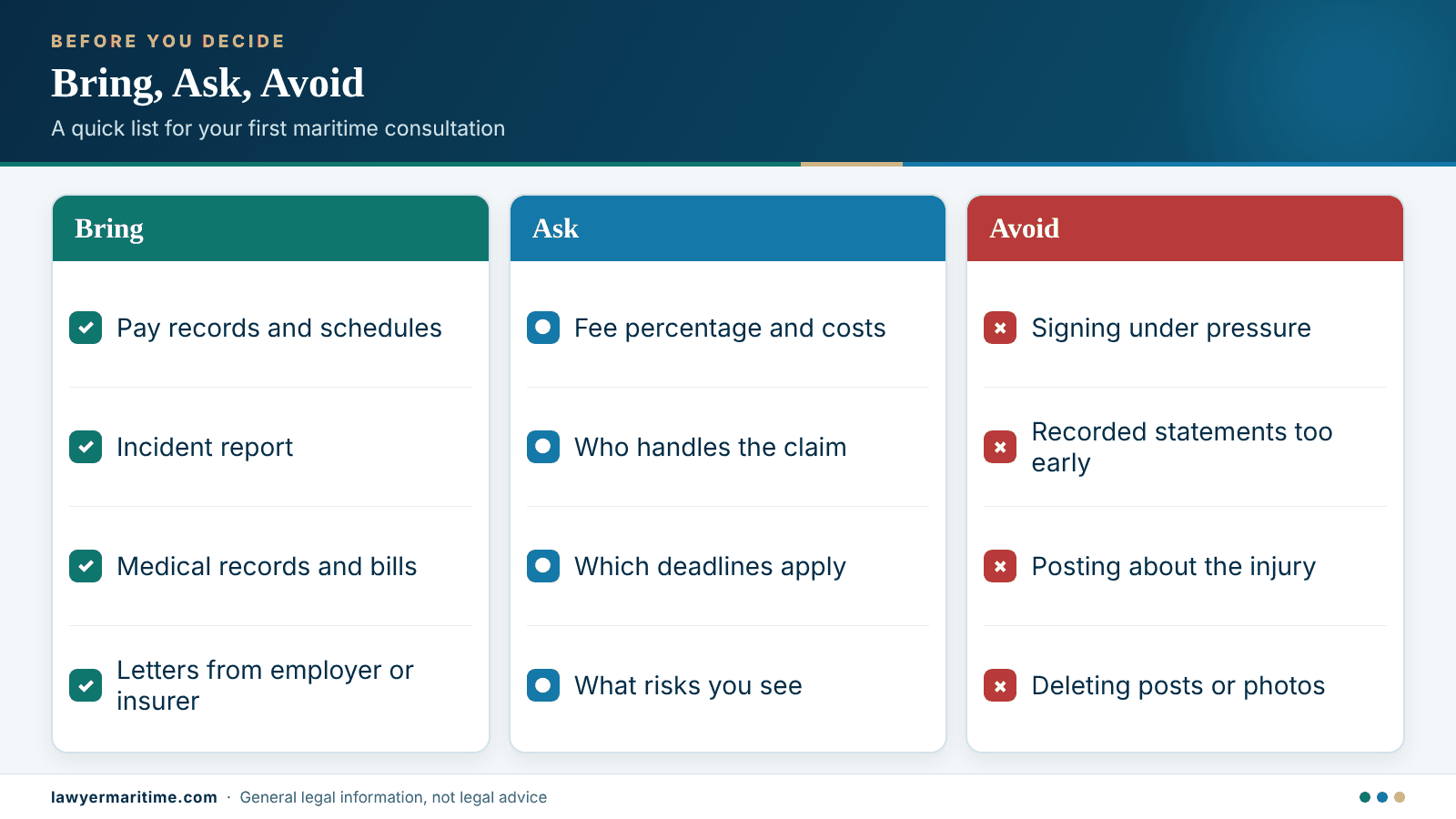
Think in two piles: records that show who you worked for and how, and records that show what happened to you afterward. Bring copies, and keep the originals somewhere safe. If something is missing, say so. A gap in your records is itself information, and the lawyer may know how to obtain what you can’t.
Work and pay records
These tell the lawyer what kind of worker you were, which can decide whether you look to the Jones Act, the LHWCA, or another source of recovery. Pay stubs and tax forms show the employer’s name and your earnings. Schedules, hitch or rotation calendars, and crew lists show how much time you spent on or around vessels, which matters in seaman-status analysis.
Also bring any contract, offer letter, job description, safety training certificate, or union paperwork you have. If you worked on more than one vessel or for more than one employer, make a simple list of names and dates. Courts look at the overall nature of the work, so a clear picture of your assignments is more useful than a single pay stub.
Injury, medical, and benefit records
Bring the incident or accident report if you received one, along with photographs, texts, or messages that describe what happened and when. If the employer filed a Coast Guard casualty report, a copy is helpful; written reports of reportable marine casualties are addressed in 46 CFR Part 4, including the five-day report on Form CG-2692 under 46 CFR 4.05-10. Not every injury is reportable, so don’t be alarmed if there isn’t one.
Add your medical records, discharge papers, work-status notes, and bills. Record any payments you’ve received, such as wages, maintenance, cure, or compensation benefits, and note who paid them. Also bring every letter from an employer, adjuster, or insurer. Those letters often reveal what the other side believes, and a lawyer will read them differently than you might.
| Item | Why it helps | Where it may come from |
|---|---|---|
| Pay stubs and tax forms | Identify the employer and show earnings for a wage-loss picture | Employer portal, bank statements, tax filings |
| Hitch or crew schedules | Show time on vessels and the pattern of the work | Crew-change records, texts from a supervisor, personal calendar |
| Incident report | Records the employer’s first version of events | Employer, safety officer, or your own copy |
| Photos and messages | Capture the scene, equipment, and conditions before they change | Your phone, coworkers, vessel or site logs |
| Medical records and bills | Link the injury to treatment, work limits, and cost | Clinics, hospitals, pharmacies, insurers |
| Benefit letters and payments | Show what the employer or insurer is paying or denying | Mail, email, payroll, claim adjuster |
| Contracts and ticket terms | May set forum, notice, or time limits | Employment file, cruise or passage ticket, rental agreement |
How should you prepare your own account?
Your memory is one of the most important pieces of evidence, and it fades. The aim is to capture it once, clearly, and share it only with your lawyer. A good account sticks to what you saw, heard, and did, and it leaves out guesses about law or blame.
Write a short timeline
Put the events in order: when you started the job, when the incident happened, what happened immediately afterward, who you told, and what treatment you received. Add names of witnesses and the vessel, platform, dock, or site. If you’re unsure about a date, write “about” and move on rather than inventing precision.
Consider labeling the document as prepared for your attorney, and don’t forward it to coworkers or post it. Whether the notes are protected can depend on the facts and the law that applies, so the safer approach is to keep one copy and to hand it only to the lawyer you consult.
Leave out the extras
You don’t need to bring a theory of the case, a stack of internet research, or a complete list of every complaint you’ve ever had about the employer. Those can bury the facts that matter. Don’t alter, rename, or “clean up” any photos or messages, and don’t ask coworkers to write statements for you before you’ve spoken with counsel.
If you’re tempted to confront a supervisor or a coworker to get a version of events on record, hold off. Ask the lawyer how to approach that safely. A conversation that seems harmless can later be described differently by each side.
What Happens During the First Meeting
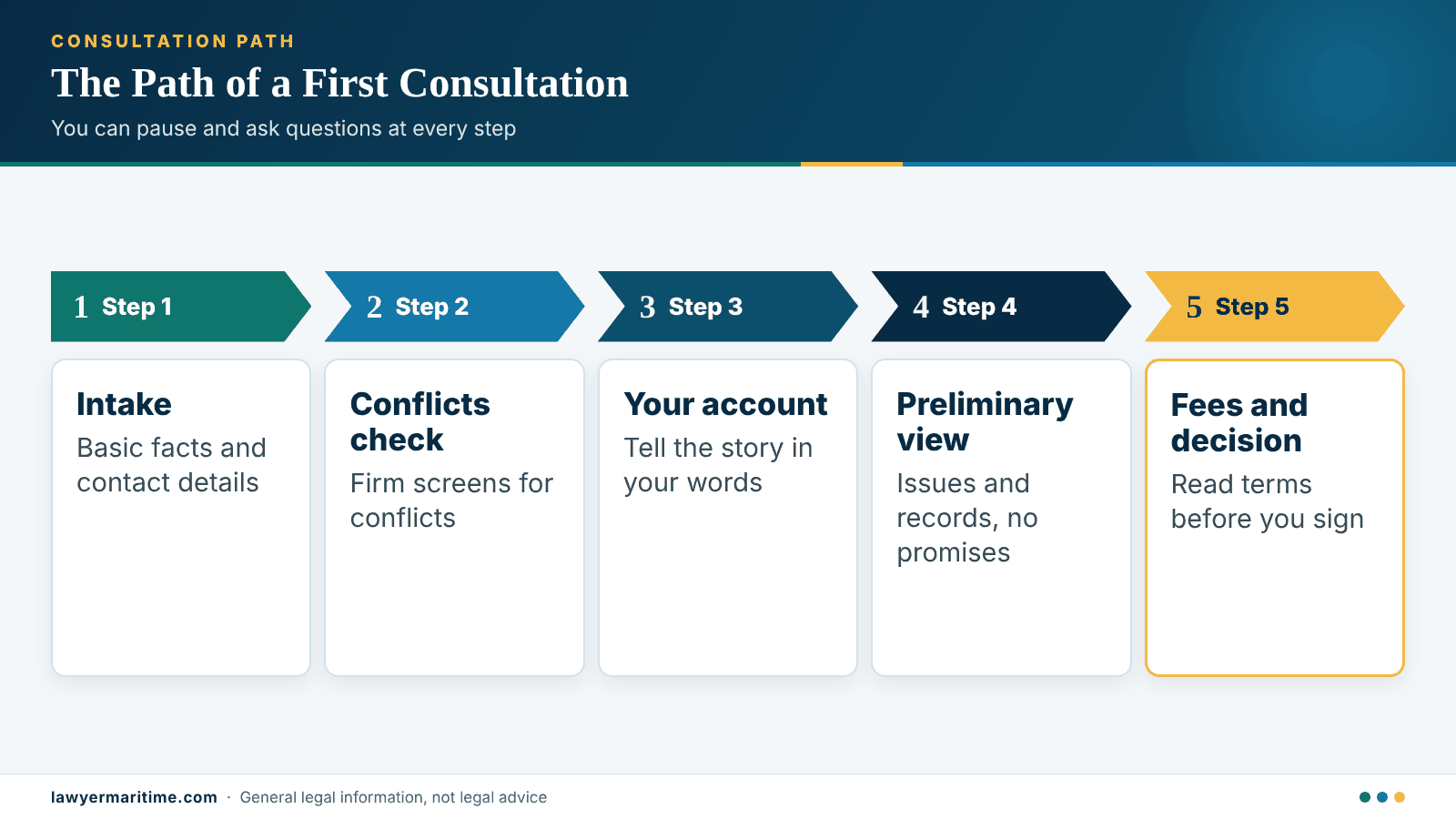
People often arrive picturing either a quick sales pitch or a full legal opinion. The reality sits in between. A first consultation is a two-way screening: you’re deciding whether this lawyer seems right for your claim, and the lawyer is deciding whether the claim fits the firm’s practice, resources, and conflicts. Knowing the usual rhythm helps you use the time well.
How does a typical consultation unfold?
Formats differ. Some firms start with a call to an intake coordinator, some go straight to a lawyer, and some use video from the start. Length also varies, and there is no standard that every firm follows. What follows is a general sequence, not a promise about any particular office.
Before the meeting: intake and conflicts
Expect basic questions first: your name, contact details, the date and place of the incident, the employer or vessel owner, and the other people involved. Firms need that information to run a conflicts check, which looks for any existing client or past matter that would prevent them from representing you. Under the ABA’s prospective-client rule, a lawyer should limit this early stage to what reasonably appears necessary to decide whether to take the matter, so you may be asked to hold back detail until the firm clears the conflict.
If the intake worker asks something you’re not comfortable answering by email or text, say so and ask for a phone or in-person call. You can also ask whether the person you’re speaking with is a lawyer, and whether a lawyer will review your information before any decision is made.
In the meeting: the questions you’ll hear
The lawyer will usually ask you to tell the story in your own words, then circle back with pointed questions. Expect to be asked what your job was, how much time you spent on which vessels or sites, where the injury happened, who was in charge, what was said afterward, and what treatment followed. Those questions aren’t random. They map onto the legal tests for seaman status, vessel status, the location and connection requirements for admiralty jurisdiction, and the defendants who might be responsible.
You’ll also be asked about anything that could complicate the claim. That includes earlier injuries, medical history, prior claims, and any statement you gave. Answer honestly, because a lawyer can only manage a problem they know about. A concealed prior condition can become a defense issue later, and the first meeting is the safest place to raise it.
What can the lawyer tell you, and what can’t they?
You should leave the meeting with a clearer map, not a guarantee. An honest lawyer will separate what the law generally says from what depends on records not yet reviewed. That’s not evasion; it’s accuracy.
A preliminary view is not a promise
Lawyers can often say which legal theories look worth exploring, which deadlines to calendar, and which records to gather. They can’t ethically promise a result. Model Rule 7.1 bars false or misleading statements about a lawyer’s services, and a confident prediction of success before the facts are tested is a warning sign, whether it appears in an advertisement or in the meeting itself.
Be cautious about any number offered in the first meeting. A dollar figure given before the lawyer has medical records, wage records, and an understanding of fault is a guess. You are entitled to ask what assumptions lie behind any estimate and what would change it.
Common outcomes of a consultation
Most first meetings end in one of a handful of ways. The lawyer may offer a written fee agreement, ask for records and a second conversation, refer you to another firm better suited to the claim, or decline. Each outcome has a different next step for you, and none of them ends your options.
A decline, in particular, is not a verdict on your claim. Firms turn matters away for many reasons, including conflicts, capacity, geography, or a practice focus that doesn’t match. What matters is that you leave knowing whether the lawyer is declining, so you can keep your own calendar and contact someone else promptly.
| Outcome | What it usually means | Your next step |
|---|---|---|
| Offer to represent you | The firm will send or present a written fee agreement | Read it fully, ask about costs, and take time before signing |
| Request for more records | The lawyer can’t judge the claim yet | Send what you have, and ask what the decision date will be |
| Referral to another firm | The claim may fit a different practice or location | Ask why, and ask whether any referral fee will affect you |
| Decline | The firm won’t take the matter, for reasons that may not relate to the merits | Ask for the decision in writing and keep your deadlines in view |
Is What You Say Confidential Before You Hire Anyone?
Most people holding back details at a first meeting are worried about one thing: “If I tell this lawyer everything and then don’t hire them, who else hears it?” The professional-conduct rules answer that question for the lawyer’s side, and a few common-sense habits cover the rest. This section explains how the protection generally works and where it can fall short.
What duties does a lawyer owe a prospective client?
ABA Model Rule 1.18, which most states have adopted in some version, creates a category called the prospective client. The protection is narrower than what a full client receives, but it is real, and it applies whether or not you hire the lawyer.
Who counts as a prospective client?
Under Rule 1.18(a), a person who consults a lawyer about the possibility of forming a client-lawyer relationship in a matter is a prospective client. The comments explain that a consultation can occur by phone, email, or in person. They also explain that a person who sends information to a lawyer without a reasonable expectation that the lawyer is willing to discuss representation, for example by volunteering details after reading only general advertising, is not treated as a prospective client.
The practical lesson concerns websites. If a lawyer’s site invites you to describe your case and doesn’t clearly warn you that sending a message creates no obligations, you’re more likely to be protected. If the site contains a clear and reasonably understandable warning that limits the lawyer’s duties, you may not be. So read the small print near any contact form before you type your story into it.
What does the lawyer have to do with what you share?
Rule 1.18(b) says that a lawyer who has learned information from a prospective client may not use or reveal it, with narrow exceptions that mirror those for former clients. That duty applies even when the conversation is short and even if no representation follows.
The rule also deals with conflicts. If the information could be significantly harmful to you, the lawyer generally can’t take on a client with interests adverse to yours in the same or a substantially related matter. The firm may avoid that bar only with informed written consent from both sides or by meeting specific safeguards, including screening the lawyer and giving written notice. This is one reason a conflicts check comes first, and why a firm may ask you not to share every detail until it clears. The rule’s comments encourage lawyers to limit the first conversation to what is reasonably necessary.
How do you protect your privacy in practice?
Rules bind lawyers. They don’t control what you do on a shared phone, a family computer, or a group chat. A little attention to how you communicate keeps the protection you’ve been given from being undermined by habits that are easy to fix.
Choose the channel with care
Use a phone, email account, and device that only you control. A work email address, an employer-issued phone, or a shared household tablet can allow someone else to read your messages. If you’ve been told that company devices are monitored, assume that anything typed on them is not private.
Don’t send details to a lawyer through social-media direct messages or comment threads unless you’ve been told that channel is acceptable. Public comments are not confidential at all. And if a lawyer’s intake form asks for more than you’re comfortable giving before a conflicts check, ask what the minimum is and offer to supply the rest by phone.
| Channel | Main risk | Safer approach |
|---|---|---|
| Website contact form | May state that no relationship is formed; may be read by staff | Read the notice; share minimum facts until you’re in touch with a lawyer |
| Employer email or phone | Employer may be able to read or retrieve messages | Use a private device and personal account |
| Text or messaging apps | Messages can be forwarded, screenshot, or synced to shared devices | Move sensitive details to a phone call or secure portal |
| Social media posts or messages | Public or discoverable, and no confidentiality expectation | Don’t discuss the claim; contact the firm directly instead |
| Conversation with a friend or coworker present | Third-party presence can raise privilege questions | Ask the lawyer before bringing anyone to the meeting |
What about insurers, employers, and friends?
A claims adjuster or an employer’s safety manager is not your lawyer, no matter how friendly. What you tell them isn’t protected, and it may be written down, recorded, or shared with the party you might later face. That is true even when the person is kind and says the call is routine.
Friends and family are a more delicate case. Telling a spouse or coworker what happened is natural, but those conversations are generally not privileged and can be asked about later. Whether a family member in the room at the consultation affects privilege depends on the law of the place where the issue arises, so ask the lawyer before you bring anyone. For what happens to confidentiality clauses in a later settlement, see the separate guide on maritime settlement confidentiality.
Questions to Ask Before Hiring Maritime Counsel
A consultation runs in both directions, and the questions you ask matter as much as the answers you give. Good questions are specific, easy to answer, and hard to dodge. They also reveal how a lawyer communicates, which is an early preview of the working relationship. This section groups the most useful questions into two clusters: what the lawyer knows and how they would approach your claim, and what the arrangement will cost and how you’ll stay informed.
What should you ask about experience and strategy?
Maritime practice is a specialty, and the label on a website says little. Ask questions that can only be answered by someone who works with the relevant rules every week. Be wary of an answer that could apply to any personal-injury matter without change.
Maritime-specific questions
Start with the legal regime. Ask which body of law the lawyer thinks may apply to you and why, whether seaman status looks likely to be contested, and what facts would settle it. A lawyer familiar with the field should be able to talk about the vessel or location, the kind of work you did, and the main alternatives, such as the Jones Act, the LHWCA, OCSLA, or state law, without drowning you in citations.
Then ask about the practical side of maritime litigation. Which court might hear the claim, and why? Is a jury trial likely to be available? Will the vessel owner be expected to file a limitation-of-liability action, and what would that do to timing? The limitation statute lets an owner file within six months after receiving written notice of a claim, under 46 U.S.C. § 30529, so how and when notice is sent can be a strategic choice. For a deeper look at what specialized experience means, the guide to which claims call for admiralty experience goes through it claim by claim.
Questions that test the evaluation
Ask what the lawyer thinks the biggest weaknesses in your claim are. A candid answer builds trust, and a refusal to identify any risk is a warning sign. Ask what records they would request first, what could delay the claim, and who in the firm would actually do the work.
You can also ask about experience with similar claims, but phrase it carefully. A lawyer can’t reveal confidential client information, so a fair request is general: “What kinds of maritime matters does the firm handle most often?” Be skeptical of vague boasts of results. Rules on lawyer advertising bar statements that are false or misleading, so a claim about results is one the lawyer should be able to explain and support. For a framework on evaluating counsel across several firms, see the guide to how to evaluate maritime lawyers, which focuses on criteria rather than rankings.
What should you ask about fees and communication?
The second cluster concerns money and contact. Many disputes between clients and lawyers begin with an assumption nobody voiced at the start. A few minutes spent on these questions can prevent most of them.
Fee and cost questions
Ask for the fee percentage in writing and whether it changes if the claim settles, goes to trial, or goes on appeal. Ask which expenses the firm will advance, whether you’ll owe any of them if there is no recovery, and whether costs are subtracted before or after the percentage is calculated. Ask whether medical bills, liens, or benefits already paid will affect what you take home, and when you’ll receive a written accounting.
Fees can work differently in longshore matters. Under 33 U.S.C. § 928, fees for a claimant’s lawyer in an LHWCA claim generally require approval by the agency or court, and in some situations the employer or insurer is ordered to pay them. The statute also makes it a crime to receive an unapproved fee for representing a claimant in such a matter. If your claim falls under the LHWCA, ask how the lawyer handles fee approval.
Communication, decisions, and referrals
Ask who your day-to-day contact will be, how often you’ll receive updates, and how quickly the firm normally responds to messages. Ask who makes the decision to accept a settlement offer. In general, the client decides whether to settle, and the lawyer advises. A fee agreement that gives the firm sole authority over settlement should be examined closely.
Finally, ask whether the firm expects to work with other lawyers. Under Model Rule 1.5(e), lawyers in different firms may divide a fee only if the division reflects the work each does or each takes joint responsibility, the client agrees in writing, and the total fee is reasonable. A firm that refers your claim to a lawyer in another city should be able to explain who will do the work and whether that changes what you pay.
| Topic | What a clear answer sounds like | What should give you pause |
|---|---|---|
| Governing law | Names the regimes that may apply and the facts that decide between them | A generic “personal injury” answer with no maritime analysis |
| Risks in your claim | Identifies specific weaknesses and records that could resolve them | Promises that the claim is strong before reviewing any records |
| Fee percentage | States the percentage and any changes by stage, in writing | Declines to put terms in writing or says it can be worked out later |
| Costs | Explains which costs are advanced, which you owe regardless, and the order of deduction | Says “don’t worry about costs” without explanation |
| Who does the work | Identifies the responsible lawyer and the support team | Unclear who will handle the claim or whether it will be referred out |
| Settlement authority | Confirms that you decide whether to settle after advice | Seeks broad authority to settle without your approval |
You don’t need to ask every question in a single sitting. Pick the six or eight that matter most to you, write them down before the meeting, and leave room for follow-up.
What Not to Sign, Say, or Post
The weeks around a first consultation are when many avoidable mistakes happen. Employers and insurers move quickly, paperwork arrives with friendly cover letters, and online habits don’t pause because you’re hurt. None of the points below are about hiding anything. They’re about giving yourself time to understand what you’re agreeing to and who may later read it.
Which documents and statements deserve a pause?
The rule of thumb is simple: if a document gives something up, or a statement will be kept as a record of what you said, take time first. Ask for a copy, say you want to review it, and find out whether a short delay will cost you anything.
Releases, forms, and recorded statements
A release is a document in which you give up claims, often in exchange for a payment. Seamen have long been treated as “wards of admiralty,” and in Garrett v. Moore-McCormack Co., 317 U.S. 239 (1942), the Supreme Court placed the burden on the party relying on a seaman’s release to show the seaman signed freely, without deception or coercion, and understood his rights. That protection helps, but it is a defense you’d have to litigate, not a reason to sign casually. The separate guide to maritime settlement releases explains what rights a release can reach.
Recorded statements, broad medical authorizations, and employer or insurer forms deserve the same care. You may be asked to sign an authorization that opens your entire medical history rather than records tied to the injury. You may also be asked for a recorded statement before you’ve seen the incident report. Answering a few factual questions politely is different from agreeing to a long recorded interview, and a lawyer can often tell you which is which.
Fee agreements and engagement letters
The document you sign to hire a lawyer deserves the same scrutiny as any other. Take it home if you can. Check the percentage, the treatment of costs, what happens if you end the relationship, and whether the firm may refer your claim to another firm. Make sure all blanks are filled in, and keep a signed copy.
Be wary of pressure. A real deadline may be in the picture, but a lawyer who says you must sign on the spot without time to read isn’t helping you make an informed choice. If you’ve received a decline letter or a non-engagement letter, read that too. It should state that the firm isn’t representing you, and it’s your cue to keep your own deadlines in mind.
What about social media and unsolicited contact?
Two other sources of trouble have nothing to do with paper: what you put online and who contacts you after an accident. Both can affect a claim without ever involving a lawyer.
Online posts and deleted content
Posts, photos, check-ins, and comments can be collected by an employer or insurer and read out of context. A photo of you lifting a cooler may be offered as proof that your injury is minor, whatever the real circumstances. The safest approach is to stop posting about your injury, your activities, and the claim, and to ask the lawyer what to do about privacy settings.
Do not delete existing posts, messages, or photos in a hurry. Destroying material that may be relevant to a dispute can cause its own problems, and courts may react badly when evidence disappears. Ask for guidance first, so that preservation and privacy are handled in the right order.
Unsolicited calls, runners, and look-alike offers
After a serious accident, strangers sometimes contact injured people to offer help finding a lawyer. Professional-conduct rules generally restrict lawyers from soliciting prospective clients through live person-to-person contact, with exceptions, and states often add rules of their own. The ABA Model Rules also generally bar a lawyer from paying someone for recommending the lawyer’s services, with limited exceptions such as certain referral services.
The LHWCA goes further for longshore claims. Under 33 U.S.C. § 928(e), it is a crime to receive an unapproved fee for representing a claimant or to run a business of soliciting employment for a lawyer in matters covered by that chapter. If someone you don’t know pushes you to sign with a specific firm, take their name and the firm’s name, decline to sign anything, and verify the lawyer’s license on your own through the state bar.
| Common mistake | Why it can hurt | Better action |
|---|---|---|
| Signing a release the day it arrives | May give up claims, including future benefits, before you know their value | Ask for time, and have a lawyer review it |
| Agreeing to a long recorded statement | Creates a record that may be used to question your account | Ask what it’s for, and speak with counsel first |
| Signing a broad medical authorization | Opens unrelated history to review by the other side | Ask that it be limited to relevant records and dates |
| Posting about the injury or activities | Images and comments can be used out of context | Stop posting, and ask about privacy settings |
| Deleting posts or messages | May look like destroying evidence | Preserve first; get guidance on what to do next |
| Signing with the first caller | Unsolicited offers may come from someone paid to refer you | Verify the lawyer’s license, then compare options |
What to Do After the Consultation
The meeting is over, and now you have information, a fee agreement or a decline, and a calendar that keeps moving. This is the phase where people either lose momentum or sign too fast. A steady, written approach keeps you in control of the decision.
How do you decide whether to hire the lawyer?
You don’t have to decide in the room. Unless a deadline forces a faster choice, you can review the agreement, compare it with the notes you took, and sleep on it. If you met with more than one lawyer, compare them using the same set of questions so that you’re not swayed by whoever had the smoothest delivery.
Compare what you heard against what you were given
Put your notes next to the written agreement. Check that the fee percentage, costs, and scope match what was said aloud. Look at whether the lawyer explained the main legal issues clearly and whether they answered your hardest question directly. Then consider the softer factors: did you feel heard, and could you reach this person if something urgent came up?
Ask for corrections in writing if the paper and the conversation differ. A firm that is willing to fix a mismatch quickly is showing how it will treat future problems. A firm that gets defensive about a reasonable question is showing you something too.
If the lawyer declines or refers you elsewhere
Ask for the decision in writing and write down the date. A declination doesn’t tell you whether your claim has merit, and it doesn’t stop any clock. Contact another maritime lawyer promptly, and tell them honestly that another firm declined. The reason may have nothing to do with your facts, such as a conflict or a case load.
If you’re referred, ask why that firm and whether the referring firm will receive a share of any fee. As noted earlier, the Model Rules require that you agree to any fee division in writing. You are free to ask for more than one referral and to choose.
How do you keep your claim organized going forward?
A lawyer handles the legal work, but you still hold the information that only you can supply. Keeping it tidy makes the representation cheaper and faster, and it protects you if the relationship changes.
Build one file and one calendar
Keep a folder, paper or digital, for records related to the claim: the fee agreement, the medical bills, benefit letters, and every notice from an employer or insurer. Note the dates and times of each conversation with the lawyer’s office. Put the deadlines the lawyer gives you on your own calendar, and ask the firm to confirm in writing which clock they believe applies and when it ends.
If you’re uncertain about a deadline, don’t rely on this article or any other general source. The periods summarized earlier are starting points, and your lawyer is responsible for the dates that apply to your case.
Keep up with treatment and honest reporting
Follow your doctors’ advice and attend your appointments. Gaps in treatment are routinely used to question the seriousness of an injury, and your health matters more than any claim. Report changes in your condition to your providers, and tell your lawyer when something significant happens, such as a new diagnosis, a return to work, or a new letter from the other side.
The same honesty applies to the lawyer. If you remember a detail that you left out, or you realize a date was wrong, say so promptly. Corrections made early are minor; corrections made after sworn testimony can be costly.
- Write down the lawyer’s name, the date of the meeting, and any decision they promised.
- Read the fee agreement fully, and ask about every cost you don’t understand.
- Calendar each deadline the lawyer confirms, and ask for it in writing.
- Keep treating, keep your records together, and keep your social media quiet.
- Decline to sign any release or statement until counsel has reviewed it.
Frequently Asked Questions
These are the questions readers most often ask when they’re about to book a first meeting with a maritime lawyer. The answers are general, and your own facts or your state’s rules may change them.
Cost and fees
Is a maritime lawyer’s consultation really free?
Many firms advertise a no-charge first conversation, but it depends on the firm, and some charge for the initial meeting or for a document review. Ask at the start of the call whether anything will be charged and for how long the first conversation lasts.
Does “no fee unless you win” mean I will never owe anything?
Not necessarily. A contingent-fee arrangement usually means the lawyer’s fee depends on a recovery, but the agreement must also state which expenses you owe even if there is no recovery. Read that part closely, and ask the lawyer to walk through an example of how costs and the fee would be calculated.
Can a lawyer charge by the hour for a maritime injury claim?
Yes, hourly and flat-fee arrangements exist, and some lawyers use them for limited tasks such as reviewing a release. Ask for an estimate, a retainer amount, and a billing schedule in writing. For an LHWCA claim, remember that fees generally require approval under 33 U.S.C. § 928.
Privacy and process
Is what I tell a lawyer confidential if I don’t hire them?
Generally, yes, in the sense that Model Rule 1.18 restricts a lawyer’s use and disclosure of what a prospective client shares. The protection is more limited if you sent information after a website clearly warned that doing so creates no obligation. Privilege is a separate doctrine, so ask the lawyer how it applies in your state.
Can I talk to more than one maritime lawyer?
Yes. You’re allowed to compare, and many people do. Be aware that sharing the same detailed facts with several firms can lead one of them to decline because of a conflict, so start with the basics and add detail once a firm is interested.
Do I need a lawyer in the port city where I was hurt?
Not always. Federal maritime law is national, and many lawyers handle claims remotely or file in distant courts. Local knowledge can help, though, and the guide to finding a maritime lawyer when location matters explains when it does.
Timing and your claim
How soon after an injury should I schedule a consultation?
As early as you reasonably can. Some time limits, such as LHWCA notice of injury, can be as short as 30 days, while the general maritime period is three years, and contracts can alter both. A lawyer can confirm which clock applies to you.
Will talking to a lawyer affect my job or my benefits?
Consulting a lawyer is your right, and you generally don’t need an employer’s permission. Concerns about retaliation or the effect on payments such as maintenance and cure are fact-specific, so raise them with the lawyer directly. Don’t assume either way.
What if the lawyer I call says no?
Ask for the decision in writing and move quickly to another firm. A declination may reflect a conflict, capacity, or practice focus instead of the strength of your claim, and it doesn’t pause any deadline. The overview of what a maritime lawyer does can help you describe your need to the next firm.
Sources and Legal Authorities
The authorities below support the legal statements in this guide. Each should be checked against current text before you rely on it.
Statutes and regulations
Federal statutes
- 46 U.S.C. § 30104 – Jones Act personal injury and death of a seaman
- 46 U.S.C. § 30106 – Time limit on bringing maritime action for personal injury or death
- 45 U.S.C. § 56 – FELA, limitation of actions
- 46 U.S.C. § 30529 – Action by owner for limitation of liability
- 46 U.S.C. § 55102 – Coastwise transportation (cabotage)
Longshore and Harbor Workers’ Compensation Act and regulations
- 33 U.S.C. § 912 – Notice of injury or death
- 33 U.S.C. § 913 – Filing of claims
- 33 U.S.C. § 928 – Attorney’s fees; penalties for unapproved fees and solicitation
- 46 CFR 4.05-10 – Written report of marine casualty
Cases and agency materials
Supreme Court decisions
- Garrett v. Moore-McCormack Co., 317 U.S. 239 (1942) – burden on the party relying on a seaman’s release
- Chandris, Inc. v. Latsis, 515 U.S. 347 (1995) – seaman-status test
Professional-conduct rules and agency materials
- American Bar Association, Model Rule 1.5 (Fees) – fee communication, contingent fees, and fee division between firms
- American Bar Association, Model Rule 1.18 (Duties to Prospective Client) – confidentiality and conflicts for prospective clients
- American Bar Association, Model Rule 7.1 (Communications Concerning a Lawyer’s Services) – false or misleading communications
- American Bar Association, Model Rule 7.2 (Advertising) – payment for recommendations and referrals
- American Bar Association, Model Rule 7.3 (Direct Contact with Prospective Clients) – solicitation
- U.S. Department of Labor, Division of Longshore and Harbor Workers’ Compensation – program information, forms, and claim filing
- Cornell Legal Information Institute, Admiralty (Wex) – background on admiralty law