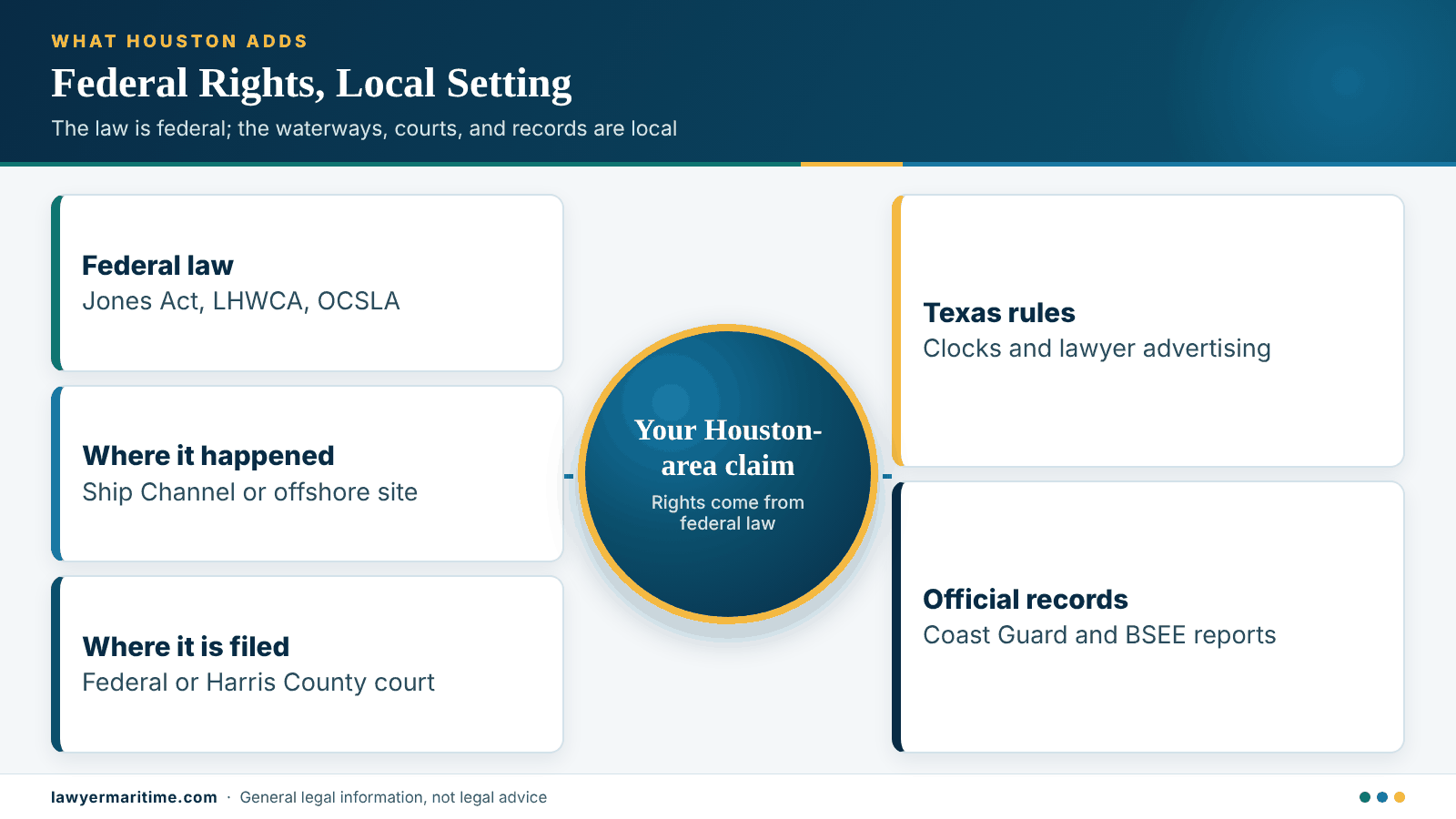
If you typed “maritime injury lawyer Houston” into a search box, you’re probably hurt, worried, and trying to work out whether being in Houston changes anything. Mostly it doesn’t change your rights, which come from federal maritime law, but it does change the practical setting. A seaman may bring a Jones Act claim under 46 U.S.C. § 30104, many harbor and terminal workers fall under the Longshore and Harbor Workers’ Compensation Act (LHWCA), and offshore workers may be covered by the Outer Continental Shelf Lands Act (OCSLA). What Houston adds is local: the Houston Ship Channel and Port Houston’s terminals, federal courts in the Southern District of Texas and the Fifth Circuit, Harris County’s state courts, and Texas rules on deadlines and lawyer advertising. This guide is for injured crew members, port and shipyard workers, offshore workers, and their families in the Houston area. It explains which law probably applies, where a case can be filed, which records matter, and which clocks may be running. It’s general information, not advice, and it doesn’t describe any firm’s office or service area.
How Does Houston Change a Maritime Injury Claim?
Houston changes the setting of a claim far more than the substance of it. The people, the waterways, the regulators, and the courts around you are local, while the rules that decide whether you can recover are largely federal. Getting your bearings means separating those two layers early.
What is the local setting for a Houston-area maritime claim?
Local context matters because it tells you who was likely on the scene, which records exist, and which defendants or agencies may be involved. It doesn’t tell you what law applies. Think of it as the map, not the rulebook.
Port Houston and the Houston Ship Channel
Port Houston says it owns and operates eight public facilities along the 52-mile Houston Ship Channel. Its site names the Bayport and Barbours Cut container terminals and a group of multi-purpose, breakbulk, and project-cargo facilities. Port Houston’s history page adds that the channel’s opening was marked on November 10, 1914, at the Turning Basin, the head of navigation.
The practical point is that a job along the channel can involve very different employers and structures. A dock, a terminal, a barge, and an industrial plant can sit within sight of each other, and the owner or operator of each may be a different company. Port Houston describes its own public facilities, so whether your site was one of them, or belonged to a private operator, is a fact to pin down early.
The regulators who investigate Houston-area casualties
The Coast Guard’s Sector Houston-Galveston describes an area of responsibility that starts at the east bank of the Colorado River in southwest Texas, runs north to the Texas-Oklahoma border, and extends 200 miles offshore. The Coast Guard also lists marine casualty investigations among the Sector’s work. For offshore energy facilities on the Outer Continental Shelf, the Bureau of Safety and Environmental Enforcement (BSEE) says it inspects rigs and platforms and investigates incidents involving injuries or pollution.
These agencies matter to you for one reason. Their reports, notices, and interview records can become evidence, and some of them are public. We’ll come back to how that works in the records section below.
What stays the same no matter where you were hurt?
Some points hold in every port. Knowing them keeps a local search from steering you toward the wrong assumptions.
There is no Houston version of federal maritime law
The seaman’s remedy in 46 U.S.C. § 30104, the duty to provide maintenance and cure, the vessel owner’s duty of seaworthiness, the LHWCA, and OCSLA all apply on the same terms in any federal court. What can differ by region is how a federal appeals court has interpreted them. For Texas, that court is the Fifth Circuit, which also covers Louisiana and Mississippi, so its decisions on seaman status and other issues are the ones Houston-area federal judges follow.
Your residence does not decide your rights, either. A worker who lives in the Houston area and is hurt on a vessel in another state’s waters, or a worker from elsewhere hurt on the Houston Ship Channel, is analyzed on the work, the craft, and the location of the incident.
What a local page can and can’t tell you
A page like this can explain the framework, show you where a Houston-area case may be filed, and flag the records worth keeping. It can’t tell you whether you are a seaman, whether a particular structure is a vessel, or whether you have a claim. Those answers depend on your work history and documents.
It also can’t speak for any particular law firm. This page does not state the firm’s service area or any office. If you need help beyond Houston, our guides to finding a maritime lawyer near you and to the New Orleans maritime market cover other Gulf Coast settings.
Which Maritime Law Covers Which Houston-Area Worker?
Houston-area maritime work spans vessels, docks, shipyards, plants beside the water, and offshore energy sites. Each setting can point to a different legal system, and the table below gives a first-pass map. It’s a starting point for a conversation with a lawyer, not a diagnosis.
| Work setting | Law that may apply | Question that usually decides it |
|---|---|---|
| Crew on a tug, towboat, supply boat, or dredge | Jones Act and maintenance and cure may be available | Do your duties and your connection to a vessel in navigation meet the seaman test? |
| Dock or terminal worker loading or unloading cargo | LHWCA often; a claim against a vessel may also exist | Do you meet the status and situs requirements, and were you a crew member instead? |
| Shipyard or ship-repair worker | LHWCA often; seaman status for some hybrid workers | Was your work on or near navigable water, and how much time did you spend aboard a vessel? |
| Offshore platform or rig worker | OCSLA, state law as surrogate federal law, LHWCA through OCSLA, or Jones Act | Is the site a vessel or a fixed structure, and where was the work done? |
| Plant or refinery contractor on land | Texas law or workers’ compensation, depending on the employer | Was the work over or next to navigable water in a way that reaches the LHWCA? |
How do vessel crews fit in?
Crew members are the group the Jones Act was written for, but status is never automatic. A deckhand, mate, engineer, or cook on a working vessel often has the strongest starting position, and a worker whose job is mostly ashore has the weakest. Most people fall somewhere in between, which is why the test matters.
The seaman test in plain English
The Supreme Court’s decisions in McDermott International, Inc. v. Wilander and Chandris, Inc. v. Latsis describe two parts. First, your duties must contribute to the function or mission of a vessel. Second, your connection to a vessel in navigation, or to an identifiable fleet of vessels, must be substantial in both duration and nature. Courts often use 30 percent of work time aboard as a rule of thumb, but Chandris treats it as a guideline, not a bright line.
In 2021 the en banc Fifth Circuit decided Sanchez v. Smart Fabricators of Texas, L.L.C., an appeal from the Southern District of Texas. The court asked whether the worker owed allegiance to a vessel or only to a shoreside employer, whether the work was sea-based, and whether the assignment was limited to a discrete task or included sailing with the vessel from place to place. It held that a land-based welder who did short repair jobs on jack-up drilling barges was not a seaman. Because Houston-area federal courts follow the Fifth Circuit, those questions frame many local status disputes.
Why the craft itself can be disputed
Seaman status requires a vessel. Under Stewart v. Dutra Construction Co., a vessel is a watercraft practically capable of being used for maritime transportation, and under Lozman v. City of Riviera Beach a reasonable observer must see the structure as designed to carry people or things over water. Tugs, barges, dredges, and supply boats usually raise few questions.
Rigs, platforms, and special-purpose craft raise more, and the label an employer uses does not settle the issue. A jack-up rig tied beside a dock, for example, can be analyzed differently from one moving between drilling sites. Whether a given craft is a vessel is a legal conclusion that depends on its design, current use, and case law, so this page doesn’t make it for you.
How do dock, terminal, shipyard, and plant workers fit in?
Workers whose jobs are tied to ships but based on land are usually analyzed under the LHWCA, a federal workers’ compensation system administered by the U.S. Department of Labor. Texas adds its own twist for workers outside the maritime systems entirely.
LHWCA status, situs, and claims against a vessel
The LHWCA, at 33 U.S.C. § 902(3), defines a covered employee as someone in maritime employment, including longshoring operations and harbor work such as ship repair and shipbuilding. Section 903(a) adds a location test: the injury must occur on navigable waters or on an adjoining pier, wharf, terminal, or similar area customarily used for loading, unloading, repairing, or building vessels. The statute excludes a ship’s master and members of a vessel’s crew, which is why a crew member’s remedies run through the seaman systems instead.
An LHWCA worker generally can’t sue the direct employer in tort. Section 905(b) does allow a negligence claim against a vessel, subject to limits written into that section. The Department of Labor’s longshore program lists a Houston suboffice among its district offices, and you should confirm with the Department which office handles your claim.
When Texas workers’ compensation rules enter the picture
Many plant and refinery jobs near the water are not covered by the LHWCA, and the injured worker’s rights come from Texas law. Texas treats workers’ compensation coverage as generally elective for employers, so some employers do not carry it. When a worker sues an employer without workers’ compensation coverage, Texas Labor Code § 406.033 removes certain defenses, such as contributory negligence and assumption of risk, but the worker must still prove the employer was negligent.
This matters in a maritime setting because the choice between a state-law claim and a maritime one is not always obvious at the start. A lawyer may need to sort out which system fits before anyone picks a filing date.
How do offshore energy workers fit in?
Offshore work out of Gulf Coast ports can fall under several regimes at once. The most reliable shorthand is that the structure and the job, not the company’s Houston address, decide where a worker lands.
OCSLA and the surrogate state-law rule
Under 43 U.S.C. § 1333(a)(1), federal law extends to the Outer Continental Shelf and to the artificial islands and installations attached to the seabed for developing resources. Section 1333(a)(2)(A) then adopts the law of the adjacent state as surrogate federal law where it is applicable and not inconsistent with federal law. In Union Texas Petroleum Corp. v. PLT Engineering, Inc., the Fifth Circuit described a three-part test: the dispute must arise on a covered site, federal maritime law must not apply of its own force, and the state law must not conflict with federal law.
Section 1333(b) separately extends LHWCA compensation to injuries from covered operations on the shelf, and it excludes masters and crew members. For areas off Texas, the adjacent state would generally be Texas, but that is a boundary question, not an assumption.
Hitch work, crew boats, and why labels mislead
Imagine a hypothetical worker who lives near Houston, works a rotating hitch on a fixed platform, and rides a crew boat to and from the site. The platform work may point toward OCSLA and LHWCA-style coverage, while the crew boat is a vessel and may raise a different question. If the worker also spends meaningful time aboard vessels, a seaman argument may be on the table.
Pay stubs that say “platform operator” or “contractor” do not end the analysis. The time spent on each type of structure, who controlled the work, and the Sanchez-style questions all feed into it. That’s why hitch schedules and assignment records are worth preserving early.
Where Can a Houston Maritime Injury Case Be Filed?
Maritime claims can often be heard in more than one place, and the choice is part of strategy. Federal district courts have original jurisdiction over admiralty and maritime cases under 28 U.S.C. § 1333, but that statute also saves to claimants other remedies they would otherwise have. For a Houston-area injury, that opens a federal path and a state-court path, plus an administrative path for LHWCA benefits.
| Forum | Generally used for | Practical note |
|---|---|---|
| U.S. District Court, Southern District of Texas, Houston Division | Admiralty and maritime claims, Jones Act suits, diversity cases, and limitation actions | Counties include Harris, Fort Bend, Montgomery, and Waller, among others in the Division |
| U.S. District Court, Southern District of Texas, Galveston Division | Similar federal matters tied to its counties | Covers Brazoria, Chambers, Galveston, and Matagorda counties, so the incident location can matter |
| Harris County district courts | Saved maritime claims, including Jones Act suits where the claimant elects a state court | Texas procedure applies, and defendants may try to move a case to federal court |
| U.S. Department of Labor, longshore program | Administrative claims for LHWCA compensation | Notice and claim periods are short, and the process differs from a lawsuit |
| Fifth Circuit and Texas courts of appeals | Appeals from federal and state trial courts | Fifth Circuit decisions bind Houston federal courts on federal maritime questions |
What federal courts cover the Houston area?
Federal filing typically means the Southern District of Texas and, on appeal, the Fifth Circuit. Knowing the geography prevents a common early mistake, which is assuming every Gulf Coast case belongs in the same courthouse.
The Southern District of Texas: Houston and Galveston Divisions
The Southern District of Texas has seven divisions: Brownsville, Corpus Christi, Galveston, Houston, Laredo, McAllen, and Victoria. Under 28 U.S.C. § 124, the Houston Division includes Austin, Brazos, Colorado, Fayette, Fort Bend, Grimes, Harris, Madison, Montgomery, San Jacinto, Walker, Waller, and Wharton counties. The Houston courthouse is the Bob Casey United States Courthouse at 515 Rusk Avenue.
The Galveston Division covers Brazoria, Chambers, Galveston, and Matagorda counties. That split can matter for an incident in Texas City, Galveston, or along the lower channel, because the proper division depends on venue rules and the facts. A federal admiralty plaintiff can also elect under Federal Rule of Civil Procedure 9(h) to proceed in admiralty, which generally means a bench trial, while a Jones Act claim carries a jury right.
The Fifth Circuit and why it shapes Houston cases
The Fifth Circuit hears appeals from federal district courts in Louisiana, Mississippi, and Texas, and its clerk’s office is in New Orleans. For a Houston case, the Fifth Circuit’s published opinions are binding precedent on federal maritime questions. Examples include Sanchez on seaman status, Gautreaux v. Scurlock Marine, Inc. on a seaman’s duty of care, and McCorpen v. Central Gulf Steamship Corp. on the defense that a seaman concealed a pre-existing condition when seeking maintenance and cure.
Other circuits can see these issues differently, so statements you read on a national website may not describe the Fifth Circuit’s rule. The same circuit also covers Louisiana, which is why a New Orleans maritime guide and this one will often cite the same appellate decisions.
How do Harris County courts and the saving clause fit in?
A Houston-area claimant is not always limited to federal court. The saving-to-suitors clause is the reason, and it is one of the most useful local-forum facts in maritime practice.
Saving to suitors, the Jones Act jury right, and removal
Section 1333(1) preserves to suitors “all other remedies to which they are otherwise entitled.” Section 30104 gives a seaman the right to elect a civil action at law with a jury trial, and the FELA provisions it incorporates allow suit in state or federal court. In Lewis v. Lewis & Clark Marine, Inc., the Supreme Court noted that Jones Act claims are generally not removable from state court.
The Fifth Circuit has recognized an important limit. In Burchett v. Cargill, Inc., it affirmed the denial of a motion to remand where the structure at issue was held not to be a vessel as a matter of law, so the plaintiffs could not establish a Jones Act claim. A defendant who can show a seaman claim has no real possibility of succeeding may therefore succeed in moving the case to federal court.
Harris County district courts and Texas appeals
Harris County’s civil district courts decide personal-injury cases, and the District Clerk’s civil offices are at 201 Caroline in Houston. The Texas First and Fourteenth Courts of Appeals both sit at 301 Fannin in Houston, and each serves a ten-county region that includes Harris, Galveston, Brazoria, Chambers, and Fort Bend counties.
A state court hearing a saved maritime claim generally applies its own procedure but must respect federal maritime substantive law. Choosing a Harris County court over a federal one is a strategic decision about jury pools, timing, and the risk of removal, and no forum guarantees an outcome. Our admiralty law hub explains the saving clause in more depth.
What is a limitation of liability action and why does it matter locally?
Vessel owners can ask a federal court to cap their liability, and that filing can change where and how your claim proceeds. Houston-area injuries on the water can trigger these filings in the Southern District of Texas.
The six-month filing window
Under 46 U.S.C. § 30529, a vessel owner may file a civil action in federal district court to limit liability, and the filing must come within six months after a claimant gives the owner written notice of a claim. Supplemental Rule F governs the procedure. Once the owner deposits the required fund or security, related claims and proceedings against the owner over the same matter must generally stop while the court sets a deadline for claimants to come forward.
If you receive a federal notice about a limitation action, treat it as a deadline document. Missing the court’s claim deadline can cost you rights you would otherwise have, so take it to a lawyer promptly.
How Lewis keeps state-court options alive
Lewis addressed the tension between the Limitation Act and the saving clause. The Court held that a claimant may proceed in state court if the federal court’s protection of the owner’s right to seek limitation is preserved. The claimant there stipulated that his claim was worth less than the limitation fund and agreed the owner could relitigate limitation in federal court.
Single-claimant cases and cases with adequate stipulations are the classic examples. When several claimants are competing for a limited fund, the federal court may keep the whole dispute. Our guide to maritime accident attorneys explains how liability is built across defendants.
What Records and Investigations Matter Around Houston Waters?
Maritime cases are won and lost on records, and many of them sit with employers, vessel operators, and agencies rather than with you. Part of the work is knowing which records exist, who holds them, and which ones you can start preserving today. The table below sorts the usual suspects.
| Record | Who may hold it | Why it matters |
|---|---|---|
| Marine casualty investigation reports | U.S. Coast Guard; searchable through the Coast Guard’s CGMIX and report pages | Facts about vessel casualties, though use in court can be limited |
| Offshore incident investigation records | BSEE for Outer Continental Shelf facilities; the operator and contractors | Cause, equipment, and safety-management context for rig and platform injuries |
| Crew, hitch, and assignment schedules | You, your employer, the vessel operator | Shows duration and nature of vessel connection for status |
| Vessel logs, maintenance, and safety records | Vessel owner or operator | Supports negligence and unseaworthiness theories |
| Pay stubs, tax forms, and employment contracts | You and your employer | Identifies the true employer and wage base |
| Medical records and symptom notes | Providers and you | Links the injury to the incident and documents treatment |
Which official investigations should you know about?
Two sets of regulators dominate the Houston-area picture: the Coast Guard for vessels and offshore casualties, and BSEE for offshore energy facilities. Their reports can help you understand what happened, even when the rules limit how they are used in a lawsuit.
Coast Guard casualty reporting and investigations
Under 46 CFR 4.05-1, the owner, operator, master, or person in charge of a covered vessel or offshore unit must notify the nearest Coast Guard office immediately after addressing safety concerns following certain marine casualties. The triggers include loss of life, an injury requiring professional medical treatment beyond first aid, and, for a person working on a commercial vessel, an injury that leaves the person unable to perform routine duties. They also include property damage above $75,000 and significant environmental harm.
The Coast Guard publishes reports of investigation, including for outer continental shelf casualties, on its Marine Casualty Reports page and through CGMIX. Section 6308 of Title 46 generally limits the use of a Coast Guard casualty investigation report as evidence in civil proceedings, with exceptions for proceedings initiated by the government. That means the report is a map to the facts, while the underlying witnesses, logs, and physical evidence still have to be located and obtained.
BSEE and offshore energy incidents
BSEE says its Gulf of America regional office, based in New Orleans, regulates offshore oil and gas activity from exploration through decommissioning. Its listed work includes inspecting drilling rigs and production platforms, reviewing operators’ safety and environmental management systems, and investigating incidents involving injuries or pollution. Federal agencies now use the name Gulf of America for the waters long called the Gulf of Mexico, so both names show up in sources.
For a worker, the practical value is that an operator or contractor may have reported the incident, and an agency may have looked into it. A lawyer can sometimes obtain records through public-records requests or through discovery in a case, but the process and timing vary. If your injury happened on an offshore structure, note the facility name, the operator, and the date so those records can be traced.
What records can you start preserving yourself?
Agencies take time, and employers hold their own records. The documents in your control are the ones you can protect today, and they’re often the same ones that decide your legal category.
Proving what your job really was
Status disputes are won on work history, which is why a calendar of where you worked matters. Keep pay stubs, W-2 or 1099 forms, offer letters, crew lists, hitch or rotation schedules, and any messages assigning you to a particular vessel or platform. If your employer called you by one title while you did another kind of work, record the real duties and who directed them.
Consider a hypothetical worker who spent three weeks in one month aboard a supply boat and the next month on a fixed platform. The mix of time by craft, not the paperwork title, is what the Chandris and Sanchez analyses examine. A simple written timeline created from your memory and pay records, shared only with your lawyer, can fill gaps.
The scene, the witnesses, and the medical trail
Photographs of the area, equipment, and your injuries are valuable, especially when taken before conditions change. Write down the names and contact information of anyone who saw the incident or knew about the conditions, along with the date, location, vessel or facility name, and weather. Keep every medical record, prescription, and bill, and note symptoms and missed work in a dated log.
Be careful with social media. Posts, photos, and messages can be pulled into a dispute and read without context, so avoid discussing the incident or your recovery online. Our maritime collision investigation guide goes deeper on how investigators reconstruct what happened on the water.
Which Deadlines Can Matter in a Houston Case?
Deadlines are the most dangerous part of a maritime claim because the right one depends on your category, the forum, and the facts. The table collects the periods most likely to come up in a Houston-area case, each with a caveat. None of them should be treated as your personal deadline without legal review.
| Clock | Source | General period | Caveat |
|---|---|---|---|
| Maritime tort injury or death suit | 46 U.S.C. § 30106 | Three years after the cause of action arose | “Except as otherwise provided by law,” so claim-specific rules can change it |
| Jones Act seaman suit | 46 U.S.C. § 30104 and 45 U.S.C. § 56 | Three years after the cause of action arose | Incorporates the FELA period; confirm how it applies to your facts |
| LHWCA notice of injury | 33 U.S.C. § 912(a) | 30 days, with a knowledge-of-relationship rule | Exceptions exist, but late notice invites a fight |
| LHWCA claim for compensation | 33 U.S.C. § 913(a) | One year, with a related-to-employment awareness rule | Payments of compensation can affect the period |
| Vessel owner’s limitation action | 46 U.S.C. § 30529 | Owner must file within six months of written claim notice | Triggers court-set deadlines for claimants |
| Texas state-law personal injury suit | Tex. Civ. Prac. & Rem. Code § 16.003 | Two years after the cause of action accrues | Does not automatically govern a maritime claim |
What federal clocks apply to maritime injury claims?
Federal law supplies the best-known periods, but they sit beside shorter, procedure-specific ones. Seeing them side by side helps explain why waiting to “see how it goes” is risky.
The three-year period for many maritime suits
Section 30106 of Title 46 says a civil action for damages for personal injury or death arising out of a maritime tort must be brought within three years after the cause of action arose, unless other law provides otherwise. For a Jones Act claim, the incorporated FELA provision, 45 U.S.C. § 56, sets a three-year period for suits that can be filed in either state or federal court. Death claims under the Death on the High Seas Act apply to deaths beyond three nautical miles from the U.S. shore, and their timing is discussed in our DOHSA claim deadline guide.
Three years is an outer boundary for suit, not a plan. Evidence, witness memories, and vessel records fade much faster, and some benefits, such as maintenance and cure, are meant to be paid while treatment is ongoing. Our maritime injury compensation guide covers those benefits.
Short LHWCA notice and claim periods
The LHWCA moves faster. Section 912(a) calls for written notice of the injury within 30 days after the injury, or within 30 days after the worker knew or should have known the injury was related to the job. The notice goes to both the deputy commissioner for the compensation district and the employer. Section 912(d) excuses a late notice in several situations, including where the employer already knew of the injury or was not prejudiced.
Section 913(a) separately bars a claim for compensation unless it is filed within one year of the injury or death, and the period does not start until the worker knows or reasonably should know the injury relates to employment. If compensation was paid without an award, the period can run from the last payment. Because the exceptions are fact-specific, relying on them is a gamble you don’t need to take.
What Texas and other clocks can differ?
Some clocks come from Texas law, a court order, or a contract. They’re easy to miss because they sit outside the maritime statutes.
The Texas two-year period and why the label matters
Under Texas Civil Practice and Remedies Code § 16.003, personal-injury suits and suits for injury resulting in death generally must be filed within two years after the cause of action accrues, and a death claim accrues at death. That period applies to many state-law claims, such as a land-based plant worker’s negligence claim against a Texas employer.
Whether the two-year state period or the three-year federal maritime period governs a claim filed in a Harris County court depends on whether the claim is a maritime one, and that in turn depends on the category and facts. A prudent approach is to calendar the shorter possible clock until a lawyer resolves the question.
Limitation actions, releases, and contract terms
A vessel owner’s six-month window to file a limitation action, discussed above, produces court-set deadlines for claimants that can be shorter than any statute of limitations. Separately, employers and insurers sometimes present releases or settlement papers early. Seamen are often called “wards of admiralty,” and the Supreme Court in Garrett v. Moore-McCormack Co. placed the burden on the shipowner to show a seaman’s release was executed freely and with full understanding. Our maritime settlement release guide explains what to review before signing.
Passenger tickets, employment contracts, and union agreements can also set notice or filing terms. Those are matters of contract, and a lawyer should read them before you assume any period applies or doesn’t.
How Do You Evaluate a Maritime Injury Lawyer in Houston?
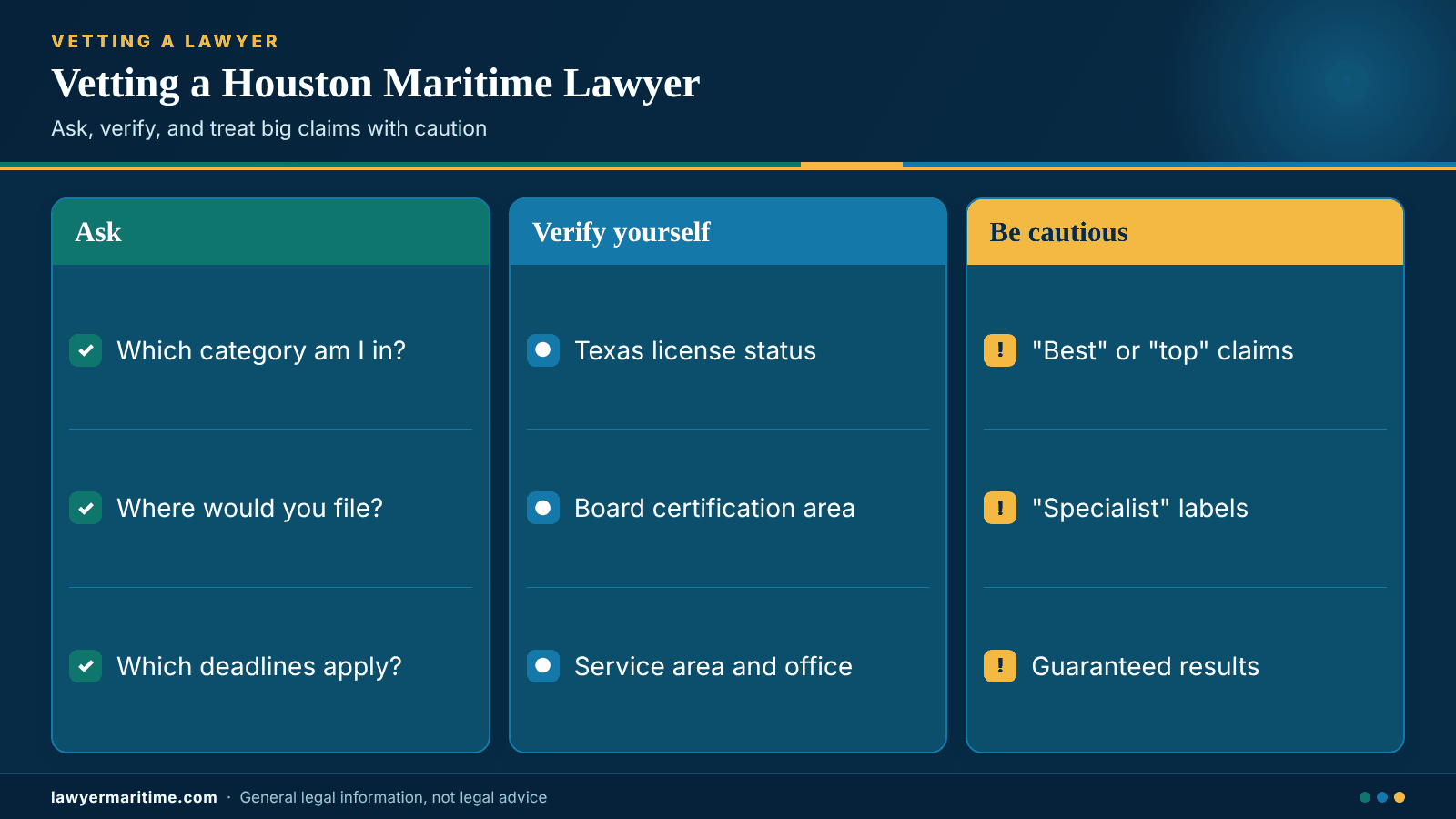
A search for a local lawyer produces many websites that sound alike. The useful questions are about substance: what the lawyer can verify, which forums the lawyer works in, and how the lawyer will handle the status and clock issues above. This section gives you a Texas-specific way to test claims without relying on any marketing language, including this site’s.
| Question | Why it matters | What a grounded answer sounds like |
|---|---|---|
| Which category do you think I’m in, and why? | Status decides the remedies and the forum | Explains the legal test and what documents would support it |
| Where would you file, and what are the risks? | Federal court, Harris County, or an LHWCA claim lead to different paths | Discusses removal, venue, the Houston and Galveston Divisions, and tradeoffs without guarantees |
| Which deadlines are you calendaring for me? | Short LHWCA and Texas periods can pass early | Names specific clocks and says what facts could change them |
| Are you licensed in Texas and admitted to the court where my case may be filed? | Court admission and licensing govern who can appear | Gives a direct answer you can check against public records |
| How are fees and costs handled? | Fee terms should be clear before you commit | Provides terms in writing |
How do Texas rules shape what lawyers can say about themselves?
Texas regulates lawyer advertising through Part VII of the Texas Disciplinary Rules of Professional Conduct. Knowing the outline helps you spot claims that deserve a closer look.
The core rules behind a lawyer’s website and ads
Under the Texas rules, communications about a lawyer’s services must be truthful and not misleading, whether through what they say or what they leave out. The rules restrict statements that create unjustified expectations about results and require comparisons with other lawyers to be verifiable and objective. They also address how a lawyer may designate an area of practice and how specialist claims are made.
Texas also requires many lawyer websites and public-media advertisements to be filed with the State Bar’s Advertising Review Committee, with certain categories exempt. That is a compliance duty for the lawyer, not something you need to check, but it explains why careful firms keep their claims plain. ABA Model Rules 7.1 to 7.3 set a similar baseline in other states.
Results, comparisons, and board certification
Be cautious with phrases such as “best,” “top,” “leading,” or “specialist.” In Texas, lawyers are generally restricted from advertising themselves as specialists, but a lawyer may state certification from the Texas Board of Legal Specialization (TBLS) in the prescribed form, and credentials from other groups are allowed only in limited circumstances. If a website cites a TBLS certification, check the area it covers on TBLS’s lawyer search rather than assuming it relates to maritime work.
Past results can be advertised only under conditions, and a prior result doesn’t predict yours. A page that lists large numbers with no context, or that promises compensation, is a warning sign. Our guide to choosing the best maritime lawyer covers selection criteria in more detail.
Does a lawyer need a Houston office to handle your claim?
Not necessarily, because federal maritime law is the same everywhere and many maritime clients are in transit, offshore, or in different states. What matters is whether the lawyer can appear in the court where your case belongs, and whether you can communicate easily.
Service area and office facts to confirm
This page is intentionally silent about where any firm is based or where it takes cases. When you contact any firm, ask where its lawyers are licensed, whether it has an office in Houston or serves the area remotely, and which lawyer will actually handle your matter. Check the answer against the State Bar of Texas’s attorney directory.
If an advertisement shows a Houston skyline or uses “Houston” in a business name, that tells you nothing by itself. The Texas rules say a firm name may not be misleading about who practices under it, so ask for the facts in writing.
Fifth Circuit and forum experience
Ask whether the lawyer regularly handles the kind of claim that fits your category, such as seaman claims, LHWCA claims, or offshore matters, and whether the lawyer has litigated in the Southern District of Texas or Harris County. Experience with Fifth Circuit law on seaman status, vessel classification, and the saving clause can influence how a case is framed from the start.
You can also bring documents to a first meeting and ask how the lawyer would sort them. Our guide to preparing for a maritime lawyer consultation lists what to bring.
What Should You Do Now After a Houston-Area Injury?
Whatever your category turns out to be, the first days follow a similar pattern. Protect your health, document the facts, and slow down on paperwork. The steps below don’t depend on a particular lawyer or court.
What belongs in the first few days?
Early choices shape both your recovery and your record. Most of them cost nothing and can be done before you speak with anyone about a claim.
Medical care and written reporting
Get medical attention, and tell the provider how the injury happened and what duties you were performing. Report the injury to your employer, master, or supervisor in writing, keep a copy, and ask for a copy of any incident report. A written report matters under the LHWCA, which calls for notice within 30 days in the usual case, and it creates a dated record in every other setting.
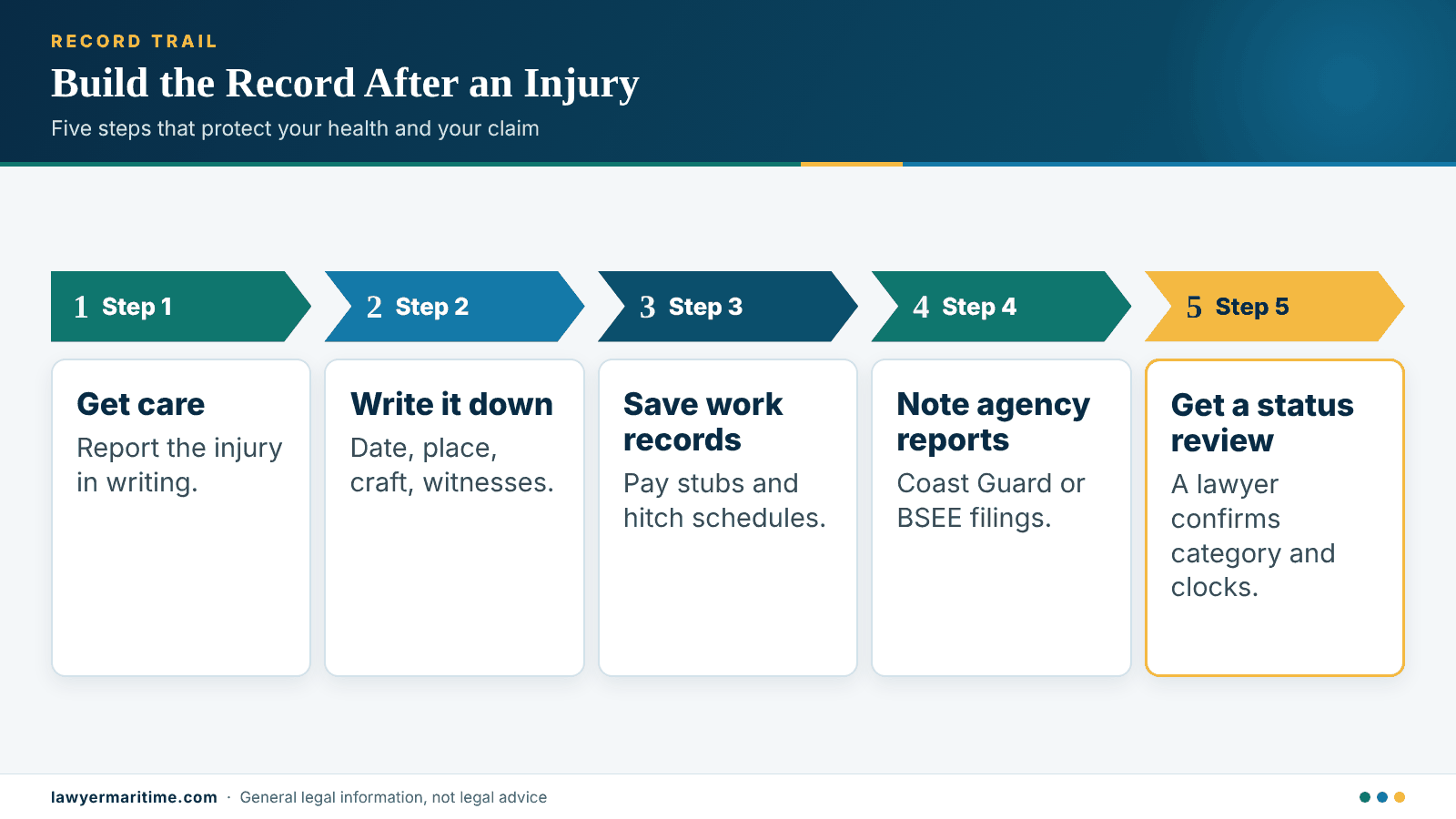
- Get care. Follow the provider’s advice and keep appointments and records.
- Report in writing. Tell your employer or the vessel’s master what happened, and keep a copy.
- Record the facts. Note the date, time, place, craft or facility, witnesses, and conditions.
- Save work records. Keep pay, schedule, and assignment documents.
- Get a status review. Ask a maritime lawyer which category and clocks apply.
Statements, forms, and calls from insurers
Insurers and claims representatives may call quickly, sound friendly, and ask for a recorded statement. In many situations you can ask to speak with a lawyer first, and doing so is reasonable. Read any form that describes your job, your injury, or your health history before signing, because a careless description can be used against you later.
Don’t sign a release or accept a payment labeled as final without legal advice. Early offers may not reflect your full medical picture or lost earnings, and releases can be difficult to undo. Our maritime settlement release guide covers the fine print.
Which mistakes weaken Houston-area claims?
Most avoidable problems fall into a few patterns. The table pairs each with a better move.
Common mistakes and better moves
| Mistake | Why it hurts | Better move |
|---|---|---|
| Assuming Houston residence decides your rights | Status and location control the law, not where you live | Document your duties, craft, and where the work took place |
| Waiting to give written notice | LHWCA notice and claim periods are short | Report in writing and keep a copy |
| Giving a recorded statement without advice | Offhand answers can be quoted out of context | Ask to consult a lawyer first |
| Posting about the incident online | Posts can be used to dispute injuries or facts | Keep details private and save what you do post |
| Choosing a lawyer from an ad alone | Marketing claims may not reflect experience | Verify license, forum experience, and service area |
The table covers the usual pitfalls, but your situation may add others. A status review is the best way to find them.
When to bring in a maritime lawyer
Many people speak with a lawyer when they’re unsure of their category, when an insurer is pressing for a statement or release, or when benefits are delayed or denied. Doing it early can help you identify the right clocks and avoid conflicting statements. It doesn’t commit you to filing anything.
If you were hurt as a passenger or recreational boater instead of as a worker, different rules apply, and our maritime injury attorney guide sorts the categories. For the broader legal landscape, see maritime law and the maritime lawyer hub.
Frequently Asked Questions
These answers are general. Your category, your facts, and the forum may change the result.
Local law and courts
Does Houston have its own maritime law?
No. Maritime injury rights come from federal statutes and federal maritime law, plus Fifth Circuit decisions that bind federal courts in Texas. What differs locally is the setting: the ports and waterways, the Southern District of Texas and Harris County courts, and Texas rules on matters such as state-law deadlines.
Can I file a Jones Act case in a Harris County court?
A seaman may be able to, because the saving-to-suitors clause and the FELA provisions behind the Jones Act allow suit in state or federal court, and Jones Act cases are generally not removable. A defendant may still argue that no real seaman claim exists, so forum choice should be reviewed by a lawyer.
Which federal court would hear a case from Galveston or Texas City?
Galveston, Brazoria, Chambers, and Matagorda counties are in the Galveston Division of the Southern District of Texas, while Harris and the other counties listed in 28 U.S.C. § 124 are in the Houston Division. The right court depends on venue rules and the facts, so a lawyer should confirm it.
Workers and status
Am I a seaman if I work on the Houston Ship Channel?
Not automatically. Seaman status turns on whether your duties contribute to a vessel’s mission and whether your connection to a vessel in navigation is substantial in duration and nature. Many channel jobs are land-based and fall under the LHWCA or Texas law instead.
I work offshore out of the Gulf Coast. Which law covers me?
It may be the Jones Act, OCSLA, the LHWCA through OCSLA, or state law as surrogate federal law, depending on whether you served aboard a vessel or on a fixed structure and how much time you spent on each. Records of your assignments help answer that question.
Does it matter that my employer is based in Houston?
It can matter for practical reasons, such as where records are kept or where a defendant can be sued. It generally doesn’t decide which body of law governs your injury. That depends on your work, the craft or structure, and the place of the injury.
Deadlines and lawyers
How long do I have to file a maritime injury claim in Texas?
There isn’t one universal answer. Many maritime tort suits have a three-year federal period under 46 U.S.C. § 30106, LHWCA notice and claim periods are much shorter, and a Texas state-law injury claim generally carries a two-year period. A lawyer can identify the clocks that apply to you.
Do I need a lawyer with a Houston office?
Not necessarily. Federal maritime law is the same across the country, so the key questions are whether the lawyer is licensed in Texas, can appear in the right court, and has experience with your type of claim. Verify service area and office claims directly.
Can a lawyer tell me what my case is worth at the first meeting?
A careful lawyer can explain the kinds of recovery that may apply and the factors that affect them. No honest lawyer can promise a result at the start. For the categories of recovery, see our maritime injury compensation guide.
Sources and Legal Authorities
The authorities below support the legal and local statements in this guide. Each should be checked against current text before you rely on it.
Statutes and regulations
Federal statutes and rules
- 46 U.S.C. § 30104 – Jones Act personal injury and death of a seaman
- 46 U.S.C. § 30106 – Time limit on maritime actions for personal injury or death
- 46 U.S.C. § 30302 – Death on the High Seas Act, application
- 46 U.S.C. § 30529 – Action by owner for limitation of liability
- 46 U.S.C. § 6308 – Marine casualty investigation reports
- 45 U.S.C. § 56 – FELA limitation of actions and venue
- 28 U.S.C. § 1333 – Admiralty jurisdiction and saving to suitors
- 28 U.S.C. § 1445 – Nonremovable actions
- 28 U.S.C. § 124 – Texas judicial districts and divisions
- Supplemental Rule F – Limitation of liability
- 33 U.S.C. § 902 – LHWCA definitions, § 903 – coverage, § 905 – exclusiveness of liability, § 912 – notice of injury, and § 913 – filing of claims
- 43 U.S.C. § 1333 – OCSLA laws applicable to the Outer Continental Shelf
Regulations and Texas law
- 46 CFR 4.05-1 – Notice of marine casualty
- Texas Civil Practice and Remedies Code ch. 16, § 16.003 – Two-year limitations period
- Texas Labor Code ch. 406, §§ 406.002 and 406.033 – Workers’ compensation coverage and nonsubscriber suits
- Texas Disciplinary Rules of Professional Conduct, Part VII – Information about legal services
Cases and agency materials
Supreme Court and federal appellate decisions
- Chandris, Inc. v. Latsis, 515 U.S. 347 (1995) – seaman status test and the 30 percent guideline
- McDermott International, Inc. v. Wilander, 498 U.S. 337 (1991) – contribution to a vessel’s function or mission
- Stewart v. Dutra Construction Co., 543 U.S. 481 (2005) – definition of a vessel
- Lozman v. City of Riviera Beach, 568 U.S. 115 (2013) – reasonable-observer view of a vessel
- Lewis v. Lewis & Clark Marine, Inc., 531 U.S. 438 (2001) – saving clause and limitation actions
- Garrett v. Moore-McCormack Co., 317 U.S. 239 (1942) – burden on shipowner regarding a seaman’s release
- Sanchez v. Smart Fabricators of Texas, L.L.C., No. 19-20506 (5th Cir. May 11, 2021) (en banc) – Fifth Circuit seaman-status inquiries
- Union Texas Petroleum Corp. v. PLT Engineering, Inc., 895 F.2d 1043 (5th Cir. 1990) – OCSLA surrogate state-law test (checked against a reporter copy; no official link)
- Burchett v. Cargill, Inc., 48 F.3d 173 (5th Cir. 1995) – removal of a Jones Act claim (checked against a secondary summary; no official link)
- Gautreaux v. Scurlock Marine, Inc., 107 F.3d 331 (5th Cir. 1997) (en banc) and McCorpen v. Central Gulf Steamship Corp., 396 F.2d 547 (5th Cir. 1968) – cited from the site’s authority matrix, not separately fetched
Agency and official local materials
- Port Houston – overview of public facilities and the Houston Ship Channel
- Port Houston – background and history of the Houston Ship Channel
- U.S. Coast Guard – Sector Houston-Galveston
- U.S. Coast Guard – Marine Casualty Reports
- BSEE – Gulf of America Regional Office
- U.S. Department of Labor – Longshore program contacts
- U.S. District Court, Southern District of Texas
- U.S. Court of Appeals for the Fifth Circuit – about the court
- Texas First Court of Appeals and Fourteenth Court of Appeals
- Harris County District Clerk – civil court information