A Jones Act attorney is a lawyer who handles injury and death claims by seamen under 46 U.S.C. § 30104, along with the maintenance and cure and unseaworthiness claims that usually travel with them. For most injured crew members, the practical question is not whether to talk with one but when. As a general rule, the right time is before you sign, record, or concede anything that could shape your claim, and that moment tends to arrive sooner than people expect. It may come after a serious injury, when an adjuster asks for a recorded statement, when maintenance and cure slows down, or when you’re told you’re unfit for duty or handed a release. This page is for injured seamen and their families. It explains the situations that usually call for legal help, what early advice can change, what you can safely do on your own in the meantime, and what a first conversation covers. It describes general rules rather than advice on your facts, and it can’t promise any result.
When Should an Injured Seaman Talk to a Jones Act Attorney?
Hiring a lawyer is a decision, not an emergency, but timing still matters in seaman cases. A few events in the weeks after an injury are hard to reverse once they happen. This section explains the logic of timing before the next sections list the specific triggers.
Is there a right moment to get legal help?
Why earlier usually beats later
A seaman’s claim has several parts that start at different moments. Maintenance and cure, the no-fault right to a living allowance and medical care, begins when you’re hurt or fall ill in the ship’s service. A negligence claim under the Jones Act depends on what the evidence shows about the employer’s conduct, and that evidence changes fast. Crews rotate, equipment gets repaired, and memories fade.
A lawyer who is involved early can ask the employer to preserve records, check that the first injury report says what actually happened, and help keep your medical file organized. None of that is dramatic. It is housekeeping that is hard to do well months later.
Early involvement also changes how the other side handles the file. Employers and their insurers see many injuries, and they have routines for statements, medical review, and settlement. Knowing how those routines work before you’re inside one helps you decide which requests to meet, which to postpone, and which to decline politely.
Why people wait, and what waiting can cost
Waiting is understandable. Many seamen worry that calling a lawyer will cost them a berth or a relationship with a captain they respect. Others assume the company will do the right thing because maintenance and cure payments are arriving on schedule. Some simply want to see whether the injury heals.
Those reasons are real, and for a minor injury that is resolving, waiting may be reasonable. The risks come from the cases that don’t resolve cleanly. Evidence disappears, early statements get locked in, and offers appear when you’re financially stretched. A three-year period applies to many maritime injury suits under 46 U.S.C. § 30106, but that statute begins with “except as otherwise provided by law,” and other clocks can be shorter. Our guide to possibly missed maritime injury deadlines explains how those clocks differ.
Here is the practical takeaway. Talking with a lawyer doesn’t file a claim or commit you to anything. Waiting can quietly close options.
Does this page apply to your situation?
Which “Jones Act” are we talking about?
People use the same nickname for two unrelated things. This page is about the seaman’s personal injury and death remedy in 46 U.S.C. § 30104. That statute lets an injured seaman, or the personal representative of a seaman who dies from the injury, elect to bring a civil action at law against the employer, with the right to a jury trial. It also applies the federal laws that govern recovery by railway employees, which is why Jones Act cases borrow so much from the Federal Employers’ Liability Act.
The other “Jones Act” is the cabotage rule found at 46 U.S.C. § 55102 and nearby sections, which generally limits who may carry merchandise between U.S. points. News about “Jones Act waivers” concerns that shipping law, not injury claims. For the statute itself, start with our Jones Act guide.
What if you aren’t sure you are a seaman?
Only a seaman can sue under § 30104, and a job title doesn’t decide status. In Chandris, Inc. v. Latsis, 515 U.S. 347 (1995), the Supreme Court described two requirements. Your duties must contribute to the function of a vessel or the accomplishment of its mission, and your connection to a vessel in navigation, or to an identifiable group of vessels, must be substantial in duration and in nature. The Court offered about 30 percent of working time in the service of a vessel as a rule of thumb, not a bright line.
Congress has also carved certain aquaculture workers with access to state workers’ compensation out of the statute’s definition of “seaman” in § 30104(b). If you work on or near vessels and can’t tell which system covers you, that uncertainty is itself a reason for an early opinion. The answer affects which benefits to request, which forms to file, and what to avoid signing. Our pages on who maritime law covers and the full seaman remedy stack go further.
Which Situations Call for Legal Help Right Away?
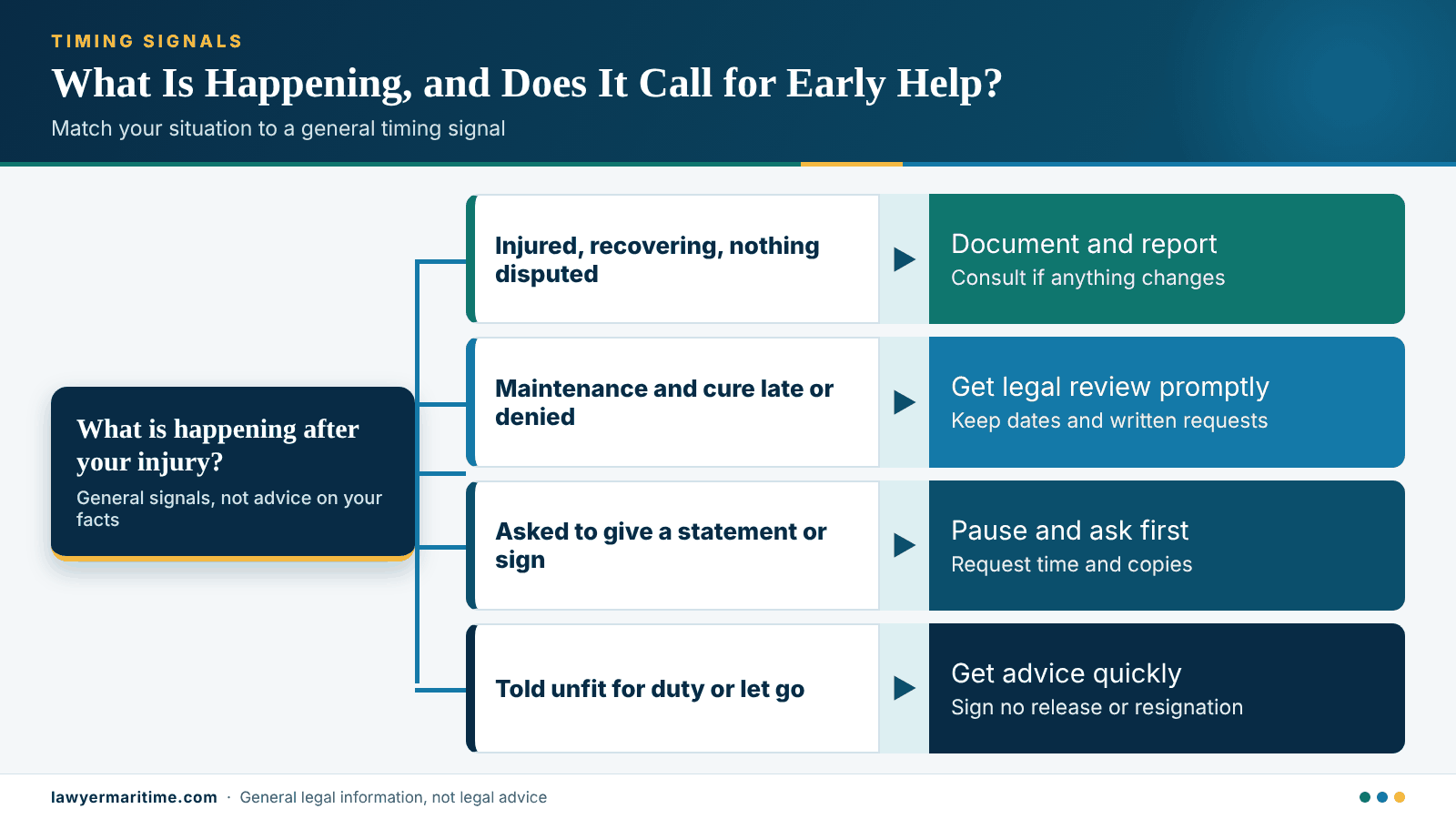
Not every injury needs a lawyer on day one. The situations below are the ones where the next step is hard to reverse or where the other side’s position is likely to harden. A table at the end of this section puts them side by side with a plain next move.
Medical and recovery triggers
Serious injury, surgery, or a long recovery
An injury that needs surgery, leaves lasting restrictions, or keeps you off the vessel for months raises the stakes of every later decision. Future medical care, lost earning capacity, and the possible end of a seagoing career are not questions the first incident report was written to answer. Damages in a Jones Act case may reach those losses when fault or unseaworthiness is proven, so early choices about documentation matter.
Surgery also raises practical questions. Who is paying, which surgeon will operate, whether a second opinion is available, and whether treatment is being routed through the employer’s preferred providers? Rules about who chooses the treating doctor vary by court and sometimes by crew agreement. A lawyer can’t practice medicine, but one can help protect your ability to get the care your own doctors recommend and to document why it is needed.
Employer-scheduled exams and medical disputes
Employers and insurers often request an independent medical examination, or IME, which is an exam by a doctor they select. The name suggests neutrality, but the examiner is typically retained by the side that asked. Whether you must attend before a lawsuit is filed usually depends on your employment terms and how the request is made.
Once a case is pending in federal court, Federal Rule of Civil Procedure 35 governs. A court may order an exam only on motion and for good cause, after notice, and the examiner must provide a written report. Findings from any exam can feed the company’s position on maximum medical improvement, or MMI, the point at which further treatment is not expected to improve the condition and maintenance and cure generally ends. Ask a lawyer whether to attend, what to bring, and how to obtain the report. Don’t skip your own medical appointments out of frustration, because gaps in treatment are easy to misread.
Pay and job triggers
Maintenance and cure that is late, reduced, or denied
Maintenance and cure is the employer’s obligation to pay a daily living allowance (maintenance) and cover medical treatment (cure) for a seaman who falls ill or is injured in the service of the ship. It is owed without proving anyone was at fault. In Farrell v. United States, 336 U.S. 511 (1949), the Supreme Court explained that the duty ends when the seaman has been cured as far as possible or the incapacity is declared permanent.
When payments are late, cut, or stopped, the cause is often a disagreement about MMI, a claim that a condition pre-existed, or a dispute over the rate. The Supreme Court has allowed attorney’s fees as damages where a failure to pay was callous and persistent, in Vaughan v. Atkinson, 369 U.S. 527 (1962). In Atlantic Sounding Co. v. Townsend, 557 U.S. 404 (2009), it held that punitive damages are available for a willful or wanton refusal to pay.
Those remedies depend on facts and on a record of written requests, medical notes, and dates. That is why a denial is a strong reason to get help early. Our guide to maintenance and cure denials covers the remedies in depth, and this page only flags the timing.
Unpaid wages, termination, and “unfit for duty”
Seamen are sometimes told they’re not fit for duty, removed from a crew list, or let go after reporting an injury. A company doctor’s fitness-for-duty finding can end a job and may later be used to argue that your disability is smaller than you say. Wages can also be in play, because maintenance and cure generally includes unearned wages through the end of the voyage or engagement.
Congress has protected seamen from discharge or discrimination for certain activities, including notifying the vessel owner of a work-related injury or illness. That protection is in 46 U.S.C. § 2114(a)(1)(E), and a complaint under it follows its own procedures and filing requirements. If you think you’re being punished for reporting an injury, ask about those procedures promptly instead of assuming there is time.
Pressure and paperwork triggers
Requests for recorded statements or signed incident accounts
After an injury, the company or its insurer may ask for a recorded statement or a written account. A basic factual report is normal and you should give one promptly: what happened, when, where, and who saw it. A detailed recorded interview is different. Adjusters ask open-ended questions about prior injuries, hobbies, and how you feel, and the answers become part of the record.
Statements given while you’re medicated, exhausted, or in pain can be quoted back later in ways you didn’t intend. Ask for a copy of anything you sign, don’t guess about details you don’t know, and consider having a lawyer look first. Our guide to the Jones Act claim process covers the steps around reporting.
Releases and early settlement offers
A release is a document in which you give up claims in exchange for payment. Admiralty courts have long treated seamen as “wards of admiralty.” In Garrett v. Moore-McCormack Co., 317 U.S. 239 (1942), the Supreme Court held that the party relying on a seaman’s release must show it was executed freely, without deception or coercion, and with full understanding of the seaman’s rights.
That protection is real, but it is not a reason to sign now and sort it out later. A release can still be hard to undo, disputing one is costly, and courts look at the adequacy of the payment and the advice you had when you signed. Payment letters and checks sometimes carry release language, so read what you’re endorsing. Our page on maritime settlement releases explains what a release can give up.
| Situation | Why timing matters | What to do now |
|---|---|---|
| Surgery or a long recovery is recommended | Future care, earning capacity, and the choice of surgeon are decided early. | Follow your doctors’ advice, keep records, and ask a lawyer about care and documentation. |
| Adjuster asks for a recorded statement | Detailed answers get fixed in the file before your medical picture is clear. | Give a basic injury report, then ask for time to consult counsel. |
| Employer schedules an IME | The report can shape the MMI date and the dispute over disability. | Ask in writing who, where, and what; request the report; get advice on attending. |
| Maintenance and cure is late, reduced, or denied | Fee and punitive remedies depend on a record of demands and the reason for refusal. | Document dates and amounts, make written requests, and get legal review promptly. |
| You’re told you’re unfit or let go | Job loss, pay, and benefits are all in play, and retaliation rules have their own procedures. | Keep every notice, don’t sign a resignation or release, and get advice quickly. |
| A release or check is offered | A signed release can be hard to undo even with admiralty’s protective rule. | Don’t sign or endorse until a lawyer has read it. |
| The company cites a pre-existing condition | Concealment defenses turn on what was asked and answered at hiring. | Gather your hiring medical forms and prior records; get advice before further statements. |
| Injury on a foreign-flag vessel or in a foreign port | Choice of law, forum, and arbitration terms can be decided early. | Keep the crew agreement and ask for a status and forum opinion. |
| A crew member has died | Family members face forms, offers, and deadlines at the worst moment. | Sign nothing from the employer or insurer until counsel has reviewed it. |
What Changes When You Get Help Early or Later?
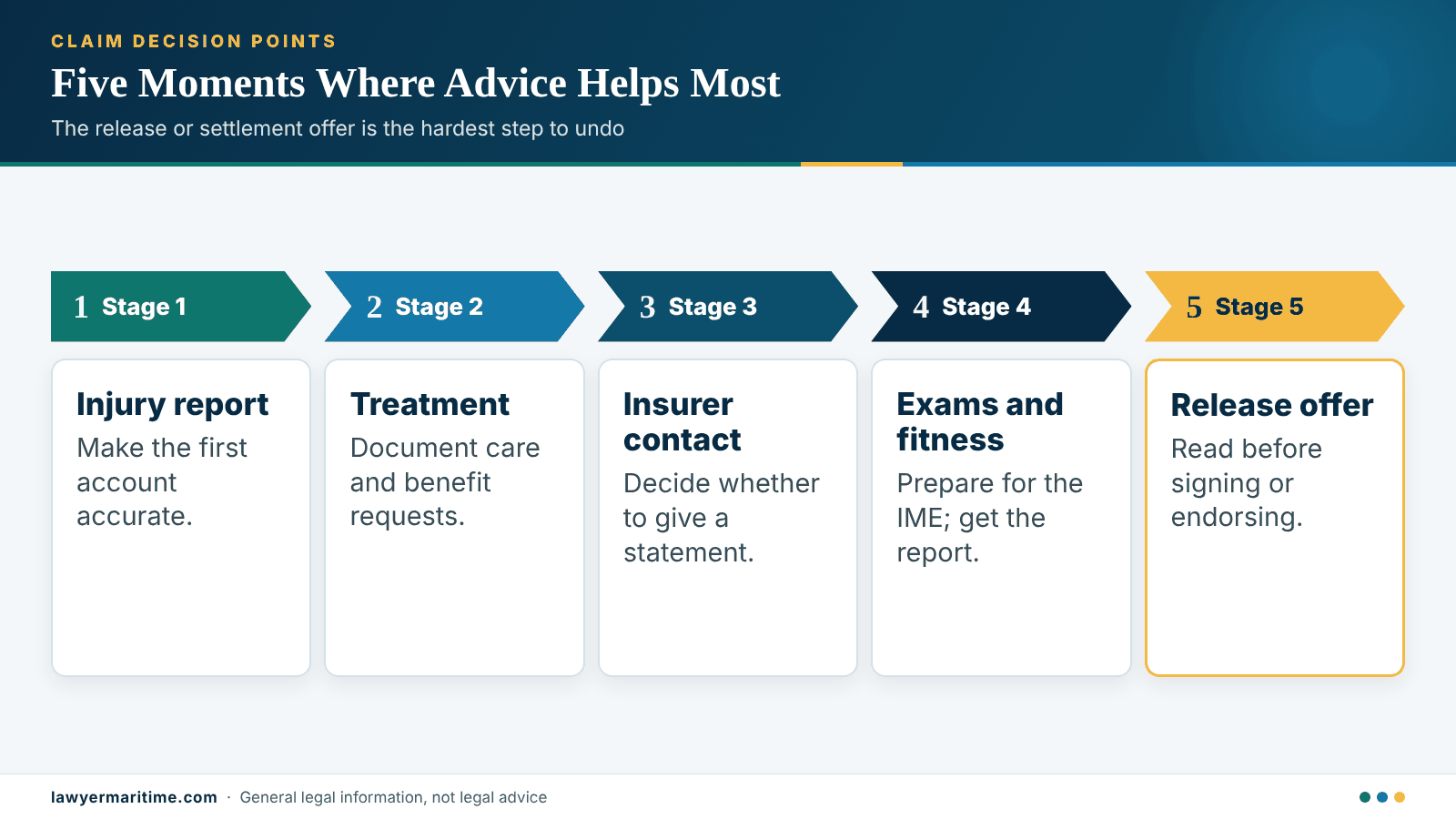
People often ask whether calling a lawyer in week one really differs from calling in month six. It can, though not in every case. This section separates what early advice tends to protect from what a later call can still accomplish.
What early advice can change
Evidence and preservation
Evidence in a seaman case lives in many places. It includes the vessel’s logs, maintenance and repair records, safety management documents, crew lists, photographs, messages, the company’s own incident report, and the memories of crew members who may be on another vessel within weeks. A lawyer can send a written preservation notice, sometimes called a litigation-hold or spoliation letter, asking the employer to keep those materials.
Without that notice, routine retention practices apply. A failed winch, a worn line, or a slick deck may be repaired or replaced in the normal course of operations, and electronic messages may be overwritten. A written request doesn’t guarantee that everything survives, but it can matter later if records turn out to be missing. Vessel inspections and expert review belong to the investigation phase, which our Jones Act lawyer guide describes.
Choosing what to say, sign, and attend
Early advice is most valuable on the decisions you make once, in the moment: whether to give a recorded statement, how to answer a medical history form, whether to attend an IME, and what to do with a release or a broad authorization for medical records. A blanket authorization can open your entire medical history to the other side, so it is worth asking whether it can be narrowed to the body parts and dates that matter.
If you work under a union agreement, there may also be notice or grievance steps with their own time limits. A lawyer can read the agreement alongside the crew terms and tell you which steps are mandatory. Nothing in this section means you must hire anyone. It means the choices above are easier to make with advice than to repair without it.
What a later call can still do
What usually remains possible after delay
Many seamen first call a lawyer months or even years after the injury, and a good deal can still be done. Medical records exist and can be collected. A denial of maintenance and cure can still be documented and answered in writing. Negligence and unseaworthiness claims may still be within time, since a three-year general period applies to many maritime personal injury suits under 46 U.S.C. § 30106, and the Federal Employers’ Liability Act that § 30104 incorporates has its own three-year period in 45 U.S.C. § 56 measured from the day the cause of action accrued.
Whether your claim is still open depends on facts such as when you were hurt, when you learned of the condition, and what the contract or other statutes say. Don’t assume either that you’re too late or that you have time. A prompt review is how you find out.
What is hard to undo
Three things are difficult to reverse. A signed release comes first, followed by a detailed statement that doesn’t match the later medical picture, and finally physical evidence or witnesses that are no longer available. A lawyer can still try to explain a statement, contest a release, or work around missing records, but those efforts are harder than avoiding the problem in the first place.
The wording here is “hard to undo,” not “impossible.” Courts review seamen’s releases with care, and records sometimes turn up elsewhere. Still, the sensible approach is to treat these three items as the ones to slow down on, and to treat everything else as fixable.
| Stage | Early involvement may help with | If you call later |
|---|---|---|
| Injury report | Making sure the first account is accurate and complete. | A lawyer can request the report and address errors, but the original wording stays in the file. |
| Treatment and benefits | Documenting maintenance and cure requests and care choices from the start. | Past gaps can often be documented, but the record is thinner. |
| Insurer contact | Deciding whether and how to give a recorded statement. | Earlier statements can be reviewed and explained, not erased. |
| Exams and fitness for duty | Preparing for the IME and getting the report. | Results can be challenged with other medical opinions. |
| Release or settlement offer | Reading the release before signing and weighing the offer against your losses. | A signed release must be contested after the fact. |
Which Unusual Situations Raise the Stakes?
Some fact patterns make the standard advice more urgent because the legal question itself is unsettled or the other side has a ready-made argument. If any of the following fits you, an early opinion is worth more than usual.
Confusion about who you are and what you were on
Passenger, crew member, or something in between?
The line between passenger and crew looks obvious until it isn’t. Ship’s staff, concession workers, entertainers, contractors riding along for a repair, and off-duty crew all raise the question. Passengers generally proceed under general maritime negligence law rather than § 30104, and a seaman’s claim against an employer follows different rules and different remedies. Our overview of maritime injury routes by person type compares them.
The practical risk is filing, or accepting benefits, under the wrong label. A company may call you a contractor, a trainee, or a shoreside employee, and each label points toward a different benefits system. Don’t let a form decide your category for you. Keep your contract, pay records, and anything that shows what you actually did and where.
Vessel and fleet questions
Seaman status needs a connection to a vessel in navigation or an identifiable group of vessels. That immediately raises the question of what counts. The Supreme Court has described a vessel as a watercraft practically capable of maritime transportation in Stewart v. Dutra Construction Co., 543 U.S. 481 (2005), and it held in Lozman v. City of Riviera Beach, 568 U.S. 115 (2013), that a floating home was not a vessel, looking at how a reasonable observer would see the structure.
Barges, platforms, rigs, dredges, and special-purpose craft are where disputes cluster. Courts apply the status inquiry closely, as the Fifth Circuit did in Sanchez v. Smart Fabricators of Texas, L.L.C., 997 F.3d 564 (5th Cir. 2021) (en banc), and circuits phrase it differently. Don’t assume the structure you worked on is, or isn’t, a vessel. Ask early, because the answer decides whether the Jones Act is on the table at all.
Foreign-flag vessels and foreign ports
Which country’s law may apply?
Being hurt on a foreign-flag ship, or in a foreign port, doesn’t automatically take you outside U.S. law. In Lauritzen v. Larsen, 345 U.S. 571 (1953), the Court held that the Jones Act did not apply to a Danish seaman injured on a Danish-flag ship in a Cuban harbor, weighing connecting facts and giving the law of the flag heavy weight. In Hellenic Lines Ltd. v. Rhoditis, 398 U.S. 306 (1970), it applied the Act to a Greek seaman on a Greek-flag ship because the owner’s base of operations and substantial business were in the United States.
Those factors are weighed, not tallied, so facts like ownership structure, trade routes, and where the contract was signed deserve attention. The table below lists the factors in plain terms.
| Factor | Question to ask | Why it matters |
|---|---|---|
| Law of the flag | Which country’s flag does the vessel fly? | Lauritzen gave it heavy weight, but later cases show it is not decisive. |
| Seaman’s allegiance | What is your nationality and where is your home? | A seaman tied to the flag state pulls toward that country’s law. |
| Shipowner’s allegiance and base | Where is the owner based and where does it do business? | Rhoditis stressed a U.S. base of operations and U.S. business contacts. |
| Place of contract | Where and under what terms did you sign on? | A fortuitous signing location counts for little, but a choice-of-law clause may be raised. |
| Place of injury and forum | Where were you hurt and where can you realistically sue? | Injury in U.S. waters and an accessible forum can support applying U.S. law. |
Crew agreements, arbitration clauses, and where you can sue
Crew employment agreements, particularly for foreign-flag ships, sometimes name a foreign law, a foreign court, or arbitration. Whether a given clause is enforceable against an injured seaman is a contested, fact-specific question, and courts have not treated every clause the same way. Signing the agreement doesn’t answer the question, and neither does the company’s confidence.
That is why a foreign-flag injury is a strong early-consultation case. Keep a complete copy of the crew agreement, any union contract, your visa or seaman documents, and the names of the agencies that placed you. Don’t sign a waiver or a local-forum settlement in a foreign port without reading it in a language you understand and having it reviewed.
Pre-existing conditions and surveillance
When the company points to an earlier injury
Employers often respond to a serious claim by pointing to an old back injury, a prior surgery, or a gap in a medical questionnaire. An earlier condition doesn’t by itself end a claim, and aggravating an existing condition can generally be part of a seaman’s damages. The risk is a concealment defense. In the Fifth Circuit, McCorpen v. Central Gulf Steamship Corp., 396 F.2d 547 (5th Cir. 1968), allows an employer to deny maintenance and cure where the seaman intentionally concealed a material medical fact and the concealed condition is causally connected to the injury. Other circuits apply their own versions.
What you said at hiring, and what you were asked, becomes central. Gather your pre-employment medical forms and prior records before you give further statements about your history, and let counsel help you answer honestly and completely. Don’t minimize an old injury in a conversation with an adjuster, and don’t volunteer guesses about its cause.
Surveillance, social media, and ordinary life
Insurers sometimes hire investigators to photograph or film claimants, and defense lawyers review social media. Footage is compared with your reported limits and your doctors’ restrictions. This is normal, not sinister, but it means ordinary activity can be quoted out of context.
The practical point is consistency. Follow your restrictions, and tell your doctors the truth about what you can and can’t do. Avoid posting about physical activity, travel, or the case, and don’t delete old posts after an injury, because deleting can look worse than leaving them. If you think you’re being watched, mention it to a lawyer rather than confronting anyone.
When a seaman has died
Who may bring the claim
Section 30104 allows the personal representative of a seaman who dies from the injury to bring the action. The personal representative is the person legally appointed to act for the estate, usually through a state court process, and counsel can explain who qualifies where the seaman lived. Which law governs the recoverable damages depends on the facts. Deaths on the high seas can implicate the Death on the High Seas Act, which our DOHSA deadline guide covers, and the Supreme Court has limited some categories of damages in seamen’s wrongful death claims, as in Miles v. Apex Marine Corp., 498 U.S. 19 (1990).
What families can do first
Families receive forms, calls, and sometimes offers in the first days, often from people who are kind and also represent the employer’s interests. Sign nothing from the employer or insurer that mentions a release, a settlement, or “full and final” payment until a lawyer has read it. Ask for copies of the incident report and any Coast Guard report, keep a list of everyone who contacts you, and save the seaman’s messages, pay records, and employment papers.
A short consultation can also clarify who is entitled to act and which time limits apply. Our guide to maritime injury compensation gives context on the remedies, and there is no need to decide everything in the first week.
What Can You Safely Do Yourself, and What Should Wait?
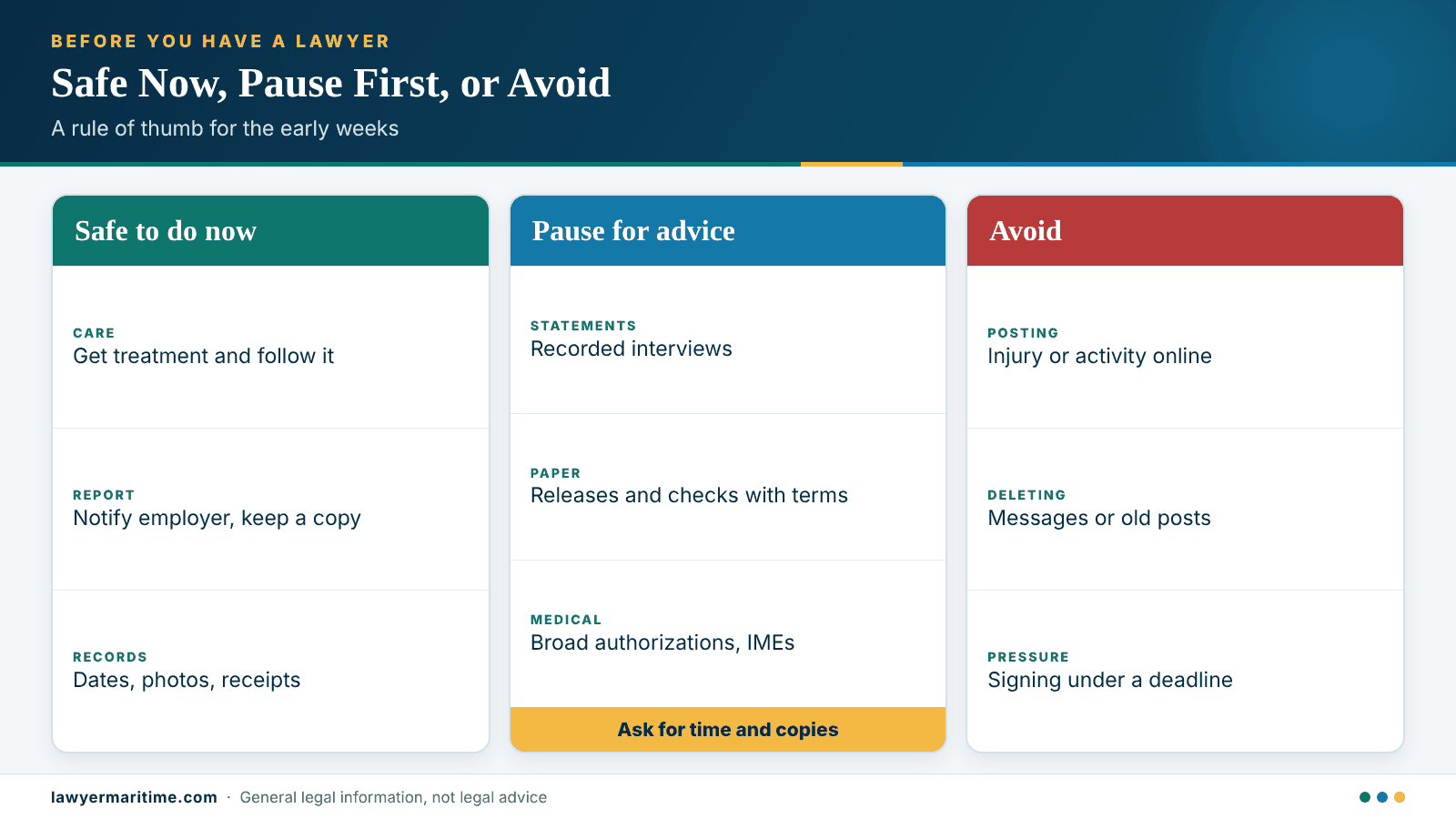
Seeing a lawyer early doesn’t mean doing nothing until then. Some steps are safe, helpful, and in your own interest, while others are best paused until you have advice. This section draws that line, and a table at the end sets common mistakes beside better moves.
Steps that are generally safe to take on your own
Medical care and reporting the injury
Get treatment and follow it. Tell every provider that the injury happened at work and describe what happened accurately, because medical records often become the most reliable account of the first days. Report the injury to your supervisor or the master promptly, in writing if you can, and keep your own copy. Federal law protects a seaman from discharge or discrimination for notifying the vessel owner of a work-related injury or illness, under 46 U.S.C. § 2114.
The company also has reporting duties of its own. Under 46 CFR § 4.05-1, an owner, agent, master, operator, or person in charge must notify the Coast Guard of certain casualties, including an injury that requires professional medical treatment beyond first aid and, for a person working on a commercial vessel, leaves the person unable to perform routine duties. A written report on Form CG-2692 is due within five days under 46 CFR § 4.05-10. It is the company’s report, not yours, so it’s reasonable to ask whether one was filed and to request a copy.
Records, notes, and receipts
Start a simple file the day you can. Include dates of the injury and each appointment, names of witnesses and supervisors, photographs of the scene and your injury, pay records, and receipts for out-of-pocket costs such as prescriptions and travel to appointments. Save texts, emails, and messages about the incident and don’t edit or delete them.
Keep any notes factual and private. Written notes can be requested in a lawsuit, so stick to what happened and when, not guesses about blame. Our step-by-step guide to the Jones Act claim path covers the full sequence of reporting and documentation, and for a preparation list before a lawyer call, see preparing for a maritime law consultation.
Steps to pause until you’ve had advice
Statements, signatures, and exams
Pause before any recorded interview, any form that mentions a release, settlement, or “full and final” payment, and any broad medical authorization. A lawyer can check whether release language is attached to something that looks like routine paperwork. Ask for requests in writing, and ask for time. A reasonable employer or insurer can wait a few days for you to get advice.
For an IME, ask in writing who the examiner is, where and when it will happen, what will be done, and whether you’ll receive the report. Bring a list of your medications and a short account of your symptoms. Attend appointments you’ve been told are required unless a lawyer advises otherwise, since refusing outright can create its own dispute.
Posts, payments, and pressure
Avoid posting about your injury, activities, or the company. Be careful about discussing the claim with coworkers by text, because messages can be requested later. Accepting maintenance and cure payments ordinarily doesn’t by itself waive your claims, but read any paper that comes with a check before you deposit or sign it.
Also be wary of urgency. Offers that expire “today” or messages implying that you’ll lose your job or benefits if you talk to a lawyer are reasons to slow down, not speed up. Don’t resign or accept a settlement under that pressure without advice. If you feel threatened or retaliated against, write down what was said, when, and by whom.
| Common mistake | Why it hurts | Better move |
|---|---|---|
| Giving a long recorded statement while in pain | Details and guesses can be quoted back against your medical record. | Give a basic report; ask for time and a copy of anything written. |
| Signing a broad medical authorization | It can open your whole history, including unrelated treatment. | Ask that it be limited by body part and date range. |
| Skipping treatment because of the dispute | Gaps in care can be read as recovery or as a failure to follow medical advice. | Keep appointments and document who denied what. |
| Cashing a check with release language | Endorsing it may be treated as accepting its terms. | Read the paperwork first and ask a lawyer. |
| Posting or deleting social media | Posts can be taken out of context and deletions can raise questions. | Stop posting about the case and leave existing content alone. |
| Assuming the company will keep you informed | Benefit decisions and deadlines can pass without notice. | Keep your own calendar of payments, appointments, and letters. |
What Does a First Conversation With a Lawyer Cover?
Many people delay because they don’t know what a first call involves or whether it commits them to something. It doesn’t. A first conversation is a two-way assessment, and a good one leaves you with a clearer picture of your options even if you decide not to go further.
What to expect from the call
Questions about you, your work, and the vessel
Expect questions in a predictable order. The lawyer will ask what happened and when, what your job and duties were, which vessel or vessels you worked on, who employed and paid you, what treatment you’ve received, and what anyone has asked you to sign or say. These questions aren’t idle. They test seaman status, identify the right defendants, and show which time limits and benefits are in play.
You don’t need a perfect file to start. Bring what you have and say what you don’t know. Our page on preparing for a maritime law consultation lists the documents and the intake questions in detail, so this page doesn’t repeat them.
What the lawyer should tell you in return
You should leave with more than a sales pitch. A careful lawyer can explain, in general terms, which legal framework appears to fit your facts, which questions are still open, which clocks may be running, and what you should do or avoid in the meantime. The answers will often be qualified, because early facts are incomplete and maritime law varies by circuit.
Be cautious if you hear a guaranteed outcome, a promised dollar figure, or pressure to sign that day. Professional conduct rules bar misleading statements about results, and a careful lawyer will say what is uncertain. For what counsel does once you retain them, see our Jones Act lawyer guide.
Choosing who to call
What “Jones Act attorney” does and doesn’t tell you
The phrase describes a type of practice, not a license. Lawyers are admitted to practice state by state, and calling oneself a “Jones Act attorney” is a description of the work, not a credential issued by a federal body. Some states certify legal specialists, and rules about advertising a specialty differ by state, so it is worth checking a lawyer’s bar status and discipline record on the state bar’s website.
Experience with seaman cases matters because status, forum, and maintenance and cure disputes are specialized. Look for a lawyer who explains the law clearly and tells you when they don’t know. Our guide to how to evaluate a maritime lawyer offers a fuller framework, and nothing on this page ranks or recommends any particular lawyer or firm.
Confidentiality, cost, and no obligation
Under the ABA Model Rules, a lawyer owes confidentiality duties to a prospective client even if no representation follows, though state rules vary. That is why it is generally safe to describe the facts to a lawyer you are considering. It is not a reason to share your story with the company or on social media.
Fees differ. Many injury lawyers use contingent fees, and ethics rules call for the fee arrangement to be explained clearly, but terms vary and this page doesn’t state what any lawyer charges. Ask about fees and costs at the start and get the terms in writing. Our page on free maritime lawyer consultations explains how consultations and fee advertising typically work. For a broader entry point to maritime representation, see our maritime lawyer hub.
A Calm 48-Hour Checklist
If you’ve just been hurt, or if you’ve just been handed something to sign, use this list to get your bearings. It is a general checklist, not advice on your facts, and you can stop at any item and ask for advice.
Hours 0 to 24: protect your health and your account
Care and the first report
- Get medical attention, and tell providers the injury happened at work.
- Report the injury to your supervisor or the master, in writing if possible, and keep a copy.
- Ask for maintenance and cure in writing, and ask who the company’s contact is.
- Write down what happened while it’s fresh: time, place, equipment, and witnesses.
- Take photographs of the scene, equipment, and your injury if you safely can.
Things to hold off on
- Don’t sign a release, resignation, or settlement paper.
- Don’t give a long recorded statement until you’ve had a chance to get advice.
- Don’t post about the injury or the company.
- Don’t throw away messages, receipts, or damaged gear.
Hours 24 to 48: take stock and line up advice
List what has been asked of you
- Write down every request so far: statements, exams, forms, authorizations, and calls.
- Note which requests have deadlines and who set them.
- Collect your crew agreement, pay records, and any union contract.
- Gather your hiring medical forms and a short list of prior injuries and treatment.
- Save every letter or email about maintenance and cure, with dates.
Arrange a conversation with a lawyer
Choose a day this week for a consultation, especially if any trigger from the earlier table fits you. Use the checklist from our page on consultation preparation, and ask about confidentiality and fees at the start. If you can’t reach anyone quickly, don’t let that push you to sign something. A short delay to get advice is almost always reasonable, and the next steps can wait a day or two.
For a broader view of what comes after the first call, see the maritime law hub.
Frequently Asked Questions
These are the questions injured seamen and their families ask most about timing. The answers are general and depend on your facts.
Timing and cost
Do I need a Jones Act attorney for a minor injury?
Not always. If the injury is minor, treatment is covered, you’re back at work, and nobody is asking you to sign anything, you may reasonably wait and watch. If symptoms linger, benefits slow down, or a form with release language appears, the calculation changes. A short consultation costs little, and minor injuries sometimes turn out not to be minor.
Will talking to a lawyer get me fired?
The worry is common, and it deserves a straight answer. A consultation is confidential, and an employer generally learns of it only if you or the lawyer tell them. Federal law protects seamen against discharge or discrimination for specified activities, including notifying the owner of a work-related injury, under 46 U.S.C. § 2114. Whether other conduct is covered is a question for counsel.
Can I hire a lawyer after the company has already paid me something?
Yes, though what you signed and what the payment was for will matter. Ordinary maintenance and cure payments aren’t a release. A payment tied to a signed release is different, and a lawyer will want to read it. Bring every paper that came with the money.
Statements, exams, and paperwork
Do I have to give a recorded statement?
There is no single rule that fits every case. Company policy, your crew agreement, and any union contract may address cooperation. A basic injury report is normal and prompt reporting is protected. For a detailed recorded interview, you can ask for time and a lawyer’s review first.
Can I refuse the company’s doctor?
It depends on your employment terms and how the request is made. Before a lawsuit, an exam request is often a matter of agreement. Once a federal case is pending, Rule 35 lets a court order an exam for good cause. Ask for the details in writing and get advice before you refuse outright.
Is a release I already signed binding?
Not necessarily, but don’t assume it is void either. Under Garrett v. Moore-McCormack Co., the party relying on a seaman’s release must show it was signed freely and with full understanding of rights. Whether that can be shown turns on the circumstances, the payment, and the advice you had. A lawyer can review it quickly.
Status and special cases
What if the company says I’m not a seaman?
That is a position, not a ruling. Status turns on your duties and your connection to a vessel or fleet in navigation, as Chandris describes, and courts look at the facts. Keep your pay records, job descriptions, and a list of the vessels you worked on, and ask for an early opinion before you accept a different benefits system.
Is the Jones Act the same as the law about foreign ships carrying cargo?
No. The injury remedy is 46 U.S.C. § 30104. The cabotage rules restricting who may carry merchandise between U.S. points are at 46 U.S.C. § 55102 and related provisions. News about shipping waivers doesn’t change a seaman’s injury rights.
What if I was hurt on a foreign-flag ship?
You may still have claims under U.S. law, but the answer depends on factors such as the flag, your nationality, the owner’s base of operations, and the crew agreement. Keep the agreement, avoid signing anything locally without review, and ask for a forum and choice-of-law opinion early.
Sources and Legal Authorities
These are the statutes, rules, and decisions this page relies on. Statutes and rules are linked to the Legal Information Institute at Cornell, and decisions are linked to the Supreme Court opinions as published there or by Justia.
Statutes and regulations
Federal statutes
- 46 U.S.C. § 30104 – Personal injury to or death of seamen (Jones Act)
- 46 U.S.C. § 30106 – Time limit on bringing maritime action for personal injury or death
- 45 U.S.C. § 56 – Actions; limitation; concurrent jurisdiction of courts
- 46 U.S.C. § 2114 – Protection of seamen against discrimination
- 46 U.S.C. § 55102 – Transportation of merchandise (cabotage)
Regulations and rules
- 46 CFR § 4.05-1 – Notice of marine casualty
- 46 CFR § 4.05-10 – Written report of marine casualty (Form CG-2692)
- Federal Rule of Civil Procedure 35 – Physical and mental examinations
Cases and professional rules
Supreme Court and federal appellate decisions
- Chandris, Inc. v. Latsis, 515 U.S. 347 (1995) – two-part test for seaman status
- Garrett v. Moore-McCormack Co., 317 U.S. 239 (1942) – burden on the party relying on a seaman’s release
- Farrell v. United States, 336 U.S. 511 (1949) – scope and end of maintenance and cure
- Vaughan v. Atkinson, 369 U.S. 527 (1962) – attorney’s fees for callous failure to pay maintenance and cure
- Atlantic Sounding Co. v. Townsend, 557 U.S. 404 (2009) – punitive damages for willful failure to pay maintenance and cure
- Lauritzen v. Larsen, 345 U.S. 571 (1953) – choice of law for a foreign seaman on a foreign-flag ship
- Hellenic Lines Ltd. v. Rhoditis, 398 U.S. 306 (1970) – Jones Act applied where the owner’s base of operations was in the United States
- Stewart v. Dutra Construction Co., 543 U.S. 481 (2005); Lozman v. City of Riviera Beach, 568 U.S. 115 (2013); Miles v. Apex Marine Corp., 498 U.S. 19 (1990) – vessel definition, floating structures, and seamen’s death damages
- McCorpen v. Central Gulf Steamship Corp., 396 F.2d 547 (5th Cir. 1968), and Sanchez v. Smart Fabricators of Texas, L.L.C., 997 F.3d 564 (5th Cir. 2021) (en banc) – concealment defense and Fifth Circuit status analysis
Professional conduct rules
- ABA Model Rules of Professional Conduct 1.5 (fees), 1.18 (prospective clients), and 7.1 (communications) – baseline rules; state rules vary and may be stricter