Jones Act retaliation is the everyday label for what happens when a seaman reports an injury or a safety problem and then gets fired, sent home, cut from the schedule, or quietly passed over. The Jones Act itself, 46 U.S.C. § 30104, gives an injured seaman a negligence claim against the employer, but it does not contain a stand-alone anti-retaliation clause. Protection after a report usually comes from a different source: the Seaman’s Protection Act at 46 U.S.C. § 2114, a court-recognized maritime claim for retaliatory discharge, or a union contract. Two things generally survive a termination: your Jones Act claim and your right to maintenance and cure. This guide is for deckhands, mates, engineers, cooks, and other vessel crew who are worried about their jobs after speaking up. It explains which laws may apply, what counts as retaliation, how short the complaint deadlines can be, and how to document your situation, without promising any result.
What Jones Act Retaliation Means and What a Firing Does Not End
Most seamen first hear the phrase from a coworker or a search result, and it sounds like a named cause of action. It isn’t, at least not in the way a wrongful-discharge claim might be in a state statute. This section gets your bearings on the vocabulary, on what survives a termination, and on how to tell retaliation from ordinary discipline.
What do people mean by “Jones Act retaliation”?
Two different “Jones Acts,” and no single retaliation section
“Jones Act” can point to two unrelated bodies of law. This guide uses the term for the seaman’s personal injury remedy in 46 U.S.C. § 30104, which lets an injured seaman elect a civil action at law, with a jury, against the employer. The other meaning is the cabotage rule on domestic shipping, which begins at 46 U.S.C. § 55102 and has nothing to do with injured crew.
Section 30104 says that federal laws governing recovery for injured railway employees apply to these suits. That language is how the Federal Employers’ Liability Act (FELA) framework reaches seamen. It does not, in the text we read, create a free-standing claim for being fired. So when someone says “Jones Act retaliation,” they are usually describing a bundle: the Jones Act injury claim, plus whichever separate protection covers the adverse action that followed.
Adverse actions that can raise a retaliation question
Retaliation rarely arrives as a letter that says “you’re fired for reporting.” More often it shows up as a pattern that begins after a report. The following actions, taken because of protected activity, are the ones that most often raise the issue:
- Termination, or being told your services are “no longer needed” at the end of a hitch.
- Being sent home or taken off the vessel and not called back.
- Blacklisting, meaning a quiet signal to other operators or crewing offices not to hire you.
- Reduced hours, worse watch assignments, or a sudden loss of overtime.
- Discipline that’s new, unusually harsh, or tied to something others were not written up for.
- Refusal to rehire after you have recovered and been cleared for duty.
- Pressure to sign a statement, release, or resignation, or pressure not to report at all.
None of these is automatically unlawful. Each one becomes a legal question only when the facts connect it to something the law protects.
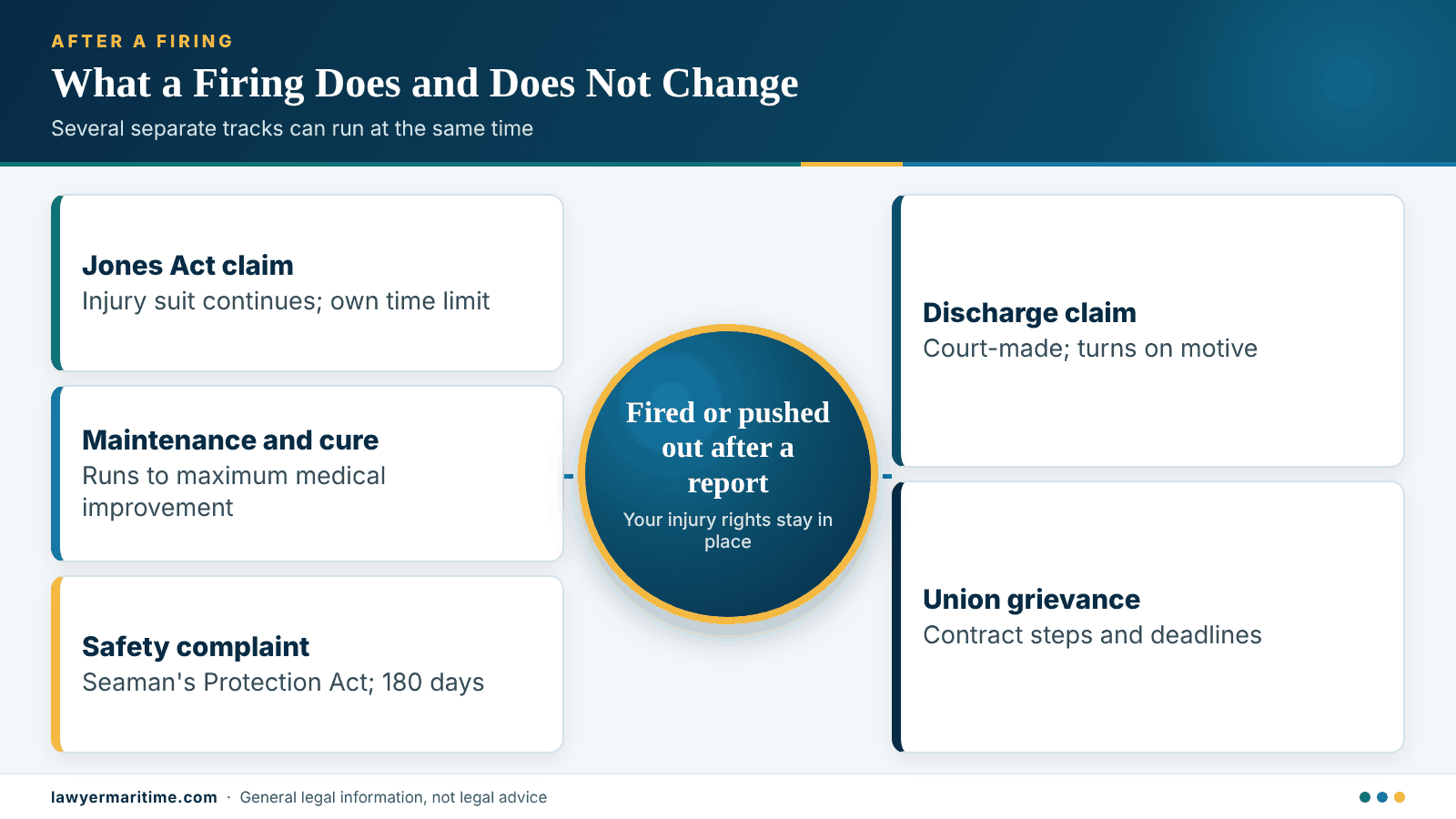
What does a firing not end?
Your Jones Act negligence claim
The right to sue under § 30104 belongs to a seaman injured in the course of employment. It turns on your status and on what happened when you were hurt, not on whether the company keeps you on the payroll afterward. A termination months later does not wipe out a claim for an injury caused by a defective ladder, an unsafe procedure, or a short-handed crew.
Timing still matters. The Jones Act claim has its own limitation period, which our guide to the Jones Act statute of limitations explains, and that clock doesn’t wait for a retaliation dispute to finish. For the mechanics of the claim itself, see our guide to a Jones Act claim.
Maintenance and cure, which is owed whether or not you’re employed
Maintenance and cure is the shipowner’s duty to pay for a sick or injured seaman’s food and lodging (maintenance) and medical care (cure). In Vaughan v. Atkinson, 369 U.S. 527 (1962), the Supreme Court described the duty as lasting until the seaman reaches maximum medical recovery, and said it is imposed by the law as part of the employment relationship. The obligation attaches because you were injured in the ship’s service, so being let go doesn’t by itself end it.
Employers sometimes treat a termination as the end of benefits. That position is worth challenging, because the usual endpoint is maximum medical improvement, not the date of separation. Our guides to maintenance and cure terminated and maximum medical improvement explain when benefits can legitimately stop, and maintenance and cure denied covers what to do when they are withheld.
How do you tell retaliation from ordinary discipline?
Motive is the hinge
Seamen are generally employed at will unless a contract sets a definite term or voyage. In Smith v. Atlas Off-Shore Boat Service, Inc., 653 F.2d 1057 (5th Cir. 1981), the court said an employer may still fire a seaman for good cause, no cause, or most reasons, but not for filing or intending to file an injury claim. The seaman there had to show that the claim was a substantial motivating factor in the discharge.
That framing is useful well beyond one circuit. Whatever the legal vehicle, the central question is why the employer acted. A company that can document a genuine rule violation, a documented performance history, or a vessel layup has a different story than one whose first criticism of you arrives the week after your incident report.
Signals that point one way or the other
Courts and agencies look at the whole picture. Timing, consistency, and the employer’s explanation each carry weight, and none of them decides the question alone. The table below sets out illustrative contrasts; it describes patterns, not findings, and a real case turns on the specific evidence.
| Situation | May point toward retaliation | May point toward ordinary discipline |
|---|---|---|
| Timing | First discipline in years arrives days after an injury report or safety complaint. | A written warning follows a documented incident that predates any report. |
| Treatment of others | Others who committed the same violation were not disciplined. | The same rule was applied the same way to every crew member. |
| Stated reason | The reason changes, appears only after you complain, or conflicts with the records. | The reason is consistent, written at the time, and matches the logs. |
| Scheduling | You’re the only crew member whose rotation or hours are cut after reporting. | The vessel is laid up or the whole crew’s schedule changed for operational reasons. |
| Rehire | You’re cleared for duty, but openings are filled by others without explanation. | A documented medical restriction that the job cannot accommodate remains in place. |
| Conversations | A supervisor links your job to dropping a claim or staying quiet. | Discussions stay on performance, safety rules, or staffing needs. |
Employers don’t have to prove a spotless history. They usually defend by pointing to a legitimate, independent reason and by arguing that the same decision would have been made anyway. You can’t predict how that contest turns out from the label alone, which is why the facts, the paperwork, and the comparison to other crew members carry so much weight.
The practical lesson is that retaliation is proven mostly through contrast and chronology. That is why the record-building steps later in this guide matter as much as the legal theories.
Which Laws Can Protect a Seaman After Reporting?
There is no single statute titled “Jones Act retaliation,” so the realistic answer is a menu of sources, each with its own scope and its own limits. Some are statutes, one is judge-made, and one is a private contract. The sources below are the ones most often discussed for seamen, with caveats on each.
What does the Seaman’s Protection Act cover?
The protected activities listed in 46 U.S.C. § 2114
The Seaman’s Protection Act is codified at 46 U.S.C. § 2114. As we read it, subsection (a) says a person may not discharge or in any manner discriminate against a seaman for certain protected activity. The listed activities include:
- Reporting, or being about to report, a believed violation of a maritime safety law or regulation to the Coast Guard or another appropriate federal agency, in good faith.
- Reporting sexual harassment or sexual assault, either against the seaman or against another seaman, to the vessel owner or a federal agency. Congress added this item in 2022.
- Refusing to perform duties ordered by the employer because of a reasonable apprehension of serious injury.
- Testifying in a proceeding to enforce a maritime safety law.
- Notifying, or attempting to notify, the vessel owner or the Secretary of a work-related injury or illness.
- Cooperating with a safety investigation by the Coast Guard or the National Transportation Safety Board.
- Furnishing information about a marine casualty involving injury, death, or property damage.
- Accurately reporting hours of duty.
For an injured seaman, the injury-notification item is the one that most directly matches the facts. If you told the company or the Coast Guard about your injury and were pushed out afterward, that sequence is the pattern the statute describes. For the hours-of-duty item, see our guide to maritime fatigue accidents.
Conditions and limits to keep in mind
The refusal protection comes with strings. The statute, as we read it, requires that the danger be one a reasonable person in the same circumstances would see as real, and that the seaman first sought correction from the employer and could not get it. Refusing a task and walking off the job on a hunch is not the same thing.
A good-faith report is one the seaman honestly believes, even if an investigator later decides the concern was mistaken. A report you know to be false, or one made only as a tactic to shield yourself from legitimate discipline, is a different matter and can undercut your credibility. Stick to what you saw, felt, or were told, and say so plainly.
Other limits matter too. Reports are protected when made in good faith, which makes accuracy and honesty important. The Act also refers to a “seaman,” and who qualifies for these purposes should be confirmed rather than assumed; our guide to the seaman status test explains why labels can mislead. Finally, the page we read does not itself set out remedies or deadlines in subsection (a), because it points elsewhere for procedure, which the next section covers.
Is there a court-made claim for retaliatory discharge?
Smith v. Atlas Off-Shore Boat Service
Yes, in at least one major circuit. In Smith v. Atlas Off-Shore Boat Service, Inc., 653 F.2d 1057 (5th Cir. 1981), a seaman was cleared to work after an ankle injury. His lawyer then told the company he planned to file an injury claim, and the port captain said he could not return unless he dropped it. He refused and was fired.
The Fifth Circuit recognized a maritime tort for retaliatory discharge. It held that a seaman fired for filing or intending to file a personal injury claim may sue under general maritime law, and the case could be tried to a jury alongside the Jones Act claim. The damages it allowed were compensatory, covering losses not already compensated through the Jones Act claim, and it rejected the punitive award in that case.
Feemster, and why courts differ on the edges
The same circuit drew a boundary eight years later. As described in a Tulane Law Review note, Feemster v. BJ-Titan Services Co., 873 F.2d 91 (5th Cir. 1989), involved an at-will tugboat captain who refused an eighteen-hour trip, citing a federal limit on hours of navigation, and was fired. The court held that general maritime law did not give him a private action for retaliatory discharge on those facts.
The contrast shows how fact-specific this area is. Being fired for pursuing an injury claim and being fired for refusing an order are different situations, and courts have not treated them alike. Rules also vary by circuit, and the Supreme Court has since addressed punitive damages in other maritime settings (Atlantic Sounding Co. v. Townsend, 557 U.S. 404 (2009), for willful nonpayment of maintenance and cure, and Dutra Group v. Batterton, 588 U.S. 358 (2019), for unseaworthiness). Whether a particular court would allow more or less today on a retaliation claim is a question for counsel who know that court.
What about FELA provisions and union contracts?
45 U.S.C. §§ 55 and 60: what the text says and what it leaves open
Because § 30104 brings in the federal railway-employee recovery laws, readers often ask about two FELA sections. Section 55 makes unenforceable, to the extent it tries to exempt a carrier from FELA liability, any contract, rule, regulation, or device. Section 60 voids devices meant to stop employees of a common carrier from voluntarily giving information about an injury or death, and makes it an offense to threaten, or to discharge or discipline, an employee for providing that information.
Two cautions apply. Section 60 is written as a criminal provision with a fine of up to $1,000, imprisonment of up to a year, or both, and the text we read does not itself describe a private lawsuit. And how far these railway-oriented sections carry into a seaman’s claim against a vessel employer is a legal question this guide does not resolve. Treat them as background that a lawyer may consider, not as a right you can count on.
Collective bargaining agreements and grievance procedures
If you work under a union contract, the agreement may require just cause for discipline, set seniority and hiring-hall rules, and provide a grievance and arbitration path. Those procedures can have their own notice deadlines, sometimes measured in days, and they run separately from any statute. Missing a contract step does not necessarily end a statutory complaint, but it can limit the contract remedy.
The practical step is to find your agreement, read the grievance article, and ask the union representative in writing what the deadlines are and whether a grievance has been filed on your behalf. Keep a copy of the response.
| Framework | What it addresses | Main caveat |
|---|---|---|
| Seaman’s Protection Act, 46 U.S.C. § 2114 | Discharge or discrimination for listed activity such as reporting an injury, reporting violations, or accurate hours reporting. | Short administrative filing window; refusal protection has conditions; coverage should be confirmed. |
| General maritime law retaliatory discharge | Firing for filing or intending to file an injury claim, as recognized in the Fifth Circuit in Smith. | Circuit law varies; Feemster shows limits when the facts differ; damages rules may vary. |
| Jones Act, 46 U.S.C. § 30104 | Negligence claim for the injury itself, with a jury right. | Not a firing claim; has its own limitation period. |
| Maintenance and cure | Food, lodging, and medical care after injury or illness in service. | Not a retaliation remedy, but generally continues after separation until maximum medical improvement. |
| FELA §§ 55 and 60 | Voids devices limiting liability; criminal bar on punishing injury-related information. | Reach into seamen’s claims and private enforcement are unsettled on the text we read. |
| Union contract grievance | Just-cause discipline, hiring-hall, and seniority protections, if you have a covered job. | Contract deadlines may be short; depends entirely on the agreement. |
Several of these tracks may be pursued together, but the order and timing matter, and that is where legal advice earns its keep.
The OSHA Complaint Process and Its Short Deadlines
The Seaman’s Protection Act does not run through the ordinary courts first. Its procedure is administrative, and the time limits are measured in days, not years. Everything below reflects the statutes and regulations as we read them in October 2026, and a lawyer should confirm the current text and how it applies to your dates.
How and when do you file a Seaman’s Protection Act complaint?
Where and how a complaint is filed
Section 2114(b) says a seaman, or another person at the seaman’s request, may file a complaint in the same manner as under 49 U.S.C. § 31105(b), which sends complaints to the Secretary of Labor. The Occupational Safety and Health Administration (OSHA) runs the program, and its procedures appear in 29 CFR Part 1986.
The regulation we read says no particular form is required, a complaint may be oral or written, and OSHA reduces an oral complaint to writing. It should go to the OSHA office responsible for the area where you live or worked, but it may be filed with any OSHA officer or employee. OSHA’s whistleblower statutes page lists the Seaman’s Protection Act among the laws the program enforces, and its Seaman’s Protection Act page carries OSHA’s toll-free number, 1-800-321-6742.
The 180-day filing window
The same regulation, at 29 CFR 1986.103(d), says a complaint must be filed no later than 180 days after the alleged violation occurs. It adds that the period may be tolled, meaning paused or extended, for reasons warranted by applicable case law. OSHA’s whistleblower site also says each statute it enforces sets its own filing window, counted in days from the alleged retaliation.
Treat 180 days as the working limit and count from the first adverse act you can identify. A seaman who waits for the employer to “do the right thing” can lose months without realizing it. Tolling exists in principle, but nobody should plan around it. If you are close to or past that mark, talk to a lawyer promptly rather than assuming the door is closed.
What happens after a complaint is filed?
Investigation, objections, and possible remedies
Under § 31105(b)(2), as we read it, the Secretary of Labor has 60 days after receiving the complaint to investigate and decide whether there is reason to believe it has merit. If so, the decision includes findings and a preliminary order of relief. Either party then has 30 days to object or request a hearing, and if nobody does, the preliminary order becomes final and is not subject to judicial review. If a hearing is held, the Secretary is to issue a final order within 120 days after it ends.
The OSHA regulation on decisions, 29 CFR 1986.109, lists the relief an administrative law judge may order after finding a violation: abatement of the violation, reinstatement to the former position with the same pay and privileges, back pay with interest, other special damages, litigation costs, expert witness fees, and reasonable attorney fees. It also caps punitive damages at $250,000. Whether any relief is awarded depends on the proof, and no complaint guarantees reinstatement or money.
The 210-day option to go to federal court
The process has a safety valve. Section 31105(c) and 29 CFR 1986.114(a), as we read them, allow a complainant to bring an original action in the appropriate federal district court if no final order has issued within 210 days after the complaint was filed and the delay is not due to the complainant’s bad faith. The statute text also says either party may request a jury trial in that setting.
That option matters for strategy. A seaman who files early may preserve the right to move to court if the agency is slow, while a seaman who files late may lose the administrative route altogether. Counsel can explain how the federal-court path interacts with your other claims.
How do these clocks fit with your other claims?
The injury claim and maintenance and cure run separately
The 180-day window belongs to the safety-law complaint alone. Your Jones Act injury claim has its own limitation period, discussed in our guide to the Jones Act statute of limitations, and maintenance and cure is an ongoing duty with its own practical timing concerns. A union grievance may add a third set of dates.
Do not assume that filing one thing pauses another. Each track needs its own calendar entry, and the shortest one usually controls the first month of planning.
Choosing the order and avoiding overlap
Some seamen file the OSHA complaint first because it is inexpensive and has a defined process. Others lead with a court case. The right order depends on the facts, the evidence, the damages at stake, and the circuit where a suit would be filed.
Courts generally do not let a person recover the same loss twice, so overlapping claims are usually coordinated rather than stacked. A settlement of one claim may also affect another, which is why the release language discussed in our guide to maritime settlement releases deserves a careful read.
| Step or claim | Period or limit | Source and caveat |
|---|---|---|
| File Seaman’s Protection Act complaint with OSHA | 180 days after the alleged violation occurs | 29 CFR 1986.103(d); tolling may apply for reasons recognized in case law, which should not be assumed. |
| Secretary of Labor investigation and preliminary decision | 60 days after receipt of the complaint | 49 U.S.C. § 31105(b)(2)(A), incorporated by 46 U.S.C. § 2114(b); actual agency timing can vary. |
| Object to preliminary order or request a hearing | 30 days after notice | § 31105(b)(2)(B); if no one objects, the preliminary order becomes final. |
| Go to federal district court if no final order | After 210 days from filing | § 31105(c); 29 CFR 1986.114(a); not available if the complainant caused the delay in bad faith. |
| Jones Act injury suit | Separate limitation period | See the statute-of-limitations guide; do not borrow the OSHA period. |
| Court-made retaliatory discharge claim | Not addressed in the sources we read | Ask counsel which limitation period a court in your circuit would apply. |
| Union grievance | Set by the collective bargaining agreement | Often short; read the grievance article and ask the representative in writing. |
The pattern to remember is that the administrative clocks are short and the injury clocks are longer, so do not let the longer clock lull you into ignoring the shorter one.

Building the Record: Timeline, Messages, and Written Requests
Retaliation cases are won and lost on chronology. A seaman who can show what was reported, when, to whom, and what changed afterward stands on much firmer ground than one relying on memory. Good records also help a lawyer decide quickly which of the frameworks above fits.
What should you document, and how?
Build a dated timeline of reports and reactions
Start a running log today, in a notebook or a private file that the company cannot access. Write down each date you reported an injury, raised a safety concern, asked for treatment, or refused a task, and note who you told and how. Then record each change that followed: a schedule edit, a comment from a supervisor, a missed call, a new write-up.
Add details while they are fresh, including who was present, what was said, and whether anything was put in writing. A log made close to the events carries more weight than a summary assembled months later, and it will help your lawyer prepare for a deposition.
Preserve messages, records, and the paper trail
Save text messages, emails, voicemails, and chat threads that touch on your injury, your schedule, your pay, or your status. Take screenshots that show dates and sender names, and back them up somewhere the employer does not control. Keep copies of your incident report, pay stubs, crew lists, discharge papers, medical records, and any written discipline.
Don’t delete anything, even messages that embarrass you, because later gaps can look worse than the content. Don’t take company property, log in to accounts that are not yours, or record people without first checking the rules where you’re. A lawyer can tell you which steps are safe in your situation.
Think of the record as two sets of evidence: yours and the company’s. Yours is what you can save today. The company’s, including logbooks, crew lists, scheduling data, and internal emails about the decision, is usually obtained later through a formal demand or in discovery. Telling your lawyer exactly what you believe exists and who has it helps them ask for it early. Our guide to the Jones Act claim process explains how that evidence feeds the injury case.
Why does putting things in writing matter?
Report injuries and safety concerns in writing
Under the Seaman’s Protection Act, notifying or trying to notify the owner or the Secretary of a work-related injury or illness is listed as protected activity. A written report gives that notification a date and a recipient. A casual remark to a shipmate leaves you arguing later about whether you said anything at all.
Keep the report factual. State what happened, when, where, and what you needed, and avoid guesses about fault or exaggeration. If a supervisor tells you not to file a report, write down the instruction, the time, and the name, and follow up by email so there is a record of the request.
Request medical care and benefits in writing
Maintenance and cure is easier to enforce when you can show exactly what you asked for and when. Send written requests for treatment authorization, for payment of maintenance, and for reimbursement of out-of-pocket costs, and keep the receipts. If a request is ignored or refused, the file shows a company that was on notice, which matters if willful nonpayment later becomes an issue.
In Vaughan v. Atkinson, the Supreme Court allowed attorney’s fees where a shipowner had ignored a seaman’s claim and forced him to sue, and Atlantic Sounding Co. v. Townsend later recognized punitive damages for willful failure to pay maintenance and cure. Neither case guarantees a result, but both show why a written trail of requests is worth the effort. See also our guide to maintenance payments for seamen.
| What to record or save | Why it matters | How to preserve it |
|---|---|---|
| Dates and wording of every injury or safety report | Shows the protected activity and who was on notice. | Written report with a copy for yourself; follow-up email if the report was verbal. |
| Schedule, hours, and pay before and after the report | Shows whether treatment changed after you spoke up. | Pay stubs, rotation sheets, crew lists, and screenshots of scheduling apps. |
| Texts, emails, and voicemails from supervisors or crewing staff | May show motive, shifting reasons, or pressure to stay quiet. | Screenshots with dates visible and an off-device backup. |
| Written discipline, termination notice, or resignation request | Shows the stated reason that can be compared with the records. | Keep originals; don’t sign acknowledgments without advice. |
| Medical records and work-status notes | Ties your injury to the service and shows fitness for duty. | Request copies from each provider; keep appointment and cost records. |
| Requests for maintenance and cure and the responses | Shows benefits were asked for and how the company answered. | Send by email or letter; keep receipts for lodging and out-of-pocket costs. |
| Names of witnesses and comparators | Allows comparison with how others were treated for similar conduct. | List names, roles, and dates in your timeline; do not pressure anyone to take sides. |
You don’t need a perfect file to start. A rough timeline and a folder of saved messages put a lawyer weeks ahead.
Common Mistakes and Employer Pressure
Many retaliation disputes are shaped less by the original action than by what the seaman does in the first few days afterward. The pressure is often subtle and sounds reasonable. This section covers the decisions that deserve a pause, and the conversations that are easy to mishandle.
Which decisions deserve a pause under pressure?
Resigning or “agreeing to part ways” quickly
A resignation can be used to argue that you left voluntarily, which may undercut a claim that you were forced out. It can also complicate your position on benefits, rehire, and any wage claim. If a supervisor offers a quiet exit with a reference or a short payment, treat that as a legal document to review, not as a favor.
Whether a particular resignation was truly voluntary depends on the facts, including what was said and what choices you were given. If you have already resigned, don’t assume it is too late to ask a lawyer about it. Write down exactly how the conversation went while you remember it.
Signing releases, statements, or acknowledgments
Seamen are often described as wards of admiralty, and courts look closely at releases. Under Garrett v. Moore-McCormack Co., 317 U.S. 239 (1942), the party relying on a seaman’s release must show that it was signed freely, without deception or coercion, and with a full understanding of the seaman’s rights. That protection is real, but it is far easier to avoid a bad signature than to undo one.
The same caution applies to incident statements and to forms that say you have no ongoing medical problems or that you resigned for personal reasons. Ask for time to read, ask for a copy, and have a lawyer look before you sign. For more on how releases work, see our guide to maritime settlement releases, and for the settlement side, Jones Act settlements.
One more pressure point is worth naming: the quick fix that depends on silence. An offer of a better rotation, a bonus, or a promise of rehire in exchange for dropping the matter isn’t unlawful on its face, but it can waive rights if the paper says so. Ask what exactly you’d be giving up before you take any deal.
How should you handle pressure about reporting?
When you’re told not to report or to keep it off the record
Some seamen hear that a report will “hurt the crew’s safety record” or “cost you your next hitch.” The Seaman’s Protection Act lists notifying the owner or the Secretary of a work-related injury as protected activity, and an employer that discourages reporting may be creating its own problem. Pressure to stay quiet can itself be evidence.
The safest response is calm and written. Say that you need to document the injury, ask for the correct form or the person to give it to, and follow up by email. Don’t argue or make threats. A professional, documented record puts the burden on the company to explain why it resisted.
Recorded statements, coworkers, and social media
Insurers and company representatives may ask for a recorded statement soon after an injury, and an early answer given while you’re in pain or unsure of the facts can be used later. You may want advice before giving one. Be polite, give your contact information, and say you will respond after you speak with counsel.
Be careful with coworkers and online posts as well. Venting on social media can be screenshotted and read as an admission, and asking coworkers to “back you up” can look like coaching. Keep contact with witnesses simple and factual, and leave the substance for your lawyer.
| Common mistake | Why it hurts | Better action |
|---|---|---|
| Quitting on the spot to avoid a confrontation | May be argued as a voluntary departure and can complicate benefits and rehire. | Stay calm, write down what was said, and get advice before deciding. |
| Signing a release or resignation at the dock | Can compromise claims you did not know you had, and is hard to undo. | Ask for a copy and time; have a maritime lawyer review it first. |
| Reporting only by word of mouth | Leaves no date, recipient, or content to prove later. | Follow every verbal report with an email or written note. |
| Waiting for the company to fix things | Lets short administrative periods run, such as the 180-day window. | Calendar each deadline and ask about it early. |
| Skipping medical care to look reliable | Creates gaps in treatment records and can worsen the injury. | Follow medical advice and keep every appointment and receipt. |
| Posting about the dispute online | Statements can be screenshotted and used against you. | Keep the story private and share it only with counsel. |
| Treating a job loss as the end of benefits | Gives up maintenance and cure that may still be owed. | Request benefits in writing and cite continuing treatment. |
Each of these mistakes is common precisely because it feels like the polite or practical thing to do in the moment.

What to Do Now: A Practical Checklist
If you have reported a problem and something has changed at work, this is the short version. None of these steps requires a lawsuit, and each one keeps your options open while you get advice. The details behind them appear earlier in this guide.
What should you do in the first few days?
Steps that are generally safe to take right away
- Get or keep medical care. Follow your providers’ advice and keep records of every visit and cost.
- Write the timeline. List each report you made, each reaction, and each change in your schedule, pay, or status.
- Save the evidence. Back up messages, pay records, and paperwork outside any company system.
- Put requests in writing. Ask for care, maintenance, and any reports or forms by email or letter, and keep copies.
- Hold off on signing. Do not sign a release, a resignation, or a statement until you have had advice.
These steps don’t require you to accuse anyone of anything. They simply create a clear record.
Questions worth asking a maritime lawyer
A short, focused consultation can answer the questions that matter most. Consider asking which of the frameworks above fits your facts, and whether your dates put you inside the 180-day window or close to its edge. Ask what the lawyer would want to see in your records, and how a retaliation complaint would interact with your injury claim and your maintenance and cure.
It also helps to ask about the forum, because circuit law on retaliatory discharge varies. If you’re comparing counsel, see our guides to the Jones Act lawyer role and to seaman injury lawyers. This page does not state any firm’s fees, location, or availability.
Bring your timeline, your saved messages, your medical records, and any paperwork the company gave you. If you’ve lost access to the vessel’s systems, say so, because a lawyer can seek preservation of key records, including logs and scheduling data, before they are overwritten.
What should you do over the next few weeks?
Keep care, benefits, and communication on track
Keep attending treatment and keep sending written requests for maintenance and cure until a doctor places you at maximum medical improvement or fit for duty. If the company stops paying, read our guide on maintenance and cure denied and take the next step quickly. If you’re cleared to work, ask in writing about returning, and keep any response.
Treat every employer conversation as something you may need to describe later. After a phone call or meeting, send a short email recapping what was said, such as “Thank you for speaking with me today; as I understand it, you said..”. That habit alone fills many gaps in the record.
Calendar the clocks and revisit them
Put the 180-day date for a possible Seaman’s Protection Act complaint in your calendar, counted from the first adverse act, and add reminders well before it. Add the dates for any union grievance and a note to ask about your Jones Act limitation period. Revisit the list when new events occur, such as a termination letter or a refusal to rehire.
If you’ren’t sure whether a date has passed, don’t assume it has. Tolling and other rules sometimes apply, and a lawyer can tell you whether any option remains.
Frequently Asked Questions
These answers are general. Your facts, your circuit, and your dates can change the result, so use them to prepare questions rather than to reach conclusions.
Can I be fired after reporting an injury?
Is it legal for my employer to fire me after an injury report?
It depends on why the employer acted. Seamen are generally employed at will, so an employer may still end employment for reasons unrelated to your report. But the Seaman’s Protection Act lists notifying the owner of a work-related injury as protected activity, and the Fifth Circuit recognized a maritime claim for firing a seaman over an injury claim in Smith. A firing that’s really a response to your report may be actionable.
Do I lose my Jones Act claim if I am fired or quit?
No, not by that fact alone. The claim is based on an injury in the course of employment and on the employer’s negligence, not on your current job status. The claim still has its own limitation period and the usual proof requirements, so keep your records and ask counsel about timing.
Does maintenance and cure stop when I lose my job?
Generally not. The Supreme Court has described the duty as lasting until maximum medical recovery, and it attaches to the injury in service. Employers sometimes dispute the endpoint or the underlying condition, which is why written requests and medical records matter. See the guide on maintenance and cure terminated.
Deadlines and complaints
How long do I have to file a retaliation complaint?
For a Seaman’s Protection Act complaint, the OSHA regulation we read says no later than 180 days after the alleged violation occurs, with possible tolling for reasons recognized in case law. Other options, such as a court-made retaliation claim or a union grievance, have different or unclear periods. Ask a lawyer to build a calendar for all of them.
Do I have to go through OSHA before I can sue?
Not for every claim. The Seaman’s Protection Act has an administrative path with an option to go to federal district court if no final order issues within 210 days. A court-made retaliatory discharge claim, where recognized, is a separate route, and a Jones Act injury claim is not part of the OSHA process. How the routes combine in your case is a strategy question for counsel.
Can I file with OSHA without a lawyer?
The regulation we read says no particular form is required and that a complaint may be oral or written. People do file on their own. But because an administrative filing can affect later claims, many seamen get advice first or at least immediately afterward.
Evidence and next steps
What evidence helps most in a retaliation situation?
Dates, writing, and comparison. A timeline that shows when you reported and when treatment changed, saved texts and emails, pay and schedule records, and the names of others treated differently tend to carry the most weight. Our documentation log lists what to save.
Is a blacklist or refusal to rehire the same as being fired?
Not legally, but it can raise the same retaliation question. The Seaman’s Protection Act speaks of discharging or discriminating against a seaman, and a refusal to hire or recall may be argued to be a form of discrimination, depending on the facts. Proof is often harder, because the evidence is outside your hands. Record who said what and when, and ask counsel how to proceed.
Should I talk to a lawyer before or after I file?
Before, if you can. A lawyer can check the dates, explain which framework fits, and make sure a filing does not conflict with your injury claim or any release. If you can’t reach one in time, a timely filing with OSHA may preserve your options, and you can seek advice right afterward. Our Jones Act guide gives the broader background.
Sources and Legal Authorities
The authorities below are the ones we read for this guide in October 2026. Hub pages that frame the topic are maritime law and the Jones Act guide.
Statutes and regulations
Federal statutes
- 46 U.S.C. § 30104 – Jones Act personal injury
- 46 U.S.C. § 2114 – Seaman’s Protection Act (protection of seamen against discrimination)
- 49 U.S.C. § 31105 – Complaint procedures incorporated by § 2114(b)
- 45 U.S.C. § 55 – FELA, contracts and devices limiting liability
- 45 U.S.C. § 60 – FELA, penalty for suppression of information
Regulations and rules
Cases and agency materials
Supreme Court and federal appellate decisions
- Vaughan v. Atkinson, 369 U.S. 527 (1962) – duration of maintenance and cure; attorney’s fees for callous nonpayment
- Garrett v. Moore-McCormack Co., 317 U.S. 239 (1942) – burden on the party relying on a seaman’s release
- Atlantic Sounding Co. v. Townsend, 557 U.S. 404 (2009) – punitive damages for willful nonpayment of maintenance and cure
- Smith v. Atlas Off-Shore Boat Service, Inc., 653 F.2d 1057 (5th Cir. 1981) – maritime retaliatory discharge claim (read in the published opinion text; no official link used)
- Feemster v. BJ-Titan Services Co., 873 F.2d 91 (5th Cir. 1989) – no private action on the facts described; known to us through a law review note, not the opinion
- Dutra Group v. Batterton, 588 U.S. 358 (2019) – no punitive damages for unseaworthiness