
If you searched for “maintenance payment seaman” because an injury has you paying rent and buying groceries without a paycheck, the short answer is this: maintenance is the daily living allowance that U.S. maritime law requires an employer to pay an injured or ill seaman for food and lodging while he or she recovers. It doesn’t depend on proving the employer did anything wrong, and it is separate from medical care (called cure) and from unearned wages. This guide explains which expenses count, who pays and when payments start, how to ask for them in writing, what records help, what to do when payments run late, and how other benefits and taxes can interact. It is written for injured crew members and their families, and it describes general rules under the general maritime law of the United States, not the facts of any one claim. The daily rate has its own page, which we link below.
What Maintenance Payments Cover for an Injured Seaman
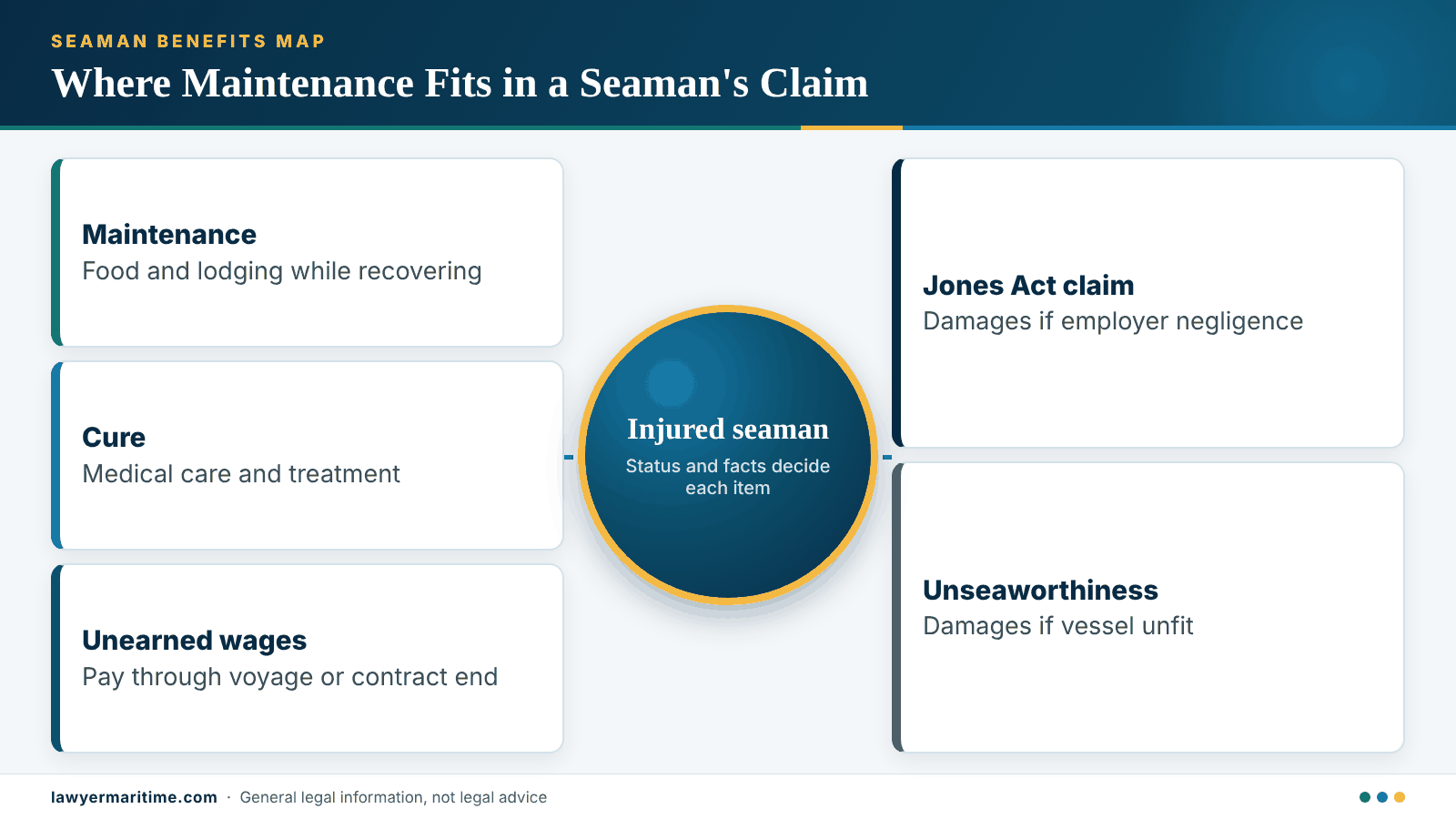
Maintenance is one of the oldest protections in American maritime law. It is the shipowner’s duty to cover a sick or injured seaman’s day-to-day living costs, mainly food and lodging, while the seaman is recovering and unable to work. Before getting into the details, it helps to see where the remedy comes from and how it fits with the other benefits a seaman may be owed.
Maintenance in plain English
Think of this subsection as the definition and the map. Once you know what maintenance is and what it is not, the later questions about expenses, timing, and disputes are much easier to sort out.
What maintenance is and where it comes from
Maintenance is the right of an injured or ill seaman to a living allowance, while cure is the right to medical care. Cornell’s Legal Information Institute describes the pair as a longstanding protection for seafarers that the employer or shipowner must provide, and that employers and unions cannot contract away. The Supreme Court has traced the duty back centuries and has said it is not something the parties can modify or waive by agreement (Atlantic Sounding Co. v. Townsend, 557 U.S. 404 (2009)).
Because it comes from the general maritime law, maintenance is not created by the statute people call the Jones Act. In this article, “Jones Act” means the seaman injury statute at 46 U.S.C. § 30104, not the cabotage rules that govern which vessels may carry cargo between U.S. ports (46 U.S.C. § 55102 and following sections). A seaman can have a maintenance claim and a Jones Act negligence claim from the same injury, and they work differently, as the next sections show.
Maintenance, cure, and wages: three different things
Courts and employers use the three terms differently, and mixing them up is one of the quickest ways to be shortchanged. Maintenance pays for food and lodging. Cure pays for medical treatment, including doctors, hospitals, medicine, and similar care. Unearned wages replace pay you would have earned through the end of the voyage or hitch, and they are covered in their own section below.
The Ninth Circuit’s pattern jury instruction on this subject says maintenance is independent of lost wages and is neither a substitute for wages nor given in place of them. In practical terms, a seaman who is receiving maintenance is not “being paid” in the way a salary pays someone. Maintenance is a subsistence benefit, and it is designed to keep a recovering worker housed and fed.
Who is owed maintenance, and what it does not depend on
The right belongs to seamen, which is a legal status with its own tests, and it runs against the seaman’s employer. The next two points explain what has to be true before maintenance is owed and what does not.
Seaman status and being in the service of the vessel
Maintenance is a seaman’s remedy, so the first question is whether you are a seaman. That depends on your connection to a vessel in navigation or a fleet of vessels, and on whether that connection is substantial in both duration and nature, as the Supreme Court explained in Chandris, Inc. v. Latsis, 515 U.S. 347 (1995). A job title doesn’t settle it, and working near water doesn’t either. Our guide to the seaman status test walks through those factors.
Seaman status is also not enough on its own. The Ninth Circuit’s instruction frames the elements as seaman status, an injury or illness while in the service of the vessel, and the amount owed. An illness or injury does not have to be work-related to qualify, but it generally has to arise while you are in the vessel’s service. That is why a deckhand who becomes ill on hitch may have a claim even if no one can point to an accident. Even seamen who live ashore and commute to a vessel can qualify, according to the Third Circuit in Delaware River & Bay Authority v. Kopacz (3d Cir. Sept. 25, 2009).
Why fault and waivers rarely matter
The Supreme Court has said the duty arises regardless of whether the shipowner was negligent, and that the seaman’s ordinary carelessness does not erase it (Vella v. Ford Motor Co., 421 U.S. 1 (1975)). Only serious wrongdoing, such as willful misconduct, can change that picture. That is why maintenance is often described as a no-fault benefit: you are not asked to prove how the injury happened before you receive it.
The Court has also long read the duty generously. Where the facts or the law are doubtful, doubts are resolved in the seaman’s favor (Vaughan v. Atkinson, 369 U.S. 527 (1962)). That doesn’t mean every request is granted. Employers can raise defenses, and other pages on this site cover the common ones, including what to do when a claim is refused. See our guide on maintenance and cure denied.
Which Living Expenses Count Toward Maintenance?
“Food and lodging” sounds simple until you are looking at a household budget. Rent, a mortgage, a utility bill, and a grocery run all feel like living expenses, but courts don’t treat every bill the same way. The sections below sort the common categories and explain how courts handle shared households and free housing.
Food and lodging: the categories that usually matter
Courts generally ask two questions about each expense: did you actually pay it, and is the amount reasonable for one person living in your area? The categories below are the ones that come up most often.
Rent, mortgage, utilities, and groceries
Rent and mortgage payments are the clearest lodging costs. In Hall v. Noble Drilling (U.S.) Inc., a Fifth Circuit decision from February 2001 (reported at 242 F.3d 582), the court treated a seaman who pays the full rent or mortgage as spending the full amount, and it measured the award by what he actually paid, up to a reasonable amount for a single seaman in the locality. Groceries and meals fall under the food half of the benefit and are measured the same way.
Utilities are less settled. Some courts treat heat, electricity, and water as part of the cost of keeping a place to live, while others look at the total lodging figure and ask whether it is reasonable as a whole. Because that approach can vary by court, keep the bills. A reasonable total for food and lodging is the question, and individual line items are evidence of it.
Renting, owning, and what usually falls outside
Whether you rent or own should not by itself decide whether you receive maintenance, but it changes what proof looks like. A renter can show a lease and payment records. A homeowner can show mortgage statements, and may also pay property taxes and homeowner’s insurance. Whether those extras count as part of the cost of keeping a roof overhead is a question to raise with a lawyer, because we didn’t find a settled rule.
Expenses that are not food or lodging usually sit outside maintenance. Car loans, credit card payments, child support, and entertainment are common examples. They may matter to your financial strain, and some may matter to other damages in a Jones Act claim, but they’re generally not maintenance. Our page on how the maintenance rate is calculated and disputed covers the dollar figure, and this page stays on what counts.
| Expense | Usually treated as maintenance? | Proof that helps |
|---|---|---|
| Rent | Generally yes, up to a reasonable amount for one person locally | Lease, rent receipts, bank or card statements |
| Mortgage payment | Generally yes, measured by actual payments within a reasonable amount | Monthly mortgage statements and payment history |
| Utilities (power, water, heat) | Courts differ; often folded into the reasonable lodging figure | Utility bills for the months at issue |
| Groceries and meals | Generally yes as the food component | Receipts, card statements, a simple weekly log |
| Phone, internet, streaming | Not usually food or lodging; can be argued case by case | Bills, plus a note on why the service is needed |
| Travel to medical appointments | The Ninth Circuit’s pattern instruction lists it under maintenance; classification can vary | Mileage log, fuel, fares, appointment records |
| Car loan, credit cards, child support | Generally not food or lodging | Keep for other damages and financial records |
Living with family, shared costs, and free lodging
Many injured seamen move back in with parents or share a home with a partner. That is a common reason maintenance becomes contested, so the details deserve their own attention.
When you live with parents, a partner, or roommates
Employers sometimes argue that costs should be divided by the number of people in the household. The Fifth Circuit rejected a proration argument in Hall: it agreed maintenance is for the seaman alone, but held that a seaman who actually pays the whole rent or mortgage actually spends the whole amount, with reasonableness for a single seaman acting as the cap. If you pay only your share of the rent, though, your actual cost is your share.
Courts also expect evidence. The Fifth Circuit said a seaman must present enough proof for a court to estimate his actual food and lodging costs, but described the burden as light, and said his own testimony about local living costs may be enough. If you pay a relative a fair amount for a room, document it. A written note, regular transfers, and a statement from the relative describing the arrangement can all help show that the payment is real rather than a courtesy.
When food or lodging is truly free
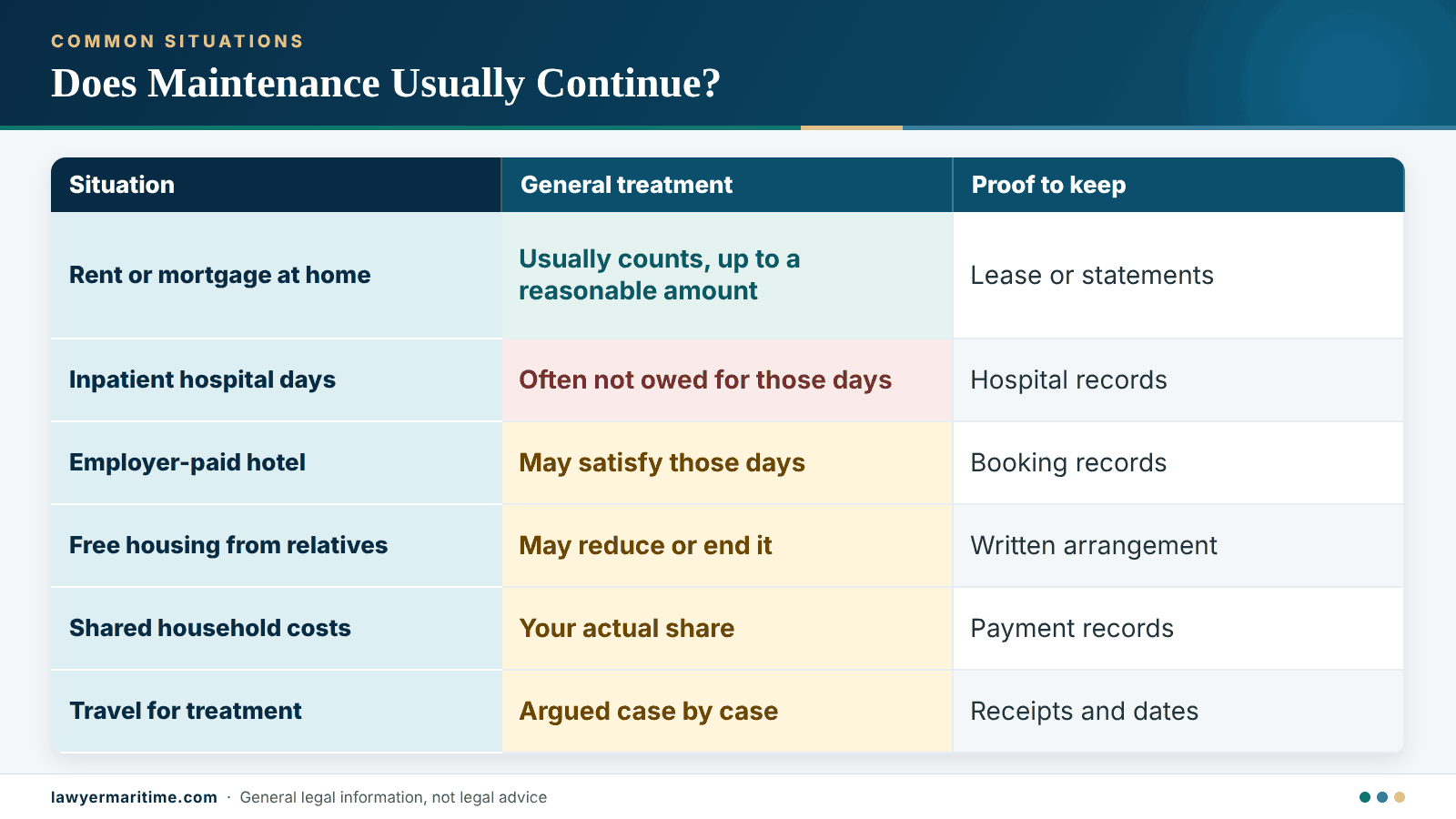
If somebody else provides your food and lodging at no cost, maintenance can shrink or disappear. Hall states that if a seaman’s food and lodging are both reasonable in quality and free, he is not entitled to maintenance from the shipowner. The employer therefore has a legitimate question to ask when you have moved into a relative’s spare room and are paying nothing.
Two cautions apply. First, “free” means the arrangement is actually free, which differs from a family member covering costs you will repay later, or one who is carrying a household strain you are expected to share. Second, a court may still award the reasonable amount if your actual spending is too low to provide adequate food and lodging. Describe your real arrangement honestly and in writing; an inaccurate statement can do more harm than a low number.
Who Pays Maintenance, and When Do Payments Begin and End?
Knowing what counts is only half the picture. The other half is the mechanics: who is legally on the hook, how often money is supposed to arrive, the date the clock starts, and the point at which payments can stop. Each of those questions has an answer in the case law, even though the day-to-day paperwork varies from company to company.
The payer and the payment rhythm
The obligation is simple to state and more varied in practice. The legal duty sits with one party, but several others often handle the money.
The employer owes it, even when someone else sends the check
Maintenance and cure is owed by the seaman’s employer or the shipowner, as Cornell’s overview of the doctrine explains. In practice, a P&I club, an insurer, or a third-party claims administrator often corresponds with the injured worker and issues payments. That arrangement is a convenience for the employer and doesn’t change who owes the duty.
It matters most when a claims adjuster says something like “we need more information before we can pay.” You can cooperate with reasonable requests for documents, and you should. Still, the duty doesn’t depend on an adjuster’s comfort level. As noted earlier, courts resolve doubts in favor of the seaman, so a reasonable request for records is different from open-ended delay.
Payments as the need arises, not a lump sum
The Supreme Court has described the remedy as one paid as the need arises, rather than as a lump sum or a pension (Farrell v. United States, 336 U.S. 511 (1949)). In everyday terms, that is why maintenance is usually calculated per day and paid weekly, every two weeks, or monthly while you remain unfit for duty. The daily figure multiplied by the covered days gives the amount due for a period.
Some union agreements and employment contracts set a daily amount or describe how payment is made. Courts read those provisions against the rule that the basic duty cannot be bargained away. In Padilla v. Maersk Line, Ltd. (2d Cir. June 25, 2013), for example, the Second Circuit applied general maritime law because the collective bargaining agreement before it did not expressly say otherwise. If your payments follow a contract formula, ask for a copy of the formula in writing.
When maintenance starts and when it stops
Two dates drive most disagreements: the date payments should have begun and the date they can lawfully end. Neither depends on the employer’s internal timetable.
The start date: leaving the vessel
The Ninth Circuit’s pattern instruction says maintenance and cure run from the time the seaman leaves the ship. That means the entitlement can begin before any claim form is filed, before the employer finishes its investigation, and before you have a final diagnosis. If you were medically removed from the vessel or went ashore ill and cannot work, the clock generally starts from that departure.
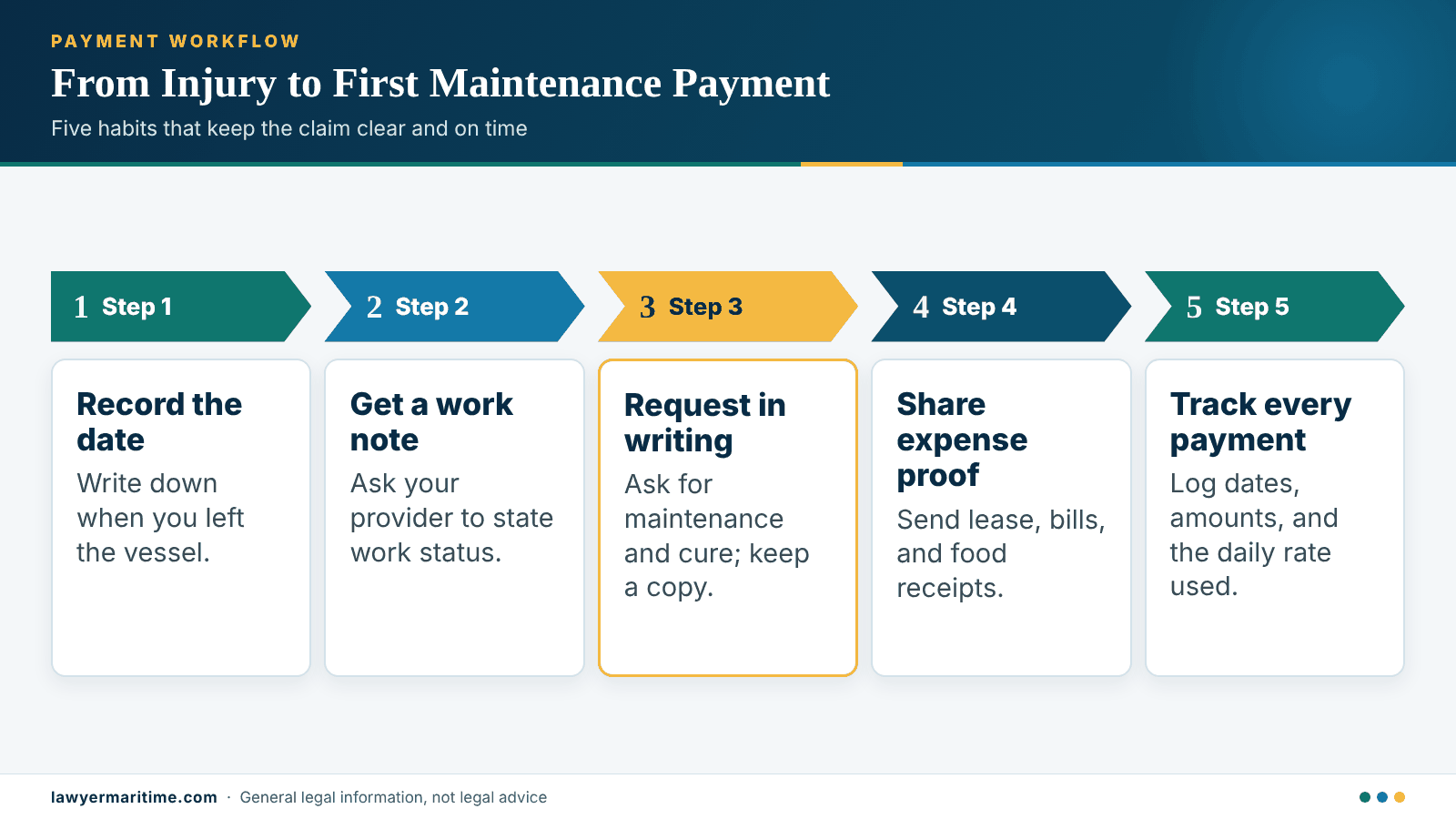
The practical lesson is to write down the date you left the vessel and the date a provider first said you could not work. Those two dates anchor everything else, including any back payment you request later.
The end point: fitness for duty or maximum medical improvement
Cornell’s summary says payments continue until the seafarer is fit for duty or additional treatment will not help. The Supreme Court’s decision in Vella put it in terms of when the incapacity is declared to be permanent, and the Ninth Circuit’s instruction uses the phrase “maximum cure,” meaning no further improvement is reasonably expected. These formulations point in the same direction, but the label “maximum medical improvement” gets argued over, and the exact timing is often the real fight.
This page does not try to settle that fight. Our guide to maximum medical improvement and maintenance and cure covers how it is determined, and the guide to terminated maintenance and cure covers what to do when payments stop earlier than you expected.
| Stage | What generally happens | Practical step |
|---|---|---|
| Leaving the vessel | The entitlement can begin once you depart the ship unfit for duty | Record the date and the reason you left |
| First days ashore | The employer or its insurer opens a file and may ask for details | Send a written request for maintenance and cure right away |
| First payment | A daily amount is calculated and paid, often on a regular schedule | Ask what daily figure is being used and how it was set |
| Ongoing treatment | Payments continue while you remain unfit for seaman’s work | Send updated work-status notes from your provider |
| Medical status change | A provider may say you have improved or reached maximum cure | Ask for the opinion in writing and keep a copy |
| End of payments | Payments may stop at fitness for duty or maximum cure | If they stop early, ask for the written reason and the medical basis |
Unearned Wages: How They Differ From Maintenance
Many injured seamen hear the phrase “maintenance and cure” and never hear about unearned wages. That gap can matter, because unearned wages are a separate component of the traditional package, and they are calculated in a completely different way from the daily living allowance.
What unearned wages are and how far they run
Unearned wages are the pay you would have received if the injury or illness had not interrupted your service. The question is how long that period lasts and what counts as pay.
Pay through the end of the voyage or contract term
In The Osceola, 189 U.S. 158 (1903), the Supreme Court listed the owner’s obligations to a seaman hurt in the ship’s service as maintenance, cure, and wages at least until the end of the voyage. The Court revisited that history in Atlantic Sounding Co. v. Townsend, noting that the duty has historically included unearned wages. Modern courts apply the idea to the voyage or the contractual employment period, whichever the facts support.
The Second Circuit described the rule this way in Padilla v. Maersk Line, Ltd.: an injured or ill seaman may recover the wages he would have earned but for the injury, through the end of the voyage or the contractual period of employment. In that case, the employer had paid base wages and maintenance and cure to the end of the contract, and the fight was over overtime. Not every summary of the doctrine mentions unearned wages at all (Cornell’s overview does not), so ask for them by name.
Overtime, bonuses, and where courts draw lines
The Padilla court held that unearned wages can include overtime that the seaman would have earned “but for” the injury, if the expectation was regular, customary, and not speculative. The employer’s own records helped prove the amount in that case. The lesson is that the payroll history and the crew agreement are central evidence.
Other pay items are less predictable. Whether a performance bonus, a per diem, or a premium for a particular assignment counts depends on the contract, the usual practice, and the court. If an item was guaranteed or paid every pay period, it is easier to argue for than one that depended on events that had not happened yet.
Hitches, rotations, and the line between unearned wages and other damages
Offshore and rotational schedules do not fit neatly into the old image of a single voyage. The ideas remain the same, but the application takes some thought.
Rotations, hitches, and open-ended work
A deckhand on a tug may work a fixed number of days on and off. A supply vessel crew member may have an hourly or day-rate arrangement that lasts as long as the employer needs him. When there is no clear voyage end, the dispute is usually about the period during which the employer would have kept paying you. We did not find a single rule that applies everywhere, so look first at the employment contract, the crew agreement, any union agreement, and the way hitches were actually scheduled.
Document your work pattern now. A calendar of recent hitches, your last several pay stubs, and any text or email from a supervisor describing the schedule can all help show what the period would have been. Don’t guess at a number; ask the employer to show how its figure was calculated.
Unearned wages are not lost earning capacity
Unearned wages and lost earnings damages sound alike, but they are different. Unearned wages are actual wages missed during a defined period, and they travel with maintenance and cure. A Ninth Circuit memorandum disposition, Foss Maritime Co. v. Easly (9th Cir. Nov. 4, 2013), which is unpublished and not binding precedent, says the district court wrongly treated them as the same: lost wages in that sense are an estimate of lost earning potential and are separate from the maintenance obligation.
The bigger-picture damages, such as future lost earning capacity and pain and suffering, come from fault-based claims like the Jones Act claim or unseaworthiness, and they require proof of fault or an unfit vessel. Our guide to Jones Act damages covers those categories, and our page on maritime injury compensation shows how the pieces fit together.
| Item | What it pays for | How it is generally measured | Typical proof |
|---|---|---|---|
| Maintenance | Food and lodging while you cannot work | Actual cost, up to a reasonable amount for one person locally, per day | Lease or mortgage statements, bills, food receipts |
| Cure | Medical treatment, hospital care, medicine, and related care | Cost of reasonable treatment while the condition can improve | Medical records, bills, referral and treatment notes |
| Unearned wages | Pay you would have earned through the end of the voyage or contract term | Wage rate times the covered period, with regular overtime in some cases | Crew agreement, pay stubs, hitch schedule, employer payroll records |
| Lost earning capacity | Future income lost because of a lasting injury | Estimated from the injury’s effect on future work; not part of maintenance | Medical opinions, work history, vocational and economic evidence |
How to Request Maintenance and Document Your Expenses
We are not aware of a standard federal maintenance claim form, and no agency administers the benefit the way the Department of Labor administers longshore compensation. The request is between you and your employer, which makes a clear written record the most valuable thing you can create. Good records also protect you later if payments are disputed or reduced.
Making the request in writing
A short, factual written request does more than a phone call. It fixes the date you asked, shows what you asked for, and gives the employer no room to say it never knew the amount or the reason.
What a written request should contain
You don’t need legal language or a formal pleading. A request is clearer when it covers the same points every time, and the list below works as a checklist you can adapt to your own situation.
- Your full name, the vessel or employer’s name, and the date you left the vessel
- A plain statement that you are asking for maintenance, cure, and any unearned wages that apply
- The date a provider first said you could not work, and the date of your next appointment
- The monthly lodging cost you pay and how you pay it, with the lease or mortgage statement attached
- Your approximate monthly food costs and the proof you can provide, such as receipts or a log
- A request for the daily rate the employer will use and the date payments will start
- A request for a written explanation if any part is refused, delayed, or reduced
- Your preferred way to receive payment and an address for correspondence
Stay factual. Avoid accusations, speculation about the employer’s motives, or statements about how the injury happened beyond what the records already show. Anything you write may later be read by an adjuster, a lawyer, and possibly a judge.
How to send it and keep track of what happens next
Use a method that creates a record, such as email with a read receipt, a letter with tracking, or both. Keep a copy of what you sent and note the date and time. If a company representative calls you instead of replying, follow up with a short message summarizing the call, such as “Thank you for speaking with me today. You said payments would begin on a date to be confirmed. Please confirm in writing.”
Keep a simple log with the date of each request, the answer you received, and every payment with its date and amount. If your employer uses an online claims portal, take screenshots. Small records like these turn a later dispute from “he said, she said” into a timeline anyone can follow.
Receipts, logs, and medical proof
Maintenance is measured by what you actually spend and what is reasonable locally, so evidence of both is the point. Two kinds of proof carry most of the weight: money records and medical records.
Money records that show what you spend
Start with lodging: the lease, rent receipts or transfers, mortgage statements, and utility bills. Then add food: grocery receipts, restaurant receipts where you have no cooking facilities, and card or bank statements that show the pattern. If cash is involved, a dated notebook entry beats memory. Photographs of receipts on your phone are fine as long as they are readable.
Because the Fifth Circuit has said a seaman’s burden of production is light and that his own testimony about local costs may be enough, imperfect records do not necessarily sink a claim. Still, the better your paper trail, the less room there is for argument. Keep the records for the whole period of recovery, not just the first month, because disputes often arise months after payments begin.
Medical records that tie the expenses to the injury
Maintenance generally continues while you are unfit for seaman’s work and not yet at maximum cure. The medical record is what proves both. Ask each provider for visit notes and a clear, dated work-status statement. When your condition changes, ask whether the provider can say whether you have reached the limit of expected improvement and what restrictions apply.
Be careful about gaps. A missed follow-up or an unexplained stretch without treatment can be used to argue that you were fit for duty or that your recovery has plateaued. If something prevents you from attending an appointment, note the reason and reschedule in writing.
| Common mistake | Why it causes trouble | Better action |
|---|---|---|
| Asking only by phone | No record of what you requested or when | Send a short written request and keep a copy |
| Throwing away receipts | The employer can dispute amounts you cannot document | Photograph and store every receipt or bill |
| Waiting to ask for unearned wages | The request may be treated as an afterthought | Name them in your first request along with maintenance and cure |
| Signing a form without reading it | A release or statement could limit later rights | Read every page and consider legal review first |
| Skipping medical appointments | Gaps may be used to argue you have recovered | Attend, or reschedule in writing with the reason |
| Describing living arrangements loosely | Inconsistent statements can hurt credibility | State plainly who pays what and keep a written note |
What Happens When Maintenance Is Late, Short, or Disputed?
Most maintenance problems are not outright refusals. They are slow starts, payments that do not match the expenses, or labels that make an ordinary payment look like something else. Knowing what the pattern looks like, and what the law gives you when an employer falls short, lets you respond calmly and in writing.
What delay and underpayment look like in practice
Not every gap is a violation, and not every delay is bad faith. The point is to recognize the common patterns early, while the paper trail is still easy to build.
Slow starts and “pending investigation”
A common pattern is an adjuster who says maintenance will begin after the investigation is done. An investigation can be reasonable, and an employer may ask for records that bear on seaman status, medical history, or the cause of the problem. But the duty to pay doesn’t wait for a finished accident report, and the Supreme Court has said that doubts are resolved in the seaman’s favor (Vaughan v. Atkinson).
If weeks go by with no payment, put the timeline in writing: the date you left the vessel, the date you asked, what you were told, and what you have received. Keep the tone neutral. A clear factual summary is far more useful than an angry letter if the dispute ever reaches a lawyer or a court.
Partial payments, advances, and the daily-rate question
A second pattern is a payment that arrives but is smaller than your real costs. The cause may be a rate the employer treats as fixed, a figure from an old contract, or a refusal to count certain expenses. The legal measure is generally actual cost up to a reasonable local amount, as discussed above, so a flat number that ignores your real lodging cost deserves a polite question. The mechanics of the rate are on our page about the maintenance and cure rate.
A third pattern is relabeling. In Foss Maritime Co. v. Easly, an unpublished Ninth Circuit memorandum, a union contract set a daily figure, and the employer treated part of it as maintenance and part as an advance against lost wages. The employer reduced the payment to the lower maintenance figure after the seaman recovered lost wages from a third party, and the court held that the contract did not allow that, calling maintenance an obligation that cannot be abrogated. That decision is not binding precedent, but it shows why you should ask exactly what each payment is meant to cover.
What the law provides when payment is withheld
The consequences of failing to pay maintenance can go beyond the missing money, though they depend on the facts and on how the employer acted. Courts have drawn distinctions between honest disputes and callous refusals.
Interest, aggravation, and attorney’s fees
A seaman who wins a maintenance claim is owed the unpaid amount. The Third Circuit also upheld an award of prejudgment interest in Delaware River & Bay Authority v. Kopacz (3d Cir. Sept. 25, 2009), reasoning that it compensated the seaman for losing the use of money he was owed. The Ninth Circuit’s pattern instruction also cites a Supreme Court decision, Cortes v. Baltimore Insular Line, Inc., 287 U.S. 367 (1932), for the point that failure to pay when due can make the employer liable for harm that follows, including aggravation of the condition.
Attorney’s fees are narrower. In Vaughan, the Court allowed a seaman to recover counsel fees as damages where the shipowners’ failure to respond to the claim was callous, willful, and persistent. In Kopacz, by contrast, the court denied fees and consequential damages where the employer’s refusal rested on a colorable legal theory. An honest legal disagreement, in other words, is treated differently from stonewalling.
Punitive damages and where to read next
The Supreme Court held in Atlantic Sounding Co. v. Townsend that punitive damages remain available for the willful and wanton failure to pay maintenance and cure. That is a high bar. It isn’t triggered by a late check or a good-faith disagreement about the rate, and many disputes never get near it.
If your problem is a flat refusal, rather than delay or underpayment, read our guide to maintenance and cure denied. If you want the extra-damages picture, see maintenance and cure punitive damages. In either case, the sooner the paper trail exists, the easier it is for a lawyer to evaluate.
Hospital Stays, Treatment Away From Home, and Other Special Situations
The standard picture of maintenance is a seaman recovering at home, paying rent and buying groceries. Real recoveries are messier. Surgery, rehabilitation centers, treatment in another city, and attempts to return to light work all raise their own questions about whether the living-expense benefit continues and in what form.
When someone else is providing your food and lodging
Maintenance replaces the cost of food and lodging that you would otherwise pay. When a hospital, a rehabilitation facility, or the employer itself provides those things, the analysis changes.
Inpatient hospital stays
The Ninth Circuit’s pattern jury instruction says maintenance is not owed while the seaman is hospitalized, because hospitalization already provides food and lodging. That is the general logic: the benefit exists to cover costs you incur, and a hospital stay covered as cure includes room and board. Other courts may analyze the issue differently, and we didn’t find a settled national rule on whether ongoing costs at home during a short stay are treated differently.
What this means in practice is that you should expect questions about the days you spent in a hospital, and you should keep your housing records for those days anyway. If you continue to pay rent on a home you are not using, a clear record gives a lawyer something to argue from if the point is contested. The medical bills themselves belong to cure, not maintenance.
Rehabilitation centers and employer-provided housing
The same reasoning appears in the Fifth Circuit’s Hall decision, which said that if a seaman’s food and lodging are reasonable in quality and free, he is not entitled to maintenance from the shipowner. If the employer arranges and pays for a hotel, a rehabilitation residence, or meals directly, the employer can reasonably argue that its obligation for those days is already met.
The key words are “reasonable in quality.” A cot in a facility that you cannot use because of your condition, or housing far from your treatment, may not meet that test. Write down what the employer provided, for which dates, and whether it was suitable. If it fell short, say so in writing at the time rather than months later.
Treatment away from home and attempts to work
Two further situations produce the most confusion: leaving home for treatment, and trying to work again before you are fully recovered.
Travel and temporary lodging for treatment
If the best provider is in another city, you may need transportation and a place to stay near the treatment. The Ninth Circuit’s instruction includes transportation to and from a medical facility within maintenance, though courts do not always classify travel the same way. The label matters less than the principle: reasonable costs of getting to and staying near necessary treatment may be part of what the employer owes.
Get the arrangement in writing before you go, when you can. Ask who will book and pay for the hotel, whether you will be reimbursed for fuel or fares, and whether any extra food costs will be covered. Keep every receipt, and note the appointment dates that justify the trip.
Light duty, other work, and earnings while recovering
Employers sometimes offer light or modified duty, and some injured seamen take other jobs to pay bills. Either step can affect maintenance, because the benefit generally runs while you are unfit for seaman’s work. We did not find a single rule we can state with confidence about how part-time earnings are treated, and the answer may differ by court and by the facts.
Be careful here. Don’t take on work your doctor hasn’t cleared, don’t hide earnings, and don’t stop reporting your status. Before accepting light duty or another job, ask your provider for written restrictions and consider speaking with a maritime lawyer, because a well-meant effort to earn money can later be used to argue that you were fit for duty.
Other Benefits, Offsets, Taxes, and Back Payments
An injured seaman rarely has maintenance as the only source of money. There may be disability insurance, union benefits, Social Security, or a spouse’s income, along with questions about taxes and about payments that should have started weeks ago. These topics are where general information runs out fastest, so treat what follows as a map of the questions to raise rather than a set of answers.
How other benefits interact with maintenance
The starting assumption is that maintenance is its own obligation and does not disappear because you also receive something else. Courts have looked at specific benefit plans, though, so the details matter.
Workers’ compensation and the Longshore Act
Seamen are generally outside the Longshore and Harbor Workers’ Compensation Act. The statute’s definition of “employee” excludes a master or member of a crew of any vessel (33 U.S.C. § 902(3)(G)). Seamen look instead to maintenance and cure, and to Jones Act and unseaworthiness claims when fault or vessel condition is involved. State workers’ compensation systems also generally do not cover seamen, although details vary, so ask a lawyer before assuming either way.
If you are not sure whether you are a seaman, the stakes are high, because the answer changes which system pays you. A harbor or shipyard worker who is not a seaman may be covered by the Longshore Act and its benefit schedule, which is a separate system with its own rates. Our page on LHWCA compensation rates covers that side, and our guide to who counts as a Jones Act seaman covers the status question.
Disability insurance, Social Security, and union plans
The most useful decision on offsets we found is Delaware River & Bay Authority v. Kopacz (3d Cir. Sept. 25, 2009). The Third Circuit held that employer-funded long-term disability benefits and Social Security disability benefits did not offset the seaman’s maintenance in that case. It treated the long-term disability benefits as a wage substitute rather than maintenance, and it found that Social Security disability serves a different purpose and has different eligibility rules.
The court also noted that a shipowner can avoid double liability by expressly specifying that disability benefits are meant to satisfy its maintenance obligation, so the plan wording is important. That is one court, applying specific facts. Other circuits may analyze it differently, so don’t treat Kopacz as a guarantee. Also remember that benefits with income limits can react to maintenance: a 1980 Social Security ruling, SSR 80-21, treated a seaman’s maintenance as unearned income for SSI purposes. Rules change, so ask the benefits office how maintenance would be counted today.
| Other benefit | Does it generally cancel maintenance? | What to check |
|---|---|---|
| Longshore Act benefits | Seamen are generally outside the Act; not a substitute | Whether your status is seaman or covered harbor worker |
| Employer-funded long-term disability | Not in Kopacz; plan wording can change the analysis | Whether the plan or contract says it satisfies maintenance |
| Social Security disability | Not in Kopacz; different purpose and eligibility | Any offset language in other plans you receive |
| SSI or other needs-based benefits | Maintenance may count as income for eligibility | Ask the benefits office how maintenance is treated now |
| Union or employer sick pay | Depends on the agreement and how it is labeled | Read the agreement for “in lieu of” or credit terms |
Taxes and back payments
Two practical questions remain: whether payments are taxed, and what happens if weeks or months have already passed without full payment.
Taxes: why to ask a tax professional
We aren’t giving tax advice, and the treatment of each payment can differ. Section 104(a)(2) of the Internal Revenue Code excludes from gross income damages received on account of personal physical injuries or physical sickness, but whether that provision reaches a particular maintenance, cure, or wage payment is a question for a qualified tax adviser (26 U.S.C. § 104). Unearned wages in particular look like pay and may be handled differently on payroll paperwork.
What you can do now is keep every pay statement, tax form, and cover letter that accompanies a payment, and ask the employer in writing how each payment is being reported. If a settlement is on the table, the allocation among categories can matter, which is another reason to get tax and legal advice before signing.
Back payments and how long you can wait
If payments were late or never started, you can generally ask for the amounts that accrued from the time you left the vessel unfit for duty, and the written record you have been building supports that request. Back payments are usually calculated by the same method as current ones, using actual costs up to a reasonable amount for the period in question, so receipts from earlier months matter.
Waiting has a cost. The general three-year period in 46 U.S.C. § 30106 governs many maritime personal injury suits unless another law provides otherwise, but how it or other time doctrines apply to a maintenance claim can depend on the court and the way the claim is framed. Our overview of Jones Act statute of limitations discusses the timing questions in more detail. If you are negotiating a settlement, our guide to Jones Act settlements explains how maintenance owed to date can fit into the discussion.
What to Do Now: A Maintenance Checklist
Everything above comes down to a short list of habits. Some belong in your first days away from the vessel, and some are routines to keep for as long as you are recovering. None of them requires legal training, and all of them make later conversations with an employer or a lawyer easier.
In the first days after leaving the vessel
Early steps set the foundation. The goal is to fix the dates, ask clearly, and start collecting proof before any dispute arises.
Fix the dates and make the request
- Write down the date you left the vessel and the reason, in your own words
- Get a dated note from a provider stating whether you can work
- Send a written request for maintenance, cure, and unearned wages, and keep a copy
- Ask which daily figure will be used and how it was set
If the employer sends a form to sign, read every page. A document that mentions a release, a settlement, or a statement about the cause of your injury deserves a pause and, ideally, legal review before you sign.
Start the paper trail
- Save your lease or mortgage statement and the most recent utility bills
- Photograph grocery receipts and keep a weekly food log
- Gather pay stubs, your crew or employment agreement, and any union contract
- Write down who lives in your home and who pays which costs
Store everything in one place, either a folder or a cloud album, and back it up. Months from now, you will want to find a single receipt in seconds.
While you are recovering
The longer the recovery, the more the routine matters. These habits keep the claim current and make it harder for a dispute to catch you off guard.
Keep the record current
- Log every payment with its date, amount, and the daily rate used
- Send updated work-status notes whenever your condition or restrictions change
- Keep every appointment, or reschedule in writing with the reason
- Follow up in writing when a payment is late, short, or unexplained
Short, calm, factual messages are the best kind. They give an adjuster no reason to dispute your tone and give a lawyer a clean timeline.
Know what to avoid and when to get help
- Do not sign a release or settlement paper without understanding what rights it gives up
- Do not take work your provider has not cleared, or hide earnings from the employer
- Do not rely on a phone call that was never confirmed in writing
- Do not wait to ask a lawyer about time limits if payments have been refused or have stopped
If payments are refused, delayed for weeks, or stopped before your provider says you have reached maximum cure, a consultation with a maritime lawyer is a reasonable step. Our page on seaman injury lawyers explains what to ask, and the broader maritime lawyer hub can help you get your bearings.
Frequently Asked Questions
These short answers cover questions that readers often ask once the basics are clear. Each answer is general, and your facts, your contract, and your court can change it.
Eligibility and coverage
These questions deal with whether maintenance applies to your situation at all.
Do I qualify if my injury or illness did not happen on the job?
It may still qualify. The Ninth Circuit’s pattern instruction says the injury or illness need not be work-related, though it must arise while you are in the service of the vessel. In Vella, the Supreme Court likewise described the duty as arising without regard to the shipowner’s negligence. Employers can raise defenses, so keep your records of when symptoms began.
Is maintenance the same as workers’ compensation?
No. Workers’ compensation is a statutory system with its own schedules and agencies, and the Longshore Act expressly excludes crew members of a vessel. Maintenance is a judge-made duty that comes from the general maritime law and is owed by the employer directly. They can look similar on a bank statement, but the rules that govern them are different.
Can a pre-existing condition affect my right to maintenance?
It can become an issue, most often when an employer argues that a seaman knowingly hid a prior condition when hired. The Fifth Circuit recognized a defense of that kind in McCorpen v. Central Gulf Steamship Corp., 396 F.2d 547 (5th Cir. 1968), and other courts treat the subject in their own ways. The details are in our guide on denied maintenance and cure claims.
Payment and timing
The next set of questions concerns the mechanics of getting paid.
How often should maintenance be paid?
There is no single schedule in the law that we are aware of. The Supreme Court has described the remedy as paid as the need arises, and employers commonly pay weekly, every two weeks, or monthly. If a contract or union agreement sets a schedule, ask for a copy and compare it with what you receive.
Are unearned wages paid on top of maintenance?
Generally, yes. They are a separate component, covering wages you would have earned through the end of the voyage or contract term, while maintenance covers food and lodging. In Padilla, the employer had paid base wages and maintenance and cure through the end of the contract, and the dispute was over overtime. Ask for each item by name.
Can my employer make me sign something before paying?
Be cautious. Because the duty is imposed by law and cannot be waived by agreement, as the Supreme Court said in Townsend, an attempt to condition basic maintenance on a release of your other claims deserves a careful look. Read any document before signing it, and consider legal review, since our page on maritime settlement releases explains how a signature can reach beyond its heading.
Problems and next steps
The final group covers what to do when things do not go smoothly.
What if I cannot prove my exact expenses?
Imperfect records don’t necessarily end a claim. The Fifth Circuit described the seaman’s burden of production as light and said his own testimony about local living costs can suffice, although a seaman who offers no evidence of his actual costs may not recover. Reconstruct what you can from bank statements, leases, and a written estimate, and be honest about what is an estimate.
Are maintenance payments taxable?
We don’t give tax advice, and the answer can differ by type of payment and your circumstances. Keep every statement and ask the employer how each payment is reported. A tax professional can tell you how your payments should be handled and whether any settlement allocation matters.
Do I need a lawyer to get maintenance?
The law doesn’t require one. Many seamen begin by asking in writing and, when payments flow, never need more. If payments are refused, shortened, or stopped early, or if you are being pressed to sign a release, speaking with a maritime lawyer is a reasonable step. Our overview of the Jones Act shows how maintenance fits with the larger set of seaman remedies.
Sources and Legal Authorities
The links below are the statutes, decisions, and official materials we read while preparing this article; where a source is a court opinion, the summary above is ours and not a quotation.
Statutes, tax provisions, and agency rulings
Federal statutes
- 46 U.S.C. § 30104 – Jones Act personal injury to seamen
- 46 U.S.C. § 30106 – Time limit on maritime personal injury and death actions
- 33 U.S.C. § 902 – Longshore Act definitions, including the exclusion of a master or member of a crew of any vessel
- 46 U.S.C. § 55102 and following sections – cabotage rules, mentioned only to distinguish them from the seaman injury statute
Tax and benefits materials
- 26 U.S.C. § 104 – Compensation for injuries or sickness
- Social Security Ruling 80-21 – Seaman’s maintenance as unearned income for SSI
Cases and court materials
Supreme Court decisions
- The Osceola, 189 U.S. 158 (1903) – owner’s duties of maintenance, cure, and wages at least until the voyage ends
- Farrell v. United States, 336 U.S. 511 (1949) – background on the nature and duration of maintenance and cure
- Vaughan v. Atkinson, 369 U.S. 527 (1962) – doubts resolved for the seaman; attorney’s fees for callous, willful, persistent failure to respond to a claim
- Vella v. Ford Motor Co., 421 U.S. 1 (1975) – duty arises irrespective of shipowner negligence; duration
- Chandris, Inc. v. Latsis, 515 U.S. 347 (1995) – seaman status
- Atlantic Sounding Co. v. Townsend, 557 U.S. 404 (2009) – duty cannot be waived by agreement; punitive damages for willful failure to pay
- Cortes v. Baltimore Insular Line, Inc., 287 U.S. 367 (1932) – cited in the Ninth Circuit pattern instruction below for harm from failure to pay when due
Courts of appeals decisions and pattern instructions
- Hall v. Noble Drilling (U.S.) Inc., 242 F.3d 582 (5th Cir. 2001) – actual cost up to a reasonable amount; light burden of production; no proration
- Padilla v. Maersk Line, Ltd., No. 12-834 (2d Cir. June 25, 2013) – unearned wages and overtime
- Delaware River & Bay Authority v. Kopacz, Nos. 08-4029 and 08-4086 (3d Cir. Sept. 25, 2009) – commuter seamen; no offset for the disability benefits at issue
- Foss Maritime Co. v. Easly, No. 12-36032 (9th Cir. Nov. 4, 2013) (unpublished memorandum) – maintenance, advances, and unearned versus lost wages
- Ninth Circuit Manual of Model Civil Jury Instructions, No. 7.11 – Maintenance and cure: elements and burden of proof
- McCorpen v. Central Gulf Steamship Corp., 396 F.2d 547 (5th Cir. 1968) – concealment defense, cited for context only


