
A maintenance and cure denied letter is not the last word, because the obligation doesn’t depend on fault. Under general maritime law, an employer generally owes an injured or ill seaman a daily living allowance (maintenance), medical care (cure), and, traditionally, unearned wages through the end of the voyage or hitch. Insurers and employers still stop or refuse payment for reasons that range from a legitimate medical dispute to a pre-existing-condition defense to plain delay. This guide is for injured crew members, deckhands, offshore workers, and their families who need to understand why benefits get denied, what to document, how a written demand works, and which remedies may follow an unjustified refusal. It covers the governing case law and the practical steps, and it keeps the Jones Act negligence claim in the background. A denial is a dispute to be answered with records, not a final answer.
What Maintenance and Cure Covers and Who Owes It
Before you can answer a denial, you need to know what the employer was supposed to provide. Maintenance and cure is one of the oldest duties in maritime law, and it works differently from workers’ compensation or a negligence lawsuit. The Supreme Court has described it as an obligation that dates back centuries as part of general maritime law, and it exists whether or not anyone did anything wrong.
The three parts of the obligation
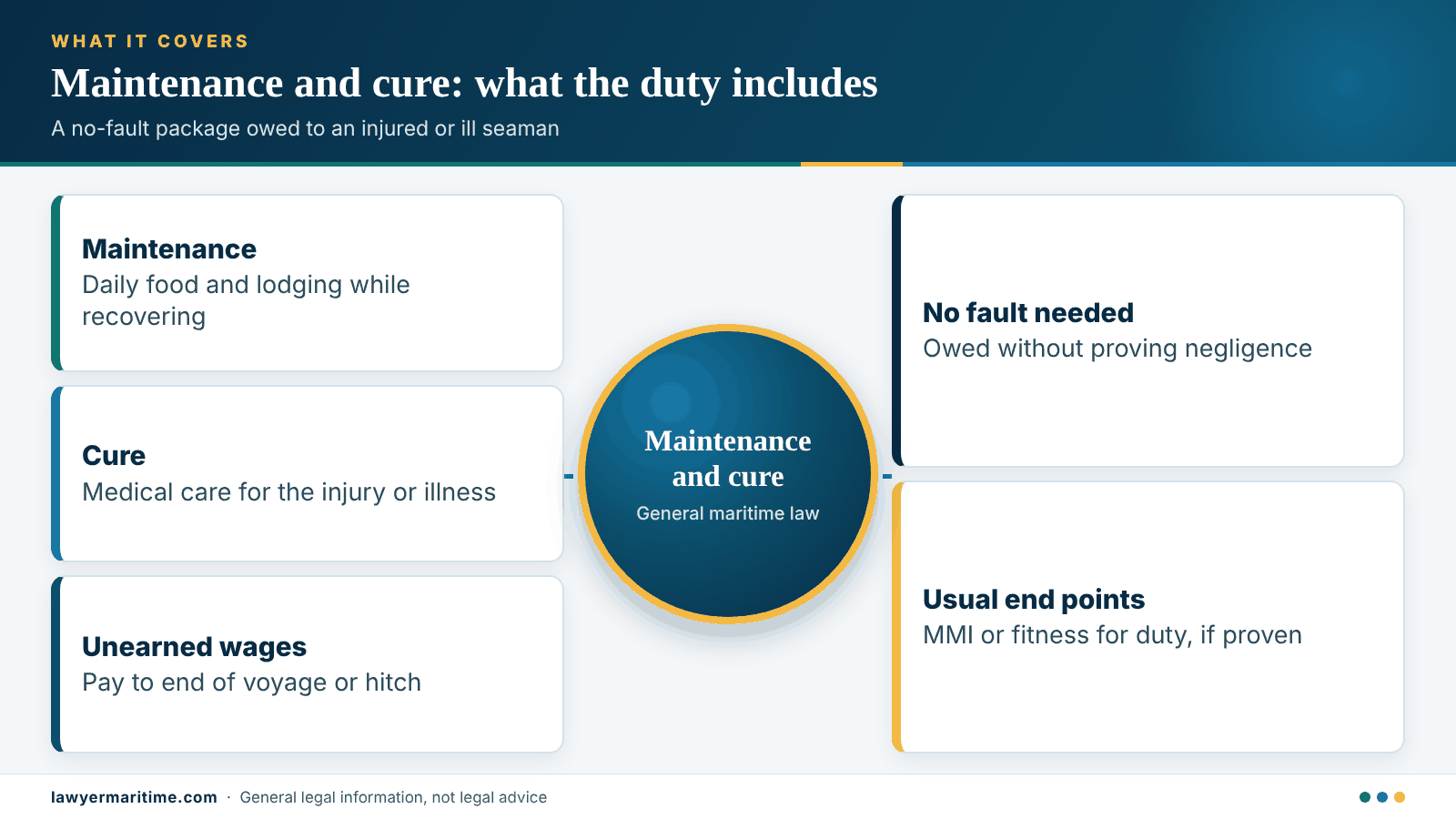
The label sounds like one benefit, but it’s really a package. Each part answers a different problem for an injured crew member: where to live, how to pay for treatment, and how to replace pay that stopped when the work did.
Maintenance: a daily allowance for food and lodging
Maintenance is the seaman’s living support while recovering ashore. In Calmar S.S. Corp. v. Taylor, 303 U.S. 525 (1938), the Supreme Court described it as comparable to what the seaman received while serving at sea. In practice, that means a daily amount meant to cover reasonable food and lodging, not a salary and not compensation for the injury itself.
Federal law doesn’t set one national daily figure. Some employment contracts and collective bargaining agreements name a rate, and a seaman may argue that actual local costs are higher. That disagreement is one of the most common maintenance disputes, and we return to it below.
Cure: medical care until the seaman has recovered as far as possible
Cure is the medical side: doctor visits, hospital care, surgery, therapy, prescriptions, and, depending on the circumstances, related costs such as travel to treatment. The Court in Calmar described it as care, including nursing and medical attention, for as long as the duty continues. The duty generally runs until the seaman reaches maximum medical improvement (often shortened to MMI), meaning further treatment is expected to relieve symptoms at most rather than improve the condition.
The exact end point is more nuanced than the shorthand suggests. In Vella v. Ford Motor Co., 421 U.S. 1 (1975), the Court tied the duty to the point at which a medical diagnosis establishes that the condition is permanent and incurable. Vella also left open whether purely palliative care is owed earlier, and lower courts can differ on that question. The practical lesson is that the end date is a medical question that someone has to prove with records, not a date an adjuster can announce.
Unearned wages: pay through the end of the voyage or engagement
The traditional package also includes unearned wages, which are the wages the seaman would have earned through the end of the voyage or the agreed period of work if the injury had not happened. On a vessel without a defined voyage, such as a harbor tug or a rotating offshore crew, that period is usually measured by the hitch, pay period, or assignment. Fishing crews may be measured by a share arrangement instead.
Union agreements and contracts sometimes define how unearned wages are calculated, and courts can treat those terms differently. Because the rules depend on the vessel type and the contract, a denial letter that ignores unearned wages entirely is worth noticing. It may mean a whole category of benefits was never considered.
| Part | What it is meant to cover | Where disputes usually arise |
|---|---|---|
| Maintenance | Reasonable daily food and lodging while recovering | The daily rate, proof of actual living costs, and the date payments stop |
| Cure | Medical treatment aimed at recovery, plus related costs | Who chooses the doctor, whether a procedure is curative, and when MMI is reached |
| Unearned wages | Pay through the end of the voyage, hitch, or engagement | How the period is measured and whether overtime or contract terms count |
Why the duty applies without proving fault
Many injured workers assume they must prove the employer did something wrong. For maintenance and cure, that assumption is mistaken, and understanding why helps you spot weak denials.
A duty tied to the employment, not to blame
The Court in Calmar explained that the duty arises from the contract of employment and does not rest on negligence or culpability by the owner or master. Later cases keep that framing: Aguilar v. Standard Oil Co., 318 U.S. 724 (1943), stressed that liability does not turn on the shipowner’s fault, and that a seaman’s ordinary negligence, short of willful misbehavior, does not defeat the claim. The duty also is not limited to injuries the job caused, which is why an illness that first appears during service can qualify.
That is a very different starting point from a negligence claim. A seaman who wants damages for pain, lost earning capacity, or future losses generally has to prove fault through the Jones Act or an unseaworthiness claim. We cover that separate path in our guides to the Jones Act seaman remedy and the Jones Act claim process.
Who is covered: seaman status and the service of the ship
Two questions sit underneath every claim. First, is the injured person a seaman, which depends on tests developed in cases such as McDermott International, Inc. v. Wilander and Chandris, Inc. v. Latsis? Second, was the injury or illness connected to service of the ship? Our guide to the seaman injury claim explains the first question in depth.
On the second question, courts have read “in the service of the ship” broadly. Aguilar held that a seaman hurt without misconduct while going ashore on shore leave could recover, because shore leave is part of the voyage. A denial that rests only on “you weren’t working when it happened” isn’t self-proving, and it deserves a factual answer.
Why Maintenance and Cure Gets Denied or Stopped
Denials rarely arrive as a flat refusal. More often, payments slow down, a nurse case manager starts steering treatment, or a letter announces that benefits have ended. Sorting the stated reason into one of three buckets is the quickest way to get your bearings: the employer says the duty never arose, says it has ended, or disputes the amount.
Arguments that the duty never arose
These are the most serious denials because they attack the claim at the root. Each one turns on facts and on the exact words used in paperwork, so the fine print matters.
Seaman status and the service of the ship
An employer may argue that the worker is not a seaman, that the structure or craft was not a vessel in navigation, or that the injury happened outside the service of the ship. Status is decided by legal tests, not by a job title, and our overview of maritime jurisdiction explains how those threshold questions fit together. A genuine status dispute can end a claim, so treat this denial as a reason to gather employment records quickly.
Examples of useful records include crew lists, work schedules, vessel assignments, and pay stubs showing the vessel or fleet. They show how much of your work was aboard a vessel or fleet of vessels and how much was ashore.
Misconduct defenses
Because the duty does not rest on fault, ordinary carelessness by the seaman does not end it. Aguilar drew the line at willful misbehavior or deliberate indiscretion, and Farrell v. United States, 336 U.S. 511 (1949), described forfeiture as reserved for conduct such as gross misconduct, insubordination, or disobedience. Employers sometimes cite intoxication, a rules violation, or leaving the vessel without permission.
Whether the behavior is the kind that forfeits benefits, and whether it caused the injury, are disputed questions. Don’t assume a write-up in your file settles them.
Pre-existing conditions and the McCorpen defense
The pre-existing condition defense is probably the most litigated denial theory. In McCorpen v. Central Gulf S.S. Corp., 396 F.2d 547 (5th Cir. 1968), the Fifth Circuit allowed an employer to avoid maintenance and cure if the seaman willfully concealed a prior condition. Courts applying the defense generally ask three things: did the seaman intentionally misrepresent or conceal medical facts, were those facts material to the hiring decision, and is there a causal link between the undisclosed condition and the injury now claimed.
In Brown v. Parker Drilling Offshore Corp., 410 F.3d 166 (5th Cir. 2005), the court indicated the concealment element can be met without a finding of subjective intent when a pre-employment questionnaire was plainly designed to elicit the information, as the Fifth Circuit later described in Boudreaux v. Transocean Deepwater, Inc.. The defense originated in the Fifth Circuit, and other circuits may apply it differently or describe it in different terms. Two points matter for you: the employer generally carries the burden of proving the defense, and the causal link requirement means a disclosed or unrelated old problem does not automatically defeat a new injury.
Arguments that the duty has ended
Even a valid claim can run out. The question is whether the end date was set by a reliable medical judgment or by a calendar and a claims reserve.
Maximum medical improvement declarations
An MMI declaration usually comes from a physician the employer or insurer has chosen, and it usually triggers a termination letter. The doctrine itself is sound. Cure generally ends when the condition has been treated as far as it can be, and Farrell noted the duty generally ends once maximum cure is reached or the condition is declared permanent.
But an MMI label is evidence, not a verdict. It doesn’t end the conversation. Ask whether the doctor examined you, reviewed your imaging and surgical history, and addressed treatment you have not yet received. A recommendation for surgery or injections that nobody has authorized is a strong sign that MMI may be premature.
Fitness-for-duty opinions and competing medical views
A fit-for-duty note is a different question from MMI. A seaman can be unable to return to the vessel while still improving, or can reach MMI while still unable to work at sea. When benefits stop because a physician cleared you for work, ask what job duties the doctor actually considered.
Conflicting medical opinions are common. Your own treating physician’s records, a second opinion, and a clear description of what your regular duties require often decide which view carries weight.
Arguments about the amount and the pace of payment
Some of the most frustrating denials do not formally deny anything. They pay too little, too slowly, or only after repeated calls.
Maintenance rate disputes
If you are paid a flat daily amount, compare it with what you actually spend on rent, utilities, and food while recovering. Farrell set no dollar figure, and the law generally looks to reasonable food and lodging comparable to what shipboard life would provide. A contract or union agreement may set a rate, and whether a court treats that figure as controlling can depend on the agreement and on where the case is brought.
Keep your lease, utility bills, and grocery receipts. Without them, a rate argument becomes your word against a form.
Delay, investigation, and treatment control
Employers are generally entitled to a reasonable period to investigate a claim and to request medical documentation. Courts have said a refusal can be reasonable when a diligent investigation shows the claim lacks merit, or when the seaman fails to provide requested records. What an employer can’t easily justify is silence, a refusal to investigate, or a delay that leaves you without treatment.
Treatment control is the other pressure point. Employers may prefer particular clinics or require pre-authorization, and the extent of their say over your choice of doctor is contested and varies by court. Document every authorization request, every refusal, and every canceled appointment.
What to Do in the First Days After a Denial
The first week sets the tone for everything that follows. You are protecting two things at once: your health, which needs uninterrupted care, and your record, which will have to prove what happened and what you needed. Neither requires an argument with the adjuster.
Pin down the denial itself
A verbal denial is hard to answer. A written one, even a short one, tells you which legal theory the employer is relying on and therefore which records matter most.
Ask for the reason and the medical basis in writing
Send a short, polite message asking the employer or insurer to state in writing why benefits were denied or ended, and to identify any medical report, questionnaire, or investigation it relied on. Keep the tone neutral. You aren’t accusing anyone; you’re collecting the facts you’ll need.
If the reason is a physician’s opinion, ask for a copy of the report. If the reason is a pre-employment form, ask for a copy of what you signed. People often argue about documents they have never seen.
Keep treating and keep your appointments
Don’t stop care because a payment stopped. Gaps in treatment give the employer a ready argument that you recovered, that you were not following medical advice, or that the condition was never serious. If you can’t afford a visit, tell the provider, and note in writing that care is continuing despite the denial.
Some providers will treat on a lien or deferred-payment basis while the dispute plays out. Whether that is available depends on the provider and the state, and the terms are worth having reviewed before you sign them.
Build the documentation the denial reason calls for
Different denials call for different proof. Collecting everything is possible but exhausting, so start with the records that answer the stated reason directly.
Match your records to the reason given
The table below links the most common denial reasons to the records that typically answer them. It is a starting list, not a legal standard, and your lawyer may ask for more or less depending on the facts.
| Stated denial reason | Records and facts to gather | Why they matter |
|---|---|---|
| “You are not a seaman” or “not in the service of the ship” | Crew lists, schedules, vessel assignments, pay records, job descriptions, witness names | Shows time spent aboard and the nature of the work, which drive status and service-of-the-ship questions |
| “You hid a pre-existing condition” | The exact hiring forms and questions, prior medical records, any pre-employment exam results, proof of what you were asked | Tests whether information was concealed, material to hiring, and causally linked to the current injury |
| “You reached maximum medical improvement” | Treating physician notes, imaging, specialist referrals, pending treatment recommendations, therapy records | Shows whether further curative treatment is expected, which bears on the end of cure |
| “You are fit for duty” | Written job duties, physical demands, work restrictions from your own doctor, functional testing results | Distinguishes the ability to do light tasks from the ability to do the actual job at sea |
| “The maintenance rate is enough” | Lease or rent receipts, utility bills, food receipts, a short monthly expense log | Supports a reasonable-cost argument with real numbers rather than estimates |
| “Misconduct” or a rules violation | Incident reports, discipline records, witness statements, toxicology or drug-test paperwork if any | Tests whether the conduct was willful, how it relates to the injury, and what actually happened |
Create a simple running record
Start a dated log the day you read the denial. Write down each phone call, who you spoke to, what was said, and what was promised. Save texts, emails, and voicemails, and photograph letters before they get lost.
Also record your symptoms and limits in plain words. Entries such as “could not sit through a two-hour drive to the clinic” or “needed help with the stairs” are concrete, and they help explain why treatment should continue. Keep medical conclusions to your doctors.
How to Put a Written Demand Together
A written demand is the formal way of telling the employer what you believe it owes and why. It doesn’t start a lawsuit, and nothing in the law requires one. Still, a clear, documented request is often the most useful single step, because it turns a vague phone dispute into a record that a lawyer, an insurer’s supervisor, or a judge can read later.
What a useful demand contains
The goal is to be specific, calm, and complete. A demand that reads as organized and reasonable also makes it harder for anyone to say later that they were never told what was needed.
The facts and the specific request
Start with identifying details: your name, the vessel or employer, the date and place of the injury or the date symptoms began, and the claim number if one exists. Then state plainly what you are asking for, such as resumption of cure at a named provider, payment of specific outstanding medical bills, reinstatement of maintenance at a stated daily amount from a stated date, or payment of unearned wages.
Keep the account of the injury short and factual. Describe what happened, not what you think the employer did wrong. If any detail is uncertain, say it is your best recollection rather than guessing.
Medical support and a reasonable response date
Attach or reference the medical records that support continuing care: the treating physician’s notes, imaging reports, and any recommendation for further treatment. If the employer relied on an MMI or fitness opinion, point to the part of your records that contradicts or complicates it.
Ask for a written response by a stated date that gives the employer a fair chance to review the file. A reasonable window is consistent with the law’s expectation that employers may investigate, and it shows you’re not trying to manufacture a refusal. Deliver the letter by a method that creates proof of delivery, and keep a copy.
| Element | What to include | Caution |
|---|---|---|
| Identification | Full name, employer, vessel, date of injury or onset, claim number | Use exact names and dates from your records, not approximations |
| Specific request | Cure to resume, bills to be paid, maintenance rate and start date, unearned wages | Don’t demand things you can’t support with records |
| Medical basis | Treating physician notes, imaging, referrals, treatment plan | Quote your doctors accurately and do not offer your own diagnosis |
| Response date | A fair written deadline for a reply | Avoid ultimatums or threats; they can complicate the record |
| Delivery proof | Certified mail, courier receipt, or email with confirmation | Keep the signed receipt and a copy of exactly what you sent |
What a demand letter can and cannot do
A demand is a tool, not a guarantee. Understanding its limits keeps you from relying on it for something it was never designed to do.
It builds a record, but it doesn’t pause the clock
Sending a letter, calling an adjuster, or exchanging emails does not by itself stop any filing deadline from running. If negotiations drag on, the time available for a lawsuit can quietly shrink. Courts have treated the timing of maintenance and cure claims in different ways, as the timing section below explains, so a demand should run alongside, not instead of, a conversation with counsel.
The record you build also matters later. The law that allows attorney’s fees and punitive damages turns on how the employer responded after being told what was needed, and a dated demand with attached medical support is the best evidence of what the employer knew and when.
Have counsel review before you send
This article does not offer a template. A letter that overstates a medical fact, concedes a point about a prior injury, or describes the incident inconsistently with other statements can create problems that are hard to undo. A maritime lawyer can adjust the letter to the denial reason, the likely forum, and the circuit’s rules, and can tell you whether to send it at all or go straight to litigation. Our guide on what to expect from a maritime law consultation explains how to prepare.
If you’re not ready to hire anyone, still write down the facts and save the documents. A prepared file makes the first conversation with a lawyer shorter and more useful.

What Remedies Can Follow an Unjustified Denial
Maritime law treats maintenance and cure as a protective duty, and it backs that duty with remedies that grow with the employer’s conduct. The Fifth Circuit’s decision in Morales v. Garijak, Inc., 829 F.2d 1355 (5th Cir. 1987), is often cited for a tiered model, and other courts describe the same ladder in their own words. What you can recover depends on how the refusal happened, which is why the story of the denial matters as much as the injury.
Recovering the benefits and the harm the delay caused
The first rung is the simplest: the benefits the employer should have paid. It is also where the law’s pro-seaman attitude is most visible.
Past-due maintenance, cure, and unearned wages
If a court finds the duty was owed, the employer generally must pay what it withheld: maintenance for the period of the dispute, unpaid medical bills, and unearned wages where they apply. A payment made after a lawsuit begins does not necessarily erase the claim for what the delay cost.
The Supreme Court has said that ambiguities and doubts in the maintenance and cure duty are resolved in favor of the seaman. In Vaughan v. Atkinson, 369 U.S. 527 (1962), the Court described admiralty’s liberal approach to this duty, and it refused to reduce the seaman’s maintenance by wages he earned while the owner was withholding payment. That reasoning is a reminder to tell your lawyer about any work you take on to get by.
Compensatory damages for aggravation and hardship
When a refusal is unreasonable, damages may reach beyond the benefits themselves. As far back as Cortes v. Baltimore Insular Line, Inc., 287 U.S. 367 (1932), the Court recognized that a seaman whose illness is caused or made worse by a failure to provide maintenance and cure can recover for that harm. A delayed surgery that leads to a worse outcome, or an untreated infection, are the kinds of facts that matter here.
Proof is the hard part. Medical evidence has to connect the missed or delayed treatment to the worsened condition, which is another reason the treatment records and appointment history discussed earlier matter.
Attorney’s fees, punitive damages, and interest
The upper rungs are reserved for conduct the law treats as especially wrong. They are not automatic, and a good-faith dispute over medical facts generally does not reach them.
Attorney’s fees for willful or callous refusals
In Vaughan, the shipowner had done little to investigate the claim, never accepted or rejected it, and left the seaman to hire a lawyer on a contingency basis. The Court held that the seaman could recover counsel fees as part of damages, in light of the owner’s callous attitude and a default it described as willful and persistent. The Fifth Circuit’s later framework places fees and punitive damages at the top tier, reserved for callousness and indifference to the seaman’s plight.
The practical takeaway is that fee recovery tends to turn on proof about the employer’s behavior: whether it investigated, whether it had a reasonable defense, and how it responded once medical evidence arrived.
Punitive damages after Townsend and Batterton
In Atlantic Sounding Co. v. Townsend, 557 U.S. 404 (2009), a five-to-four Supreme Court held that punitive damages remain available under general maritime law for the willful and wanton failure to pay maintenance and cure. The Court reasoned that the Jones Act did not displace the older maintenance and cure remedy and that Miles v. Apex Marine Corp., 498 U.S. 19 (1990), which dealt with wrongful death remedies, did not bar it.
Ten years later, Dutra Group v. Batterton, 588 U.S. 358 (2019), held that punitive damages are not available on an unseaworthiness claim. The majority explained that Townsend rested on the long history of punitive awards for maintenance and cure, a history that unseaworthiness lacks. So Batterton leaves the maintenance and cure rule intact, and our page on unseaworthiness damages covers the other side of that distinction.
Interest and what is not guaranteed
Courts in admiralty often have discretion to award prejudgment interest on amounts found to be owed, but whether and how it applies to a particular maintenance and cure award can vary by court and by claim. Don’t assume it’ll be added automatically.
More broadly, none of these remedies is guaranteed. A court may find the employer had a reasonable basis for what it did, may reduce an award, or may find that the seaman’s evidence fell short. Our overview of maritime injury damages shows how these remedies fit with the larger set of recoverable losses, including negligence-based damages that maintenance and cure does not provide.
| Employer’s conduct | What may be recoverable | Key authority and caution |
|---|---|---|
| Reasonable refusal after a diligent investigation | Generally only the benefits themselves, if later found owed | The Fifth Circuit’s Morales model; a good-faith defense limits enhanced damages |
| Unreasonable failure or delay in paying | Past-due benefits plus compensatory damages for aggravation or hardship | Cortes; requires proof linking the delay to the harm |
| Callous, arbitrary, or willful refusal | Attorney’s fees, and potentially punitive damages | Vaughan (fees); Townsend (punitive damages); fact-specific and discretionary |
| Unseaworthiness claim joined with the dispute | Compensatory damages only, not punitive damages | Batterton; does not change the maintenance and cure rule |
What employers argue in response
Employers aren’t without defenses, and a realistic view of them helps you avoid overconfidence. They generally fall into two groups: reasons the duty does not apply and reasons the conduct was reasonable.
Reasonable investigation and good-faith medical disputes
An employer that asks for medical records, schedules an independent examination, and pays while it investigates is in a much stronger position than one that does nothing. A refusal based on an honest disagreement among doctors usually looks different from a refusal based on an adjuster’s guess. That is why submitting records promptly and responding to reasonable requests helps your case.
Defenses that may reduce the claim
Besides the pre-existing condition and misconduct theories discussed earlier, employers may argue that some treatment is not curative, that charges are unreasonable, or that you were paid by another source. Courts differ about how to treat payments from disability insurance, unions, or health plans, and the answer often depends on who funded the benefit. Do not assume that outside benefits automatically reduce or eliminate what the employer owes.
Where to Bring a Claim and How Timing Works
If a demand does not resolve the dispute, the next questions are where a case could be filed and how long you have. Both answers vary, and an early mistake on either can cost more than the underlying benefits. Treat this section as a map of the issues, not as a prediction for your case.
Which court can hear a maintenance and cure claim
Maintenance and cure is a claim under general maritime law, so it can arise in more than one kind of court. The choice affects who decides the facts and how fast the case moves.
Federal court under admiralty jurisdiction
Federal district courts have original jurisdiction over admiralty and maritime claims under 28 U.S.C. § 1333. A plaintiff who files in federal court on the admiralty side may designate the claim as an admiralty claim under Federal Rule of Civil Procedure 9(h), which generally means the judge, not a jury, decides the case unless another basis for a jury exists. Our explainer on admiralty jurisdiction describes how that threshold works.
State court and the saving-to-suitors clause
Section 1333 also preserves, for suitors, any other remedy to which they are entitled. That saving clause is why a seaman may often bring a maintenance and cure claim in state court, where a jury may be available under state procedure. Defendants sometimes try to move such cases to federal court, and whether removal is allowed can depend on the claims joined and the circuit, so the choice of forum is a strategic decision for counsel.
Joinder with a Jones Act claim and the jury question
When a seaman also brings a Jones Act negligence claim based on the same facts, the Supreme Court has held in Fitzgerald v. United States Lines Co., 374 U.S. 16 (1963), that the maintenance and cure claim must go to the jury with it. That rule can make joinder attractive, though it also means the denial dispute is decided alongside the negligence case. Our Jones Act lawyer guide explains how lawyers weigh that choice.
How much time you have
Timing is the hardest part of this topic to state responsibly. No one number fits every seaman, and you shouldn’t wait for a perfect set of facts before getting advice.
No single fixed period, and courts disagree
The general maritime tort statute, 46 U.S.C. § 30106, sets a three-year period for civil actions for personal injury or death arising out of a maritime tort, unless other law provides otherwise. It is unsettled whether that period applies directly to maintenance and cure claims or whether courts use the equitable doctrine of laches, which asks whether a delay was unreasonable and caused prejudice. Courts that use laches often look to the three-year period for guidance, so letting years pass is risky either way.
Because maintenance and cure can continue for months, a separate question is when each missed payment or termination starts a clock. That answer varies, so confirm it with a lawyer who practices in your court.
Related claims, contracts, and procedures that can run faster
If you also have a Jones Act claim, it has its own limitation period under the statute that incorporates the Federal Employers’ Liability Act. A claim for unseaworthiness or against a third party may have other deadlines. Our guide to maritime injury deadlines sorts those clocks.
Employment agreements, union contracts, and fishing or offshore contracts may add notice requirements, grievance steps, or arbitration clauses. Some are enforceable and some are not, depending on the contract, the statute involved, and the jurisdiction. Read what you signed, keep a copy, and give it to your lawyer early.
| Issue | What to know | Caveat |
|---|---|---|
| Filing time for maintenance and cure | No single clearly settled period; courts use laches or look to the three-year maritime tort period | Treat the earliest possible date as the real one and confirm locally |
| Joined Jones Act claim | Has its own limitation period under the statute incorporating FELA | Separate from the maintenance and cure question; check both |
| Contract or union terms | May require notice, a grievance step, or arbitration | Enforceability depends on the document and the jurisdiction |
| Employer investigation period | Employers generally get a reasonable time to investigate and request records | That period is not a freeze on your own deadlines |
Mistakes That Can Weaken a Denied Claim
Most claim problems aren’t caused by the injury. They come from small decisions made under stress in the weeks after a denial, such as a skipped appointment, a casual statement, or a signature on a document nobody explained. Knowing the common ones helps you avoid giving the other side material they never had to earn.
Mistakes involving treatment and statements
These are the errors that most often turn a strong medical record into a contested one.
Stopping treatment or missing appointments
It is tempting to wait for the dispute to resolve before going back to the doctor. The risk is that a gap in care can be read as proof that you recovered, or as failing to follow medical advice. If transportation or cost is the barrier, tell the provider and write down the reason, rather than simply not showing up.
Follow your doctors’ work restrictions as well. Doing tasks your physician has restricted, even once, can be used to question both the injury and your credibility.
Recorded statements and medical forms
Adjusters may ask for a recorded statement, a questionnaire about prior injuries, or a signed medical authorization. These documents can matter a great deal, because the pre-existing condition defense is built from precisely such forms. Answer truthfully and consistently, and ask for time to review anything you do not understand.
Consider having a lawyer look at a broad medical authorization before you sign it. Authorizations that reach every provider you have ever seen can produce records that have little to do with the current injury.
Mistakes involving money and paperwork
Financial pressure is real, and some employers know it. Decisions here are the hardest to reverse.
Signing a release or accepting a quick payoff
A seaman who signs a release or settlement document may later find it difficult to pursue further benefits. Courts have long treated seamen as wards of admiralty, and under Garrett v. Moore-McCormack Co., 317 U.S. 239 (1942), the shipowner bears the burden of showing that a release was executed freely, without deception or coercion, and with full understanding of the seaman’s rights. That burden is not a reason to sign casually. Our guide to maritime settlement releases explains what to look for before you agree to anything.
Be especially careful with documents labeled as simple receipts or “full and final” payments. Ask what rights each document waives and which benefits it ends.
Working, posting online, and mixing up other benefits
If you take temporary work to pay rent, tell your lawyer before you do it, because the details can affect both medical restrictions and the benefit calculations. Public social media posts about physical activity can also be read in the worst possible light, so consider posting less while the dispute is active.
Do not assume that state unemployment, disability insurance, or union benefits replace maintenance and cure, or that taking them waives it. Each program has its own rules, and some require reimbursement. Ask before you apply, and keep a record of every payment from every source.
| Common mistake | Why it hurts | Better action |
|---|---|---|
| Stopping treatment until the dispute ends | Creates gaps that suggest recovery or noncompliance | Keep appointments and document any barrier to care |
| Giving an unreviewed recorded statement | Loose answers can conflict with later records | Ask for time, answer accurately, and consider counsel’s review first |
| Signing a release or “final” receipt | May waive benefits and the right to sue | Have a maritime lawyer explain exactly what is given up |
| Answering medical forms from memory | An inaccurate answer can feed a concealment defense | Check your own records and answer truthfully and completely |
| Waiting to see if the insurer relents | Evidence fades and filing time may be running | Send a documented demand and get timing advice early |
| Doing restricted physical tasks or posting about them | Can be used to question the injury and your credibility | Follow restrictions and keep public posts minimal |

What to Do Now: A Working Checklist
Here is the practical takeaway from everything above, in the order most people can act on it. None of these steps requires a legal degree, and none of them commits you to a lawsuit.
Steps for this week
The goal this week is to stabilize your care and capture the facts while they are fresh.
Secure your records and your care
- Confirm your next appointment. Keep every scheduled visit, and ask your provider for a copy of the notes and any treatment recommendations.
- Request the denial in writing. Ask what reason was given and which report or form was relied on.
- Gather what you signed. Pull together hiring forms, medical questionnaires, contracts, union agreements, and any incident report.
- Start the log. Note calls, dates, symptoms, missed payments, and out-of-pocket costs from day one.
Keep communication clean and consistent
Route routine contact with the employer or insurer through email or letters when you can, so there is a record. If a phone call happens, write down the date, the person, and what was said immediately afterward.
Be polite and brief. State facts, avoid guessing about medical diagnoses, and do not volunteer opinions about who caused the injury.
Deciding on the next step
If the denial is ending your care or leaving you without income, you are probably past the point where a letter alone will resolve it.
Questions to bring to a maritime lawyer
- Which legal theory is the employer using, and how strong does it look on these records?
- Which forum and which circuit’s rules are likely to apply to my claim?
- What are the possible filing deadlines, and which should I treat as the earliest?
- Should a demand be sent first, or should we file now?
- How would a Jones Act or unseaworthiness claim fit with the maintenance and cure dispute?
Our guide to working with a maritime lawyer explains how to choose one, and the overview of maritime injury compensation shows how benefits and damages relate.
When the situation is more urgent
Some facts raise the stakes: a surgery recommendation the employer will not authorize, a termination letter that cites MMI while you are still in treatment, a request to sign a release, or a long gap since the denial. In those cases, getting advice quickly is more important than perfecting your records first.
You don’t need to wait for a complete file. A lawyer can often work from what you have and tell you what else to collect.
Frequently Asked Questions
These short answers address common questions from readers whose maintenance and cure benefits were denied. They are general, and your facts may change the answer.
Questions about benefits and eligibility
Do I have to prove my employer was negligent to get maintenance and cure?
No. The duty generally doesn’t depend on fault, and it can apply to an illness as well as an injury. Negligence matters for a separate Jones Act claim, not for the basic benefits.
Can maintenance and cure be denied because I had a prior injury?
Sometimes the employer will try. Under the McCorpen line of cases from the Fifth Circuit, the employer generally must show that you concealed a medical condition, that it was material to hiring, and that it is causally linked to the current injury. Disclosing the prior problem, or showing it is unrelated, can change the result.
How long does maintenance and cure last?
It generally continues until you reach maximum medical improvement or are declared fit for duty, and the end date is often disputed. A doctor’s opinion about MMI is evidence that can be challenged with other medical records.
Is maintenance the same as my regular pay?
No. Maintenance is a daily allowance for food and lodging, not a replacement for your wages. Unearned wages are a separate component, and lost future earning capacity usually belongs to a negligence-based claim instead.
Questions about denial and next steps
What should I do first if my maintenance and cure is denied?
Keep treating, ask for the denial in writing, and gather the records tied to the stated reason. Then consider a documented demand and an early conversation with a maritime lawyer.
Can I recover attorney’s fees or punitive damages?
Possibly, if the refusal was willful and callous. The Supreme Court allowed fees in Vaughan and punitive damages in Townsend in that setting, but a reasonable good-faith dispute usually does not qualify.
Does a demand letter stop the deadline from running?
Generally no. A letter or a pending insurance claim is not a lawsuit. Ask counsel about the filing time that applies to your situation.
Should I sign a release the employer sent me?
Not before a maritime lawyer has reviewed it. Releases can end benefits and waive claims, and the law scrutinizes them closely, but you wouldn’t want to test that after you’ve signed.
Where can I file a maintenance and cure claim?
Often in federal court under admiralty jurisdiction or in state court under the saving-to-suitors clause. The best forum depends on your facts, so ask a lawyer who practices in your region.
Sources and Legal Authorities
The authorities below support the legal statements in this article. Circuit-level cases are listed without links where we did not confirm an official page.
Statutes and rules
Federal statutes
- 46 U.S.C. § 30104 – Jones Act personal injury to or death of seamen
- 46 U.S.C. § 30106 – Time limit on maritime actions for personal injury or death
- 45 U.S.C. § 56 – Limitation of actions under the Federal Employers’ Liability Act
- 28 U.S.C. § 1333 – Admiralty, maritime, and prize cases
- 46 U.S.C. § 55102 – Cabotage: transportation of merchandise (distinguished from the seaman remedy)
Court rules
Cases and agency materials
Supreme Court decisions
- Calmar S.S. Corp. v. Taylor, 303 U.S. 525 (1938) – maintenance and cure as a no-fault duty arising from employment
- Cortes v. Baltimore Insular Line, Inc., 287 U.S. 367 (1932) – recovery for harm caused or aggravated by failure to provide maintenance and cure
- Aguilar v. Standard Oil Co. of New Jersey, 318 U.S. 724 (1943) – shore leave and service of the ship; misconduct limits
- Farrell v. United States, 336 U.S. 511 (1949) – scope and limits of maintenance and cure
- Vaughan v. Atkinson, 369 U.S. 527 (1962) – attorney’s fees for willful and callous default; doubts resolved for the seaman
- Fitzgerald v. United States Lines Co., 374 U.S. 16 (1963) – jury trial when joined with a Jones Act claim
- Vella v. Ford Motor Co., 421 U.S. 1 (1975) – duration of the cure obligation
- Atlantic Sounding Co. v. Townsend, 557 U.S. 404 (2009) – punitive damages for willful failure to pay maintenance and cure
- Dutra Group v. Batterton, 588 U.S. 358 (2019) – no punitive damages for unseaworthiness
- Garrett v. Moore-McCormack Co., 317 U.S. 239 (1942) – burden on the shipowner to support a seaman’s release
- Miles v. Apex Marine Corp., 498 U.S. 19 (1990) – background on remedies under the Jones Act and general maritime law
- McDermott International, Inc. v. Wilander, 498 U.S. 337 (1991) and Chandris, Inc. v. Latsis, 515 U.S. 347 (1995) – seaman status
Federal appellate decisions and reference
- McCorpen v. Central Gulf S.S. Corp., 396 F.2d 547 (5th Cir. 1968) – the pre-existing condition concealment defense
- Brown v. Parker Drilling Offshore Corp., 410 F.3d 166 (5th Cir. 2005) – application of the McCorpen elements
- Boudreaux v. Transocean Deepwater, Inc., No. 12-30041 (5th Cir. Mar. 14, 2013) – Fifth Circuit discussion of the McCorpen defense
- Morales v. Garijak, Inc., 829 F.2d 1355 (5th Cir. 1987) – tiered framework for damages and fees
- Cornell Legal Information Institute – Maintenance and cure (Wex)


