A Jones Act settlement is a written agreement in which an injured seaman accepts payment, and usually signs a release, in exchange for ending some or all of the claims that grew out of a work injury. The paper matters as much as the number, because the release decides which claims end, which companies are protected, and whether future care or maintenance and cure is traded away. The seaman’s injury remedy comes from 46 U.S.C. § 30104, which gives a seaman a negligence action against the employer, and it sits beside the general maritime remedies of unseaworthiness and maintenance and cure. This guide explains how those claims typically resolve, what a release may cover, how courts treat a seaman’s signature, who else may claim a share of the money, and what to do before and after you sign. It is written for injured crew members, their families, and anyone trying to understand an offer on the table. It covers the seaman injury remedy, not the Jones Act cargo-shipping (cabotage) rules, and it explains general rules rather than predicting what any claim is worth.
What Does a Jones Act Settlement Actually Settle?
A settlement ends a dispute by agreement instead of by verdict. For a seaman, one agreement can touch several different rights at once, which is why the document deserves more attention than the dollar figure.
A settlement is a contract that closes the claim
Before you can judge an offer, it helps to know exactly what is being traded under maritime law. The answer is rarely “the Jones Act claim” alone.
Which claims are being compromised
An injured seaman can have up to three overlapping claims. The Jones Act itself, 46 U.S.C. § 30104, lets a seaman sue the employer for negligence, with a jury available, and it borrows the negligence rules of the Federal Employers’ Liability Act (FELA). Unseaworthiness is a separate claim that the vessel or its equipment was not reasonably fit for its intended use. Maintenance and cure is the employer’s duty to provide a living allowance and medical care while the seaman recovers, whether or not anyone was at fault.
A settlement may resolve one, two, or all three, and the paper should say which. If it is vague, the other side may later argue that everything was released, and you may argue that something was left open. Clear drafting protects both sides, which is why the wording gets such close attention in the sections that follow.
Why seaman status is priced into the deal
Only a seaman can bring a Jones Act claim, and status turns on the work and the vessel connection, not on a job title. Our guide to the seaman status test explains the two-part inquiry courts apply. When status is genuinely disputed, both sides know a court could decide the worker is not a seaman, and that uncertainty affects how each side values the claim.
That’s one reason a settlement offer can look low or high without any change in the injury. The offer reflects the risk the other side sees in the status question, not just the medical file. A worker who understands that dynamic can ask better questions about what the offer assumes.
Settlement, consent judgment, and verdict compared
A private settlement is a contract. The parties agree on payment and a release, and the lawsuit, if one exists, is dismissed. Enforcing the deal later is a matter of contract law.
A judgment is different. It is an order of a court, whether it follows a trial verdict or an agreement the parties asked the court to enter. A judgment carries the court’s enforcement powers, and it can only be challenged through the appeal and post-judgment procedures the rules allow. A private release can sometimes be challenged on grounds such as deception or mutual mistake, which is a very different path, so the form of the ending matters.
What a settlement contains besides money
Most people focus on the number, and it’s real money. The rest of the document, though, sets the boundaries of the deal.
The money components
A settlement figure usually bundles several things: compensation for past and future lost earnings, medical expenses already incurred and expected, and the non-economic harm that comes with an injury. Whether the agreement itemizes them or states one lump sum, it is worth understanding what the total is meant to cover. The Jones Act damages guide lists the categories a seaman may claim in a lawsuit, which are the same categories negotiators weigh.
Deductions also belong in this picture. Attorney’s fees and case costs under your fee agreement, repayment of medical payers, and credits the employer claims for advances can all reduce the net amount. The table below sets out the common components and the question each one should trigger.
| Component | What it addresses | Question to ask |
|---|---|---|
| Lump-sum payment | A single payment meant to cover past and future losses together | Which losses does it include, and does the paper say so? |
| Lost wages and earning capacity | Income missed so far and the ability to earn in the future | Does the figure reflect a realistic return-to-work picture? |
| Past medical expenses | Treatment already received, often paid by insurers or the employer | Who has paid, and who may claim repayment from the settlement? |
| Future medical care | Treatment expected after the agreement is signed | Does the deal end the employer’s duty to pay for it? |
| Structured or periodic payments | Payments spread over time instead of one lump sum | Are the amounts and dates fixed, and who guarantees them? |
| Fees, costs, and liens | Amounts that come out of the gross figure before you are paid | What is the estimated net amount after every deduction? |
| Non-money terms | Release, dismissal, confidentiality, and indemnity language | What exactly am I giving up besides the claim itself? |
The non-money terms
The release is the central non-money term, and it often arrives with companions: a dismissal with prejudice, which means the same claims cannot be filed again; an indemnity promise about repayment of liens; sometimes a confidentiality or non-disparagement clause; and occasionally employment-related terms. Each one has a practical effect on your future, and none of them is automatic. They are negotiated terms, and a seaman or the seaman’s lawyer can ask to change them.
Two siblings of this page go deeper on those terms. The guide to maritime settlement releases looks at the release itself across worker types, and the guide to confidentiality in maritime settlements covers privacy clauses in detail. This page keeps its focus on the process and the main terms that shape a Jones Act deal.
How Do Jones Act Claims Typically Reach Settlement?
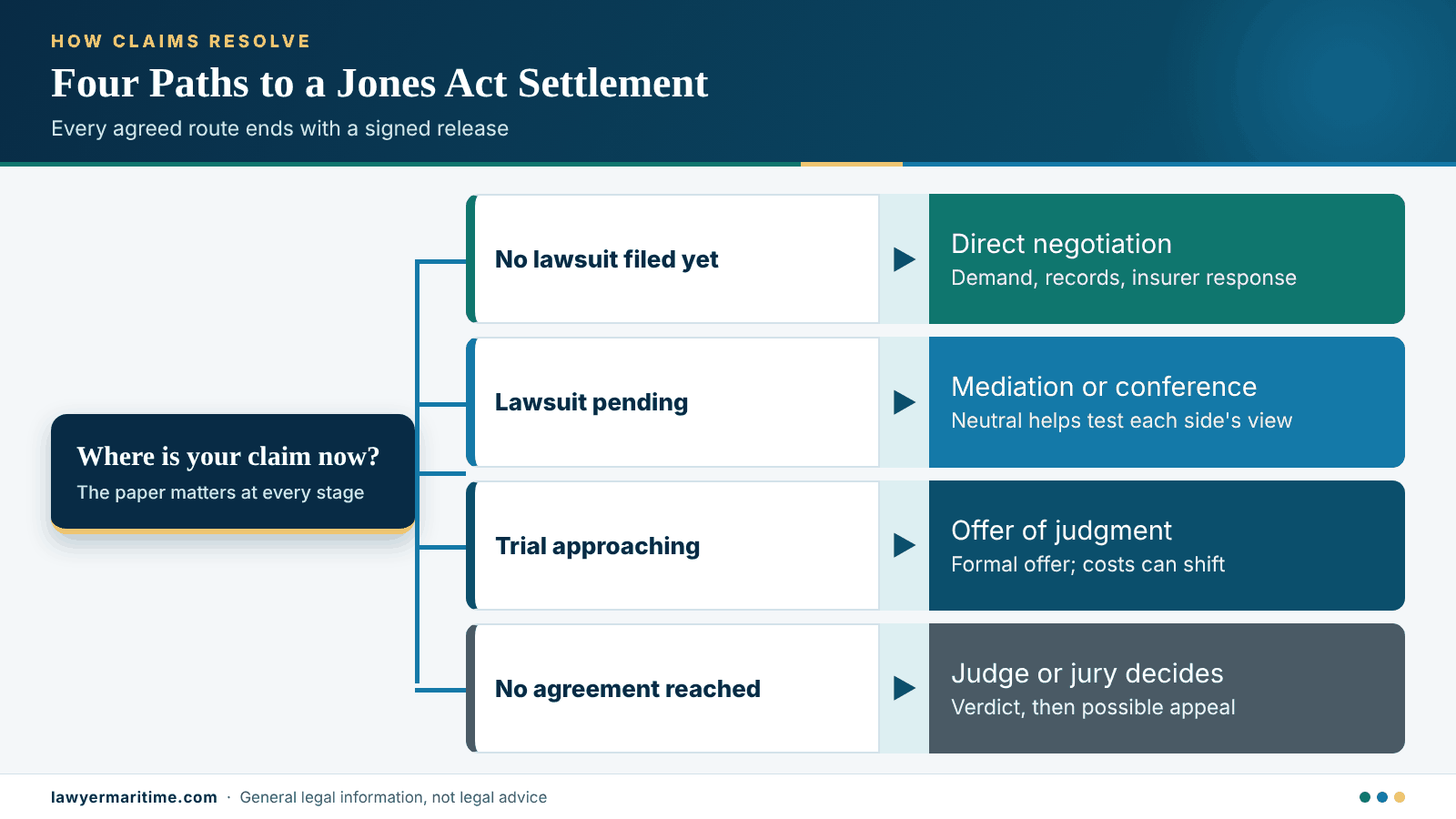
There is no single route. Some claims resolve in a few exchanges of letters, and others settle only after depositions, expert reports, and a trial date. The common thread is that offers tend to move when new information changes how someone sees the risk.
Negotiation before and during a lawsuit
Most of the back-and-forth happens between the seaman or the seaman’s lawyer and an adjuster or defense counsel. It can start before any suit is filed, and it often continues quietly after one is.
Demands, information, and the insurer’s role
Behind most employers sits an insurer, such as a protection and indemnity (P&I) underwriter or another liability carrier, and the adjuster usually needs approval from that carrier to settle. A typical negotiation begins with a written demand supported by medical records, wage documentation, and an account of how the injury happened. The other side responds with questions, a request for records or an examination, and eventually an offer.
Each side is trying to answer the same question: how likely is it that a jury accepts the seaman’s account, and what would the harm be worth if it does? Evidence that answers that question moves numbers. Evidence that raises doubts, such as inconsistent reports or gaps in treatment, can move them the other way. Our guide to the Jones Act claim process covers the records worth building from the first days.
Why medical status sets the pace
Few offers are meaningful until the medical picture is reasonably clear. Maintenance and cure generally continues until the seaman reaches maximum medical improvement (MMI), the point at which further treatment is not expected to improve the condition. The Supreme Court discussed how long the duty lasts in Farrell v. United States. Settling before that point means guessing at future care and future earnings.
That isn’t an argument for waiting forever, because evidence and witnesses can fade and bills do not stop. It is an argument for knowing what your doctors expect before you put a price on the rest of your working life. The article on maximum medical improvement explains why that label matters so much to both the benefits and the bargaining.
Court-connected and late-stage routes
Once a lawsuit is filed, the court itself often pushes the parties toward a conversation. These routes are tools for getting a deal, not requirements to make one.
Mediation and settlement conferences
Federal district courts are required by statute to adopt local rules that allow alternative dispute resolution, a category that includes mediation and early neutral evaluation (28 U.S.C. § 651). Each court designs its own program, so what is available, and when, varies. The federal civil rules also let a judge address settlement at a pretrial conference and, where the court considers it appropriate, require a party or representative to be present or reasonably available to consider possible settlement (Fed. R. Civ. P. 16(c)).
In a mediation, a neutral third party shuttles between the sides and helps test each side’s assumptions. The mediator doesn’t decide the case, and nothing is binding until the parties sign. Our Jones Act mediation guide describes the session itself, so this page leaves that detail there.
Offers of judgment and trial-eve settlements
In federal court, Rule 68 lets a defending party serve a formal offer of judgment, generally at least 14 days before trial. The seaman then has 14 days to accept in writing, and if the offer is not accepted and the final judgment is not more favorable, the seaman must pay the costs incurred after the offer was made. Costs are a defined category and are not the same as every expense of the case, so it is worth asking a lawyer exactly what a Rule 68 offer puts at stake. State courts have their own versions of these rules.
Many cases also settle close to trial, when the schedule forces both sides to price the risk of a verdict. Our guides to the Jones Act lawsuit and the Jones Act trial show what the parties face at that stage, which helps explain why late offers sometimes look different from early ones.
Why Do Courts Look Closely at a Seaman’s Release?
Courts applying admiralty law have long treated seamen differently from ordinary contracting parties. The reason shapes who has to prove what if a release is ever challenged, and it explains why careful employers document how a seaman came to sign.
Seamen as wards of admiralty and the Garrett rule
The doctrine is old, but the Supreme Court’s 1942 decision in Garrett v. Moore-McCormack Co. remains the usual starting point. It’s worth knowing the rule and its limits in plain terms.
Where the protective rule comes from
Courts of admiralty have historically described seamen as “wards of admiralty,” a phrase attributed to Justice Story. The idea is that seamen, who live and work under the authority of a ship and its owner, deserve protection against bargains that take advantage of them. In Garrett v. Moore-McCormack Co., 317 U.S. 239 (1942), the Court compared a seaman’s dealings to those of a ward with a guardian, where the stronger party must show that no advantage was taken.
The Court also pointed to Congress’s long-standing policy of protecting seamen in their dealings with owners. That policy background is why admiralty does not simply apply the ordinary contract-law presumption that a signed document means what it says.
The burden falls on the party relying on the release
In Garrett, a seaman sued under the Jones Act and for maintenance and cure, and the employer pointed to a release he had signed for $100. The seaman testified that he was under the influence of pain medication, had been threatened, and believed the payment was wages. The Supreme Court held that the party relying on a seaman’s release bears the burden of showing that it was executed freely, without deception or coercion, and with full understanding of the seaman’s rights. It also held that the rule is part of the substantive federal right, so a state court hearing the case could not substitute a tougher state standard.
The practical translation is simple. If a release is challenged, it is the employer or insurer, not the seaman, who must prove the signing was fair and informed. That is a significant starting point for a seaman, but it is only a starting point.
How the rule plays out in practice
A burden of proof doesn’t cancel a release. It determines who has to bring the evidence once the release is questioned.
What courts tend to weigh
Garrett itself identified two considerations: the adequacy of what the seaman received in exchange, and the nature of the medical and legal advice available to him when he signed. Beyond those two, the inquiry is fact-heavy, and the questions that tend to come up include the seaman’s physical and mental condition at signing, whether a lawyer or other adviser was involved, how clearly the document explained the rights being given up, and whether anyone applied pressure. Courts can differ in emphasis, so the outcome depends on the record and the forum.
The limits of the protection
The wards-of-admiralty idea isn’t a guarantee that a release will be undone. A seaman who signed with a lawyer’s advice, after treatment stabilized, in exchange for a figure the evidence supports, has a very different record from the seaman in Garrett. A documented process gives the release a much better chance of standing.
It’s also useful to compare other employees. In Callen v. Pennsylvania Railroad Co., 332 U.S. 625 (1948), the Court declined to place the burden on a railroad defending a release signed by an employee under FELA, and said a person challenging such a release must show fraud or mutual mistake. A seaman’s Jones Act claim borrows FELA’s negligence framework, but the maritime rule about releases comes from admiralty, which is why the seaman’s position on the burden is different.
Which Release Terms Deserve a Close Read?
The fine print matters most in the release. A few clauses decide whether the settlement ends one claim or every claim you might ever have against anyone connected to the vessel.
The scope of what you release
Scope has two dimensions: which legal claims end, and whose liability ends. Both are worth reading line by line.
Which claims and which parties are covered
A release often lists the claims by name: Jones Act negligence, unseaworthiness, maintenance and cure, and sometimes “any and all claims arising from the incident.” Broad catch-all language can reach claims you have not yet thought about, including claims for a condition that develops later from the same injury. If the language is broader than the deal you believe you made, ask that it be narrowed.
The released parties matter just as much. A release naming only the employer is very different from one that also covers the vessel owner, operators, charterers, insurers, affiliated companies, and their employees. If another company contributed to the accident, such as an equipment manufacturer or a contractor, a broad release could give up claims against that company without any payment from it. Before signing, you should be able to say who is protected and why they are paying.
Maintenance and cure, future care, and unearned wages
This is where seamen’s releases get distinctive. Maintenance and cure is a separate employer duty, and a release can address it expressly, ending the right to future payments and future treatment. Because the duty generally runs until maximum medical improvement, a release signed before that point trades an open-ended obligation for a fixed sum. Our guide to terminated maintenance and cure shows why employers and seamen often disagree about when the duty ends.
A release can also reach claims that arise if the employer mishandled maintenance and cure. The Supreme Court has recognized attorney’s fees where an employer’s failure to pay was willful or callous (Vaughan v. Atkinson) and punitive damages for a willful failure to pay (Atlantic Sounding Co. v. Townsend). If you have a dispute over unpaid benefits, check whether the release would waive those claims too, and read our guide to punitive damages for maintenance and cure before agreeing.
| Term | What it may do | What to check |
|---|---|---|
| Released claims | Ends Jones Act, unseaworthiness, and maintenance and cure claims, sometimes “all claims” | Is the list limited to what you intended to settle? |
| Released parties | Protects the employer and often owners, operators, insurers, and affiliates | Does it cover companies that are not contributing money? |
| Future care and maintenance | Ends the employer’s duty to pay for later treatment or living expenses | Is the payment sized for realistic future needs? |
| Unknown or worsening conditions | Treats later complications as already released | Does the language cover conditions not diagnosed yet? |
| Indemnity and hold-harmless | Makes you responsible if a lienholder pursues the released parties | Is liability capped, and are all liens identified first? |
| Dismissal with prejudice | Bars refiling the same claims in court | When must dismissal be filed, and does it depend on payment? |
| Confidentiality and non-disparagement | Limits what you may say about the deal or the company | Are there carve-outs for family, advisers, and agencies? |
| Employment terms | May include resignation, no-rehire, or return-to-work provisions | Are you giving up a job or seniority, and is it priced in? |
Terms that move risk onto you
Some clauses are less about the claims than about who bears future risk. They deserve a calm read because they sound routine.
Indemnity, hold-harmless, and dismissal language
An indemnity or hold-harmless clause is a promise to cover the other side’s losses in a specified situation. In a settlement it most often addresses liens: if a health insurer or government payer later demands repayment from the employer or insurer, you agree to cover it. The clause is not unusual, but its width is negotiable, so ask whether it is limited to liens on the settlement proceeds or reaches beyond them.
The dismissal clause should also be specific. A dismissal with prejudice ends the case permanently, so it should be filed only after the agreed conditions are met, and the agreement should state who files it and when. If payment is delayed, you want the document to say what happens, not leave it to argument.
Employment, cooperation, and payment terms
Some releases include terms unrelated to the injury itself. A resignation or no-rehire clause can end your connection to a company that may have been your main source of work, and it may affect a union seniority position or a future job application. If a clause like that is on the table, treat it as part of the price you are paying, not as boilerplate.
Payment terms deserve similar scrutiny: when the money is due, where it goes, and what happens if it is late. A vague promise to pay “promptly” gives you little to enforce. A date, or a fixed number of days after a stated event, is easier to hold the other side to. The confidentiality and non-disparagement point is covered in our confidentiality guide, and the wider release analysis is in the maritime settlement release article.
Who Else May Claim Part of the Money, and What About Future Care?
The gross settlement figure is not always what lands in your account. Several parties may have a claim on part of it, and the agreement also decides who pays for care after the case closes.
Liens, reimbursement claims, and deductions
A lien or reimbursement claim is a right of someone who paid for your care or income to be repaid from your recovery. Which claims exist depends on who paid for what, and the rules differ between payers.
Health plans, employer advances, and other private payers
If a health plan paid for treatment that the employer was responsible for, the plan’s documents or applicable law may give it a right to repayment. Plan terms and the type of plan can change the analysis considerably, so a lawyer should look at the actual documents rather than assume. Disability insurers and other benefit payers may likewise have contract terms that call for repayment or offsets.
The employer or its insurer may also claim credit for advances it made, such as maintenance payments, medical costs, or wages. A defendant is generally not expected to pay twice for the same loss, but that principle can be applied aggressively, so ask the other side to itemize every credit it claims and how it was calculated. Healthcare providers can sometimes assert their own claims for unpaid bills as well, depending on state law and the facts.
Medicare and other government payers
Medicare is a “secondary payer” when another source, such as liability insurance, is responsible for the same medical costs. Under 42 U.S.C. § 1395y(b)(2), if Medicare makes a conditional payment for treatment that a primary plan should have covered, Medicare is entitled to reimbursement, and the government’s recovery rights reach not only the responsible payer but also anyone who received money from it. Whether and how that reaches a particular settlement recipient is a detail for counsel. The statute also provides for double damages in specified circumstances against a primary plan that fails to reimburse.
Insurers and self-insured defendants have their own reporting duties to Medicare. The Centers for Medicare & Medicaid Services’ current reporting guide for liability, no-fault, and workers’ compensation settlements describes a dollar threshold above which liability settlements must be reported, and the obligation sits with the insurer or self-insurer, not with you. In practice, expect to be asked for identifying information, including whether you are a Medicare beneficiary, before the other side will fund a settlement. Other government programs, such as state Medicaid agencies, may assert reimbursement rights of their own, and the rules vary by program and state.
| Possible claimant | Where the claim comes from | What to ask |
|---|---|---|
| Health insurer or benefit plan | Plan documents and applicable law | Has the plan asserted reimbursement, and in what amount? |
| Medicare | Medicare Secondary Payer statute, 42 U.S.C. § 1395y(b)(2) | Were there conditional payments, and how is the amount confirmed? |
| Medicaid or other government program | Program rules that vary by state and program | Did a program pay, and how does it assert recovery? |
| Employer or insurer credits | Advances of maintenance, medical costs, or wages | Which credits are claimed, and does the settlement account for them? |
| Healthcare providers | Unpaid bills, sometimes backed by state-law liens | Are any balances unpaid, and who is responsible for them? |
| Disability or other benefit payers | Contract terms calling for repayment or offsets | Does any benefit contract require repayment from a recovery? |
| Attorney’s fees and costs | The fee agreement you signed, not a lien in the usual sense | What is the estimated net amount after fees and costs? |
Who pays for care after the case closes?
Future treatment is often the largest unknown in a seaman’s settlement. The agreement should make the answer explicit, because silence can be read in more than one way.
When the settlement replaces the employer’s duty to pay
A Jones Act settlement typically treats future medical costs as part of the lump sum. If the release ends maintenance and cure, the employer no longer owes treatment, and you or your own coverage become responsible for the care that follows. That’s a fair trade only if the figure realistically accounts for what the doctors expect, including follow-up surgery, injections, medication, therapy, or equipment.
It helps to ask your treating physician for a written opinion on likely future care before you evaluate an offer. A note that says “may need additional treatment” is less useful than one that describes the treatment, its likelihood, and its approximate frequency. Ask the doctor to address the question in terms of what you are medically likely to need, not in terms of what is certain.
Set-asides and the Medicare question
A Medicare set-aside is an amount of settlement money earmarked for future injury-related care, intended to protect Medicare from paying for treatment the settlement was supposed to cover. For workers’ compensation settlements, CMS has a voluntary review process. The current CMS reporting guide we read describes that process only for workers’ compensation, and it doesn’t describe a formal CMS review or approval process for set-asides in liability settlements.
That doesn’t make the issue go away. Parties to liability settlements involving Medicare beneficiaries, or people who may become beneficiaries soon, often consider whether and how to account for Medicare’s interests, and professional views and practices differ. This is a question to put to a lawyer who handles Medicare issues before you sign, not one to guess at. Our release guide touches on the same topic from the document’s side.
How Do Structured Payments, Taxes, and Payment Timing Work?
Agreeing on a number is not the last step. How the money is paid, how it is taxed, and when it arrives all affect whether the settlement does the job you need it to do.
Lump sum or structured settlement?
Most settlements are paid as a single lump sum, but a structured settlement spreads some or all of the value over time. Neither is better in every case, and the right fit depends on your needs and your discipline with a large check.
How a structured settlement works
In a structured settlement, the defendant or its insurer arranges for periodic payments, often funded by an annuity bought from a life insurer. The payments can be monthly, annual, or scheduled lump sums at future dates. Federal tax law has a framework for this, called a qualified assignment (26 U.S.C. § 130), under which the obligation to make payments can be transferred to an assignee. To qualify, the payments generally must be fixed and determinable in amount and timing, and the recipient must not be able to speed up, defer, increase, or decrease them.
That last point is the key practical feature. A structure gives you a guaranteed, predictable income stream that is not easy to spend all at once. It also means the arrangement is difficult to change later, so it should be built around realistic needs rather than around what the other side finds convenient.
Trade-offs to weigh
The appeal of a structure is steady income for a person who may not be able to return to the same work, and protection against running out of money. The drawbacks are real, too: you lose flexibility, your payments cannot be accelerated if an emergency arises, and you depend on the financial strength of the company that stands behind the payments. Ask who the obligor is, what protections exist if that company has difficulty, and what the structure costs the defendant to buy, so you can compare it with a lump-sum figure.
Many people choose a mix, taking a lump sum for immediate medical bills, debts, and a reserve, and structuring the rest. Whichever route you take, an independent financial adviser or settlement planner who does not work for the defendant can help you test the numbers. The adviser’s fee and role should be explained in advance.
Taxes and the calendar
Two practical questions follow any signed agreement: how the money will be treated for tax purposes, and when it will actually reach you.
Taxes: a general overview
Under 26 U.S.C. § 104(a)(2), gross income generally does not include damages, other than punitive damages, received on account of personal physical injuries or physical sickness, whether paid through a lawsuit or a settlement and whether paid as a lump sum or over time. Punitive damages fall outside that exclusion. The statute also says emotional distress is not treated as a physical injury or sickness for this purpose, with an exception for amounts paid for medical care connected to that distress.
What this means in practice is that the labels and allocations in the agreement can matter. A settlement that stays silent about how it divides payments, or that characterizes payments in a way that does not match the facts, can invite questions later. Interest, payments for non-injury claims, and amounts treated as wages can raise separate issues. This is a subject for a tax professional, who should see the draft agreement before you sign, not after.
Payment timing: from signature to funds
The timeline after signing is a matter of contract, not of any fixed legal schedule. It commonly includes returning the signed documents, providing tax and identifying information, resolving liens or confirming how they will be handled, and then funding the payment to your lawyer’s trust account or to you. Delays often come from the lien and Medicare steps, so raising them early helps.
The agreement should state the payment deadline and what follows if the deadline is missed. A due date tied to a clear event, such as a number of days after the other side receives the signed release and required forms, is easier to enforce than a general promise. Also keep a calendar of the filing deadline: negotiations do not automatically stop the general three-year period for maritime injury actions under 46 U.S.C. § 30106, and our guide to the Jones Act statute of limitations explains how timing questions can arise.

Should You Settle or Keep Going? The Factors That Matter
No article can tell you whether to accept a particular offer. What it can do is lay out the considerations that experienced lawyers and cautious clients weigh, so your questions are sharper when you sit down with someone who has your file. For a framework on how value is assessed, the separate guide to maritime injury case value covers that subject, and this section stays with the decision itself.
What the decision turns on
Two clusters of facts usually drive the choice: how strong the proof is, and how settled your medical and financial picture has become.
Liability, causation, and seaman status
If the evidence of employer negligence or an unseaworthy condition is strong, and the seaman status question is not seriously in doubt, an offer can be measured against a realistic picture of what a jury might do. If the proof depends on one witness, a missing document, or a contested account of the accident, the uncertainty cuts both ways. A weaker liability record may favor accepting a fair offer, while a strong one may support asking for more or declining.
Seaman status deserves its own line in the analysis, because losing it can remove the Jones Act claim entirely. The question is addressed in our seaman status article, and a worker whose status is contested may place more weight on a certain payment. Comparative fault also matters, since a seaman’s own share of responsibility, if proven, reduces recovery rather than barring it.
Medical stability and financial needs
A seaman who has reached maximum medical improvement, with a clear treatment plan and a documented work capacity, can evaluate an offer with real numbers. A seaman still in active treatment, facing a possible surgery or an uncertain prognosis, is being asked to price what nobody can yet measure. In that situation, settling early can be a gamble about the future.
Financial pressure belongs in the analysis, honestly stated. Unpaid bills, a missed mortgage, or a lapse in income can make a modest offer feel urgent, and the other side may know it. Naming that pressure to your lawyer lets them look for ways to ease it, such as confirming that maintenance and cure is being paid, without forcing a decision that your medical picture does not support.
| Factor | May point toward settling | May point toward continuing |
|---|---|---|
| Liability evidence | Proof is thin or depends on a disputed account | Records, witnesses, or equipment evidence support fault |
| Seaman status | Status is seriously contested and could end the claim | Status facts are strong and well documented |
| Medical outlook | Condition has stabilized and future care is well described | Prognosis is unclear or treatment is still ongoing |
| Offer compared with losses | Offer fairly reflects documented wages and care costs | Offer leaves obvious losses, such as future care, unaccounted for |
| Time and money pressure | Delay would cause serious hardship that settlement would relieve | Benefits are being paid and waiting carries little immediate risk |
| Risk tolerance | Certainty is worth more than a chance at a larger verdict | You can accept the uncertainty of trial for a possible greater result |
| Employer’s conduct | The other side is engaging in good faith and documenting terms | Benefits have been stopped or delayed, or terms keep shifting |
The practical realities of continuing
Continuing a case is a legitimate choice, and it has real costs and no guarantees. A fair-minded comparison weighs both sides.
Time, cost, and the uncertainty of a verdict
A lawsuit goes through pleadings, written discovery, medical examinations, and depositions before any trial, and each stage takes time. Our guide to the Jones Act deposition shows how much of that work happens before a jury ever sees the case. A jury trial can produce a result higher or lower than the last offer, and an appeal can extend the timeline further.
Litigation expenses are usually advanced under the fee agreement and repaid from a recovery, which is another reason to understand your agreement’s treatment of costs before comparing offers. Rejecting an offer is not risk-free, either. If you reject a formal offer of judgment and then do worse at trial, the rule described earlier may shift certain costs to you.
Who decides, and how to ask for time
Under the ABA Model Rules of Professional Conduct, which most states follow in some form, the decision whether to settle belongs to the client, and a lawyer must abide by it (Model Rule 1.2). A lawyer should explain the offer, the risks, and the alternatives, but the choice is yours. State rules can differ, so check the rules that apply to your lawyer.
If you are not ready to decide, say so, and ask for a deadline extension in writing. A reasonable counterparty will often agree to a short extension for a seaman to get medical or tax input. A refusal to allow any time to review is a warning sign in itself, and it is worth discussing with your lawyer what the pressure signals about the other side’s position.
What Should You Do Before You Sign? A Practical Checklist
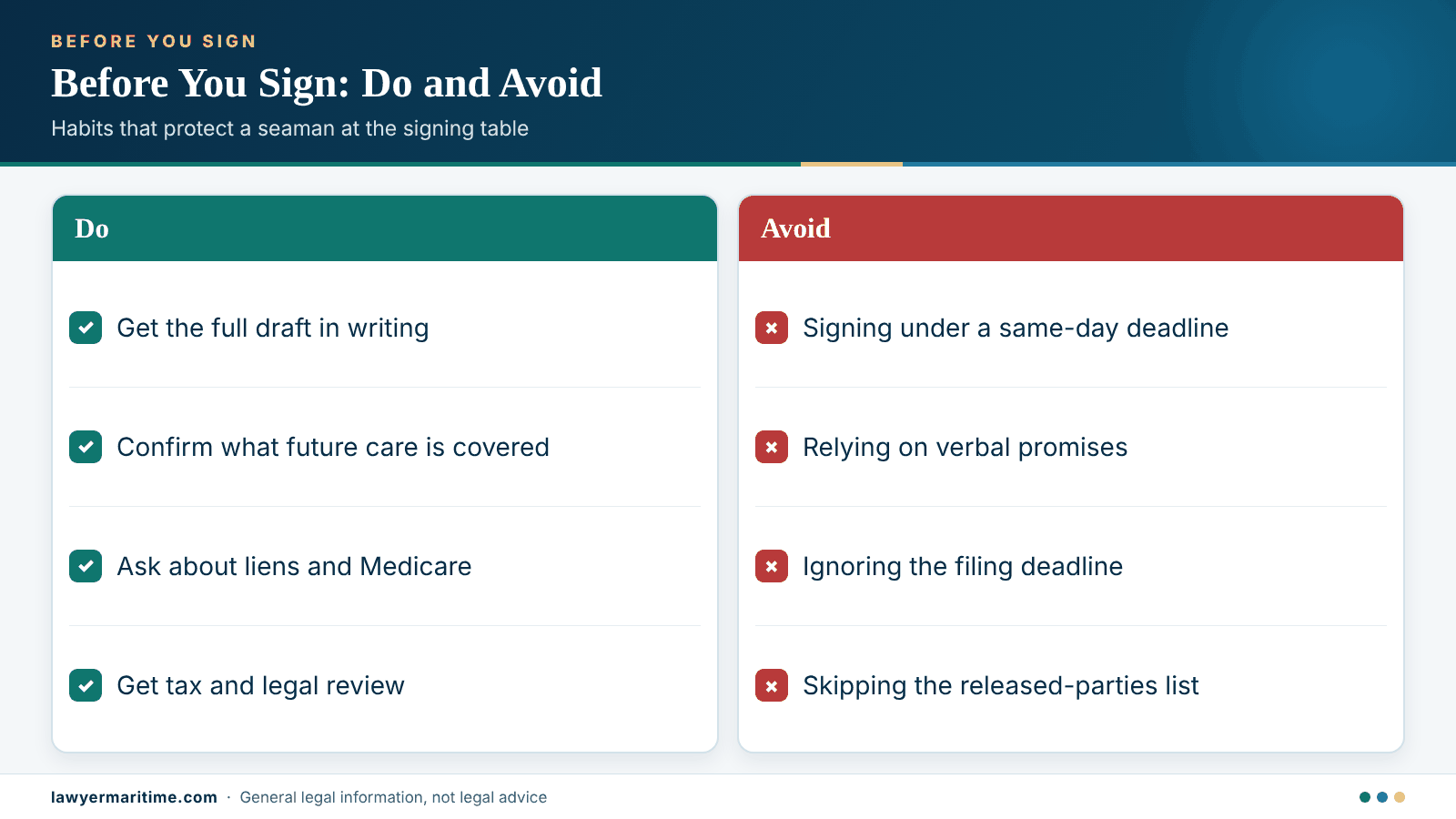
Most settlement regrets trace back to the signing moment: a rushed afternoon, a document nobody explained, or a question that went unasked. A few habits reduce that risk considerably.
Signing discipline
The goal is simple. You should understand every page, have had time to think, and be signing because you chose to, not because someone made waiting uncomfortable.
Time, copies, and pressure
Ask for the complete draft, including every exhibit and any referenced documents, well before you are expected to sign. Read it when you are rested and not in pain or on medication that clouds your thinking, which is exactly the kind of circumstance that raised concern in Garrett. If anyone says the offer disappears in an hour, treat that as a reason to slow down and not as a reason to hurry.
Questions worth asking about the paper
Before signing, you should be able to answer a short list in your own words. What claims am I releasing, and against whom? Does this end maintenance and cure and future care? What is the net amount after fees, costs, and any repayment claims? Who handles the liens, and what happens if one turns up later? When is payment due, and what is my recourse if it is late?
If you can’t answer one of them, the next step is to ask, in writing if possible. A written question and a written answer also create a record, which may be helpful if the meaning of a term is disputed later.
Building the right review team
A settlement touches law, medicine, benefits, and taxes. You don’t need to be an expert in any of them, but each deserves a qualified set of eyes.
Lawyer, tax adviser, and Medicare questions
A maritime lawyer can explain what the release reaches, whether the figure fits the evidence, and how courts have treated similar language. Our guide to choosing a Jones Act lawyer explains what to ask when you are looking for help. A tax professional can review how the agreement labels and allocates payments, and someone who handles Medicare issues can address whether your situation raises set-aside or reimbursement questions.
Be wary of advice from anyone paid by the other side. An adjuster or the employer’s representative may be perfectly courteous, but their job is to resolve the claim on terms that benefit their principal. The same applies to documents prepared by the other side’s lawyers: they’re drafted to protect the party who wrote them.
Common mistakes and the better move
Most of the avoidable errors fall into a handful of patterns, and each has a straightforward correction.
| Common mistake | Why it hurts | Better move |
|---|---|---|
| Signing before treatment stabilizes | Future care and lost earnings are guesses | Get a written medical opinion on likely future care first |
| Reading only the dollar figure | The release may reach claims and parties you did not intend | Read the claims, parties, and indemnity sections line by line |
| Ignoring liens until after signing | Repayment demands can reduce the net amount you receive | Ask for a lien and Medicare status review before agreeing |
| Accepting verbal assurances | Only the signed document is enforceable | Insist that every promise appears in the written agreement |
| Letting a deadline force the decision | Time pressure is a classic cause of regret | Request a short written extension and use it for review |
| Waiting while the filing clock runs | Talks do not automatically pause the general three-year period | Confirm the deadline with counsel and protect it |
The final row is worth repeating because it’s easy to overlook. Staying in settlement talks can feel like progress, but the deadline doesn’t wait for the conversation to finish.
What Happens After a Jones Act Settlement?
The signature closes the claim, but life on the other side of it raises practical questions about income, health coverage, and work. Planning for them before you sign is easier than improvising afterward.
Benefits, income, and coverage
A release usually changes what you can expect from the employer. It’s worth mapping those changes in advance.
Maintenance, cure, and wages stop where the release says they stop
If the settlement releases maintenance and cure, the employer’s payments for living expenses and treatment generally end, and your own insurance or the funds you set aside have to carry future care. If the release is narrower, for example if it settles only the negligence claim, the employer’s duty may continue under the general maritime law until maximum medical improvement. The wording decides which of those pictures is yours.
It’s wise to ask for the last payment date and the last treatment the employer will authorize, and to have both written down. Our guide to denied maintenance and cure and the article on terminated benefits explain what disputes tend to look like when those details are fuzzy.
Health coverage and ongoing treatment
If your health coverage came through the employer or a union plan, find out how the end of your work status, or the end of benefits, affects it. Check whether you will need to enroll in other coverage, and when. Gaps in coverage are one of the most common practical surprises after a settlement.
Keep your treating doctors informed that the claim has settled and ask how follow-up care will be billed. If a provider has been treating you under an arrangement that depended on the claim, such as a letter of protection, confirm in writing how the account will be resolved from the settlement proceeds so that no balance reappears later.
Work, health changes, and records
The months after a settlement bring their own decisions. A little organization now helps with all of them.
Returning to work, or not
Whether you can return to sea depends on the medical findings, on any fitness-for-duty requirements that apply to your job, and on what the release says about employment. A seaman who is medically cleared can often return to work for the same or a different employer, while one with permanent restrictions may need a different line of work. Settlement terms can affect that path, particularly a no-rehire clause, which is why they should be on your list of questions before signing.
If you believe you were treated unfairly for reporting an injury, separate rules protect seamen from retaliation, and our guide to Jones Act retaliation explains them. Whether a release could affect those protections depends on its wording, so ask a lawyer about any clause that touches them.
What to keep, and what if your condition worsens
Keep a complete copy of the signed agreement, the correspondence that led to it, the final accounting of fees, costs, and liens, and proof of payment. Keep them with your medical and tax records, because you may need them for tax filings, benefit applications, or a dispute about the terms. If a lienholder or insurer contacts you later, those documents let you and your adviser respond quickly.
If your condition changes after the release, the first question is what the release says about unknown or worsening conditions. Language that treats later complications as already released can make a new claim very difficult, and a lawyer is the right person to read it. Whether any exception applies depends on the wording, the facts, and the court, so don’t assume either answer.
Frequently Asked Questions About a Jones Act Settlement
These short answers cover the questions injured seamen and families ask most often about settling. Each is general information, and the facts of a particular case can change the answer.
The settlement process
Does every Jones Act claim end in a settlement?
No. Many claims resolve by agreement, but some are decided by a judge or jury, and some end for other reasons, such as a ruling that the worker is not a seaman. Whether a claim settles depends on the evidence, the injury, the parties’ view of the risks, and the court’s schedule.
How long does a Jones Act settlement take?
There’s no standard timeline. A claim may resolve after a few months of negotiation or after years of litigation, and medical recovery often sets the pace. After the parties agree, paperwork, lien resolution, and funding add more time, so ask for payment terms in writing.
Do I need a lawyer to settle?
The law doesn’t require one, but a seaman’s release can end rights that are hard to recover later. A maritime lawyer can review the release, the evidence, and the offer. If you decide to represent yourself, at least have the paper reviewed by a lawyer before you sign.
Does the court have to approve my settlement?
The text of 46 U.S.C. § 30104 doesn’t set up a settlement-approval procedure. Other rules or the circumstances of your case, for example a pending lawsuit, may bring a judge into the process, so ask whether any court filing or approval applies to you.
Releases and your rights
Can a seaman’s release be set aside?
Sometimes. Under Garrett v. Moore-McCormack, the party relying on a seaman’s release must show it was signed freely and with full understanding of the seaman’s rights. Whether a particular release can be set aside depends on the facts, the evidence, and the court, so get legal advice promptly.
Will I lose maintenance and cure if I settle?
It depends on the release. A settlement that expressly releases maintenance and cure ends the employer’s duty to pay it going forward. A narrower release may leave it open. Read the clause that addresses it and the language about future care, and ask for plain wording.
Can I still sue another company involved in the accident?
Possibly, but only if the release does not cover it. Broad language that names affiliates, contractors, or “all persons” can end claims against companies that paid nothing. Confirm the list of released parties before you sign.
What if my condition gets worse after I settle?
Check what the release says about unknown or worsening conditions. Language covering later complications can make a new claim difficult. A lawyer can read the document against your facts, but there is no general guarantee that you can reopen a settled claim.
Money, Medicare, and taxes
Will Medicare or my health insurer take part of my settlement?
They may seek repayment if they paid for care the employer or its insurer was responsible for. Medicare has statutory reimbursement rights under 42 U.S.C. § 1395y(b)(2), and health plans may rely on their plan terms. Ask for a lien review before the agreement is signed.
Is a Jones Act settlement taxable?
Damages received on account of personal physical injuries or physical sickness are generally excluded from gross income, other than punitive damages, under 26 U.S.C. § 104(a)(2). Emotional distress alone is not treated as physical injury for that rule. Because allocation and labels can matter, have a tax adviser review the draft.
Should I take a lump sum or a structured settlement?
Neither is right for everyone. A lump sum offers flexibility, while a structure gives predictable income and less ability to change course. A financial adviser who is independent of the defendant can help you compare the two.
What happens if I reject the offer?
The claim continues, and the other side may improve its offer, hold firm, or prepare for trial. In federal court, a rejected formal offer of judgment can shift certain costs if you do not do better at trial. Your lawyer can explain the risks that apply in your court.
Sources and Legal Authorities
The authorities below support the legal statements in this guide. Confirm each against the current text before you rely on it for a specific situation.
Statutes and regulations
Federal statutes
- 46 U.S.C. § 30104 – Jones Act, personal injury to or death of a seaman
- 46 U.S.C. § 30106 – Time limit on bringing a maritime action for personal injury or death
- 46 U.S.C. § 55102 – Cabotage, the separate Jones Act shipping rules
- 45 U.S.C. § 53 – FELA, contributory negligence
- 45 U.S.C. § 55 – FELA, contracts and devices to avoid liability
- 28 U.S.C. § 651 – Alternative dispute resolution in the federal district courts
- 42 U.S.C. § 1395y(b)(2) – Medicare Secondary Payer provisions
- 26 U.S.C. § 104 – Compensation for injuries or sickness
- 26 U.S.C. § 130 – Certain personal injury liability assignments
Regulations and rules
- Federal Rule of Civil Procedure 16 – Pretrial conferences and scheduling
- Federal Rule of Civil Procedure 68 – Offer of judgment
- ABA Model Rule 1.2 – Scope of representation and allocation of authority between client and lawyer
Cases and agency materials
Supreme Court and federal appellate decisions
- Garrett v. Moore-McCormack Co., 317 U.S. 239 (1942) – burden on the party relying on a seaman’s release
- Callen v. Pennsylvania Railroad Co., 332 U.S. 625 (1948) – releases under FELA and the burden on the challenger
- Farrell v. United States, 336 U.S. 511 (1949) – duration of maintenance and cure
- Vaughan v. Atkinson, 369 U.S. 527 (1962) – attorney’s fees for callous failure to pay maintenance and cure
- Atlantic Sounding Co. v. Townsend, 557 U.S. 404 (2009) – punitive damages for willful failure to pay maintenance and cure
Agency and official data
- Centers for Medicare & Medicaid Services, Section 111 NGHP User Guide, Chapter III Policy Guidance – reporting of liability settlements and set-aside review process