A seaman injury lawyer helps an injured crew member work out which of several overlapping maritime remedies apply, against whom, and in which court. In the United States, a seaman’s rights can include maintenance and cure, a Jones Act negligence claim under 46 U.S.C. § 30104, an unseaworthiness claim against the vessel owner, and sometimes a claim against a third party. Families have separate wrongful-death routes. These remedies stack rather than replace one another, so the first question is always whether you legally qualify as a seaman, because a harbor or shipyard worker usually follows a different system. This guide is for deckhands, tankermen, engineers, cooks, fishing crew, offshore vessel workers, and their families. It maps every remedy, the limits on punitive damages, the boundary with longshore and state workers’ compensation, the paperwork that follows an injury aboard, and the evidence that matters, so you can ask better questions before you choose counsel.
What a Seaman Injury Lawyer Works With: The Remedy Stack
Most people search for a seaman injury lawyer after something has already gone wrong: a fall on a wet deck, a crushed hand on a winch, a back injury during a long hitch, or a call telling them a relative will not be coming home. The legal system they are about to enter is unusual. Instead of one workers’ compensation claim, a seaman may hold several separate rights, each with its own proof, defendants, and damages.
This page is the map. It shows how those rights fit together, where each one stops, and which neighboring systems apply when you aren’t a seaman. For the statute itself, our Jones Act guide goes deeper, and the Jones Act lawyer guide follows a claim from first report to resolution.
The layers of a seaman’s remedies
Think of the remedies as layers. The bottom layer needs the least proof, and each layer above it asks for more but can pay more.
Five layers, from no-fault care to third-party liability
The first layer is maintenance and cure, a shipowner’s old duty to provide food, lodging, and medical care to a seaman who falls ill or is hurt in the vessel’s service, regardless of fault. The second is a Jones Act negligence claim against the employer under 46 U.S.C. § 30104, which asks whether the employer’s negligence played any part in the injury. The third is an unseaworthiness claim against the vessel’s owner, which asks whether the vessel or its crew, gear, or appliances were not reasonably fit for their intended use.
The fourth layer is a third-party claim, such as a suit against a company that wasn’t your employer but whose negligence or defective product contributed to the injury. The fifth is the family’s set of death and survival claims when a seaman doesn’t survive. Table 1 compares them side by side.
| Remedy | Who generally owes it | Fault required? | What it is built to cover | Main source |
|---|---|---|---|---|
| Maintenance and cure | The employer, as shipowner or operator | No | Food and lodging, medical treatment, and traditionally unearned wages through the voyage or engagement | General maritime law (Calmar, Farrell, Vaughan) |
| Jones Act negligence | The seaman’s employer | Yes, but the causation bar is low | Compensatory damages for lost earnings, medical costs, and pain | 46 U.S.C. § 30104; FELA, 45 U.S.C. §§ 51-60 |
| Unseaworthiness | The vessel’s owner or operator | No negligence, but an unfit condition must be proved | Compensatory damages when an unfit vessel, crew, or equipment causes injury | General maritime law (Mitchell v. Trawler Racer) |
| Third-party claim | A non-employer whose fault or product contributed | Depends on the theory | Compensatory damages from another responsible party | General maritime law; the facts of the incident |
| Death and survival claims | Employer, vessel owner, or third parties | Depends on the route | Losses of dependents and the seaman’s own pre-death losses, within statutory limits | 46 U.S.C. § 30104; 45 U.S.C. § 59; Moragne; Miles; DOHSA |
Why the remedies stack but never double up
Seamen are allowed to plead these claims together because they protect different interests. Maintenance and cure keeps you fed and treated while you recover. The negligence and unseaworthiness claims compensate for the full harm, including lost future income and pain, once fault or unfitness is shown.
What a seaman can’t do is collect twice for the same loss. If an employer has paid maintenance and cure, it may ask for credit against a later damages award for overlapping expenses. The same logic applies when a third party pays part of a loss. Your lawyer’s job is to sequence the claims so the early benefits aren’t lost and the later recovery isn’t reduced by avoidable offsets.
What a seaman injury lawyer actually does
A lawyer who handles seaman injuries isn’t just filing a Jones Act suit. The work usually begins before any suit is filed, and a large part of it is deciding which system you are in. This page doesn’t describe any particular firm, its location, or its fees.
The work across the stack
The first task is a status analysis: are you a seaman, a longshore or harbor worker, an offshore platform worker, or someone else? Next comes evidence, which means securing logs, safety records, crew lists, equipment, and witness names before they disappear. Then comes benefits advocacy, including pressing for maintenance and cure and challenging a premature “fit for duty” cutoff.
Only then does the forum question arise: whether to file in state court, federal court, or, in some cases, an arbitration or limitation proceeding. Along the way, the lawyer coordinates the claim with medical providers, health insurers, and possibly Medicare. Our broader explainer on what a maritime lawyer does covers the profession in general terms.
Questions worth asking before you choose counsel
You don’t need to evaluate a lawyer’s marketing. You can ask plain questions instead. How often does the lawyer handle injuries to crew on the type of vessel you work on? Who will actually work on the file? How are costs handled if there is no recovery? Will the fee agreement be in writing?
On that last point, the American Bar Association’s Model Rule 1.5(c) calls for a contingent-fee agreement to be in a writing signed by the client that explains the percentages and how expenses are handled, and individual states set their own rules. If you are comparing options, our guide to choosing a maritime lawyer and our note on preparing for a maritime law consultation add practical detail.
Are You a Seaman? Status and the “Who Are You?” Decision Tree
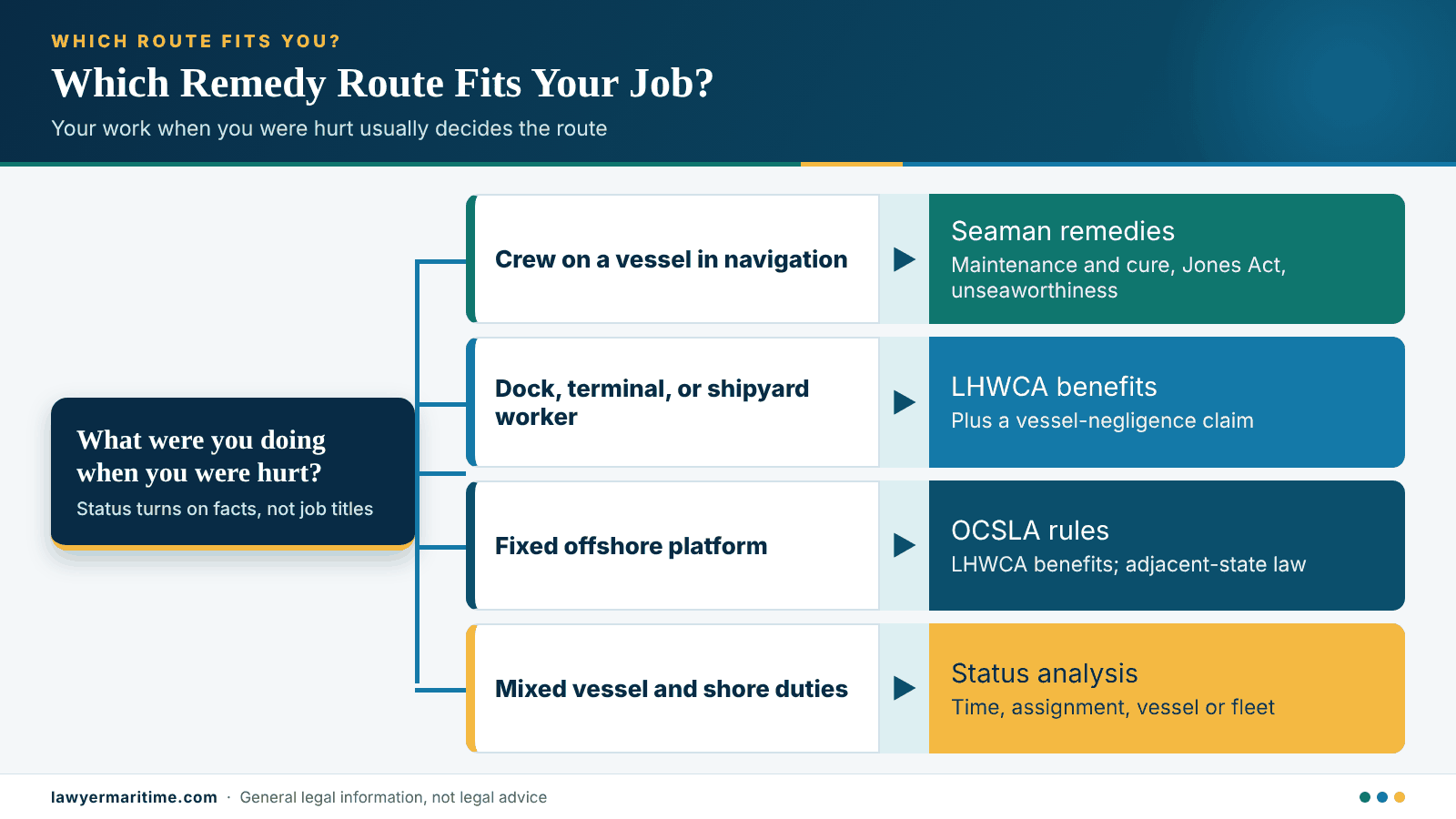
Every remedy on the stack described above depends on one threshold question. A person who works on or near the water isn’t automatically a seaman, and a person with the job title “deckhand” isn’t automatically excluded either. Courts look at what you actually do and how closely your work is tied to a vessel.
It helps to treat this as a sorting exercise. Once you know which group you fall into, the rest of the article tells you which rules to read. The decision tree after this section gives the quick version, and the explanation below gives the legal reasons.
The two-part test for seaman status
The Supreme Court set the modern test in McDermott International, Inc. v. Wilander, 498 U.S. 337 (1991), and refined it in Chandris, Inc. v. Latsis, 515 U.S. 347 (1995). It has two requirements, and both must be met.
Requirement one: your work contributes to the vessel’s function or mission
The first requirement is broad. Your duties must contribute to the function of a vessel or to the accomplishment of its mission. You don’t have to navigate or even work on deck: cooks, engineers, deckhands, and others who do the ship’s work can satisfy it. Wilander made clear that a seaman need not aid in navigation.
In practice this element is rarely the hard part. Disputes usually arise because someone’s job is mostly onshore and only occasionally touches a vessel, which leads to the second requirement.
Requirement two: a connection that is substantial in duration and nature
The second requirement asks whether your connection to a vessel in navigation, or to an identifiable group of vessels, is substantial in both duration and nature. The duration side is about time. As a rule of thumb drawn from earlier case law, Chandris said a worker who spends less than about 30 percent of his time in service of a vessel in navigation should generally not qualify, while stressing that this is a guideline and not a fixed rule.
The nature side is about the kind of perils you face. The test is meant to separate sea-based workers, who are exposed to the hazards of the sea, from land-based workers who only visit a vessel. In the Fifth Circuit, the en banc court in Sanchez v. Smart Fabricators of Texas, L.L.C., 997 F.3d 564 (5th Cir. 2021), organized the nature inquiry around three questions: whether your allegiance is to the vessel or only to a shoreside employer, whether your work is sea-based or involves seagoing activity, and whether your assignment is limited to a discrete task that ends your tie to the vessel or instead involves sailing with it from place to place. Other circuits phrase the analysis differently.
What counts as a vessel in navigation
Even a perfect connection doesn’t help if the structure you worked on isn’t a vessel. Vessel status is a separate legal question, and it is where many rig, barge, and floating-structure cases turn.
The Supreme Court’s practical-capability definition
Congress defines a vessel in 1 U.S.C. § 3 as a watercraft used, or capable of being used, as a means of transportation on water. In Stewart v. Dutra Construction Co., 543 U.S. 481 (2005), the Court read that definition to ask whether the craft is practically capable of maritime transportation, not merely theoretically so. A dredge that moved itself across the water with anchors and cables qualified, even though moving cargo or people wasn’t its main purpose.
In Lozman v. City of Riviera Beach, 568 U.S. 115 (2013), the Court held that a floating home wasn’t a vessel, using the perspective of a reasonable observer who looks at the structure’s physical characteristics and activities. The practical takeaway is that permanent mooring, no means of self-propulsion, and a shoreside function weigh against vessel status.
Barges, rigs, and special-purpose craft
Barges, towboats, tugs, supply boats, and dredges are routinely treated as vessels. Offshore units are more mixed. Courts have often treated mobile offshore drilling units such as jack-up rigs and drillships as vessels, while fixed platforms and other permanently attached structures generally aren’t. Those are general patterns, not guarantees.
Classification can also change over time. A structure that was once a vessel may lose that status if it is permanently moored or taken out of navigation, and a floating work platform might gain it. Because the label can decide whether you have a Jones Act claim at all, this is an early question for your lawyer, not a late one.
Status in real working life
Seaman status isn’t a badge you carry from job to job. It is a conclusion about a particular injury, based on the work you were doing and the vessels you were assigned to.
Reassignments, mixed duties, and fleets
Chandris recognized that if your essential duties change, your status can change with them. A shoreside employee who is reassigned to a regular crew position may become a seaman, and a mariner who moves to a permanent office job generally doesn’t keep the status from earlier sea service. When your work spans several vessels, courts generally look at whether they are under common ownership or control, so that they function as an identifiable fleet.
Think about how this plays out for a welder who serves several vessels for different customers, or a worker who spends part of each hitch on a barge and part on a dock. The time you spent, the tasks you performed, and who directed them can each matter. Records such as hitch schedules, vessel assignments, and payroll codes become evidence of your actual connection.
Why status is usually a question of facts
The Court has described crew membership as a mixed question of law and fact. If reasonable people could disagree on the facts, a jury may decide it, though a judge can resolve the issue earlier when the undisputed facts show a clearly inadequate connection. That means status disputes often arrive early, in a motion before trial.
It also means you should not self-diagnose from a job title. A “welder,” “roustabout,” or “relief mate” could fall on either side of the line. A lawyer looks at the records and your account together, and may identify alternative claims if status is genuinely uncertain. Our guide to maritime jurisdiction explains how location and connection tests work for the incident itself.
| Your role at the time of injury | System that usually applies | What decides it |
|---|---|---|
| Deckhand, mate, captain, or engineer on a tug or towboat | Seaman remedies | Assignment to a vessel in navigation, and a substantial connection to it |
| Crew on an offshore supply boat or liftboat | Seaman remedies | Vessel status of the boat and your regular assignment to it |
| Roustabout or welder moving between a platform and boats | Depends on the facts | Time on vessels, the vessel or fleet involved, and your employer |
| Longshore worker loading or unloading a ship | Usually the LHWCA | Land-based, cargo-handling work, not membership in a crew |
| Shipyard repair or construction worker | Usually the LHWCA | Shoreside employer and a discrete repair task |
| Worker on a fixed offshore platform | Often OCSLA-related rules | Whether the structure is a vessel and where it sits |
| Passenger, guest, or recreational boater | General maritime negligence | Not a member of the crew |
Maintenance and Cure: The No-Fault Floor
Maintenance and cure is the first benefit most injured seamen should ask about, because it doesn’t wait for a finding of fault. It is also the remedy most often delayed in practice, since an employer can dispute when it ends, what it covers, or whether a prior condition disqualifies it. This section explains the duty and its limits. If your benefits have already been refused, the detailed playbook is in our guide to what to do when maintenance and cure is denied.
What maintenance and cure is, and who owes it
The duty is older than the Jones Act. Admiralty courts have long treated seamen as vulnerable workers whose employers must care for them when they fall sick or hurt in the ship’s service.
A duty that doesn’t depend on fault
In Calmar Steamship Corp. v. Taylor, 303 U.S. 525 (1938), the Supreme Court described maintenance and cure as an obligation that comes from the employment relationship and doesn’t depend on the shipowner’s negligence. It isn’t compensation for disability. In Vaughan v. Atkinson, 369 U.S. 527 (1962), the Court added that admiralty reads the duty liberally for seamen and that ambiguities or doubts are resolved in the seaman’s favor.
That means your own mistake doesn’t usually cancel the benefit. A seaman who was careless and got hurt still has the right to care, although the damages claims described later can be reduced for fault. The duty generally covers an injury or illness that arises or comes to light while you are in the vessel’s service.
Maintenance is lodging and food; cure is medical care
Maintenance is the daily living allowance that stands in for the room and meals you would have had aboard. Cure is the medical treatment reasonably needed to improve your condition, which can include doctor visits, hospital care, surgery, medication, and rehabilitation. The two are owed together, but they are measured differently.
The Court in Farrell v. United States, 336 U.S. 511 (1949), described the usual measure as maintenance and cure at the ship’s expense, provided as needed rather than as a pension or lump sum. In practice, the daily maintenance rate is often set by a union agreement, by negotiation, or by evidence of what lodging and food actually cost where you live. Ask which of those applies to you, and keep receipts.
| Component | What it generally covers | What to document | A common point of dispute |
|---|---|---|---|
| Maintenance | A daily allowance for food and lodging while you recover | Rent or mortgage, utilities, and food costs; the daily rate offered | Whether the rate reflects real local costs |
| Cure | Reasonably needed medical care aimed at improvement | Medical bills, prescriptions, referrals, and treatment plans | Which provider decides the treatment, and what counts as necessary |
| Unearned wages | Traditionally, wages that would have been earned through the end of the voyage or engagement | Hitch or voyage schedule, pay stubs, and your crew agreement | How “voyage” applies to rotations, seasons, or share systems |
| Remedies if withheld | Possible fees, consequential harm, and punitive damages for willful failure | Every request, denial, and gap in payment, with dates | Whether the refusal was a good-faith dispute or willful |
How long maintenance and cure lasts
The duty isn’t endless, and the end date is where disputes concentrate. The test looks at your medical condition, not at the calendar or your employment status.
Until maximum medical improvement
The traditional rule, drawn from Calmar and Farrell, is that the duty continues until you are cured or until your condition is declared permanent, meaning treatment can no longer be expected to improve it. Courts and doctors often call that point “maximum medical improvement” or “maximum cure.” Treatment that only relieves symptoms, without expected improvement, may fall outside the duty.
Three practical consequences follow. First, a doctor’s declaration is evidence, but it isn’t always the last word, and a second medical opinion can matter. Second, reaching maximum cure ends maintenance and cure, not your damages claims for permanent harm. Third, being discharged by the company doesn’t by itself end the duty for an injury that arose in service.
Unearned wages
The traditional package also includes unearned wages: the pay a seaman would have earned through the end of the voyage or period of engagement. This is different from the lost future income you can seek as damages in a negligence or unseaworthiness claim, which looks ahead to your working life.
How the voyage rule applies to modern schedules isn’t always obvious. A rotation of weeks on and weeks off, a seasonal fishing engagement, and a share-based arrangement all require a fact-specific reading of the crew agreement. No single rule fits every arrangement, so treat this component as one to review with counsel.
Where maintenance and cure disputes arise
Employers who contest the benefit usually rely on one of a few arguments. Knowing them in advance helps you avoid giving them material.
Pre-existing conditions and concealment
A prior condition doesn’t automatically cancel the duty. The leading defense comes from McCorpen v. Central Gulf Steamship Corp., 396 F.2d 547 (5th Cir. 1968), which allows an employer to avoid the benefit when a seaman willfully concealed a known medical condition during the hiring process and the condition is connected to the later injury. The details vary by circuit, so a court outside the Fifth may apply a different standard.
The safest practice is straightforward: answer medical questionnaires fully and accurately, and keep a copy where possible. An honest disclosure of an old back strain is far easier to defend than an omission that surfaces later in an employer’s records search.
Rates, records, and proof of need
Most of the day-to-day friction is administrative. Checks arrive late or at a rate that doesn’t match actual living costs, an adjuster asks for new forms, or a treatment authorization is slow. Each gap hurts if you can’t show you asked.
Write requests down and keep the replies. Save every medical bill, keep a simple log of calls with dates and names, and be careful with any payment receipt or form that describes itself as a final settlement. Our overview of maritime injury compensation shows how these benefits connect with larger damages claims.
When benefits are wrongfully withheld
If an employer unreasonably refuses maintenance and cure, the law gives the seaman more than the unpaid amount. Vaughan held that a seaman forced to sue for benefits can recover attorney’s fees as damages when the refusal was callous or willful. In Atlantic Sounding Co. v. Townsend, 557 U.S. 404 (2009), the Court held that punitive damages remain available under general maritime law for a shipowner’s willful or wanton failure to pay maintenance and cure.
These remedies are for willful conduct, not every dispute. An employer who investigates promptly and pays what the facts support is in a very different position from one that ignores a documented claim. Calmar also noted that a breach can expose an owner to consequential damages, such as a condition that worsens because treatment was delayed.
Jones Act Negligence and Unseaworthiness: The Fault-Based Claims
Maintenance and cure keeps you afloat while you heal. The two fault-based claims are what compensate you for the injury itself, including lost income over the rest of your career. They look similar from the outside, but they ask different questions and sometimes point at different defendants.
The Jones Act negligence claim
The Jones Act is the seaman’s statutory right to sue an employer for negligence. It was written into federal law in 1920 and is now codified at 46 U.S.C. § 30104. If you want the statute explained section by section, our Jones Act guide does that, and this section stays focused on how the claim fits with the others.
What the statute gives you
The statute says an injured seaman may elect to bring a civil action at law, with the right to a jury trial, against the employer. It also borrows the rules that govern railroad workers under the Federal Employers’ Liability Act (FELA), 45 U.S.C. §§ 51-60. That borrowed framework brings two features that matter.
The first is a relaxed causation standard. In CSX Transportation, Inc. v. McBride, 564 U.S. 685 (2011), the Court addressed the FELA causation standard, which asks whether the employer’s negligence caused the injury in whole or in part. The second is fault-sharing. Under 45 U.S.C. § 53, a seaman’s own negligence reduces damages in proportion but doesn’t bar the claim, except that the FELA text removes the reduction when the employer’s violation of a federal safety statute contributed to the injury. Under 45 U.S.C. § 54 assumption of risk isn’t a defense. Seamen still owe a duty of ordinary prudence under the circumstances, as the Fifth Circuit en banc court put it in Gautreaux v. Scurlock Marine, Inc., 107 F.3d 331 (5th Cir. 1997).
What negligence can look like aboard a vessel
Negligence is a failure to use reasonable care, and on a working vessel the possibilities are practical and concrete. Examples include a crew too small for a heavy lift, a missing or ignored safe-work procedure, poor training on a new winch or crane, defective protective gear, and a deck left slick or cluttered after a known hazard was reported. Excessive hours that leave a crew exhausted can also be a negligence theory, which our article on maritime fatigue accidents explores.
An employer is generally responsible for the negligence of its own officers and crew acting within their jobs, so you don’t need to show that a manager personally caused the injury. For a broader look at how negligence works under maritime law, see our maritime negligence guide.
The unseaworthiness claim
Unseaworthiness is the seaman’s claim aimed at the vessel’s condition rather than at anyone’s carelessness, and it has been part of general maritime law for a very long time.
A strict duty tied to the vessel
In Mitchell v. Trawler Racer, Inc., 362 U.S. 539 (1960), the Supreme Court described the owner’s duty to furnish a vessel and appurtenances reasonably fit for their intended use as an absolute duty that doesn’t depend on negligence. The standard is reasonable fitness, not perfection. A vessel isn’t unseaworthy just because someone was hurt.
The Court also drew a boundary in Usner v. Luckenbach Overseas Corp., 400 U.S. 494 (1971), holding that a single, isolated negligent act doesn’t by itself make a vessel unseaworthy. Courts have recognized unfit gear, inadequate crew numbers or training, and unsafe working methods or equipment as possible bases for the claim. The detail is explored in our piece on unseaworthiness damages.
Who owes the duty, and why the employer may be a different party
The unseaworthiness duty belongs to the vessel’s owner, or to an operator who stands in the owner’s place, such as a bareboat charterer. The Jones Act duty belongs to the employer. In many cases those are the same company, which makes the claims easy to pair. They can also be different, for example when you are hired and paid by a crewing company but work on a vessel someone else owns.
That gap matters for both defendants and recovery, so a good first step is to identify precisely who employed you, who owned the vessel, and who controlled the work. Seaman status doesn’t fix the defendants automatically. Be aware that the duty doesn’t run to everyone who works near a vessel: harbor workers covered by the LHWCA lost the unseaworthiness remedy when Congress amended 33 U.S.C. § 905(b) in 1972.
Using both claims together
Seamen and their lawyers rarely choose one. The more useful question is how the two claims support or limit each other in a particular case.
Pleading in the alternative
The same facts often support both claims, but the proof differs. The Jones Act claim needs employer negligence with a light causation link. The unseaworthiness claim needs an unfit condition and a closer causal link between that condition and the injury. If a court finds no negligence but a defective piece of equipment, the second claim may still succeed.
Because Jones Act claims carry a jury right, joined claims commonly go to the same decision-maker. Where and how you file affects that, so forum choice is an early decision, discussed in our Jones Act claim walkthrough.
How fault is divided
Admiralty applies comparative fault to seamen’s claims. In Socony-Vacuum Oil Co. v. Smith, 305 U.S. 424 (1939), the Court held that assumption of risk isn’t a defense in a seaman’s action and that damages are reduced in proportion to the seaman’s own negligence. So an employer can’t erase a claim by showing you took a risk, though it can seek a reduction by showing you contributed to the harm.
Other participants may also share fault, such as another vessel or a contractor. Allocation among several parties is one reason claims against the employer and a third party are coordinated rather than pursued in isolation, as the third-party section below explains.
| Question | Jones Act negligence | Unseaworthiness |
|---|---|---|
| Who is the defendant? | The seaman’s employer | The vessel’s owner or operator |
| What must be shown? | Negligence that played a part in the injury | An unfit vessel, crew, or equipment that caused the injury |
| Is fault required? | Yes, with a relaxed causation link | No negligence needed, but unfitness is |
| Your own carelessness | Reduces damages in proportion | Also reduces damages under comparative fault |
| Punitive damages | Courts have generally held them unavailable | Not available after Batterton |
| Typical example | Unsafe work method or understaffing | Defective winch, damaged ladder, or unsafe gear |
What a Seaman Can Recover, and Where Punitive Damages Stop
Readers often ask what an injury is “worth,” and no responsible article can answer that. What a page like this can do is explain which categories of loss the law recognizes, which remedies carry extra damages, and which ones don’t. Our companion guide on maritime injury damages goes further on the arithmetic, and this section concentrates on the rules that are specific to seamen.
Compensatory damages for an injured seaman
Compensatory damages are meant to make up for the harm, not to punish the defendant. Under the Jones Act and the general maritime claims, they are the core of a recovery once fault or unseaworthiness is established.
Economic losses
Economic losses are the ones that can be tied to records. They generally include past wages lost since the injury, future lost earnings or reduced earning capacity if you can’t return to the same work, and medical expenses that maintenance and cure doesn’t cover. Future loss is the hard part, because it requires projecting a career that the injury interrupted.
Evidence for that projection usually comes from tax returns and pay histories, hitch and share records, vocational assessments, and medical opinions about permanent limits. This is one reason the evidence you collect early, discussed later in this guide, matters for value.
Non-economic losses
Seamen who prove a Jones Act or unseaworthiness claim may also seek compensation for pain and suffering, mental anguish, and loss of enjoyment of life. These categories don’t come with receipts, and they are decided by the jury or judge in light of the injury, its permanence, and its effect on daily life.
They are also where the line between a seaman’s own injury and a family member’s loss matters. As the death-claims section below explains, the Supreme Court has limited some non-economic damages when a seaman dies.
Punitive damages: the Townsend and Batterton line
Punitive damages punish willful or reckless conduct and deter it. In maritime law, whether they are available depends on which claim you are asking about, and the Supreme Court has drawn two different answers for two different claims.
Available for willful failure to pay maintenance and cure
In Atlantic Sounding Co. v. Townsend, decided in 2009, the Supreme Court held that general maritime law allows punitive damages when a shipowner willfully or wantonly fails to pay maintenance and cure. The majority reasoned that both the duty and punitive damages for its breach predated the Jones Act, and that the Jones Act didn’t address them. The decision turned on the history of the remedy, not on a general policy in favor of punishment.
The Court’s holding is narrow. It speaks to willful or wanton conduct, not to a good-faith disagreement over a bill or a treatment plan.
Not available for unseaworthiness, and unsettled elsewhere
In Dutra Group v. Batterton, decided June 24, 2019 and reported at 588 U.S. 358, the Court held that a seaman can’t recover punitive damages on an unseaworthiness claim. The majority distinguished Townsend because punitive damages for unseaworthiness lacked the historical record that supported them for maintenance and cure. It also relied on the Jones Act’s compensation-only remedies as a guide to Congress’s policy.
The majority noted that lower courts have held punitive damages unavailable under the Jones Act itself, while stating that it wasn’t reopening that question. In plain English, the clearest rule is this: punitive damages are a realistic subject for willful maintenance-and-cure refusals, and they aren’t available on an unseaworthiness claim. For negligence under the Jones Act, courts have generally said no, and an attorney should check the current law in your circuit.
What reduces or offsets a recovery
The headline value of a claim and the amount that reaches you can differ. Several adjustments can intervene, and each one is predictable if you know to look for it.
Fault percentages and credits
If a factfinder assigns you part of the fault, the damages are reduced by that percentage under the comparative-fault rules discussed earlier. Separately, an employer that has paid maintenance, cure, or wages may seek credit for overlapping amounts against a later award, so that you aren’t compensated twice for the same loss.
Those credits are often negotiated, not automatic, and they depend on the type of expense and what the payments actually covered. A settlement agreement should identify what is included.
Why no honest article can give you a number
The amount of any recovery depends on the severity and permanence of the injury, your age and earnings, the medical evidence, the strength of the fault case, the forum, and the defendants’ resources. Two seamen with the same diagnosis can have very different outcomes. Be cautious of any source that quotes averages or promises a result.
What you can fairly expect from a good evaluation is an explanation of which categories apply to your facts and how each is proved. Our guide to compensation for maritime injuries and the deeper article on unseaworthiness damages carry that conversation further.
| Remedy | Compensatory damages | Punitive damages | Attorney’s fees from the defendant |
|---|---|---|---|
| Maintenance and cure | Unpaid benefits and consequential harm from a wrongful refusal | Possible for willful or wanton failure (Townsend) | Possible for callous or willful refusal (Vaughan) |
| Jones Act negligence | Yes, reduced by your share of fault | Courts have generally held no | Generally no |
| Unseaworthiness | Yes, reduced by your share of fault | No (Batterton) | Generally no |
| Third-party maritime claim | Yes, subject to the governing law | Depends on the theory and claim | Generally no |
| Seaman’s wrongful death claims | Pecuniary losses, with non-economic damages limited by Miles | Generally not recoverable on the statutory routes | Generally no |
Reporting the Injury and Building the Evidence
The first days after an injury shape the claim more than most people expect. Reports are written, equipment is repaired, crews rotate off, and memory fades. This section explains what an injured seaman should report, what the Coast Guard requires the company to do, and which records are worth protecting. It is general guidance, not a substitute for advice on your own incident.
Reporting an injury aboard
There are two separate reporting tracks. One is yours: telling the employer what happened. The other belongs to the vessel’s owner or operator: notifying and filing with the Coast Guard. They overlap in subject but not in responsibility.
Tell the employer promptly and accurately
Report the injury to your supervisor or master as soon as you can, and ask that it be recorded in the vessel’s incident system. A prompt report protects your credibility and removes an easy defense. If the injury emerges slowly, as a back or shoulder problem often does, report it when you realize it is work-related and say what you believe caused it.
Stick to facts you know, such as where you were, what you were doing, what you felt, and who was nearby. Don’t guess at causes or guess at blame, and don’t sign a blank form or a statement you haven’t read. Ask for a copy of whatever you sign, and keep your own dated note of what you reported and to whom. Some crew agreements and company policies set their own reporting windows, so check yours.
The Coast Guard’s casualty notice and Form CG-2692
Under 46 CFR § 4.05-1, an injury must be reported to the Coast Guard when it requires professional medical treatment beyond first aid and, for a person working on a commercial vessel, renders that person unfit to perform routine duties. The duty to notify rests with the vessel’s owner, agent, master, operator, or person in charge, and it applies immediately after safety concerns are addressed.
A written report follows on Form CG-2692, due within five days under 46 CFR § 4.05-10, and it can carry addenda such as the Personnel Casualty Addendum and the Involved Persons and Witnesses Addendum. The same section lists an addendum for chemical testing after a serious marine incident, and the regulations in 46 CFR § 4.03-2 treat a qualifying injury as one such incident. You, as the injured crew member, don’t file the form, so it is worth asking what the company reported. Where a major accident draws a federal investigation, our guide to NTSB marine investigation reports explains what those reports are and how they differ from company records.
Building the evidence file
Evidence in a seaman case is unusually perishable. Vessels sail, logs are archived, equipment goes back into service, and crew members scatter across rotations. A short list of early steps preserves most of what matters.
What to collect, and where it sits
Table 6 lists the main categories. The list is deliberately practical. Some items you can gather yourself, and others, such as vessel records, usually require a formal request or a preservation letter from counsel.
| Evidence | Why it matters | Where it usually sits | How to protect it |
|---|---|---|---|
| Incident reports and Coast Guard filings | Fix the employer’s first account of what happened | Vessel office, operator, Coast Guard | Request copies; compare with your own notes |
| Photos, video, and scene condition | Show the hazard before it changes | Your phone, vessel cameras | Take images early; ask that video be preserved |
| Witness names and contact details | Crew rotate off and can be hard to find later | Crew lists, your memory | Write names and watch assignments down now |
| Medical records and bills | Link the injury to the work and prove cure expenses | Hospitals, clinics, pharmacies | Keep every record; follow treatment plans |
| Logs, maintenance and safety records | Show prior complaints, repairs, and fitness of gear | Vessel and company systems | Preservation request through counsel |
| Hours, hitch schedules, and pay records | Support status, wages, fatigue theories, and lost earnings | Payroll, crewing office, your stubs | Keep copies of stubs, share sheets, and crew agreement |
| Equipment and protective gear | May show defect or inadequate protection | Vessel, shore warehouse | Ask that it be kept unaltered; don’t repair or discard it |
| Texts, emails, and radio traffic | Show what supervisors knew and when | Phones, company servers | Screenshot and back up; avoid deleting anything |
Preservation, statements, and your own conduct
A preservation request is a written demand that the company and vessel owner keep relevant records and equipment. Counsel typically sends it, because it must be specific enough to reach logs, video, maintenance files, and the item that failed. Without one, ordinary retention schedules may quietly erase important material.
Be careful with recorded statements to adjusters. They are often presented as routine, but they can be used later to challenge your account. Be careful on social media too, because photos and posts about activities can be read against your injury claims. And keep a short symptom and treatment diary: dates, pain levels, missed activities, and appointments. It’s simple, and it gives your medical story a timeline that records alone may not show. Our guide to the Jones Act claim process shows where these records fit as a case develops.
Fitness for Duty, Return to Work, and Retaliation
Recovery rarely ends on a clean date. A doctor clears you, or says you’ve plateaued, and suddenly there are questions about pay, benefits, and whether you still have a berth. Two issues come up repeatedly: who decides when you are fit, and what protects you from being punished for reporting an injury.
Fitness for duty and returning to work
For a working seaman, “fit for duty” is a medical conclusion with financial consequences. It can end maintenance and cure, trigger a return-to-work order, and shape how an employer argues about your future earnings.
Who declares you fit, and what follows
Employers often send injured crew to a company-selected physician, and that physician’s opinion may drive the decision to stop paying. The opinion deserves a close read. Ask what exam produced it, whether your own treating doctor agrees, and whether the conclusion is that you are cured, that you have reached maximum medical improvement, or simply that you can perform limited tasks.
Those are different conclusions. A release for light duty is not the same as a finding that treatment can no longer help. Because doubts about maintenance and cure are resolved in the seaman’s favor under Vaughan, a disputed or incomplete medical opinion is a reason to seek a second opinion rather than to accept the cutoff. Getting that opinion in writing is worth the effort.
Credentials, restrictions, and the practical return
Returning too soon carries its own risk. A seaman who goes back to a physically demanding job before recovering may reinjure the same area, and the employer may later point to the return as proof of fitness. If you are asked to sign a fitness statement, understand it before you do. If you are asked to work beyond your restrictions, say so in writing.
Many deck and engine officers and other mariners also hold Coast Guard-issued credentials that carry medical requirements, so a condition can affect the credential as well as the current job. We haven’t verified the details for every credential type here, and they vary, so ask counsel or the credentialing office how a diagnosis or restriction could interact with yours. Keep your medical records and work restrictions consistent, because gaps between what you tell a doctor and what you tell an employer can be used against you in either direction.
Retaliation and termination
Many injured seamen worry that reporting an injury will cost them the job. The law does not leave that fear unanswered, although the remedy has its own rules and its own deadline.
What 46 U.S.C. § 2114 protects
Section 2114 of Title 46 says a person may not discharge or in any manner discriminate against a seaman for specified protected activities. The activities listed in the statute include reporting, in good faith, a belief that a maritime safety law or regulation was violated, notifying the vessel owner or the Coast Guard of a work-related personal injury or illness, cooperating with a safety investigation by the Coast Guard or the NTSB, and accurately reporting hours of duty. It also covers reports of sexual harassment or assault and, with conditions, a refusal to perform duties out of a reasonable apprehension of serious injury.
The refusal protection is deliberately narrow. The danger must be one that a reasonable person under similar circumstances would recognize, and the seaman must have sought correction of the unsafe condition from the employer without success. Anyone considering a refusal should get advice first, because an unprotected refusal can be treated as insubordination.
How a retaliation complaint works, and how it differs from your injury claim
Section 2114 sends complaints through the process in 49 U.S.C. § 31105(b). Under that procedure, a complaint goes to the Secretary of Labor within 180 days after the alleged violation. The Secretary investigates, either side can ask for a hearing, and if no final decision issues within 210 days, the employee may bring an action in federal district court. The statute lists relief such as reinstatement, back pay with interest, compensatory damages, and costs and attorney fees. The implementing rules appear at 29 CFR Part 1986.
The key practical point is that this is a separate process with a far shorter clock than the three-year periods that apply to most injury suits. Missing the retaliation window does not end your injury claim, and filing a retaliation complaint does not replace it. If you were terminated while injured, the question of continuing maintenance and cure is a distinct issue, covered in our article on denied maintenance and cure.
Third-Party Claims Beyond the Employer
The Jones Act reaches only the employer, and unseaworthiness reaches only the vessel’s owner or operator. Some injuries involve fault that sits entirely outside those two companies. A seaman’s lawyer therefore asks a second question at the start: who else touched this incident?
Who else may be legally responsible
The candidates depend on how the injury happened. A crushed finger on a deck with only company equipment is a different case from a collision, a transfer between vessels, or a failed piece of gear.
Non-employer companies and other vessels
Other vessel owners and operators are the most familiar third parties. If your tug is struck by another vessel, or a crew transfer is mishandled by a different company’s boat, that company’s negligence may be a separate source of liability. Contractors can fall into the same category, including a dock or platform owner whose unsafe premises hurt a visiting crew member, a repair yard that returned equipment in poor condition, or a service company that controlled a task.
Be careful with the word “employer.” In some arrangements, a staffing firm, a manning agency, or a company that directed your work could each be argued to be your employer, and the answer affects the Jones Act claim. Collisions and similar incidents raise their own evidence issues, which our guide to maritime collision investigations covers.
Makers of defective equipment and safety products
Product claims apply to the manufacturer of a defective winch, crane, hatch, ladder, harness, or life-saving appliance. The Supreme Court addressed product liability in the maritime setting in Air & Liquid Systems Corp. v. DeVries (No. 17-1104, decided March 19, 2019), holding that a manufacturer can have a duty to warn when its product requires incorporation of a part, the manufacturer knows or has reason to know the integrated product is likely dangerous for its intended uses, and it has no reason to believe users will realize that danger.
That holding concerns a specific warning situation, and product cases involve many other theories. The practical point for a seaman is simple: the broken or failed item itself is often the most valuable piece of evidence, which is why it should not be repaired, discarded, or sent back without notice.
How third-party claims fit with the rest of the stack
Adding a defendant doesn’t simply add money. It adds coordination, and mistakes in that coordination are costly.
One recovery, shared fault, and release language
A seaman can pursue the employer, the vessel owner, and a third party in a coordinated way, but can’t recover twice for the same loss. Each defendant typically argues that someone else was more responsible, so fault allocation becomes central. The risk is that a release signed with one party is written so broadly that it reaches the others. Our guide on maritime settlement releases explains the language to watch.
The same coordination applies to benefits. Maintenance and cure continues to be owed by the employer while a third-party claim is pending, and any settlement should state what it does and doesn’t resolve.
Evidence and forum issues unique to third parties
Third parties aren’t under your employer’s roof, so records are scattered. The other vessel’s logs, a contractor’s inspection files, and the manufacturer’s design records each require their own preservation request. Time matters here too, because ordinary retention schedules at companies you have never dealt with can end sooner than you’d think.
Forum questions also multiply. A vessel owner may ask a federal court to cap its liability and collect all claims into one proceeding, which can change where and how a third-party claim is heard. The mechanics belong to the broader field described in our admiralty law hub.
When a Seaman Dies: Claims for Families
Families usually arrive at this topic in the worst possible week. The legal rules they face are layered and, in places, unusually restrictive, because Congress and the Supreme Court have limited what a seaman’s survivors can recover. This section explains the routes and the limits in plain terms. It is not a prediction for any specific family, and the shorter, more focused treatment of ocean deaths is in our guide to the DOHSA claim deadline.
Which law lets a family sue
A fatality can touch more than one source of law at once. The mix depends on the seaman’s status, where the death occurred, and which defendant is involved.
The Jones Act and who benefits
The Jones Act itself covers a death. Under 46 U.S.C. § 30104, if a seaman dies from the injury, the seaman’s personal representative may bring the civil action against the employer. Through FELA, the right of action passes to the personal representative for the benefit of listed relatives. 45 U.S.C. § 59 names the surviving spouse and children first, then the parents if there are none, and then dependent next of kin, and it provides for only one recovery for the same injury.
The same framework supports a survival claim, which pursues the seaman’s own losses before death, such as pain and suffering if the seaman lived for a time. Wrongful death and survival are different claims with different beneficiaries and damages, and a complaint often includes both.
General maritime law and DOHSA
In Moragne v. States Marine Lines, Inc., 398 U.S. 375 (1970), the Supreme Court recognized a general maritime wrongful-death action for a death caused by a breach of a maritime duty, such as providing a seaworthy vessel, in state territorial waters. That is how unseaworthiness reaches wrongful-death cases.
The Death on the High Seas Act, 46 U.S.C. § 30302, covers deaths caused by wrongful acts at sea more than three nautical miles from the U.S. shore, brought by the personal representative for a spouse, parent, child, or dependent relative. Under 46 U.S.C. § 30303 the recovery is for the pecuniary loss of those beneficiaries. In Mobil Oil Corp. v. Higginbotham, 436 U.S. 618 (1978), the Court held that general maritime law could not add to those damages for a death on the high seas.
What a family can and cannot recover
The recoveries available to a seaman’s family are narrower than those in many ordinary wrongful-death cases under state law. That surprises families, and it is better to hear it early.
The Miles limits
In Miles v. Apex Marine Corp., 498 U.S. 19 (1990), the Court held that a seaman’s family can sue under general maritime law for wrongful death caused by unseaworthiness, but that damages cannot include loss of society, because the Jones Act limits recovery to financial losses and a strict-liability claim should not exceed what Congress allows for negligence. The Court also ruled that a maritime survival action cannot recover the seaman’s lost future earnings, since the Jones Act’s survival rule reaches only losses suffered before death.
Courts have applied Miles in later cases and the precise boundaries can vary with the claim, the location, and the defendant. A family should assume that damages for grief and companionship are restricted for a seaman, and ask a lawyer to explain which exceptions, if any, apply on their facts.
Pecuniary loss and comparison with non-seafarers
Pecuniary loss focuses on the financial effect of the death on the people who depended on the seaman, such as lost support. A family will usually need records of the seaman’s pay, benefits, and household contributions, plus the beneficiary relationships that the governing statute recognizes.
The contrast with non-seafarers is instructive. In Yamaha Motor Corp. v. Calhoun, 516 U.S. 199 (1996), the Court allowed state remedies to supplement maritime law for the death of a nonseafarer in state territorial waters. Seamen sit in a different place in that system, which is one reason the family of a seaman and the family of a boating passenger can face different rules. For the wider injury and fatality picture, see our overview of maritime injury compensation.
| Situation | Likely route | Who brings it | Limit to watch |
|---|---|---|---|
| Seaman dies from injury aboard, in state waters | Jones Act wrongful death and survival; unseaworthiness under Moragne | Personal representative, for listed beneficiaries | Miles limits on loss of society and lost future earnings |
| Seaman dies at sea, more than three nautical miles from shore | Jones Act, plus DOHSA against others where it applies | Personal representative | Pecuniary loss only on the DOHSA route (Higginbotham) |
| Seaman lived briefly before dying | Survival claim for pre-death losses | Personal representative | No lost future earnings for the post-death period |
| Death caused by a non-employer | Third-party claim under the governing law | Personal representative or listed relatives | Choice of law, location, and coordination with benefits |
Seaman Claims by Vessel Type
The remedy stack is the same in principle for every seaman, but the practical fights are different on a river towboat than on a fishing boat, and different again on a cruise ship or a drilling unit. The vessel type affects who counts as a seaman, which documents govern your pay, who the employer is, and sometimes where you can file. Table 8 at the end of this section summarizes the pattern.
Inland and coastal work
Rivers, harbors, and coastal waters employ many of the crews who bring Jones Act claims, and the facts tend to be familiar to the courts that hear them.
Tugs, towboats, and barge crews
Deckhands, mates, pilots, engineers, and cooks on towing vessels are classic crew members, assigned to a vessel in navigation and exposed to its hazards. Their cases often turn on fatigue, line handling, barge hazards, and equipment, such as winches and ratchets, rather than on status. Rotational schedules make hitch and hours records important evidence.
The harder edge cases are shore-based or fleeting-area workers who move barges around a terminal, clean or repair barges while moored, or work mostly on a dock. For them, the questions are the ones in the status section: how much of the work is vessel service, and whether the work resembles a crew member’s.
Dredges, construction vessels, and the Great Lakes
Dredges are a settled example. After Stewart v. Dutra, a dredge that can move across the water is generally a vessel, and the crew assigned to it may qualify as seamen, while pipeline or shoreline workers supporting it may not. Floating cranes, derrick barges, and similar work platforms raise the same practical-capability question.
The Great Lakes sit within federal admiralty jurisdiction. The Supreme Court extended admiralty beyond tidewater in The Genesee Chief v. Fitzhugh, 53 U.S. (12 How.) 443 (1852), a case that arose on Lake Ontario. Lake freighters and tugs operate on seasonal schedules, so the way wages and “voyage” are measured for an off-season injury may need special attention. Our guide to admiralty jurisdiction explains how water and activity tests apply.
Offshore energy
Offshore work mixes vessels and fixed structures, and the legal system differs for each. Many disputes begin with a simple question: was the worker assigned to a vessel or to a platform?
Supply boats, crew boats, and liftboats
Boats that carry supplies, crews, and equipment to offshore facilities are vessels in the ordinary sense. Their captains, mates, engineers, and deckhands are strong seaman candidates. Liftboats, which raise their hulls on legs, are frequently treated as vessels, although a specific craft deserves its own analysis.
The complexity is with workers who ride these boats without being part of the crew. A contractor’s technician who is transported to a platform each week isn’t necessarily a member of the boat’s crew, and the answer depends on assignment, duration, and employer. These are among the cases where a status analysis early in the process pays off.
Jack-ups, drillships, and fixed platforms
Mobile offshore drilling units such as jack-up rigs and drillships have often been treated by courts as vessels, so crew assigned to them can be seamen. Fixed platforms and other structures permanently attached to the seabed generally aren’t vessels, and injuries there often invoke the Outer Continental Shelf Lands Act, which can extend LHWCA benefits and adopt adjacent-state law. The rig’s classification, its movement history, and your assignment all matter. Our article on choosing a maritime injury attorney discusses how coverage decisions are made across these categories.
Fishing, cruise, research, and government vessels
These categories look different because the paperwork and the employer differ. Each has a rule or a risk that a reader on a tug or supply boat wouldn’t meet.
Fishing vessels and share arrangements
Federal law requires a written agreement between the owner, charterer, or operator and each seaman on certain fishing vessels. Under 46 U.S.C. § 10601, that rule applies to fishing, fish processing, and fish tender vessels of at least 20 gross tons sailing from a U.S. port, and the agreement must be made before the voyage and cover the period and any pay or share terms. The agreement and the share formula are central to wage and unearned-wage calculations.
Congress also changed the Jones Act in 2022. Under 46 U.S.C. § 30104(b), certain aquaculture workers are excluded from the definition of seaman for purposes of the Jones Act claim, for injuries on or after December 23, 2022, when state workers’ compensation is available and the other statutory conditions are met. Commercial fishermen aboard fishing vessels are a different group, and aquaculture status should not be assumed from the setting.
Cruise ships and foreign crew
Cruise lines employ large crews, many of whom are foreign nationals working under employment contracts that often include arbitration provisions and choose a foreign law. Whether the Jones Act applies, and whether a forum clause or arbitration agreement will be enforced, depends on facts such as citizenship, the flag, the contract, and the court. Courts haven’t all treated these questions the same way, so general statements are risky.
The practical advice is to keep every document you signed when you were hired, including the crew agreement and any union contract, and to give them to your lawyer before talking with the company’s claim representative. The contract section later in this guide explains how arbitration rules work for seamen.
Research and government vessels
Research vessels, ferries, and training ships are often operated by universities, states, or agencies. If your employer is a state entity, sovereign immunity can limit where and how you can sue. If your employer is the federal government, claims generally proceed against the United States under the Suits in Admiralty Act, which provides for actions in admiralty and requires them to be tried without a jury under 46 U.S.C. § 30903. The Act’s own time limit, in 46 U.S.C. § 30905, is two years from when the cause of action arose.
That shorter period is why a seaman who works for a public employer should not assume the general three-year period applies. Check the employer first.
| Vessel or setting | Usual status question | Special rule or document |
|---|---|---|
| Tug, towboat, or barge | Crew versus shore-based fleet or terminal worker | Hitch and hours records; union contract |
| Dredge or floating construction vessel | Vessel status; crew versus shoreline support | Stewart v. Dutra practical-capability test |
| Great Lakes freighter or tug | Seasonal schedule and wage measurement | Admiralty reaches the Lakes |
| Supply boat, crew boat, or liftboat | Crew member versus passenger-like rider | Assignment and employer records |
| Jack-up rig or drillship | Vessel status of the unit; your assignment | Movement history and employer identity |
| Fixed offshore platform | Usually not a vessel; OCSLA questions | OCSLA and LHWCA extension |
| Fishing vessel | Share system, vessel size, and agreement terms | Written agreement under 46 U.S.C. § 10601; aquaculture exclusion |
| Cruise ship | Citizenship, flag, and contract choice of law | Arbitration and forum clauses in employment contract |
| Research or government vessel | Who the employer is | Suits in Admiralty Act; shorter period; state immunity |
Seaman or Longshore Worker? The LHWCA and State Compensation Boundary
If the stack above is the seaman’s system, the Longshore and Harbor Workers’ Compensation Act (LHWCA) is the neighboring system that most often catches the people who work around it. Getting on the wrong side of the line can be costly, because the two systems differ in who pays, what you must prove, and how soon you must act. The official program page is the Department of Labor’s Division of Longshore and Harbor Workers’ Compensation, and our note on LHWCA compensation rates covers the numbers.
Why a worker lands on one side or the other
The simplest way to think about the boundary is that Congress carved the crew out of the LHWCA and gave them their own remedies. Everyone else who works in maritime employment and satisfies the Act’s location rule may fall inside it.
The crew exclusion
The LHWCA defines “employee” in 33 U.S.C. § 902(3) as a person engaged in maritime employment, including longshore work and harbor work such as ship repair, shipbuilding, and ship-breaking. The definition excludes several groups, among them a “master or member of a crew of any vessel.” Unlike some of the other exclusions, which apply only if state workers’ compensation covers the worker, the crew exclusion applies regardless. That is why a person who is a seaman is outside the Act, and why the status test described earlier matters so much.
Coverage under the Act also depends on a location requirement set out in 33 U.S.C. § 903(a), which generally ties coverage to injuries on navigable waters or certain adjoining areas used for loading, unloading, repairing, or building vessels. A worker has to satisfy both the status and the location parts.
When the line is unclear
Some workers can’t know in advance which system applies. A ship repairer who occasionally sails for sea trials, or a worker who divides time between a barge and a dock, may be argued into either category. A lawyer may preserve both routes while the question is resolved, though benefits received under one system can affect recovery under the other.
The practical lesson is to avoid treating an early benefits form as a final statement of your status. Describe your work accurately, and let the legal classification be decided with the full facts in front of the decision-maker.
What a longshore or harbor worker gets instead
Workers on the LHWCA side aren’t left without rights, but the rights are structured differently, and some of the seaman’s most important tools are missing.
LHWCA benefits and the vessel-negligence claim
The LHWCA is a federal workers’ compensation system. Covered workers generally receive medical benefits and disability or death compensation without proving employer fault, calculated under the Act’s formulas, and the employer is generally shielded from negligence suits under the exclusivity provision in 33 U.S.C. § 905(a). A covered worker can still sue the vessel for negligence under § 905(b), but that route doesn’t include an unseaworthiness claim.
Time limits are also shorter than those that govern most seaman suits. Under 33 U.S.C. § 912(a), notice of injury is due within 30 days, with excuses available in some circumstances. Under 33 U.S.C. § 913(a), a claim is generally barred unless filed within one year, with the period tied in some cases to when the worker knew or should have known of the work connection. These are general summaries, not substitutes for the statutes.
State compensation, OCSLA, and a trap in third-party settlements
Some maritime-adjacent workers, such as certain retail, recreational, marina, and clerical workers, are excluded from the LHWCA when a state workers’ compensation law covers them, and state systems then apply. Workers injured in outer Continental Shelf operations may be covered by LHWCA benefits through the Outer Continental Shelf Lands Act, depending on the facts.
| Feature | Seaman | Longshore or harbor worker |
|---|---|---|
| Who qualifies | Crew with a substantial connection to a vessel in navigation | Maritime employees who meet the status and location tests, excluding crew |
| No-fault benefits | Maintenance and cure | LHWCA medical and compensation benefits |
| Negligence claim against the employer | Yes, under the Jones Act | Generally barred by exclusivity |
| Claim against the vessel | Unseaworthiness, if the vessel owner is a defendant | Negligence only under § 905(b) |
| Where claims go | Court, with a jury right on the Jones Act claim | Department of Labor process for benefits; court for vessel or third-party suits |
| Early deadlines | Generally three years for suits; check contracts | 30-day notice and one-year claim, with exceptions |
| Third-party settlement rule | No LHWCA approval requirement | Written approval rules under § 933(g) |
Crew Agreements, Arbitration, Releases, and Reimbursement
Many seaman cases are decided as much by paperwork as by the injury. A crew agreement may set pay and benefit terms, a union contract may fix a maintenance rate, an arbitration clause may point the dispute to a private forum, and a settlement release may close the door on everything. Medicare and health plans can then claim part of the proceeds. This section follows that paper trail.
Crew agreements, union contracts, and arbitration
Collect the documents first. Without them, no one can tell which rules apply to your claim.
What the crew agreement and union contract can change
A crew or fishing agreement describes the period of service, pay or share terms, and sometimes benefits. Federal law requires written agreements for certain vessels, such as the fishing vessels covered by 46 U.S.C. § 10601 discussed earlier. A collective bargaining agreement can go further, setting a daily maintenance rate, medical coverage, grievance steps, and rules about who may treat you.
Those terms can affect the benefits available during recovery, but they don’t automatically replace statutory and maritime-law rights. Whether a union grievance procedure reaches a Jones Act or unseaworthiness claim depends on the contract’s language and the governing law. Ask your union representative for the current agreement, and ask your lawyer before you accept any benefit described as a substitute for a legal claim.
Arbitration clauses and the seamen’s exemption
The Federal Arbitration Act contains a carve-out. Under 9 U.S.C. § 1, nothing in the chapter applies to “contracts of employment of seamen” and certain other transportation workers. That means an employer can’t always rely on the Act itself to force a seaman into arbitration.
The carve-out doesn’t end the discussion. Employers may point to a collective bargaining agreement, to state arbitration law, or, for foreign crew, to international arbitration conventions, and courts haven’t applied these arguments uniformly. If you’ve signed a contract with an arbitration clause, don’t assume it is enforceable or unenforceable. Have a lawyer read it against your citizenship, vessel flag, and employer, because the same clause can have different effects in different cases.
Releases, settlement, and who gets paid back
Settlement is the stage at which the earlier decisions pay off or come back to haunt you. Two issues deserve extra attention: what you are giving up, and who else has a claim to the money.
Seamen and the scrutiny of releases
Admiralty has historically treated seamen as “wards of the admiralty,” a phrase traced to Justice Story’s early nineteenth-century opinions. In Garrett v. Moore-McCormack Co., 317 U.S. 239 (1942), the Supreme Court held that a shipowner who relies on a seaman’s release must prove that the seaman signed it freely, without deception or coercion, and with a full understanding of his rights. The adequacy of the payment, and the medical and legal advice available when the seaman signed, are relevant to that question.
That protection is valuable but not a reason to sign casually. Fighting over a release years later is expensive and uncertain, and a release that is upheld ends the claim. Read the language for whether it covers maintenance and cure, future medical care, third parties, and confidentiality. Our guides to maritime settlement releases and confidentiality terms in maritime settlements go through the clauses one by one.
Medicare, health plans, credits, and taxes
Medicare is a secondary payer when liability insurance or another primary plan is responsible. Under 42 U.S.C. § 1395y(b)(2), Medicare may pay conditionally and is entitled to reimbursement if a primary plan is later found responsible, and a settlement can establish that responsibility even without an admission of liability. The Centers for Medicare & Medicaid Services explains that its Benefits Coordination & Recovery Center identifies related Medicare payments, sends a conditional payment letter, and issues a demand after settlement; interest accrues if the demand goes unpaid. Details of the process are on the CMS recovery process page.
Private health plans and union plans may also seek reimbursement under their own terms, and employers may claim credit for maintenance and cure and wage payments. The tax picture is separate again: 26 U.S.C. § 104(a)(2) excludes from income damages received on account of personal physical injuries or physical sickness, but not punitive damages, and emotional distress alone is generally not treated as a physical injury. Because different components of a settlement can be treated differently, a tax adviser should review it. Raise all of these issues before you agree to terms, not after the funds arrive.
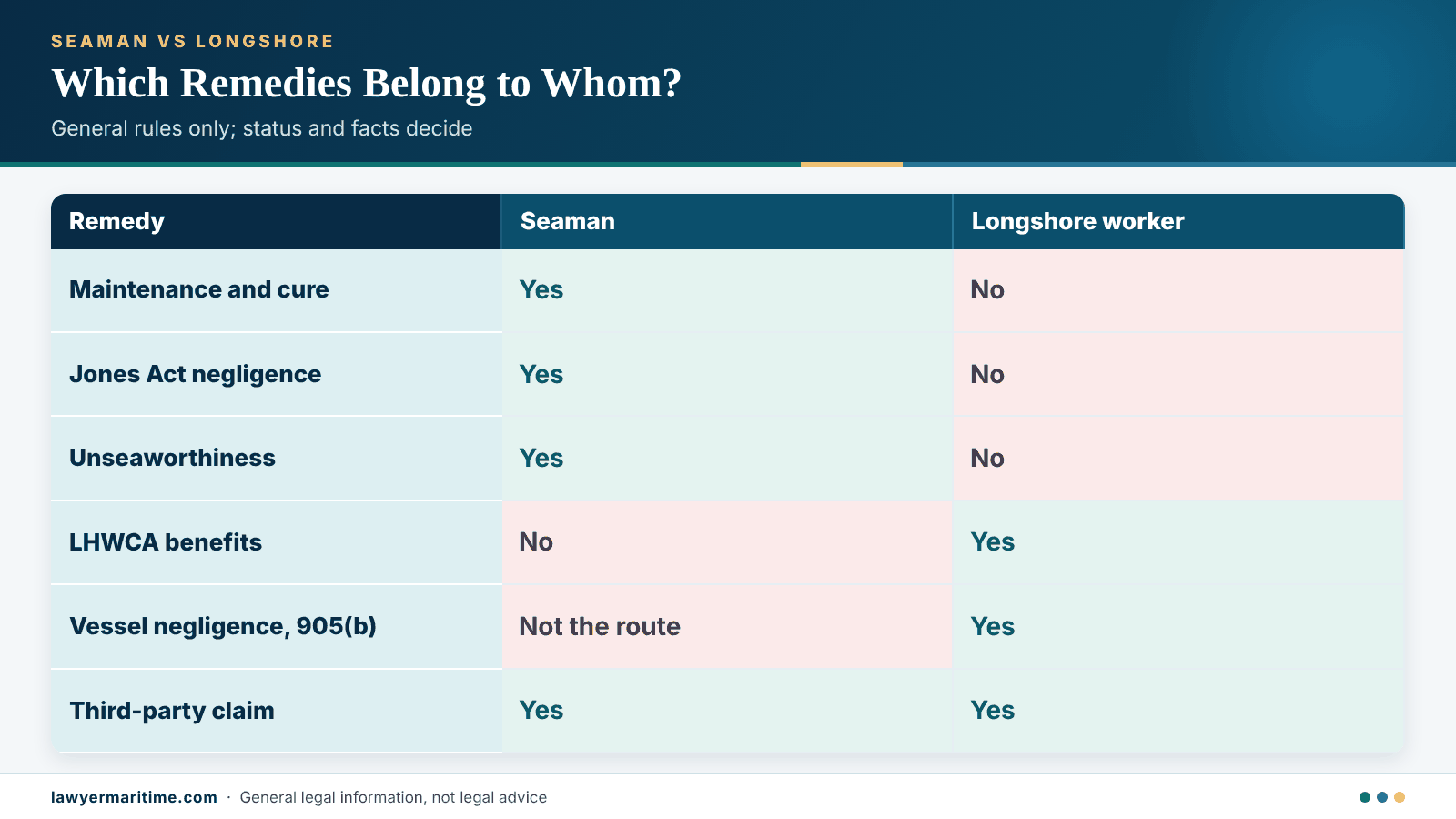
Deadlines and Notice Periods for Seaman Claims
No single deadline governs a seaman’s injury. The right clock depends on the claim, the defendant, and sometimes the contract. The summary in Table 10 reflects general rules drawn from the statutes cited, and every period has caveats. Treat the table as a prompt to ask a lawyer about your dates, not as a calendar to rely on.
The main periods, claim by claim
Most seaman suits against private employers and vessel owners share a three-year period, but several adjacent claims run on shorter clocks.
Suits against employers and vessel owners
For the Jones Act, the borrowed FELA rule in 45 U.S.C. § 56 sets a three-year period. For maritime torts in general, 46 U.S.C. § 30106 provides that, except as otherwise provided by law, a civil action for damages for personal injury or death arising out of a maritime tort must be brought within three years after the cause of action arose. Unseaworthiness and third-party maritime tort claims typically fall within the same general rule.
Maintenance and cure is a different kind of claim, based on the employment relationship rather than on a tort, and courts haven’t all treated its timing the same way. Waiting to see whether the employer resumes paying is a risk, so seek advice on that clock early.
Shorter and special clocks
Several nearby claims run on much shorter periods. A suit against the United States under the Suits in Admiralty Act must be brought within two years under 46 U.S.C. § 30905. A retaliation complaint under 46 U.S.C. § 2114 goes through the procedure in 49 U.S.C. § 31105, which calls for filing with the Secretary of Labor within 180 days. LHWCA claims require notice within 30 days and a claim within one year, subject to exceptions.
Contracts and court orders can add their own clocks. A union agreement may set grievance filing steps, and a federal limitation proceeding sets a court-ordered deadline for claimants. Our article on maritime injury deadlines explains how these periods interact.
Managing the clocks in practice
Deadlines punish delay, not confusion. The best defense is a simple habit: write down the dates and ask early.
When the clock starts
The usual rule starts the period when the cause of action arose, which for a sudden accident is the date of injury. Gradual injuries, such as repetitive stress or an occupational illness, can make that date less obvious, and courts may consider when you knew or reasonably should have known of the injury and its cause. Do not rely on a later date without advice, because the safe course is to count from the earliest plausible date.
Building a deadline calendar
List every date: the injury, the report, the last maintenance and cure payment, any denial letter, any settlement offer, and any government or court notice. Then mark the earliest possible deadline from the table that could apply to you. If you are unsure whether you are a seaman, calendar the shorter longshore periods until a lawyer has analyzed status.
| Claim or step | General period | Main source | Caveat |
|---|---|---|---|
| Jones Act negligence suit | Three years | 46 U.S.C. § 30104; 45 U.S.C. § 56 | Count from the earliest plausible date; accrual can be disputed |
| Unseaworthiness and maritime tort suits | Three years | 46 U.S.C. § 30106 | “Except as otherwise provided by law” |
| Maintenance and cure suit | Not a single fixed period | General maritime law | Courts differ on timing; don’t wait |
| Suit against the United States in admiralty | Two years | 46 U.S.C. § 30905 | Applies when the Suits in Admiralty Act governs |
| Retaliation complaint for a seaman | 180 days | 46 U.S.C. § 2114; 49 U.S.C. § 31105(b) | Separate from the injury claim |
| LHWCA notice and claim | 30 days notice; one year claim | 33 U.S.C. §§ 912-913 | Exceptions and excuses exist |
| Death at sea beyond three nautical miles | Generally three years | 46 U.S.C. § 30106; DOHSA | Confirm with counsel; see the DOHSA guide |
What to Do Now: A Practical Plan
If you are hurt, or helping someone who is, the legal map above can feel like a lot to hold in your head. The plan below breaks it into steps you can take without making any legal decision you can’t undo. It is general information, so adapt it to your doctor’s advice and your employer’s procedures.
The first steps after an injury
Sequence matters more than speed in the first weeks. Health comes first, then documentation, then decisions.
In the first days
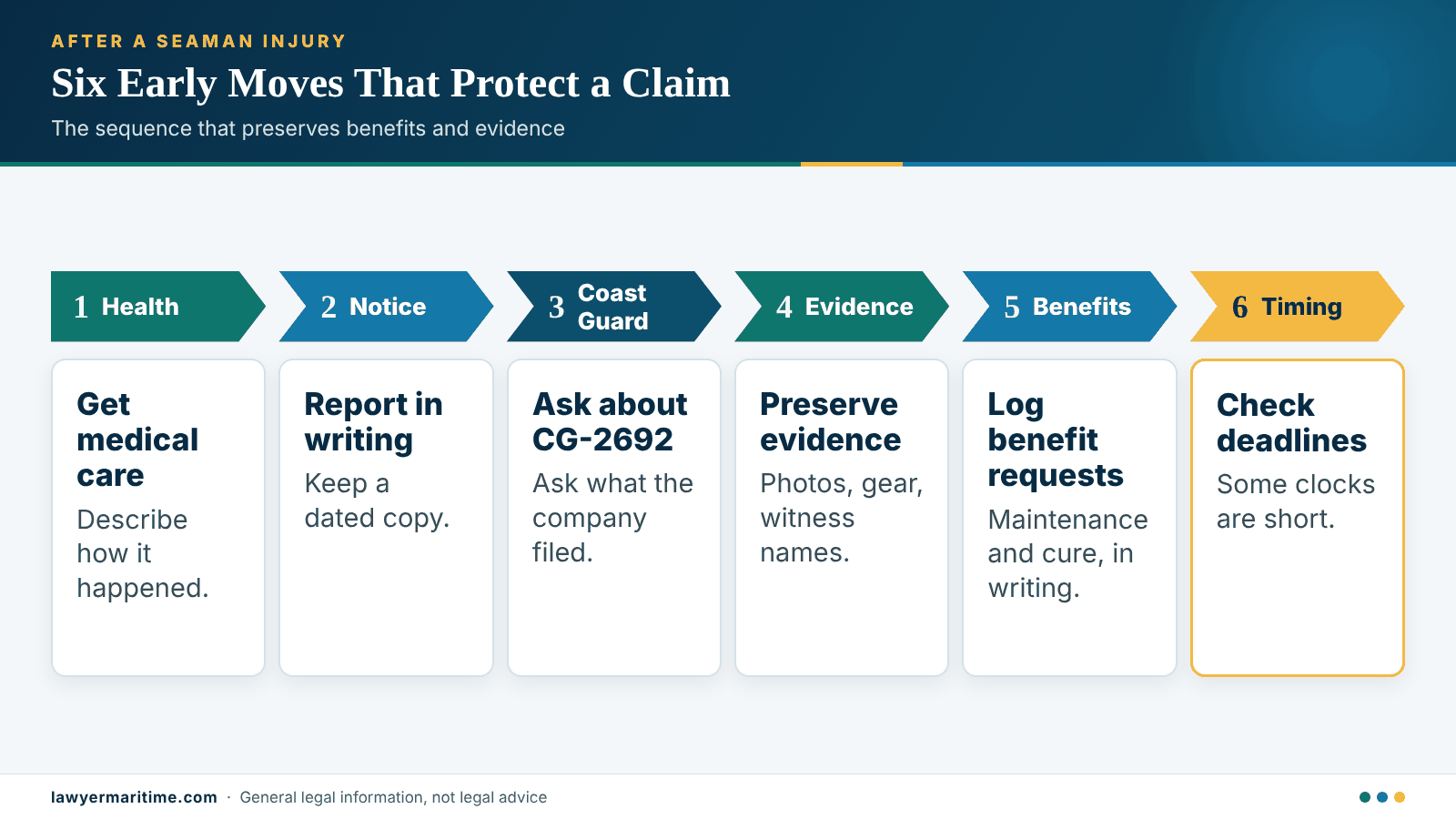
- Get medical care. Describe the injury fully, including how it happened, so the work connection is in the record from the start.
- Report in writing. Tell your supervisor or master, keep a dated note of what you reported, and ask for a copy of any report you sign.
- Ask what was filed. Ask whether the company has notified the Coast Guard and filed Form CG-2692, and ask for a copy if one exists.
- Protect the evidence. Photograph the scene and the equipment, write down witness names, and ask that logs and video be preserved.
- Request maintenance and cure. Make the request in writing and keep every reply.
In the first weeks
- Follow your treatment plan and keep every appointment, because gaps give an insurer an argument.
- Keep a log of calls with the company, including dates, names, and what was said.
- Save pay stubs, share sheets, hitch schedules, your crew agreement, and any union contract.
- Collect receipts for living costs and medical costs that you pay yourself.
- Write down your calendar of possible deadlines, using the shortest period that might apply.
- Talk with a qualified maritime attorney before giving a recorded statement or signing a release.
Mistakes that can cost a claim
Most avoidable problems in seaman cases are small decisions made quickly. The table below pairs the common ones with a safer alternative.
The common mistakes, and better actions
| Common mistake | Why it hurts | Better action |
|---|---|---|
| Waiting to report because the pain “might pass” | Late reports invite doubts about cause | Report as soon as you believe the problem is work-related |
| Signing a form or receipt you haven’t read | Documents can contain releases or admissions | Read it, ask for a copy, and have counsel review releases |
| Guessing at who was to blame in a statement | Speculation can be used to dispute your account | State what you saw, did, and felt |
| Assuming your job title decides status | You may miss remedies or file in the wrong system | Collect assignment, hitch, and payroll records for analysis |
| Letting repairs or disposal destroy the failed item | Physical evidence may be lost | Ask in writing that it be preserved unaltered |
| Treating the three-year period as the only clock | Shorter periods may apply to related claims | Calendar the earliest possible date and ask early |
When to talk with a maritime attorney
It is reasonable to speak with a maritime attorney as soon as you are seriously hurt, when benefits stop or are disputed, when you are asked to sign a release, or when your status is unclear. A first conversation is a way to learn your options and ask the questions this guide raises, and asking questions doesn’t commit you to anything. This page doesn’t state any firm’s availability, fees, or location. If you are looking for someone, our guide on finding a maritime lawyer near you and the discussion of the role of a maritime lawyer can help you compare.
Come prepared. Bring your documents, a timeline, and a list of questions about status, benefits, deadlines, and fees. For maritime injury work beyond seamen, our maritime injury attorney page explains how coverage decisions are made.
Frequently Asked Questions About Seaman Injury Claims
These answers are short by design. Each points back to the section that explains the rule, and none replaces advice from a lawyer who knows your facts.
Choosing and paying for a lawyer
Do I need a seaman injury lawyer if my employer is already paying maintenance and cure?
Not always at the very start, but the question often changes quickly. Maintenance and cure covers living costs and treatment, not lost future earnings, pain, or permanent limits, and it can end when a doctor reports maximum improvement. A lawyer can review whether the benefits are adequate, whether a release is being offered, and whether the larger claims are still open.
Can I be a seaman if I only work on boats part of the year?
Possibly. The test looks at the nature and duration of your connection to a vessel or an identifiable fleet, and the 30 percent figure from Chandris is a guideline, not a cutoff. Seasonal and rotational schedules are measured in light of the work you actually do. Keep your schedules and pay records, because they are the evidence.
How much does a seaman injury lawyer cost?
Fee arrangements vary by lawyer and by state, and this page can’t state any particular firm’s terms. Many personal injury lawyers use contingent fees, but you should ask for the fee agreement in writing and ask how costs are handled if there is no recovery. Under ABA Model Rule 1.5(c), a contingent-fee agreement should be in a signed writing that explains the percentage and expenses, and some states set stricter rules.
Benefits, damages, and fault
Can I get maintenance and cure if the accident was partly my fault?
Generally yes. Maintenance and cure doesn’t depend on fault, and the Supreme Court has said that doubts in applying it are resolved in the seaman’s favor. Your own carelessness can reduce damages in a negligence claim, but it doesn’t ordinarily cancel the basic duty to provide care. A willful concealment of a known medical condition during hiring is a different issue.
How long does maintenance and cure last?
It generally lasts until you are cured or your condition is declared permanent, meaning treatment can no longer be expected to improve it. Disputes concentrate on who decides that and when. A second medical opinion in writing is often the most useful evidence. Details are in the maintenance and cure section above and in our guide to denied maintenance and cure.
Can I recover punitive damages in a seaman case?
Sometimes, but only on narrow facts. The Supreme Court allowed punitive damages for a willful or wanton failure to pay maintenance and cure in Townsend, and rejected them for unseaworthiness in Batterton. Courts have generally held them unavailable for Jones Act negligence. Do not assume any punitive award in your case.
Process, court, and your job
Can I file a seaman injury lawsuit in state court?
Often, yes. The saving-to-suitors clause in 28 U.S.C. § 1333 preserves many state-court remedies, and Jones Act cases filed in state court are generally difficult for a defendant to move to federal court. Other issues, such as arbitration clauses or a vessel owner’s limitation action, can change the forum. Our maritime law guide explains forum choices in more detail.
What if the company doctor says I’m fit for duty but my own doctor disagrees?
Do not treat the company doctor’s opinion as final. Ask for the reasoning in writing, get your treating physician’s opinion in writing, and consider an independent examination. If maintenance and cure is cut off based on a disputed opinion, the decision is worth challenging early, because the law resolves doubts in the seaman’s favor.
Can I be fired for reporting an injury?
Federal law prohibits discharge or discrimination against a seaman for notifying the vessel owner or the Coast Guard of a work-related injury or illness, among other protected activities, under 46 U.S.C. § 2114. A complaint to the Secretary of Labor has a 180-day filing period. Whether a particular termination was retaliatory depends on the company’s stated reasons and the timing, so get advice quickly if it happens.
Sources and Legal Authorities
The authorities below support the legal statements in this guide. Check each against its current text before relying on it, because statutes, regulations, and case law change, and courts in different circuits may apply them differently.
Statutes and regulations
Federal statutes
- 46 U.S.C. § 30104 – Personal injury to or death of seamen (Jones Act), including the 2022 aquaculture provision
- 46 U.S.C. § 30106 – Time limit on bringing maritime action for personal injury or death
- 46 U.S.C. § 2114 – Protection of seamen against discrimination
- 49 U.S.C. § 31105 – Procedures for employee protection complaints (incorporated by § 2114)
- 45 U.S.C. § 53 – FELA, contributory negligence
- 45 U.S.C. § 59 – FELA, survival of right of action and beneficiaries
- 46 U.S.C. § 30302 – Death on the High Seas Act, cause of action
- 46 U.S.C. § 30303 – Death on the High Seas Act, recovery
- 46 U.S.C. § 30903 – Suits in Admiralty Act, waiver of immunity and non-jury trial
- 46 U.S.C. § 30905 – Suits in Admiralty Act, period for bringing action
- 46 U.S.C. § 10601 – Fishing agreements
- 9 U.S.C. § 1 – Federal Arbitration Act definitions and exemption for seamen
- 42 U.S.C. § 1395y – Medicare secondary payer rules
- 26 U.S.C. § 104 – Compensation for injuries or sickness
LHWCA provisions and regulations
- 33 U.S.C. § 902 – LHWCA definitions, including the crew exclusion
- 33 U.S.C. § 912 – LHWCA notice of injury
- 33 U.S.C. § 913 – LHWCA filing of claims
- 33 U.S.C. § 933 – LHWCA compensation for injuries where third persons are liable
- 46 CFR § 4.03-2 – Serious marine incident definition
- 46 CFR § 4.05-1 – Notice of marine casualty and voyage records
- 46 CFR § 4.05-10 – Written report of marine casualty (Form CG-2692)
Cases and agency materials
Supreme Court and federal appellate decisions
- Chandris, Inc. v. Latsis, 515 U.S. 347 (1995) – two-part seaman status test; 30 percent guideline
- McDermott International, Inc. v. Wilander, 498 U.S. 337 (1991) – seaman status; no requirement to aid in navigation
- Stewart v. Dutra Construction Co., 543 U.S. 481 (2005) – vessel defined by practical capability for water transport
- Lozman v. City of Riviera Beach, 568 U.S. 115 (2013) – floating home not a vessel
- Sanchez v. Smart Fabricators of Texas, L.L.C., 997 F.3d 564 (5th Cir. 2021) (en banc) – Fifth Circuit seaman status inquiries
- Calmar Steamship Corp. v. Taylor, 303 U.S. 525 (1938) – maintenance and cure background
- Farrell v. United States, 336 U.S. 511 (1949) – duration of maintenance and cure
- Vaughan v. Atkinson, 369 U.S. 527 (1962) – attorney’s fees; doubts resolved for the seaman
- McCorpen v. Central Gulf Steamship Corp., 396 F.2d 547 (5th Cir. 1968) – concealment defense (Fifth Circuit)
- Atlantic Sounding Co. v. Townsend, 557 U.S. 404 (2009) – punitive damages for willful failure to pay maintenance and cure
- Dutra Group v. Batterton, 588 U.S. 358 (2019) – no punitive damages for unseaworthiness
- Mitchell v. Trawler Racer, Inc., 362 U.S. 539 (1960) – unseaworthiness duty independent of negligence
- Usner v. Luckenbach Overseas Corp., 400 U.S. 494 (1971) – isolated negligent act and unseaworthiness
- CSX Transportation, Inc. v. McBride, 564 U.S. 685 (2011) – FELA causation standard
- Gautreaux v. Scurlock Marine, Inc., 107 F.3d 331 (5th Cir. 1997) (en banc) – seaman’s duty of ordinary prudence
- Socony-Vacuum Oil Co. v. Smith, 305 U.S. 424 (1939) – assumption of risk and comparative fault
- Air & Liquid Systems Corp. v. DeVries, No. 17-1104 (2019) – maritime products duty to warn
- Moragne v. States Marine Lines, Inc., 398 U.S. 375 (1970) – general maritime wrongful-death action
- Miles v. Apex Marine Corp., 498 U.S. 19 (1990) – limits on a seaman’s wrongful-death and survival damages
- Mobil Oil Corp. v. Higginbotham, 436 U.S. 618 (1978) – DOHSA damages limited to pecuniary loss
- Yamaha Motor Corp. v. Calhoun, 516 U.S. 199 (1996) – state remedies for nonseafarer deaths in state waters
- Garrett v. Moore-McCormack Co., 317 U.S. 239 (1942) – burden on the shipowner to uphold a seaman’s release
- The Genesee Chief v. Fitzhugh, 53 U.S. (12 How.) 443 (1852) – admiralty jurisdiction beyond tidewater
Agency and official program materials
- U.S. Department of Labor – Division of Longshore and Harbor Workers’ Compensation
- Centers for Medicare & Medicaid Services – Medicare’s recovery process
- 29 CFR Part 1986 – procedures for retaliation complaints under the Seaman’s Protection Act (cited in the notes to 46 U.S.C. § 2114)