
If you typed “maritime injury lawyer Miami” into a search box, you’re probably hurt, worried, and unsure whether being hurt in Miami changes your rights. Mostly it doesn’t, because the rights come from federal maritime law. A crew member may bring a Jones Act claim under 46 U.S.C. § 30104, a cruise passenger’s rights often turn on the ticket contract and federal passenger-vessel statutes, and many port and boatyard workers fall under the Longshore and Harbor Workers’ Compensation Act (LHWCA) or Florida workers’ compensation. What Miami adds is local: PortMiami and its cruise terminals, Port Everglades next door in Broward County, the Miami River, the Southern District of Florida and the Eleventh Circuit, Miami-Dade’s state courts, and Florida’s own deadlines and lawyer-advertising rules. This guide is for injured crew, port and yard workers, cruise passengers, boaters, and their families. It explains which law probably applies, where a case can be filed, which records matter, and which clocks may be running. It’s general information, not advice, and it doesn’t say where any firm is based or serves.
How Does Miami Change a Maritime Injury Claim?
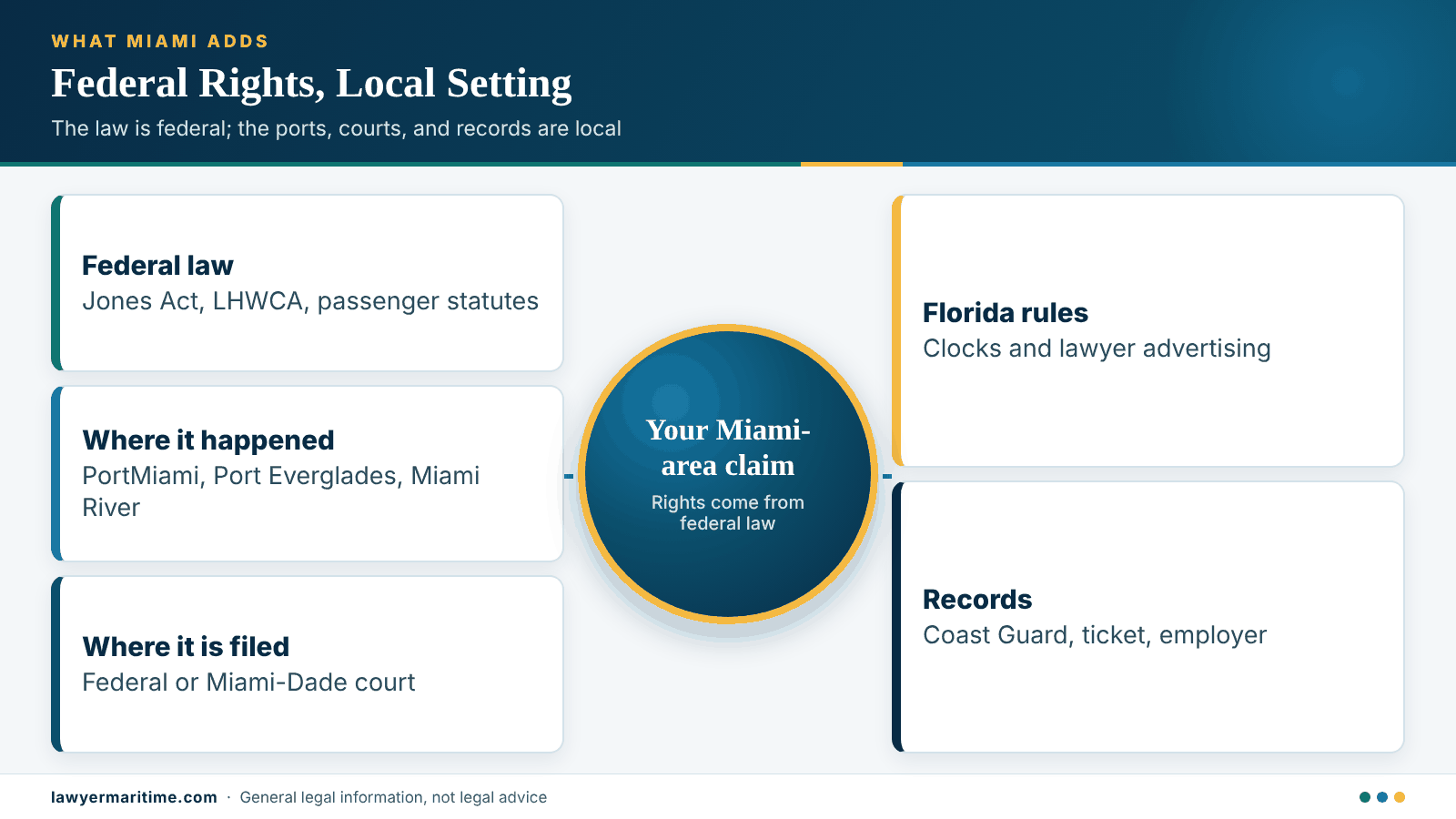
Miami changes the setting of a claim far more than the substance of it. The ports, the waterways, the courts, and the Florida deadlines around you are local, while the rules that decide whether you can recover are largely federal. Getting your bearings means separating those two layers early.
What is the local setting for a Miami-area maritime claim?
Local context tells you who was probably on the scene, which records exist, and which companies or agencies may be involved. It doesn’t tell you what law applies. Think of it as the map, not the rulebook.
PortMiami and Port Everglades are two different ports
PortMiami calls itself the “Cruise Capital of the World” and the “Cargo Gateway of the Americas,” and its site describes cruise itineraries to the Caribbean, Mexico, Key West, and South America alongside container cargo. A Miami-Dade County master-plan document describes the port as built on spoil islands in Biscayne Bay, joined to downtown Miami by a bridge, and owned and operated by the county’s Seaport Department. The same document says the port lies within Miami city limits but under county jurisdiction.
Port Everglades is a separate port in the Fort Lauderdale area of Broward County. Its website describes cruise, cargo, and energy operations and says one-third of Florida’s energy, including petroleum, is stored and distributed through the port. The distinction matters for a claim because the two ports sit in different counties, and county lines can affect where a state-court case is filed and which local agencies hold records. Our New Orleans maritime market guide and Houston guide show how the same federal law plays out in other port cities.
The Miami River, boatyards, and the Coast Guard
A Miami River Commission planning document describes the Miami River as a working river. It lists international shipping terminals, recreational boatyards, commercial fishing businesses, and recreational marinas along its banks. The document is older, so treat it as a picture of the kinds of employers on the river, not a current directory.
That mix matters because one stretch of water can hold a seaman on a tug, a laborer at a terminal, a mechanic at a boatyard, and a deckhand on a fishing boat. Each may fall under a different system. On the safety side, Coast Guard Sector Miami lists a base on the MacArthur Causeway, and the Coast Guard is the agency that receives marine casualty reports for many incidents. Which unit handled yours is a fact to confirm from your own paperwork.
What stays the same no matter where you were hurt?
Some points hold in every port. Knowing them keeps a local search from steering you toward the wrong assumptions.
There is no Miami version of maritime law
The seaman’s remedy in 46 U.S.C. § 30104, the duty to provide maintenance and cure, the vessel owner’s duty of seaworthiness, and the LHWCA apply on the same terms in any federal court. What can differ by region is how a federal appeals court has interpreted them. For Florida that court is the Eleventh Circuit, which covers Alabama, Florida, and Georgia. If you want the national picture first, start with our guides to maritime law and admiralty law.
Your residence doesn’t decide your rights, either. A Miami resident hurt on a vessel in another state’s waters, or a visitor hurt on Biscayne Bay, is analyzed on the work, the craft, and the place of the incident.
What a local page can and can’t tell you
A page like this can explain the framework, show where a Miami-area case may be filed, and flag the records worth keeping. It can’t tell you whether you’re a seaman, whether a particular craft is a vessel, or whether you have a claim. Those answers depend on your work history, your ticket, and your documents.
It also can’t speak for any law firm. This page doesn’t say where any firm is based or where it takes cases, and nothing here should be read as a claim that a firm has a Miami office. If you’re comparing options across the region, our guide to finding a maritime lawyer near you covers how to approach that search.
Which Maritime Law Covers Which Miami-Area Worker?
Miami-area maritime work spans cruise ships, yachts, tugs, fishing boats, terminals, boatyards, marinas, and the businesses that supply them. Each setting can point to a different legal system, and the table below gives a first-pass map. It’s a starting point for a conversation with a lawyer, not a diagnosis.
| Work setting | Law that may apply | Question that usually decides it |
|---|---|---|
| Crew on a cruise ship, yacht, tug, or fishing boat | Jones Act and maintenance and cure may be available | Do your duties and your connection to a vessel in navigation meet the seaman test? |
| Cruise-line crew with a signed employment agreement | Seaman remedies, but an arbitration clause may move the dispute out of court | What does the agreement say, and where and how must claims be brought? |
| Terminal worker loading or unloading cargo | LHWCA often; a claim against a vessel owner may also exist | Do you meet the status and situs requirements, and were you actually a crew member? |
| Worker repairing or building a recreational boat | Florida workers’ compensation may apply instead of the LHWCA | Is the boat a recreational vessel, and does a state workers’ compensation law cover you? |
| Marina or dockside retail employee | Often outside the LHWCA when state workers’ compensation covers the job | Does the marina or recreational-operation exclusion fit your actual duties? |
How do vessel crews fit in?
Crew members are the group the Jones Act was written for, but status is never automatic. A deckhand, mate, engineer, or steward on a working vessel often has the strongest starting position, and a worker whose job is mostly ashore has the weakest. Most people fall somewhere in between, which is why the test matters. Our seaman injury guide and Jones Act claim guide take the topic further.
The seaman test in plain English
The Supreme Court’s decisions in McDermott International, Inc. v. Wilander and Chandris, Inc. v. Latsis describe two parts. First, your duties must contribute to the function or mission of a vessel. Second, your connection to a vessel in navigation, or to an identifiable fleet of vessels, must be substantial in both duration and nature. Courts often use roughly 30 percent of work time in the service of a vessel as a guideline, but Chandris treats it as a guideline and not a bright line.
In Miami that test gets applied to a wide range of boats. A deckhand on a commercial fishing vessel and an engineer on a working tug will usually raise few status questions. A worker who bounces between several yachts, a shore-based contractor who boards ships for short repairs, or a charter employee with mixed land and water duties may raise more. Whether a given craft is a vessel is itself a legal question that turns on its design and use, so a label such as “boat,” “barge,” or “floating dock” doesn’t answer it.
Cruise crew, signed agreements, and arbitration
Many cruise-line crew sign employment agreements before they join a ship, and those agreements can include arbitration terms. In Bautista v. Star Cruises, 396 F.3d 1289 (11th Cir. 2005), which arose from a boiler explosion aboard a ship at the Port of Miami, the Eleventh Circuit upheld arbitration of foreign crew members’ injury claims under the international convention on arbitral awards. A published summary of the decision says it reached negligence, unseaworthiness, and maintenance and cure claims arising from the crew employment contracts.
That decision doesn’t mean every crew contract sends every claim to arbitration. Outcomes depend on the contract’s wording, the crew member’s nationality, where the agreement was signed, and what the claim is. The practical takeaway is to keep a copy of anything you signed with the employer, and to have a lawyer read it before you assume your claim will be heard by a jury.
How do shoreside, boatyard, and marina workers fit in?
Workers whose jobs are tied to ships but based on land are usually analyzed under the LHWCA, a federal workers’ compensation system administered by the U.S. Department of Labor. Florida’s own workers’ compensation system fills in for jobs the LHWCA leaves out. Miami’s yacht-and-boat economy makes that dividing line unusually important.
LHWCA coverage and the recreational-vessel exclusions
The LHWCA, at 33 U.S.C. § 902(3), defines a covered employee as someone in maritime employment, including longshoring operations and harbor work such as ship repair and shipbuilding. Section 903(a) adds a location test: the injury must happen on navigable waters or on an adjoining pier, wharf, dry dock, terminal, or similar area customarily used for loading, unloading, repairing, or building vessels. The statute excludes a ship’s master and members of its crew, which is why crew remedies run through the seaman systems instead.
Section 902(3) also lists exclusions that matter near Biscayne Bay. It excludes people building a recreational vessel under sixty-five feet, people repairing any recreational vessel, and people dismantling parts of one in connection with a repair. It also excludes certain marina employees who are not engaged in construction, replacement, or expansion of the marina, and employees of clubs, camps, recreational operations, restaurants, museums, and retail outlets. Those exclusions apply only if a state workers’ compensation law covers the worker, so a boatyard mechanic who is excluded from the LHWCA should ordinarily look to Florida’s system instead. For the national rate tables, see our LHWCA rates guide.
An LHWCA worker generally can’t sue the direct employer in tort, although 33 U.S.C. § 905(b) allows a negligence claim against a vessel, subject to limits in that section. The Department of Labor’s longshore program lists a Jacksonville suboffice for Florida, and you should confirm with the Department which office handles your claim.
When Florida workers’ compensation applies
For a worker the LHWCA excludes, Florida’s workers’ compensation law, Chapter 440 of the Florida Statutes, is the likely home. It carries its own early deadline: section 440.185(1) says an employee must tell the employer of a work-related injury within 30 days, with listed exceptions, such as the employer’s actual knowledge of the injury or exceptional circumstances. The Florida Division of Workers’ Compensation runs an ombudsman office that says its services are free to injured workers.
The choice between a Florida claim and a maritime one is not always obvious at the start. A worker who spends part of the week repairing recreational boats at a yard and part of it working aboard a commercial vessel, for example, may present a mixed picture. Sorting out the right system early prevents a missed notice period under the wrong statute.
What Rules Protect Cruise Passengers and Boaters in Miami?
Passengers and recreational boaters are not crew, so they generally don’t have Jones Act or maintenance and cure rights. Their claims usually rest on general maritime negligence, and cruise passengers face a contract layer on top. Miami is where both groups meet, since cruise terminals and recreational marinas share the same bay. The table below separates the two.
| Issue | Cruise passenger | Recreational boater, renter, or guest |
|---|---|---|
| Main source of the claim | Maritime negligence against the cruise line, shaped by the ticket contract | Maritime negligence against an operator, owner, or rental or charter business |
| Contract terms to read | Forum clause, notice of claim, and suit deadline in the ticket | Rental, charter, or waiver paperwork, which may be limited by law |
| Federal safety statute that may matter | 46 U.S.C. § 3507 for large passenger vessels embarking or disembarking in the United States | Navigation rules and state boating laws, depending on the facts |
| Official report most likely to exist | Coast Guard casualty report; crime reports to the FBI for serious incidents | Florida vessel accident report and, in some cases, a Coast Guard report |
| Where a death outside state waters is analyzed | Death on the High Seas Act beyond three nautical miles, in the covered cases | State remedies may supplement federal law in state territorial waters |
What matters to a cruise passenger hurt on a ship that sails from Miami?
Most claims by cruise passengers start with the ticket. The contract passengers accept when they board is not negotiable, but the law treats it as binding in some respects and unenforceable in others. Our maritime accident attorney guide covers how fault is evaluated once the contract questions are sorted out.
Forum clauses and Carnival Cruise Lines v. Shute
In Carnival Cruise Lines, Inc. v. Shute, 499 U.S. 585 (1991), a Washington couple bought a cruise through a local travel agent, the ticket was issued from Carnival’s Florida headquarters, and Mrs. Shute was injured aboard a ship in international waters off Mexico. The ticket required disputes to be litigated in a court in Florida. The Supreme Court held the clause enforceable, reasoning that a cruise line has a legitimate interest in limiting where it can be sued and that the clause was subject to review for fundamental fairness.
The case is strong precedent for cruise lines, but it has limits. The Court noted that Carnival’s principal place of business was in Florida and that many of its cruises left from Florida ports, and it found no evidence of fraud or overreaching. A forum clause can still be challenged on facts like those, but passengers shouldn’t assume a judge will set one aside. Tickets today vary, so read the forum clause in yours to see which court, if any, it names.
Notice of claim, suit deadlines, and limits on liability terms
Federal law sets floors for what a passenger ticket can say. Under 46 U.S.C. § 30526, the owner of a covered seagoing vessel carrying passengers between U.S. ports, or between a U.S. port and a foreign port, cannot set a notice-of-claim period shorter than six months or a period to file suit shorter than one year for personal injury or death. The statute lists exclusions, including pleasure yachts, tugs, and fishing vessels, and it sets two-year minimums for certain small passenger vessels. It also says that failing to give a notice required by a contract does not bar recovery in listed situations, such as when the owner knew of the injury and wasn’t prejudiced.
A companion provision, 46 U.S.C. § 30527, makes void a ticket term that caps liability for the owner’s or its crew’s negligence or takes away a passenger’s right to sue in court. It lets tickets waive some emotional-distress claims, but not those that stem from a physical injury or the risk of one, or from intentional conduct by crew. In Shute the Court found the predecessor of that provision was not violated by a forum clause, so the two ideas coexist. The practical point is that a ticket may set short periods within the federal minimums, so the clock can start earlier than many passengers expect.
Federal passenger-vessel safety requirements
Congress has also regulated large cruise ships directly. Section 3507 of Title 46 applies to passenger vessels authorized to carry 250 or more passengers, with overnight accommodations for 250 or more, on voyages that embark or disembark passengers in the United States. Among other things, it addresses ship rails, video surveillance systems, a plain-English passenger security guide, a logbook of crime complaints, and reporting of listed serious incidents to the FBI.
These rules matter in two ways. They help show what safety measures a covered ship was expected to have, and they identify records, such as video and incident logs, that may exist. The statute doesn’t by itself decide who is liable for an injury, and counsel should evaluate how it applies to a particular incident.
What matters to a boater, renter, or guest hurt on Biscayne Bay?
Recreational boating injuries are common in busy South Florida waters. They raise different questions from cruise claims, starting with whether federal admiralty law applies at all. For deadlines specific to this group, see our boating injury claim deadline guide.
Why admiralty law reaches pleasure boats
Some people assume maritime law covers only commercial shipping. The Supreme Court rejected that view in Foremost Insurance Co. v. Richardson, 457 U.S. 668 (1982), holding that a collision between two pleasure boats on navigable waters fell within federal admiralty jurisdiction. The Court reasoned that the federal interest in maritime commerce supports uniform rules for all vessel operators on navigable waters, because even a noncommercial collision can disrupt commerce.
The result is that a collision, grounding, or onboard injury on Biscayne Bay or the Intracoastal Waterway can be a maritime tort even when the boat was purely for pleasure. Federal admiralty jurisdiction and state-court options can both be available. Our maritime jurisdiction guide and admiralty jurisdiction guide explain the location-and-connection tests in more detail.
Florida accident reports and deaths in state waters
Florida requires a written report after certain vessel accidents. Under Fla. Stat. § 327.301, the operator, or the owner if the operator can’t act, must report an accident that causes bodily injury, death, or disappearance, or property damage of at least $2,000, within the time limits in federal regulation 33 C.F.R. § 173.55. If a vessel was leased, rented, or chartered, the statute makes the person who offered it responsible for compliance. The statute also says these reports and statements to officers may not be used as evidence in any trial, so a lawyer should explain how that provision interacts with any claim.
When a boating accident causes a death, the governing law depends on where it happened. The Death on the High Seas Act, 46 U.S.C. § 30302, covers a death on the high seas beyond three nautical miles from the shore of the United States, and our DOHSA claim deadline guide covers that timing. In Yamaha Motor Corp. v. Calhoun, 516 U.S. 199 (1996), the Court held that state remedies remain available in a maritime wrongful-death case involving a nonseafarer in state territorial waters. Which remedies apply to a death on Biscayne Bay therefore depends on both the victim’s status and the location.
Where Can a Miami-Area Maritime Injury Case Be Filed?
Maritime cases can often be brought in either federal or state court, and the choice shapes the judge, the jury pool, and the procedural fights that follow. Miami-area claims also run into contract clauses that can narrow the options. The table below lays out the main forums, and the sections after it explain the rules behind them.
| Forum | When it may be available | Points to check |
|---|---|---|
| U.S. District Court, Southern District of Florida | Federal admiralty jurisdiction under 28 U.S.C. § 1333, or diversity in some cases | Local rules, venue, and any forum clause that points elsewhere |
| Miami-Dade state court | Saved common-law remedies, including a seaman’s Jones Act jury claim | Removal arguments, and whether a contract names a different court |
| Court named in a cruise ticket | Where the ticket’s forum clause applies and is enforceable | Fundamental fairness, as in Shute, and the exact wording of the clause |
| Arbitration under a crew agreement | Where a signed agreement requires it and a court enforces it | Contract wording, the crew member’s status, and the type of claim |
| LHWCA claim process | For covered shoreside workers, handled through the Department of Labor | Notice and claim periods, and whether a separate vessel-negligence suit exists |
How do the federal courts in Florida fit in?
Federal courts have original jurisdiction over admiralty and maritime cases under 28 U.S.C. § 1333. That statute also contains the saving-to-suitors clause, which keeps other remedies available to those entitled to them. Together, they explain why many maritime plaintiffs can choose between federal and state court.
The Southern District of Florida
By statute, 28 U.S.C. § 89, the Southern District of Florida covers nine counties, including Dade (now Miami-Dade), Broward, Palm Beach, and Monroe, and it holds court at Fort Lauderdale, Fort Pierce, Key West, Miami, and West Palm Beach. That means a claim arising at PortMiami and one arising at Port Everglades both belong, for federal purposes, to the same district, even though the counties differ. How a particular case is assigned among the courthouses depends on venue rules and the district’s local rules.
The court’s website currently posts a notice of proposed amendments to its local rules, dated September 15, 2026, with a hearing to receive public comment. That is a reminder to check the current rules rather than rely on any summary, including this one. Our maritime injury attorney guide explains who is covered by the main federal systems.
The Eleventh Circuit
Appeals from the Southern District of Florida go to the U.S. Court of Appeals for the Eleventh Circuit, which under 28 U.S.C. § 41 covers Alabama, Florida, and Georgia. Its published decisions bind federal district judges in Florida, so its treatment of questions such as arbitration of crew claims in Bautista, discussed above, matters for Miami cases.
Federal appeals courts can differ on the same legal question, which is one reason local counsel experience can matter. A rule from the Fifth Circuit that governs Houston and New Orleans cases may not apply in Miami, and vice versa. Treat any out-of-circuit case you read online as persuasive at most.
What about Miami-Dade state courts and the saving clause?
State courts can hear maritime claims too, and for seamen the state-court route has special features. The advantages and risks of each forum are strategic questions for counsel, but the rules below explain why the option exists.
Saving to suitors and non-removal of Jones Act claims
The saving-to-suitors clause in § 1333 preserves common-law remedies for people with maritime claims, and the Jones Act itself gives a seaman a right to a jury trial under 46 U.S.C. § 30104. Because the Jones Act incorporates the Federal Employers’ Liability Act, 28 U.S.C. § 1445(a) is generally read to bar removal to federal court of a seaman’s Jones Act case filed in state court. A defendant may still argue that the Jones Act claim is not genuine and ask a federal court to keep the case, and courts handle that argument differently.
That doesn’t mean state court is automatically the better choice. Removal rules for other maritime claims, such as a passenger’s negligence claim or a seaman’s unseaworthiness claim, are less settled, and a state court still applies federal substantive maritime law to maritime claims. The decision about where to file is one to make with a lawyer who has reviewed your documents.
Miami-Dade circuit courts and limitation of liability actions
State-court cases in Miami-Dade County are heard by the Eleventh Judicial Circuit of Florida, whose website lists Circuit Civil and County Civil divisions and links to the Miami-Dade Clerk’s case search. A case arising at Port Everglades may belong in Broward County’s state courts instead. Which division fits a case depends on the claim and its size, and counsel can confirm it.
A vessel owner can complicate the choice of forum by filing a limitation of liability action in federal court. Under 46 U.S.C. § 30529, an owner may file within six months after a claimant gives written notice of a claim, and may deposit the value of its interest in the vessel and pending freight with the court. In Lewis v. Lewis & Clark Marine, Inc., 531 U.S. 438 (2001), the Court held that a claimant may proceed in state court with a saved remedy when the owner’s limitation rights are protected, for example through stipulations by a single claimant. The case also describes the Limitation Act as a limit on liability and not an immunity from it.
What Records and Investigations Matter Around Miami Waters?
Maritime injury cases are won and lost on documents as often as on testimony. Around Miami, the useful records come from three places: government agencies, the company that ran the vessel or facility, and you. The table below lists what each source may hold and how to ask for it.
| Record | Who usually holds it | Practical step |
|---|---|---|
| Coast Guard casualty report (Form CG-2692) and notices | The vessel owner or operator, and the Coast Guard | Ask what was reported and when; request copies through counsel or the agency |
| Florida vessel accident report | The operator or owner, and the state reporting division | Note whether a report exists and who filed it |
| Cruise ticket, booking confirmation, and passenger contract | You, the booking site, and the cruise line | Save the full terms you accepted, not only a summary page |
| Crew agreement, pay records, and assignment history | You and the employer | Keep every copy; they help prove status and employer identity |
| Ship video, incident logs, and witness lists | The vessel operator | Send a prompt written request to preserve them, ideally through a lawyer |
| Medical records and treatment notes | Treating providers, ship or shore clinics | Request complete records and keep a symptom diary |
Which official investigations and reports may exist?
Government records can fix facts such as time, place, vessel identity, and sequence of events. They are often the first neutral account of what happened, though their legal use is limited. Our guides to maritime collision investigation and maritime fire investigation explain how those investigations work.
Coast Guard casualty reporting and what the reports can be used for
Under 46 C.F.R. § 4.05-1, the owner, agent, master, operator, or person in charge must notify the nearest Coast Guard unit after a covered marine casualty. The listed casualties include loss of life and an injury that needs professional medical treatment beyond first aid, and for commercial-service crew it also includes an injury that leaves the person unable to perform routine duties. Section 4.05-10 requires a written report on Form CG-2692 within five days of the casualty. These duties fall on the vessel’s side, not on you, but the resulting forms can tell you what the company said happened.
Don’t assume such a report can simply be offered in court. Under 46 U.S.C. § 6308, a Coast Guard marine casualty investigation report generally can’t be used as evidence or obtained through discovery in a civil or administrative proceeding, and the statute treats the information as not being an admission of liability. A lawyer can explain which parts of the file remain useful for leads, such as names of witnesses and the timeline.
NTSB reports and Florida accident reports
Some significant marine accidents are investigated by the National Transportation Safety Board, which publishes reports and safety recommendations. Under 49 U.S.C. § 1154(b), NTSB accident reports generally may not be used in a civil damages action over the matters they cover, although the underlying facts and your own evidence still matter. The report’s value is often in the background facts it reveals and the questions it raises for discovery.
For recreational boating, the Florida report under § 327.301 is the parallel record. The statute says the operator’s and witnesses’ reports can’t be used as evidence in a trial, so treat the report as a lead rather than a trial exhibit. Note who the investigating officer was and keep any short-form report you were given at the scene.
Which records can you start gathering yourself?
Your own records are the part of the file you control. They tend to matter most when status, fault, or the terms of a contract are disputed.
Proving the job, the ticket, and the vessel
If you worked on a vessel, save anything that shows who employed you, which vessels you served on, and how often. That includes crew lists, pay stubs, schedules, texts with a captain or manager, and training certificates. Those documents are the raw material for the seaman-status test, and they matter just as much when your employer is a staffing company or a vessel management company rather than the owner.
If you were a passenger, save the booking confirmation, the ticket contract, boarding documents, receipts, and any message from the cruise line after the incident. For a rental or charter, save the contract, the waiver, the payment record, and the name of the company that rented you the boat. Those documents show which company controlled the vessel and what terms you accepted.
Scene evidence, video, and medical proof
Photographs of the place where you were hurt, the equipment involved, and your injuries can be valuable, as can the names of coworkers or fellow passengers. Write down what happened while it’s fresh, including the time, the weather, the sea state, and who said what. Don’t edit the notes later; add new notes with dates instead.
Video can disappear quickly. On large cruise ships, 46 U.S.C. § 3507 requires a video surveillance system and sets retention rules, including a minimum retention period that can be short when no incident has been reported to law enforcement. A prompt written request through counsel to preserve footage is often more effective than an informal conversation. Medical records matter too, because a gap in treatment or an inconsistent description can be used to argue that an injury was minor or unrelated.
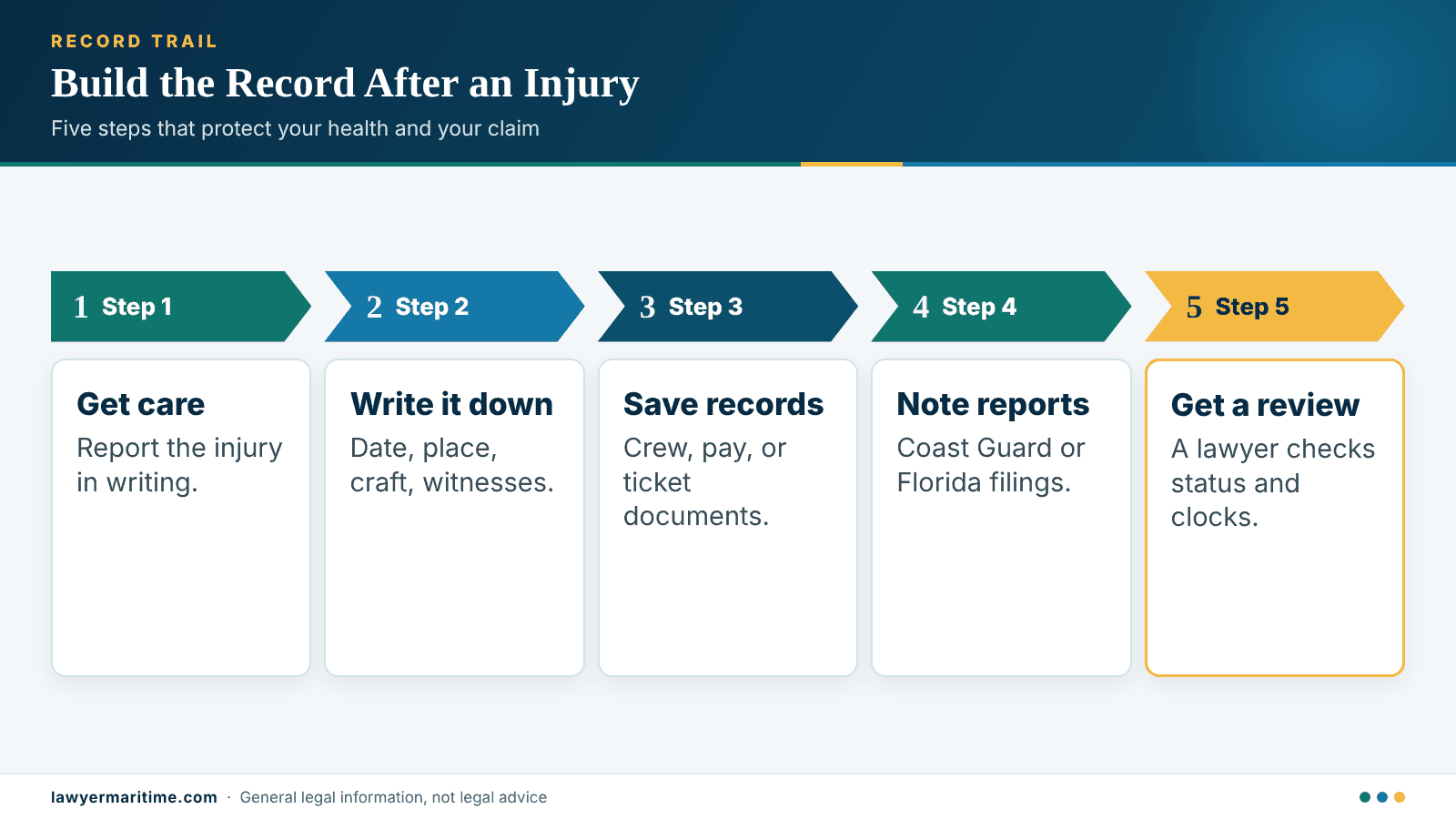
Which Deadlines Can Matter in a Miami Case?
Deadlines are where local and federal rules collide most sharply. Several clocks can run at once, and they can start on different dates and carry different consequences. The table below is a map of the main ones, not a calculator, because exceptions and the facts of each case can change the answer.
| Clock | Source | Caveat |
|---|---|---|
| Three years for many maritime injury and death suits | 46 U.S.C. § 30106; Jones Act suits borrow 45 U.S.C. § 56 | “Except as otherwise provided by law,” and claim-specific rules can differ |
| 30 days to give written notice of an LHWCA injury | 33 U.S.C. § 912(a) | Exceptions exist, including the employer’s knowledge and lack of prejudice |
| One year to file an LHWCA claim | 33 U.S.C. § 913(a) | Runs from the injury, or from when you knew or should have known it was work-related |
| Six months or more for cruise-ticket notice, one year or more for suit | 46 U.S.C. § 30526, plus the ticket terms | Applies to covered seagoing vessels; a ticket may not go below these floors, and exclusions exist |
| Two years for negligence under Florida law | Fla. Stat. § 95.11(5) | How it interacts with federal maritime law for a given claim is a question for counsel |
| 30 days to tell an employer about a Florida workers’ compensation injury | Fla. Stat. § 440.185(1) | Listed exceptions apply |
| Six months for an owner to file a limitation action | 46 U.S.C. § 30529 | Runs from written notice of a claim, and it is the owner’s clock, not yours |
What federal deadlines can apply?
Federal clocks come from different statutes depending on who you are and what you’re claiming. Starting with the federal ones gives you a baseline before adding Florida and contract periods.
The three-year maritime period and its limits
Section 30106 of Title 46 says that, except as otherwise provided by law, a civil action for damages for personal injury or death arising out of a maritime tort must be brought within three years after the cause of action arose. A seaman’s Jones Act claim incorporates the Federal Employers’ Liability Act, whose limitation provision, 45 U.S.C. § 56, also sets three years. Courts generally apply the same three-year period to Death on the High Seas Act claims, and our DOHSA claim deadline guide covers that timing.
Three years is a ceiling in many cases, not a target. Evidence fades, witnesses scatter, and ships change crews and ports long before a limitation period runs out. Waiting until the final months of a period also leaves little room for a procedural surprise, such as a removal fight or a challenge to your status.
LHWCA notice and claim periods
The LHWCA is much stricter. Section 912(a) calls for written notice of an injury to the employer and to the Department of Labor’s deputy commissioner within 30 days after the injury, or after you knew or should have known it was work-related. Section 913(a) bars compensation unless a claim is filed within one year of the injury or death, with the clock starting when you knew or should have known of the work connection. A failure to give notice isn’t a bar in listed situations, such as when the employer already knew of the injury or wasn’t prejudiced.
Those exceptions are not a plan. Giving written notice early, and keeping a copy, avoids a fight over what the employer knew. If you’re covered by the LHWCA, our maritime injury compensation guide explains what benefits the claim can lead to.
What Florida and contract deadlines can apply?
Florida and contract periods can be shorter than the federal ones, and they often come with paperwork requirements. They’re also the periods most likely to be missed, because they live in documents people don’t expect to matter.
Florida’s two-year period and why the label matters
Florida’s general limitation statute, section 95.11, lists “an action founded on negligence” and “an action for wrongful death” among actions to be brought within two years. A maritime claim brought in a Florida court still involves federal maritime law, and the federal three-year period applies to maritime torts in the terms section 30106 states. How the two interact in a particular case is a question for a Florida lawyer, who can also tell you whether a state-law claim exists alongside the maritime one.
The practical lesson is to avoid relying on whichever number looks longest. If the injury happened aboard a vessel on navigable water, a maritime lawyer should analyze it, and the safest approach is to treat the shortest candidate period as the working deadline until that analysis is done.
Ticket periods, limitation actions, and notice to employers
For cruise passengers, the ticket contract may require written notice of a claim within a stated period and suit within another. The federal floors in section 30526 are six months for notice and one year for suit on covered seagoing vessels, and some small passenger vessels get a two-year minimum. The statute also tolls the contractual notice period for minors, people who lack mental capacity, and wrongful-death claims until a representative is appointed or three years after the injury, whichever comes first.
Employers and vessel owners have clocks too, but they run differently. An owner’s six-month window to file a limitation action begins when the owner receives written notice of a claim. That means a demand letter can start a procedural clock for the other side, which is one reason to have counsel review any written claim notice before it goes out, while still meeting any notice deadline that applies to you. Florida’s workers’ compensation notice period in section 440.185(1) belongs to a different system, with its own 30-day rule, and applies only to injuries that fall under Chapter 440.
How Do You Evaluate a Maritime Injury Lawyer in Miami?
A search for a local lawyer produces many websites that sound alike. The useful questions are about substance: what the lawyer can verify, which forums the lawyer works in, and how the lawyer will handle the status and clock issues above. This section gives you a Florida-specific way to test claims without relying on any marketing language, including this site’s. For a broader selection framework, see our guide to choosing the best maritime lawyer.
| Question | Why it matters | What a grounded answer sounds like |
|---|---|---|
| Which category do you think I’m in, and why? | Status decides the remedies and the forum | Explains the legal test and what documents would support it |
| Do my ticket or crew agreement limit where or how I can sue? | Forum, arbitration, and notice clauses can narrow options early | Reads the document with you and identifies the specific clause |
| Where would you file, and what are the risks? | Federal court, Miami-Dade court, arbitration, and an LHWCA claim are different paths | Discusses removal, venue, and tradeoffs without guarantees |
| Which deadlines are you calendaring for me? | Short LHWCA, ticket, and Florida periods can pass early | Names specific clocks and says what facts could change them |
| Are you licensed in Florida and admitted to the court where my case may be filed? | Licensing and court admission govern who can appear | Gives a direct answer you can check against public records |
| How are fees and costs handled? | Fee terms should be clear before you commit | Provides terms in writing and explains who pays costs if there is no recovery |
How do Florida rules shape what lawyers can say about themselves?
Florida regulates lawyer advertising through Chapter 4, Subchapter 4-7 of the Rules Regulating The Florida Bar, and the Bar publishes checklists to help lawyers comply. Knowing the outline helps you spot claims that deserve a closer look.
What Florida’s advertising checklist prohibits
The Florida Bar’s checklist for ads such as print, internet, and sponsored social media says an ad must not be misleading or deceptive, and must not predict or guarantee success or specific results. It says past results must be objectively verifiable and must not omit material information or mislead. It also says comparisons or characterizations of a lawyer’s skills, experience, reputation, or record must be objectively verifiable, and it prohibits advertising in practice areas where the lawyer doesn’t practice. For quoted fees, the checklist calls for a disclosure of whether the client owes costs or expenses, including when an ad says no fee is owed unless there is a recovery.
The same checklist asks for the name of at least one lawyer or firm responsible for the ad and the city, town, or county of at least one bona fide office location. It treats a lawyer’s own website as a separate category with its own checklist, so don’t assume every rule applies identically to every page. The practical use for you is simple: a claim of guaranteed results, or a skyline photo with no stated office, is a reason to ask questions. ABA Model Rules 7.1 through 7.3 set a similar national baseline.
Board certification in Admiralty & Maritime Law
Florida is one of the states with a board-certification area for this field. The Florida Bar lists “Admiralty & Maritime Law” among its certification areas, with minimum standards in Rule 6-17 of the Rules Regulating The Florida Bar. Its page describes at least five years of law practice before applying, with at least 35 percent of that practice involving active participation in admiralty and maritime law in each of the three years before applying. It also describes at least 50 approved continuing legal education hours in the field in the prior three years, a peer review of character, ethics, and reputation, and a written examination.
Under the Bar’s advertising checklist, only board-certified lawyers may claim certification and only in the areas where they are certified. A certified lawyer must name the certifying organization and the area, and a law firm cannot claim certification. Claims of specialization or expertise must be objectively verifiable through certification, education, training, experience, or substantial involvement. Lack of certification doesn’t by itself mean a lawyer is unqualified, but a certification claim is one you can check with the Bar, and experience should be judged on the work a lawyer has actually done.
Does a lawyer need a Miami office to handle your claim?
Not necessarily, because federal maritime law is the same everywhere and many maritime clients are in transit, offshore, or in different states. What matters is whether the lawyer can appear in the court where your case belongs and whether you can communicate easily.
Service area and office facts to confirm yourself
This page is intentionally silent about where any firm is based or where it takes cases. When you contact any firm, ask where its lawyers are licensed, whether it has an office in Miami-Dade County or serves the area remotely, and which lawyer will actually handle your matter. Then check the answers yourself against the lawyer’s license record with The Florida Bar.
If an advertisement shows the Miami skyline or uses “Miami” in a business name, that tells you nothing by itself. Our guide to preparing for a maritime lawyer consultation lists what to bring to a first meeting, and our maritime law consultation guide covers what to expect from one.
Forum and Eleventh Circuit experience
Ask whether the lawyer regularly handles the kind of claim that fits your category, such as seaman claims, LHWCA claims, cruise-passenger claims, or recreational boating claims, and whether the lawyer has litigated in the Southern District of Florida or in Miami-Dade state court. Experience with Eleventh Circuit law on arbitration, forum clauses, and seaman status can influence how a case is framed from the start.
It also helps to ask how the lawyer would handle a cruise ticket’s forum clause or a crew arbitration agreement if one applies to you. A lawyer who has seen those documents before will usually describe the likely fight, the options, and the risks without promising how it ends. For the main categories of recovery you might discuss, see our maritime injury damages guide.
What Should You Do Now After a Miami-Area Injury?
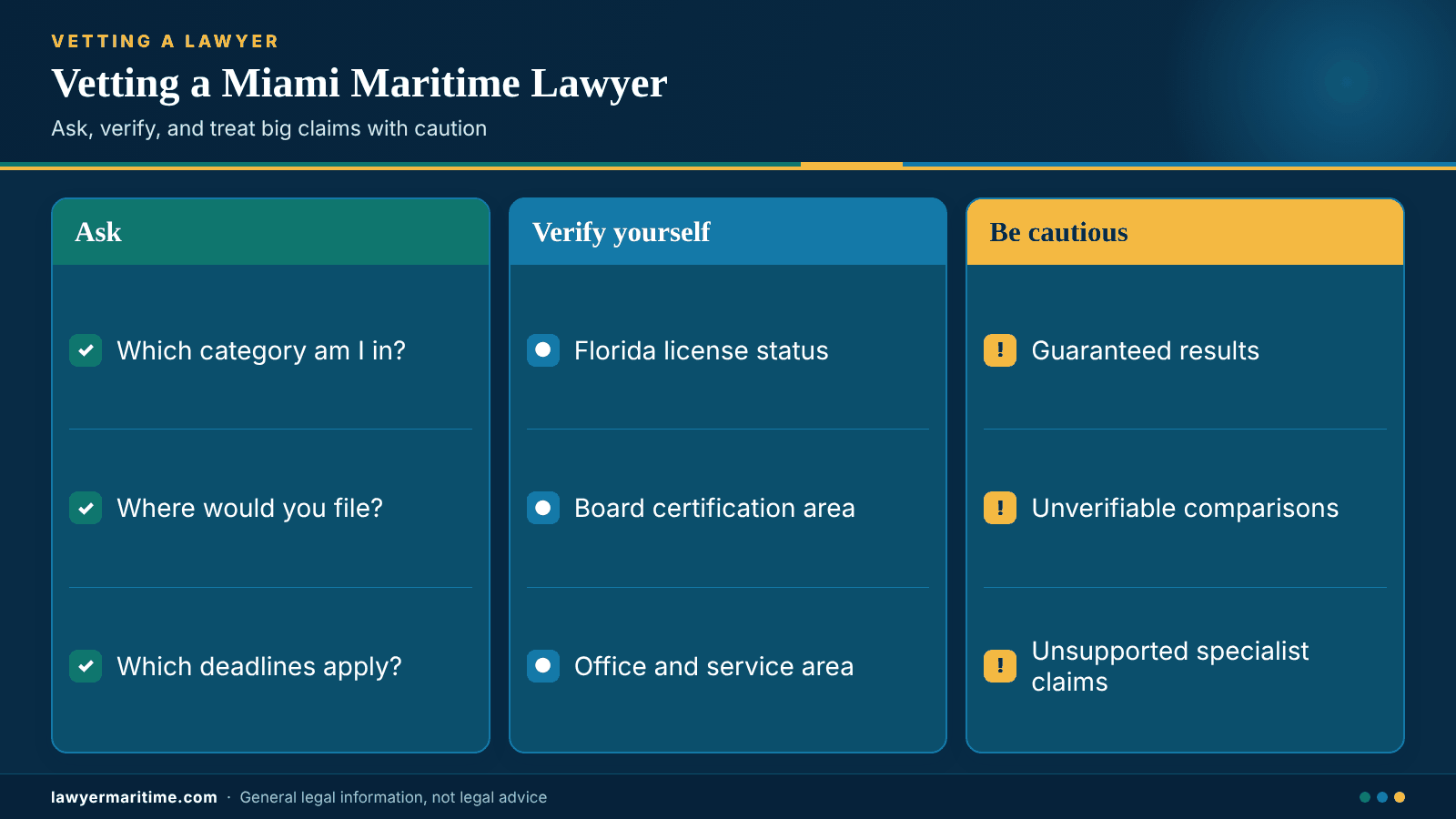
The first days after an injury shape both your health and your claim. The steps below are general and safe for most people, and they leave the legal decisions for a conversation with a lawyer who has your documents. If you’re a family member handling things for someone who can’t, the same steps apply.
What should you do in the first days?
Think in two tracks: protect your health, and protect your paper trail. Neither one should wait for the other.
Get care and report the injury in writing
- Get medical care. Tell the provider how the injury happened, even if you feel the symptoms are minor.
- Report in writing. Give your supervisor, captain, or the ship’s guest services a written report, and keep a copy or a photo of it.
- Ask what was reported. Find out whether a Coast Guard report or a Florida accident report was made, and who has the copy.
- Keep your documents. Save tickets, crew agreements, pay records, and messages in one place.
A written report matters because LHWCA and Florida workers’ compensation notice periods can be short, and a ticket may require written notice of a claim. For seamen, prompt medical treatment is also tied to maintenance and cure; see our maintenance and cure denial guide if a payment is refused or cut off.
Be careful with statements, forms, and early offers
Employers, insurers, and cruise lines often ask for statements, signatures, and releases soon after an incident. You can be courteous and cooperative while still asking to read anything before you sign. A recorded statement given before you understand your status or your injuries can be used later, so many people prefer to speak with a lawyer first.
A release can end a claim permanently. In Garrett v. Moore-McCormack Co., 317 U.S. 239 (1942), the Supreme Court held that the party relying on a seaman’s release must show it was executed freely, without deception or coercion, and with full understanding of the seaman’s rights. That protection helps seamen, but it’s no substitute for reading before signing. Our maritime settlement release guide explains what to look for.
What common mistakes cost people the most?
Most costly mistakes aren’t dramatic. They’re small delays and assumptions that compound over weeks.
| Mistake | Why it hurts | Better action |
|---|---|---|
| Waiting to report because the pain seems minor | Notice periods can pass, and the company can argue it never knew | Report in writing right away and keep a copy |
| Signing a form without reading it | It may be a release or a statement that limits your options | Ask for time to read it and to have a lawyer review it |
| Skipping the ticket or crew agreement | Forum, arbitration, and deadline clauses may already apply | Save the full document and give it to your lawyer |
| Posting about the incident on social media | Posts can be quoted back and used against the claim | Keep details private and talk to counsel instead |
| Assuming Florida or the ship line sets the rules | Federal maritime law, not the port, decides much of the claim | Ask which law and which court apply to your category |
Status and statement traps that are easy to miss
- Assuming your job title or your employer’s label settles whether you are a seaman.
- Giving a detailed recorded statement before you’ve seen your own medical records.
- Treating a friendly call from a claims representative as harmless small talk.
- Relying on a deadline you read about online without confirming that it applies to your category of claim.
The table above pairs the everyday mistakes with better steps, and the list adds the status and statement traps that are easier to miss. Each of these turns on timing and documents, which is why the earlier sections spend so long on both.
When it makes sense to speak with a maritime lawyer
It usually makes sense to speak with a lawyer when your injury is serious, when anyone asks you to sign something, when benefits are denied or stopped, or when you’re unsure which system covers you. The same is true if a death is involved, if a ticket or crew agreement limits where you can sue, or if the incident involved more than one company. For a first-principles overview of what a maritime lawyer does, see our maritime lawyer guide, and for a broader view of injury claims, our maritime personal injury lawyer guide.
Frequently Asked Questions
These answers are general. Your category, your facts, and the forum may change the result.
Local law and courts
Does Miami have its own maritime law?
No. Maritime injury rights come from federal statutes and federal maritime law, plus Eleventh Circuit decisions that bind federal courts in Florida. What differs locally is the setting: PortMiami, Port Everglades, the Miami River, the Southern District of Florida, Miami-Dade state courts, and Florida rules on matters such as state-law deadlines and lawyer advertising.
Can I file a Jones Act case in a Miami-Dade court?
A seaman may be able to, because the saving-to-suitors clause and the Jones Act’s incorporation of FELA allow suit in state or federal court, and a Jones Act case filed in state court is generally treated as nonremovable. A defendant may still argue that no real seaman claim exists, so forum choice should be reviewed by a lawyer. Our Jones Act attorney guide explains how seamen usually approach that choice.
Which federal court hears a case from Fort Lauderdale or Port Everglades?
It would generally be the Southern District of Florida, which holds court at Fort Lauderdale as well as Miami. Which courthouse a case is assigned to depends on venue rules and the district’s local rules, so a lawyer should confirm it.
Workers and status
Am I a seaman if I work on the Miami River or at PortMiami?
Not automatically. Seaman status turns on whether your duties contribute to a vessel’s mission and whether your connection to a vessel in navigation is substantial in duration and nature. Many shoreside jobs fall under the LHWCA or Florida workers’ compensation instead.
I repair yachts at a boatyard. Which law covers me?
It may be Florida workers’ compensation, because the LHWCA excludes people who repair recreational vessels when a state workers’ compensation law covers them. If your work includes commercial vessels, or you spend significant time aboard as crew, a different system may apply. Records of your assignments help answer that question.
Does it matter that my employer is based in Miami?
It can matter for practical reasons, such as where records are kept or where a defendant can be sued. It generally doesn’t decide which body of law governs your injury. That depends on your work, the craft or structure, and the place of the injury.
Passengers and boaters
Can a cruise line make me sue in Florida?
A ticket’s forum clause can be enforceable, as the Supreme Court held in Carnival Cruise Lines v. Shute, though courts review such clauses for fundamental fairness. Read the clause in your ticket and ask a lawyer whether it applies to your situation.
How long do I have to give notice of a cruise injury claim?
Federal law sets minimum periods for covered seagoing vessels: not less than six months for notice of a claim and not less than one year for suit, with listed exceptions. Your ticket may set specific periods, so read it right away instead of waiting.
Does maritime law apply if I was hurt on a rented pleasure boat?
It can. The Supreme Court held in Foremost Insurance Co. v. Richardson that a collision between two pleasure boats on navigable waters falls within federal admiralty jurisdiction. Whether the claim is a maritime tort in your case depends on the location and the facts.
Deadlines and lawyers
How long do I have to file a maritime injury claim in Florida?
There isn’t one universal answer. Many maritime tort suits have a three-year federal period under 46 U.S.C. § 30106, LHWCA notice and claim periods are much shorter, cruise tickets can set their own periods within federal limits, and Florida lists two years for negligence and wrongful death. A lawyer can identify the clocks that apply to you.
Do I need a lawyer with a Miami office?
Not necessarily. Federal maritime law is the same across the country, so the key questions are whether the lawyer is licensed in Florida, can appear in the right court, and has experience with your type of claim. Verify service area and office claims directly, since this page doesn’t make them for any firm.
Can a lawyer tell me what my case is worth at the first meeting?
A careful lawyer can explain the kinds of recovery that may apply and the factors that affect them. No honest lawyer can promise a result at the start. For the categories of recovery, see our maritime injury compensation guide, and for a wider look at hiring help, see our maritime law attorney guide.
Sources and Legal Authorities
The authorities below support the legal and local statements in this guide. Each should be checked against current text before you rely on it.
Statutes and regulations
Federal statutes and rules
- 46 U.S.C. § 30104 – Jones Act personal injury and death of a seaman
- 46 U.S.C. § 30106 – Time limit on maritime actions for personal injury or death
- 46 U.S.C. § 30302 – Death on the High Seas Act, application
- 46 U.S.C. § 30526 – Provisions requiring notice of claim or limiting time for bringing action and § 30527 – Provisions limiting liability for personal injury or death
- 46 U.S.C. § 30529 – Action by owner for limitation of liability
- 46 U.S.C. § 3507 – Passenger vessel security and safety requirements
- 46 U.S.C. § 6308 – Marine casualty investigation reports
- 49 U.S.C. § 1154 – NTSB reports and their use in civil actions
- 45 U.S.C. § 56 – FELA limitation of actions and venue
- 28 U.S.C. § 1333 – Admiralty jurisdiction and saving to suitors
- 28 U.S.C. § 1445 – Nonremovable actions
- 28 U.S.C. § 89 – Florida judicial districts and § 41 – Courts of appeals circuits
- 33 U.S.C. § 902 – LHWCA definitions, § 903 – coverage, § 905 – exclusiveness of liability, § 912 – notice of injury, and § 913 – filing of claims
Regulations and Florida law
- 46 CFR 4.05-1 – Notice of marine casualty
- 46 CFR 4.05-10 – Written report of marine casualty
- Florida Statutes § 95.11 – Limitations other than for the recovery of real property
- Florida Statutes § 327.301 – Written reports of vessel accidents
- Florida Statutes § 440.185 – Notice of injury or death; reports
Cases and agency materials
Supreme Court and federal appellate decisions
- Carnival Cruise Lines, Inc. v. Shute, 499 U.S. 585 (1991) – enforcement of a passage-ticket forum clause
- Foremost Insurance Co. v. Richardson, 457 U.S. 668 (1982) – admiralty jurisdiction over pleasure-boat collisions
- Yamaha Motor Corp. v. Calhoun, 516 U.S. 199 (1996) – state remedies in maritime wrongful-death cases involving nonseafarers
- Lewis v. Lewis & Clark Marine, Inc., 531 U.S. 438 (2001) – saving clause and limitation actions
- Garrett v. Moore-McCormack Co., 317 U.S. 239 (1942) – burden on shipowner regarding a seaman’s release
- Chandris, Inc. v. Latsis, 515 U.S. 347 (1995) – seaman status test and the 30 percent guideline
- McDermott International, Inc. v. Wilander, 498 U.S. 337 (1991) – contribution to a vessel’s function or mission
- Bautista v. Star Cruises, 396 F.3d 1289 (11th Cir. 2005) – arbitration of seafarers’ claims under the New York Convention (described from a published summary; no official link)
Agency and official local materials
- PortMiami – official port site
- PortMiami 2035 Master Plan – introduction
- Port Everglades – official port site
- Miami River Commission – marine industry planning document
- U.S. Coast Guard – Sector Miami
- U.S. Department of Labor – Longshore program contacts
- U.S. District Court, Southern District of Florida
- U.S. Court of Appeals for the Eleventh Circuit
- Eleventh Judicial Circuit of Florida