Jones Act mediation is a usually confidential, non-binding negotiation in which a neutral mediator helps an injured seaman and the employer’s side try to resolve a claim without a trial. In most cases the talks cover the three claims that travel together in a seaman injury case: negligence under the Jones Act (46 U.S.C. § 30104), unseaworthiness under general maritime law, and maintenance and cure. The mediator can’t decide who is right and can’t make anyone sign, but a well-prepared session can turn disputed medical, wage, and liability facts into a number and a set of written terms. This guide is for injured crew members, offshore and workboat workers, and family members who want to understand the process before they walk into it. It explains when mediation typically happens, who attends, how to prepare, how offers move, what a term sheet and release contain, and what follows if talks fail. A signed release can give up rights you may not get back, so the fine print matters as much as the number. For settlement value and release wording in depth, the page points you to our dedicated guides.
What Is Jones Act Mediation, and Why Do Seaman Injury Cases Use It?
Mediation is one of the few moments in a maritime injury case when everyone with real decision-making power sits down together with a single question: can this claim be resolved on terms both sides can live with? Before you can prepare for that conversation, you need to know who runs it, what they can and can’t do, and which claims are actually being negotiated. This section covers those basics.
What does a mediator actually do?
A facilitated negotiation, not a mini-trial
A mediator is a neutral person, often a retired judge or an experienced litigator, who helps the parties negotiate. The mediator doesn’t take sworn testimony, doesn’t rule on evidence, and doesn’t issue a judgment. Nothing becomes binding unless you and the other side agree to it.
That is the central difference from a trial or an arbitration. In a courtroom, a judge or jury decides who is right and the result binds everyone. In mediation, the only binding outcome is the one you sign, and if no agreement is reached the case simply keeps moving toward trial.
Because the outcome depends on agreement, the process works best when both sides arrive with real information. A mediator can only help negotiate the facts the parties bring: medical records, wage proof, accident reports, and a sober view of the risks.
Facilitative, evaluative, and everything in between
Mediators differ in style. A facilitative mediator mostly asks questions, carries messages, and helps each side hear the other. An evaluative mediator is more willing to offer opinions about the strengths and weaknesses of each position and may suggest where a deal could land.
Many maritime mediators blend the two. In private meetings, called caucuses, they often “reality-test” a position by asking how you would prove seaman status, how you would answer a comparative-fault argument, or what the jury will hear about a pre-existing condition. Those questions aren’t a ruling. They reflect what a person who has seen many similar disputes thinks each side may be missing.
Ask your lawyer in advance which style the mediator uses and how that mediator has handled seaman cases before. Knowing the style helps you separate pressure to settle from a genuinely useful assessment.
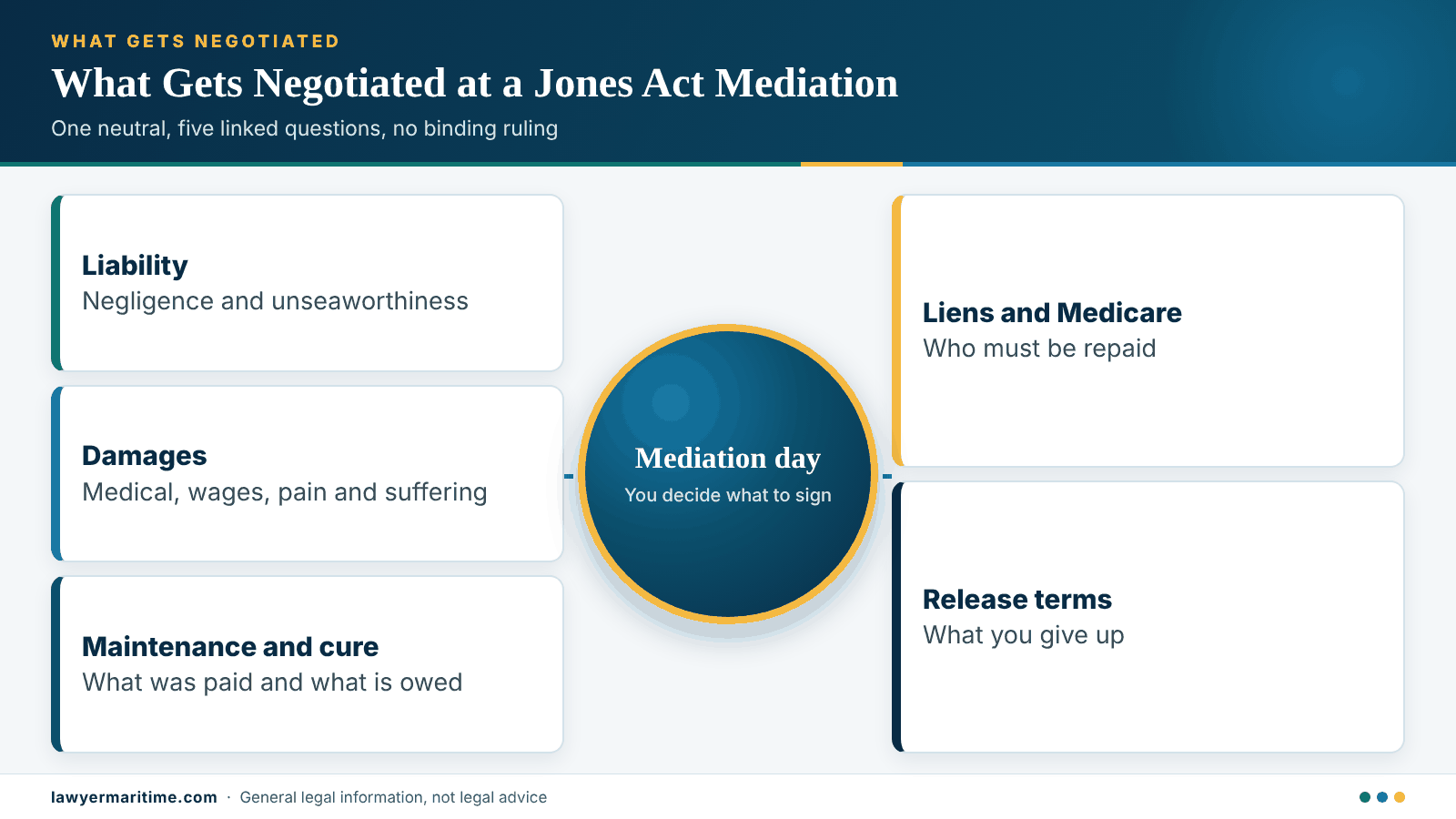
What is actually being negotiated in a seaman injury case?
Three claims that usually travel together
A seaman who is hurt in the service of a vessel can often assert several claims at once. The first is negligence against the employer under the Jones Act, 46 U.S.C. § 30104, which incorporates the Federal Employers’ Liability Act. Under that framework, a seaman’s own fault reduces damages in proportion rather than barring recovery, as 45 U.S.C. § 53 explains.
The second is unseaworthiness, a duty the vessel owner owes to provide a vessel and crew reasonably fit for their intended use, without regard to fault in the ordinary negligence sense. Our guide to the elements of an unseaworthiness claim covers that doctrine. The third is maintenance and cure: the employer’s obligation to pay for an injured seaman’s basic living costs (maintenance) and medical care (cure) while the seaman recovers, whether or not anyone was negligent.
Mediation usually takes all three claims together. A release that resolves one claim but leaves another open can create loose ends, so the parties generally negotiate the whole package, including the Jones Act claim itself.
Why both sides come to the table
For the seaman, a negotiated outcome offers certainty. A trial may be a long way off, medical bills and household costs continue, and a jury could find that the seaman was partly at fault or even that seaman status doesn’t apply. The seaman status test is a threshold question that can reshape the whole case.
For the employer and its insurer, mediation caps the cost of a defense and removes the risk of a jury reaction to a sympathetic plaintiff. If maintenance and cure payments have been late or denied, the employer also faces exposure beyond the underlying injury. The Supreme Court has recognized attorney’s fees for callous refusals in Vaughan v. Atkinson and punitive damages for willful failures in Atlantic Sounding Co. v. Townsend; our guide to punitive damages for maintenance and cure explains the limits.
Offers made while trying to compromise a claim generally can’t be used to prove or disprove the claim’s validity or amount, a rule found in Federal Rule of Evidence 408. That protection lets each side talk openly. Agreeing to mediate is not an admission and not a sign of weakness.
When Does Mediation Typically Happen in a Seaman Injury Case?
There is no single moment when a Jones Act case becomes “ready” for mediation. The right time depends on how stable the medical picture is, how much the parties have learned about each other’s evidence, and whether a court has set a deadline. This section walks through the common windows and explains how a mediation gets scheduled in the first place.
At what stage of the case does mediation usually happen?
Early or pre-suit sessions
Some employers and insurers propose mediation shortly after the injury, before a lawsuit is filed. The appeal is speed: both sides avoid litigation costs, and the seaman may get a resolution while bills and household pressures are fresh. Early sessions can make sense when the injury is relatively simple, the treatment is finished, and liability facts are not seriously disputed.
The drawback is uncertainty. If the seaman is still in treatment, nobody knows whether surgery will be needed, what permanent restrictions will apply, or whether a return to sea duty is realistic. A settlement reached before those answers arrive can underprice future care and lost earning capacity, because the release will often end maintenance and cure going forward.
After medical stabilization and discovery
Many practitioners see the middle of a case as the most productive window. By then the seaman has typically reached, or come close to, maximum medical improvement (MMI), the point at which treatment is expected to stop improving the condition. Our guide to maximum medical improvement and maintenance and cure explains why that milestone matters so much for both cure and valuation.
Discovery, the formal exchange of information in litigation, also tends to be well along. Written responses, records, an independent medical examination, and key depositions have usually been completed, as described in our Jones Act deposition guide. Each side can then assess the claim with something firmer than a pleading and a hunch.
On the eve of trial
Courts often schedule a settlement conference, or require a mediation report, as trial approaches. The pressure of an actual trial date focuses everyone. Expert fees, witness preparation, and the risk of an unpredictable verdict are all about to become real expenses and real uncertainty.
Late mediation has costs of its own. Both sides have already spent heavily, positions may have hardened, and the seaman has gone a long time without a resolution. For what a trial involves, see our guide to the Jones Act trial; for the full court sequence, see the Jones Act lawsuit process.
| Stage | What is usually known | Possible advantage | Possible drawback |
|---|---|---|---|
| Early or pre-suit | Initial treatment, basic accident facts, early wage loss | Speed, lower litigation cost, income relief sooner | Future care and permanency may be guesswork |
| After stabilization (near MMI) | Treating-physician opinions, work restrictions, cure paid to date | Medical future is easier to price | Months of waiting; benefits disputes may have grown |
| After discovery and key depositions | Records, testimony, independent medical examination, status evidence | Both sides see the real strengths and weaknesses | Legal costs already incurred; positions may be set |
| After expert disclosures and motions | Vocational and economic opinions, rulings on status or key issues | Rulings can narrow disputes and clarify risk | Late, expensive, and close to the trial calendar |
| Eve of trial or court-ordered conference | Nearly everything, plus a firm trial date | Deadline pressure focuses negotiation | Little room to prepare further; costs are mostly spent |
Is Jones Act mediation voluntary or court-ordered?
Voluntary mediation by agreement
Either side can propose mediation at any point, even before a case is filed. The parties pick a mediator, a date, and a place or video platform, then sign a mediation agreement that sets the rules for the day. That agreement typically covers confidentiality, the mediator’s fee, and whether anything said can be used later.
Mediator fees are commonly split between the sides, though the arrangement varies and is worth confirming. Your own lawyer’s fee agreement should separately explain how any costs advanced on your behalf are handled.
Court-ordered or court-encouraged mediation
In federal court, 28 U.S.C. § 652 requires each district court to adopt a local rule requiring litigants to consider alternative dispute resolution at a suitable point and to make at least one process available. A court that requires ADR in particular cases may mandate mediation or early neutral evaluation, but it can require arbitration only if the parties consent.
Federal Rule of Civil Procedure 16 adds a case-management layer. It lets a court consider settlement and special procedures at a pretrial conference where a statute or local rule authorizes them, and it permits the court to require a party or representative to attend or be reasonably available to discuss settlement. You can read the text in Rule 16. State courts have their own ADR statutes and local practices, so the mechanics differ by court.
Being ordered to mediate means showing up and taking part as the court’s rules require. It does not mean you must settle, and a mediator can’t require you to make or accept an offer.
Who Attends a Jones Act Mediation, and What Stays Confidential?
A mediation day has a cast of characters, and the person with the authority to say yes isn’t always the person sitting closest to you. This section explains who normally attends, how the mediator runs the session, and what “confidential” does and doesn’t protect.
Who sits at the table?
The seaman and the seaman’s lawyer
You attend, and so does your lawyer. Your lawyer presents the case, carries the negotiation, and explains each offer, but the decision whether to accept belongs to you. Lawyers’ professional-conduct rules generally leave the question of settlement with the client.
Expect to spend long stretches waiting while the mediator meets with the other side. Bring something to read, plan for a full day, and ask in advance whether family members may be present. You may be invited to speak in a joint session or you may not, and either way your lawyer can prepare you for what to expect.
The employer’s side
The employer is usually represented by defense counsel and a claims representative from its insurer. In vessel cases, that insurer is often a protection and indemnity (P&I) underwriter or club, though the arrangement depends on the employer. The claims representative matters because that person typically holds the settlement authority, meaning the right to commit money.
Authority is a practical question you should ask about beforehand. If the person who can approve a settlement is unavailable or capped at a figure below a realistic range, the day can stall. The mediation agreement or a court order may require a representative with authority to attend or be reachable.
Other parties sometimes join. A vessel owner that is separate from the employer, a contractor, or an equipment maker may be involved if the case has several defendants. Health insurers and other lienholders rarely attend, but their repayment claims still affect the numbers.
How does the mediator run the day?
Choosing the mediator
Mediators are selected by agreement or appointed by the court from a list. Parties often look for someone with maritime or personal-injury experience, a reputation for fairness to both sides, and a track record of helping stuck cases move. Cost, availability, and any conflict of interest are also factors.
Your lawyer should be able to tell you about the proposed mediator’s background and how that person has run sessions in the past. If you have concerns, raise them before the date is set rather than at the table.
The rhythm of a typical session
Most sessions follow a familiar pattern. The mediator may begin with a joint session where each side briefly states its view, though many mediators skip joint statements when the parties are far apart or emotions are raw. The sides then separate into private rooms, or video breakout rooms, and the mediator moves between them.
The rest of the day is a series of offers, counteroffers, questions, and reality checks. A session can last a few hours or most of a day, and some cases need a follow-up session. Many mediators also offer video sessions, which can matter if you live far from the venue or have mobility limits.
What stays confidential?
Where confidentiality comes from
No single rule governs every mediation. Protection usually comes from a combination of the written mediation agreement, court rules, state mediation statutes in state-court cases, and the evidence rule that limits use of compromise negotiations. In federal court, 28 U.S.C. § 652(d) requires each district court to adopt a local rule protecting the confidentiality of ADR processes and prohibiting disclosure of confidential dispute-resolution communications.
Read the mediation agreement before you sign it. It should say what the mediator may share between the rooms, whether statements can be used later, and whether the mediator can be called as a witness. This is a different subject from whether the final settlement terms must stay secret, which our guide on maritime settlement confidentiality addresses.
What confidentiality does not do
Confidentiality doesn’t make underlying facts disappear. Medical records, accident reports, and pay records can still be obtained from their ordinary sources in discovery. The evidence rule on compromise negotiations also contains exceptions, because evidence may be admitted for other purposes, such as showing a witness’s bias or prejudice.
Private caucus information is normally kept private unless you authorize the mediator to share it. Even so, say only what you are comfortable having used strategically. Final settlement papers may also have to be shared with a court or with a government payer such as Medicare where the law requires it, so confidentiality has practical limits.
How Should a Seaman Prepare for Mediation?
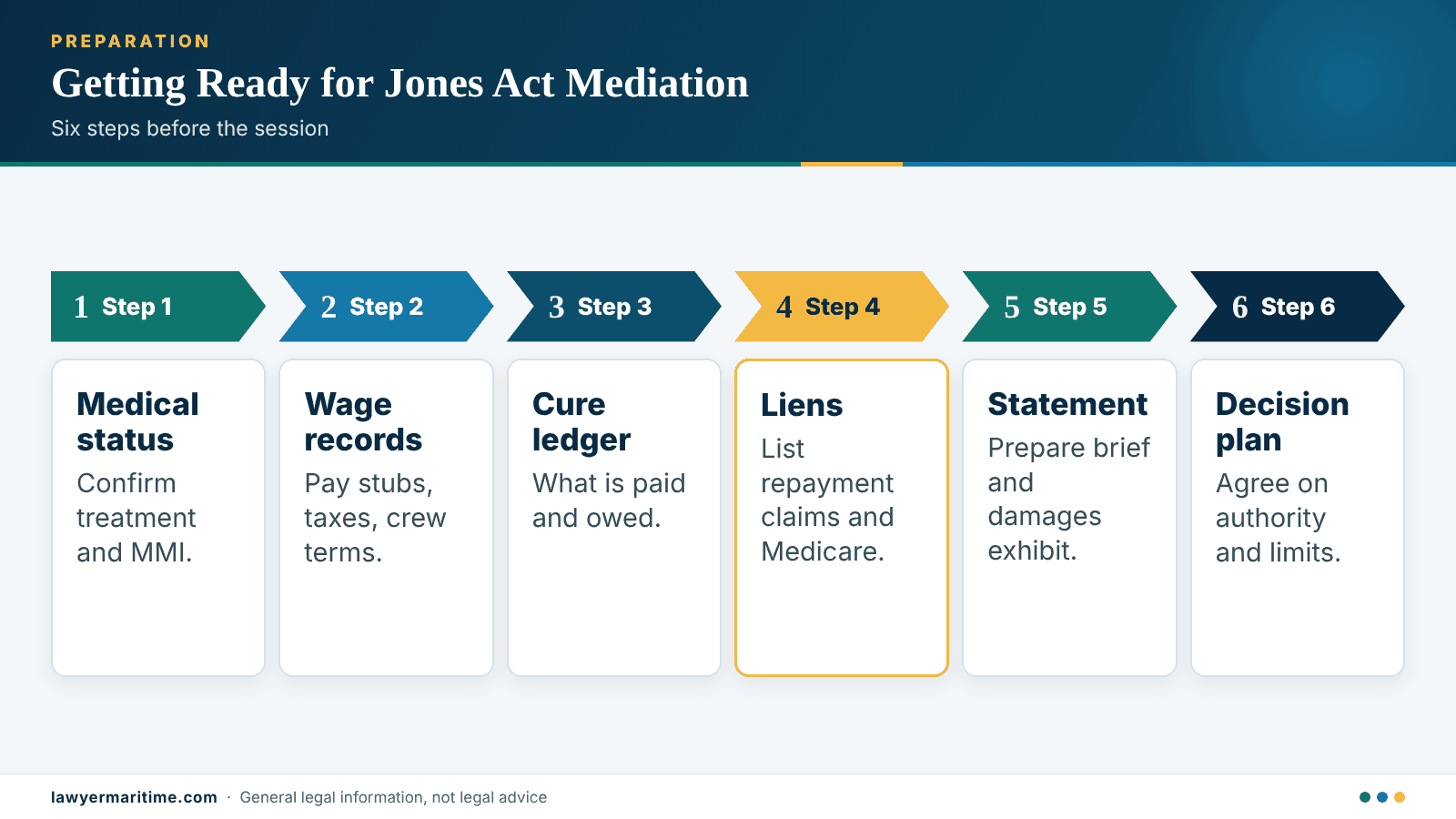
Mediation days move quickly, and the side with better organized proof usually negotiates from firmer ground. Preparation falls into two jobs: assembling the records that support each part of the claim, and deciding how to present the case and what you will accept. This section covers both.
Which records should be ready before the session?
Medical proof and MMI status
Start with the treatment record: diagnoses, imaging, operative reports, therapy notes, and the opinions of your treating doctors. A narrative report from the treating physician that explains the injury, the work restrictions, and any recommended future care is often more useful than a stack of raw chart pages. If a surgery or injection has been recommended but not yet done, say so, because it changes how the future-care component is priced.
Know where you stand on MMI. If the employer contends you’ve reached it, find out who made that call and on what basis, and whether an independent medical examination (IME) has been done. If you disagree, a second opinion may be worth discussing with your lawyer before mediation rather than after.
Wage and earning-capacity proof
Wage loss and loss of future earning capacity are often the largest damages questions for a seaman who can’t return to sea duty. Gather pay stubs, W-2 or 1099 forms, tax returns, crew agreements, day rates, hitch or rotation schedules, and any overtime or bonus history. Records from before and after the injury show what you earned and what you can still earn.
If your lawyer has retained a vocational expert or an economist, ask whether their work will be part of the mediation presentation. Expert opinions can help convert a general claim of lost earning capacity into a figure the other side has to respond to. Our guide to Jones Act damages describes the categories of loss that these records support.
The maintenance and cure ledger
Keep a running ledger of what the employer has paid and what remains unpaid. For maintenance, list the daily amounts paid, the dates covered, and any gaps. For cure, list unpaid medical bills, authorizations that were refused, and any treatment you’ve paid for yourself. Include denial or termination letters.
The ledger matters because unpaid benefits are both a debt and a negotiating factor. A seaman who was deprived of benefits through a willful refusal may have additional remedies, as discussed in our guides to denied maintenance and cure and terminated maintenance and cure. A clear ledger lets everyone see the cure balance, which is the amount of medical expense still owed, instead of arguing over it from memory.
| Item | Why it matters at mediation | Where it usually comes from |
|---|---|---|
| Treating-physician report and work restrictions | Supports permanency, future care, and fitness-for-duty arguments | Your doctors; your lawyer requests it |
| MMI status and any IME report | Frames cure, ongoing benefits, and how far the medical picture has settled | Treating doctors, employer-arranged examiner |
| Wage and tax records | Proves past wage loss and the baseline for earning capacity | Employer, payroll portals, tax returns |
| Maintenance and cure ledger | Shows what has been paid, what is owed, and any gaps | Your payment records; employer or insurer statements |
| Accident and incident reports | Supports liability and the unseaworthiness or negligence theory | Employer, vessel logs, witness statements, agency reports |
| Lien and repayment notices | Determines how much of any recovery is spoken for | Health insurer, hospital, Medicare or Medicaid, employer |
| Damages summary and exhibits | Turns separate records into one clear, organized presentation | Your lawyer and any retained experts |
How do you present your side and plan the decision?
The mediation statement and damages exhibit
Most mediators ask each side for a written statement before the session. It outlines the facts, the legal theories, the main damages, and the history of settlement talks. Some statements are shared with the other side, and others go only to the mediator, so ask which approach applies and write accordingly.
A damages exhibit is a visual summary of the claim, often a chart or table that sets out past medical expenses, future care, wage loss, earning capacity, and non-economic harm. It should be accurate, supported by records, and easy to follow. For how lawyers think about putting value on these components, see our guide to maritime injury case value.
Liens, authority, and a realistic risk map
Identify every lien before you walk in. A lien is a legal claim on settlement money by someone who paid for your care or benefits, such as a health insurer, a hospital, Medicare, or Medicaid. If you are on Medicare, or expect to be soon, tell your lawyer early, because Medicare has its own repayment rights.
Then talk through risk. A fair risk map covers the strongest points in the claim and the arguments the employer will press: a challenge to seaman status, comparative fault, or a claim that you concealed a pre-existing condition. In the Fifth Circuit, the McCorpen decision recognizes a defense to maintenance and cure for willful concealment of a known medical condition, and courts elsewhere may analyze the issue differently. Decide with your lawyer, in advance and in writing if possible, what outcomes would be acceptable and what questions you want answered before you say yes.
How Do Offers Move During Mediation?
The most nerve-racking part of mediation is watching numbers go back and forth without knowing what they mean. Offers carry signals, assumptions, and deductions that aren’t visible on the page. This section explains how the negotiation usually unfolds and how to read a figure once it’s on the table.
How does the negotiation unfold during the day?
Opening positions and the first moves
Opening numbers are usually far apart, and that gap is normal. A demand typically reflects a best-case view of liability and damages, while a first offer reflects the employer’s assessment of risk, its reserve, and how much it expects the numbers to move. A wide gap at 10 a.m. doesn’t predict how the day will end.
Each move sends a message. The size and speed of a counteroffer tell the mediator, and indirectly the other side, how serious a party is and how firmly it holds certain assumptions. A mediator who sees both sides’ private reasoning can often spot where a shared understanding is possible even when the numbers look distant.
Don’t treat the first offer as final, and don’t treat it as an insult to answer in kind. It is the opening line of a conversation that depends on information still to be exchanged.
Caucuses, messages, and mediator tools
In private caucuses the mediator asks what the next move would be and carries messages between rooms. The mediator may ask what facts would change your thinking, and may ask the other side the same question. Those answers often reveal which issue is really driving the dispute: a status argument, a disagreement about future surgery, or a lien that cuts into the net.
When talks slow down, mediators often use a few common tools. In bracketing, each side proposes a range tied to the other side’s movement. In a mediator’s proposal, the mediator suggests a figure to both sides, and each privately says yes or no, so a number becomes a deal only if both agree. Ask your lawyer which tools may be used and how the process protects your position if you say no.
How should you read an offer?
Risk discounting and comparative fault
Every offer is a guess about what a jury might do. The employer’s side discounts for the chance that it wins on seaman status or on a causation argument. It also discounts for the chance that a jury finds the seaman partly at fault, since under 45 U.S.C. § 53 a seaman’s own negligence reduces damages in proportion instead of barring recovery.
The same logic applies to your own side. If a trial could produce a larger verdict, it could also produce a smaller one, or none at all if the court finds that seaman status or another threshold issue fails. A fair offer isn’t a prediction of what a jury will award. It’s a negotiated price for uncertainty on both sides, and our Jones Act settlement guide describes how settlement terms and value interact in more detail.
From the headline number to the net
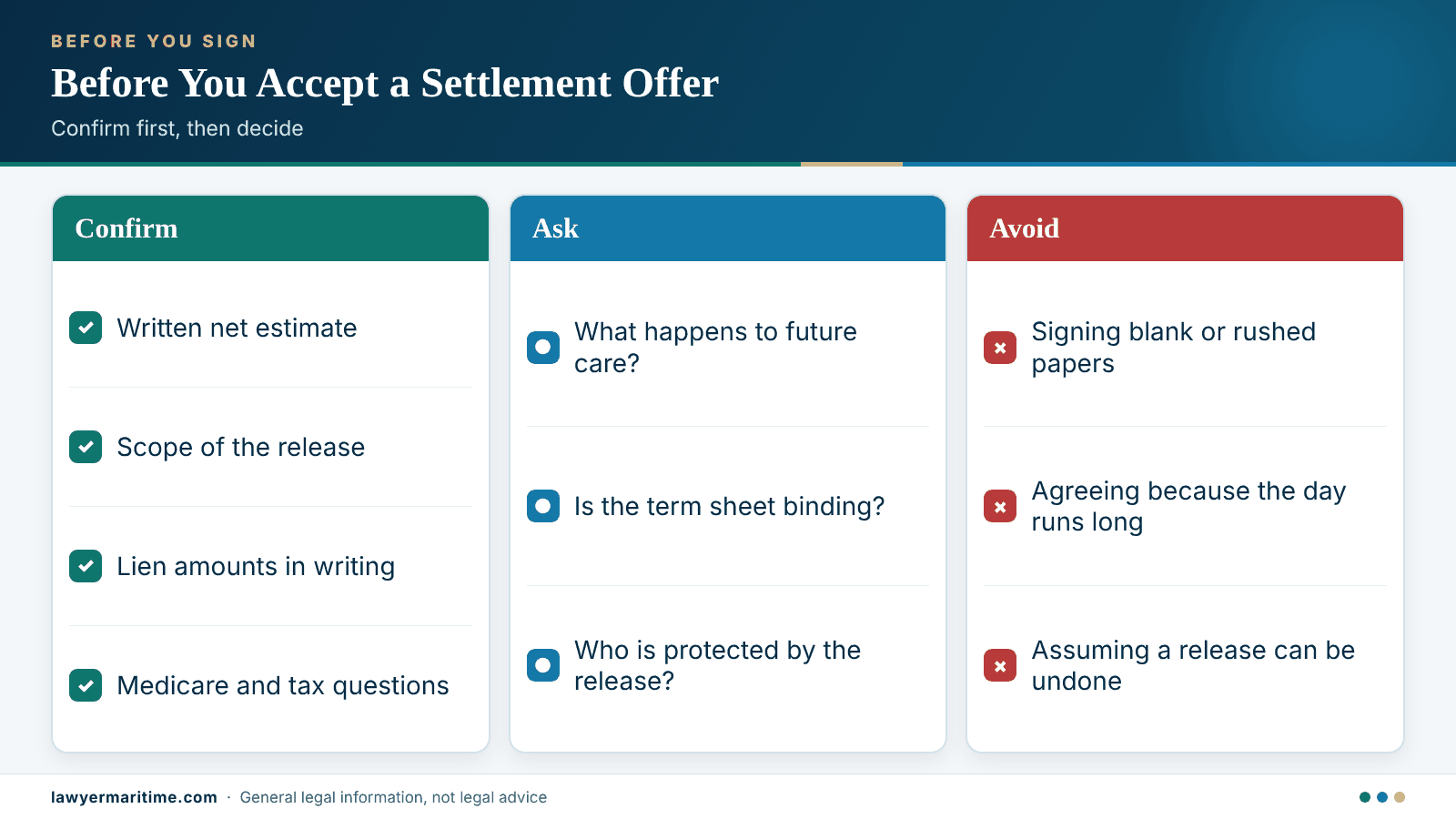
A settlement figure is a gross number. Before you reach the money you’d actually receive, several deductions may apply, and they are different in every case. Ask your lawyer for a written net estimate, sometimes called a net sheet, before you accept, and compare the net to what you need for your medical care, your household, and your future work plans.
The employer may also claim credit for certain payments. The Federal Employers’ Liability Act, incorporated by the Jones Act, allows an employer to subtract amounts it contributed to insurance or relief benefits paid for the same injury, under 45 U.S.C. § 55. How that rule applies to a particular payment is a legal question for your lawyer, not something to resolve at the table.
| Item | What it is | Question to ask |
|---|---|---|
| Attorney’s fee | The lawyer’s share, set by your written fee agreement | What percentage applies, and is it calculated before or after costs? |
| Case costs | Expenses advanced for experts, records, filing, and depositions | What is the itemized total, and who is repaid first? |
| Liens and repayment claims | Money owed to insurers, hospitals, Medicare, or Medicaid | Have the amounts been confirmed in writing, and can any be reduced? |
| Unpaid medical bills | Treatment bills not covered by cure or insurance | Are these paid from the settlement, and are they in the offer? |
| Employer credits | Payments the employer says should be subtracted | Is the credit legally justified, and is it already reflected in the offer? |
| Tax and payment form | Lump sum or structured payments, and how they are described | Has a tax adviser reviewed the settlement language before signing? |
What Do the Term Sheet and Release Look Like?
When both sides finally agree on a number, the mediation isn’t over. The agreement has to be written down, and the written terms decide what you’ve actually given up. This section is a plain-English look at the paperwork. For a deeper treatment of settlement terms and release language, see our guides to Jones Act settlements and maritime settlement releases.
What gets signed, and when?
The term sheet at the end of the day
If the parties reach agreement, the mediator or the lawyers usually write the main points on a short document before anyone leaves. A term sheet often covers the amount, the payment timing, who handles liens, the scope of the release, confidentiality, and the dismissal of any lawsuit. It is meant to capture the deal while everyone is in the room.
Ask a direct question before you sign: is this term sheet binding now, or only a summary until a formal release is signed? Mediation agreements and term sheets are drafted both ways, and the wording controls. Never sign a blank or partly filled document, and never agree to terms that you haven’t had time to read.
The formal release and the scrutiny courts apply
A fuller settlement agreement and release is usually drafted by the employer’s side in the days or weeks after mediation. A release is the document in which you give up claims in exchange for payment. For seamen, courts have long treated releases with special care. In Garrett v. Moore-McCormack Co., decided in 1942, the Supreme Court relied on the description of seamen as “wards of the admiralty” and held that a party relying on a seaman’s release must show that it was executed freely, without deception or coercion, and with full understanding of the seaman’s rights. The Court didn’t invalidate the release in that case; it sent the case back for further proceedings.
Garrett is a burden-of-proof rule, not a guarantee. Factors courts look at include whether the payment was adequate and what medical and legal advice the seaman had when signing. A seaman who has counsel, current medical information, and time to review the papers is generally in a stronger position to show that the release was informed. Don’t plan on undoing a signed release later; plan to understand it before you sign.
Which terms deserve a slow read?
Scope: what you give up and who is protected
Start with the list of released claims. A broad release may cover Jones Act negligence, unseaworthiness, maintenance and cure (past and future), and any other claim arising from the injury. Releasing future maintenance and cure is especially significant, because it ends a benefit that the employer would otherwise owe until maximum medical improvement.
Then check who is protected. A release might name only the employer and its insurer, or it might extend to vessel owners, managers, contractors, and “all other persons.” The more parties a release protects, the more claims you give up against people who may not be contributing to the settlement.
Also read how the document treats the unknown. Some releases cover injuries or conditions that haven’t yet appeared, which means a later complication would not be compensated. Ask your lawyer to explain each of these provisions in your own words.
Liens, Medicare, taxes, and other non-money terms
Most settlements require you to satisfy liens from the proceeds and to protect the paying party if a lienholder pursues it. Medicare is a special case. Under 42 U.S.C. § 1395y(b)(2), Medicare generally can’t pay for a service that liability insurance, including self-insurance, has paid or is expected to pay, though it may make conditional payments that must be reimbursed. A settlement can trigger a repayment obligation, and how future medical care and Medicare’s interests are addressed depends on the facts, so tell your lawyer early if you are a beneficiary or may become one.
Tax treatment needs a professional. Under 26 U.S.C. § 104(a)(2), damages received on account of personal physical injuries or physical sickness are generally excluded from gross income, but punitive damages are not, and emotional distress alone is not treated as a physical injury except for the cost of related medical care. Because settlement wording can matter, have a tax adviser review the documents before you sign.
Finally, scan the non-money terms: confidentiality, non-disparagement, whether you agree to resign or not seek re-employment, how and when payment is made, and whether payments are structured over time. A confidentiality clause may carry penalties if breached.
| Term | Plain-English meaning | Question to ask |
|---|---|---|
| Release of claims | You give up listed claims in exchange for payment | Which claims are released, including future maintenance and cure? |
| Released parties | The people and companies protected from future suits | Does it protect only the payer, or other parties too? |
| Lien indemnity | You promise to pay lienholders and protect the payer from their claims | Which liens exist, and what happens if one is larger than expected? |
| Medicare language | Statements about Medicare’s interests and future care | Am I a beneficiary or likely to become one, and what does this require? |
| Confidentiality and non-disparagement | Limits on what you may say about the case or the employer | What is covered, and what are the consequences of a breach? |
| Payment timing and form | When and how money is delivered, lump sum or structured | What is the deadline, and what tax advice do I need first? |
| Employment terms | Provisions about resignation, rehire, or future work | Do these terms affect my ability to work in my field? |
How Do Mediation, Trial, and Arbitration Compare?
Mediation is one route to resolving a seaman injury claim, and it helps to see it beside the alternatives. The differences come down to who decides, how much control you keep, and what happens if you don’t like the result. This section lays out those differences and then turns to the question that sits behind every mediation: should you settle?
How do the three paths differ?
Mediation versus a Jones Act trial
At trial, a judge or jury decides liability and damages, and the verdict binds both sides subject to post-trial motions and appeal. The proceeding is public, follows formal evidence rules, and can take a long time to reach. The outcome is out of the parties’ hands once testimony begins.
Mediation reverses most of those features. It is private, informal, usually quicker, and controlled by the parties. The tradeoff is that no one guarantees an outcome: a case that doesn’t settle goes back to the court’s calendar. For more on what a trial involves, see our Jones Act trial guide.
Where arbitration fits, and where it may not
Arbitration looks more like a private trial. A neutral arbitrator hears evidence and issues a decision that is usually binding. It typically arises from a contract, such as a crew agreement or a union collective bargaining agreement, or from an agreement the parties make after a dispute begins.
Whether an arbitration clause applies to a seaman’s injury claim is a contested legal question. The Federal Arbitration Act, in 9 U.S.C. § 1, excludes “contracts of employment of seamen, railroad employees, or any other class of workers engaged in foreign or interstate commerce” from the chapter, and courts have addressed how that exclusion interacts with clauses in crew agreements. Don’t assume a clause is enforceable or unenforceable. Ask a maritime lawyer to read the specific contract. In federal court-annexed ADR, 28 U.S.C. § 652 allows a court to require arbitration only if the parties consent.
| Feature | Mediation | Trial | Arbitration |
|---|---|---|---|
| Who decides | The parties, with a neutral’s help | Judge or jury | An arbitrator or panel |
| Binding result | Only if you sign an agreement | Yes, subject to appeal | Usually yes, with limited review |
| Privacy | Usually confidential | Generally public record | Often private, depending on rules |
| Formality | Informal; no testimony under oath | Formal rules of evidence and procedure | Less formal than trial, still adversarial |
| Control over outcome | High; you can say no | Low once the case is submitted | Low once the hearing begins |
| Source of authority | Agreement, court order, or local rule | Court jurisdiction and your chosen forum | A contract or later agreement; enforceability can be disputed |
How do you decide whether to settle?
Factors that tend to favor settlement
No formula answers this question, but several factors commonly point toward resolving the case. A medical picture that has stabilized makes future care easier to price. A genuine need for funds for treatment, household costs, or a career change makes certainty more valuable. A real risk on seaman status, comparative fault, or causation makes a guaranteed recovery more attractive than a trial.
The offer’s structure matters as much as its size. A deal that covers future medical needs, handles liens, and leaves you with a net figure you understand is different from one that only looks large on paper.
Factors that may favor continuing
Other factors may point toward continuing. If you’re not yet at MMI and surgery is still being considered, settling now may leave future care underfunded. If the employer has denied or cut off benefits without a sound basis, that conduct may increase its exposure and change the negotiating balance. And if an offer doesn’t account for lost earning capacity, it may not reflect how the injury affects your working life.
The decision is yours, not the mediator’s and not your lawyer’s. Ask for your lawyer’s advice in plain language, ask what happens if you say no, and take the time you need to think. Mediators may press for a decision that day, but a good deal usually still looks good after a night’s sleep.
What Happens If Mediation Fails, and Which Myths Mislead?
Not every mediation ends in a deal, and that’s not a sign that the case is lost or that the process was wasted. What matters is what happens next and which assumptions about mediation can lead a seaman astray. This section covers both.
What happens if no settlement is reached?
Impasse is not always the end of talks
Mediators describe an impasse as the point where neither side will move. It often reflects a gap in information, not a final answer. Cases sometimes settle in the weeks after a mediation, once a new deposition, a new medical report, or a ruling on a motion changes how each side sees the risk.
A mediator may follow up by phone, propose a second session, or float a figure to both sides after the day ends. Ask your lawyer whether the mediator will stay involved and what information would help the next round.
The case keeps moving, and so do the deadlines
If mediation ends without a deal, the case returns to its schedule: discovery, expert disclosures, motions, and trial, as outlined in our guide to the Jones Act lawsuit. Attending a mediation doesn’t by itself pause court deadlines or the time limit for filing suit unless a court order or a written tolling agreement says so.
The general maritime time limit in 46 U.S.C. § 30106 is three years for many personal injury claims, and the Federal Employers’ Liability Act has its own period under 45 U.S.C. § 56. Exceptions and contract-based rules may apply, so confirm your deadline with counsel; our guide to the Jones Act statute of limitations explains how those clocks work.
Maintenance and cure also doesn’t stop because talks fail. The duty generally continues until maximum medical improvement, and the warning signs of an improper cutoff are covered in our guide to terminated maintenance and cure.
Which myths about mediation cause problems?
Myths about the mediator and the process
One myth is that the mediator will decide who is right. A mediator has no authority to do that, and an opinion offered in a caucus is only an opinion. Another is that agreeing to mediate signals a weak case; in fact, both strong and weak cases mediate, because the process reduces risk and cost for everyone.
A third myth is that you must settle once you’re at the table. You don’t. A mediation that ends without a deal can be the right outcome when the offer doesn’t match the risk or the medical future is still unclear.
Myths about releases and confidentiality
People often assume that anything said at mediation is sealed forever, or that a signed release can always be undone because seamen are wards of admiralty. Neither is dependable. Confidentiality rules vary and have limits, and Garrett sets a burden of proof, not a promise that a court will undo a deal.
Another misconception is that a settlement only ends the lawsuit. In many cases it also ends ongoing maintenance and cure and claims against other parties, which is why the scope of the release deserves a close read.
| Myth | Reality | Practical takeaway |
|---|---|---|
| The mediator decides who wins. | The mediator facilitates and has no power to rule or impose terms. | Treat a mediator’s view as input, not a verdict. |
| Agreeing to mediate shows weakness. | Strong and weak claims both mediate to reduce cost and risk. | Say yes to a prepared session when the timing is right. |
| You must settle on mediation day. | You can decline an offer, and the case continues if no deal is reached. | Take time before accepting a deal you don’t understand. |
| Everything said is secret forever. | Rules vary, and underlying facts remain discoverable elsewhere. | Speak with your lawyer before you share anything sensitive. |
| A bad release can always be undone later. | Courts apply Garrett scrutiny, but relief isn’t automatic. | Read and understand the release before signing. |
| Settlement only ends the lawsuit. | It may also end maintenance and cure and other claims. | Confirm exactly which claims and parties are covered. |
What Should You Do Before, During, and After Mediation?
Everything above comes down to a handful of practical steps. This section turns the guidance into checklists you can take to a meeting with your lawyer. It is general information, so adapt it to your own facts with qualified advice.
What should you do before mediation day?
Questions to ask your lawyer
Walk through the process with your lawyer well before the date. The answers should leave you able to explain, in your own words, what you want and what you will accept.
- Who is the mediator, and what is that person’s approach to seaman cases?
- Is the mediation confidential, and what exactly does the mediation agreement say?
- Who will attend for the employer, and do they have full settlement authority?
- What are the strongest and weakest points of my claim, including seaman status and comparative fault?
- What liens exist, and have the amounts been confirmed in writing?
- What happens to my maintenance and cure if I settle, and if I don’t?
Organize your own records
Your lawyer will gather most of the proof, but you can help by keeping your own file in one place. A shared folder with dates and labels saves time at the table and reduces the risk that something important is missed.
- Medical bills, appointment notes, and work restriction letters
- Pay records, tax returns, and crew agreements
- Records of every maintenance and cure payment and any denial letter
- Letters or notices from health insurers, hospitals, or Medicare
- A list of questions you want answered before you decide
What should you do on the day and afterward?
On mediation day
Plan to be there for most of the day. Eat beforehand, bring your medications, and arrange transportation so you aren’t rushed. Bring any questions with you and ask them when you have time to hear the answers.
- Don’t sign a term sheet you haven’t read or that has blanks in it.
- Don’t agree to a number because the day is running long.
- Don’t discuss confidential mediation details outside the room, including on social media.
Before you sign, and after
Read the full release slowly, even if the term sheet seems simple. Confirm what it says about future maintenance and cure, liens, Medicare, taxes, and confidentiality. If a term doesn’t match what you understood at mediation, say so before signing.
After the settlement, keep copies of everything. Learn when payment is due and what happens to your benefits, and plan with your lawyer and a tax adviser for the funds, particularly if you may not return to your former work. If anything in the paperwork is unclear, ask first.
Frequently Asked Questions
These answers are general and don’t replace advice about your own claim. Facts, courts, and contracts can change the answer.
Questions about the process
Is mediation required in a Jones Act case?
Not always. Mediation can be voluntary, or a court may order or strongly encourage it under its local rules or case-management orders. Even when a court orders it, you aren’t required to reach a settlement, only to take part as the order or rules provide.
Do I have to attend in person?
Many mediators expect the injured party to attend because the person with the decision should be present. Some sessions are held by video, and arrangements can sometimes be made for travel or health limits. Ask your lawyer and the mediator well before the date.
Questions about money and cost
Does mediation cost me anything?
Mediators charge fees, and those fees are commonly shared among the parties, though the split varies and should be spelled out in the mediation agreement. Separately, your lawyer’s written fee agreement should explain how fees and case costs are handled. Ask for those terms in writing before the session.
Can I change my mind after the mediation ends?
It depends on what you signed. If a term sheet is expressly binding, backing out may be difficult. If it was only a summary pending a formal release, you might still have room to negotiate or decline, but do not assume so. After a final release, courts apply scrutiny to seamen’s releases under Garrett, yet relief is not automatic. Speak with your lawyer before you sign.
Questions about what comes next
Will settling end my maintenance and cure?
It can. A release often covers future maintenance and cure, which means the employer would no longer owe those benefits after the settlement. That is why the future-care component of an offer deserves close attention. See our guide to denied maintenance and cure if payments have been withheld.
What if the other side asks me to sign the release right away?
Take your time. A release is a legal document with lasting effects, and a reasonable counterpart should allow you and your lawyer to review it. If you feel rushed, ask for more time in writing, and consider asking a Jones Act lawyer to explain it before you decide.
Sources and Legal Authorities
The authorities below support the legal statements in this guide. Each link points to the page we read, and current text should be checked before you rely on it. For the broader legal setting, see our guide to maritime law.
Statutes and rules
Federal statutes
- 46 U.S.C. § 30104 – Jones Act personal injury and death of a seaman
- 46 U.S.C. § 30106 – Time limit on maritime actions for personal injury or death
- 45 U.S.C. § 53 – FELA contributory negligence and comparative fault
- 45 U.S.C. § 55 – FELA contracts and set-off and 45 U.S.C. § 56 – FELA limitation of actions
- 28 U.S.C. § 652 – Court-annexed alternative dispute resolution
- 9 U.S.C. § 1 – Federal Arbitration Act definitions and exclusions
- 42 U.S.C. § 1395y – Medicare Secondary Payer provisions
- 26 U.S.C. § 104 – Compensation for injuries or sickness
Court rules
- Federal Rule of Civil Procedure 16 – Pretrial conferences and scheduling
- Federal Rule of Evidence 408 – Compromise offers and negotiations
Cases and agency materials
Supreme Court and federal appellate decisions
- Garrett v. Moore-McCormack Co., 317 U.S. 239 (1942) – burden on the party relying on a seaman’s release
- Vaughan v. Atkinson, 369 U.S. 527 (1962) – attorney’s fees for callous refusal to pay maintenance and cure
- Atlantic Sounding Co. v. Townsend, 557 U.S. 404 (2009) – punitive damages for willful failure to pay maintenance and cure
- McCorpen v. Central Gulf Steamship Corp., 396 F.2d 547 (5th Cir. 1968) – willful concealment defense (cited from the site’s authority matrix; not separately fetched)