
A Jones Act deposition is sworn, recorded testimony that a party or witness gives outside the courtroom while a seaman’s injury lawsuit is in discovery. If you’ve sued your employer under the Jones Act, 46 U.S.C. § 30104, expect the defense lawyer to question you under oath, usually in a conference room or on a video call, with your own attorney beside you. In federal court the process runs mainly on Federal Rule of Civil Procedure 30, and the transcript can follow your case to summary judgment, mediation, and trial. A deposition is often the defense’s best chance to pin down your account, so preparation matters more than most injured workers expect. This guide explains who gets deposed, how depositions are scheduled, what you’ll be asked, how objections work, how the testimony is used later, and which mistakes cause the most damage. It is written for injured seamen and their families, and it uses the federal rules as its model. State courts and local rules can differ, so treat it as orientation rather than instructions for your own case.
What Is a Jones Act Deposition, and Where Does It Fit in a Case?
Most injured seamen have never testified under oath, so the first deposition notice can feel alarming. The process is more structured than it looks, and once you understand its purpose, the rules start to make sense. This section gets your bearings: what a deposition is, where it sits in a seaman’s lawsuit, and what it is not.
The basics of deposing a witness in federal court
Sworn testimony, recorded outside the courtroom
A deposition is a form of pretrial discovery in which a lawyer asks oral questions and the witness answers under oath. Federal Rule of Civil Procedure 30 lets a party depose “any person,” including another party, without asking the court first in most situations. Rule 28 requires an officer who is authorized to administer oaths, which in practice means a court reporter. The reporter swears the witness in and certifies that the transcript accurately records what was said.
The notice must say how the testimony will be recorded. Under Rule 30(b)(3), the choices are audio, audiovisual, or stenographic, and any other party may arrange an additional method after giving notice. A judge generally isn’t in the room. The lawyers, the witness, the reporter, and sometimes a videographer make up the room.
Discovery is broader than trial evidence. Rule 26(b)(1) lets parties seek nonprivileged information that is relevant to a claim or defense and proportional to the needs of the case, and the information doesn’t have to be admissible at trial to be discoverable. That is why deposition questions can range well beyond the moment you were hurt.
Where it fits in a seaman’s injury case
The Jones Act gives an injured seaman a civil action against the employer, with the right to a jury if the seaman chooses that route. The statute, 46 U.S.C. § 30104, also adopts the federal laws that govern recovery for injured railway employees, which is why Jones Act cases borrow so much from the Federal Employers’ Liability Act. A short clarification: this article is about the seaman’s injury remedy, not the separate cabotage rules in 46 U.S.C. § 55102 that restrict which vessels may carry cargo between U.S. points.
Discovery usually begins after the lawsuit is filed and the parties have conferred about how the case will proceed. Under Rule 26(d)(1), formal discovery generally cannot start before that conference. Depositions then sit alongside written questions, document requests, medical records, and sometimes a court-ordered medical examination. Our guide to the Jones Act lawsuit process walks through the full sequence, and this article zooms in on the deposition stage.
What a deposition is not
It is not a trial, even though it feels like one
You’ll be sworn, a lawyer will question you, and a transcript will be made. Those features can make a deposition feel like a courtroom, but there is no jury and usually no judge present. The setting is typically a law office conference room, an agreed location, or a video platform, and the questions come from lawyers rather than from the bench.
That difference creates a trap. Because the room is informal, some witnesses relax, joke, or speculate in ways they never would on a witness stand. The oath is the same, though, and the transcript can be read to a judge or jury later. The place where a case can quietly turn is often an offhand answer given at a conference table. For the courtroom version, see our guide to the Jones Act trial.
It is not a recorded statement or a casual interview
After an injury, an employer or its insurer may ask for a recorded statement, an incident report, or a conversation with an investigator. Those are informal, and they happen before a lawsuit exists. A deposition is formal: it comes with written notice, an oath, a certified record, and your own lawyer present to protect your rights.
The earlier statements don’t disappear, however. Defense lawyers often use them as roadmaps and ask whether your deposition account matches what you said weeks or months earlier. If you’ve already given a statement or signed a report, tell your lawyer exactly what you said and when.
Who Is Deposed in a Jones Act Case, and Why?
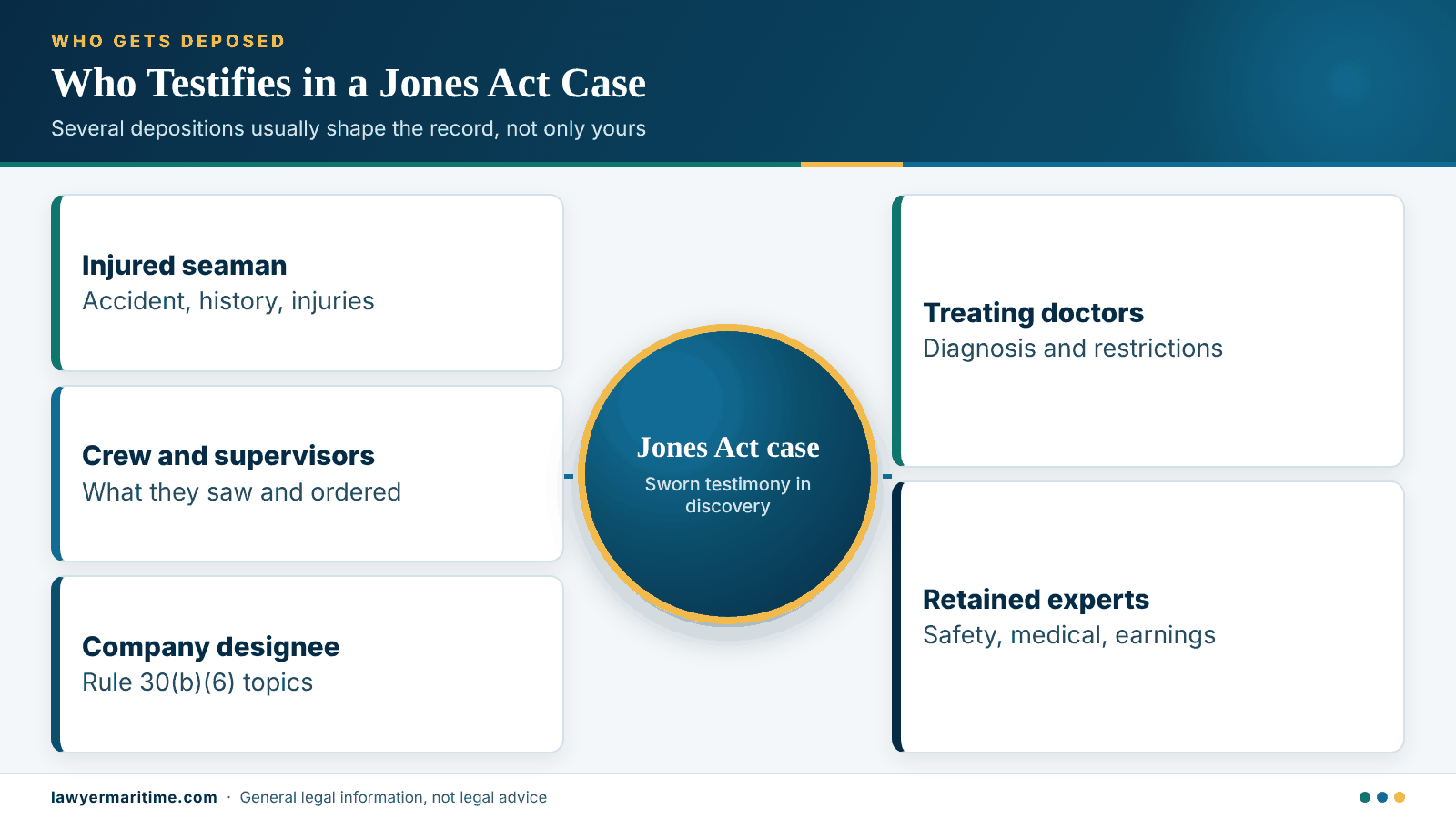
The seaman is the witness everyone thinks about, but a Jones Act case is usually built from several depositions. Each witness fills a different gap: what happened, what the company knew, what the injury means medically, and what the future may cost. The table below maps the usual cast before the sections that follow explain each role.
| Witness | Why the testimony matters | How the deposition is usually arranged |
|---|---|---|
| The injured seaman | Account of the accident, work history, injuries, treatment, and daily life afterward | Party deposition on written notice; no subpoena required |
| Shipmates and eyewitnesses | What they saw or heard, the condition of the work area, and what was said afterward | Agreed scheduling, or a subpoena for a nonparty who won’t cooperate |
| Captain, mate, and supervisors | Instructions given, staffing decisions, safety practices, and how the incident was handled | Notice or subpoena, often coordinated through the employer’s lawyer |
| Corporate representative | The company’s organized knowledge on topics such as policies, maintenance, training, and investigations | Rule 30(b)(6) notice describing the topics; the company chooses who testifies |
| Treating physicians | Diagnosis, cause of the condition, work restrictions, and outlook | Subpoena to a nonparty provider, scheduled around the doctor’s availability |
| Retained experts | Opinions on safety standards, medical causation, earnings loss, or future care | Deposed after the required report is served under Rule 26 |
The seaman as the central deponent
Why the defense will want your testimony
The employer’s lawyer can depose you without a subpoena, because you’re a party to the case. Rule 32(a)(3) allows an adverse party to use a party’s deposition “for any purpose” at a hearing or trial, subject to the evidence rules. In practical terms, your answers carry unusual weight. They aren’t just background; they can be read back as your own account.
The defense also uses the deposition to test your claim’s weak points. Those usually include whether you were a seaman, what caused the injury, whether you contributed to it, whether the injury is as serious as you say, and whether you’ve been honest about your history. Because a Jones Act recovery can be reduced in proportion to a seaman’s own fault under 45 U.S.C. § 53, questions about what you did and did not do aren’t random. They go to the percentage a jury might assign to you.
Time limits and second depositions
Absent a stipulation or court order, Rule 30(d)(1) limits a deposition to one day of seven hours. The court must allow more time when it’s needed for a fair examination, or when the witness or another circumstance impedes or delays the process. Parties sometimes agree to different arrangements, particularly when a witness has a complicated history or the deposition is split over two days.
A second deposition of the same person generally requires either the other side’s agreement or the court’s permission under Rule 30(a)(2)(A)(ii). That rule protects you from repeated questioning, but it isn’t an invitation to hold back. A seaman who gives incomplete answers may find that the defense gets leave to continue, and the delay can cost time and goodwill.
Crew members, supervisors, and the company itself
Shipmates, supervisors, and other fact witnesses
Crew members who saw the accident or the conditions around it are often the most important witnesses in the case. They can describe the deck, the equipment, the weather, the staffing, and how the work was really done, as opposed to how the written procedures say it should be done. They can also describe what the captain or supervisor said in the minutes after you were hurt.
Arrangements for a current employee often run through the employer’s lawyer. A witness who isn’t affiliated with a party generally has to be subpoenaed under Rule 45. For depositions, that subpoena can require attendance only within 100 miles of where the person lives, works, or regularly does business in person, and a party or party officer may be required to attend anywhere in the state where they live, work, or regularly do business. Mariners who have moved on to other vessels can be hard to locate, so early identification of witnesses matters.
The corporate representative under Rule 30(b)(6)
Sometimes the facts you need aren’t in any one person’s head. A party can name the company in a deposition notice and describe the topics “with reasonable particularity” under Rule 30(b)(6). The company must then designate one or more people to testify about information known or reasonably available to the organization, and both sides are expected to confer in good faith about the topics.
In a seaman’s case, those topics may include safety policies, vessel maintenance and inspection practices, crew staffing and training, the company’s investigation of the incident, and how it handled medical care and maintenance and cure. The designee testifies for the company, not as an individual, which makes the testimony useful when a company tries to disclaim what one supervisor said. The same Rule 32(a)(3) that applies to your deposition allows the adverse party to use a designee’s testimony for any purpose.
Doctors and experts
Treating physicians
The doctors who have examined and treated you often know your medical story better than anyone. Their depositions usually cover your history as they recorded it, diagnosis, the likely cause, what restrictions they imposed, whether surgery or future care is expected, and when they believe you may stop improving. That last point affects the end of maintenance and cure, so it connects to our explanation of maximum medical improvement.
Treating doctors are nonparties, so their depositions are typically arranged by agreement or subpoena. They are busy, and their schedules can control the calendar. What they wrote in your chart in the first weeks, including how you described the accident, often becomes an exhibit, which is one reason consistency matters.
Retained experts and the court-ordered medical examination
Each side may hire experts, such as a marine safety professional, a physician, a vocational specialist, or an economist. Under Rule 26(a)(2), a retained expert generally must provide a signed written report, and Rule 26(b)(4) allows the other side to depose an expert who may testify, after the report is served. Drafts of reports and most lawyer-expert communications are protected, with limited exceptions.
A medical examination is a different tool. Under Rule 35, a court may order a party whose physical condition is in controversy to be examined by a suitably licensed or certified examiner, but only on a motion that shows good cause. The examination is not a deposition, though the examiner’s report can be requested and the examiner may later be deposed or testify. Ask your lawyer to explain the difference before the appointment.
How Are Depositions Scheduled, and Can They Happen Remotely?
Depositions rarely arrive without warning, but the timing can still feel abrupt. Knowing how scheduling works helps you plan around treatment, work, and family obligations. It also helps you spot the moments when your lawyer should be negotiating the details.
Timing and notice
When depositions usually happen
Under Rule 26(d)(1), discovery generally cannot begin until the parties have held their discovery-planning conference, and depositions come after that point. Courts then set deadlines through a scheduling order. Within those deadlines, lawyers decide the order of depositions based on strategy, witness availability, and what documents they still need.
Seamen are frequently deposed after the lawyers have exchanged medical records and employment files. That sequence gives the defense something to ask about, and it gives your lawyer a chance to review the records with you first. If your treatment is ongoing, you and your lawyer may also discuss whether your deposition should wait until your condition is clearer. That is a strategy question without a single right answer.
What the notice must say
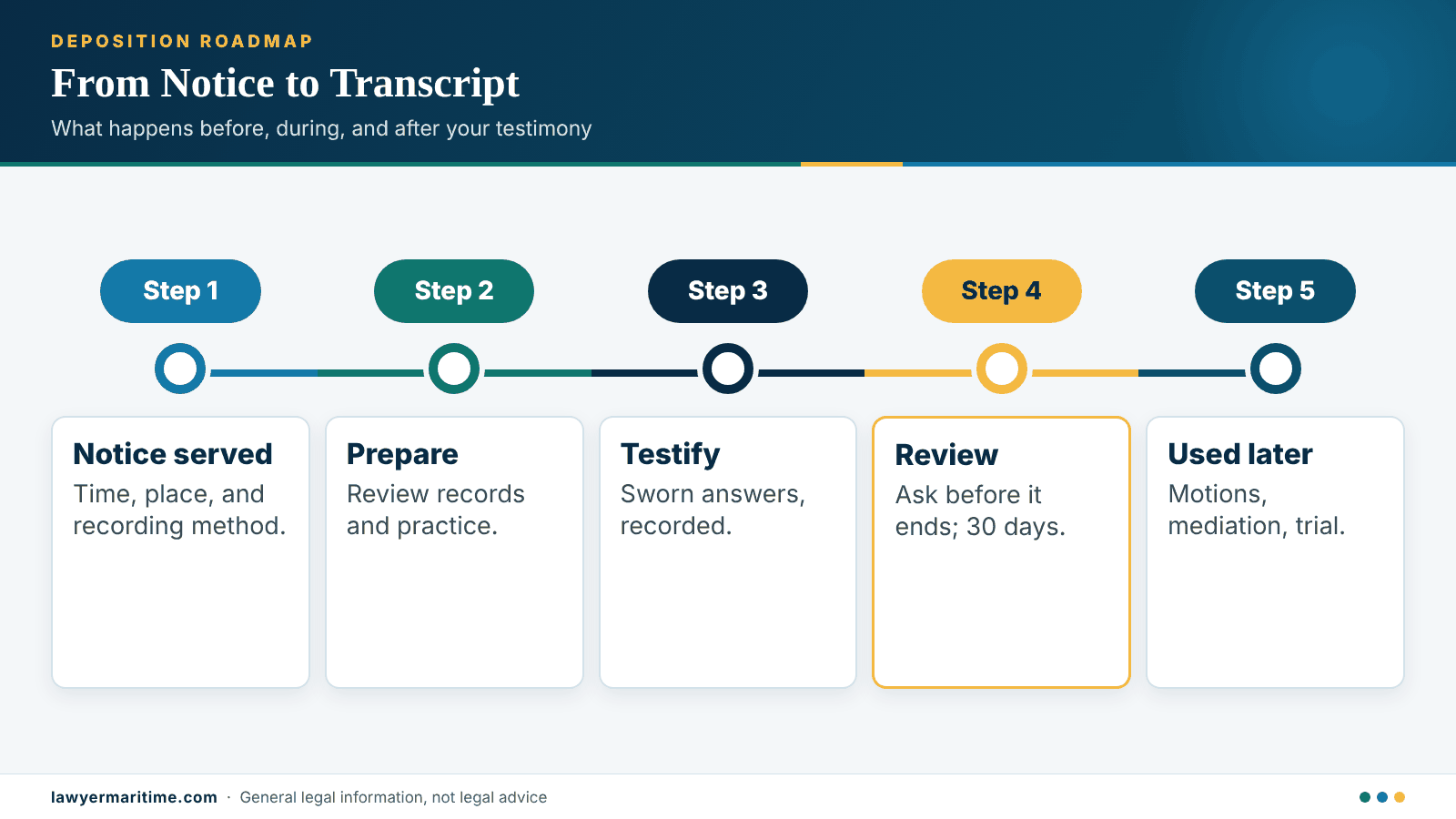
Rule 30(b)(1) requires “reasonable written notice” to every other party, stating the time and place and, if known, the deponent’s name and address. The notice must also state the recording method. A notice to a party can include a request to bring documents under Rule 34, and a subpoena to a nonparty must list the materials requested.
Read the notice carefully with your lawyer. It tells you whether the deposition will be videotaped, whether you’ve been asked to bring records, and whether the location is workable. If a date conflicts with a medical procedure or a work rotation, tell your lawyer right away, because rescheduling is usually easier when it’s requested early and politely.
Location, format, and remote testimony
Where a deposition takes place
The notice proposes a place, and the lawyers often agree on a location that works for the witness, the court reporter, and everyone else. Mariners who live far from the court or work offshore on rotation can complicate that choice. When the parties can’t agree, a court can resolve a dispute about the location or the burden of travel. Nonparties served with a subpoena are protected by the 100-mile limit in Rule 45(c)(1), described earlier.
Ask your lawyer where the deposition will be, who will be present, and how long it’s expected to last. Knowing those details removes some of the uncertainty, and uncertainty is what tends to raise anxiety.
Remote depositions by video
Under Rule 30(b)(4), the parties may stipulate, or the court may order on motion, that a deposition be taken by telephone or another remote means. For venue purposes, the deposition takes place where the witness answers the questions. Video platforms are common today, particularly when a witness is on a vessel, offshore rotation, or out of state.
Remote testimony has its own risks. Connections fail, exhibits are shared on screen, and it’s harder for your lawyer to read the room. Choose a quiet, private space with a stable connection, keep your phone silenced, and avoid having notes, messages, or people nearby that the other side could later ask about. The oath and the rules are the same as in person, and a recording of a remote deposition can be played later just like any other.
How Should an Injured Seaman Prepare to Testify?
Good preparation isn’t memorizing a script. It’s making sure you know your own records, understand the ground rules, and can say what you know clearly without adding anything you don’t. Lawyers cannot ethically coach a witness to say something untrue, and the strongest witnesses are usually the ones who stay close to the truth and to their own experience.
Work with your lawyer before the day arrives
Review your own records and prior statements
Start with the documents that tell the story in your own words or someone else’s. These typically include the incident report, any recorded or written statement, medical records, employment and training files, payroll records, and records of maintenance and cure payments. Your lawyer can usually obtain many of them in discovery, but you should read what you have already.
The goal isn’t to memorize dates. It’s to avoid being surprised by a document, and to notice where your memory differs from the paper. Tell your lawyer about any inconsistency before the deposition, not during it. A discrepancy that is explained in advance is far less damaging than one that the defense discovers first.
Practice questions and talk through the process
A practice session with your lawyer lets you hear the kind of questions you’ll face and feel the pace of the exchange. You can practice listening to a question fully, pausing, and answering in your own words. You can also rehearse how to ask for clarification, ask for a break, or ask to see a document.
Preparation meetings are usually protected by the attorney-client privilege, so you can be candid about weak points, prior injuries, or things you wish you had done differently. Those are exactly the topics you want your lawyer to know about early. Holding back from your own attorney is one of the most avoidable mistakes in a seaman’s case.
Ground rules for answering questions
Tell the truth, listen, and answer only what is asked
The first rule is simple: tell the truth, including when the truth is unhelpful. The second is to listen to the whole question before answering, because a partial answer to a half-heard question is how misunderstandings get into the record. The third is to answer the question that was asked and stop. Adding explanation can feel natural, but each extra sentence gives the other side a new topic to pursue.
Yes-or-no questions often deserve a yes or a no, followed by silence if no explanation was requested. If a question can’t fairly be answered yes or no, say so and give a short, accurate answer. Never guess. If you don’t know, say “I don’t know.” If you don’t remember, say “I don’t recall,” but only if that is actually true. A reasonable estimate, clearly labeled as an estimate, is different from a guess, and your lawyer can explain the difference during preparation.
Breaks, documents, and the video camera
You can ask for a break to use the restroom, rest, or take medication. Many lawyers prefer that you answer a pending question before a break begins, and conferring with your own lawyer during a break is common, though courts and local rules can differ on what’s allowed while a question is pending. Ask your lawyer how that will work.
When the other side hands you a document, read as much of it as you need before answering. It’s fine to say you don’t recognize it, or that you’d need to see the whole document. If the deposition is recorded on video, behave as if a jury might one day watch: sit upright, speak clearly, avoid sarcasm, and keep your temper. The recording captures tone and demeanor, and Rule 30(b)(5) prohibits recordings that distort anyone’s appearance or demeanor.
| Situation | A sound response | Why it helps |
|---|---|---|
| You don’t remember a detail | Say you don’t recall, but only if that is true; offer what you do remember if asked | Avoids invented details that can later be contradicted |
| The question is unclear | Ask the lawyer to rephrase or explain what a term means | Prevents you from answering a question that wasn’t asked |
| You are asked to estimate time, distance, or weight | Give your best honest estimate and label it as one | Separates a reasoned estimate from a guess |
| You are shown a document | Read it, ask for context, and say if you’ve never seen it | Keeps the record accurate about what you know |
| The question sounds improper | Pause and let your lawyer object; answer unless instructed otherwise | Preserves objections without turning the deposition into an argument |
| You realize an earlier answer was wrong | Say so as soon as you notice, or tell your lawyer at the next break | Correcting early looks honest and limits the harm |
| You are asked about talks with your lawyer | Wait for your lawyer to respond before answering | Protects the attorney-client privilege |
What Will You Be Asked About?
Few seamen expect how wide the questioning can run. Discovery reaches any nonprivileged matter that is relevant to a claim or defense and proportional to the needs of the case, so the defense may cover your whole working life, your medical history, and your life since the injury. The questions fall into predictable groups, which makes preparation possible.
Your background and history
Work history, training, and your connection to vessels
Expect questions about where you’ve worked, in what jobs, for how long, and why each job ended. The lawyer will ask about training, safety courses, any mariner credentials you hold, and your experience on the type of vessel involved. Those answers can show how experienced you were, what you knew about the hazard, and whether the employer trained you.
If your status as a seaman is disputed, these questions take on added weight. Courts applying Chandris, Inc. v. Latsis look at whether your duties contribute to a vessel’s function or mission and whether your connection to a vessel or identifiable fleet is substantial in duration and nature. Be ready to describe which vessels you worked on, for whom, and for roughly what share of your time. Our guide to the seaman status test explains the framework.
Prior injuries, claims, and medical history
The defense will ask about previous injuries, accidents, surgeries, workers’ compensation claims, lawsuits, and medical conditions, especially involving the same body part. That isn’t always an attack. A prior injury can change how much of your current condition the accident caused, and it can affect damages and the medical opinions on both sides.
Hiring paperwork is also a target. In the Fifth Circuit, a shipowner may defend against maintenance and cure by proving that a seaman intentionally concealed medical facts, that the facts were material to hiring, and that they connect to the injury at issue. That defense comes from McCorpen v. Central Gulf Steamship Corp., and other courts may treat the issue differently. If you filled out a pre-employment medical questionnaire, review it with your lawyer before you testify, and see our article on maintenance and cure denials for why these answers matter.
The accident and the vessel
Your account of what happened
The accident narrative is the center of the case, and the lawyer will walk through it slowly. Expect questions about the date and time, where you were, what task you were doing, who assigned it, what instructions you received, and what you noticed beforehand. Then the lawyer will ask what happened second by second, who saw it, what you said, what others said, and who you told afterward.
These questions often involve diagrams, photographs, or incident reports. If you made a written account earlier, the lawyer will compare it with your testimony. You aren’t expected to remember every detail perfectly, but you are expected to be consistent about the main facts and honest about what you remember and what you don’t.
Vessel conditions, staffing, training, and safety reports
To prove employer negligence, a seaman needs to show how the company or its employees fell short. So the lawyer for the defense, and your own lawyer when it’s your turn, will ask about equipment, lighting, deck conditions, weather, manning levels, rest hours, safety meetings, job hazard assessments, and complaints or near-miss reports. Your answers can set up or undercut claims of both negligence and unseaworthiness.
The defense will also probe your own conduct. Under 45 U.S.C. § 53, a seaman’s recovery may be reduced in proportion to the seaman’s own negligence. Questions about whether you followed procedures, used protective gear, asked for help, or knew of a safer method are aimed at that percentage. Answer them directly and without defensiveness; explanations about what you were told to do and the time pressure you faced belong in your answer when they’re true.
Your injuries, benefits, and life since the accident
Treatment, symptoms, and benefits received
Expect detailed questions about your treatment: which providers you’ve seen, when, what they recommended, whether you followed their advice, and how your symptoms have changed. The lawyer may ask about gaps in care and about any treatment you declined. If gaps exist, explain them honestly, including financial reasons or difficulty getting approval for care.
You may also be asked about benefits, including maintenance and cure payments, unemployment, disability, or other income. Those answers help the defense measure damages and check for inconsistencies. They are also an opportunity to document problems, such as late or inadequate maintenance. Our overview of maintenance payments for seamen explains what the payments are meant to cover.
Work, earnings, daily activities, and social media
To evaluate lost earnings, the defense will ask whether you’ve worked since the injury, searched for jobs, turned down work, or earned money in other ways. Expect questions about hobbies, exercise, travel, lifting, household tasks, and anything you did that seems inconsistent with your claimed limits. The aim is to compare your testimony with real life.
Social media is a frequent source. Posts, photographs, and messages can be requested in discovery, and a lawyer may ask you about specific ones. Do not delete anything once a claim is likely, because destroying relevant material can create serious problems of its own. Ask your lawyer what to preserve, and be careful about posting anything new about your health, activities, or the case.
| Topic area | What the questions are trying to establish | How to prepare |
|---|---|---|
| Work history and training | Experience, hazard awareness, employer training, and facts bearing on seaman status | Build a dated list of jobs, vessels, and courses; bring it to your lawyer |
| Prior injuries and medical history | Cause of current symptoms, pre-existing conditions, and accuracy of hiring paperwork | Gather records, review any pre-employment questionnaire, and disclose everything to your lawyer |
| The accident | Sequence of events, witnesses, instructions, and your own conduct | Review incident reports and statements; separate what you saw from what you were told |
| Vessel conditions and safety | Equipment, staffing, training, safety practices, and prior complaints | Recall specific conditions and who knew about them; avoid generalizations you can’t support |
| Treatment and benefits | Medical course, compliance with care, and payments received | List providers, dates, and any gaps; keep records of every payment and denial |
| Work, earnings, and activities | Lost earnings, mitigation efforts, and daily capabilities | Document job searches and limitations; preserve, don’t alter, social media |
What Do Lawyers, Objections, and the Transcript Do?
A deposition has its own rhythm, and much of it is invisible to a witness who has never sat through one. Lawyers object, the reporter types, the video runs, and afterward a transcript goes through certification and sometimes review. Understanding those steps helps you stay calm when a lawyer interrupts or when a question seems to go nowhere.
The role of your own attorney
Objections: noted on the record, but you usually still answer
Under Rule 30(c)(2), objections are noted on the record and the examination continues, and the testimony is taken subject to the objection. A judge rules on the objection later if it matters, such as when the testimony is offered at a hearing or trial. Objections must be concise, nonargumentative, and nonsuggestive, so a lawyer may not use them to coach a witness toward a particular answer.
The result is a pattern witnesses find odd: the lawyer says “objection, form,” pauses, and then you answer anyway. Your lawyer will usually tell you in advance when you should pause to allow an objection and when you can answer. If your lawyer instructs you not to answer, follow the instruction and let the lawyers sort it out.
| Objection | What it usually signals | What the witness generally does |
|---|---|---|
| Form | The question may be confusing, compound, leading, or otherwise worded in a way that can be fixed | Pause, then answer unless instructed otherwise; ask for rephrasing if you’re unsure |
| Foundation or speculation | The question may assume facts not yet established or ask you to guess | Answer only what you know; say so if you would be guessing |
| Asked and answered | The lawyer thinks the question repeats an earlier one | Usually answer again, consistently, unless instructed otherwise |
| Relevance or scope | The lawyer disputes that the topic is a proper subject of discovery | Usually answer, because the court can rule later |
| Privilege and instruction not to answer | The question may call for protected communications | Do not answer if instructed; the lawyers can address it with the court |
Privilege and the limits on instructing a witness not to answer
Rule 30(c)(2) allows a lawyer to instruct a witness not to answer only when necessary to preserve a privilege, to enforce a limit ordered by the court, or to present a motion to terminate or limit the deposition under Rule 30(d)(3). Relevance objections do not, by themselves, justify refusing to answer. That narrow list is deliberate, because a deposition would stall if lawyers could withhold testimony whenever they disagreed about a question.
The most common privilege issue is the conversation between you and your lawyer. Those communications are generally protected, so the defense may ask whether you met with your lawyer, how long you met, and what documents you reviewed, but it generally cannot ask what the two of you said. Let your lawyer handle those questions, and be careful about discussing your testimony with anyone else, since those conversations may not be protected.
Video, transcript review, and corrections
How video changes the deposition
A video deposition records more than words. It preserves tone, hesitation, facial expressions, and body language, and a lawyer may later play clips for a mediator, a judge, or a jury. Rule 30(b)(3) lets the noticing party choose audiovisual recording, and other parties can arrange their own additional record.
Video can help an honest witness, because sincerity comes across on screen. It can hurt a witness who snaps, shrugs, or argues. Practice with your lawyer beforehand if you’ve never been recorded, and keep the same calm tone from the first question to the last, including late in the afternoon when you’re tired.
Reading the transcript and submitting corrections
Rule 30(e) gives a deponent a limited right to review. If the witness or a party asks before the deposition is completed, the witness has 30 days after being notified that the transcript or recording is available to review it. If the witness wants to change the form or substance of an answer, the witness signs a statement listing the changes and the reasons for them.
That right is easy to lose, because the request must be made before the deposition ends, so ask your lawyer to make it on the record. Typo and spelling corrections are routine. Substantive changes are riskier, since courts differ on how much change they will accept, and the original answers generally remain part of the record. The best correction is the one you never need because you answered carefully the first time.
When a deposition goes off track
Improper conduct and motions to stop or limit
Occasionally a deposition becomes harassing, repetitive, or abusive. Rule 30(d)(3) lets the witness or a party move to terminate or limit the deposition if it’s conducted in bad faith or in a way that unreasonably annoys, embarrasses, or oppresses the witness, and the deposition can pause while the court considers the motion. Rule 30(d)(2) also lets the court sanction a person who impedes, delays, or frustrates a fair examination.
These motions are unusual, and most depositions are routine, if tiring. If you feel the questioning has crossed a line, say so to your lawyer at a break. Don’t walk out or argue with the questioner on your own, because the decision to seek relief belongs to your counsel.
Failing to appear
If a party who has received proper notice doesn’t show up for a deposition, Rule 37(d) allows the court to impose sanctions, which range from an award of expenses to more serious orders that can affect the claim itself. A genuine emergency is a different matter, but the safe course is to tell your lawyer at once about any illness, travel problem, or conflict. The lawyers can often agree on a new date, or ask the court to approve one, before anything goes wrong.
A witness who isn’t a party and who is served with a valid subpoena has similar obligations. Neither side benefits from a missed deposition, since the delay adds cost and gives the other side an argument that you’re avoiding the case.
How Is Deposition Testimony Used Later in a Jones Act Case?
A deposition is not only a way to learn facts. It’s also a way to capture testimony in a form that a court can use. The same transcript may appear in a motion, a mediation brief, and a trial cross-examination, each time with a slightly different purpose.
Before trial
Summary judgment motions
A party may ask the court for summary judgment under Rule 56. The court grants it only when the movant shows there is no genuine dispute as to any material fact and that it is entitled to judgment as a matter of law. Under Rule 56(c)(1), parties support their positions by citing materials in the record, and depositions are one of the main sources.
In a seaman’s case, the defense may use your testimony to argue that you weren’t a seaman, that the structure wasn’t a vessel, that the injury wasn’t caused by any negligence, or that a particular claim lacks proof. Your lawyer, in turn, can cite deposition testimony from crew members and the company to show that the facts are genuinely disputed. Summary judgment is one reason depositions matter even in cases that will likely settle.
Mediation and settlement discussions
Most civil cases resolve before trial, and deposition transcripts shape those negotiations. Both sides use testimony to judge how a witness will come across, which facts are undisputed, and where risk lies. A strong deposition can make a seaman’s account credible. A poor one can lower the value the defense assigns to the case.
That connection is practical, not mysterious. Insurers and defense counsel read transcripts to estimate how a jury might react. For how that process works, see our guides to Jones Act mediation and Jones Act settlements, and be careful with any proposed release, as explained in our article on maritime settlement releases.
At trial
Impeachment and admissions
If you testify at trial in a way that conflicts with your deposition, the other side can use the deposition to contradict or impeach you under Rule 32(a)(2). Separately, a statement offered against a party that the party made is not hearsay under Federal Rule of Evidence 801(d)(2)(A), and Rule 32(a)(3) allows an adverse party to use your deposition for any purpose. A prior inconsistent statement given under oath in a deposition can also fall outside the hearsay rule in the circumstances described in Rule 801(d)(1)(A).
The practical lesson is that your deposition answers follow you to the courtroom. Under Federal Rule of Evidence 613, a lawyer who questions a witness about an earlier statement doesn’t have to show it to the witness first, although opposing counsel can ask to see it. Unlike a deposition, live trial testimony is heard by a judge who rules on objections as they arise, and a witness can’t revise it afterward. For the courtroom phase, see our guide to the Jones Act trial.
When a witness cannot appear live
Witnesses sometimes can’t attend trial. Under Rule 32(a)(4), a party may use a witness’s deposition for any purpose when the court finds the witness is dead, is more than 100 miles from the trial or outside the United States (unless the party offering the testimony procured the absence), can’t attend because of age, illness, infirmity, or imprisonment, or can’t be compelled by subpoena. A court can also allow it in exceptional circumstances.
This is why lawyers often record doctors and other key witnesses on video. A treating physician’s schedule may make live testimony difficult, and a well-prepared video deposition may be shown instead. The testimony still has to be admissible under the evidence rules, and the other side has the chance to cross-examine at the deposition.
| Stage | How the testimony is used | Practical implication for the seaman |
|---|---|---|
| Discovery | Learning facts, locking in accounts, and identifying documents and further witnesses | Complete, accurate answers reduce the chance of a second round |
| Summary judgment | Citing testimony to show facts are, or are not, genuinely disputed | Your words may be quoted to challenge status, causation, or damages |
| Mediation and settlement | Gauging credibility, consistency, and the strengths of each side’s proof | Consistent, credible testimony generally supports a stronger negotiating position |
| Trial cross-examination | Contradicting or impeaching the witness with earlier answers | Differences between deposition and trial testimony must be explainable |
| Unavailable witness | Reading or playing the deposition in place of live testimony | Every key deposition may be the only testimony the jury hears from that person |
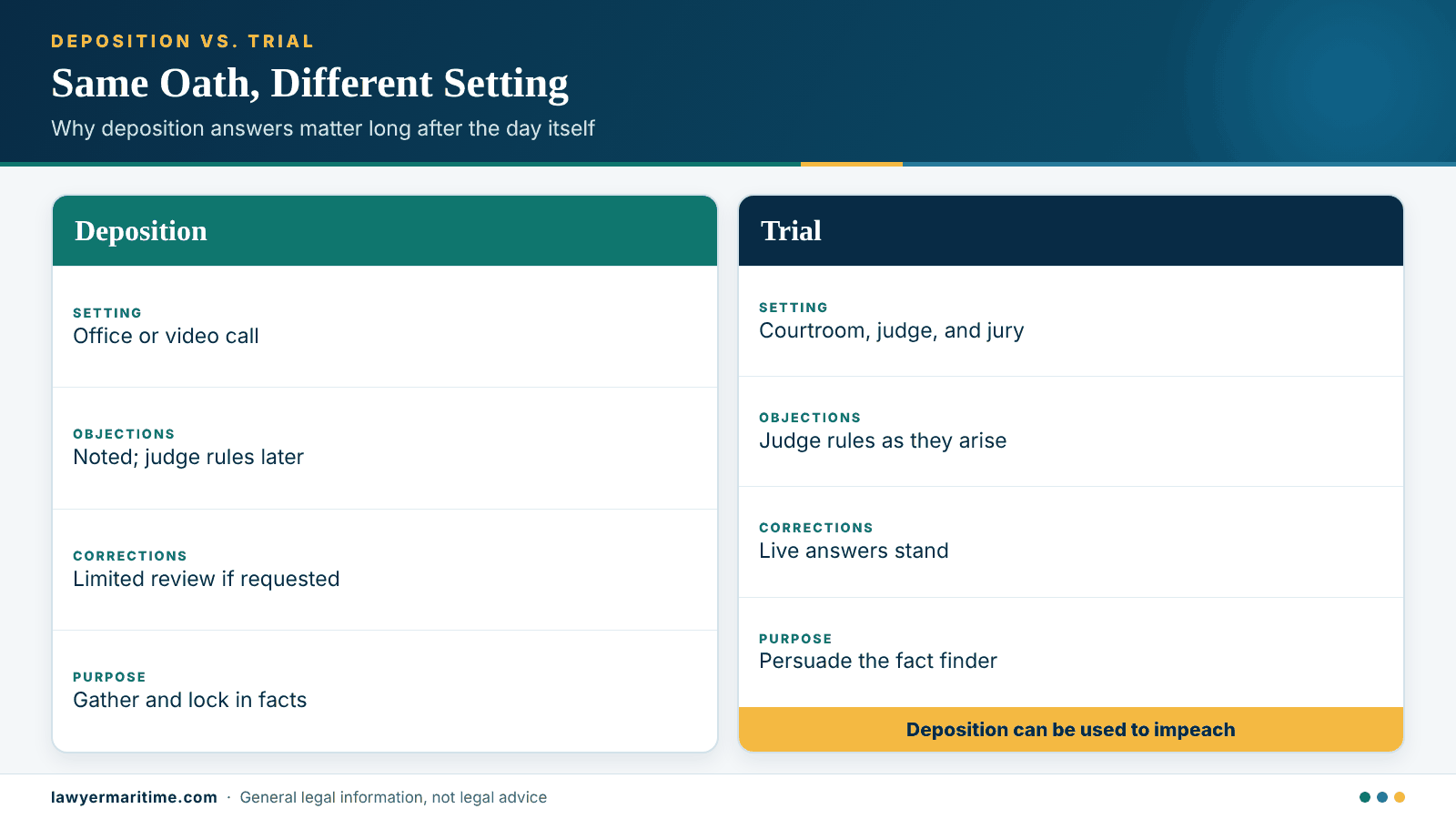
Common Deposition Mistakes and a Practical Checklist
Most damaging deposition moments come from a handful of avoidable habits. The mistakes below fall into two groups: what happens in the questioning, and what happens before and around it. After them comes a short checklist you can adapt with your lawyer.
The mistakes that cost injured seamen credibility
Mistakes inside the deposition room
The most common problem is guessing. Witnesses feel pressure to fill silence, and a guessed date, distance, or sequence can later be contradicted by a record. Close behind are volunteering extra information, exaggerating symptoms, minimizing them to seem tough, and arguing with the questioner. Seamen, particularly experienced ones, often understate pain because they’re used to working through it, and that habit can make a real injury look minor on the record.
Another mistake is answering a question you didn’t understand. If a term is unclear, ask what it means. A question about “the incident” or “the vessel” can mean different things to different people, and an answer to the wrong version of a question can cause confusion that lasts through trial.
Mistakes outside the room
Problems also arise before and after the deposition. Posting about your health or activities, discussing your testimony with coworkers, and speaking with an insurer or adjuster without your lawyer’s guidance can all create new evidence. Withholding a prior injury, a past claim, or a bad fact from your own lawyer is just as risky, because the defense often finds these things through records.
Finally, don’t assume that a favorable deposition ends the case, or that an unfavorable one ends it either. Depositions are one stage. A single poor answer can often be explained or placed in context, but the explanation works best when it’s offered early and honestly.
| Common mistake | Why it hurts | Better action |
|---|---|---|
| Guessing at dates, distances, or sequences | Records may contradict the guess, which raises doubts about everything else | Say what you remember, label estimates, and say “I don’t know” when it is true |
| Volunteering extra information | Gives the other side new topics and may add unhelpful detail | Answer the question asked, then stop |
| Understating pain to seem tough | Makes a real injury look minor in the record | Describe symptoms accurately, including how they limit specific tasks |
| Exaggerating symptoms or limits | Surveillance, records, or social media can contradict the story | Describe good days and bad days honestly |
| Posting about activities or the case online | Posts can be requested and used to question your claimed limits | Preserve existing content, avoid new posts, and ask your lawyer before changing settings |
| Hiding a prior injury from your lawyer | The defense may find it first, and a concealment issue can affect maintenance and cure | Disclose all prior injuries and claims during preparation |
| Talking about testimony with coworkers | Those conversations are not privileged and can be asked about | Save testimony discussions for your attorney |
A practical checklist for deposition preparation
Before a notice arrives
You can lay groundwork long before the lawsuit reaches discovery. Keep a running file with medical bills, appointment dates, pay records, correspondence from the employer or insurer, and notes on witnesses you remember. Write down your own account of the accident while it is fresh, and give it to your lawyer rather than sharing it with others, since a private account prepared for your lawyer may be protected, while documents shared with outsiders may not be.
In the days before the deposition
As the date approaches, use the list below as a conversation starter with your lawyer. Your own case may need other steps, and some of these points may not fit your facts.
- Review the notice for the date, place, recording method, and any documents you are asked to bring.
- Reread your medical records, incident reports, and any statement you gave, and flag inconsistencies for your lawyer.
- Meet with your lawyer for at least one practice session, and ask how breaks and objections will work.
- Arrange transportation, childcare, and time off, and plan for medication or rest needs.
- Sleep, eat, and arrive early; for remote depositions, test your equipment and choose a private room.
- Ask your lawyer to request transcript review on the record before the deposition ends.
- Do not guess, argue, or answer questions you don’t understand.
- Do not discuss your testimony with coworkers or on social media.
- Do not delete or change posts, messages, or records without your lawyer’s guidance.
Frequently Asked Questions About Jones Act Depositions
These short answers cover questions injured seamen raise most often. Each is general information, and the facts of an individual case, the court, and the governing rules can change the answer.
Basic questions
Do I have to give a deposition if I sue under the Jones Act?
As a party, you can generally expect the defense to notice your deposition, and a party who ignores proper notice can face sanctions under Rule 37(d). Your lawyer can negotiate the date, place, and format, and may ask for limits if there’s a real hardship.
How long does a Jones Act deposition last?
The federal default in Rule 30(d)(1) is one day of seven hours, unless the parties agree otherwise or the court orders more time. Many depositions finish sooner, but a complicated medical history can use most of the day.
Will my lawyer be with me?
Yes, a party’s lawyer typically attends and defends the deposition. The lawyer can object to questions and can instruct you not to answer in the narrow situations the rules allow, such as protecting a privilege.
Can the other side ask about my prior injuries?
Generally yes, when the questions are relevant to a claim or defense and proportional to the case. Prior injuries to the same body part, previous claims, and hiring paperwork are common subjects.
During the deposition
What if I don’t understand a question?
Say so and ask for the question to be repeated or rephrased. An answer to a question you misunderstood becomes part of the record, so clarifying is better than guessing at what the lawyer meant.
Can I take a break?
Yes, breaks are normal. Practices differ on when they happen and whether you can confer with your lawyer while a question is pending, so ask your lawyer before the deposition how breaks will work.
What happens if I make a mistake in my testimony?
Tell your lawyer as soon as you notice. You may be able to correct it on the record, later in the deposition, or through the review process under Rule 30(e) if review was requested, although courts differ on how they treat substantive changes.
Should I bring documents?
Only what the notice or your lawyer asks you to bring. Don’t bring personal notes or files on your own, because documents you use to refresh your memory may have to be shared with the other side.
After the deposition
Can I read the transcript?
You can if review is requested before the deposition ends, in which case you have 30 days after being notified that the transcript or recording is available. Ask your lawyer to make the request at the deposition.
Can my deposition be used against me?
Yes. An adverse party may use a party’s deposition for any purpose under Rule 32(a)(3), subject to the evidence rules, and it can also be used to impeach you if your trial testimony differs.
Does a deposition mean my case is going to trial?
No. Depositions are a normal step in discovery, and many cases settle afterward, often at or after mediation. Our guides to the Jones Act lawsuit process and Jones Act settlements describe the paths a case can take.
Sources and Legal Authorities
The authorities below support the legal statements in this guide. Confirm each against its current text before relying on it, because statutes, rules, and case law change, and local court rules can add requirements.
Statutes and rules
Seaman injury statutes
- 46 U.S.C. § 30104 – Jones Act, personal injury to or death of a seaman
- 45 U.S.C. § 53 – FELA, contributory negligence and comparative fault
- 46 U.S.C. § 55102 – Transportation of merchandise (coastwise cabotage rule)
Federal Rules of Civil Procedure and Evidence
- Fed. R. Civ. P. 26 – Scope of discovery, timing, disclosures, and expert discovery
- Fed. R. Civ. P. 28 – Persons before whom depositions may be taken
- Fed. R. Civ. P. 30 – Depositions by oral examination
- Fed. R. Civ. P. 32 – Using depositions in court proceedings
- Fed. R. Civ. P. 35 – Physical and mental examinations
- Fed. R. Civ. P. 37 – Failure to make disclosures or to cooperate in discovery
- Fed. R. Civ. P. 45 – Subpoena
- Fed. R. Civ. P. 56 – Summary judgment
- Fed. R. Evid. 613 – Witness’s prior statement
- Fed. R. Evid. 801 – Definitions that apply to hearsay, including opposing party statements
Cases and agency materials
Court decisions
- Chandris, Inc. v. Latsis, 515 U.S. 347 (1995) – seaman status framework
- McCorpen v. Central Gulf Steamship Corp., 396 F.2d 547 (5th Cir. 1968) – defense to maintenance and cure based on concealed pre-existing conditions, as described in Ramirez v. American Pollution Control Corp., No. 10-40911 (5th Cir. Mar. 14, 2011) (unpublished)
Related guidance on this site
- Jones Act overview – the seaman injury remedy and its related claims
- Jones Act lawyer guide – what counsel does at each stage of a seaman’s claim