The unseaworthiness elements are the things an injured seaman generally has to prove to hold a vessel owner or operator liable under general maritime law: that the duty was owed to the claimant, that the vessel, its gear, its crew, or its work methods were not reasonably fit for their intended use, that the unfit condition was a substantial cause of the injury, and that the claimant suffered real harm. The claim does not require proof that anyone was careless, which is why it differs from a Jones Act negligence claim, but it does demand proof of an unfit condition and a causal link. The doctrine comes from judge-made maritime law rather than from the Jones Act statute, and it is aimed at the vessel’s owner or operator, not simply at the employer. This guide walks through each element in order, shows what evidence tends to matter, explains where defenses and overlapping remedies come in, and is written for injured crew members, their families, and anyone trying to get their bearings before speaking with a maritime lawyer. It describes general rules, not predictions about any case.
What Are the Elements of an Unseaworthiness Claim?
Unseaworthiness is a doctrine of general maritime law, developed in admiralty courts, under which a vessel owner can be liable when the vessel, its equipment, or its crew was not reasonably fit for the work being done. No single statute lists its elements. Courts have built them from Supreme Court decisions such as Mitchell v. Trawler Racer, Inc., 362 U.S. 539 (1960), and then restated them in circuit opinions, so the wording you see varies a little from court to court.
What must a claimant prove, in plain English?
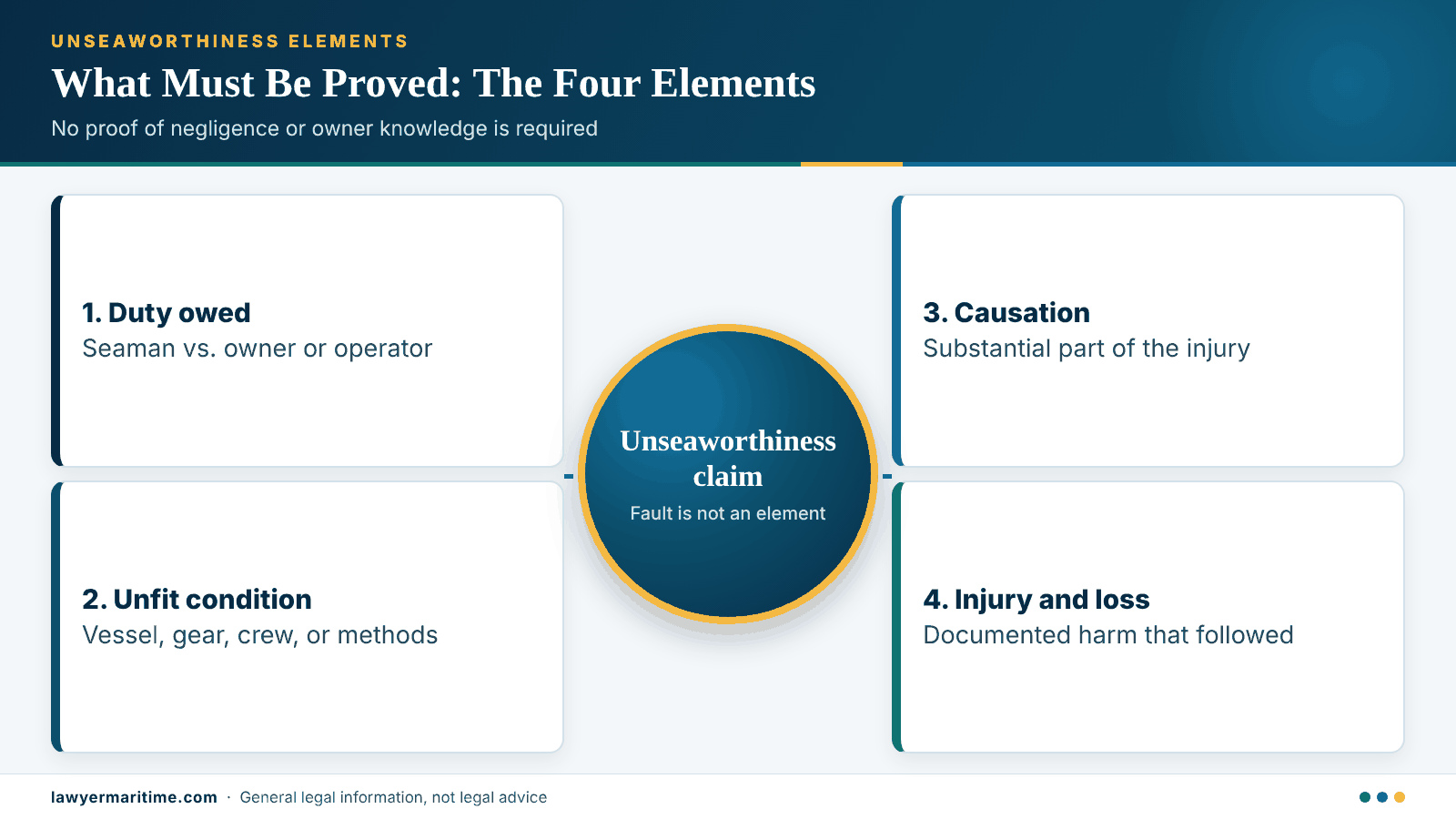
Think of the claim as a chain with four links. If any link fails, the claim usually fails with it, so each deserves its own look in the sections that follow.
The four links in the chain
First, the claimant must be someone to whom the vessel owner owes the duty, which in practice means a seaman. Second, the claimant must show that the vessel, its gear and appurtenances, its crew, or the way work was assigned was not reasonably fit for its intended use. Third, that unfit condition must have been a substantial cause of the injury. Fourth, the claimant must show an injury and the losses that flow from it.
Many practitioners fold the first link into “standing” and the last into “damages,” which leaves two or three headline elements. The substance is the same, and treating all four separately makes it easier to see where a particular case is strong or thin.
What you do not have to prove
You don’t have to prove that the owner was negligent. In Mitchell, the Court called the owner’s duty “absolute” and described it as completely independent of the Jones Act’s duty of reasonable care. You also don’t have to prove that the owner knew about the condition, because the Court said actual or constructive knowledge is not essential to liability.
Not needing to prove fault isn’t the same as not needing to prove anything. The claimant still carries the burden on the condition and on causation, and those two points are where most of these cases are won or lost.
The order matters for a practical reason. A claimant who skips straight to the dramatic part of the story, the broken winch or the slick deck, can overlook the quieter questions of status and defendant that decide whether the claim is available at all. Working through the elements in sequence keeps those threshold points from being an afterthought.
Where do these elements come from?
Because the elements are judge-made, it helps to know which sources carry the weight. A brief tour of the main ones keeps you from relying on a summary that has drifted from the case law.
Supreme Court foundations
Three Supreme Court decisions anchor the doctrine for seamen. Mitchell set the duty and its no-fault character. Usner v. Luckenbach Overseas Corp., 400 U.S. 494 (1971), drew the line between an unfit condition and an isolated negligent act. Waldron v. Moore-McCormack Lines, Inc., 386 U.S. 724 (1967), confirmed that the way crew are assigned to a task can itself make a vessel unfit.
How circuit courts restate the elements
In Luwisch v. American Marine Corp., No. 19-30499 (5th Cir. Apr. 15, 2020), the Fifth Circuit summarized the claim in two steps: the vessel was not reasonably fit for its intended use, and the unseaworthy condition played a substantial part in causing the injury. The court quoted earlier Fifth Circuit decisions for those points, including Johnson v. Offshore Express, Inc., 845 F.2d 1347 (5th Cir. 1988). Other circuits use their own phrasing, so confirm the rule that applies where a case would be filed.
| Element | Question the court asks | Typical proof | Where this guide covers it |
|---|---|---|---|
| 1. Duty owed | Is the claimant a seaman, and is the defendant the vessel’s owner or operator? | Employment and assignment records, crew lists, charter or ownership documents | Section on the duty |
| 2. Unfit condition | Was the vessel, gear, crew, or work method not reasonably fit for its intended use? | Photos, inspection and repair records, crew testimony, expert opinion | Section on unseaworthy conditions |
| 3. Causation | Did that condition play a substantial part in bringing about the injury? | Accident reconstruction, witness accounts, medical timeline | Section on causation and injury |
| 4. Injury and loss | What harm resulted, and can it be documented? | Medical records, wage and tax records, vocational evidence | Section on causation and injury, plus the damages guide |
Element One: Is the Unseaworthiness Duty Owed to You, and by Whom?
Before anyone argues about a frayed line or a missing guard, the claim has to clear a threshold: the right person must be suing the right defendant. This is the element that gets the least attention in popular summaries and causes some of the earliest surprises in real cases.
Who is owed the duty?
The warranty of seaworthiness protects people who work aboard as crew. The details turn on status, and status turns on facts rather than job titles.
Seamen are the core group
The claim is a seaman’s remedy, and our overview of who counts as a Jones Act seaman is a good companion to this section. A worker who qualifies as a seaman, meaning someone with a substantial connection in duration and nature to a vessel in navigation or an identifiable fleet under Chandris, Inc. v. Latsis, 515 U.S. 347 (1995), may bring it. If seaman status is disputed, the question is generally the same one a Jones Act claim raises, so the threshold fight tends to be shared. Our guide to the seaman status test explains how that question is decided.
Seamen’s families may also have a claim when a seaman dies. The Supreme Court recognized a general maritime wrongful-death action in Moragne v. States Marine Lines, Inc., 398 U.S. 375 (1970), a case that itself involved an unseaworthiness theory. What a family can recover is a separate question covered in our guide to unseaworthiness damages.
Most LHWCA-covered workers are outside the claim
Historically, the Supreme Court extended the warranty to longshore workers doing a seaman’s work in Seas Shipping Co. v. Sieracki, 328 U.S. 85 (1946). Congress later changed that. Under 33 U.S.C. § 905(b), a covered worker injured by a vessel’s negligence may sue the vessel, but the statute says the vessel’s liability cannot rest on the warranty of seaworthiness or a breach of it.
The practical takeaway is that a longshore, shipyard, or harbor worker covered by the LHWCA generally has a negligence claim against the vessel, not an unseaworthiness claim. Which side of the line you fall on depends on the facts, and a worker who is wrongly assumed to be covered by one regime can lose time on the wrong theory.
Who owes the duty?
The duty rests on the vessel’s owner and on anyone treated as the owner for the voyage. That isn’t always the company that signs the paychecks.
Owners and owners pro hac vice
A bareboat charterer, who takes full possession and control of a vessel, is treated as the owner for many admiralty purposes and is called an owner pro hac vice, meaning “for this turn.” In Reed v. The Yaka, 373 U.S. 410 (1963), the Court explained that such a charterer is personally liable for the vessel’s unseaworthiness and that the duty cannot be shifted away by contract. If your vessel was bareboat chartered, the charterer may stand in the owner’s shoes.
When the employer is not the owner
Seamen are sometimes employed by one company while the vessel belongs to, or is operated by, another. A Jones Act negligence claim runs against the employer under 46 U.S.C. § 30104. An unseaworthiness claim runs against the owner or operator. In a split arrangement, those can be different defendants, and a claimant who sues only one may leave a source of recovery untouched.
Charter arrangements vary, and how the duty is allocated in a time charter or a management agreement is a fact-specific contract question. Ask a maritime lawyer to trace ownership, operation, and employment early, before limitation and timing issues complicate the picture.
| Person or entity | Role in the claim | Why, in brief |
|---|---|---|
| Seaman crew member | Generally owed the duty | The warranty is a seaman’s remedy under general maritime law |
| LHWCA-covered longshore or harbor worker | Generally not owed the duty | 33 U.S.C. § 905(b) bars vessel liability based on the warranty of seaworthiness |
| Vessel owner | Generally owes the duty | The duty runs from the owner and is independent of fault |
| Bareboat charterer | Treated as owner pro hac vice | Full possession and control; Reed v. The Yaka |
| Employer that neither owns nor operates the vessel | Usually a Jones Act defendant, not an unseaworthiness defendant | Depends on ownership, operation, and charter terms |
Element Two: What Counts as an Unseaworthy Condition?
This is the heart of the claim, and it is where the doctrine’s vocabulary can mislead. “Unseaworthy” sounds like a hull problem, yet courts apply it to gear, to people, and to the way a job is organized. What ties these together is a single idea: the vessel, taken as a working whole, was not reasonably fit for what it was being used to do.
What does “reasonably fit for its intended use” mean?
The standard has two edges. It is more demanding than ordinary care because it ignores fault, and it is less demanding than perfection because it accepts that some hazards come with the job.
The standard in Mitchell
Frank Mitchell was a crew member on a fishing trawler. After the crew unloaded the catch, he stepped onto the ship’s rail to reach a ladder to the pier, and his foot slipped on slime and fish residue covering ten to twelve feet of the rail. The trial judge had required proof that the slime was there long enough for the owner to find and remove it, and the Supreme Court sent the case back for a new trial on unseaworthiness.
The Court said the duty is not to furnish an accident-free ship. It is a duty to furnish a vessel and appurtenances reasonably fit for their intended use. A slick rail that no one had a fair chance to clean can still be an unseaworthy condition, because the owner’s knowledge is not the test.
Why temporary hazards still count
The Court also refused to treat a temporary condition differently from a permanent one. A grease spill, a coil of loose line, or an unsecured tool left in a walkway can qualify if it makes the vessel unfit for the job at that moment. The condition doesn’t have to be a structural defect or a long-standing neglect.
The flip side is that a temporary hazard is easy to lose track of. Whether the hazard existed, how long it existed, and who saw it are facts that fade fast, which is why photographs and prompt written accounts carry so much weight.
What kinds of conditions have supported claims?
Lawyers sort unfit conditions into a few recurring categories. The labels are for convenience, and a single injury can involve more than one.
Gear, equipment, and the vessel’s structure
The most familiar category is physical: worn lines, defective winches, missing guards, faulty ladders, poorly maintained decks, and inadequate lighting. In Luwisch, a chief engineer fell about ten feet from an upper deck after tripping over line that had been left at the top of the ladder, and the district court found that the obstruction made the vessel unseaworthy. The Fifth Circuit affirmed, finding no clear error in that determination.
That case also shows how ordinary the facts can be. Nothing was broken. A walkway was blocked, and that was enough.
Crew numbers and crew fitness
The doctrine reaches people as well as equipment. In Waldron, a crew member was one of two men told to uncoil and carry an eight-inch mooring line for fifty-six feet, and expert testimony suggested that three or four men were needed. The Court held that assigning too few men to a task can make a vessel unseaworthy, even when the vessel is fully manned overall and the line and the officer’s competence are not in question.
Inadequate training and fatigue are sometimes argued as crew-fitness problems as well. Whether a court accepts that framing depends on the facts and the circuit, and our guide to maritime fatigue accidents covers the safety side of those cases.
Work methods and orders
A third category looks at how the work was organized rather than at any object. An unsafe method, a poorly planned lift, or an order that put crew into a hazard may be framed as a condition of the vessel’s operation. Courts are cautious here, because this category sits next to ordinary negligence, and that line is where defendants push hardest. Don’t assume a bad decision by a supervisor automatically converts into an unseaworthy vessel.
When is a mistake not an unseaworthy condition?
The most common reason an unseaworthiness claim fails isn’t a lack of injury. It is that the evidence shows a mistake rather than a condition.
The isolated negligent act
In Usner, a longshoreman was struck when a winch operator lowered a load too far and too fast. No equipment had malfunctioned. The Supreme Court held that a single negligent act did not make the ship unseaworthy, because the injury was not caused by the condition of the ship, her appurtenances, her cargo, or her crew.
Usner arose from a longshoreman’s claim, but the line it drew between condition and conduct is the one lawyers and courts use whenever a crew member alleges unseaworthiness. Where exactly courts place that line varies with the facts and the circuit.
Turning conduct into a condition
Careful pleading asks whether the careless act exposed something deeper. A winch operator’s slip is conduct. A winch with a sticking brake, an operator who was never trained on it, or a crew too small to spot the load safely points to a condition, even if one person’s hand made the final mistake.
That is the practical question to bring to a lawyer: is this a one-off act, or is it the visible part of an unfit vessel? The answer often decides whether the claim is worth bringing as an unseaworthiness count at all.
| Scenario | Condition-based framing | Conduct-based framing | What usually decides it |
|---|---|---|---|
| Slip on a slick deck | Ongoing leak or grease buildup left in a work area | One-time spill by a crew member | How long the hazard existed and whether it was a recurring problem |
| Injury during a heavy lift | Too few hands assigned to the task, or faulty rigging | A competent crew member’s momentary misjudgment | Whether the staffing or gear fell below what the job required |
| Fall from a ladder | Damaged rung, missing handhold, or obstructed access | Climber lost footing with nothing wrong in the equipment | Inspection of the ladder and the area around it |
| Struck by moving equipment | Sticking brake, missing guard, or untrained operator | Operator’s one careless movement | Equipment condition and the training and supervision record |
Elements Three and Four: How Do Causation and Injury Fit In?
An unfit condition is necessary, but it isn’t enough. The claimant must also connect that condition to the harm. This is the point at which strong-sounding facts sometimes collapse, because the unfit gear was real but the injury happened for another reason.
What causal link does the claim require?
Courts don’t all use identical words, yet the common thread is that the condition must matter to how the injury happened. A remote or incidental connection tends not to be enough.
The substantial-part standard
In the Fifth Circuit, as the court restated it in Luwisch and drawn from Johnson v. Offshore Express, the claimant must prove that the unseaworthy condition played a substantial part in bringing about or actually causing the injury. The court added that the injury must have been a direct result or a reasonably probable consequence of the unseaworthiness. Other circuits phrase the test in their own terms, and the exact wording can matter at trial and on appeal.
Why this is often called stricter than the Jones Act
A Jones Act claim imports the Federal Employers’ Liability Act through 46 U.S.C. § 30104. The Fifth Circuit has described Jones Act causation as the employer’s negligence causing the injury “in whole or in part.” The Supreme Court, applying FELA in CSX Transportation, Inc. v. McBride, 564 U.S. 685 (2011), described the test as whether negligence played a part, no matter how small, in bringing about the injury.
Set beside that language, “substantial part” sounds more demanding, and the unseaworthiness standard is generally described that way. The comparison is one of framing, not a precise measurement, and we don’t suggest it settles any case. The practical lesson is simpler: for the unseaworthiness count, build the causal story as carefully as the story of the condition.
How does causation play out on real facts?
Causation is rarely a single dramatic moment. It is usually a sequence, and the claimant’s job is to show where the unfit condition sits in it.
Tying the condition to the mechanism of injury
The most persuasive causation evidence answers three questions in order. What exactly was wrong with the vessel? How did that defect operate on the claimant’s body at the time? Why would the injury probably not have happened without it?
In Luwisch, the chain was short. Line was left at the top of a ladder, the engineer tripped on it, and he fell. A sticking brake that fails to hold a load and a load that then crushes a hand is a similarly direct chain. A defect that only might have contributed, with no clear path to the injury, is harder to prove.
Consistency matters as much as the physical evidence. If your description of how you fell changes between the incident report, the doctor’s intake form, and a later statement, the owner will use the differences to argue that the condition wasn’t what hurt you. Tell the same accurate story each time, and correct honest mistakes promptly instead of letting them stand.
Multiple causes and other actors
Real accidents often have several causes: a worn fitting, a rushed schedule, a coworker’s lapse, and the claimant’s own footing. The Fifth Circuit’s “substantial part” wording doesn’t suggest that the unfit condition must be the only cause. It requires that the condition played a substantial part, so the presence of other causes doesn’t automatically defeat the claim.
Other causes do change the arithmetic, however. A court or jury can reduce damages for the claimant’s own fault, and a defendant may point to a third party’s role. Those points are taken up in the section on defenses below.
What counts as injury and loss?
The fourth element is more straightforward but no less important, because an unseaworthiness claim is a claim for compensation and needs documented harm to support it.
Proving the injury itself
The injury is usually proved through medical records that tie the diagnosis to the incident, along with the treating providers’ notes about how the injury happened. Gaps in treatment, delayed reporting, and inconsistent histories given to different providers are the points an opposing side will pick at. Accurate, consistent descriptions to every provider, from the first visit, protect the claim.
Documenting the losses that follow
Losses can include medical expenses, lost earnings, reduced future earning capacity, and pain and suffering, as discussed in our guide to unseaworthiness damages. This article stays with the elements. What matters here is that the same medical and wage records that prove the injury also support the loss, so they are worth gathering early. Because punitive damages are not available for unseaworthiness under Dutra Group v. Batterton, 588 U.S. 358 (2019), the claim is about compensating documented harm.
What Evidence Proves an Unseaworthiness Claim?
Knowing the elements is one thing. Proving them from a vessel you no longer control, against an owner that controls the records, is another. Evidence for an unseaworthiness claim falls into two groups: proof of what the vessel was like, and proof of what happened to you.
What evidence shows the vessel’s condition?
This group of evidence speaks to the second element, and because the owner holds most of it, the claimant often has to ask for it formally in a lawsuit.
Records the owner or operator keeps
Maintenance schedules, repair and work orders, inspection reports, equipment manuals, safety management records, and crew lists can show whether a defect was known, reported, or ignored. Knowledge is not an element, but a documented history of complaints makes a condition easier to prove and harder to dismiss as a freak event. Logbooks and incident reports completed right after the event carry the same weight.
Government investigation materials can add context in some events. Our guide to NTSB marine reports explains how those reports work, and what a government report can and cannot do in a civil case is a separate legal question.
Photographs, video, and the physical object
Pictures of the scene taken as soon as it is safe to take them are often the best evidence of a temporary condition. A photo of the oily deck, the loose line, or the missing guard shows what a written report may leave out. If the failed equipment itself can be preserved, such as a snapped shackle or worn line, the object can be examined by an expert later.
Many vessels also have cameras and electronic records, from engine data to navigation logs. Footage and data are routinely overwritten, so a written preservation request to the owner and operator is worth discussing with a lawyer promptly.
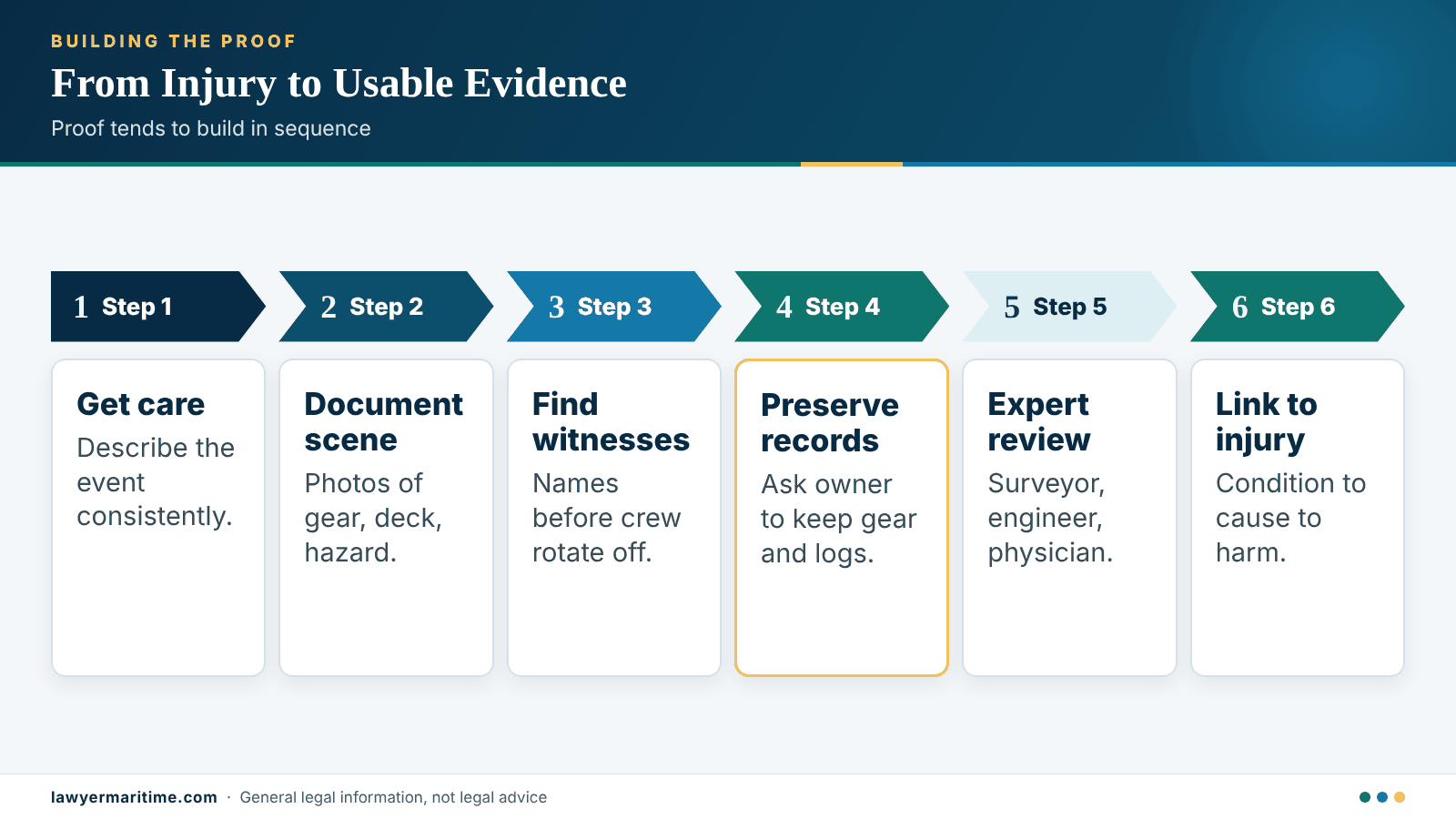
Timing is the common thread. Crews rotate, vessels sail, equipment is repaired, and software overwrites old data, so the owner’s ordinary operations can erase proof without anyone intending it. That’s one reason lawyers often send a preservation letter long before a lawsuit is filed.
What evidence shows what happened to you?
The second group speaks to causation and injury. It is closer to home, and much of it is in your control.
Witnesses and your own account
Crew members who saw the incident or the condition beforehand can speak to how long the hazard existed and whether anyone complained. Names and contact information are easy to lose once a crew change happens. Your own written account, made while memory is fresh, helps you stay consistent when you later repeat the story to doctors, adjusters, and lawyers.
Statements to company representatives deserve care. A recorded statement given to an employer’s insurer is evidence that can be used against you later, so speak with a lawyer about whether and how to give one.
Experts and medical proof
Complicated claims often need expert help. A marine surveyor or safety engineer can explain why a condition fell below what the job required, an accident reconstruction specialist can address the causal sequence, and a treating or consulting physician can tie the injury to the event. Experts cost money and are not needed in every case, so the choice is a strategic one for you and your lawyer.
| Evidence | What it can show | Element it mainly supports | Preservation note |
|---|---|---|---|
| Photos and video of the scene | The hazard, the area, and the gear as they were | Unfit condition | Take them early and keep originals with metadata |
| Maintenance, repair, and inspection records | Whether the problem was known, reported, or repaired | Unfit condition | Usually held by the owner; request in writing and in discovery |
| Crew list and work assignments | How many people were assigned and who was trained | Unfit condition (crew) | Records may change after a crew rotation |
| Incident report and logbook entries | How the employer first described the event | Condition and causation | Ask for copies of anything you sign or complete |
| Witness names and statements | How long the hazard existed and what happened | Condition and causation | Collect contact details before crew leave the vessel |
| The failed gear or part | Wear, defect, or breakage mechanism | Condition and causation | Do not allow it to be discarded or repaired without a record |
| Medical and wage records | The injury, its course, and the economic loss | Injury and loss | Keep complete copies and follow treatment advice |
What Defenses and Limits Can Weaken an Unseaworthiness Claim?
A claim that satisfies the elements on paper can still be reduced or blocked. Defendants know the doctrine well, and the arguments they raise tend to follow the same few themes. Seeing them in advance helps you understand why the evidence matters.
What arguments will the vessel owner raise?
Most defenses attack one of the elements directly, which is why they line up so neatly with the structure of this article.
Attacks on the condition and on causation
The owner may argue that there was no unfit condition, that the vessel was reasonably fit for its use, or that the accident was an isolated act in the Usner sense. It may also argue that whatever defect existed did not cause the injury, or that the connection is too remote to count as a substantial part. These are element defenses, and they are won or lost on the evidence discussed above.
Comparative fault
The most common reduction is the claimant’s own fault. In Luwisch, the Fifth Circuit quoted earlier decisions for two points: comparative negligence applies in both Jones Act and unseaworthiness actions, and a claimant’s contributory negligence mitigates damages but does not bar recovery. The district court there assigned twenty percent of the fault to the engineer and eighty percent to his employer, and the court of appeals affirmed.
That allocation was specific to its facts and isn’t a typical figure. The lesson is that fault is divided and damages are reduced accordingly, not that the claim disappears. The related rule that assumption of risk is not a defense for seamen under the Jones Act appears in 45 U.S.C. § 54, and our guide to maritime negligence covers fault in more detail.
Fault arguments usually focus on what the claimant knew and did. Did the claimant see the hazard, skip a safer route, ignore a warning, or fail to use available equipment? Evidence that the work schedule, an order, or the lack of a safe alternative left little real choice can limit how much fault a court assigns.
What legal limits shape the claim?
Beyond defenses on the facts, several rules of law cap or condition what the claim can achieve.
No punitive damages
In Dutra Group v. Batterton, the Supreme Court held that a plaintiff may not recover punitive damages on an unseaworthiness claim. The Court reasoned that the Jones Act and unseaworthiness claims compensate for the injury and its resulting losses, and that adding punitive damages to unseaworthiness would conflict with the uniformity the Court sought. Maintenance and cure for willful nonpayment follows a different rule, which we address in our guide to denied maintenance and cure.
Limitation of liability and timing
Under 46 U.S.C. § 30529, a vessel owner may file a federal action to limit its liability, generally within six months after receiving written notice of a claim. Once the owner files and deposits the required security, other proceedings over the same matter must generally stop, so a limitation action can change how and where the claim is heard. The general cap in 46 U.S.C. § 30523 is tied to losses arising without the owner’s privity or knowledge, which is often a central dispute, so don’t assume the filing ends your case. The Supreme Court addressed how limitation actions interact with the saving-to-suitors clause in Lewis v. Lewis & Clark Marine, Inc., 531 U.S. 438 (2001).
On deadlines, 46 U.S.C. § 30106 sets a three-year period for many maritime personal-injury suits “except as otherwise provided by law.” Other rules, contracts, and facts can change the picture, which is covered in our guide to Jones Act limitations periods. Confirm your own deadline with counsel instead of counting on a general rule.
| Defense theme | What the owner argues | What may answer it |
|---|---|---|
| No unfit condition | The vessel and gear were reasonably fit for the work | Photos, repair history, expert opinion on the standard for the job |
| Isolated negligent act | One person’s mistake, not a condition of the vessel | Evidence of staffing, training, equipment state, or recurring hazards |
| No causal link | The defect did not substantially cause the injury | Mechanism-of-injury evidence, medical timeline, reconstruction |
| Claimant’s own fault | The injured seaman failed to use reasonable care | Evidence that the hazard was unavoidable or that orders left no safe choice |
| Limitation of liability | The owner seeks to cap its exposure in federal court | Evidence about privity or knowledge, and early advice from counsel |
How Do the Elements Compare With Jones Act and Maintenance and Cure Claims?
Seamen rarely bring an unseaworthiness claim alone. The same accident often supports three different remedies, each with its own proof. Keeping them separate prevents the common mistake of assuming that failing at one means failing at all.
How does unseaworthiness differ from a Jones Act negligence claim?
The Jones Act claim asks whether the employer was negligent. The unseaworthiness claim asks whether the vessel was fit. Same injury, different questions.
Different proof for the same accident
In Johnson v. Offshore Express, as the Fifth Circuit has repeated, Jones Act negligence and unseaworthiness are two distinct causes of action. Under the Jones Act, the claimant looks for negligence by the employer or its employees, and the causal bar is the lower “in whole or in part” standard. Under unseaworthiness, the claimant looks for an unfit condition and a substantial causal link, with no negligence required. Our guides to the Jones Act and the Jones Act claim process explain the negligence side in detail.
A falling load may be best framed one way, and a loose line another. That is why lawyers commonly plead both and let the evidence sort them out.
Why courts rarely let you collect twice
The Supreme Court noted in Batterton that the two claims compensate for the injury and the losses resulting from it, and that a plaintiff cannot recover twice for the same injury. The Fifth Circuit has said that once a court finds unseaworthiness, it ordinarily need not reach Jones Act negligence, because the remedies largely overlap.
Pleading both is therefore a hedge, not a way to stack awards, and you shouldn’t expect two recoveries for one loss. If one theory succeeds, the other may become unnecessary on the damages question, though it can still matter for fault allocation and for who must pay.
Where does maintenance and cure fit?
Maintenance and cure is a separate obligation. It is not a damages theory at all, and it doesn’t depend on any of the elements above.
A no-fault duty to the injured seaman
Maintenance is a daily living allowance and cure is payment for medical care, owed by the employer to a seaman who falls ill or is injured in the service of the ship, generally without regard to fault. A seaman doesn’t need to prove an unfit condition or negligence to ask for it. Our guide to maintenance and cure denials covers what to do when it is withheld.
How it interacts with the other claims
Maintenance and cure payments usually continue while the other claims are investigated and litigated, and the right can survive even when the seaman cannot prove the vessel was unfit. It generally ends at a point described as maximum medical improvement, a topic in our guide to maximum medical improvement. Keep a record of what you received and when, because those payments can matter when losses are later tallied.

What to Do Now: A Practical Checklist
If you were hurt on a vessel and suspect the equipment, the staffing, or the working conditions played a part, the steps below protect your health first and your proof second. They are general suggestions, not a substitute for advice from a lawyer who knows your facts.
What should you do in the first days?
Early choices shape what can be proved later, so think of the first few days as the period when the evidence is most available.
Protect your health and your account
- Get medical care and describe how the injury happened consistently to every provider.
- Report the injury to the vessel’s officers as your employer’s procedures require, and ask for a copy of anything you sign.
- Write down your own account of the event, with dates, times, and locations on the vessel.
- Keep copies of medical bills, pay records, and any maintenance and cure payments you receive.
Preserve the proof
- Photograph the area, the gear, and any hazard if you can do so safely.
- Note the names and contact details of witnesses before crew members rotate off.
- Ask that the failed equipment or part not be discarded, and say so in writing.
- Avoid posting about the accident or your recovery on social media.
What should you ask a maritime lawyer?
A first conversation goes further when you arrive with specific questions. These four are a good starting set.
Questions about status and defendants
- Am I a seaman for this claim? Ask how status will be analyzed on your facts and what could change it.
- Who owns and operates the vessel? Ask who the proper defendants are besides your employer.
Questions about the condition and the timeline
- Is this a condition or an isolated act? Ask how the facts fit the unseaworthiness cases and what evidence would strengthen them.
- What deadlines could apply? Ask about limitation periods, any notice requirements, and the possibility of a limitation action.
For broader context on how seamen’s remedies fit together, see our overview of maritime injury compensation, and for a detailed look at how lawyers work with injured crew, see our seaman injury lawyer guide.
Frequently Asked Questions
These answers are general. Your facts, your court, and any contracts that apply may change the result.
The basics
What are the elements of an unseaworthiness claim?
Generally, a claimant must show that the duty was owed to the claimant, that the vessel, gear, crew, or work methods were not reasonably fit for their intended use, that the unfit condition substantially caused the injury, and that the claimant suffered harm. Courts phrase the elements differently, so the wording that applies depends on the court.
Do I have to prove the owner was negligent?
No. In Mitchell v. Trawler Racer, the Supreme Court described the duty as independent of negligence and said the owner’s knowledge of the condition is not essential. You still must prove the unfit condition and its causal connection to your injury.
Who can bring an unseaworthiness claim?
Seamen can, and in some situations a seaman’s family can after a death. Covered LHWCA workers generally cannot, because 33 U.S.C. § 905(b) bars vessel liability based on the warranty of seaworthiness. Whether you are a seaman is a fact-driven question worth reviewing with counsel.
Proof and causation
Is one careless act enough to make a vessel unseaworthy?
Generally not. Usner v. Luckenbach Overseas held that a single negligent act did not make the ship unseaworthy when no unfit condition caused the injury. But a careless act can point to an underlying condition, such as faulty equipment or inadequate training, and that’s what lawyers look for.
Is the causation standard harder than under the Jones Act?
It is generally described that way. The Fifth Circuit has framed unseaworthiness causation as a substantial part in bringing about the injury, while Jones Act causation is framed as the employer’s negligence causing the injury in whole or in part. Standards can differ by circuit.
What evidence matters most?
Photos of the hazard, maintenance and repair records, crew assignments, witness accounts, and medical records tend to matter most. The right mix depends on whether the dispute is about the condition, the cause, or the extent of harm, and some of it sits with the owner and may require a formal records request.
Defenses, deadlines, and related claims
Does my own fault bar the claim?
Typically not. Courts apply comparative fault, so your own carelessness can reduce damages without defeating the claim. In the Fifth Circuit’s Luwisch decision, the claimant was assigned part of the fault and still recovered the remainder.
Can I recover punitive damages for unseaworthiness?
No. The Supreme Court held in Dutra Group v. Batterton that punitive damages are not available on an unseaworthiness claim. See our unseaworthiness damages guide for what compensatory recovery may include.
Is there a deadline to file?
Many maritime personal-injury suits are subject to a three-year period under 46 U.S.C. § 30106, unless another law provides otherwise. Other rules, contracts, and a vessel owner’s limitation action can affect timing, so confirm your deadline with a lawyer rather than relying on a general figure.
Sources and Legal Authorities
The authorities below support the legal statements in this guide. Statutes, rules, and cases can change, so check current text before you rely on any of them.
Statutes
Seaman remedies, time limits, and limitation of liability
- 46 U.S.C. § 30104 – Jones Act personal injury and death of a seaman
- 46 U.S.C. § 30106 – Time limit for maritime action for personal injury or death
- 46 U.S.C. § 30523 – General limit of liability
- 46 U.S.C. § 30529 – Action by owner for limitation
Related federal statutes
- 33 U.S.C. § 905 – LHWCA exclusiveness of liability and vessel negligence
- 45 U.S.C. § 54 – FELA assumption of risk
Cases and court materials
Supreme Court decisions
- Seas Shipping Co. v. Sieracki, 328 U.S. 85 (1946) – historic extension of the warranty to longshore workers
- Mitchell v. Trawler Racer, Inc., 362 U.S. 539 (1960) – the unseaworthiness duty and its no-fault character
- Reed v. The Yaka, 373 U.S. 410 (1963) – bareboat charterer as owner pro hac vice
- Waldron v. Moore-McCormack Lines, Inc., 386 U.S. 724 (1967) – crew assignment and unseaworthiness
- Moragne v. States Marine Lines, Inc., 398 U.S. 375 (1970) – general maritime wrongful-death action
- Usner v. Luckenbach Overseas Corp., 400 U.S. 494 (1971) – isolated negligence and unseaworthy conditions
- Chandris, Inc. v. Latsis, 515 U.S. 347 (1995) – seaman status test
- Lewis v. Lewis & Clark Marine, Inc., 531 U.S. 438 (2001) – limitation actions and the saving-to-suitors clause
- CSX Transportation, Inc. v. McBride, 564 U.S. 685 (2011) – FELA causation standard
- Dutra Group v. Batterton, 588 U.S. 358 (2019) – no punitive damages for unseaworthiness
Federal appellate decisions
- Luwisch v. American Marine Corp., No. 19-30499 (5th Cir. Apr. 15, 2020) – Fifth Circuit summary of unseaworthiness elements, causation, and comparative fault, citing Johnson v. Offshore Express, Inc., 845 F.2d 1347 (5th Cir. 1988)