A maritime personal injury lawyer handles injuries that fall under federal maritime law, but the first job is sorting out which route your claim takes, because the law that applies depends on who you were when you were hurt. A crew member usually looks to seaman remedies, including the Jones Act (46 U.S.C. § 30104) and maintenance and cure. A longshore, shipyard, or terminal worker usually looks to the Longshore and Harbor Workers’ Compensation Act (LHWCA), with a possible negligence claim against the vessel. A passenger, boater, or guest generally proceeds under general maritime negligence law, subject to ticket terms and reporting rules. Bystanders, contractors, and families land on routes of their own. This guide walks through each route, explains what a lawyer evaluates first and which evidence supports each path, and flags the clocks that differ from one route to the next. It is written for injured workers, passengers, boaters, and families who want to get their bearings before choosing counsel. It describes general rules, not outcomes or case values.
What Counts as a Maritime Personal Injury Claim, and Which Route Fits You?
Not every injury near water is a maritime claim, and not every maritime claim follows the same rules. Before anyone can talk about benefits, damages, or fees, a maritime personal injury lawyer has to answer two questions. Does federal maritime law govern the incident, and if it does, which route does this particular person take?
This guide is organized around the second question. It stays at the level of routes and the facts that choose between them. For a category-by-category look at what each route can pay, see our guide to maritime injury compensation.
When does maritime law govern a personal injury?
Maritime law is federal law, and federal courts have original jurisdiction over admiralty and maritime cases under 28 U.S.C. § 1333. Whether a particular injury qualifies is a threshold question, and it is separate from the question of which remedy fits the injured person.
Location and connection: the two-part test
For most maritime torts, courts ask about location and connection. The location question is whether the injury happened on navigable waters, or whether a vessel on navigable waters caused an injury that was completed on land. Congress addressed the second scenario in the Admiralty Extension Act, 46 U.S.C. § 30101.
The connection question has two parts. As the Supreme Court explained in Jerome B. Grubart, Inc. v. Great Lakes Dredge & Dock Co., 513 U.S. 527 (1995), a court looks at whether the incident has a potential to disrupt maritime commerce and whether the general character of the activity bears a substantial relationship to traditional maritime activity. Earlier, in Executive Jet Aviation, Inc. v. City of Cleveland, 409 U.S. 249 (1972), the Court declined to treat an aircraft crash into a navigable lake as a maritime tort merely because the water was navigable.
Pleasure boats and non-commercial activity
Many readers assume maritime law covers only freighters, tugs, and oil platforms. It doesn’t. In Foremost Insurance Co. v. Richardson, 457 U.S. 668 (1982), the Supreme Court held that a collision between two pleasure boats on navigable waters fell within federal admiralty jurisdiction, and it emphasized that the activity need not be commercial.
That means a weekend boating collision, a personal watercraft crash, or a fall on a charter boat can all raise maritime questions. State law may still matter alongside federal law, particularly for deaths in state waters, as discussed later. The practical point is that the word “maritime” describes the legal setting, not the size of the vessel or the identity of the employer.
How do injured people sort into routes?
Once maritime law is in the picture, the next step is sorting. The sorting is not a formality. It decides who the defendants are, what kind of recovery exists, which court options are open, and which clock to watch first.
Six routes in one view
Most claims fit one of six patterns: a crew member, a shore-based longshore or shipyard worker, an offshore energy worker, a commercial passenger, a recreational boater or guest, and a bystander or family member. Offshore workers appear separately because they can land on either the crew route or the statutory route, depending on facts that are easy to overlook. The table gives the working map, and the rest of the guide fills in each row.
| Injured person | Route the claim usually follows | Typical defendants | First fact to check |
|---|---|---|---|
| Crew member on a vessel | Seaman remedies: maintenance and cure, Jones Act, unseaworthiness | Employer; vessel owner or operator; sometimes third parties | Seaman status and whether the craft was a vessel in navigation |
| Longshore, terminal, or shipyard worker | LHWCA benefits, plus a possible negligence suit against the vessel | Employer (benefits); vessel and other third parties (suits) | Status and situs under the LHWCA |
| Offshore energy worker | Seaman remedies or LHWCA benefits through the Outer Continental Shelf Lands Act, depending on the work | Employer; platform operator; vessel owner; contractors | Vessel versus fixed platform, and the worker’s connection to a vessel |
| Commercial passenger | General maritime negligence, shaped by the ticket | Carrier, vessel owner, tour operator | Ticket terms, notice requirements, and the hazard’s history |
| Recreational boater, rental customer, or guest | General maritime negligence, with state law at the edges | Operator, owner, rental company, other boaters | Who was operating, and what any waiver or policy says |
| Bystander or family member | Depends on where the injury or death occurred and on the decedent’s status | Vessel interests; marine contractors; sometimes the government | Location of the incident and the decedent’s role |
When roles overlap or change
People do not always stay in one box. A deckhand may work a season on a tug and the next on a shore-based crew. A ship repairman may spend most of the year in a yard and a few weeks aboard a vessel. A crew member who is off duty on a day cruise may be a passenger for purposes of that outing, though that conclusion depends on the facts.
Two points keep this manageable. First, the LHWCA excludes a master or member of a crew of any vessel from its definition of employee, 33 U.S.C. § 902(3)(G), so the crew route and the longshore route are generally separate tracks. Second, status is judged on the real work and the real vessel connection, not the job title on a pay stub. If your work history is mixed, say so early and bring the records.

Seamen and Vessel Crews: The Employer-and-Vessel Route
If you work aboard a vessel in navigation, your claim may run along what lawyers sometimes call the seaman route. It is the most layered of the routes because it combines a no-fault benefit with two different fault-based claims aimed at two different defendants. The questions below cover how the route is built and who tends to end up on it.
What does the crew route include?
The crew route is built from several distinct rights, and it helps to keep them apart. Mixing them up is one of the most common sources of confusion for injured mariners and their families.
Three claims, two kinds of defendant
First, a seaman who is hurt or falls ill in the service of the ship may be owed maintenance and cure: a no-fault duty on the employer to provide a living allowance and medical care while the seaman recovers. Calmar S.S. Corp. v. Taylor, 303 U.S. 525 (1938), is a standard source for the doctrine’s roots. Second, the Jones Act, 46 U.S.C. § 30104, lets an injured seaman sue the employer for negligence, and it borrows the Federal Employers’ Liability Act framework, including proportional reduction for the seaman’s own fault under 45 U.S.C. § 53.
Third, the owner of the vessel owes a duty to provide a reasonably fit vessel and crew. A claim for breach of that duty is called unseaworthiness, and the Supreme Court has described it as a strict duty in Mitchell v. Trawler Racer, Inc., 362 U.S. 539 (1960). It does not require proof that anyone was careless, but an isolated negligent act by a crew member does not by itself make a vessel unseaworthy, as Usner v. Luckenbach Overseas Corp., 400 U.S. 494 (1971), explains. The employer and the vessel owner are sometimes the same company and sometimes not, which is why a lawyer maps the corporate relationships early.
What each claim can pay is a separate subject, covered in the compensation guide.
Why jury and forum choices matter on this route
The Jones Act expressly gives an injured seaman the option to bring a civil action at law with a right to a jury trial, 46 U.S.C. § 30104(a). Separately, the saving-to-suitors clause in 28 U.S.C. § 1333 preserves other remedies for people who sue on maritime claims, which is why some maritime cases can be filed in state court while others are filed in federal court.
Where to file is a strategic decision that depends on the claims asserted, the defendants, and whether any party starts a federal limitation proceeding, a tool discussed in the boating section below. This is one reason crew claims call for early legal review rather than a do-it-yourself approach.
Which workers land on the crew route in practice?
The test for seaman status asks about the work and the vessel connection, not the industry. Still, certain jobs tend to raise the crew route as the first question to examine.
Tug, towboat, fishing, dredge, and supply-vessel crews
Deckhands, mates, engineers, cooks, and captains on tugs, towboats, fishing vessels, dredges, and offshore supply boats are the classic candidates. The Supreme Court’s two-part test in Chandris, Inc. v. Latsis, 515 U.S. 347 (1995), asks whether the worker’s duties contribute to the vessel’s function or mission and whether the worker’s connection to a vessel, or an identifiable fleet of vessels, in navigation is substantial in duration and nature. The Court described a rough 30 percent time-on-vessels guideline, but called it a rule of thumb rather than a fixed cutoff.
The vessel question matters too. In Stewart v. Dutra Construction Co., 543 U.S. 481 (2005), the Court treated a dredge as a vessel because it was practically capable of maritime transportation, even though its job was dredging. In Lozman v. City of Riviera Beach, 568 U.S. 115 (2013), a floating home was not a vessel when a reasonable observer would not consider it designed to carry people or things over water. A lawyer won’t assume either answer for your craft.
Hybrid jobs, aquaculture, and shoreside employees
Hybrid workers split time between shore and water. A ship repairman is not automatically a seaman, but he is not automatically excluded either: in Southwest Marine, Inc. v. Gizoni, 502 U.S. 81 (1991), the Court said the question turns on the employee’s connection to a vessel rather than the particular job, and that receiving LHWCA benefits did not bar a later Jones Act claim in that setting. In the Fifth Circuit, the en banc court in Sanchez v. Smart Fabricators of Texas, L.L.C., 997 F.3d 564 (5th Cir. 2021), looked closely at whether the worker’s work was sea-based and whether the vessel assignment was limited to a discrete task.
Congress added a specific carve-out in 2022: under 46 U.S.C. § 30104(b), an aquaculture worker is not treated as a seaman when state workers’ compensation is available and the worker was injured while engaged in aquaculture at a place where the worker had lawful access. The statute defines an aquaculture worker narrowly, so a lawyer will read the text against the facts rather than the job label.
| Situation | Why the crew route is often considered | What can complicate it |
|---|---|---|
| Towboat deckhand on a river or inland tow | Regular assignment to vessels in navigation, with duties that serve the vessel’s mission | Fleet and assignment questions if the worker moves among employers’ vessels |
| Deckhand on a commercial fishing boat | Work aboard a working vessel; claims against the owner and the employer | Pay arrangements, the vessel owner’s identity, and any contract terms |
| Dredge or construction-barge worker | A dredge can be a vessel under Stewart, and the work can be sea-based | Whether the particular craft was a vessel and how long the worker was assigned |
| Offshore supply or crew boat mate | Navigation-related duties on a vessel that moves between locations | Multiple contractors, charter terms, and indemnity chains |
| Shipyard worker aboard a vessel for repair | Possible if the connection to a vessel is substantial in duration and nature | Short or one-time assignments often point toward the LHWCA instead |
| Aquaculture worker | The 2022 amendment limits seaman treatment when state compensation is available | The statutory definition, lawful-access language, and state law |
Longshore, Shipyard, and Offshore Workers: The Statutory Route
Workers who spend their days on docks, in shipyards, at marine terminals, or on offshore energy installations face a different structure. Their employer usually owes them statutory benefits regardless of fault, and any fault-based claim is aimed at someone other than the employer. Offshore work sits at the border between this route and the crew route, so it gets its own treatment below.
How does the LHWCA route work for shore-based maritime workers?
The Longshore and Harbor Workers’ Compensation Act, 33 U.S.C. §§ 901-950, is a federal workers’ compensation system for covered maritime employees. It is administered through the U.S. Department of Labor’s Division of Longshore and Harbor Workers’ Compensation. The first question is always whether the injured worker is covered.
Who is covered, and who is carved out
Coverage turns on two things the cases call status and situs. Status asks whether the person is an “employee” in maritime employment, which the Act describes to include longshoremen, other persons engaged in longshoring operations, and harbor workers such as ship repairmen, shipbuilders, and ship-breakers, 33 U.S.C. § 902(3). Situs, in 33 U.S.C. § 903(a), asks whether the injury occurred on the navigable waters of the United States or in an adjoining area, such as a pier, wharf, dry dock, or marine railway, customarily used for loading, unloading, repairing, dismantling, or building a vessel.
Section 902(3) also excludes several groups. These include certain clerical and security workers, some recreation and retail workers, most marina workers, workers building recreational vessels under 65 feet or repairing recreational vessels, aquaculture workers, and persons engaged by a master to load, unload, or repair a small vessel under eighteen tons net. Some of those exclusions apply only if the worker is covered by a state workers’ compensation law, while the exclusion for a master or member of a crew applies without that condition. Compensation is also unavailable if an injury was occasioned solely by intoxication or a willful intent to injure, 33 U.S.C. § 903(c).
Suing the vessel: § 905(b) and its limits
The LHWCA makes the employer’s liability exclusive as against the employee, 33 U.S.C. § 905(a). But a covered worker may sue a vessel as a third party for negligence under § 905(b). That provision also states that the vessel’s liability is not based on the warranty of seaworthiness, so unseaworthiness is not available on this route, and it voids agreements that shift the vessel’s liability onto the employer.
The Supreme Court has described what a vessel owes covered workers in Scindia Steam Navigation Co. v. De Los Santos, 451 U.S. 156 (1981), and Howlett v. Birkdale Shipping Co., 512 U.S. 92 (1994): a duty to turn over the vessel in reasonably safe condition, a duty regarding areas under the vessel’s active control, and a duty to intervene in certain circumstances. Workers may also have claims against other third parties, such as equipment makers or other contractors. Benefits and a third-party suit can coexist, but the interaction raises credit and lien questions that are best resolved before any settlement.
What changes for offshore energy workers?
Offshore energy work is a common source of mislabeling. A worker’s employer, uniform, and paycheck may look the same whether the job is on a supply vessel, a drilling rig, or a fixed production platform, yet the legal route can differ sharply.
Vessel work versus platform work
If an offshore worker has the substantial vessel connection described in Chandris, the crew route may apply. If the work is tied to a fixed platform and not to a vessel, the picture changes. In Herb’s Welding, Inc. v. Gray, 470 U.S. 414 (1985), the Supreme Court held that a welder working on a fixed platform in state waters was not engaged in maritime employment under the LHWCA and could not get benefits that way. The Court did not decide whether the Outer Continental Shelf Lands Act (OCSLA) supplied coverage.
OCSLA, 43 U.S.C. § 1333(b), extends LHWCA compensation to disability or death from injuries resulting from operations on the Outer Continental Shelf, with crew members excluded. Whether a floating or mobile rig counts as a vessel is fact-specific and sometimes contested, so a lawyer asks for the rig’s design, mobility, and operating history before choosing a route. Fixed platforms are generally not treated as vessels, but that’s a starting point, not a conclusion.
Adjacent state law, indemnity, and layered contractors
On the Outer Continental Shelf, OCSLA provides that the civil and criminal laws of the adjacent state apply as federal law to the extent they are not inconsistent with federal law, 43 U.S.C. § 1333(a)(2)(A). In practice, that can mean a platform injury is judged under a state’s tort rules even though the case is in federal court. Which state, and which rule, depends on where the installation sits.
Offshore projects also stack contractors and subcontractors, each with contracts that may include indemnity promises. Section 905(c) of the LHWCA preserves enforcement of reciprocal indemnity agreements between a vessel and an employer for injuries to their employees, according to their terms. Port-city practice details differ, which is why our local pages on Houston maritime injury claims and New Orleans maritime injury claims discuss the forums and industries of those Gulf hubs.
| Worker type | Route often considered | Suit against a vessel? | Open question |
|---|---|---|---|
| Longshore worker loading or unloading a ship | LHWCA benefits | Negligence only, under § 905(b) | Whether a vessel duty was breached |
| Shipyard repairer or shipbuilder | LHWCA benefits if status and situs are met | Negligence only, with limits when the vessel is also the employer | Facility certification and state-compensation overlap |
| Marine terminal worker | LHWCA benefits, depending on duties and location | Possible if a vessel contributed | Whether the work was maritime employment |
| Marina or recreational-boat worker | Often state compensation, because of LHWCA exclusions | Depends on the facts | Which exclusion applies and whether state coverage exists |
| Worker on a fixed offshore platform | LHWCA through OCSLA, or state law, depending on location | Not usually, unless a vessel is involved | Distance from shore and the nature of the operation |
| Offshore worker based on a vessel | Possibly the crew route | Unseaworthiness may be available if the worker is a seaman | Seaman status and vessel status |
What Does a Maritime Personal Injury Lawyer Evaluate First?
The earlier sections described the routes for workers. Before turning to passengers, boaters, and bystanders, it helps to see how a lawyer tests all of the routes against your facts. If you’re starting from the type of accident instead of the type of person, our page on the maritime accident attorney is the better entry point. The review isn’t mysterious, and knowing its shape lets you gather the right material before a first conversation.
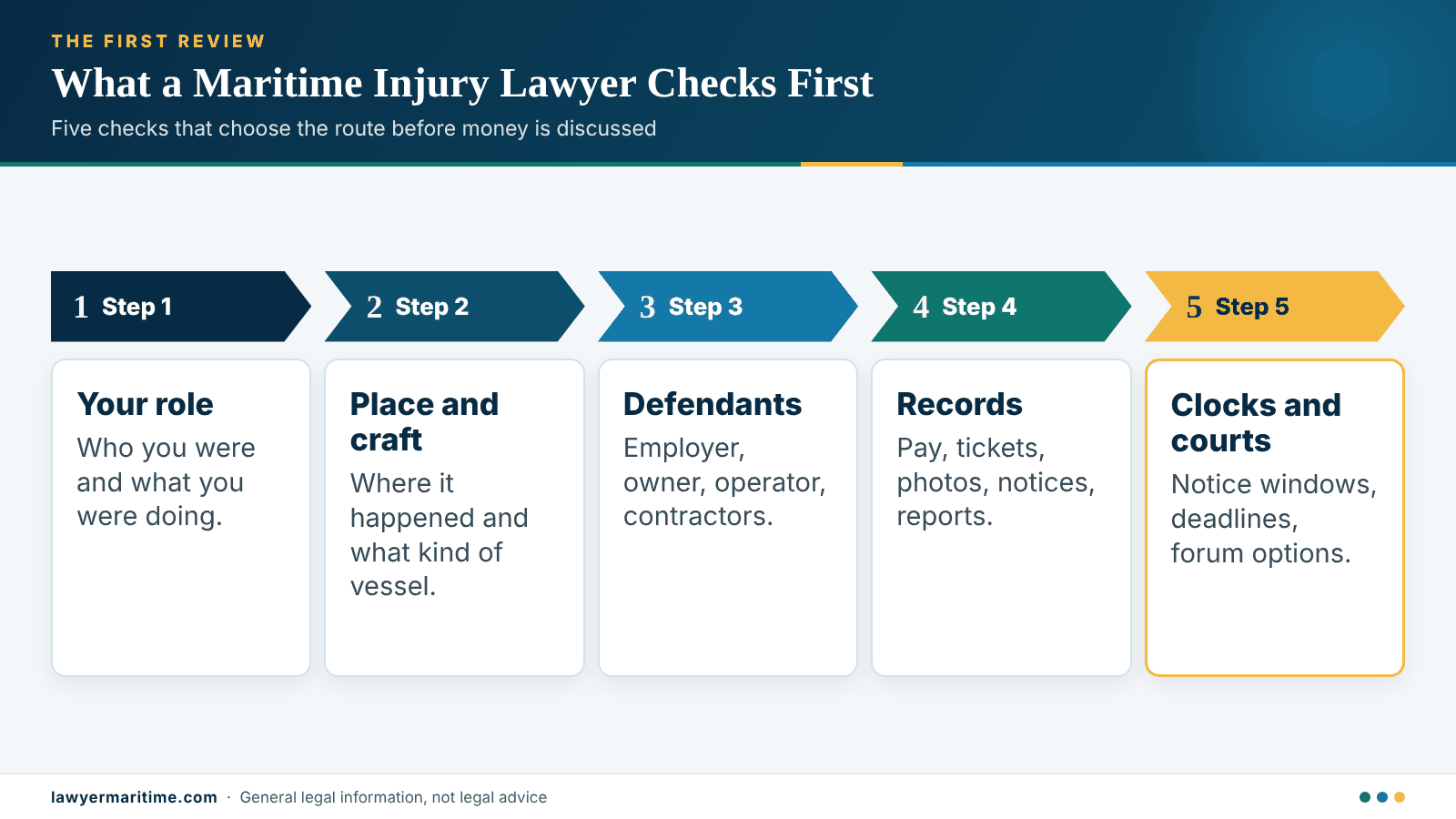
Think of it as two passes. The first pass asks which law governs and who might be responsible. The second asks what evidence exists, and what could disappear, for each route that remains plausible.
What are the first questions a lawyer asks?
Good intake questions are specific and factual. They are meant to rule routes in or out, not to judge the claim’s merits on a first call.
Facts that choose the route
A lawyer typically starts with who you were and what you were doing. Were you employed, and by whom? Did you work aboard a vessel, on a pier, at a yard, or on an installation? How long had you been assigned there, and was the craft moving or moored? For a passenger or boater, the questions shift to the ticket or rental, who was operating the craft, and where the incident happened.
Location carries more weight than most people expect. Distance from shore, state or federal waters, and whether the water was navigable can affect jurisdiction, the applicable statute, and even the court. Write down the place as precisely as you can, and note whether you or someone else logged a position.
Defendants, insurers, and the corporate map
The second set of questions maps who may be responsible. On a working vessel, that can include the employer, the vessel’s owner, an operator, a charterer, a manager, and other contractors. Ashore, it can include the terminal operator, a stevedore, an equipment maker, or a shipyard. For recreational incidents, it may include the operator, the owner, a rental company, a marina, or another boater.
Fault in maritime cases is often shared. In United States v. Reliable Transfer Co., 421 U.S. 397 (1975), the Supreme Court adopted proportionate fault allocation in maritime collision cases, replacing an older equal-division rule. Your own conduct may also be examined. That’s not a reason to stay silent about it; a lawyer needs the full picture to evaluate the route accurately.
What evidence supports each route?
Evidence in a maritime claim has two jobs. It connects the injured person to the right route, and it supports fault, vessel condition, and losses within that route. The table below shows how those jobs differ by route.
Records that tie you to a route
For workers, the most useful records are the ones that show what you actually did. Pay stubs, tax forms, crew lists, hitch or rotation schedules, assignment emails, safety training certificates, and vessel names or numbers all help show whether your connection to a vessel or a shoreside facility was substantial. If your employer calls you a contractor, keep the contract and any invoices.
For passengers and boaters, the key records are the ticket, booking confirmation, rental agreement, waiver, and photos of the area where you were hurt. Keep medical records, but also keep ordinary receipts for care and travel. They show the effect of the injury on your life in a way that a diagnosis code cannot.
Official reports and their limits
Government investigations can supply facts, but they have legal limits. Under 46 U.S.C. § 6308, the contents of Coast Guard marine casualty investigation reports are generally shielded from use as evidence or discovery in civil proceedings, and investigators generally cannot be compelled to testify without the Secretary’s permission. Under 49 U.S.C. § 1154(b), no part of an NTSB accident report may be admitted into evidence or used in a civil damages action about the matter reported. Our guide to maritime collision investigations explains how those processes work.
The practical lesson is to preserve underlying facts rather than count on a report. Photos, logs, witness names, maintenance records, and your own contemporaneous notes belong to the claim. In shipyard and terminal settings, OSHA also has a role; the Supreme Court recognized in Chao v. Mallard Bay Drilling, Inc., 534 U.S. 235 (2002), that OSHA may regulate working conditions on uninspected vessels where the Coast Guard has not exercised its own authority over those conditions.
| Route | Records that connect you to the route | Records that bear on fault or vessel condition | Often overlooked |
|---|---|---|---|
| Crew member | Crew lists, pay and tax records, assignment history, vessel names | Logs, maintenance records, incident reports, witness names | Text messages with the captain or dispatcher about the injury |
| Longshore or shipyard worker | Employer identity, job assignments, work location, badge or gate records | Equipment inspection records, safety meeting notes, photos of the area | Written notice of injury to the employer and the claim paperwork |
| Offshore worker | Work orders, platform or vessel assignment, rotation schedule, contracts | Operator procedures, job hazard reviews, indemnity and master service contracts | Which company actually controlled the work area |
| Passenger | Ticket, booking confirmation, passenger contract, receipts | Photos of the hazard, other passengers’ names, complaints, crew statements | Date and time of the incident report you were given |
| Boater or guest | Registration, rental agreement, waiver, insurance details | Weather, lighting, speed, alcohol questions, navigation lights, photos of damage | Any state or federal accident report that was filed |
Passengers, Boaters, and Guests: The Negligence Route
People who are on the water for travel, tourism, or recreation don’t receive maintenance and cure, and they aren’t covered by the LHWCA merely because they’re aboard. Their claims generally rest on general maritime negligence, which asks whether someone owed a duty of care and failed to meet it. The paperwork around the trip often matters as much as the accident itself.
What rules govern passengers on commercial vessels?
Cruise ships, ferries, excursion boats, and charter operations differ in size, but the framework for an injured passenger is similar. The carrier’s duty, the passage contract, and a few federal statutes frame the claim.
Reasonable care, notice, and proof
The baseline duty comes from Kermarec v. Compagnie Generale Transatlantique, 358 U.S. 625 (1959). There, the Supreme Court held that a shipowner owes those lawfully aboard a duty of reasonable care under the circumstances of each case, and it rejected the land-based distinction between licensees and invitees. That standard is flexible. A crowded gangway in rough weather demands more care than an empty promenade on a calm day.
Courts also often ask whether the carrier knew, or should have known, about the dangerous condition. That is why evidence of earlier complaints, repeated spills, broken equipment, or missing warnings can matter. A passenger who fell on a wet deck may need to show how long the water was there, whether crew had been alerted, and what a careful operator would have done. Photographs taken right away and the names of other passengers can carry real weight.
Tickets: notice windows, suit deadlines, and forum clauses
The ticket is a contract, and its fine print can reshape a claim. For seagoing vessels carrying passengers or property between U.S. ports, or between a U.S. port and a foreign port, 46 U.S.C. § 30508 provides that the carrier may not limit the period for giving notice of a personal injury or death claim to less than six months, or the period for filing suit to less than one year. The section excludes categories such as pleasure yachts, tugs, towing vessels, and fishing vessels, so it is not universal. Section 30509 adds that covered carriers may not use a contract to cap liability for passenger injury or death caused by their negligence or fault, although it permits some limits on emotional-distress claims.
Many passage contracts set a suit period shorter than three years, within those floors, and many contain forum-selection clauses. In Carnival Cruise Lines, Inc. v. Shute, 499 U.S. 585 (1991), the Supreme Court enforced a forum-selection clause printed on a cruise ticket. Keep your ticket, your booking confirmation, and any terms you were emailed, and don’t assume that a clause is either valid or invalid until a lawyer has read it.
What about recreational boating, rentals, and guests?
Recreational incidents are common and legally varied. They can involve a single boat, a collision, a passenger who was not the owner, or a rented craft. The route is general maritime negligence, but the details and the paperwork look different from the commercial setting.
Operators, owners, rentals, and guests
As noted earlier, Foremost confirms that pleasure-boat collisions can fall within admiralty jurisdiction. The operator’s conduct is usually the center of the case: lookout, speed, distance, lighting, impairment, and compliance with the navigation rules, which for inland waters appear at 33 U.S.C. §§ 2001-2038 and for international waters at 33 U.S.C. §§ 1601-1608. Under The Pennsylvania, 86 U.S. (19 Wall.) 125 (1874), a vessel that violates a statutory rule designed to prevent collisions may bear the burden of showing its violation could not have caused the accident.
A guest on a friend’s boat is generally owed reasonable care, and the owner’s responsibility may extend to maintenance and equipment as well as navigation. Rental customers often sign agreements with waivers, damage terms, and notice requirements. Whether a particular waiver is enforceable can depend on the court and the facts, so keep the rental contract and avoid signing anything further without review.
Reporting, insurance, and the limitation action
Federal regulations require the operator of a covered recreational vessel to file a boating accident report when a person dies or disappears, when someone needs medical treatment beyond first aid, or when damage reaches a stated threshold. Under 33 C.F.R. § 173.55, the report is due within 48 hours in the death and serious-injury situations, and within 10 days in other cases. The report goes to the state reporting authority, so ask whether one was filed and request a copy.
Two other features can surprise injured boaters. Liability insurers often have their own notice rules, so the owner should tell the insurer promptly. And vessel owners can ask a federal court to cap their liability under the Limitation of Liability Act, now codified starting at 46 U.S.C. § 30523 after a 2022 renumbering, which limits an owner’s exposure to the value of the vessel and pending freight in qualifying situations. Courts have worked out how those proceedings interact with a claimant’s right to choose a forum, as in Lewis v. Lewis & Clark Marine, Inc., 531 U.S. 438 (2001).
| Scenario | Framework that usually applies | Where disputes tend to arise |
|---|---|---|
| Cruise passenger falls on a wet deck | General maritime negligence; passage contract; 46 U.S.C. §§ 30508-30509 if they apply | Notice of the hazard, ticket terms, forum clause |
| Ferry or excursion passenger hurt during a sudden maneuver | General maritime negligence; carrier’s duty of reasonable care | Operator conduct, passenger positioning, incident records |
| Guest injured on a friend’s boat | General maritime negligence against the owner or operator | Who was operating, insurance coverage, the guest’s own conduct |
| Rental watercraft collision | General maritime negligence; rental contract; possible limitation proceeding | Waiver enforceability, rental company’s instruction and maintenance, operator fault |
| Charter-boat customer hurt by deck equipment | General maritime negligence; charter terms | Crew’s training, equipment condition, contract language |
Bystanders, Contractors, and Families: When the Route Is Less Obvious
Some injured people do not fit the worker or passenger templates. A swimmer, a dock visitor, a contractor who boards for one afternoon, and a family grieving a death each raise their own questions. Their routes are less obvious, which is exactly why they benefit from careful sorting at the start.
Who else can be hurt by a vessel or a marine operation?
Maritime injuries are not limited to people aboard. Vessels move through crowded waterways, tie up beside piers, and work near people who have no connection to the crew.
Swimmers, dock visitors, and people on land
A swimmer struck by a boat on navigable waters is an easy case on location, because the injury happened on the water. The Admiralty Extension Act, 46 U.S.C. § 30101, extends admiralty jurisdiction to injuries on land caused by a vessel on navigable waters, which can cover a vessel that strikes a pier and injures someone standing on it or nearby. The statute allows these claims to proceed in rem or in personam under the usual admiralty principles.
When the vessel belongs to or is operated by the federal government, special rules apply. Section 30101(c) provides that, for land-damage claims against the United States, the chapters on suits in admiralty and public vessels supply the exclusive remedy, and a civil action generally cannot be filed until six months after a written claim is presented to the agency. That is a claim-presentment step, and it is easy to miss because it comes before any lawsuit.
Contractors, vendors, and inspectors aboard
Surveyors, vendors, technicians, and other contractors often board vessels for a short task. Most are not seamen, because their connection to any one vessel is brief. Their employer’s workers’ compensation system is usually the first source of benefits, and which system applies depends on whether they fall within the LHWCA or outside it.
The LHWCA definition itself shows how fine the lines are: 33 U.S.C. § 902(3)(D) excludes certain workers of suppliers, transporters, or vendors who are temporarily doing business on an employer’s premises and are not performing that employer’s usual covered work, when state compensation covers them. A contractor who is covered by the LHWCA may sue the vessel in negligence under § 905(b). One who is outside it may have different options against the vessel, depending on the facts and on state compensation rules.
What routes open when someone dies?
A death raises many of the same questions as an injury, plus the question of who may bring the claim. Several federal and state sources can be involved, and the decedent’s role and the place of death both count.
Death on the high seas, in state waters, and of a crew member
The Death on the High Seas Act (DOHSA), 46 U.S.C. § 30302, allows the personal representative of a person killed by wrongful act, neglect, or default on the high seas more than three nautical miles from the shore of the United States to sue in admiralty, for the exclusive benefit of the decedent’s spouse, parent, child, or dependent relative. In Mobil Oil Corp. v. Higginbotham, 436 U.S. 618 (1978), the Supreme Court held that DOHSA limits recovery to pecuniary loss and does not allow a general maritime supplement for deaths governed by it.
Closer to shore, the picture shifts. In Yamaha Motor Corp. v. Calhoun, 516 U.S. 199 (1996), the Court held that state remedies were not displaced for the death of a nonseafarer, a child killed in a jet-ski collision in state territorial waters. For a seaman’s death, the personal representative may sue under the Jones Act, 46 U.S.C. § 30104(a), and Miles v. Apex Marine Corp., 498 U.S. 19 (1990), held that loss-of-society damages are not available in a seaman’s wrongful-death claim under general maritime law. Families of covered shore workers may also be eligible for statutory death benefits under the LHWCA.
Who brings the claim, and why timing questions come early
In most death cases, a personal representative must bring the action for the benefit of others. Who qualifies, and how an estate is opened, depends on state procedure. A family that waits to sort out the estate may be using time that a limitation period is already consuming.
The general three-year period for maritime tort injury and death actions is found in 46 U.S.C. § 30106, and DOHSA claims are generally treated under that period, though other laws can differ. Our deeper guide on the DOHSA claim deadline covers those timing questions, which are beyond the route-by-person focus of this article. Families should also be cautious about signing early releases, a subject addressed in our guide to maritime settlement releases.
Clocks and First Steps for Each Route
Deadlines are where a route stops being academic. The same injury can come with a notice window measured in days on one route and a suit period measured in years on another. This section gives you the pattern, not your personal date, which only a lawyer can confirm from your facts.
Why do the clocks differ from route to route?
Different statutes, contracts, and regulations create different clocks, and they often run at the same time. Some govern notice, some govern filing a claim, and some govern filing suit.
The general three-year period and what can change it
For many maritime tort claims, 46 U.S.C. § 30106 provides that a civil action for personal injury or death must be brought within three years after the cause of action arose, unless another law provides otherwise. The Jones Act borrows the FELA limitations period in 45 U.S.C. § 56, which is also three years. Those periods are the backdrop for seaman claims, many passenger claims, and many boating claims.
The backdrop is not the whole story. A contract may shorten the period within the limits that the law allows. State-law claims, such as some wrongful-death or land-based claims, follow state limitation statutes. And when the clock starts, or pauses, can itself be contested. Our DOHSA claim deadline guide goes deeper on how these questions play out in fatal cases.
Shorter windows: LHWCA notice, passenger tickets, and boating reports
Some clocks are much shorter. Under the LHWCA, 33 U.S.C. § 912(a) calls for written notice of an injury to the employer and the Department of Labor’s deputy commissioner within 30 days of the injury, or of when the worker knew or should have known of its connection to employment, with exceptions in § 912(d) for situations such as employer knowledge or lack of prejudice. Section 913(a) generally bars a claim for compensation unless it is filed within one year, with a knowledge-based starting point and special rules where payments have been made.
For passengers, contracts may set notice and suit windows within the floors of 46 U.S.C. § 30508. For recreational boating, the operator’s accident report is due in as little as 48 hours under 33 C.F.R. § 173.55. That report isn’t your deadline, but the speed of the report is a reminder that facts become harder to pin down quickly. Local ports and courts can change practice, but they don’t change these federal rules.
| Route | Clock or notice to check | Source | Main caveat |
|---|---|---|---|
| Seaman | Three-year period for the injury action; prompt written notice of the injury to the employer | 46 U.S.C. § 30106; 45 U.S.C. § 56 | Accrual, tolling, and employer or contract notice terms can differ |
| Longshore or shipyard worker | Notice within 30 days; claim within one year; separate period for a third-party suit | 33 U.S.C. §§ 912-913; 46 U.S.C. § 30106 for suits against vessels | Knowledge-based starting points and excuses for late notice |
| Commercial passenger | Contract notice and suit windows, within statutory floors | Passage contract; 46 U.S.C. § 30508; 46 U.S.C. § 30106 | Applies to certain vessels and voyages only; exceptions exist |
| Recreational boater or guest | Three-year period for the injury action; operator accident report within days | 46 U.S.C. § 30106; 33 C.F.R. § 173.55 | Rental contracts and insurance policies may add notice terms |
| Claim against the United States for land damage from a vessel | Written claim before suit; at least six months before filing | 46 U.S.C. § 30101(c) | Other statutes may set their own limits on the government claim |
| Family after a death | Generally three years for maritime death actions; state periods for state-law claims | 46 U.S.C. § 30106; state law | Estate steps and the governing statute can change timing |
What should you do in the first days?
The first days are about two goals: protecting your health and keeping options open. The steps are the same across routes, though the details vary.
Steps that protect your health and your options
- Get medical care and follow it. Tell providers how the injury happened, list every symptom, and keep your discharge papers and work restrictions.
- Report the injury in writing. Crew and shore workers should notify the employer or supervisor, and passengers and boaters should ask for an incident report from the carrier, operator, or rental company. Keep a copy.
- Record what you can while memory is fresh. Photograph the area, equipment, and injuries, write down names and contact details for witnesses, and note the weather and the time.
- Collect the paperwork that proves your route. Gather pay records, crew or assignment lists, tickets, rental agreements, and insurance details before they are lost or replaced.
- Talk to a maritime attorney before signing or recording anything. This matters most for releases, recorded statements, and claim forms.
Mistakes that complicate the route
A few errors turn up often enough to name. Some come from pressure, and some from assuming that the first form or phone call is routine.
- Signing a release, settlement paper, or waiver you haven’t had reviewed
- Giving a recorded statement to an adjuster or investigator without understanding the purpose
- Assuming your job title or the label on your pay stub decides your legal route
- Posting about the accident, your recovery, or your activities on social media
- Understating or leaving out earlier injuries or conditions on medical or employment forms
- Throwing away tickets, texts, photos, or emails because the case “seems simple”
The point about earlier conditions deserves care. For seamen, courts have developed a defense where a worker willfully concealed a relevant pre-existing condition, as in McCorpen v. Central Gulf S.S. Corp., 396 F.2d 547 (5th Cir. 1968). Being accurate on medical forms protects you, and a lawyer can help you decide how to answer questions that you don’t understand.

How to Choose a Maritime Personal Injury Lawyer for Your Route
By now the pattern should be clear: the best lawyer for one route is not automatically the best fit for another. A crew member’s Jones Act case, a shipyard worker’s LHWCA claim, and a cruise passenger’s contract dispute draw on different statutes, different forums, and different habits of proof. Choosing counsel is a matching exercise, and this section shows how to do it without relying on advertising language.
For a broader comparison framework, our guides on how to evaluate a maritime lawyer’s qualifications and what to expect from a first consultation go further than this page can.
How do you match a lawyer to your route?
Maritime law is a federal specialty with many sub-areas. A lawyer who is strong on one route may refer another, and that’s a sign of candor, not weakness.
Experience that fits your category
Start by asking which routes the lawyer actually handles. Seaman claims draw on the Jones Act, maintenance and cure, and unseaworthiness. Longshore claims involve the Department of Labor’s administrative process and § 905(b) litigation. Passenger and boating claims turn on ticket terms, negligence proof, and sometimes limitation proceedings. Offshore claims may combine several of these with OCSLA questions.
Also ask about forums. Some cases belong in federal admiralty court, some in state court under the saving-to-suitors clause, and some in an administrative system. A lawyer who regularly works in the relevant forum will often see procedural traps sooner. Maritime law is federal, so geography matters less than it does in many other fields, although local practice and courts do vary. Our pages on the maritime law attorney role and the maritime lawyer hub give more background.
Checking claims instead of trusting slogans
Law-firm marketing is regulated. The ABA Model Rules treat false or misleading communications about a lawyer’s services as improper, and state rules, which control, can be stricter. A website that promises results, claims to be the best, or implies a specialty the lawyer doesn’t hold deserves skepticism.
You can check a lawyer’s license and discipline history through the licensing state’s bar. Some states certify specialists in particular fields, and the rules for describing a specialty differ by state, so ask what a credential means and who grants it. If you’re starting from a local search, our page on finding a maritime lawyer near you is a useful companion.
What should you ask at the first meeting?
A first meeting is a two-way evaluation. You are deciding whether to trust the lawyer with a significant matter, and the lawyer is deciding whether the route and facts fit the practice.
Questions about your route and plan
The best questions are the ones that make the lawyer apply the route logic to your facts. Listen for specifics. A good answer will say what must be shown, what records are needed, and what remains uncertain. A weak answer will focus on how large the result might be.
Bring the documents you gathered after the injury, but don’t worry if you can’t produce all of them. A lawyer can often help obtain missing records through proper channels, and a candid account of gaps is more useful than a polished story.
| Question | Why it matters | What to listen for |
|---|---|---|
| Which route do you think fits my facts, and what could change that? | Wrong-route filings can waste time and options | A reasoned answer with named facts to check, not a certainty |
| Which defendants and insurers do you want to identify first? | The defendant list determines the claims and the forum | Specific categories such as employer, vessel owner, operator, contractor |
| What notices or reports should I confirm now? | Short windows can apply to some routes | Route-specific answers with caveats about your facts |
| Do you handle this route yourself or with co-counsel? | Some matters need coordinated counsel in different systems | A clear explanation of who does what and how you will be updated |
| How will fees, costs, and liens work? | Costs and reimbursement claims can affect what you receive | A written agreement and plain explanations rather than slogans |
Fees, communication, and what no one can promise
Ask for any fee arrangement in writing before you commit. Under ABA Model Rule 1.5, fees must be reasonable, and the rule calls for a contingent fee agreement to be in writing and to explain how expenses are handled. State rules vary, so confirm what applies where the lawyer practices. Under Model Rule 1.18, information you share with a lawyer as a prospective client is generally protected even if you do not hire the lawyer, though the exact scope depends on the state.
Be wary of any promise about outcomes. No ethical lawyer can tell you at the first meeting that a claim will succeed or what it will be worth. What you can reasonably expect is a clear explanation of the route, the evidence that matters, the uncertainties, and the next steps.
Frequently Asked Questions
These answers are general. They show how the rules usually work, and your facts may change the result.
Choosing and sorting your route
What does a maritime personal injury lawyer do that a general injury lawyer might not?
A maritime personal injury lawyer works with federal maritime statutes and doctrines, such as the Jones Act, maintenance and cure, the LHWCA, and general maritime negligence. The lawyer also handles forum questions that don’t arise in ordinary injury cases, including admiralty jurisdiction and limitation proceedings. A general injury lawyer may be excellent in state court and still not handle these systems regularly.
How do I know whether I’m a seaman or a longshore worker?
Status turns on the facts of your work, not your title. Courts ask about your duties and the substantial duration and nature of your connection to a vessel in navigation. Crew members are excluded from the LHWCA, so the two routes are generally separate. A lawyer will look at your work history and the vessel before naming a route.
Can I be both a worker and a passenger on the same trip?
It depends on the circumstances. A crew member off duty on a leisure outing may be treated differently from the same person working a shift. The legal question focuses on what the person was doing and under what arrangement, so the answer is fact-specific.
Workers and offshore claims
Can an LHWCA worker also sue the vessel?
Often yes, in negligence, under 33 U.S.C. § 905(b), though not for unseaworthiness. The vessel’s duties are limited by case law, and special bars apply in some employment relationships. The worker can generally receive LHWCA benefits and pursue a third-party suit, which raises credit and lien questions to resolve with counsel.
Is an offshore platform a vessel?
Fixed platforms are generally not treated as vessels, but the status of floating or mobile rigs depends on the structure and its use. The question matters because vessel status can open the crew route and unseaworthiness claims. A lawyer will review the rig’s design, mobility, and operating history rather than relying on a label.
What if my employer says I’m covered by state workers’ compensation?
That statement does not settle your legal route. Some workers are properly covered by state systems, while others fall under the LHWCA or qualify as seamen. Because benefits and third-party rights differ, ask a lawyer to review your status before you accept a characterization, and keep copies of any claim forms you sign.
Passengers, boaters, and families
Does my cruise ticket limit my claim?
It can shape it. Tickets may set notice windows, suit deadlines, and forum clauses, though federal statutes set minimum notice and suit periods for certain voyages and restrict some liability limits. Keep your ticket and any emailed terms, and have them reviewed early rather than assuming a clause is unenforceable.
What if I was hurt in a boating accident and nobody filed a report?
Federal regulations require the operator of a covered recreational vessel to file a report in specified situations, and the timing can be short. If none was filed, tell a lawyer. Your own photos, witness names, medical records, and notes can still document what happened.
Can my family bring a claim if someone died on the water?
Possibly, but the route depends on where the death occurred and who the person was. DOHSA, the Jones Act, general maritime law, the LHWCA, and state law can each be involved. A personal representative usually brings the action, so speak with counsel about the estate and the timing early.
Timing, evidence, and next steps
How long do I have to file a maritime injury claim?
A general three-year period applies to many maritime injury actions under 46 U.S.C. § 30106. Notice windows, contracts, and other statutes can be shorter, and LHWCA claims have much shorter notice and filing periods. Confirm your own dates with a lawyer rather than counting from an article.
What should I bring to a first consultation?
Bring identification, medical records and bills, any written reports or notices, pay and assignment records, tickets or rental agreements, photos, and a short timeline of events. If you don’t have everything, bring what you have. A lawyer can often suggest how to obtain the rest.
Should I talk to the insurance adjuster first?
There is no rule that fits every case, but you generally have no obligation to give a recorded statement before understanding your rights. Adjusters work for the insurer. A short conversation with counsel before you sign or record anything can prevent misunderstandings.
Can a lawyer tell me what my claim is worth?
A careful lawyer can explain the categories of recovery that may apply and the factors that raise or lower them. No honest source can promise an amount at the start, because liability, medical outcome, and records are still developing. Our guide to maritime injury compensation covers the categories.
Sources and Legal Authorities
The authorities below support the legal statements in this guide. Each should be checked against current text before you rely on it.
Statutes and regulations
Federal statutes
- 46 U.S.C. § 30104 – Jones Act personal injury and death of a seaman
- 46 U.S.C. § 30106 – Time limit on maritime action for personal injury or death
- 46 U.S.C. § 30101 – Extension of jurisdiction to injury on land
- 46 U.S.C. § 30508 – Limitations on notice of claim and suit in passenger contracts
- 46 U.S.C. § 30509 – Limitations on passenger contract liability terms
- 46 U.S.C. § 30302 – Death on the High Seas Act, cause of action
- 46 U.S.C. § 30523 – Limitation of liability
- 46 U.S.C. § 6308 – Marine casualty investigation reports and testimony
- 49 U.S.C. § 1154 – NTSB reports and their use in civil actions
- 28 U.S.C. § 1333 – Admiralty jurisdiction and saving to suitors
- 43 U.S.C. § 1333 – Outer Continental Shelf Lands Act, laws applicable to the shelf
Longshore and Harbor Workers’ Compensation Act and regulations
- 33 U.S.C. § 902 – LHWCA definitions, including “employee”
- 33 U.S.C. § 903 – Coverage and situs
- 33 U.S.C. § 905 – Exclusiveness of liability and vessel negligence suits
- 33 U.S.C. § 912 – Notice of injury or death
- 33 U.S.C. § 913 – Filing of claims
- 33 C.F.R. Part 173, Subpart C – Reports of casualties and accidents (recreational vessels)
Cases and agency materials
Supreme Court and federal appellate decisions
- Kermarec v. Compagnie Generale Transatlantique, 358 U.S. 625 (1959) – shipowner’s duty of reasonable care to those lawfully aboard
- Mitchell v. Trawler Racer, Inc., 362 U.S. 539 (1960) – unseaworthiness duty
- Foremost Insurance Co. v. Richardson, 457 U.S. 668 (1982) – pleasure-boat collision within admiralty jurisdiction
- Herb’s Welding, Inc. v. Gray, 470 U.S. 414 (1985) – fixed-platform welder and LHWCA maritime employment
- Southwest Marine, Inc. v. Gizoni, 502 U.S. 81 (1991) – seaman status and prior LHWCA benefits
- Chandris, Inc. v. Latsis, 515 U.S. 347 (1995) – two-part test for seaman status
- Yamaha Motor Corp. v. Calhoun, 516 U.S. 199 (1996) – state remedies for nonseafarer deaths in state waters
- Mobil Oil Corp. v. Higginbotham, 436 U.S. 618 (1978) – DOHSA damages limited to pecuniary loss
- Also referenced without links: Calmar S.S. Corp. v. Taylor, 303 U.S. 525 (1938); The Pennsylvania, 86 U.S. (19 Wall.) 125 (1874); Executive Jet Aviation, Inc. v. City of Cleveland, 409 U.S. 249 (1972); Jerome B. Grubart, Inc. v. Great Lakes Dredge & Dock Co., 513 U.S. 527 (1995); Usner v. Luckenbach Overseas Corp., 400 U.S. 494 (1971); Scindia Steam Navigation Co. v. De Los Santos, 451 U.S. 156 (1981); Howlett v. Birkdale Shipping Co., 512 U.S. 92 (1994); United States v. Reliable Transfer Co., 421 U.S. 397 (1975); Miles v. Apex Marine Corp., 498 U.S. 19 (1990); Carnival Cruise Lines, Inc. v. Shute, 499 U.S. 585 (1991); Stewart v. Dutra Construction Co., 543 U.S. 481 (2005); Lewis v. Lewis & Clark Marine, Inc., 531 U.S. 438 (2001); Chao v. Mallard Bay Drilling, Inc., 534 U.S. 235 (2002); Lozman v. City of Riviera Beach, 568 U.S. 115 (2013); McCorpen v. Central Gulf S.S. Corp., 396 F.2d 547 (5th Cir. 1968); Sanchez v. Smart Fabricators of Texas, L.L.C., 997 F.3d 564 (5th Cir. 2021) (en banc).
Agency and official materials
- U.S. Department of Labor, Division of Longshore and Harbor Workers’ Compensation – program information and claim filing
- OSHA – Maritime industry – shipyard, terminal, and longshoring safety context
- Cornell Legal Information Institute – Admiralty (Wex) – overview of admiralty jurisdiction and the saving-to-suitors clause