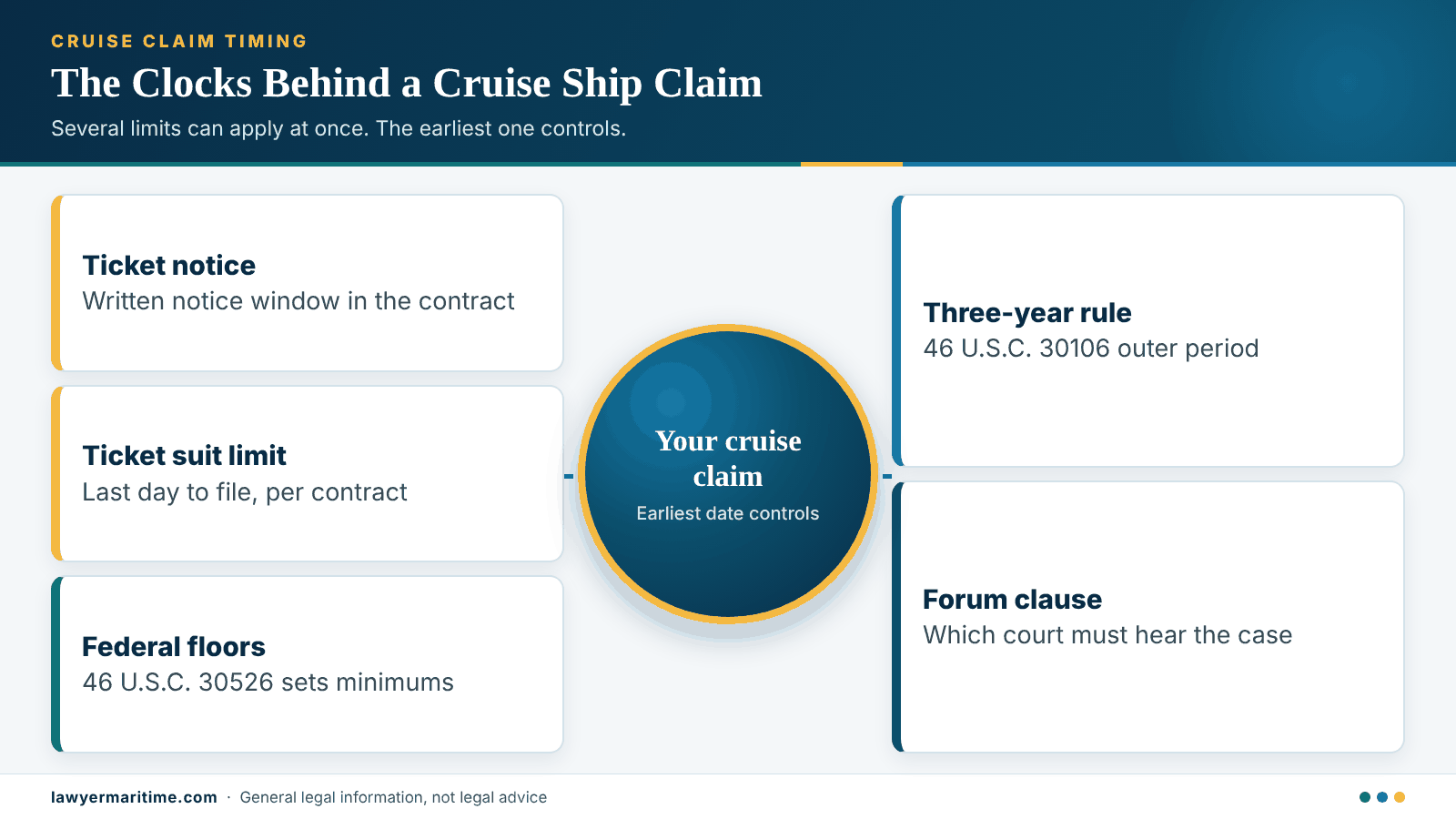
A cruise ship claim deadline is rarely a single date on a single calendar. Passengers usually face layered time limits: a notice-of-claim window and a suit-filing window written into the ticket contract, a federal statute that sets minimum floors for those windows on many U.S.-connected voyages, and the general three-year maritime period for personal injury lawsuits. The shortest applicable clock matters first, and it can be measured in months rather than years. This guide explains how those layers fit together under U.S. admiralty law, where to find and read your ticket terms, what the Supreme Court said about cruise forum-selection clauses in Carnival Cruise Lines v. Shute, and what to document in the first days after an incident. It also covers, briefly, why crew members and families follow different tracks. It is written for injured passengers, travel companions, and relatives who want to get their bearings before deciding what to do next. No article can tell you your own deadline, because the ticket, the itinerary, and the facts decide it.
Why Does a Cruise Ship Claim Have More Than One Deadline?
Most injury claims on land answer to one limitation period set by one state. A cruise injury is different because it sits where federal maritime law, a private contract, and the rules of a particular court overlap. Getting your bearings means separating those layers before you worry about any single date.
Which time limits can apply to a cruise injury?
Think of the limits as a stack. Each layer can end a claim on its own, and the layer that expires first is the one that controls your planning.
The general maritime period under federal law
The background rule is 46 U.S.C. § 30106. Unless another law provides otherwise, a civil action for damages for personal injury or death arising out of a maritime tort must be brought within three years after the cause of action arose. A passenger’s negligence claim against a cruise line is ordinarily a maritime tort claim, so this is the baseline.
The phrase “unless another law provides otherwise” does real work here. It leaves room for statutes and, as the next sections explain, for contract terms that Congress has allowed to operate inside certain limits.
The notice and suit clauses in the ticket contract
Cruise tickets commonly contain two separate contractual time limits. One requires written notice of a claim within a stated period, and the other requires a lawsuit to be filed within a stated period. Either one can be shorter than the three-year statute, and each is measured from a trigger the contract specifies, which is commonly the date of the injury rather than the date you learned how serious it was.
Those contract periods are not unlimited in how short they can be. Federal law sets minimum periods that a ticket for a covered voyage can’t undercut, which is the subject of the next section.
Why is the ticket contract part of the legal picture?
Readers sometimes expect the law to hand them one deadline. In maritime practice, the contract between passenger and cruise line is often where the first answer lives.
A passage ticket is a contract
When you buy a cruise, you accept a passage contract that governs the voyage. It typically covers refunds, itinerary changes, liability limits, and how disputes are handled. Because admiralty law treats the ticket as a binding agreement, courts look to its terms when the line argues that a claim came too late or in the wrong place.
That doesn’t mean every clause is enforceable as written. It means you should read the clauses before deciding that you have time, and you should assume the cruise line will.
Why the three-year figure is a risky planning date
The three-year period is easy to find and easy to remember, which is exactly why it misleads. A passenger who waits two years because “I have three” may discover that the ticket required notice within months and suit within a year. Courts have treated contractual limitation periods as enforceable in cruise cases, and the Eleventh Circuit made that point in a decision discussed later in this article.
| Layer | Where it comes from | What it controls | Main caveat |
|---|---|---|---|
| Ticket notice-of-claim clause | The passage contract | Whether and when you must tell the cruise line about the claim in writing | For covered voyages, it generally cannot be shorter than the statutory floor; read how your contract counts the period |
| Ticket suit-limit clause | The passage contract | The last day to file a lawsuit | Also subject to the statutory floor for covered voyages; may be shorter than three years |
| Federal minimum periods | 46 U.S.C. § 30526 | The shortest notice and suit periods a covered ticket may set | Applies to seagoing vessels on certain U.S.-connected voyages; it is a floor, not a fixed period |
| General maritime period | 46 U.S.C. § 30106 | Three years for maritime personal injury and death actions | Applies unless another law provides otherwise; not a safe target date |
| Forum-selection clause | The passage contract | Which court must hear the case | Filing in the wrong court can defeat a timely filing |
| Tolling and exceptions | Statute and court doctrine | Limited situations in which a clock may pause or a late notice may be excused | Narrow and fact-specific; never plan around them |
What Does Federal Law Say About Ticket Notice and Suit Periods?
Congress decided long ago that cruise lines should not be able to write impossibly short claim periods into passenger tickets. The current version of that rule is 46 U.S.C. § 30526, which sets minimum periods for notice of claim and for filing suit. Older articles and court opinions may cite it under earlier numbers, because a 2022 federal law, Pub. L. 117-263, renumbered it from former section 30508.
What minimum periods does the statute protect?
The statute doesn’t tell a cruise line how long its ticket must allow. It sets a floor below which the ticket cannot go on the voyages it covers.
Six months for notice of a claim
For seagoing vessels, the owner, master, manager, or agent of a vessel carrying passengers or property between U.S. ports, or between a U.S. port and a foreign port, may not set a notice-of-claim period for personal injury or death shorter than six months after the date of the injury or death. The statute says the owner cannot shorten that period by regulation, contract, or otherwise.
In plain English, if your ticket says you must report an injury within, for example, thirty days, a court asked to apply that clause to a covered voyage would have to confront the statute. Don’t rely on that argument, though, without a lawyer’s help. The safer assumption is that the ticket’s notice date is real until someone competent has analyzed it.
One year for filing suit
The same section says the period for bringing a civil action for personal injury or death on a seagoing vessel may not be shorter than one year after the date of the injury or death. That is why so many readers hear the shorthand “six months to give notice, one year to sue.” It is a useful shorthand for the floor, and a poor one for your specific deadline.
A ticket may allow more time than the floor, and the statute doesn’t forbid that. It also doesn’t create a deadline of its own. The operative date is whatever your ticket says, as long as that date is not shorter than the statute allows.
Which voyages and vessels does the section reach?
Scope matters because a floor that does not apply to your voyage protects you from nothing. The statute is more limited than many summaries suggest.
Seagoing vessels and a U.S. connection
Subsection (a) says the section applies only to seagoing vessels, and it excludes several categories: pleasure yachts, tugs, towboats, towing vessels, tank vessels, fishing vessels and fish tenders, canal boats, scows, car floats, barges, lighters, and nondescript vessels. Subsection (b) speaks to vessels carrying passengers or property between U.S. ports or between a U.S. port and a foreign port. A cruise that departs from or returns to a U.S. port is the clearest fit.
An itinerary that never touches a U.S. port presents a harder question. The text we read does not clearly answer whether the floors reach that voyage, so the ticket’s terms, its governing-law clause, and the court’s analysis become more important.
Small passenger vessels and the two-year periods
The 2022 amendments added separate, longer minimums for “covered small passenger vessels”: at least two years for both notice and suit. That category is defined elsewhere in the code and is aimed at a different kind of operation than an ocean-going cruise ship. Whether a given excursion boat or small-ship operator falls into that category is a fact-specific question.
If your injury happened on a private recreational boat rather than a passenger vessel, a different set of rules applies, and our guide to the boating injury claim deadline covers that situation.
When can a late notice be excused or a clock paused?
The statute includes two safety valves. They are real, but they’re narrow, and they work best as a reason to talk to a lawyer promptly rather than a reason to wait.
Late contractual notice is not always fatal
Subsection (c) says that failure to give a notice the contract requires is not a bar to recovery in three situations: the court finds that the owner, master, or agent knew of the injury or death and the owner was not prejudiced; the court finds a satisfactory reason why notice could not be given; or the vessel owner fails to object to the lack of notice. A cruise line that sent a nurse to your cabin and documented the fall in its own records may be in a different position than one that never learned of the incident.
Courts decide those questions on the facts, and the outcomes aren’t predictable from the outside. A missed notice window is therefore a problem to analyze quickly, not one to assume is hopeless or harmless.
Minors, incapacity, and deaths
Subsection (d) tolls the contractual notice period when the claimant is a minor or mentally incompetent, or when the claim is for wrongful death. As we read it, the notice period is tolled until the earlier of two events: the appointment of a legal representative for the minor, the incompetent person, or the decedent’s estate, or three years after the injury or death.
That subsection speaks to notice. It does not, on the text we read, settle how the suit period is handled for the same claimants, so no family should assume the suit window is also paused.
How Do You Find and Read Your Cruise Ticket Contract?
The statute sets the floor, but the ticket sets the actual dates. Many passengers have never opened the contract they accepted at booking, so the first practical task after an incident is to locate it and save a copy.
Where can you find the contract that governs your voyage?
You are looking for the passage contract or ticket contract, sometimes called guest terms or terms and conditions. The label differs from line to line, and so does the place it is posted.
Booking confirmation, cruise line website, and travel agent documents
Start with the booking confirmation email, which usually links to or attaches the governing terms. Then check the cruise line’s website, where lines commonly post their current passage contract, and any documents delivered during online check-in. If a travel agent, a package seller, or a third-party site arranged the cruise, ask for every document they gave you, because additional terms may sit in a separate set of conditions.
Layouts change and we can’t tell you where your line keeps its terms today. What matters is that you find the version that applied to your sailing and keep a dated copy.
Which version applies to your sailing
Cruise contracts are revised over time, and the terms may differ by booking date, sailing date, brand, or the market where you booked. Look for an effective date or version number on the document, and compare it with the date you booked and the date you sailed. If the website now shows a newer version, save the one that governed your trip, using a screenshot or PDF that displays the date.
Which clauses affect your deadline?
Ticket contracts run long, and the clauses that matter to a claim are scattered among refund terms, itinerary changes, and passenger conduct rules. Read the whole document once, then focus on a handful of provisions.
Notice-of-claim and suit-limit clauses
Search for headings such as claims, notice of claim, or limitation of actions, though the labels vary. Note whether the clause counts in days, months, or years, what event starts the count, and whether the notice must be written. Also note where the notice goes: some contracts name a specific address or department, and sending it elsewhere can create an argument about whether notice was ever given.
Do the arithmetic yourself and then verify it. A period stated in months can end earlier than you expect if the contract counts from an event other than the day you got hurt, so a lawyer’s confirmation is worth having.
Forum, governing-law, and other dispute terms
The same contract usually says which court must hear a lawsuit, which country’s or state’s law governs the contract, and whether any other dispute process applies. Those clauses are as deadline-relevant as the time limits because a lawsuit filed on time in the wrong place may not protect you, a point developed in the filing section below.
Also look for terms about shore excursions, which are sometimes sold by the line and operated by independent companies under separate conditions. The excursion’s own paperwork may contain notice and forum clauses that differ from the cruise contract.
| Clause | What it may do | Question to ask |
|---|---|---|
| Notice of claim | Requires written notice within a stated period, sometimes to a named address | What counts as valid notice, when does the count begin, and where does it go? |
| Limitation of actions | Sets a deadline to file suit | Is the period at least what 46 U.S.C. § 30526 allows for my voyage, and what does “filed” require? |
| Forum selection | Names the court, federal or state, where suit must be brought | Which court, and what happens if federal jurisdiction is unavailable? |
| Governing law | Picks the law that governs the contract and sometimes the claim | Does it point to U.S. maritime law or to another country’s law? |
| Limits on damages or liability | May restrict some categories of recovery | Does the term run into the limits in 46 U.S.C. § 30527? |
| Shore excursion terms | May shift responsibility to an independent operator | Which document governs the excursion, and what notice does it require? |
Will a court enforce the fine print?
Passengers often ask whether a clause they never negotiated can really bind them. The short answer from the case law is that courts have enforced many cruise ticket clauses, while still leaving room for challenges in unusual facts.
Carnival Cruise Lines v. Shute
In Carnival Cruise Lines, Inc. v. Shute, 499 U.S. 585 (1991), the Supreme Court enforced a ticket clause requiring suit in a Florida court. The Court rejected the idea that a nonnegotiated forum clause in a form ticket is unenforceable simply because passengers can’t bargain over it. It pointed to the line’s interest in limiting where it can be sued, the benefit of avoiding venue fights, and the possibility that passengers share the savings through fares.
The holding has limits. The Court noted that forum clauses in form contracts remain subject to scrutiny for fundamental fairness, and it did not decide whether the passengers had adequate notice of the clause because they conceded that point. The Court also held that the clause did not violate the then-existing statute on passenger-ticket liability limits, since a Florida court qualified as a court of competent jurisdiction.
Reasonable communication and fundamental fairness
Later cases fill in the framework. In Estate of Myhra v. Royal Caribbean Cruises, Ltd., No. 10-15840 (11th Cir. Sept. 21, 2012), the Eleventh Circuit asked whether the forum clause was reasonably communicated by looking at its physical characteristics and at whether the passenger could become meaningfully informed of it and reject its terms. Fundamental fairness, as the court described it, is a separate inquiry into matters like fraud or overreaching.
Because courts have enforced clauses in these decisions, a passenger should not plan around the hope that fine print will be set aside. A lawyer may find a genuine challenge, such as terms that were never actually presented, but that’s something to evaluate early with the deadline still open.
What Should You Document After a Cruise Ship Injury?
Evidence in a cruise case is unusually perishable. The ship sails on, the crew rotates, and the place where you fell may be repaired or cleaned before anyone photographs it. What you gather in the first days can matter more than what you remember a year later.
What should you do while you are still on the ship?
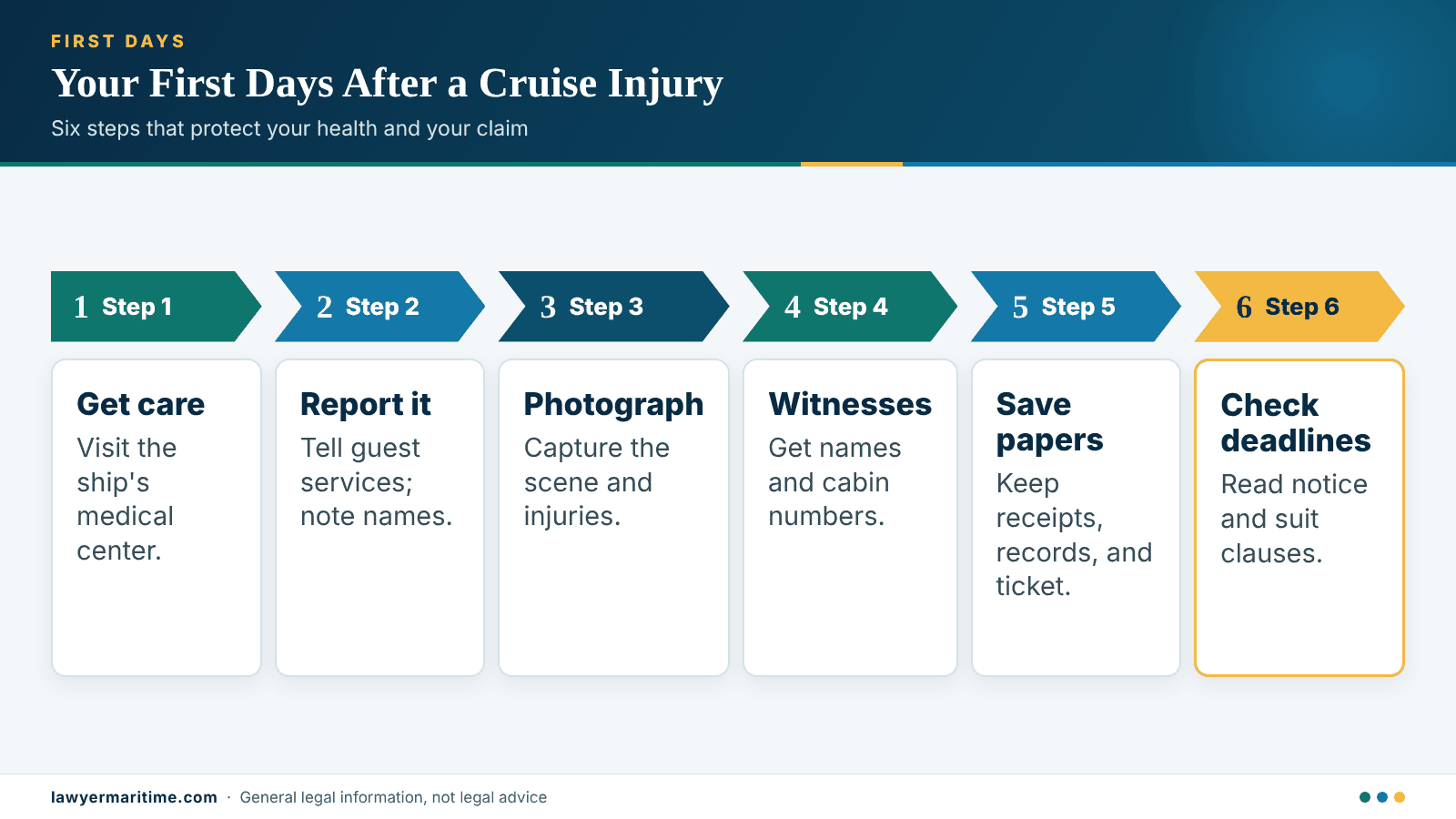
Your first priority is medical care, not building a file. Once you’re stable, a few steps give a later claim something solid to rest on.
Report to the medical center and guest services
Go to the ship’s medical center and describe what happened accurately and without guessing about fault. Ask that the visit and the cause of the injury be written into the record, and note the date, the time, and the names or descriptions of the staff you saw. If you’re asked to sign anything, read it first and ask for a copy of whatever you sign.
Then report the incident to guest services or the purser’s desk, and ask whether an incident report is being prepared. You may or may not be given a copy, but your request and the answer you received are worth recording in a notes file on your phone.
Photographs, witnesses, and the place where it happened
Photograph the spot from several angles before conditions change: a wet deck, a loose threshold, a poorly lit stairway, a missing warning sign, or a malfunctioning door. Include something that shows scale, and photograph your footwear and any visible injuries, repeating the injury photos over the following days as bruising develops.
Ask nearby passengers and crew for names and cabin numbers, and write down what each person saw. Witnesses disperse quickly at the end of a cruise, and a stranger’s contact information collected at the scene can be impossible to reconstruct later.
What should you gather before and after you disembark?
Some records live only on the ship, while others live with you. Collect the second group early, and make a plan for the first.
Records that can disappear or change
Keep your cabin key card, boarding documents, shipboard account statements, medical bills, and receipts for anything you paid for because of the injury. Preserve photographs in their original digital form, because the file data can show when and where they were taken.
The cruise line controls its own video, maintenance logs, and incident reports, and passengers can’t see how long those records are kept. A lawyer can send a written request that the line preserve them, which is one reason early legal advice can help even before you decide to file anything.
Treatment after you get home
See your own doctor promptly and describe the incident and the symptoms you noticed on the ship. Follow the treatment plan, keep your appointment records, and save pharmacy and therapy receipts. Gaps in treatment and inconsistent descriptions of how the injury happened are routinely used to challenge claims, so honest, steady documentation is more useful than a polished one.
| Item | Where it usually comes from | Why it helps |
|---|---|---|
| Ticket contract and booking confirmation | Cruise line website, email, travel agent | Shows the notice, suit, forum, and governing-law clauses that apply |
| Photographs and video of the scene | Your phone, taken before conditions change | Records the hazard and conditions that are likely to be altered or repaired |
| Witness names and contact details | Passengers and crew nearby | Preserves accounts that become hard to find after the voyage |
| Ship medical records | The ship’s medical center | Documents the first examination and the stated cause of injury |
| Incident report or request for one | Guest services or security | Shows the cruise line was told, which can matter to notice arguments |
| Shipboard account and receipts | Your folio and purchase records | Supports out-of-pocket loss and shows timing |
| Treatment records after the cruise | Your doctors, therapists, and pharmacy | Links the injury to the incident and tracks recovery |
What if the incident involves a crime or serious assault on board?
A fall or a dining-room burn is a safety claim. An assault, a sexual offense, or a missing person raises separate reporting systems, and those systems don’t replace the claim deadlines discussed in this article.
Reporting channels under the Cruise Vessel Security and Safety Act
The statute at 46 U.S.C. § 3507 applies to passenger vessels that can carry at least 250 passengers, have overnight accommodations for at least that many, and are on a voyage that embarks or disembarks passengers in the United States. As we read it, such vessels must provide passengers a plain-English security guide explaining how to report crimes, keep a log of crime complaints available to law enforcement, and promptly notify the FBI of listed serious incidents.
The same section addresses onboard medical staffing and forensic examination equipment for sexual assault cases. If you or someone traveling with you was assaulted, ask the ship’s security and medical staff how to contact law enforcement and who will hold the examination records.
Why a criminal report does not replace the claim notice
A report to the FBI or to ship security starts a criminal or security process, not a civil claim. Those processes answer to different people for different reasons, and the ticket’s notice and suit periods may keep running while an investigation proceeds. Treat the civil deadlines as a separate track from day one, and ask a lawyer to help you coordinate the two.
How Does a Written Notice of Claim Work?
A notice of claim is the letter or form that tells the cruise line you intend to pursue a claim. It isn’t a lawsuit, and it doesn’t ask a court for anything. Its job is to satisfy the contract’s notice clause and to put the line on record that someone was hurt.
What does a notice of claim need to say?
The ticket contract, not this article, controls the details. Still, most notices work best when they are short, factual, and sent exactly the way the contract directs.
Content and form
A sound notice identifies the claimant, the booking or reservation number, the ship, the sailing dates, the date and place of the incident, and a brief, neutral description of what happened and the injuries known so far. It doesn’t need to argue fault or list every expected loss. Overstating or speculating in a notice can create inconsistencies later, so stick to what you know.
If the contract prescribes a form or specific content, follow it literally. Where the contract is silent, a plain written statement with those identifying facts is the usual approach, and a lawyer can improve on it.
Delivery: address, method, and proof
Send the notice to the address and in the manner the contract specifies. If the contract allows email, send it that way and also keep the sent message with its header information. If it calls for mail, use a method that creates a delivery record, such as certified mail or a tracked courier, and keep the receipt.
Put the delivery date on your calendar and note the day the contract’s period ends, with a margin before it. An unproven notice is easy for a defendant to dispute, while a documented one is hard to argue with.
What if the notice window has already passed?
Many people read their ticket weeks or months after the incident and discover that the notice period is gone or nearly gone. That is stressful, but it isn’t necessarily the end of the claim.
The statutory exceptions
As described earlier, § 30526(c) says a failure to give contractual notice is not a bar to recovery in specified situations, including where the line knew of the injury and was not prejudiced, where there was a satisfactory reason notice could not be given, or where the owner did not object. Those are arguments, and the cruise line may contest them. The facts that tend to matter are how quickly the line learned of the incident, what its staff recorded, and whether the delay affected its ability to investigate.
Late notice and the suit deadline are separate problems
Missing the notice window doesn’t by itself extinguish the suit period, and filing a lawsuit on time doesn’t always cure a missed notice. The two requirements are written as separate clauses, and the cruise line may raise either one as a defense. Evaluate each independently rather than treating one date as the master clock.
How should you handle the cruise line’s claims department?
After a serious incident, the line or its insurer may reach out with sympathy, refunds, or onboard credit. Those contacts can be sincere and still serve the line’s interests, so go in with a plan.
Early calls, recorded statements, and offers
You are generally free to listen, take notes, and decline to give a recorded statement until you have received advice. Ask for the caller’s name, role, and contact information, and ask that requests come in writing. Describe your injuries and the events accurately, but avoid speculating about fault or minimizing symptoms you’re still discovering.
A fast offer made before you know the full extent of your injury deserves caution. Medical needs often become clearer over weeks or months, and an early figure may not reflect them.
Releases and why timing matters
Accepting a payment, credit, or refund may come with a release that gives up claims. Read the paper before signing and look for language about releasing all claims arising from the voyage. Our guide to the maritime settlement release explains how releases work and what to look for.
Signing a release can end a claim regardless of how much time remained on the clock, which makes it a deadline event of its own. If a document refers to settling or releasing claims, pause and get advice before you sign.
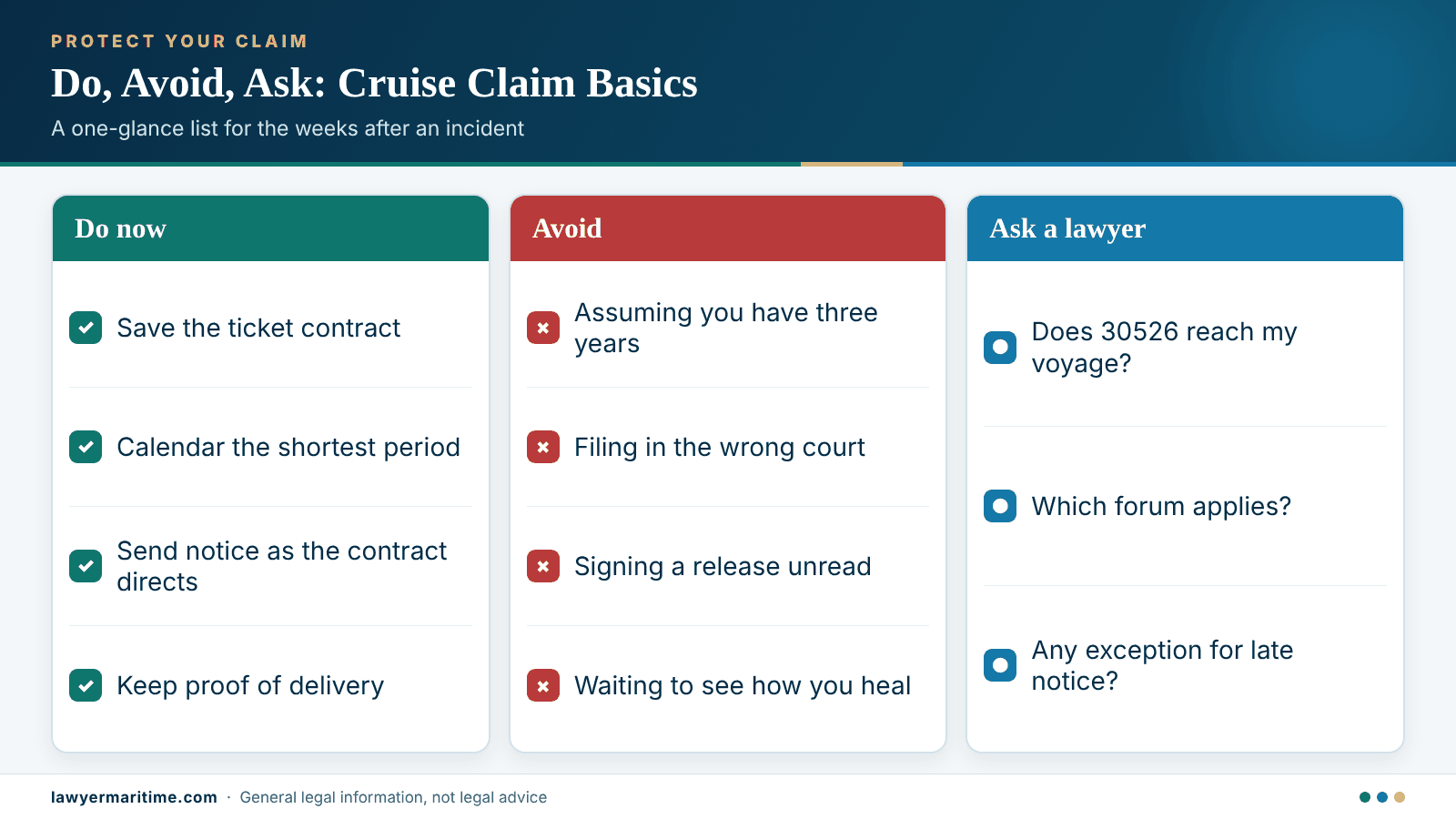
| Common mistake | Why it hurts | Better action |
|---|---|---|
| Assuming three years applies | The ticket may require notice and suit much sooner | Find the contract and treat its shortest period as the working deadline |
| Telling only a crew member | A verbal report may not satisfy a written-notice clause | Send the written notice the contract describes and keep proof of delivery |
| Waiting for treatment to finish | The notice or suit clock can run while you recover | Calendar the ticket dates now and update the claim as treatment continues |
| Filing in the wrong court | A timely filing in an improper forum may not preserve the claim | Confirm the contract’s forum clause before filing anything |
| Signing a release casually | A signed release can give up claims | Read the document and get advice before signing |
| Losing the paperwork | The ticket, receipts, and photos are core evidence | Save dated copies in two places on the day you find them |
Where and When Must You File a Cruise Ship Lawsuit?
Notice protects a claim only for the moment. The harder deadline is the one for filing suit, and it comes with a second question that surprises many readers: which court must receive the complaint.
How do forum-selection clauses work in practice?
A forum-selection clause names the court that must hear a dispute. After Shute, courts have treated these clauses as presumptively valid in cruise cases, which turns the choice of court into part of the deadline analysis.
Federal court first, then state court
Some tickets name a particular federal district and, where federal jurisdiction is not available, a state court in the same area. Admiralty claims can often be brought in federal court under the court’s maritime jurisdiction, but the availability of federal jurisdiction depends on the claim and the parties. Read your clause closely, and don’t assume it matches what a general website or a friend’s experience suggests. For a broader treatment of why maritime cases land in particular courts, see our overview of maritime jurisdiction.
The hard cases come when a passenger files in an apparently reasonable court that the contract does not allow. A clause that names a federal district generally means that a state-court filing is the wrong place when federal jurisdiction exists.
Chang v. Carnival: the wrong-court problem
The Eleventh Circuit’s decision in Chang v. Carnival Corp., No. 14-13228 (11th Cir. Oct. 6, 2016) shows how this plays out. The passenger’s ticket required a one-year filing deadline and suit in a specified federal district when federal jurisdiction existed. She sued within the year in a Florida state court after the cruise line had twice warned her counsel it would enforce the forum clause, and then filed in federal court after the deadline passed.
The court affirmed summary judgment for the cruise line. It held that the contractual limitation period was enforceable, that equitable tolling is an extraordinary remedy used sparingly, and that the passenger had not carried her burden to show it applied. The court distinguished an earlier case, Booth v. Carnival Corp., in which tolling applied because the defendant had not clearly signaled it would enforce the forum clause. The practical lesson is that a timely filing in the wrong court is a gamble, not a safeguard.
How do choice of law and foreign-flag ships affect the claim?
A cruise ship can be registered in one country, owned by a company in another, and boarded by passengers from many more. We cover this only at a high level, because it’s a question for counsel, but a few points help you ask better questions.
Flag, itinerary, and the ticket’s law clause
Many large cruise ships sail under foreign registry, and tickets often include a clause choosing the law that governs the contract or the dispute. Courts decide which law applies by looking at the contract, the vessel’s connections, and the claim itself, and the answer can differ for different issues in the same case. Admiralty jurisdiction over an injury on navigable waters doesn’t disappear because the ship flies a foreign flag, a topic explored further in our guide to admiralty law.
What matters for timing is that a governing-law clause may bring in rules about notice and limitations that differ from U.S. maritime law. That is another reason to read the clause before assuming that a familiar rule applies.
Foreign forum clauses: the Myhra example
In Myhra, the ticket terms Royal Caribbean sent through a travel agent under a U.K. booking provided that disputes would be handled only by the courts of England and Wales under English law. The Eleventh Circuit affirmed dismissal of the U.S. suit, holding that what was then 46 U.S.C. § 30509(a), now § 30527, did not bar a forum-selection clause even where the chosen forum might apply law that limits liability. It also held that the clause was reasonably communicated and not the product of overreaching.
The decision is limited to its facts and clause, but it carries a practical warning. Where and how you booked can determine the forum, so tell your lawyer exactly how the cruise was purchased.
How do you count the days?
Even after you know the period and the court, you still have to count correctly. Small errors in counting are among the most avoidable ways to lose a claim.
When the clock starts
The statute measures the minimum notice and suit periods from the date of the injury or death, and the general maritime period runs from when the cause of action arose. Your contract may state its own trigger. Unless a lawyer confirms otherwise, count from the date of the incident.
Some injuries surface later, as when symptoms from a fall or an infection appear days after the voyage. Those cases raise accrual questions that depend on the facts and the governing rule, so don’t wait to see whether a later start date helps you. Also avoid assuming that weekends or holidays extend a period, because contracts and court rules treat them differently.
Tolling, filing mechanics, and keeping a margin
Tolling pauses a clock. Statutory tolling in § 30526(d) is limited to the categories described earlier, and equitable tolling, as Chang shows, is rarely granted. Neither should be part of a plan.
The contract may say a suit must be “filed” or “brought” by a certain day. Ask counsel what exactly the contract and the court’s rules require to meet that deadline, and aim to file well before it. A margin of weeks is cheap insurance against a rejected filing, a technical error, or an unforeseen delay.
| Situation | What the ticket may say | What to confirm |
|---|---|---|
| Ticket names a federal district | Suit must be brought there when federal jurisdiction exists | Whether federal jurisdiction exists and whether filing elsewhere would be improper |
| Ticket adds a state-court fallback | A named state court applies when federal jurisdiction is unavailable | Whether the fallback truly applies to your claim and parties |
| Ticket names a foreign court | Disputes must be heard in another country, perhaps under its law | How and where you booked, and whether a court would enforce the clause |
| Ticket points to another dispute process | A pre-suit or alternative process before or instead of court | Whether it is mandatory, and how it interacts with the filing deadline |
| Voyage never touches a U.S. port | Terms and law clauses may carry more weight | Whether the federal minimum periods reach the voyage at all |
How Do Deadlines Differ for Crew Members and Families?
Everything above is written for passengers. Two other groups sit on the same ships and follow different rules: people who work aboard, and relatives of someone who died. This section sketches both briefly and points to fuller guides.
How are crew members’ claims different from passengers’ claims?
A crew member is not a passenger, and the ticket contract does not govern the employment relationship. The paperwork that matters is the employment agreement and the law that applies to a worker with seaman status.
Seaman remedies and the three-year rule
A crew member who qualifies as a seaman may have a negligence claim against the employer under the Jones Act, 46 U.S.C. § 30104, along with claims for maintenance and cure and unseaworthiness. This page uses “Jones Act” only for that seaman injury remedy, not for the cabotage rules on shipping in 46 U.S.C. § 55102 and following sections. The Jones Act incorporates the Federal Employers’ Liability Act, and that act’s limitation provision, 45 U.S.C. § 56, requires suit within three years from the day the cause of action accrued.
Whether a particular cruise employee is a seaman depends on legal tests and facts, not on a job title. Our guide to Jones Act seaman status explains the test, and the Jones Act statute of limitations article covers the crew-side deadlines in depth.
Employment contracts, arbitration, and foreign crew
Cruise crew often sign employment agreements or are covered by collective agreements that contain their own notice requirements, forum rules, and arbitration terms. In Bautista v. Star Cruises, 396 F.3d 1289 (11th Cir. 2005), the Eleventh Circuit upheld an order compelling foreign seamen to arbitrate claims in the Philippines under the international convention on foreign arbitral awards, and the claims included personal injury and maintenance and cure.
The federal arbitration statute at 9 U.S.C. § 202 carves out agreements between only U.S. citizens unless the relationship has a meaningful connection to a foreign country. A crew member’s nationality, contract, and ship all matter, which is why a general rule is dangerous. If a dispute over maintenance and cure payments is the problem, our maintenance and cure denied guide is the better starting point.
What changes after a death on a voyage?
When a passenger or crew member dies, the claimants are the family, and the claim is brought through a personal representative. The legal sources change depending on where the death occurred.
Who can sue, and under which law
The Death on the High Seas Act, 46 U.S.C. § 30302, gives a decedent’s personal representative a civil admiralty action for a death caused by wrongful act, neglect, or default on the high seas more than three nautical miles from the U.S. shore, for the benefit of the decedent’s spouse, parent, child, or dependent relative. Deaths closer to shore may involve other sources of law, and the remedies differ by source. Our guide to the DOHSA claim deadline addresses that statute directly.
Ticket terms can still matter in a death claim, including forum and governing-law clauses. Families should obtain the contract for the decedent’s voyage early.
Tolling of notice and the outer limits
As noted earlier, the contractual notice period is tolled for wrongful death claims until a representative is appointed or three years after the death, whichever comes first, under subsection (d) of § 30526. The general maritime period of § 30106 is also three years, so a family should not read the notice tolling as permission to wait.
Appointing an estate representative can take time and varies by state. A family that suspects a cruise-related death claim should speak with a maritime lawyer promptly, because the contract’s suit period and the court rules operate independently of that tolling provision.
| Claimant | Start with | Time-limit sources to check | Common complication |
|---|---|---|---|
| Injured passenger | The passage contract | Ticket notice and suit clauses, 46 U.S.C. § 30526, and 46 U.S.C. § 30106 | Forum and governing-law clauses, including foreign courts |
| Crew member who may be a seaman | The employment contract and seaman status | 46 U.S.C. § 30104 with 45 U.S.C. § 56 for the Jones Act claim, plus any contract notice terms | Whether the worker is a seaman, and arbitration agreements |
| Family after a death | The decedent’s role and where the death occurred | DOHSA, 46 U.S.C. § 30106, the ticket or employment terms, and § 30526(d) tolling of notice | Appointing a personal representative and identifying the governing law |
Cruise Ship Claim Deadline Checklist: What to Do Now
If you’re reading this after an incident, the most useful thing you can do is turn the layers above into a short list of dates and a short list of questions. This section does that without repeating the evidence steps from earlier.
How do you build your own deadline calendar?
A calendar won’t decide your case, but it keeps small decisions from turning into missed dates.
Find the earliest date first
List every period you found in the ticket, in the order they expire: notice, suit, and any dispute process the contract requires. Beside each, write how the contract counts it and what event starts the count. Then add the general three-year period from § 30106 as the outer boundary, not as a goal.
- Locate the contract. Save the version that applied to your sailing, with the date and web address.
- Mark the notice date. Count from the incident unless a lawyer confirms a later trigger.
- Mark the suit date. Note the court the contract requires.
- Add a margin. Put a reminder weeks ahead of each date.
Work backward and keep a margin
Counting backward from the earliest date shows how much time you actually have for treatment, document gathering, and finding a lawyer. A short window isn’t a reason to panic, but it’s a reason to start the conversation promptly. Reminders on two devices cost nothing.
What should you ask a maritime lawyer?
A consultation is more productive when you arrive with specific questions and a folder of paperwork. Our guide to a maritime law consultation is a good companion for preparing, and our page on the maritime injury deadline lawyer looks at deadline questions from the lawyer’s side.
Questions about deadlines and forum
- Does 46 U.S.C. § 30526 apply to my voyage, and what notice and suit periods does my ticket set?
- Which court does my forum clause require, and does it apply to my claim?
- Has any notice requirement already been missed, and are there exceptions that could apply?
- Does a governing-law clause or foreign forum clause affect my case?
- Should anything be sent to the cruise line now, and who should send it?
Documents to bring
Bring the ticket contract and booking confirmation, any email or letters from the cruise line, your photographs, witness details, medical records, and receipts. Include the names of any travel agent or excursion company. If you have already signed anything, bring that too, since it may affect which options remain.
Frequently Asked Questions About Cruise Ship Claim Deadlines
These answers are general. They describe how the rules usually work, and your ticket and facts may change the result.
Deadlines and notice
How long do I have to sue a cruise line after an injury?
There is no single answer. The general maritime period is three years under 46 U.S.C. § 30106, but your ticket may set a shorter suit period, and federal law limits how short that period can be on covered voyages. Treat the shortest period in your ticket as the working date until a lawyer confirms otherwise.
Is the cruise ship claim deadline always six months for notice and one year for suit?
No. Those numbers are the federal minimums for seagoing vessels on covered voyages, and a ticket may allow more time. Some voyages may fall outside the statute, and other facts can change the analysis. Read your own contract and have it reviewed.
Does telling the ship’s staff count as giving notice?
Not necessarily. Reporting to the medical center or guest services is wise, and it may support arguments that the line knew about the incident. But a ticket that requires written notice to a specific address is a separate requirement, so send the notice the contract describes.
What if I did not read my ticket until after the notice period ended?
Do not assume the claim is lost. The statute includes narrow exceptions for late notice, such as when the line knew of the injury and was not prejudiced. Because the suit period is a separate clock, speak with a maritime lawyer quickly.
Tickets, courts, and foreign ships
Can a cruise line make me sue in a specific court?
Often, yes. In Carnival Cruise Lines v. Shute, the Supreme Court enforced a ticket clause requiring suit in Florida, subject to fundamental-fairness review. Courts since then have enforced forum clauses in cruise cases, so confirm yours before you file anywhere.
What happens if I file in the wrong court?
You risk missing the deadline altogether. In Chang v. Carnival Corp., a passenger who sued in a state court within the year, after being warned the forum clause would be enforced, lost when her federal filing came after the deadline. Equitable tolling didn’t rescue the claim.
Does it matter that my ship sailed under a foreign flag?
It can. Foreign registry doesn’t by itself end U.S. admiralty jurisdiction, but ticket terms may select foreign law or a foreign court, and courts have enforced such clauses. Tell your lawyer where and how you booked and what your ticket says.
Crew, families, and special situations
Do cruise ship employees follow the passenger deadlines?
No. Crew claims run on employment contracts and, for seamen, the Jones Act and related remedies, so the passenger ticket doesn’t control. Arbitration clauses can also apply, particularly for foreign crew. See our guide to Jones Act seaman status to understand whether a worker qualifies.
What deadlines apply if a family member died on a cruise?
Several sources can apply, including the general three-year period and, for deaths beyond three nautical miles from the U.S. shore, the Death on the High Seas Act. The contractual notice period may be tolled until an estate representative is appointed, but the suit period and court rules can still run, so families should seek advice promptly.
Do minors get extra time?
The statute tolls the contractual notice period for a minor until a legal representative is appointed or three years after the injury, whichever comes first. As we read it, that provision addresses notice, so a parent should not assume it also extends the suit period.
Where can I read the statute myself?
The text of 46 U.S.C. § 30526 is available through the Legal Information Institute at Cornell Law School, and the sources list below links it with the other authorities discussed here. For the broader legal setting, see our maritime law hub.
Sources and Legal Authorities
We read the following official and court sources while preparing this article; statutes are paraphrased, and current text should be checked before relying on any period or section number.
Statutes and regulations
Passenger ticket and limitation statutes
- 46 U.S.C. § 30526 – notice of claim and limits on time to sue in passenger carriage
- 46 U.S.C. § 30527 – provisions limiting liability for personal injury or death
- 46 U.S.C. § 30106 – time limit for maritime personal injury and death actions
- 46 U.S.C. § 3507 – passenger vessel security and safety requirements
Crew, death, and arbitration statutes
- 46 U.S.C. § 30104 – Jones Act seaman personal injury
- 45 U.S.C. § 56 – FELA limitation of actions
- 46 U.S.C. § 30302 – Death on the High Seas Act cause of action
- 9 U.S.C. § 202 – agreements and awards falling under the arbitration convention
Cases
Supreme Court decision
- Carnival Cruise Lines, Inc. v. Shute, 499 U.S. 585 (1991) – enforcement of a forum-selection clause in a cruise passage ticket
Federal appellate decisions
- Chang v. Carnival Corp., No. 14-13228 (11th Cir. Oct. 6, 2016) – contractual one-year suit period, wrong-forum filing, and equitable tolling
- Estate of Myhra v. Royal Caribbean Cruises, Ltd., No. 10-15840 (11th Cir. Sept. 21, 2012) – foreign forum clause and reasonable communication
- Bautista v. Star Cruises, 396 F.3d 1289 (11th Cir. 2005) – arbitration of foreign seamen’s claims under the arbitration convention