

The maintenance and cure rate that injured seamen ask about is really two things: a daily amount for food and lodging, called maintenance, and the medical care itself, called cure. The daily maintenance figure is not a fixed national number and it is not a share of your wages. Under general maritime law, courts generally look to the reasonable cost of food and lodging where the seaman lives, limited by what the seaman actually spends. An employer’s flat daily payment, a union contract rate, and your own receipts can all point to different numbers, so the evidence matters. This guide explains how the daily figure is set, what goes into it, how to prove it, how contract rates interact with the legal standard, and how rate disputes tend to play out. It is written for injured crew members, offshore and vessel workers, and families who want to get their bearings. It covers the maintenance rate only, not the Jones Act negligence claim.
What Is the Maintenance Rate, and What Does It Measure?
Most people who search for the maintenance and cure rate want one number: how much per day will I be paid while I recover? The honest answer starts with what the number is supposed to measure. This section separates the daily figure from the other benefits that travel with it, so the rest of the guide has a clear target.
What the daily figure is, and what it is not
Maintenance is a living allowance for food and lodging
Maintenance and cure is an obligation under general maritime law. An employer owes it to a seaman who becomes sick or injured in the service of the vessel, and it generally does not depend on proving the employer was at fault. The Supreme Court has treated it as a duty the law itself imposes on the shipowner, not merely a term of the employment contract (Vaughan v. Atkinson, 369 U.S. 527 (1962)).
Maintenance is the living-expense half of that duty. It stands in for the board and lodging a seaman would have had aboard the vessel, paid in cash while the seaman is ashore and recovering. Cure is the medical half: treatment, medication, and related care. When people talk about a “maintenance rate,” they mean the daily dollar figure attached to the first half.
Why wages do not set the rate
A common assumption is that maintenance should be a fraction of what the seaman earned. It isn’t. The Supreme Court has described maintenance and cure as owed in addition to wages, in Atlantic Sounding Co. v. Townsend, 557 U.S. 404 (2009), and the measure is the cost of food and lodging, not the paycheck.
That has two practical consequences. A well-paid engineer and a deckhand living in the same town will usually have the same reasonable food-and-lodging cost, because the question is what it costs to eat and be housed there. And an employer who tries to set maintenance as a percentage of pay is answering the wrong question. In Incandela v. American Dredging Co., 659 F.2d 11 (2d Cir. 1981), the court disregarded an employer figure that was an arbitrary share of the seaman’s salary rather than a measure of living costs.
Maintenance, cure, and unearned wages side by side
Three benefits, three different measures
Injured seamen often hear the three terms used interchangeably, and that confusion leads to rate arguments about the wrong benefit. The table separates what each one covers, how it is measured, and where the daily rate fits.
| Benefit | What it covers | How it is measured | Does the daily rate apply? |
|---|---|---|---|
| Maintenance | Food and lodging while you recover ashore | Reasonable cost of food and lodging in your locality, tied to your actual expense | Yes. This is the daily rate |
| Cure | Medical treatment, medication, and related care | The medical care needed, not a daily dollar figure | No |
| Unearned wages | Wages you would have earned through the end of the voyage or engagement | Your wage terms and the length of the voyage or contract | No, but they run alongside maintenance |
When the three end, and why it matters for the rate
The benefits do not stop at the same time. Cure and maintenance generally continue until the seaman reaches maximum medical improvement, meaning further treatment is not expected to improve the condition. The Supreme Court has said the duty lasts until incapacity is declared permanent, not merely until a doctor first suspects it will be (Vella v. Ford Motor Co., 421 U.S. 1 (1975)), and in Farrell v. United States, 336 U.S. 511 (1949), it described the usual measure as owed “no less and no more.”
Unearned wages follow a different clock: they generally run to the end of the voyage or engagement. For the rate, the lesson is that the daily figure only matters while maintenance is owed. We cover the endpoint in maximum medical improvement and maintenance and cure, and what to do if payments stop in our guide to terminated benefits.
Why there is no universal dollar figure
The amount depends on where and how you live
Food and lodging cost different amounts in a Gulf Coast town, a Pacific Northwest port, and a Midwest river community. Federal courts recognize that, and they have said maintenance awards must account for changes in the cost of living over time and between localities (Hall v. Noble Drilling (U.S.) Inc., 5th Cir. 2001). So any number you read in a forum post, a union flyer, or an old case is a data point from one place and one year, not a rule.
This guide therefore gives no dollar figure and no “typical” daily rate. If you see one quoted as a standard, ask what locality and year it came from, and what evidence supported it.
What employers quote versus what courts apply
Many employers and insurers pay a standard daily amount to keep payments simple and prompt. That practice isn’t unlawful on its face, and a prompt payment is better than none. But a standard figure is the employer’s starting position, and the legal question remains what a seaman reasonably and actually spends on food and lodging.
When the employer’s figure and your real costs differ, you have a rate dispute, and the next sections explain how it is decided. If the problem is that nothing is being paid at all, that’s a different issue, covered in our guide to maintenance and cure denied.
How Do Courts Decide a Reasonable Daily Rate?
Because the Supreme Court has not issued a universal formula for the daily amount, the working rules come largely from federal courts of appeals. They are broadly consistent, though circuits phrase and apply them differently. This section describes the approach laid out in the leading appellate decisions we reviewed, and the next sections apply it.
The legal measure: reasonable cost and actual expense
Reasonable cost of food and lodging in your locality
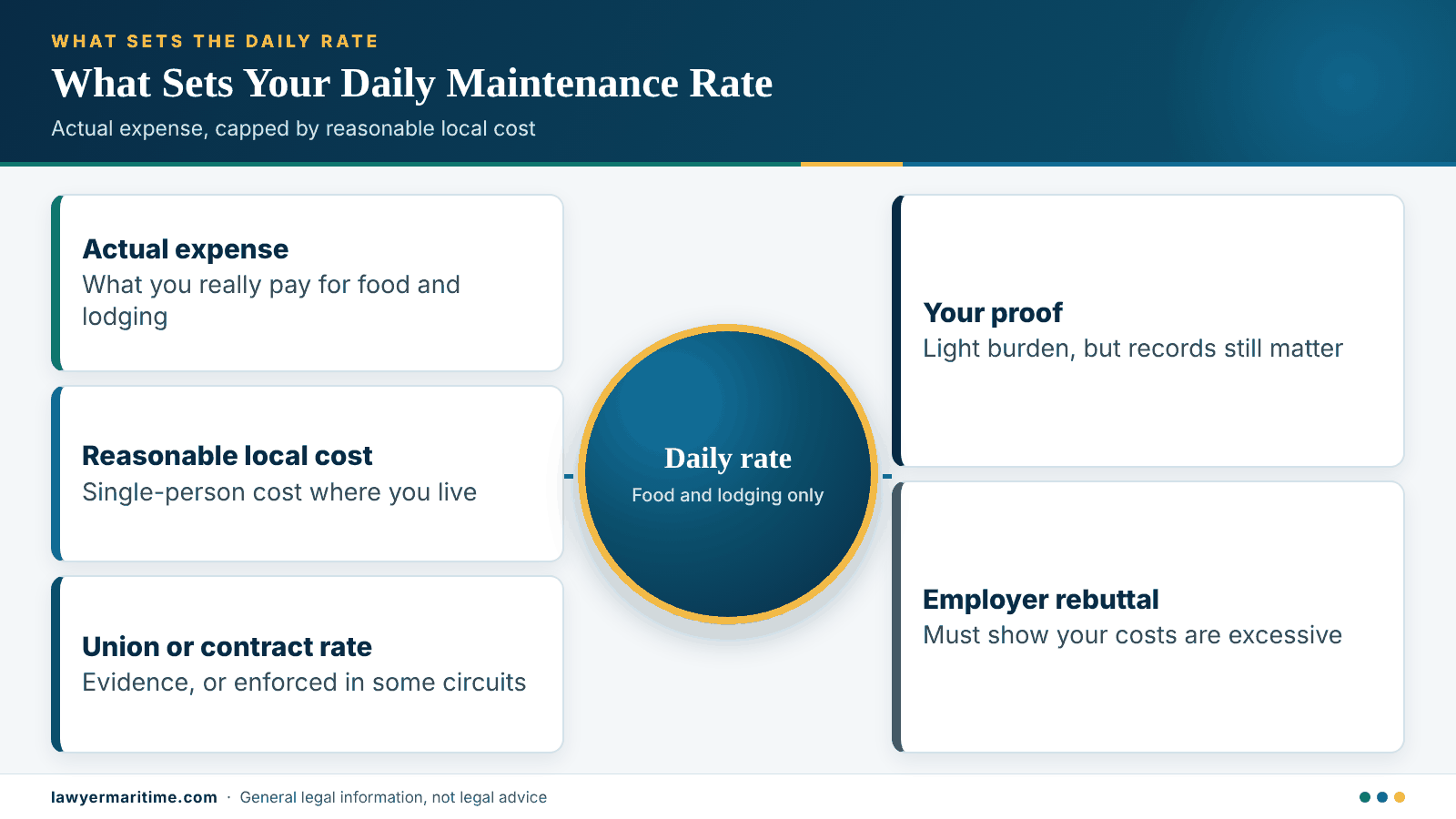
In Hall v. Noble Drilling (U.S.) Inc., decided by the Fifth Circuit in 2001, the court described maintenance as the reasonable cost of food and lodging for a single seaman in the locality of the plaintiff. The words “single seaman” matter. The court was not asking what it costs to run a family household, but what it reasonably costs one person to be fed and housed in that area.
The court said a trial judge may look at several kinds of evidence: the seaman’s actual costs, regional cost information, union contracts or per diems, and awards in other cases. It also said a court may take judicial notice of the prevailing rate in the district. Maintenance amounts are treated as factual findings, which is one reason they are hard to overturn on appeal once the trial court has an evidentiary basis.
Actual expense as the anchor
The same decision ties the reasonable-cost standard to what the seaman really spends. Put simply, a seaman recovers actual food and lodging expense up to the reasonable amount for the locality. If actual costs are higher than reasonable, the reasonable figure controls. If actual costs are lower, the lower figure is the starting point, with one important exception: where the seaman’s actual spending was too low to buy reasonable food and lodging, the court may award the reasonable amount.
The corollary is that a seaman who pays nothing for food and lodging, because someone else provides both at no cost, generally has no maintenance expense to recover. We return to family and shared-household situations in the dispute section below, and our guide on maintenance payment for a seaman covers which living arrangements count in more detail.
Who has to prove what
The seaman’s initial showing is meant to be light
Courts generally do not demand an accountant’s ledger. The Fifth Circuit called the seaman’s burden “feather light” in Hall, and said the seaman’s own testimony about local room and board costs can be enough to support an award. The Second Circuit reached a similar result earlier in Incandela v. American Dredging Co., 659 F.2d 11 (2d Cir. 1981): a seaman makes a prima facie case by proving the actual living expenditures that were necessary during recovery.
That lenient starting point reflects the purpose of the remedy. Maintenance exists to put food and a roof within reach of an injured worker without a drawn-out fight, and a heavy proof burden would defeat that purpose. Light does not mean absent, though. You still need to say what you spend and be able to back it up if asked.
The burden then shifts to the employer
In Incandela, once the seaman showed his actual expenses, the burden shifted to the employer to show those expenses were excessive, taking realistic alternatives for room and board in the area into account. The Ninth Circuit expressly adopted that burden-shifting framework in Barnes v. Sea Hawaii Rafting, LLC, 889 F.3d 517 (9th Cir. 2018).
The practical effect is that an employer cannot simply announce a lower number. It generally needs evidence that your housing or food costs are unreasonable for the area, not just a preference for a cheaper arrangement. Whether a given court applies this framework exactly this way depends on the circuit, so treat it as a strong general pattern rather than a guarantee.
Setting the rate before trial
Why waiting for trial is not always necessary
Some injured seamen assume the daily amount is fixed only at the end of a lawsuit. That is not always so. In Barnes, the Ninth Circuit held that the summary-judgment standard governs a pretrial request to set a maintenance amount, and it directed an award of the seaman’s undisputed actual and reasonable expenses, subject to possible increase after trial.
The decision also noted procedural tools a court can use to award undisputed amounts early or to try the maintenance question on an expedited basis. Whether and how a court uses such tools varies, but the idea is that a seaman should not have to go without living expenses for years while a rate argument is resolved.
What a court will not do
Courts do not treat the maintenance rate as a negotiation with a sliding scale of sympathy. They will not award more than reasonable local cost simply because the seaman’s situation is hard, and they will not award less simply because the employer prefers a round number. They also generally will not stretch maintenance to cover things outside food and lodging, such as a car payment or a phone bill, which we address in the next section.
Nor does a rate ruling decide whether benefits are owed at all. Entitlement, defenses such as concealment of a prior condition, and the date benefits end are separate questions. If your dispute is really about eligibility, see our guide to denied maintenance and cure, and if it concerns willful nonpayment, see maintenance and cure punitive damages.
What Goes Into the Daily Figure?
A daily maintenance rate is really a bundle of monthly costs divided into days. Knowing what belongs in the bundle, and what courts have left out, helps you assemble a number you can defend. The categories below follow the Fifth Circuit’s analysis in Hall, and other courts may draw the lines a little differently.
Lodging: what keeps a home habitable
Rent or mortgage payments
Housing is usually the largest piece. For a renter, the monthly rent is the starting point. For an owner, the mortgage payment is the obvious proof of what it costs to keep a roof overhead, though how a court treats the principal and interest parts of a mortgage can raise additional questions that are worth raising with counsel.
The cost has to be one you actually bear. A seaman who rents a room, pays a share of a lease, or carries a mortgage is spending money on lodging. Someone who lives rent-free in a relative’s home is in a different position, and the dispute section explains how courts have approached it.
Utilities, insurance, and property taxes
The Hall court reasoned that lodging includes the costs necessary to provide habitable housing. It specifically mentioned heat, electricity, home insurance, and real estate taxes. In other words, a house you cannot heat or light is not reasonable lodging, and a home you cannot keep insured or tax-current is not one you can keep.
The court also said utilities may be prorated only to the extent they actually vary with the size of the household. A heating bill that stays about the same whether one person or three people live in the home is not meaningfully reduced by the presence of others, while a water bill that rises with each added person may be.
Food, and what usually stays out
Groceries and meals
The food side of maintenance covers what it reasonably costs to feed yourself. Aboard the vessel the employer would have supplied meals, which is part of the logic of the remedy. Ashore, the equivalent is grocery spending and ordinary meals, measured by what is reasonable for a single person in your area rather than by what you ate before the injury.
Seamen often have the least paperwork here, because groceries are paid in small amounts from many stores. A careful monthly estimate backed by some receipts and bank or card statements is usually more persuasive than a round guess, and the evidence section shows how to build one.
Expenses courts have generally treated as outside maintenance
In Hall the court said telephone, clothing, toiletries, and travel were not part of maintenance. That doesn’t mean those costs are irrelevant to your overall losses. It means they are not generally folded into the daily maintenance figure, and they may belong to a different claim, such as damages in a Jones Act or unseaworthiness case.
Medical costs fall under cure, not maintenance, and courts may analyze travel to treatment as part of cure or as its own expense, depending on the facts and the court. Mixing categories can make a maintenance demand look inflated, which gives the employer an easy reason to dispute the whole number.
| Component | Generally counted? | Helpful proof | What to watch |
|---|---|---|---|
| Rent or mortgage | Yes, if you actually pay it | Lease, rent receipts, mortgage statement, bank records | Shared leases and family arrangements need a clear explanation |
| Utilities needed for habitable housing | Yes, such as heat and electricity | Utility bills for the months in question | Prorating may apply only to costs that change with household size |
| Home insurance and real estate taxes | Yes, for owners, in the Fifth Circuit’s analysis | Insurance declarations, tax bills, escrow statements | Other courts may handle these items differently |
| Groceries and meals | Yes, at a reasonable single-person level | Receipts, card statements, a monthly estimate | Excess or luxury spending may be challenged as unreasonable |
| Telephone, clothing, toiletries | Generally no | Not needed for maintenance | May matter to damages, not to the daily rate |
| Travel for treatment | Often treated with cure, not maintenance; it varies | Mileage and fare records | Keep these separate from the maintenance request |
How Do You Prove Your Maintenance Rate?
Because the starting burden is light and the employer must rebut a reasonable showing, good records can decide a rate dispute before it begins. Proof also protects you from an honest memory problem months later. This section covers the documents that matter and how to turn scattered paperwork into a clear daily figure.
Documents that establish what you actually spend
Housing records
Start with whatever shows what you pay to live where you live. A signed lease, rent receipts or canceled checks, a mortgage statement, a landlord’s letter, or a property tax and insurance bill each answer the employer’s first question: what is the lodging cost? If you pay rent by app or in cash, ask the landlord for a written statement of the monthly amount and the dates you paid, and keep your own note of each payment.
Bank and card statements are often the strongest backup because they were created by someone else for another reason. Highlight the housing lines rather than altering the originals, and keep the untouched versions. A one-page summary on top of the originals helps a claims handler or judge see the total quickly.
Food, utilities, and household records
For utilities, gather the monthly bills for the period you are claiming and any bills that show a seasonal swing. For food, collect grocery receipts, restaurant receipts, and the card statements that show where the money went. Most people don’t save every receipt, which is fine; the aim is a reasonable, documented picture rather than a perfect one.
If receipts are thin, write down a typical week of food spending while it’s fresh and then check it against a month of statements. Courts have accepted the seaman’s own credible testimony about local costs as supporting evidence, so a consistent, well-explained estimate is better than silence. A pattern of numbers that never changes can look made up, so record real variation.
Showing what is reasonable where you live
Local cost evidence
The legal standard is reasonable local cost, so your own spending is only half the proof. If your actual costs look high, local evidence helps confirm they are normal for your area. Useful items include typical rents for comparable one-bedroom or room-share housing in the same town, a grocery cost estimate from a reputable public source, and a recent award or published rate in a case from your federal district, if counsel can supply one.
Union per diems and contract rates can also help, and the Hall court listed them among the evidence a court may consider. Treat them as one input, not the ceiling, and read the next section before assuming a union figure caps your claim.
Keeping a running record and making a written request
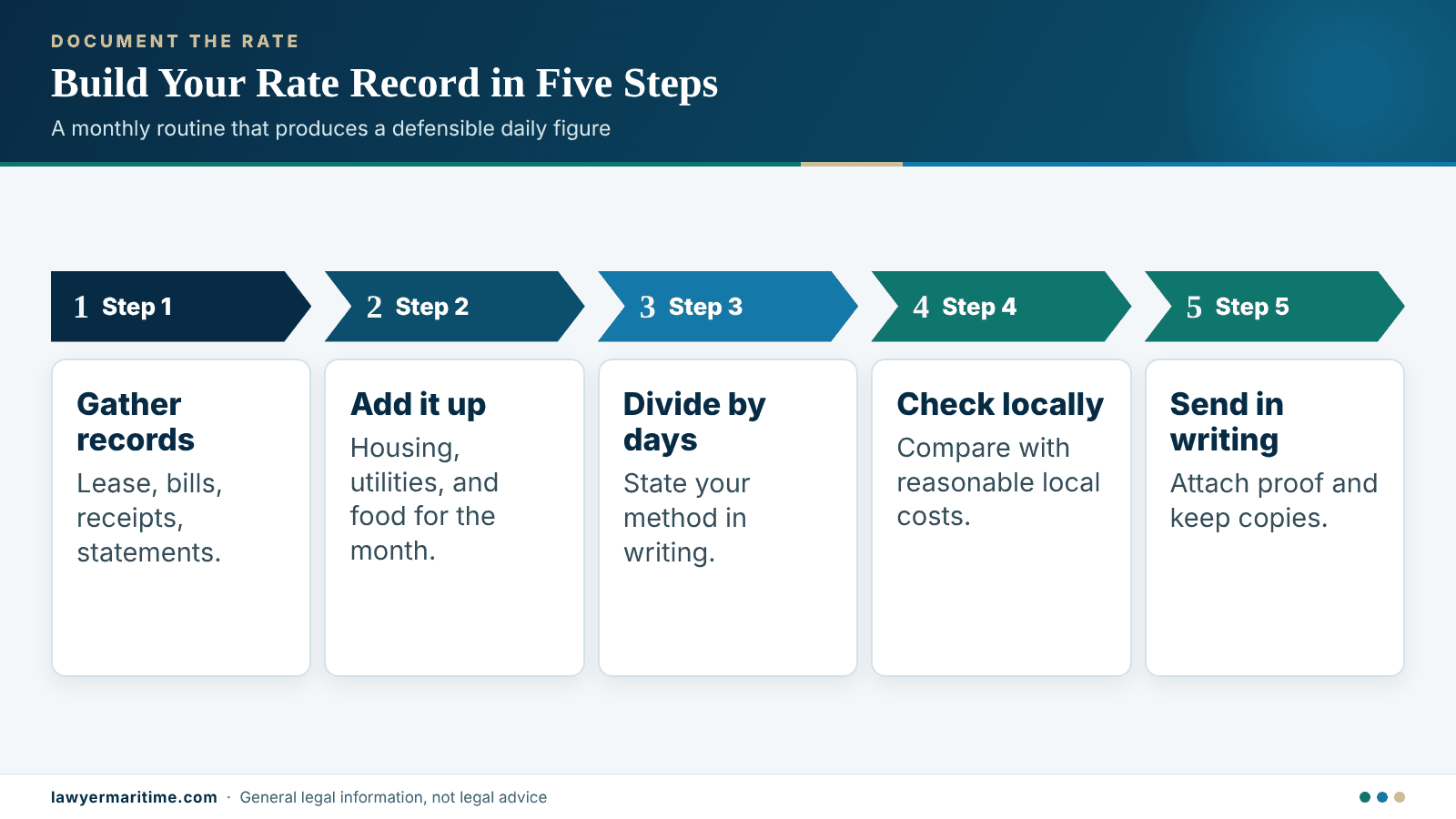
A simple log beats a late reconstruction. Each month, total the housing, utility, and food costs, note the number of days in the month, and divide to get your daily figure. Keep the source documents in a labeled folder, paper or digital, with the log on top.
When you ask the employer or insurer to pay at your documented rate, put the request in writing and attach the summary. A dated letter or email shows what was asked, what was provided, and how the employer responded, which can matter later if the dispute reaches a court. If you are working with counsel, send requests through counsel, and keep copies either way.
| Evidence | What it helps show | Where to get it |
|---|---|---|
| Lease, rent receipts, or mortgage statement | The monthly lodging cost you actually bear | Landlord, lender, or your bank records |
| Utility, insurance, and property tax bills | The costs of keeping the home habitable | Utility accounts, insurer, county tax office, escrow statements |
| Grocery and meal receipts | What you reasonably spend on food | Receipts, card statements, store loyalty accounts |
| Bank and card statements | Independent confirmation of the pattern of spending | Your bank or card issuer, in original form |
| Household cost summary | A month-by-month total and daily figure | You, built from the documents above |
| Local cost comparisons | That your costs are reasonable for your area | Public rental listings, government cost data, counsel’s research |
| Written payment requests and replies | What you asked for and how the employer responded | Your email, letters, and claim notes |
Turning documents into a daily number
A simple way to calculate the figure
The arithmetic is plain. Add the monthly housing cost, the habitability utilities, any owner costs such as insurance and taxes, and the monthly food estimate. Divide by the number of days in that month, or by thirty if you want a steady working number, and state which method you used.
The result is your documented daily figure, and it’s a claim, not a verdict. A court applies the reasonable-local-cost limit, and the employer may challenge items. Writing the method down makes it harder to dispute casually and easier to update when the numbers change.
Where the arithmetic can go wrong
Three mistakes recur. People include items courts generally exclude, such as phone and clothing, which invites a fight over the whole number. They use pre-injury spending on extras rather than a reasonable single-person level. And they forget to reconcile months, so a one-time deposit or moving cost gets spread as if it were recurring.
If your household has more than one person, show how the shared costs are divided and who pays what. The employer may argue for proration, and the household section below explains how the Fifth Circuit answered that argument. A clear explanation up front avoids an avoidable delay.
How Do Employer, Contract, and Union Rates Fit In?
Many seamen first meet the maintenance rate as a number in a union contract, an employment agreement, or an adjuster’s email. Whether that number controls is one of the most contested questions in the field. The short answer is that it depends on the source of the figure and on the court, so it is worth reading the document before accepting a number as final.
Where a stated daily figure can come from
Employer or insurer standard rates
Employers and their insurers often use a standard daily amount for all injured crew, so payments can start quickly. A standard rate has real benefits: no one must litigate before the first payment, and the seaman gets money while the claim is sorted out. Its weakness is that it may have been set years ago, or set for a different region, and never revisited.
Because a standard amount is the employer’s own policy, not a legal ruling, it doesn’t by itself define the legal measure. If it falls below your documented reasonable costs, you can document the gap and ask for an adjustment. Taking the standard payments while you do so is usually sensible, but ask in writing whether the payer treats them as full satisfaction, and do not sign a receipt or release stating that without review.
Collective bargaining agreements and union contracts
Union agreements for unlicensed and licensed seafarers sometimes state a daily maintenance amount. These numbers were negotiated, often as part of a package of wages, benefits, and conditions. They can be strong evidence of what the parties considered reasonable at the time of bargaining.
The Fifth Circuit treated union contracts and per diems as evidence a court may consider in setting a reasonable rate, in Hall. Cornell’s legal encyclopedia states the broader principle that employers and unions cannot contract out of the underlying maintenance and cure right. Those two statements fit together: the obligation itself can’t be bargained away, but a negotiated daily number may still carry weight as evidence of the amount.
When a contract rate controls and when it does not
A circuit that enforced a negotiated rate
The Ninth Circuit took a firmer view in Gardiner v. Sea-Land Service, Inc., 786 F.2d 943 (9th Cir. 1986). Seamen there sued for more than the daily rate stated in their unions’ collective bargaining agreements, and the court held the negotiated rate should be enforced, reasoning that the rate was part of a broader bargained package of wages and benefits, so its adequacy considered alone was not a matter for judicial speculation.
The court drew a limit. It said a different result could follow if a mere token amount were designated for maintenance without a genuine bargain, and one judge dissented, arguing that no private agreement can abrogate the shipowner’s duty. Later decisions may have refined this approach, so do not assume that Gardiner settles the point everywhere or even today in its own circuit.
Individual contracts and outdated numbers
Some courts have been more cautious about applying that reasoning to an individual employment contract that a worker signed alone, with no union bargaining behind it. The seaman in that setting has less leverage, and the maritime law’s longstanding protective attitude toward seamen makes courts examine waivers more closely. The same wariness appears in the release context, where the shipowner bears the burden of showing a seaman’s release was freely given and fully understood (Garrett v. Moore-McCormack Co., 317 U.S. 239 (1942)).
Age matters too. A figure negotiated many years ago may no longer track food and lodging costs, and the Hall court observed that a long-standing standard daily amount lost real value over time as living costs rose. If a contract rate predates the injury by many years, ask whether anyone has updated it and what evidence shows current local costs.
| Source of the figure | How courts may treat it | Question to ask |
|---|---|---|
| Employer or insurer standard rate | A starting position, not the legal measure | How does it compare with my documented reasonable costs? |
| Union contract or collective bargaining agreement | Evidence of reasonable cost; enforced as the rate by at least one circuit absent a token amount | Which circuit governs, and does the agreement actually state a maintenance rate? |
| Individual employment contract | Examined closely; courts may be less willing to treat it as controlling | Did I have a real choice, and does the number reflect current costs? |
| Your actual documented expenses | The anchor, up to a reasonable amount for the locality | Can I support each item with a record? |
| Rates awarded in other cases | Evidence a court may consider; location and year matter | Is the comparison recent and from a similar locality? |
Handling a contract rate in practice
Read the document before you rely on the number
Get the actual agreement, not a summary from a supervisor or a dispatcher. Look for whether it states maintenance at all, the date it took effect, which employees it covers, and whether a grievance or arbitration step is required before suing. Union representatives and your own counsel can help you read it, and the answers can differ by agreement.
If the document states a rate, compare it with your documented costs before you decide whether to challenge it. If the two are close, the dispute may not be worth the friction. If the gap is large and your costs are well supported, the contract number may be only one part of the evidence, depending on the law that governs your claim.
Accepting payments without giving up the difference
Seamen often worry that accepting a lower daily payment closes the door on asking for more. As a general matter, accepting benefits isn’t the same as signing a release, but a receipt, a settlement form, or a “full and final” payment letter can be worded to say otherwise. For that reason, read every paper that accompanies a payment and keep your own cover note stating that you accept it as partial payment and reserve your claim for the difference.
Anything labeled a release deserves a careful look before you sign. Our guide to maritime settlement releases explains why courts examine them closely, and a lawyer can tell you what a given document actually gives up.
What Do Maintenance Rate Disputes Look Like?
Rate disputes tend to follow a handful of patterns. Recognizing yours helps you decide what to document and whom to ask. The scenarios below are illustrations of common fact patterns, not client stories and not predictions of how any court will rule.
Disagreements over the amount
The employer pays less than your documented costs
This is the classic dispute. The payer sends a steady daily amount, you total your actual rent, utilities, and food, and the two numbers do not match. The legal framework described earlier points toward your actual reasonable expenses, but you still have to put them in front of the payer in an organized way.
A sensible first move is a dated written request with your summary and supporting documents, asking the payer to explain in writing any item it disputes. A specific reply, such as “we dispute the food figure because of X,” gives you something to answer. A vague reply, or silence, becomes part of the record if the matter later reaches a court.
The employer says your costs are excessive
Sometimes the employer accepts that you have housing costs but argues they’re too high, suggesting you could live more cheaply elsewhere. Under the Incandela framework, once the seaman shows actual expenses, the employer must show they are excessive, considering realistic alternatives for room and board in the area. A theoretical bargain in a distant town is not the same as a realistic alternative.
Your answer is local evidence. Show what comparable housing costs near where you live, why your arrangement is ordinary for the area, and, if relevant, why moving would interfere with your treatment or family support. Courts apply the standard to the facts, so expect the evidence to matter more than the label.
Living arrangements that complicate the number
Living with family or sharing household costs
Two facts from Hall frame this recurring issue. A seaman who receives food and lodging free of charge generally has no maintenance expense to recover. But where the seaman actually pays the full rent or mortgage, the court rejected the employer’s attempt to prorate that payment among household members, reasoning that the seaman actually spends the entire amount out of pocket and that reasonableness, not proration, is the limit.
The in-between cases are the hard ones: you pay a share of rent to a parent, split a lease with a roommate, or cover groceries but not the mortgage. The answer turns on what you really pay and whether the amount is reasonable, so document each payment and who received it. Our guide to maintenance payment for a seaman goes further into living situations and how payments work.
Disputes that are really about something else
Sometimes a “rate” fight is a symptom of a different disagreement. The employer may be using a low figure while it questions whether you are owed maintenance at all, or while it argues you have reached maximum medical improvement. Those are not rate questions, and treating them as one can waste time.
If benefits were refused outright, start with our maintenance and cure denial guide. If payments were paid and then stopped, see our guide to terminated maintenance and cure. The rate analysis in this article applies once entitlement is accepted or established.
| Scenario (hypothetical) | Employer’s likely position | Evidence that helps the seaman | Legal hook |
|---|---|---|---|
| Flat daily payment is below documented costs | The standard rate is adequate | Lease, bills, receipts, and a monthly summary | Reasonable cost, tied to actual expense (Hall) |
| Employer calls housing costs excessive | Cheaper housing exists elsewhere | Local rental listings and proof the arrangement is ordinary for the area | Burden shifts to the employer (Incandela, Barnes) |
| Seaman pays the full rent while living with relatives | Costs should be prorated among everyone in the household | Proof that the seaman pays the entire amount | Reasonableness, not proration (Hall) |
| Seaman lives rent-free in a family home | No lodging expense exists | Records of any food or utility payments actually made | Actual expense required (Hall) |
| Union contract states a lower daily rate | The negotiated rate controls | The agreement itself, its date, and current local cost evidence | Evidence of reasonable cost, or enforced rate in some circuits (Hall, Gardiner) |
| Rate unchanged for years while rent rose | The rate was fine when set | Old and new leases, bills showing the change | Awards track cost of living over time (Hall) |
Can the Maintenance Rate Change Over Time?
A recovery can last months or longer, and living costs don’t stand still during that time. Nothing in the case law we reviewed treats the first daily figure as permanent. This section covers when an update is reasonable, how to ask for one, and how long the rate keeps running.
When your costs change
Rent increases, moves, and lease changes
A new lease, a rent increase, a move to cheaper or more expensive housing, or a change in utilities each changes the facts the rate rests on. Because the legal measure is tied to actual reasonable expense, the figure that fit in January may not fit in July. The same principle works in the employer’s favor if your costs drop, so an honest update protects your credibility.
When something changes, send a short written notice with the new document and the effective date. Avoid moving solely to raise the number. A move made for a real reason, such as an end of lease or treatment logistics, is easier to explain than one that coincides suspiciously with a rate dispute.
Inflation and the slow drift of old rates
Even without a move, prices rise. In Hall, the Fifth Circuit noted that the long-standing daily amount used in earlier decades eroded as living costs went up, and said awards should account for changes in the cost of living over time and between localities. That reasoning supports asking for a fresh look when a standard payment hasn’t changed in years.
It is still your burden to show current costs. Pair the request with current bills, a current lease, and local comparisons, not just a statement that inflation has happened. A concrete, documented update is easier for a payer to accept and easier for a court to enforce than a general complaint.
How long the daily rate runs
Maintenance generally runs to maximum medical improvement
The daily rate matters only while maintenance is owed. The Supreme Court has described the duty as continuing until the seaman reaches maximum cure, and in Vella it held that the duty lasts until the incapacity is declared permanent. Courts and employers often use the term “maximum medical improvement” for that point.
Who decides when it is reached, and whether the employer can stop paying on its own say-so, are contested questions. Our article on maximum medical improvement and maintenance and cure covers them. For the rate, the point is simple: the figure you document today applies to the period during which benefits are legitimately owed, and not beyond it.
Back differences and settlement
If you were paid less than your documented reasonable costs for some period, the difference may be something you can ask for, and an early written request preserves your position. Timing rules for maintenance and cure claims are not uniform, so do not assume unpaid differences can wait indefinitely. Ask counsel about the limits that apply in your court.
The rate also comes up in settlement. A settlement discussion that covers maintenance usually has to account for what was paid, what was owed, and what future maintenance, if any, is being released. Any document that releases maintenance rights deserves careful review, because the closing of those rights is usually permanent. Our overview of maritime injury compensation shows where maintenance sits among the other remedies.
Which Mistakes Undercut a Maintenance Rate?
Most rate problems are avoidable. They come less from bad law than from thin records and informal communication. This section groups the usual errors by cause so that each has a clear alternative.
Record-keeping mistakes
Treating the first payment figure as the final answer
It’s easy to assume the number on the first check is the number. If it falls short of what you actually and reasonably spend, accepting it silently for months leaves you with a weak record of ever having asked for more. The better course is to accept the payments while you document your costs, and then send a dated written request for adjustment.
Waiting is not fatal in every case, but delay costs you evidence and credibility. The employer can say the payments were accepted without objection, and your own memory of what you spent in month two is not as good as a statement saved in month two.
Submitting inflated or inconsistent numbers
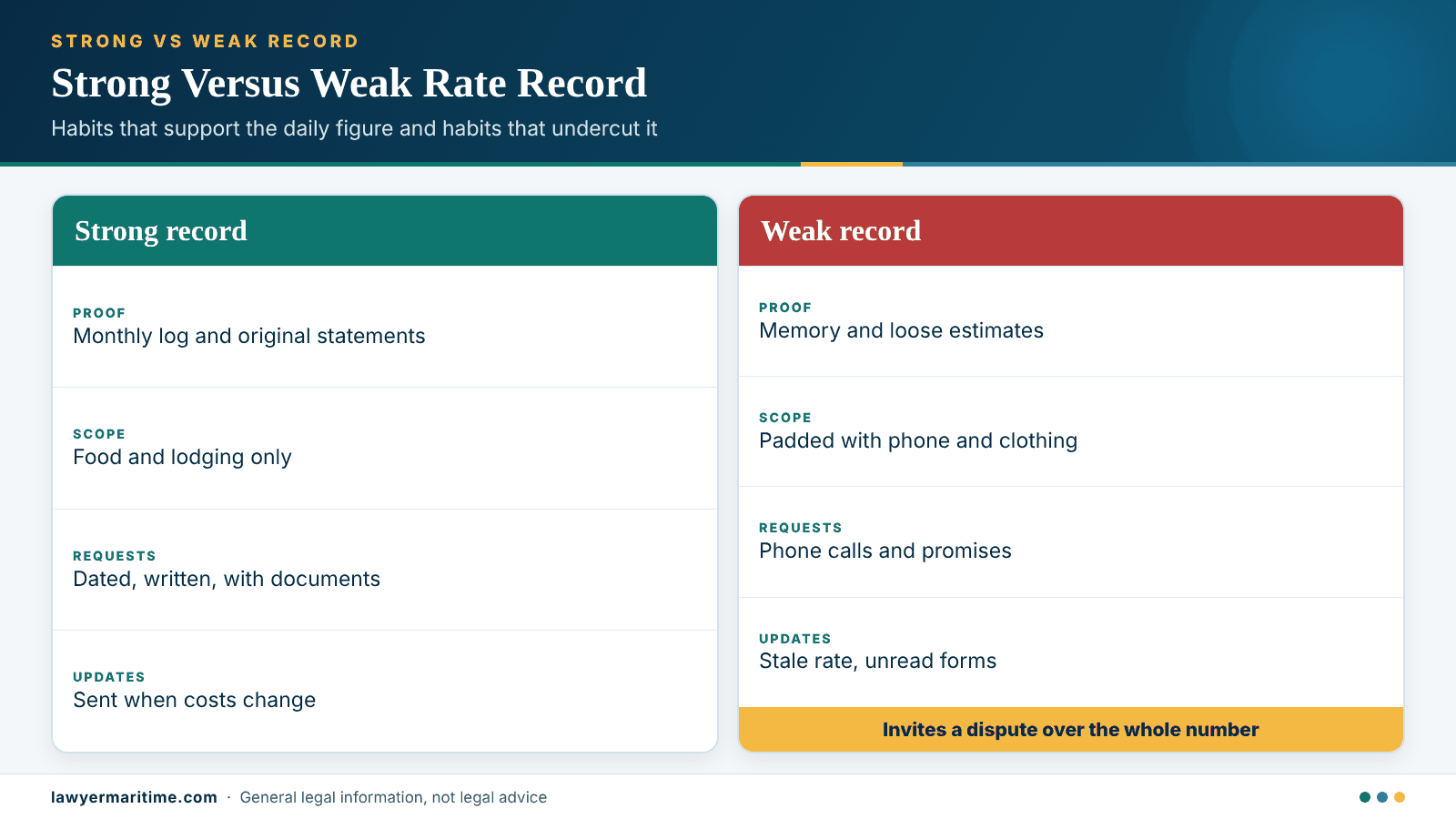
The opposite mistake is overreaching. Folding phone bills, clothing, car payments, or pre-injury lifestyle spending into the daily figure invites the employer to challenge the whole claim, and it can cost you credibility with a judge. Maintenance covers reasonable food and lodging, so a lean, well-supported number is stronger than a long one.
Consistency matters just as much. If your written request, your medical intake forms, and your deposition answers describe your living situation differently, the discrepancy will be used against you. Describe where you live, who lives there, and what you pay the same way every time.
Communication mistakes
Relying on phone calls and promises
Adjusters are often courteous on the phone and may say that a rate will be reviewed or that more is possible. Those statements are not a record. If the call mattered, confirm it by email the same day in neutral words: “Thank you for speaking with me today. My understanding is that you will review my housing costs and respond by a certain date.”
A written trail does two jobs. It prevents misunderstandings about what was promised, and it shows a court the sequence of requests and responses if a dispute escalates. Keep every message, including your own, in one folder.
Signing paperwork that changes the rate or your rights
Receipts, direct-deposit enrollment forms, and “benefit acknowledgments” sometimes carry language about the rate or about satisfaction of your claims. Read the whole document, not just the amount line, and ask for a copy before you sign. If a form says the payments fully resolve your maintenance rights, treat it as a possible release.
Seamen are often described as wards of admiralty, and courts examine releases closely, but that scrutiny comes after the fact and at your expense. It’s cheaper to ask first. When in doubt, a short review by a maritime lawyer before you sign is a modest step compared with undoing a release later. See when an injured seaman should get legal help for common triggers.
| Mistake | Why it hurts | Better action |
|---|---|---|
| Accepting a flat rate with no comment | No record that you asked for your documented costs | Take the payments, document your costs, and request an adjustment in writing |
| Counting phone, clothing, or travel in the daily figure | Gives the employer an easy reason to dispute the whole number | Limit the figure to food and lodging; track other costs separately |
| Estimating from memory months later | Weak, inconsistent proof | Keep a monthly log and original statements |
| Relying on phone promises | Nothing proves what was said | Confirm important calls by email the same day |
| Signing a payment receipt or form without reading it | May be worded as full satisfaction or a release | Read it all, ask for a copy, and get it reviewed first |
| Not updating when rent or location changes | The figure drifts from your real costs | Send a short written update with the new document |
What to Do Now: Building and Defending Your Rate
Here is the practical takeaway in order. The steps below assume you are already owed maintenance, or are asking for it, and want the daily figure to reflect what you really and reasonably spend. They are general suggestions, not a substitute for advice on your own facts.
In the first few weeks of recovery
Get your records in one place
- Collect your lease or mortgage statement, and the last few months of utility, insurance, and property tax bills.
- Save grocery and meal receipts, and download card and bank statements in their original form.
- Write down who lives in your home, who pays what, and how you divide shared costs.
- Ask the payer in writing what daily rate it is using and where that number comes from.
Make your first written request
- Total the month. Add housing, habitability utilities, owner costs, and food, then divide by the days.
- Keep it to food and lodging. Leave out phone, clothing, toiletries, and other items courts generally treat as separate.
- Attach the proof. Send the summary with the underlying documents, and keep your own copies.
- Ask for a specific reply. Request a written explanation of any item the payer disputes.
As the recovery continues
Keep the record current
- Update your monthly log when rent, utilities, or household members change.
- Send a short written notice with any new lease or bill and the date it took effect.
- Confirm important calls by email the same day.
- Keep treatment-related travel and other non-maintenance costs in a separate list.
Know when to ask for help
If the payer refuses to explain its number, cites a union or contract rate you haven’t seen, asks you to sign something that mentions full satisfaction, or stops paying, it is time for individualized advice. A maritime lawyer can read the agreement, identify the governing circuit’s rule, and tell you whether to press the rate, negotiate, or file. Our overview of the maritime lawyer role explains what that review typically involves, and the seaman injury lawyer guide shows how maintenance fits with the rest of the remedies.
Frequently Asked Questions About the Maintenance Rate
These short answers cover questions injured seamen and families ask about the daily figure. Each is general information, and the facts of a particular claim can change the answer.
The number itself
Is there one national daily maintenance rate?
No. Courts look to the reasonable cost of food and lodging in the seaman’s locality, tied to what the seaman actually spends, so the figure varies by place, year, and living situation. Any single number you see quoted is a data point from one case or one contract.
Does my pay or job title change the rate?
Generally not. Maintenance is measured by food and lodging costs, not by what you earned, and it is owed in addition to wages. A captain and a deckhand in the same town usually face the same reasonable local cost.
Why is my employer’s figure lower than my actual costs?
Many payers use a standard daily amount that may be old or may reflect a different region. That figure is a starting position, not necessarily the legal measure, so document your reasonable costs and ask for an adjustment in writing.
Proof and living situations
Do I need a receipt for every meal?
No. Courts have described the seaman’s initial burden as light, and credible testimony about local costs can support an award. Receipts, card statements, and a careful monthly estimate together make a stronger record than any single item.
Can I get maintenance if I live with family?
It depends on what you actually pay. A seaman who receives food and lodging free generally has no expense to recover, but a seaman who pays the full rent or mortgage is not necessarily limited by a prorated share, at least under the Fifth Circuit’s reasoning. Document every payment and who received it.
Does a union contract rate cap what I can recover?
Not automatically. Some courts treat a union rate as evidence of reasonable cost, and the Ninth Circuit has enforced a bargained rate absent a token amount. Which rule applies depends on the court and the agreement, so have the document reviewed.
Changes, disputes, and next steps
Can the daily rate increase while I’m recovering?
It can, if your reasonable expenses change or the original figure no longer reflects local costs. Send a written update with current documents rather than assuming the payer will notice on its own.
What if the employer ignores my written request?
Keep the request and any reply in your file and consider legal advice, because silence may become part of the record in a later dispute. If benefits are being refused, not just set low, see our guide to maintenance and cure denied.
Does accepting maintenance affect my Jones Act claim?
Maintenance and cure is a separate remedy, and a negligence claim under the Jones Act can proceed alongside it, though courts prevent double payment for the same loss. For how the remedies relate, see the Jones Act seaman guide and, if your status is in question, the seaman status test.
Sources and Legal Authorities
The authorities below support the legal statements in this guide. Confirm each against the current text, and check which court’s rule governs, before you rely on it for a specific situation.
Statutes and regulations
Federal statutes
- 46 U.S.C. § 30104 – Jones Act, personal injury to or death of a seaman (the negligence remedy, separate from maintenance and cure)
- 46 U.S.C. § 55102 – Vessels transporting merchandise (cabotage) (the different “Jones Act” referred to in waiver news)
Regulations and rules
- No regulation sets a seaman’s daily maintenance rate. The standard comes from general maritime law as applied by the federal courts.
- Employment agreements and collective bargaining agreements that state a daily amount are private documents, and their weight depends on the court.
Cases and agency materials
Supreme Court and federal appellate decisions
- Farrell v. United States, 336 U.S. 511 (1949) – the usual measure of maintenance and cure, and the end of maintenance at maximum cure
- Vaughan v. Atkinson, 369 U.S. 527 (1962) – maintenance and cure as a duty imposed by law; attorney’s fees for willful and persistent refusal to pay
- Vella v. Ford Motor Co., 421 U.S. 1 (1975) – duration of maintenance and cure until incapacity is declared permanent
- Atlantic Sounding Co. v. Townsend, 557 U.S. 404 (2009) – maintenance and cure described as owed in addition to wages
- Garrett v. Moore-McCormack Co., 317 U.S. 239 (1942) – burden on the party relying on a seaman’s release
- Hall v. Noble Drilling (U.S.) Inc., 242 F.3d 582 (5th Cir. 2001) – reasonable local cost of food and lodging, actual expense, light burden, no proration
- Also referenced without links: Incandela v. American Dredging Co., 659 F.2d 11 (2d Cir. 1981) (burden shifting on rate); Gardiner v. Sea-Land Service, Inc., 786 F.2d 943 (9th Cir. 1986) (negotiated rate enforced); Barnes v. Sea Hawaii Rafting, LLC, 889 F.3d 517 (9th Cir. 2018) (burden shifting and pretrial awards)
Agency and official data
- Cornell Legal Information Institute, Maintenance and Cure overview – background on the doctrine and the limits on contracting out