Maritime jurisdiction decides whether federal admiralty law, rather than ordinary state law, governs your injury claim, and it usually turns on three facts: where you were hurt, what you were doing, and what vessel or maritime activity was involved. If the incident happened on navigable water and has a real connection to maritime activity, federal maritime law generally supplies the rules for fault and remedies, even when you file in state court. The framework comes from Article III of the Constitution, the admiralty statute at 28 U.S.C. § 1333, and the general maritime law that courts have built around them. This page is for injured workers, passengers, boaters, and families who want a plain-English decision path before they talk with a lawyer. It explains what changes once maritime jurisdiction applies, including which courts may hear the case, whether a jury is available, and how deadlines shift. Maritime jurisdiction is a starting point, not a verdict on fault or on what a claim is worth, so treat what follows as a map for asking better questions.
What Is Maritime Jurisdiction, and Why Does It Matter to Your Injury Claim?
People use “maritime jurisdiction” to describe two related but different questions. The first is whether a court has the power to hear a maritime case at all. The second is whether federal maritime law supplies the rules that decide it. Keeping those apart makes the rest of this guide much easier to follow, and it keeps you from assuming that one answer settles the other.
Two Ideas Packed Into One Phrase
Jurisdiction: Which Courts Have the Power to Hear the Case
Article III of the Constitution extends the federal judicial power to cases of admiralty and maritime jurisdiction. Congress put that grant to work in 28 U.S.C. § 1333, which gives the federal district courts original jurisdiction, “exclusive of the courts of the States,” over any civil case of admiralty or maritime jurisdiction.
The same sentence then adds a phrase that matters enormously to injured people: “saving to suitors in all cases all other remedies to which they are otherwise entitled.” In plain English, Congress left room for remedies that don’t depend on the special admiralty side of federal court, including many suits in state court. We return to that clause in the section on choosing a court.
Maritime Law: Which Rules Decide the Case
The second meaning is about substance. Federal maritime law is made up of statutes, such as the Jones Act and the Longshore and Harbor Workers’ Compensation Act (LHWCA), plus a body of judge-made rules called general maritime law. It answers questions like who owed a duty of care, how fault is shared, and which damages are available.
The Supreme Court’s decision in Southern Pacific Co. v. Jensen, 244 U.S. 205 (1917), is the classic statement that state law must yield where it would work material prejudice to the characteristic features of the general maritime law. So a court can have the power to hear your case and still be bound to apply federal maritime rules to the merits. For a broader tour of the system, see our guide to maritime law.
Why the Label Matters When You’re Hurt
What May Change If Maritime Jurisdiction Applies
Four things can shift. The governing rules on fault and remedies may come from federal maritime law instead of the law of the state where you live. The available courts may expand or narrow, and the jury question may change with them. Special statutes may enter the picture, depending on whether you were a seaman, a harbor worker, a passenger, or a boater. And the filing deadline may differ from the state period you assumed.
None of these shifts is automatic or uniform. They depend on your facts, your status, and the court you choose or end up in, which is why this guide treats them as questions to ask rather than answers to assume.
What Does Not Change
Maritime jurisdiction doesn’t prove that anyone was at fault, and it doesn’t make a claim stronger or weaker by itself. You still need evidence that someone breached a duty, that the breach caused your harm, and that you suffered measurable losses. Medical care, documentation, and honest accounts of what happened matter in every forum.
It also doesn’t tell you whether you are a “seaman” or a covered longshore worker. Those labels follow separate legal tests, and the same waterfront accident can produce different answers for two people standing a few feet apart. Think of maritime jurisdiction as the doorway, with status and fault as the rooms behind it.
Step One: Where Did the Injury Happen?
Location is the first screen courts apply to a maritime injury claim. For torts, meaning civil wrongs such as negligence, the Supreme Court has described a two-part inquiry that looks at place and then at connection. This section gives that inquiry one compact summary from the injured person’s side. The doctrinal detail, including how courts have treated unusual fact patterns, lives in our companion article on admiralty jurisdiction.
Navigable Water and Its Edges
Which Waters Count
Admiralty jurisdiction reaches navigable waters, and “navigable” does not mean “tidal.” In The Genesee Chief v. Fitzhugh (1852), the Supreme Court held that the Great Lakes and their connecting waters fall within the constitutional grant, and it rejected the older idea that only tide-water counts. Oceans, bays, sounds, major rivers, and the Great Lakes are the familiar examples.
The harder cases involve smaller or artificial waterways. Courts generally ask whether a body of water is capable of supporting commercial navigation, not whether anyone happened to be running a business on it that day. A pond that can’t carry boats between places may not qualify, while a canal that links other navigable waters often can. Be cautious about borrowing definitions, too. Different statutes use “navigable waters” for different purposes, and the longshore statute has its own location test, so a definition from one setting may not carry over to another.
Land, Docks, and Piers
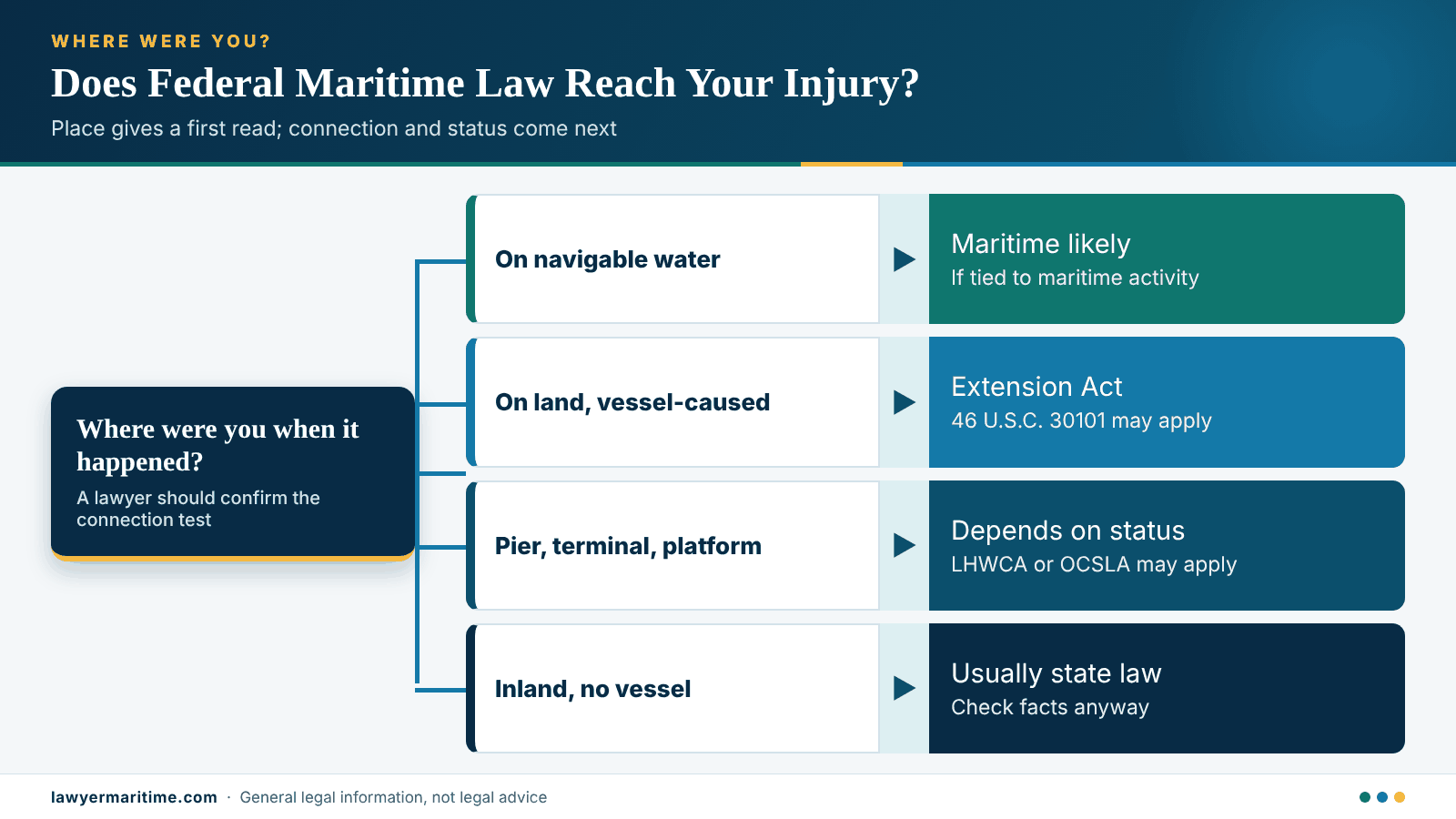
Injuries on land are not automatically outside the picture. Under the Admiralty Extension Act, 46 U.S.C. § 30101, admiralty jurisdiction extends to injury or damage on land that is caused by a vessel on navigable waters. A dock worker struck by a vessel’s swinging gear, or a person hurt when a ship strikes a pier, may therefore fall within maritime jurisdiction even though the harm landed ashore.
Without a vessel causing the harm, though, a slip on a wet pier or a fall in a terminal parking lot generally lacks the location a maritime tort claim needs. Covered workers may still have benefits under the LHWCA, whose situs rule reaches certain piers, wharves, terminals, and adjoining areas under 33 U.S.C. § 903(a). That is a compensation question with its own tests, separate from tort jurisdiction.
The Connection to Maritime Activity
The Two-Part Connection Test in Brief
Being on navigable water isn’t enough. In Jerome B. Grubart, Inc. v. Great Lakes Dredge & Dock Co., 513 U.S. 527 (1995), the Court described a location test and a connection test. The location test asks whether the tort occurred on navigable water or whether a land injury was caused by a vessel on navigable water.
The connection test has two parts. A court first looks at the general features of the incident to see whether it has a potentially disruptive impact on maritime commerce. It then asks whether the general character of the activity giving rise to the incident shows a substantial relationship to traditional maritime activity. Both parts are judged at a general level, not by the exact mechanics of your accident.
When Location and Connection Point Different Ways
The connection requirement exists because location alone can mislead. In Executive Jet Aviation, Inc. v. City of Cleveland, 409 U.S. 249 (1972), a jet that struck birds after takeoff and sank in Lake Erie was found to lack the needed link to traditional maritime activity, even though it ended on navigable water.
On the other side, Foremost Insurance Co. v. Richardson, 457 U.S. 668 (1982), held that a collision between pleasure boats on navigable waters falls within admiralty jurisdiction, because uniform navigation rules and the potential effect on maritime commerce justified federal treatment. So a weekend boating collision can qualify even though no cargo or crew wages are involved. If your facts sit near an edge, the safest assumption is that a lawyer should check them against current case law in your circuit.
| Setting | Location question | Connection question | Usual first read |
|---|---|---|---|
| Crew member hurt on a working tug on a river | On navigable water | Commercial vessel operations | Maritime jurisdiction likely |
| Two pleasure boats collide on a navigable bay | On navigable water | Navigation and boating safety (Foremost) | Maritime jurisdiction likely |
| Dock worker struck by a vessel’s gear while on a pier | Land, but vessel-caused | Vessel activity at a port | Possible under the Admiralty Extension Act |
| Visitor slips on a wet pier with no vessel involved | Land, no vessel cause | Weak | Usually not a maritime tort |
| Aircraft crashes into a navigable lake | On navigable water | Aviation, not traditional maritime activity | Location alone was not enough in Executive Jet |
| Worker hurt on a fixed offshore platform | Offshore, but attached to the seabed | Depends on structure and work | Often analyzed under OCSLA instead |
Step Two: Who Were You, and What Were You Doing?
Once a court can reach the incident, your role decides which legal route you travel. The same collision can produce a Jones Act claim for a deckhand, a compensation claim for a harbor worker, and a negligence claim for a passenger. Roles are legal categories with tests behind them, so a job title or a paycheck stub rarely settles anything.
If You Worked On or Around Vessels
Seamen: Jones Act, Maintenance and Cure, and Unseaworthiness
A seaman is a worker whose duties contribute to a vessel’s function or mission and whose connection to a vessel in navigation, or an identifiable fleet of vessels, is substantial in duration and nature. That two-part test comes from Chandris, Inc. v. Latsis, 515 U.S. 347 (1995), and the Court has also explained what counts as a vessel in Stewart v. Dutra Construction Co., 543 U.S. 481 (2005). Seamen may have access to maintenance and cure, a negligence claim against the employer under 46 U.S.C. § 30104, and an unseaworthiness claim against the vessel owner.
One clarification avoids a common mix-up. The “Jones Act” in this guide is the seaman injury remedy. It is not the cabotage rule on carrying cargo between U.S. ports, which lives at 46 U.S.C. § 55102. For a fuller treatment of the seaman route, see our guides to the Jones Act claim and to how a seaman injury lawyer evaluates status.
Harbor, Shipyard, and Offshore Workers
Workers who load, repair, or build vessels on land or on piers often fall under the LHWCA, a federal compensation system. The statute covers certain employees injured on navigable waters or on the adjoining areas listed in 33 U.S.C. § 903(a), and it excludes some categories of workers, including crew members of a vessel. Covered workers generally receive no-fault benefits from the employer, and they may also bring a negligence claim against the vessel under 33 U.S.C. § 905(b).
Offshore work adds another layer. Under the Outer Continental Shelf Lands Act, 43 U.S.C. § 1333, federal law extends to installations attached to the seabed, adjacent state law can apply as federal law where the statute leaves gaps, and certain injuries from covered operations trigger LHWCA compensation. Whether an offshore structure is a vessel, a fixed platform, or something in between often decides which route applies, and courts take that question seriously.
If You Weren’t Working
Passengers and Guests Aboard
People injured aboard a vessel who aren’t crew generally look to maritime negligence. In Kermarec v. Compagnie Generale Transatlantique, 358 U.S. 625 (1959), the Court rejected the old land-based labels of licensee and invitee and held that a shipowner owes everyone aboard for lawful purposes a duty of reasonable care under the circumstances. That makes the question practical: what did the owner or operator know, and what would a careful operator have done?
Passengers often meet the fine print. Tickets may carry forum-selection clauses, which the Court enforced in Carnival Cruise Lines, Inc. v. Shute, 499 U.S. 585 (1991), and notice and suit periods that federal law limits under 46 U.S.C. § 30526. Read your ticket contract and keep a copy, because it can shape where and how fast you must act.
Recreational Boaters and People on the Shore
Boaters, passengers on private craft, swimmers struck by a boat, and renters of small watercraft usually fall under general maritime negligence when the incident meets the location and connection tests. Since Foremost, recreational use doesn’t take a collision outside admiralty. Our guide to maritime negligence explains how duty, breach, and causation work in that setting.
State law can still matter. In Yamaha Motor Corp. v. Calhoun, 516 U.S. 199 (1996), the Court held that state remedies remained available in a nonseafarer’s maritime wrongful-death case arising in state territorial waters. The takeaway is that a boating claim may involve both federal maritime principles and state remedies, and the mix can change the damages analysis. If your claim comes from a recreational boating incident, check the timing rules in our article on the boating injury claim deadline.
| Your role | Usual framework | Forum and jury points |
|---|---|---|
| Seaman on a vessel in navigation | Maintenance and cure, Jones Act negligence (46 U.S.C. § 30104), unseaworthiness | Jones Act carries a statutory jury right and is generally not removable from state court |
| Harbor, terminal, or shipyard worker | LHWCA compensation, plus possible vessel negligence under 33 U.S.C. § 905(b) | Benefits go through the Department of Labor system; any vessel suit follows the forum rules in this guide |
| Worker on a fixed offshore platform | OCSLA, LHWCA extension, adjacent-state law where applicable | Depends on the structure, the work, and the claim pleaded |
| Passenger on a commercial vessel | General maritime negligence, subject to ticket terms | Forum-selection and notice clauses may apply |
| Recreational boater or guest | General maritime negligence, with possible state remedies | State or federal court may be open; deadlines vary by claim |
| Family after a death more than three nautical miles from U.S. shore | DOHSA, 46 U.S.C. § 30302, with general maritime law | DOHSA sets its own remedy rules, so timing and damages need separate checking |
Which Court Can Hear a Maritime Injury Claim?
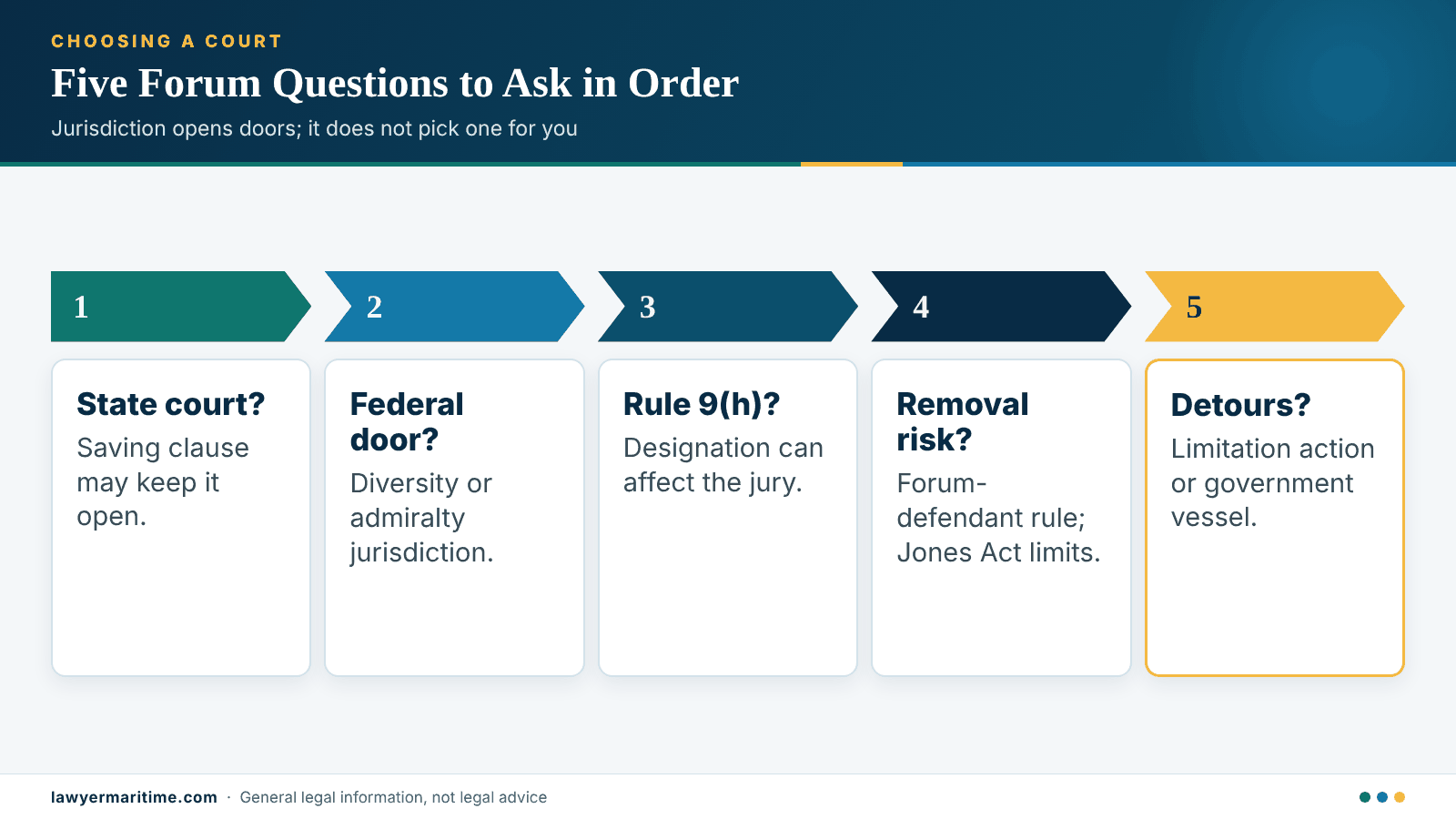
Maritime jurisdiction does not funnel every injury claim into one courtroom. Depending on the claim and the parties, an injured person may have a choice between state and federal court, and the choice can affect the jury, the procedure, and the pace of the case. The defendants also have moves available, so this section covers both the opening choice and the fights that can follow.
State Court and the Saving to Suitors Clause
What the Clause Preserves
The saving to suitors clause in 28 U.S.C. § 1333 reserves “all other remedies to which they are otherwise entitled.” Courts have long read that language to mean that a plaintiff with a maritime claim against a defendant personally, known as an in personam claim, may often proceed in an ordinary state civil court as well as in federal court. A state court hearing such a case generally applies federal maritime law to the substance of the dispute, because the clause preserves a forum and a remedy, not a license to rewrite maritime rules.
One thing the clause does not generally preserve is the special admiralty remedy against the vessel itself. An in rem action, such as arresting a ship to secure a claim, is brought in federal court under the Supplemental Rules for Admiralty or Maritime Claims, discussed in our guide to admiralty law.
State Procedure, Maritime Substance
Choosing state court means living with state procedure. In American Dredging Co. v. Miller, 510 U.S. 443 (1994), the Court held that federal maritime law did not preempt Louisiana’s rule on forum non conveniens in a Jones Act and maritime case filed in state court, treating the doctrine as procedural. The decision was limited to disputes between domestic parties.
The practical lesson is that rules about pleading, discovery, evidence, and jury selection may come from the state, while the rules of liability and damages still come from maritime law. A state forum often means a jury drawn from the local community, which some plaintiffs value and some defendants resist. Which forum fits a given case is a strategic judgment for the lawyer and client, not something this guide can answer.
Federal Court: Diversity or Admiralty
Two Doors Into Federal Court
A maritime injury suit can enter federal court through admiralty jurisdiction under 28 U.S.C. § 1333, or through diversity jurisdiction under 28 U.S.C. § 1332 when the parties are citizens of different states and the amount in controversy exceeds $75,000, exclusive of interest and costs. The two doors are not interchangeable. In Romero v. International Terminal Operating Co., 358 U.S. 354 (1959), the Court held that general maritime claims do not “arise under” federal law for purposes of the federal-question statute, 28 U.S.C. § 1331.
That holding explains why a maritime claim between two parties of the same state, with no other federal basis, depends entirely on admiralty jurisdiction to reach federal court. It also explains why a plaintiff whose claim could use either door has a decision to make.
The Rule 9(h) Designation and the Jury
When a claim fits both admiralty and another basis, such as diversity, Federal Rule of Civil Procedure 9(h) lets the pleader designate it as an admiralty or maritime claim. The designation matters because Rule 38(e) says the federal rules do not create a right to a jury trial on issues in a Rule 9(h) claim. Claims that rest only on admiralty jurisdiction are treated as admiralty claims whatever the label, and they are generally tried to a judge.
Seamen get a different result by statute. The Jones Act allows a seaman to elect a civil action at law “with the right of trial by jury,” and the Supreme Court held in Fitzgerald v. United States Lines Co., 374 U.S. 16 (1963), that a maintenance and cure claim arising from the same facts as a Jones Act claim goes to the jury along with it. Whether any particular claim gets a jury therefore depends on the statute, the pleading, and the court.
Forum Fights: Removal, Limitation, and Government Vessels
Removal From State Court
A defendant sued in state court may try to move the case to federal court. Under 28 U.S.C. § 1441(a), a state-court civil action may be removed if a federal district court would have had original jurisdiction. Subsection (b)(2) adds the forum-defendant rule: a case removable only on diversity grounds may not be removed if a properly joined and served defendant is a citizen of the state where the action was brought.
Jones Act cases are treated differently. The Jones Act incorporates the Federal Employers’ Liability Act, and 28 U.S.C. § 1445(a) bars removal of FELA actions filed in state court, so courts have generally treated Jones Act suits as nonremovable. Defendants sometimes argue that a seaman claim was pleaded without any real basis, and courts examine those arguments closely. Whether a maritime claim can be removed when admiralty is the only basis for federal jurisdiction has produced disagreement among district courts since Congress revised the removal statute in 2011, so check the rule in the court where the case sits.
Limitation Actions, Forum Clauses, and Government Vessels
Three other features can redirect a case. First, a vessel owner may file a limitation action under 46 U.S.C. § 30529 within six months after receiving written notice of a claim. Once the owner has met the statute’s fund requirement, other proceedings over the same matter must stop while the federal court sorts out the limitation. Lewis v. Lewis & Clark Marine, Inc., 531 U.S. 438 (2001), addressed how that process fits with the saving clause.
Second, passenger ticket contracts may name a court, and the Supreme Court has enforced such clauses. Third, claims against the United States over government vessels run through the Suits in Admiralty Act and the Public Vessels Act, which generally require federal court and carry their own deadlines. If a limitation action or a government vessel might be involved, that is a strong reason to get legal advice early, because these routes can change the forum and the clock at the same time.
| Forum route | Basis | Jury | Main points to check |
|---|---|---|---|
| State court | Saving to suitors clause, 28 U.S.C. § 1333 | Often available under state procedure; statutory for Jones Act claims | Removal risk, state procedural rules, venue |
| Federal court by diversity, no Rule 9(h) designation | 28 U.S.C. § 1332 | Generally available | Citizenship, the $75,000 threshold, plaintiff’s pleading choices |
| Federal court in admiralty | 28 U.S.C. § 1333 or Rule 9(h) designation | Generally tried to a judge, subject to statutory exceptions | Whether to designate; Jones Act and Fitzgerald jury rights |
| Action against the vessel (in rem) | Supplemental Rule C | Bench proceeding in admiralty | Arrest, security, and competing liens |
| Suit involving a government vessel | Suits in Admiralty Act or Public Vessels Act | Generally no jury | Federal court in most cases; the Suits in Admiralty Act has a two-year period under 46 U.S.C. § 30905 |
What Changes When Federal Maritime Law Applies?
Once maritime law applies, the practical differences show up in two places: how the court decides responsibility, and which remedies are on the table. The differences are real, but they aren’t uniformly better or worse for an injured person. Some maritime rules favor workers, while others narrow what state law would allow.
Which Rules Decide Fault and Responsibility
Federal Maritime Law Versus State Law
A maritime claim is governed first by federal statutes and general maritime law. State law doesn’t disappear, but it gives way where it would undermine the uniformity that Jensen protects. For a nonseafarer’s wrongful-death claim arising in state territorial waters, the Supreme Court in Yamaha held that state remedies remain available, so state law can supplement the federal remedy in some settings.
The result is a patchwork that depends on who the injured person is and where the harm occurred. A seaman’s remedies are largely federal. A recreational boater’s claim may blend federal negligence principles with state remedies. A worker covered by the LHWCA has a federal compensation system that displaces the usual tort claim against the employer. Because state rules on fault and damages vary widely, the choice between federal and state sources can move the outcome.
Comparative Fault and Proof
Maritime law generally shares fault instead of treating a plaintiff’s own mistake as a complete bar. In United States v. Reliable Transfer Co., 421 U.S. 397 (1975), the Court adopted proportionate fault for maritime collision and similar cases. For Jones Act claims, the incorporated FELA provision at 45 U.S.C. § 53 reduces damages in proportion to the worker’s own negligence instead of barring recovery, and assumption of risk is not a defense for seamen.
The practical effect is that a plaintiff’s own role in the accident doesn’t necessarily end the claim, though it can reduce it. The specific duty a plaintiff must prove also varies. A passenger asks about reasonable care, a seaman asks about employer negligence, and a vessel-condition claim asks whether the ship and its equipment were reasonably fit. For more on the negligence side, see our guide to maritime negligence and, for vessel-condition claims, unseaworthiness damages.
Which Remedies and Benefits Are on the Table
Remedies After an Injury
A seaman may have several overlapping remedies: maintenance and cure (daily living expenses and medical care while recovering), Jones Act negligence, and unseaworthiness. A longshore or harbor worker typically receives LHWCA benefits and may add a vessel-negligence claim where the facts support one. A passenger or boater usually relies on negligence and the damages recognized under general maritime law.
The categories and limits of damages differ by claim, and a rule that applies to one status may not apply to another. We cover those distinctions in our guide to maritime injury damages. If a seaman’s maintenance and cure has been withheld, the separate guide on maintenance and cure denial explains the issues. For the purposes of jurisdiction, the main point is that the label on your claim sets the menu of remedies.
Claims After a Death
Families face a distinct set of rules. 46 U.S.C. § 30302 creates a cause of action under the Death on the High Seas Act for deaths caused by wrongful act, neglect, or default occurring on the high seas more than three nautical miles from the shore of the United States, brought by the personal representative for the benefit of certain family members. Outside that zone, other sources of law, including general maritime law and state statutes, may apply.
The Supreme Court has also limited some damages in seaman death cases. In Miles v. Apex Marine Corp., 498 U.S. 19 (1990), the Court held that loss-of-society damages are not available in a seaman’s wrongful-death action under general maritime law. Deaths raise the highest-stakes timing and remedy questions, so families should read our overview of the DOHSA claim deadline and get advice quickly.
| Issue | If federal maritime law applies | If state law governs | What to check |
|---|---|---|---|
| Source of the rules | Federal statutes and general maritime law | State statutes and common law | Whether the incident meets the location and connection tests |
| Allocation of fault | Proportionate fault; Jones Act uses FELA comparative negligence | Varies by state; some states differ on shared fault | Your state’s rule, if state law could apply |
| Employer liability | Jones Act for seamen; LHWCA for covered workers | State workers’ compensation for most employees | Status as seaman, longshore worker, or neither |
| Death claims | DOHSA, Moragne-based general maritime action, with limits on damages | State wrongful-death and survival statutes | Distance from shore, the victim’s status, and Yamaha |
| Court choices | State or federal court, with jury depending on route | State court, or federal court by diversity | Saving clause, Rule 9(h), and removal rules |
How Do Deadlines Change Under Maritime Jurisdiction?
Deadlines are where a wrong assumption costs the most. Maritime claims don’t follow one universal clock, and the period that applies depends on the claim, the defendant, and sometimes the contract in your pocket. This section sketches the main patterns so you can see why a quick legal check matters. It is not a substitute for confirming the period that governs your own claim.
The General Maritime Period and Its Exceptions
The Three-Year Rule
For many maritime injury and death claims, the starting point is 46 U.S.C. § 30106, which says that, unless another law provides otherwise, a civil action for damages for personal injury or death arising from a maritime tort must be brought within three years after the cause of action arose. The Jones Act incorporates FELA, whose own limitations provision, 45 U.S.C. § 56, also sets a three-year period.
Three years may sound generous, but evidence fades, witnesses move, and vessels change owners and crews much sooner. The phrase “unless another law provides otherwise” also carries real weight, as the next heading shows. For a deeper treatment, our guide to the maritime injury deadline walks through how lawyers calculate and protect these periods.
Shorter and Special Clocks
Several regimes run on shorter schedules. An LHWCA compensation claim generally must be filed within one year, measured under 33 U.S.C. § 913 from the injury or, for some situations, from when the worker knew or should have known the injury was work-related. Actions under the Suits in Admiralty Act must be brought within two years under 46 U.S.C. § 30905.
Passenger ticket contracts add another layer. Under 46 U.S.C. § 30526, covered passenger vessels generally can’t use contract terms to set a notice period shorter than six months or a suit period shorter than one year, though different floors apply to some smaller passenger vessels. A ticket may therefore require written notice long before the three-year period would otherwise expire. Death on the high seas has its own set of rules, covered in our DOHSA claim deadline article.
How a Forum Mistake Can Cost Time
Filing in the Wrong Place
A case filed in a court that lacks jurisdiction, or against a defendant that can’t be sued there, may be dismissed. Whether the time already spent counts when you refile depends on the statute, the court, and the reason for dismissal. Don’t assume a refiled case gets a fresh period.
Government vessels are a common trap. A claim against the United States for harm caused by a government vessel runs through federal statutes with their own steps. For land-based harm caused by a vessel on navigable waters, 46 U.S.C. § 30101(c) requires a written claim to the agency first and bars suit until six months after it is presented. Missing a preliminary step can delay or derail a case that was otherwise filed on time.
When State Periods Might Apply
If a claim turns out to be governed by state law, the state’s limitations period applies instead. That creates a dilemma for people who aren’t sure which body of law governs: the maritime period and the state period can differ, and the longer one doesn’t automatically win. The safer course is to ask which period each plausible theory would use and to calendar the shortest one.
Boating incidents are a frequent example, because recreational claims can involve both federal and state principles. Our article on the boating injury claim deadline covers that setting in detail.
| Route | Authority | Period or pattern | Key caveat |
|---|---|---|---|
| General maritime tort injury or death | 46 U.S.C. § 30106 | Three years from when the cause of action arose | Applies unless another law provides otherwise |
| Jones Act negligence | 46 U.S.C. § 30104 with 45 U.S.C. § 56 | Three years under the incorporated FELA provision | Accrual can be disputed in occupational-illness cases |
| LHWCA compensation claim | 33 U.S.C. § 913 | Generally one year, with knowledge-based timing | Notice rules and payment history can change the analysis |
| Suit against the United States over a public or government vessel | Suits in Admiralty Act, 46 U.S.C. § 30905 | Two years | Preliminary claim steps may apply, including under 46 U.S.C. § 30101(c) |
| Passenger ticket notice and suit periods | 46 U.S.C. § 30526 | Contract terms; statute sets minimums for covered vessels | Floors differ by vessel type; read the ticket |
| Claim governed by state law | State statute of limitations | Varies by state and claim | Don’t assume the state period equals the maritime one |
Common Misconceptions About Maritime Jurisdiction
Search results and word of mouth spread a handful of shortcuts that sound plausible and break down on the facts. Each one below is a reasonable guess that can lead to a wrong forum, a missed deadline, or a claim that was never evaluated under the right law. Sorting them out helps you ask sharper questions when you do get advice.
Misconceptions About Whether Maritime Law Reaches Your Injury
“It Happened on the Water, So It’s a Maritime Claim”
Being on the water is necessary for most tort claims but not sufficient. As Executive Jet shows, location on navigable water doesn’t settle the matter without a real link to traditional maritime activity. Most boating, shipping, and vessel-work injuries clear that bar easily, but an activity that merely ends up on a lake may not.
The reverse error is just as common. People assume a claim that sounds ordinary, such as a slip or a fall, can’t be maritime if it happened aboard a ship. A fall on a cruise ship‘s deck is generally analyzed under maritime law because the location and connection both point to vessel operations.
“It Happened on Land, So Maritime Law Can’t Apply”
Land does not close the door. The Admiralty Extension Act reaches land injuries caused by a vessel on navigable waters, and the LHWCA covers certain workers hurt on piers, wharves, terminals, and similar adjoining areas. Offshore workers on fixed platforms may also be covered by the Outer Continental Shelf Lands Act, even though they are nowhere near a ship.
The reasoning differs across those three routes, so avoid blending them. A longshore worker with a compensation claim doesn’t need the Admiralty Extension Act, and a bystander struck by a dock fender dislodged by a ship isn’t an LHWCA employee. Each rule asks a different question about the same shoreline.
Misconceptions About Courts and Governing Law
“Maritime Law Means I Have to Sue in Federal Court”
The statute that gives federal courts admiralty jurisdiction also saves other remedies for injured plaintiffs. Many in personam claims can be filed in state court, and Jones Act cases filed there are generally not removable. Federal admiralty court is a real option, and sometimes the only one, such as for an in rem action against a vessel, but it isn’t mandatory for most injury plaintiffs.
The better question is which forum fits the case. State court may offer a local jury and familiar procedure, while federal court may offer different rules on discovery and pace. A lawyer weighs these tradeoffs, and no forum is automatically better.
“State Court Means State Law”
A state court hearing a maritime claim generally applies the substantive maritime rules, subject to the Jensen principle and to areas where state remedies supplement federal law. Choosing the courthouse doesn’t choose the legal framework. A seaman who sues in state court still brings a Jones Act claim under federal law, and a passenger who sues there still faces maritime negligence principles.
State procedure is the part that follows the courthouse, as American Dredging illustrates. If you remember one point, remember this one: forum and governing law are separate decisions.
“The Jones Act Covers Any Maritime Injury”
The Jones Act is a remedy for seamen against their employers. It doesn’t cover passengers, recreational boaters, or longshore workers who fall under the LHWCA. Readers also run into the cabotage law of the same nickname, which governs coastwise cargo transport and has nothing to do with injury claims.
If you aren’t sure whether you qualify as a seaman, the status tests in our guide to the Jones Act claim are the right place to start. Don’t rely on what an employer’s payroll label says.
| Misconception | What is generally true | Why it matters |
|---|---|---|
| Any injury on water is a maritime claim | Courts also look for a connection to maritime activity | You could pick the wrong law or court |
| Land injuries are never maritime | Vessel-caused land injuries and some waterfront work injuries are covered by maritime statutes | A valid route could be overlooked |
| Maritime claims must be filed in federal court | The saving clause often allows state court, and Jones Act claims are generally nonremovable | You may have more forum choices than you thought |
| State court applies state law | State court generally applies maritime substance and state procedure | Your remedies may not match a regular state injury case |
| The Jones Act protects everyone hurt at sea | It is a seaman’s remedy against the employer; cabotage is a separate subject | The wrong label can mean the wrong claim and deadline |
| I can rely on the longest deadline I’ve heard about | The governing period depends on the claim, the defendant, and any contract | A missed clock can end an otherwise valid claim |
Gathering the Facts That Place Your Claim
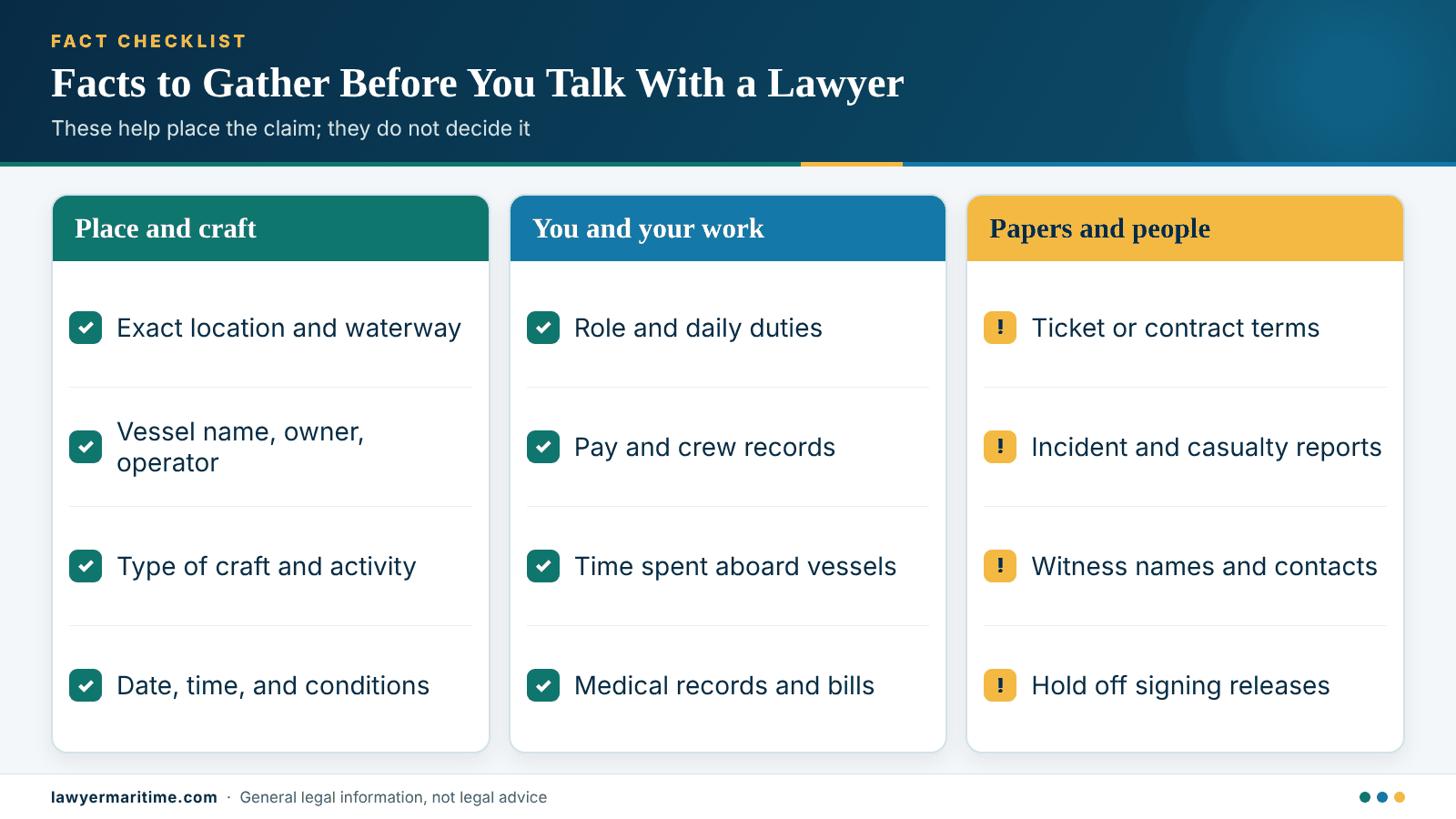
You can’t decide maritime jurisdiction from the couch, and you don’t have to. What you can do is collect the facts a lawyer will need to run the location, connection, status, and forum analysis. Start with your medical care and safety, then work through this list as your health allows.
- Get medical care and follow treatment advice before anything else.
- Write down the place, time, craft, and what you were doing while memory is fresh.
- Save contracts, tickets, pay records, and every report you receive.
- Ask a maritime lawyer to check status, forum, and deadlines before you sign or file.
Facts About the Place and the Craft
Where and When It Happened
Write down the exact location as best you can: the name of the waterway, the nearest landmark or mile marker, the pier or berth, and whether the water was open, inland, or a harbor. Note the date, the time, the weather, the tide or river stage, and any restrictions in force. Photographs and phone location data can help fix the spot, and a screenshot of a chart or map app can be useful if you took one.
Location facts feed the first jurisdiction question directly. If you were inside a marked channel, tied to a dock, anchored offshore, or standing on a fixed platform, say so, because each description points to a different analysis.
The Vessel or Structure Involved
Record the vessel’s name, hull or registration number, owner, operator, and the company that managed or chartered it, if you know them. Describe the type of craft: a tug, barge, supply vessel, passenger ship, fishing boat, rental jet ski, or private pleasure boat. Note whether it was moving, moored, or under repair.
If the structure was a rig, platform, or floating facility, capture its name, location, and function. Courts care about what a craft was used for and whether it could actually move, so small facts here can carry large legal weight. Don’t state a legal conclusion such as “it was a vessel” in your notes. Just describe it.
Facts About You and Your Work
Your Role and Employment Records
Gather anything that shows what you did and where: pay stubs, W-2s or 1099s, schedules, crew lists, hiring paperwork, safety training records, and job descriptions. Write a short timeline of your work over the past year, noting how much of your time was spent aboard vessels and which vessels belonged to the same owner or fleet.
These records help answer the status tests described earlier. Seaman status looks closely at the duration and nature of your connection to a vessel or fleet, while longshore coverage looks at the work and the place. A lawyer can’t evaluate either without the paper trail.
Witnesses, Reports, and Medical Records
List everyone who saw the incident or its aftermath, including crew, supervisors, dock staff, other passengers, and first responders, with whatever contact details you have. Ask for copies of incident reports, and note whether anyone reported the casualty to the Coast Guard. The Coast Guard and the National Transportation Safety Board publish some casualty and investigation material, as our guide to NTSB marine reports explains.
Keep every medical record, bill, prescription, and work-restriction note. Record symptoms and limits in a simple daily log as they happen. These documents don’t establish jurisdiction, but they show the extent of harm, and they become the backbone of any claim that follows.
Before You Sign or File Anything
Statements and Releases
Employers, vessel operators, and insurers often move quickly to collect statements and sign-offs. You can be polite and cooperative about the facts of what happened, but be careful about signing documents you don’t fully understand, especially anything labeled a release or settlement. For seamen, courts examine releases closely, but that protection isn’t a reason to sign without advice. Our guide to maritime settlement releases explains what to look for.
Don’t post about the injury or the incident on social media. Descriptions that seem harmless can be read out of context later, especially when location, role, or the sequence of events is in dispute.
When It Makes Sense to Talk With a Lawyer
If your injury happened on or near navigable water, or while you worked on a vessel, a dock, or an offshore structure, a conversation with a maritime attorney is a reasonable step, because the questions in this guide turn on specialized law. A lawyer can help confirm your status, identify the right court, check the deadlines, and spot overlapping claims. Our overview of what a maritime lawyer does outlines those tasks, and the guide to a maritime injury attorney explains how coverage questions are sorted.
Whoever you consult, ask about their experience with your type of claim, the courts they appear in, and how they approach forum choices.
| Fact or document | Why it matters | Where it often comes from |
|---|---|---|
| Exact location and water type | Navigable water and the location test | Your notes, photos, phone location data, charts |
| Vessel name, owner, and operator | Identifies defendants, the vessel’s type, and possible limitation or in rem issues | Hull markings, registration records, crew, employer paperwork |
| Description of the activity | The connection to maritime activity | Your account, supervisors, work orders |
| Employment and pay records | Seaman, longshore, or other status | Employer, payroll, schedules, crew lists |
| Ticket or contract terms | Forum clauses and notice periods | Passage ticket, rental agreement, employment contract |
| Incident and casualty reports | Facts on cause, timing, and who was involved | Employer, Coast Guard, NTSB, port authority |
Frequently Asked Questions About Maritime Jurisdiction
These answers are general. Your own facts, your status, and the court in which a case sits can change them.
Questions About Whether Maritime Law Applies
Does maritime law apply if I was hurt on a lake or river?
It can. Admiralty jurisdiction reaches navigable waters, which are not limited to the ocean or to tidal water, and the Great Lakes and many rivers qualify. The injury must also have a real connection to maritime activity, and recreational boating generally meets that test after Foremost. A small pond or non-navigable creek may not qualify, so the specific water body and the activity both matter.
Is a cruise ship injury governed by maritime law?
Usually, yes, when the injury happens aboard a vessel on navigable water, because both location and connection point to maritime activity. Passengers generally look to maritime negligence, and the ticket contract may add forum and notice terms that federal law partly limits under 46 U.S.C. § 30526. Read your ticket and keep a copy, since the notice period may be shorter than the general three-year suit period.
What if I was hurt on a pier or at a marine terminal?
It depends on the cause and your job. If a vessel caused the harm, the Admiralty Extension Act may bring a land injury within maritime jurisdiction. If you were a covered worker, the LHWCA may supply compensation benefits whether or not a vessel was involved. A slip with no vessel and no covered employment more often falls under state law.
Questions About Courts, Deadlines, and Next Steps
Can I file a maritime injury claim in state court?
Often, yes. The saving to suitors clause in 28 U.S.C. § 1333 preserves other remedies, and many in personam claims can be brought in state court, where federal maritime law still generally supplies the substance. Jones Act claims filed in state court are generally treated as nonremovable. Other claims may be removed in some circumstances, so the final answer depends on the claim and the parties.
Will I get a jury trial?
Possibly. The Jones Act provides a statutory jury right, and state courts often offer juries for other claims. In federal court, a claim that is designated under Rule 9(h) or that rests only on admiralty jurisdiction is generally tried to a judge, because Rule 38(e) does not create a jury right for those claims. A diversity case without a designation may be tried to a jury. Ask a lawyer how the route you take affects the jury.
How long do I have to file, and should I talk to a lawyer first?
Many maritime injury suits fall under a general three-year period, but longshore claims, government-vessel claims, and passenger tickets can set shorter clocks, and state claims follow state law. Because the right period depends on which law and defendant apply, it is wise to speak with a maritime lawyer soon after an injury, ideally before you sign a release or give a recorded statement.
Sources and Legal Authorities
The authorities below support the legal statements in this guide. Check each against its current text before relying on it, because statutes, rules, and case law change.
Statutes, rules, and regulations
Jurisdiction, forum, and procedure
- U.S. Constitution, Article III – judicial power over admiralty and maritime cases
- 28 U.S.C. § 1333 – Admiralty, maritime and prize cases (saving to suitors clause)
- 28 U.S.C. § 1332 – Diversity of citizenship; amount in controversy
- 28 U.S.C. § 1441 – Removal of civil actions
- 28 U.S.C. § 1445 – Nonremovable actions
- Federal Rule of Civil Procedure 9 – Rule 9(h), admiralty or maritime claims
- Federal Rule of Civil Procedure 38 – Rule 38(e), jury trial and admiralty claims
- 46 U.S.C. § 30101 – Extension of admiralty and maritime jurisdiction to land injuries caused by vessels
Claims, remedies, and deadlines
- 46 U.S.C. § 30104 – Personal injury to or death of seamen (Jones Act)
- 46 U.S.C. § 30106 – Time limit on bringing maritime action for personal injury or death
- 46 U.S.C. § 30302 – Death on the High Seas Act, cause of action
- 46 U.S.C. § 30526 – Provisions requiring notice of claim or limiting time for bringing action
- 46 U.S.C. § 30529 – Action by owner for limitation of liability
- 46 U.S.C. § 30905 – Period for bringing action (Suits in Admiralty Act)
- 45 U.S.C. § 53 – FELA, contributory negligence
- 45 U.S.C. § 56 – FELA, limitation of actions
- 33 U.S.C. § 903 – LHWCA coverage and situs
- 33 U.S.C. § 913 – LHWCA, filing of claims
- 43 U.S.C. § 1333 – OCSLA, laws and regulations governing the outer Continental Shelf
Cases and agency materials
Supreme Court decisions
- The Genesee Chief v. Fitzhugh, 53 U.S. (12 How.) 443 (1852) – admiralty jurisdiction is not limited to tide-water
- Southern Pacific Co. v. Jensen, 244 U.S. 205 (1917) – limits on state law in maritime matters
- Romero v. International Terminal Operating Co., 358 U.S. 354 (1959) – maritime claims and federal-question jurisdiction
- Kermarec v. Compagnie Generale Transatlantique, 358 U.S. 625 (1959) – duty of reasonable care to those aboard
- Fitzgerald v. United States Lines Co., 374 U.S. 16 (1963) – jury trial of joined maintenance and cure claims
- Executive Jet Aviation, Inc. v. City of Cleveland, 409 U.S. 249 (1972) – location alone and aviation torts
- United States v. Reliable Transfer Co., 421 U.S. 397 (1975) – proportionate fault
- Foremost Insurance Co. v. Richardson, 457 U.S. 668 (1982) – collisions of pleasure boats
- Miles v. Apex Marine Corp., 498 U.S. 19 (1990) – damages in a seaman’s wrongful-death action
- Carnival Cruise Lines, Inc. v. Shute, 499 U.S. 585 (1991) – passage-ticket forum-selection clauses
- American Dredging Co. v. Miller, 510 U.S. 443 (1994) – state forum non conveniens rule in saving-clause cases
- Jerome B. Grubart, Inc. v. Great Lakes Dredge & Dock Co., 513 U.S. 527 (1995) – location and connection tests
- Chandris, Inc. v. Latsis, 515 U.S. 347 (1995) – seaman status
- Yamaha Motor Corp. v. Calhoun, 516 U.S. 199 (1996) – state remedies in nonseafarer maritime death cases
- Lewis v. Lewis & Clark Marine, Inc., 531 U.S. 438 (2001) – limitation actions and the saving clause
- Stewart v. Dutra Construction Co., 543 U.S. 481 (2005) – definition of a vessel