Admiralty jurisdiction is the power of the federal courts to hear maritime cases, and for an injury claim it usually turns on three building blocks: whether the event happened on navigable waters, whether a vessel was involved, and whether the wrong qualifies as a maritime tort. The framework starts with Article III of the Constitution and 28 U.S.C. § 1333, and the Supreme Court filled in the details in cases such as The Daniel Ball, Stewart v. Dutra, Sisson v. Ruby, and Grubart. If any one block is missing, a court may treat the case as an ordinary state-law dispute, with different rules, different damages, and sometimes a different deadline. This page is a working toolkit for injured people, family members, boaters, dock and marina workers, and anyone studying how the doctrine fits together. It explains each test in plain English and runs five hypothetical fact patterns through them. It does not tell you whether your own claim qualifies, because the facts decide that, and a lawyer should review them.
What Admiralty Jurisdiction Means for a Tort Claim
Before anyone argues about fault, a court has to decide whether it has the power to hear the case at all and which body of law governs it. In a maritime injury dispute, that threshold question is admiralty jurisdiction. Getting your bearings on it early saves a lot of confusion later, because the answer shapes the forum, the available claims, and often the time limit.
Where the power comes from
Two sources do most of the work, and they are worth separating before the cases pile on.
Article III and 28 U.S.C. § 1333
Article III, section 2 of the Constitution extends the federal judicial power to “all Cases of admiralty and maritime Jurisdiction.” Congress then gave the federal district courts original jurisdiction over any civil case of admiralty or maritime jurisdiction in 28 U.S.C. § 1333(1), and it added a phrase that matters a great deal in practice: saving to suitors all other remedies to which they are otherwise entitled. That clause is why many maritime plaintiffs can still choose a state court, a point we return to in the section on courts and doors.
The statute doesn’t define which cases are “admiralty or maritime” ones. Courts built that definition over roughly 170 years, case by case, and the building blocks in this article are the result.
Admiralty and maritime: one phrase, two words
People use “admiralty law” and “maritime law” almost interchangeably, and the statute itself pairs them. Admiralty historically names the old English court tradition and its procedures, while maritime names the subject matter of ships, seafarers, and commerce on the water. For a tort claim you can treat them as one field. If you want the procedural machinery, such as arrests of vessels and limitation of liability, the admiralty law guide covers it, and the wider system of remedies is mapped in the maritime law overview.
The three building blocks in plain English
A tort is a civil wrong, such as negligence, that injures a person or damages property. A maritime tort is one that falls inside admiralty jurisdiction. Three questions organize nearly every analysis.
The two-part test, in one paragraph
Courts generally ask a location question and a connection question. The location question is whether the tort happened on navigable waters or, for land-side harm, whether a vessel on navigable waters caused it. The connection question has two parts: whether the general type of incident could disrupt maritime commerce, and whether the activity behind it has a substantial relationship to traditional maritime activity. The Supreme Court set out that framework in Jerome B. Grubart, Inc. v. Great Lakes Dredge & Dock Co., 513 U.S. 527 (1995).
The vessel enters twice. It is part of the location test when harm lands on shore, and it is usually part of the connection test because maritime activity almost always involves a vessel. That is why this page treats waters, vessels, and torts as separate but linked tools.
What jurisdiction does not decide
Passing the tests doesn’t make the defendant liable, and it doesn’t turn a worker into a seaman. Seaman status, which opens the Jones Act remedy, is a different inquiry about the worker’s connection to a vessel or fleet, and the Jones Act guide handles it. Negligence elements and fault allocation are covered in the maritime negligence article. Think of jurisdiction as the doorway: it tells you which room the dispute belongs in, not who wins once inside.
If your question is more personal, such as whether federal maritime law applies to a specific accident, the maritime jurisdiction decision path walks through it step by step. This page is the doctrine behind that path.
| Building block | Core question | Main authorities | Where disputes usually arise |
|---|---|---|---|
| Navigable waters | Was the event on, or caused from, waters that count as navigable? | The Genesee Chief; The Daniel Ball; 46 U.S.C. § 30101 | Small lakes, canals, shoreline, docks, and bridges |
| Vessel | Was a watercraft practically capable of maritime transportation involved? | 1 U.S.C. § 3; Stewart v. Dutra; Lozman | Floating structures, dredges, rigs, houseboats, and idle craft |
| Maritime tort | Does the incident meet the location and connection tests? | Executive Jet; Foremost; Sisson; Grubart | Recreational boating, marinas, mixed land and water work |
Navigable Waters: Where Admiralty Jurisdiction Reaches
Water is the first building block, and it is more flexible than most people expect. Admiralty jurisdiction doesn’t stop at the ocean’s edge, and it doesn’t require salt water, tides, or a connection to open sea.
Which waters count as navigable
The modern rule is functional. It asks what the water can do, not what it looks like on a map.
From the tide to navigability in fact
English admiralty courts reached only waters affected by the tide, which suited a small island. In The Genesee Chief v. Fitzhugh, 53 U.S. (12 How.) 443 (1852), the Supreme Court rejected that limit for the United States and held that admiralty jurisdiction reaches the Great Lakes and other public navigable waters, whether or not the tide ebbs and flows. The case arose from a collision on Lake Ontario.
Two decades later, The Daniel Ball, 77 U.S. (10 Wall.) 557 (1871), supplied the test most courts still repeat. Rivers are navigable in law when they are navigable in fact, meaning they are used, or are susceptible of being used, in their ordinary condition, as highways for commerce. The steamer in that case ran on the Grand River in Michigan, and the Court looked at what the river could carry rather than where it sat.
Regulatory definitions answer different questions
Agencies also define navigable waters, and the definitions are not interchangeable with the court test. The Coast Guard’s regulation at 33 CFR § 2.36, for example, describes navigable waters of the United States for the purposes of Coast Guard rules, and it includes territorial seas, tidal internal waters, and certain non-tidal waters used or usable for substantial interstate or foreign commerce.
That definition governs regulatory questions such as which safety rules apply. A court deciding admiralty jurisdiction in a tort case starts from the Supreme Court’s navigability-in-fact cases. The two often overlap, but a lawyer should not assume a regulatory label settles a jurisdiction fight, or the reverse.
Edge cases: canals, docks, bridges, and the shore
Most real disputes sit at the margins. A small lake, a man-made channel, or a pier that juts into a harbor can all raise the question.
Artificial waterways
A waterway does not have to be natural. In Ex parte Boyer, 109 U.S. 629 (1884), the Court upheld admiralty jurisdiction over a collision of canal boats on the Illinois and Michigan Canal, reasoning that a waterway used as a highway of commerce between places in different states was public navigable water even though it was wholly artificial and lay within one state. The Court expressly reserved the harder case of waters that cannot carry commerce across state lines.
The practical lesson is that connection and use matter. A canal or channel linked to larger waters and used for commercial traffic looks very different from an isolated pond, and courts have looked at the actual and potential use of the particular body of water.
Docks, piers, bridges, and the Admiralty Extension Act
Many injuries involve a structure on the shore rather than a deck. Before 1948, admiralty courts generally would not reach harm that was done on land, even if a ship caused it. Congress changed that with the Admiralty Extension Act, now 46 U.S.C. § 30101, which extends admiralty and maritime jurisdiction to cases of injury or damage to person or property caused by a vessel on navigable waters, even though the harm is done or consummated on land.
The Supreme Court applied the statute generously in Gutierrez v. Waterman Steamship Corp., 373 U.S. 206 (1963), where a longshoreman slipped on beans that had spilled onto a dock from defective bags during unloading. A ship ramming a bridge or a pier is the textbook example. A fall caused only by a dock owner’s own neglect, with no vessel involved, isn’t.
| Place | Navigable-waters question | Key authority | Typical open issue |
|---|---|---|---|
| Great Lakes or tidal river | Generally navigable | The Genesee Chief; The Daniel Ball | Usually the vessel and connection questions, not the water |
| Canal or man-made channel | Can qualify when used as a highway of commerce | Ex parte Boyer | Whether it links to broader commerce |
| Dock, pier, or bridge | Land, unless a vessel caused the harm | 46 U.S.C. § 30101; Gutierrez | Whether a vessel on navigable waters caused the injury |
| Small lake or pond | Depends on actual and potential use | The Daniel Ball | Evidence of commercial or interstate use |
| Fixed offshore platform | Water is navigable, but the structure is the issue | Rodrigue v. Aetna; 43 U.S.C. § 1333 | Whether admiralty or shelf-lands law governs |

Vessels: What Counts as a Vessel in an Admiralty Tort?
The second building block is the vessel. It matters for jurisdiction, for the identity of the defendant, and for which remedies exist, so courts treat the label seriously. Don’t assume a craft is or isn’t a vessel just because of how it looks from the dock.
The statutory definition and how courts read it
Congress answered the question in one sentence long ago, and the Supreme Court has spent two decades explaining it.
1 U.S.C. § 3 and Stewart v. Dutra
The Dictionary Act, 1 U.S.C. § 3, says the word “vessel” includes every description of watercraft or other artificial contrivance used, or capable of being used, as a means of transportation on water. In Stewart v. Dutra Construction Co., 543 U.S. 481 (2005), the Court applied that language to a dredge, the Super Scoop, working on the Boston Harbor tunnel project. The dredge had limited self-propulsion and moved short distances using anchors and cables, yet the Court held it was a vessel because it was practically capable of maritime transportation.
Stewart made three points that still guide analysis. A craft needn’t be designed primarily for carrying people or cargo. It doesn’t have to be moving when the injury occurs. And a craft that has been permanently moored or otherwise made practically incapable of transportation or movement can lose vessel status, while a temporary stop for repairs does not.
Lozman and the reasonable observer
Eight years later, Lozman v. City of Riviera Beach, 568 U.S. 115 (2013), narrowed the edges. A man had bought a floating home, a house-like structure with no steering mechanism and no self-propulsion, and towed it between marinas a handful of times. The Court held, by a vote of seven to two, that the structure was not a vessel. It called a reading that covered anything able to float and be towed too broad, and asked instead whether a reasonable observer, looking at the craft’s physical characteristics and activities, would consider it designed to a practical degree for carrying people or things over water.
The test is practical rather than theoretical. A structure can float, be tied to a tug, and still fail it. Features the Court noted included the lack of a rudder, the flat rectangular bottom, ordinary windows rather than watertight openings, and reliance on shore connections for power.
Hard cases: structures, dredges, rigs, and timing
The cases that reach court are rarely a clean sailboat or a clear dock. They sit between the extremes.
Floating structures, dredges, barges, and offshore units
Barges, tugs, ferries, workboats, and dredges are the heartland of vessel status. Stewart itself involved a dredge and a scow, and it did not require that the craft’s main job be transportation. Houseboat-style or dockside structures sit at the other end, where Lozman makes arguments about vessel status difficult when the structure is fixed in place, tied to utilities, and moved rarely.
Offshore units divide along similar lines. Fixed platforms are generally treated as artificial islands, and the Outer Continental Shelf Lands Act, 43 U.S.C. § 1333, sets a separate legal framework for them. Mobile drilling units that float and are moved from site to site have been analyzed as vessels in many cases, but the answer turns on the particular unit and the circuit. Never treat a rig or platform as a vessel as a matter of course, and never treat it as a non-vessel either.
When vessel status can change
Vessel status is not frozen. A craft can be a vessel while it carries cargo and then lose that status if it is converted into a permanent dockside attraction, stripped of its means of moving, and secured to shore. A hull under construction may raise a different question again, because courts look at whether it is practically capable of maritime use at the relevant time.
The date of injury is the date that counts. Evidence about how a craft was configured, secured, powered, crewed, and used around that date often decides the question, so photographs and records of its condition matter. The practical rule is simple: ask what the craft was on the day of the incident, not what it was built to be or what it became later.
| Craft or structure | Points toward vessel status | Points away from vessel status | Open question to answer |
|---|---|---|---|
| Cargo barge or tug | Built to move people or cargo; regularly underway | Little, unless permanently moored | Was it practically capable of transport on that date? |
| Dredge or work platform with limited power | Moves, carries equipment, and works on navigable waters | Fixed in place long term | Does Stewart’s practical-capability test fit? |
| Jet ski or small powerboat | Designed to carry people over water under power | Little in most cases | Was the activity connected to maritime activity? |
| Floating home or dockside restaurant | Floats; can be towed | No steering or propulsion; shore utilities; rarely moved | What would a reasonable observer conclude under Lozman? |
| Mobile offshore drilling unit | Floats and relocates between sites | Jacked up and stationary for long periods | How does the controlling circuit classify this type of unit? |
| Fixed offshore platform | Rarely | Attached to the seabed; treated as an artificial island | Does the shelf-lands statute govern instead? |
Maritime Torts: The Location and Connection Tests
The third building block is the tort itself. For a long stretch of American history, location was the main test: if the wrong occurred on navigable water, admiralty had jurisdiction. The modern test keeps that location rule and adds a connection requirement. Seeing how the Supreme Court got there makes the current test easier to apply.
The location test
Location is the easier half of the analysis, though it contains two routes rather than one.
Harm on navigable waters
The first route is the traditional one. A tort that occurs on navigable waters satisfies the location test, whether the injured person was on a deck, in the water, or aboard another craft. Collisions between boats, falls overboard, and onboard injuries all start here.
The usual focus is where the injury occurred. A swimmer struck by a boat while in navigable water meets it. A person who is injured entirely ashore does not, unless the second route applies.
Harm on land caused by a vessel
The second route comes from the Admiralty Extension Act, 46 U.S.C. § 30101. The location test is also met when a vessel on navigable waters causes injury or damage that is consummated on land. The statute allows the action to proceed in rem (against the vessel) or in personam (against a person or company) under the same principles that apply to harm done on the water.
This route is narrow in one sense and broad in another. A vessel must be the cause, so an ordinary trip hazard on a dock does not qualify. But the vessel does not have to be physically touching the shore; Gutierrez shows that cargo and unloading operations can be enough when the effect is felt ashore close to the wrongful act.
The connection test
Location alone stopped being enough in 1972. Understanding why requires a short tour of three decisions before the current two-part test.
From Executive Jet to Foremost to Sisson
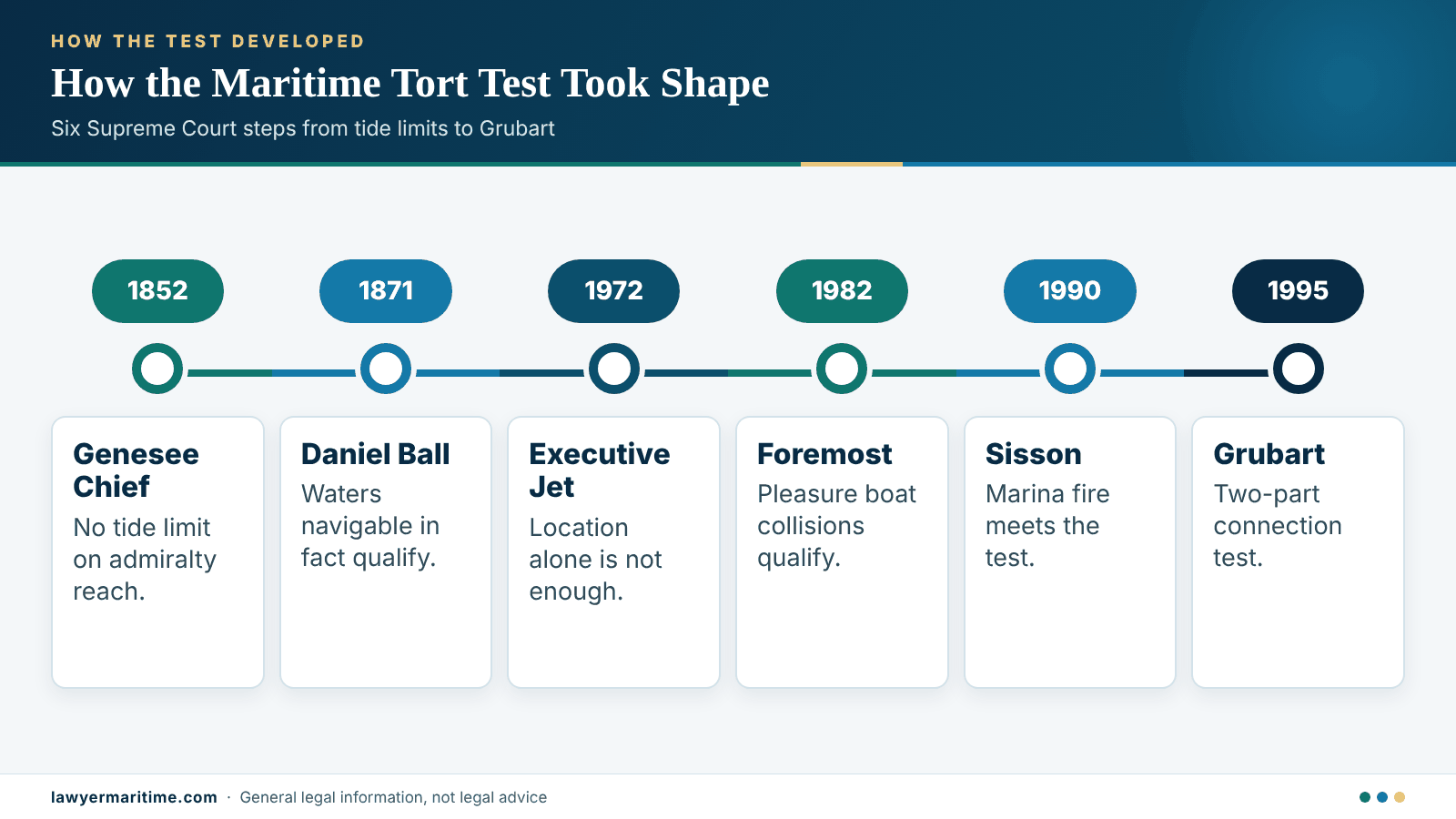
In Executive Jet Aviation, Inc. v. City of Cleveland, 409 U.S. 249 (1972), a jet struck seagulls shortly after takeoff from a lakefront airport and fell into Lake Erie. The location was navigable water, yet the Court held there was no admiralty jurisdiction, because the wrong had no significant relationship to traditional maritime activity. A domestic flight between two points on land did not become a maritime tort because it crashed into a lake.
The Court then applied the same idea to boats. In Foremost Insurance Co. v. Richardson, 457 U.S. 668 (1982), two pleasure boats collided on the Amite River in Louisiana. The Court held that a collision of vessels on navigable waters falls within admiralty jurisdiction even when both are recreational, and it rejected any requirement that the activity be commercial. The reasoning rested on the federal interest in uniform rules for everyone who uses navigable waters.
Next came Sisson v. Ruby, 497 U.S. 358 (1990). A fire started in the washer and dryer area of a yacht docked at a marina on Lake Michigan and spread, destroying the boat and damaging neighboring vessels and the marina. The Court looked at the general character of the incident rather than its actual effects, and it concluded that the fire could have endangered commercial vessels or blocked access to the marina. It described the relevant activity as the storage and maintenance of a vessel at a marina on navigable waters and held that this was substantially related to traditional maritime activity.
The two-part Grubart test
The Court consolidated these lines in Jerome B. Grubart, Inc. v. Great Lakes Dredge & Dock Co., 513 U.S. 527 (1995). Workers on a barge-mounted crane had driven pilings near bridge piers in the Chicago River. Later, river water flooded a freight tunnel under the river and the basements of downtown buildings. The Court held that admiralty jurisdiction applied and described a location test plus a two-part connection test.
The first connection question asks whether the general features of the incident show a potentially disruptive impact on maritime commerce. The second asks whether the general character of the activity giving rise to the incident shows a substantial relationship to traditional maritime activity. The Court treated damage by a vessel in navigable waters to an underwater structure as the first, and repair or maintenance work on a navigable waterway performed from a vessel as the second. It also held that the presence of a land-based party, the city, did not defeat jurisdiction when at least one alleged tortfeasor was engaged in maritime activity that was a proximate cause of the harm.
| Case and year | Facts in brief | What it added |
|---|---|---|
| Executive Jet v. City of Cleveland (1972) | Jet struck birds and fell into Lake Erie after takeoff | Location alone is not enough; the wrong needs a significant relationship to traditional maritime activity |
| Foremost v. Richardson (1982) | Two pleasure boats collided on a Louisiana river | The relationship test is not limited to aviation, and the activity need not be commercial |
| Sisson v. Ruby (1990) | Fire on a yacht at a Lake Michigan marina spread to other property | Courts examine the general character of the incident; vessel storage and maintenance at a marina on navigable waters can qualify |
| Grubart v. Great Lakes Dredge & Dock (1995) | Barge-based pile work was followed by a downtown tunnel flood | Two-part connection test, plus a rule on land-based co-defendants |
Five Hypothetical Fact Patterns Run Through the Tests
Doctrine is easier to absorb when you watch it work. The five scenarios below aren’t real cases and aren’t predictions; they’re invented teaching examples. Each shows how a court would be expected to sort the facts into the three building blocks, and each flags the detail that could flip the result.
Near-shore scenarios: docks, jet skis, and a floating restaurant
Recreational and shoreside facts produce a surprising share of jurisdiction fights, because the line between land and water is thin.
The dock slip
A marina guest steps off a rental boat and slips on algae-slick dock boards. The dock is a fixed structure attached to the shore. The slip was not caused by the vessel, so the Admiralty Extension Act does not supply the location test, and the claim looks like an ordinary premises-liability dispute under state law.
Change one fact and the picture shifts. If the boat’s crew left a mooring line stretched across the walkway and the guest tripped on it, the argument is that a vessel on navigable waters caused the harm ashore, and the analysis becomes real rather than automatic. The facts about who controlled the line, and when, would be central.
The jet ski collision
Two rented personal watercraft collide on a lake that connects to a navigable river used for commercial traffic. A passenger breaks an arm. The location is navigable water, and a jet ski is designed to carry a person over water under power, which fits the practical-capability reading of 1 U.S.C. § 3. Foremost held that a collision of recreational boats on navigable waters is within admiralty jurisdiction, so the framework points toward jurisdiction.
The weak points are the water and the proof. If the lake is a small private body of water with no link to commerce, the navigable-waters block is contested. Wake, speed, rental instructions, and rider experience matter later to fault, which the maritime negligence article explains, but they do not affect jurisdiction. Deadlines for recreational claims have their own wrinkles, covered in the boating injury claim deadline guide.
The floating restaurant
A diner slips on a wet stairway inside a restaurant built on a barge-like hull that has been tied to a pier for years, connected to city water, power, and sewer, with no crew and no plans to move. The hull floats and could be towed. Under Lozman, though, a reasonable observer looking at the structure’s physical characteristics and uses might see a dockside business, not a craft designed to a practical degree to carry people or things over water.
The likely result is that the structure is not a vessel and no vessel caused the fall, so state premises law is the natural home. A different history changes things. If the same hull is a certificated former ferry that still runs seasonal cruises under its own power, the vessel question reopens.
Working-water scenarios: river barges and offshore platforms
Industrial settings tend to satisfy the jurisdiction tests easily. The harder questions come afterward, in status and remedy.
The river barge
A worker at a barge fleeting area is struck by a parting line while shifting loaded hopper barges on a navigable river. The water is navigable, the barges are vessels in the Stewart sense, and moving cargo barges is classic maritime activity. The location and connection tests are comfortably met.
Jurisdiction does not answer who the worker may sue or under which statute. That depends on whether the worker is a seaman, a longshore or harbor worker, or something else, and on who employed and controlled the work. The Jones Act guide explains the seaman inquiry, and a collision that closes the channel is examined in the maritime collision investigation article.
The offshore platform
A contractor falls from a stairway on a fixed production platform in the Gulf of Mexico. In Rodrigue v. Aetna Casualty & Surety Co., 395 U.S. 352 (1969), the Court treated fixed drilling structures on the Outer Continental Shelf as artificial islands rather than vessels, and held that the remedy lay under the Outer Continental Shelf Lands Act and adjacent-state law rather than the Death on the High Seas Act. Today, 43 U.S.C. § 1333 addresses the field, and it applies adjacent-state law as federal law to fixed structures on the shelf where federal law is silent.
The same worker could have a very different claim if hurt aboard a supply boat at the platform, or during a transfer between boat and platform. Those facts can create mixed questions, and courts look closely at where the injury happened and which structure or vessel caused it. Outcomes vary by circuit and by facts.
| Scenario | Navigable waters | Vessel | Maritime tort tests | Working assessment |
|---|---|---|---|---|
| Dock slip | Shore structure | None involved | No vessel caused the harm | Likely state premises law |
| Jet ski collision | Yes, if the lake is navigable | Likely | Foremost points toward yes | Likely within admiralty jurisdiction |
| Floating restaurant | Yes | Doubtful under Lozman | No vessel caused the fall | Likely state law; history could change it |
| River barge | Yes | Yes | Met | Jurisdiction yes; status and remedy still open |
| Fixed platform | Water is navigable | Generally not a vessel | Contested | Shelf-lands statute and adjacent-state law likely |
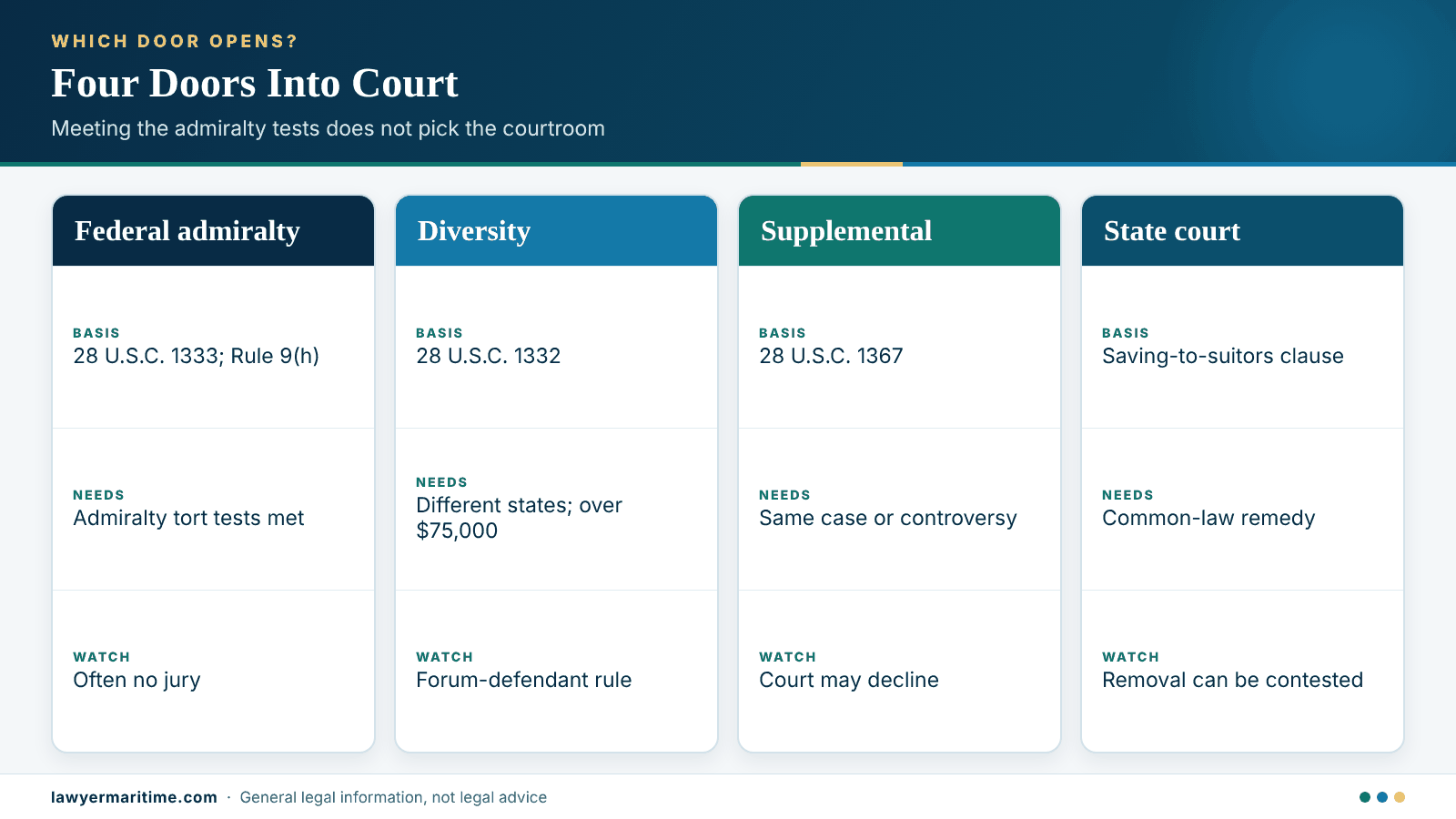
Original, Supplemental, and Diversity Jurisdiction: Which Door Opens?
Meeting the admiralty tests answers one question: the dispute belongs to the maritime world. It doesn’t force the case into a single courtroom. Several doors can lead to court, and each has its own entry requirements and side effects.
Original admiralty jurisdiction in federal court
Original jurisdiction means a court may hear a case in the first instance, without relying on another court’s decision or on some other statute to supply the power.
Section 1333 and the saving-to-suitors clause
Section 1333(1) gives the federal district courts original jurisdiction, exclusive of the state courts, over any civil case of admiralty or maritime jurisdiction, but it saves to suitors all other remedies to which they are otherwise entitled. In practice the clause lets many injured plaintiffs, who sue a person or company rather than a vessel, choose a state court that will apply maritime law. Proceedings against the vessel itself, called in rem actions, are the classic admiralty remedy and are generally brought in federal court. The interplay with a vessel owner’s limitation of liability filing is a procedural topic handled in the admiralty law guide.
The result is a real choice for many plaintiffs, but it is a strategic one. A federal admiralty case follows the Supplemental Rules and is often tried to a judge, while a state court case usually offers a jury. Which is better depends on the facts, the venue, and the claims in play.
Rule 9(h) and the admiralty designation
Federal Rule of Civil Procedure 9(h) governs how a claim becomes an “admiralty or maritime claim” for procedural purposes. If a claim is cognizable only in admiralty, it is an admiralty claim whether or not the pleading says so. If the claim is within admiralty jurisdiction and also within the court’s jurisdiction on another ground, such as diversity, the pleader may designate it as admiralty or maritime for purposes of Rules 14(c), 38(e), and 82 and the Supplemental Rules.
The designation decision shapes the case. It affects how third parties may be brought in, whether a jury demand is available under Rule 38(e), and which procedures apply. Rule 9(h)(2) also ties the designation to interlocutory appeals under 28 U.S.C. § 1292(a)(3). A plaintiff’s lawyer makes the designation decision deliberately.
Alternatives: diversity, supplemental claims, and state court
Original admiralty jurisdiction isn’t the only route into federal court, and it’s sometimes not the best one.
Diversity of citizenship and the Romero rule
Under 28 U.S.C. § 1332(a)(1), district courts have original jurisdiction over civil actions between citizens of different states where the amount in controversy exceeds $75,000, exclusive of interest and costs. A maritime plaintiff who meets those requirements can use diversity as an alternative basis, and may then choose whether to designate the case as admiralty under Rule 9(h).
Diversity matters because general maritime claims do not, on their own, “arise under” federal law for purposes of the general federal-question statute, 28 U.S.C. § 1331. The Supreme Court so held in Romero v. International Terminal Operating Co., 358 U.S. 354 (1959). In short, a federal court needs admiralty jurisdiction or another statutory basis, such as diversity, to hear a maritime claim. When a case begins in state court on a diversity-only basis, the forum-defendant rule in 28 U.S.C. § 1441(b)(2) can bar removal if a properly joined and served defendant is a citizen of the forum state.
Supplemental jurisdiction and state court
Supplemental jurisdiction under 28 U.S.C. § 1367(a) lets a federal court that already has original jurisdiction over a claim hear other claims that form part of the same case or controversy. A maritime claim and a closely related state-law claim, such as a premises claim against a shoreside owner, can sometimes travel together, and section 1367(c) lets the court decline the added claim in specified circumstances.
State courts can and do hear maritime claims under the saving clause, applying federal maritime law. Whether a defendant can remove such a case to federal court without diversity is an area where federal courts have disagreed, and section 1441(b) does not mention admiralty. Because the answer can turn on the court and the pleading, the maritime jurisdiction path and a lawyer’s review of the specific filing matter more than any general statement.
| Route | Legal basis | What it requires | Typical consequence or caution |
|---|---|---|---|
| Federal admiralty | 28 U.S.C. § 1333; Fed. R. Civ. P. 9(h) | A claim meeting the admiralty tort tests | Supplemental Rules apply; a jury is often unavailable on a designated admiralty claim |
| Federal diversity | 28 U.S.C. § 1332(a)(1) | Citizens of different states and more than $75,000 in controversy | The pleader may choose whether to designate the claim as admiralty |
| Supplemental claims | 28 U.S.C. § 1367 | Related claims forming part of the same case or controversy | The court may decline added claims in specified situations |
| State court | Saving-to-suitors clause in § 1333(1) | A suit seeking a common-law remedy, usually against a person or company | Maritime law still applies; removal can be contested |
Practical Checklist: Facts That Decide Admiralty Jurisdiction
If you are a reader with a real incident behind your interest in this topic, the practical question is what to capture now. The doctrine above turns on facts that are easy to lose: exact locations, craft descriptions, and who did what. Here is the practical takeaway for each building block.
Facts worth preserving
Most of these cost nothing to collect, and they’re far easier to gather early than months later when a vessel has moved or been repaired.
Location and water facts
Write down exactly where the incident happened, including the body of water, the nearest landmark or marker, and whether you were on the water, on a dock, or ashore. Save photos, map pins, and any phone location history. Note whether the water connects to larger waterways, whether commercial vessels use it, and whether a channel, bridge, or pier was affected.
- The name of the waterway and the nearest landmark
- Where each person stood or sat when the injury happened
- Photos of the dock, shoreline, and any structure involved
- Whether commercial or interstate traffic uses the water
Vessel and activity facts
Record what the craft was, who owned and operated it, how it was powered and secured, and what it was doing. Photos of registration numbers, hull identification numbers, and any signage help. Note whether the craft was underway, moored, anchored, or under repair, and keep any rental agreement, ticket, or work order. If a fire or collision was involved, preserve what you can, and see the maritime fire investigation guide for how investigators approach those events.
- The craft’s name, registration, or hull number
- How it was powered, steered, secured, and crewed
- What the activity was and who directed it
- Rental, ticket, or work documents tied to the trip or job
Common mistakes with jurisdiction questions
The errors below aren’t about bad faith. They come from reasonable assumptions that happen to cut against a stressed reader’s interests.
Assumptions that cost time
The first assumption is that “on the water” and “maritime” mean the same thing. The Executive Jet case shows they do not. The second is that a floating thing is a vessel, or that a thing on a dock is not, when Stewart and Lozman require a practical look at the craft. The third is that a state-court filing means maritime law is out of the picture, when the saving clause often keeps maritime law in play.
A fourth assumption deserves its own warning. Passing the admiralty tests doesn’t guarantee a remedy, and failing them doesn’t end a claim. It may only move the dispute to a different body of law, with its own elements and its own damages.
Timing and paperwork
A second group of mistakes involves the calendar. Waiting to sort out the jurisdiction question before acting can let a deadline pass, because limitation periods may differ among maritime, state, and government-claim routes. The general maritime period for personal injury or death arising out of a maritime tort is found in 46 U.S.C. § 30106, but the section applies except as otherwise provided by law, and tickets, contracts, and government-vessel rules can change the picture. For a closer look at boating timelines, see the boating injury claim deadline article.
Keep copies of anything you file or receive, and keep original photos and videos with their metadata intact. If a lawyer eventually reviews the matter, the first conversation is far more productive with dates, places, and documents already organized, a topic taken up in the broader maritime accident guide.
| Common mistake | Why it causes trouble | Better habit |
|---|---|---|
| Assuming any injury on water is maritime | Location alone has not been enough since Executive Jet | Record the activity, not just the place |
| Calling a structure a vessel (or not) without facts | Vessel status turns on practical capability and use | Document configuration, power, mooring, and history |
| Ignoring shore-side harm caused by a boat | The Admiralty Extension Act can reach it | Note what the vessel did and when |
| Waiting for the court question to be settled | Deadlines can run while the question is debated | Check the shortest plausible time limit early |
| Giving loose statements about the craft or location | They can become admissions on decisive points | Keep to facts you know and review documents first |
Frequently Asked Questions About Admiralty Jurisdiction
These answers are general and assume U.S. federal law. Local rules, circuit decisions, and the facts of an incident can change the result.
Basic concepts
What is admiralty jurisdiction in simple terms?
It’s the authority of courts to hear and decide maritime disputes under maritime rules. For injury claims, courts usually ask about navigable waters, a vessel, and whether the incident meets the location and connection tests for a maritime tort.
Is admiralty jurisdiction the same as maritime jurisdiction?
For tort claims the terms are used almost interchangeably, and the statute pairs them. For a decision path built around a specific accident, see the maritime jurisdiction guide, which approaches the topic from the injured person’s side.
Does it matter whether the water is fresh or salt?
No. Since The Genesee Chief in 1852, the question has been navigability rather than tide or salinity, and the Great Lakes and inland rivers can qualify.
Vessels and structures
Is a jet ski a vessel for admiralty purposes?
It often is analyzed as one, because it is designed to carry a person over water under power, which fits the practical-capability reading of 1 U.S.C. § 3. Whether admiralty jurisdiction then applies depends on the water and the connection test, and outcomes can vary on the facts.
Can a floating home or restaurant be a vessel?
Sometimes, but Lozman makes it harder when the structure has no steering or propulsion, depends on shore utilities, and is rarely moved. A reasonable observer’s view of the structure’s physical characteristics and use is the key.
Is an offshore oil platform a vessel?
Fixed platforms on the Outer Continental Shelf are generally treated as artificial islands under the shelf-lands statute, not as vessels. Mobile drilling units that float and relocate are analyzed separately and can be treated differently.
Courts and claims
Can I file a maritime injury claim in state court?
Often yes, under the saving-to-suitors clause of 28 U.S.C. § 1333(1), particularly when you sue a person or company rather than a vessel. Removal to federal court can be contested, and a lawyer should review the specific pleading.
Does meeting the tests mean I have a Jones Act claim?
No. The Jones Act seaman remedy, 46 U.S.C. § 30104, depends on seaman status, which is a different inquiry. This guide uses “Jones Act” only in that sense, and not for the separate cabotage rules found at 46 U.S.C. § 55102 and following. The Jones Act guide explains the seaman remedy.
Where can I read more about the whole system?
Start with the maritime law overview for remedies and the maritime lawyer guide for what counsel evaluates in a first review. Neither replaces advice on your own facts.
Sources and Legal Authorities
Statutes, rules, regulations, and court decisions cited in this article, with links to official or established legal-text sources where we verified them.
Statutes, rules, and regulations
Federal statutes and court rules
- 28 U.S.C. § 1333 – Admiralty, maritime, and prize cases
- 46 U.S.C. § 30101 – Admiralty Extension Act jurisdiction
- 1 U.S.C. § 3 – Definition of “vessel”
- 46 U.S.C. § 30104 – Jones Act personal injury to seamen
- 46 U.S.C. § 30106 – Limitations period for maritime torts
- 28 U.S.C. § 1332 – Diversity of citizenship
- 28 U.S.C. § 1367 – Supplemental jurisdiction
- 28 U.S.C. § 1441 – Removal of civil actions
- 43 U.S.C. § 1333 – Outer Continental Shelf Lands Act: law and jurisdiction
- 43 U.S.C. § 1349 – Outer Continental Shelf Lands Act: citizen suits and jurisdiction
- Federal Rule of Civil Procedure 9 – Pleading special matters, including Rule 9(h)
Regulations
Cases
Supreme Court decisions on navigable waters and vessels
- The Genesee Chief v. Fitzhugh, 53 U.S. (12 How.) 443 (1852) – admiralty jurisdiction not limited to tidewater
- The Daniel Ball, 77 U.S. (10 Wall.) 557 (1871) – navigable in fact
- Ex parte Boyer, 109 U.S. 629 (1884) – artificial canal within admiralty jurisdiction
- Stewart v. Dutra Construction Co., 543 U.S. 481 (2005) – definition of a vessel
- Lozman v. City of Riviera Beach, 568 U.S. 115 (2013) – floating home not a vessel
Supreme Court decisions on maritime torts, land injuries, and forum
- Romero v. International Terminal Operating Co., 358 U.S. 354 (1959) – maritime claims and federal-question jurisdiction
- Gutierrez v. Waterman Steamship Corp., 373 U.S. 206 (1963) – Admiralty Extension Act and shoreside injury
- Rodrigue v. Aetna Casualty & Surety Co., 395 U.S. 352 (1969) – fixed offshore structures and the Outer Continental Shelf Lands Act
- Executive Jet Aviation, Inc. v. City of Cleveland, 409 U.S. 249 (1972) – location alone not enough
- Foremost Insurance Co. v. Richardson, 457 U.S. 668 (1982) – pleasure boat collision
- Sisson v. Ruby, 497 U.S. 358 (1990) – marina fire and the connection test
- Jerome B. Grubart, Inc. v. Great Lakes Dredge & Dock Co., 513 U.S. 527 (1995) – location and two-part connection test