A maritime accident attorney helps you work out which body of law governs an accident on or near navigable water, and the answer usually starts with the type of accident and your role, not just the injury. A crew member hurt in a fall on deck, a harbor worker struck by a crane load, an offshore worker injured during a basket transfer, and a cruise passenger hurt on a gangway may be pursuing very different claims, with different defendants, evidence, and deadlines. The governing framework may be the Jones Act and unseaworthiness doctrine for seamen, the Longshore and Harbor Workers’ Compensation Act (LHWCA) for many dock and shipyard workers, the Outer Continental Shelf Lands Act (OCSLA) for some offshore work, or general maritime negligence for passengers and boaters. The accident type and your role together point to the legal route. This guide walks through the common accident types, the route each tends to implicate, the evidence that matters, the clocks to check early, and what to expect when you hire counsel. It is written for injured workers, passengers, and families who want to get their bearings first. It describes general rules, not outcomes.
Which Legal Route Does a Maritime Accident Claim Take?
Before anyone talks about fault or value, a maritime lawyer asks three things: who you were, where the accident happened, and what kind of vessel or structure was involved. Those answers sort an accident into a legal route under U.S. maritime law. The evidence plan, the defendants, and the deadlines all follow from that sorting.
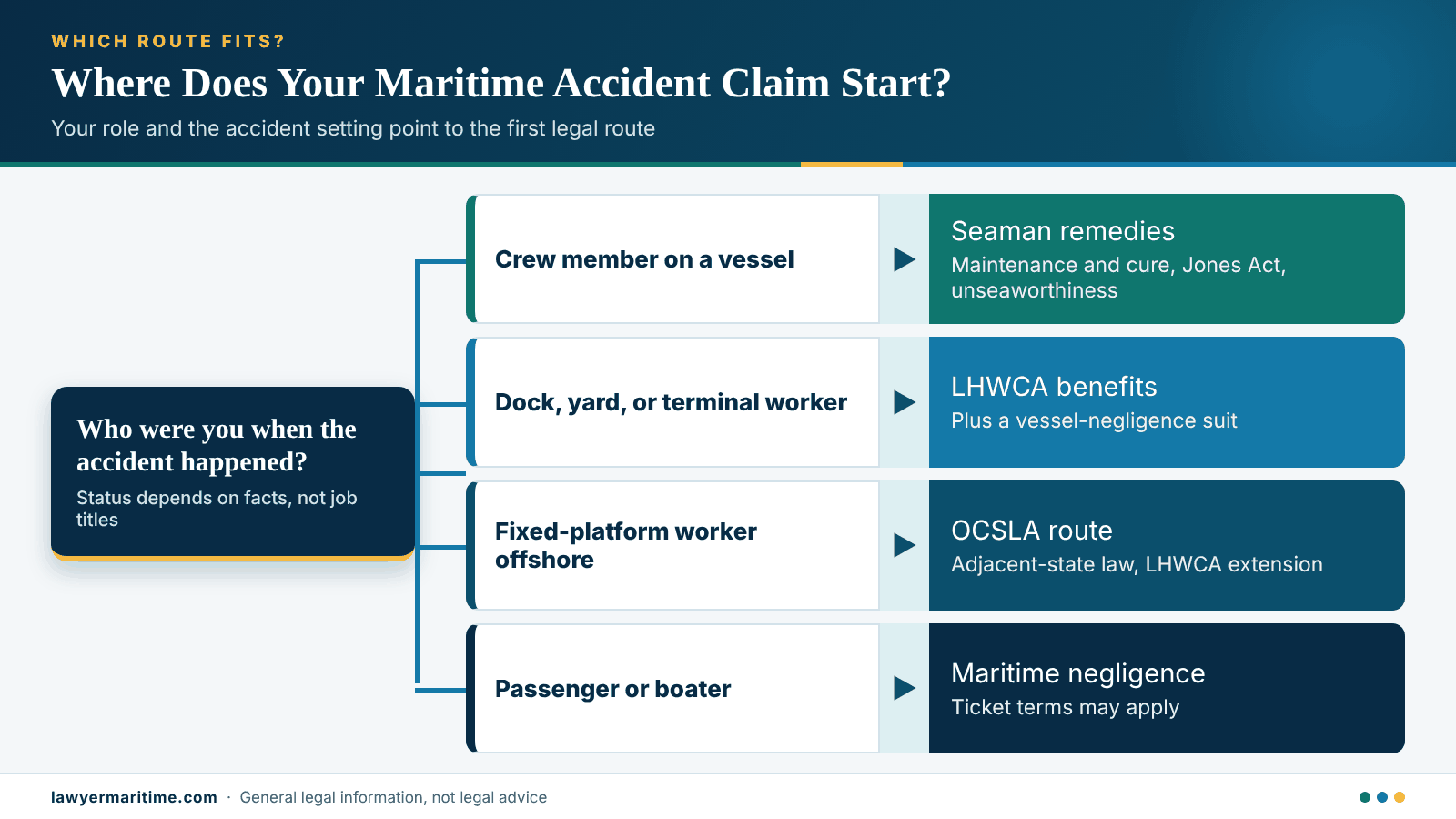
Who were you when the accident happened?
Maritime law sorts injured people by what they do and how closely their work is tied to a vessel. Your job title helps less than the actual work and where it took place.
Crew members and the seaman question
A seaman is generally a worker who contributes to the function of a vessel or the accomplishment of its mission and whose connection to a vessel, or an identifiable fleet of vessels, in navigation is substantial in both duration and nature. The Supreme Court set out that two-part test in Chandris, Inc. v. Latsis, 515 U.S. 347 (1995). It also described a rule of thumb, roughly 30 percent of work time on vessels, as a guideline rather than a fixed cutoff.
Seaman status matters because it opens the richest set of remedies: maintenance and cure, a Jones Act negligence claim against the employer, and an unseaworthiness claim against the vessel owner. Status is often disputed, and it can turn on facts a worker never thought about, such as how many days were spent aboard in the year before the accident.
Harbor workers, offshore workers, and visitors
Many people injured around vessels are not seamen. Longshore workers, ship repairers, shipbuilders, and terminal workers who meet the status and situs requirements of the LHWCA, 33 U.S.C. §§ 901-950, generally receive statutory benefits from the employer. The Act excludes masters and members of a crew, which is why the seaman question matters so much at the border between the two systems.
Offshore workers fall into several groups. Some are seamen, some are covered through OCSLA’s extension of the LHWCA, and some are governed by other law depending on the structure and location. Pilots, surveyors, vendors, and other visitors who are neither crew nor covered harbor workers may have yet another route, often general maritime negligence against whoever controlled the vessel or premises.
Where did it happen, and what was involved?
Even a serious injury on or near the water is not automatically a maritime claim. Courts look at the place of the accident and its relationship to maritime activity.
Navigable water and the maritime connection
For tort claims, federal admiralty jurisdiction generally requires a location test and a connection test. The location test asks whether the tort occurred on navigable water, or whether an injury on land was caused by a vessel on navigable water. The connection test asks whether the incident could disrupt maritime commerce and whether the activity has a substantial relationship to traditional maritime activity. See Jerome B. Grubart, Inc. v. Great Lakes Dredge and Dock Co., 513 U.S. 527 (1995).
The Admiralty Extension Act, 46 U.S.C. § 30101, covers damage on land caused by a vessel on navigable waters, such as a ship striking a pier. Why does this matter to you? Because it affects whether admiralty rules, state law, or both are available, and which court can hear the case.
Vessel, platform, or something else?
Many maritime rules depend on whether the craft involved is a vessel. In Stewart v. Dutra Construction Co., 543 U.S. 481 (2005), the Court treated a vessel as a watercraft practically capable of maritime transportation. In Lozman v. City of Riviera Beach, 568 U.S. 115 (2013), it held that a floating home was not a vessel, asking how a reasonable observer would see the structure.
That test sounds simple until you apply it to a dredge, a barge with a crane, a jack-up rig, or a floating platform. Do not assume the label on a structure settles its status. Vessel classification can decide whether a seaman’s remedies exist at all, so it is usually among the first questions a lawyer tests.
Who can be responsible besides the employer?
The employer is only one possible defendant. Maritime accidents often involve a chain of companies, and each link may owe a different duty under a different rule.
Vessel owners, operators, and charterers
A vessel owner or operator may owe a seaman the duty to provide a reasonably fit vessel, which is the unseaworthiness doctrine. For a covered harbor worker, the vessel’s liability is limited to negligence under 33 U.S.C. § 905(b), and unseaworthiness is not available against the vessel. In Scindia Steam Navigation Co. v. De los Santos, 451 U.S. 156 (1981), the Court described the vessel’s duties to turn over the ship in reasonably safe condition, to warn of hidden hazards, and in some cases to intervene once work is under way.
Who counts as the owner, operator, or charterer can be a hard factual question. Bareboat charters, time charters, and management agreements can move responsibility from one company to another, so lawyers read the contracts early.
Contractors, manufacturers, terminals, and the government
Third parties often matter as much as the vessel. A crane maker, a rigging contractor, a terminal operator, a ship repair yard, or a company that supplied a faulty winch may face a separate negligence or product claim. A worker with an LHWCA claim against an employer can usually still pursue a third party under the Act’s rules.
Claims involving government-owned vessels follow separate statutes with their own procedures and sometimes their own notice requirements. If a public vessel may be involved, treat the timeline as a priority rather than an afterthought.
| If you were. | Route often examined | Common defendants | First question to answer |
|---|---|---|---|
| Crew member on a vessel | Maintenance and cure, Jones Act negligence, unseaworthiness | Employer, vessel owner or operator, third parties | Is the seaman test met? |
| Longshore, shipyard, or terminal worker | LHWCA benefits, plus a vessel-negligence suit under § 905(b) | Employer (benefits), vessel, other third parties | Do status and situs requirements apply? |
| Offshore worker on a fixed platform | OCSLA, adjacent-state law as federal law, LHWCA extension | Employer, platform operator, contractors | Which structure and which adjacent state? |
| Passenger on a ship, ferry, or charter | General maritime negligence, subject to ticket terms | Carrier or operator, sometimes a contractor | What does the ticket require, and by when? |
| Recreational boater or guest | General maritime negligence, with state law in some cases | Operator, owner, rental company, manufacturer | Was the boat on navigable water? |
| Family after a death | Jones Act, DOHSA, general maritime law, or state remedies | Depends on the decedent and the location | Where did the death occur? |
Collisions, Allisions, and Towing Accidents: How Does Fault Work?
Accidents between vessels, or between a vessel and something fixed, tend to produce the largest evidence files and the most defendants. They also raise questions about who was steering, who was watching, and who controlled the tow.
How is fault decided when vessels collide or strike fixed objects?
Fault in these cases is usually measured against navigation rules and ordinary standards of good seamanship, then shared among the parties according to their contribution.
Navigation rules and the lookout duty
Vessels on international waters follow the International Regulations for Preventing Collisions at Sea, 33 U.S.C. §§ 1601-1608, and vessels on U.S. inland waters follow the Inland Navigation Rules, 33 U.S.C. §§ 2001-2038. One duty comes up in nearly every collision case. The lookout rule requires every vessel to keep a proper watch by sight and hearing and by all available means suited to the conditions, as 33 CFR 83.05 states for inland waters.
A violation of a collision-prevention rule carries weight. Under The Pennsylvania, 86 U.S. (19 Wall.) 125 (1873), a vessel that breaks such a statutory rule is presumed to have contributed to the collision and must show that its fault could not have been a cause. That burden shift can reshape a case, which is why bridge records and watch practices get early attention.
Shared fault and how it is apportioned
Collisions are rarely one-sided. Under United States v. Reliable Transfer Co., 421 U.S. 397 (1975), courts allocate responsibility according to each party’s comparative fault rather than splitting it equally by default. Several vessels, a pilot, a bridge owner, and a terminal can each take a percentage.
Your own position changes how this plays out. An injured crew member can generally pursue the employing vessel under the Jones Act and may also pursue the other vessel’s owner for negligence. A passenger who did nothing to cause the accident has a different problem: identifying every responsible party before the evidence is gone. Our guide to maritime collision investigations explains how the official fact-finding process works.
How do towing and barge accidents change the picture?
Towing adds a second layer of responsibility. The tug, the tow, the towing contract, and the people on each may share control in ways that are not obvious from the outside.
Tug, tow, and the chain of responsibility
A tug and its tow can have separate owners, separate crews, and separate insurers. The towing contract or charter often says who supplies the crew, who directs the navigation, and who maintains the lines and gear. Those terms matter because liability tends to follow control.
Seaman status is also less certain on some tows. A barge worker may spend most days on one barge, move among several in a fleet, or work mostly from the shore. Courts have looked at whether vessels under common ownership or control make up an identifiable fleet. That fact-heavy question often drives which claim is available. When a tow separates or a barge breaks away, scheduling and watch practices matter too, as our article on maritime fatigue accidents explains.
Line handling, mooring, and parted lines
Some of the most serious towing injuries happen at close range: a line parts under load, a winch brake slips, or a deckhand is caught in a bight of rope. Claims in these cases often turn on equipment condition, crew size, training, and whether the task was planned safely.
For a seaman, an unseaworthiness claim may focus on the line or winch itself. The Supreme Court has said that a single negligent act by the crew does not automatically make a vessel unseaworthy, in Usner v. Luckenbach Overseas Corp., 400 U.S. 494 (1971). That distinction explains why lawyers look for proof of a defective condition, not only a mistake.
| Fact pattern | Legal questions usually raised | Proof that tends to matter |
|---|---|---|
| Two vessels collide in a channel | Navigation-rule violations, lookout, proportionate fault, pilot responsibility | Voyage and AIS data, radar, bridge communications, watch schedules |
| Vessel strikes a pier, bridge, or platform | Operator negligence, speed and set, fixed-object presumptions, property owner’s duties | Track history, mooring and approach records, pilot and master statements |
| Barge breaks away or tow separates | Control of the tow, towing contract terms, weather decisions, seaworthiness of the gear | Towing contract, weather logs, line and wire records, maintenance history |
| Line parts or winch fails during towing or mooring | Unseaworthy equipment, negligent task planning, crew size and training | The failed line or part, inspection records, work plans, witness accounts |
Falls, Cranes, Gangways, and Fires Aboard: Which Theories Apply?
Most injuries aboard a working vessel are not dramatic. They happen on deck, on a ladder, at a hatch, or beside a piece of equipment. The legal theory depends on your status, but the proof usually comes down to the condition of the place and the equipment.
What claims arise from slips, trips, falls, and falls overboard?
Falls are the most common onboard accident type, and the legal analysis differs depending on whether the person who fell was crew, a harbor worker, or a passenger.
Slips, trips, and falls on deck
For a seaman, a fall on deck may support a Jones Act negligence claim against the employer and an unseaworthiness claim against the vessel owner. The Jones Act incorporates the Federal Employers’ Liability Act, whose causation standard asks whether the employer’s negligence played any part, in whole or in part, in producing the injury. The Supreme Court described that standard in CSX Transportation, Inc. v. McBride, 564 U.S. 685 (2011).
Unseaworthiness looks at the condition rather than the care taken. A deck without non-skid treatment, an oily walkway, a missing handrail, or loose gear can each be unseaworthy conditions. A passenger who falls on a wet stairway generally proceeds under maritime negligence, which asks whether the operator used reasonable care under the circumstances.
Falls overboard and man-overboard events
A fall overboard raises questions that a deck fall does not. Was the person working alone? Were lifejackets or fall protection required? How long was it before anyone noticed, and what did the search and recovery look like? Lighting, sea state, watch schedules, and the vessel’s overboard procedures all become part of the record.
The location can also decide the claim if the fall is fatal. A death beyond three nautical miles from shore may implicate DOHSA for a non-seaman, while a seaman’s death may support a Jones Act action brought by the personal representative. The next sections on deaths explain these routes in more detail.
How do cranes, gangways, fires, and explosions change the analysis?
These accidents often involve heavy equipment or energy sources that more than one company controls. Responsibility may be spread among the vessel, the shore, and the contractors who worked between them.
Cranes, lifts, and gangway accidents
When a load drops or a gangway fails, the first question is whose equipment it was. A ship’s own crane is usually part of the vessel, while a shore crane belongs to the terminal or a contractor. For a longshore worker, the vessel’s negligence duties under Scindia depend on whether the ship turned over safe equipment, kept control of an area, or knew of a hazard and ignored it. For a seaman, defective ship’s gear may support an unseaworthiness claim.
Safety rules can add context. OSHA’s maritime standards cover shipyards, marine terminals, and longshoring, in 29 CFR Parts 1915, 1917, and 1918, and Part 1919 addresses certification of vessels’ cargo gear. In Chao v. Mallard Bay Drilling, Inc., 534 U.S. 235 (2002), the Court held OSHA may regulate working conditions on an uninspected vessel where the Coast Guard has not exercised authority over them. A regulatory violation can be strong evidence, but it doesn’t automatically decide liability.
Fire and explosion
Fires and explosions are hard to prove because the cause may be destroyed by the event itself. Possible origins include engine-room fuel leaks, galley equipment, electrical systems, battery banks, cargo, and hot work. A claim might involve the employer, the vessel owner, a repair yard, or the maker of a component.
Lawyers working on these cases rely on origin-and-cause analysis by qualified investigators and on strict handling of physical evidence. The article on maritime fire investigations explains how that process works. If you were hurt in a fire, the burn or inhalation injury is only part of the picture, and documentation of the escape and firefighting response also matters.
| Hazard | Theories often examined | Typical proof |
|---|---|---|
| Slippery or damaged deck | Unseaworthy condition, negligent maintenance or cleaning | Photos, maintenance and cleaning logs, prior complaints, witness accounts |
| Fall overboard | Negligent supervision, missing safety equipment, delayed search | Watch schedules, safety gear records, lighting, communications, search log |
| Crane or rigging failure | Defective gear, improper rigging, operator or signaler negligence, third-party claims | Inspection and certification records, load data, rigging plans, operator qualifications |
| Gangway or access failure | Unsafe means of access, vessel’s duty to turn over safe premises | Photos of the gangway, placement and securing records, lighting, rail condition |
| Fire or explosion | Negligence, unseaworthiness, product claims, hot-work and storage practices | Origin-and-cause findings, retained components, alarm and suppression records |
Offshore Transfers and Platform Accidents: Which Law Follows the Worker?
Offshore accidents often happen at the point where one workplace meets another: a boat meets a platform, a crane meets a basket, or a crew meets a contractor team. That seam is where responsibility and legal status get complicated.
What goes wrong during offshore personnel transfers?
Moving people between vessels and platforms is routine, and it depends on weather, communication, and precise equipment handling. When a step fails, injuries can be severe.
Basket, crane, and gangway transfers
In a crane transfer, a worker rides in a personnel basket or is lifted by other means between a vessel and a fixed or floating structure. The vessel is moving, the crane operator may not see the deck clearly, and the signal chain may involve several companies. An injury can come from a hard landing, a swing, a dropped load, or a sudden change in sea state.
Questions include who authorized the transfer, whether weather limits were observed, who qualified the crane operator and signaler, and whether a job safety analysis was completed. Records from the vessel, the platform, and the crane owner may each tell part of the story. Preserving all three early is a common priority for counsel.
Crew boat and supply vessel injuries
Workers also get hurt aboard the boats that carry them offshore. Hard slamming in rough seas, a fall on a ladder at the landing, or an unsecured seat can all cause injuries. Whether the injured person is a seaman, a passenger-like worker, or something else depends on how much of the person’s work was tied to the vessel.
The master’s log, the weather and sea-state data, the vessel’s speed and heading, and the passenger manifest help reconstruct what happened. They can also show who else was aboard, which matters because the best witnesses are often co-workers who return to the field within days.
How does OCSLA change an offshore accident claim?
The Outer Continental Shelf Lands Act, 43 U.S.C. §§ 1331-1356b, extends federal law to the seabed and to fixed structures attached to it. That produces rules that differ from vessel-based maritime law.
Fixed platforms and adjacent-state law
Under 43 U.S.C. § 1333(a), federal law applies to the outer continental shelf and to installations attached to the seabed as if they were a federal enclave in a state, but the statute excludes ships. It also adopts the civil law of the adjacent state as surrogate federal law where it doesn’t conflict with federal law. In practice, the remedies available for a platform accident can depend on which state is adjacent to the location.
Workers should not assume that the rules of an offshore vessel carry over to a fixed platform. A claim that would be a maritime tort on a vessel may be analyzed under OCSLA when the accident happens on the structure.
When an offshore worker is a seaman instead
OCSLA’s compensation extension, 43 U.S.C. § 1333(b), provides LHWCA benefits for disability or death from injuries in covered outer continental shelf operations. It defines “employee” to exclude masters and crew members. A worker who qualifies as a seaman because of a substantial connection to vessels therefore may follow a different route from a platform worker doing similar tasks.
This is why offshore lawyers often plead in the alternative. If vessel status or seaman status is contested, a complaint may assert several theories until the facts are developed. Our guide to a maritime personal injury lawyer discusses how counsel approaches that kind of status dispute.
What Evidence Matters for Each Type of Maritime Accident?
Maritime evidence is perishable. Vessels sail, crews rotate, recorders overwrite, and damaged equipment is repaired or scrapped. The right evidence differs by accident type, and the people who hold it are often the people you may have a claim against.
Which evidence disappears fastest?
The order of importance changes by case, but two categories vanish quickly: electronic data and physical evidence. Both depend on someone deciding to keep them.
Electronic and navigational data
Larger commercial vessels often carry voyage data recorders, Automatic Identification System (AIS) transmitters, radar, electronic chart systems, engine monitoring, and cameras. Smaller vessels may have little more than a chartplotter and a phone. Some systems overwrite their data on a cycle, so a delay can mean permanent loss.
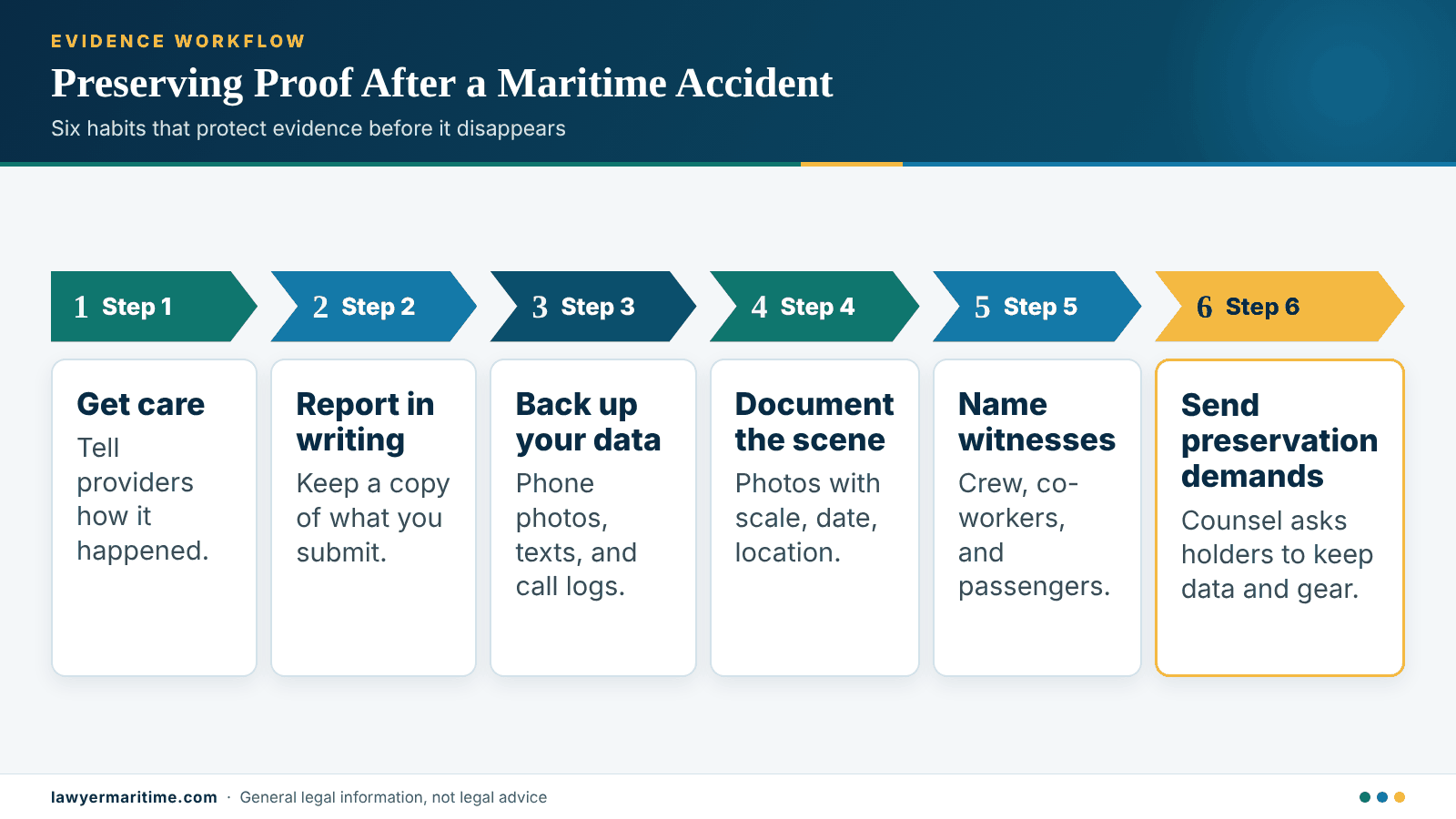
A lawyer typically sends a written preservation demand to the vessel owner, operator, employer, and any other holder. It identifies the specific data to keep and asks for it to be exported in a usable form. If you have your own phone video, photos, or messages from the event, back them up and do not edit or delete them.
Physical evidence and the scene
Failed lines, parted wires, broken fittings, damaged rigging, and defective tools are often the best proof of an unseaworthy condition. Repairs are understandable, but they can destroy proof. The goal is to keep the failed part in its post-failure condition, with a record of who has held it, and to invite all interested parties to inspect it together.
Photos help when they show scale and location. A photo of a slick deck is more useful when it includes a fixed reference point and a time stamp. Do not remove company property or alter the scene. Ask that the evidence be secured, and let counsel handle formal inspection protocols.
Which records show what the company knew and did?
Negligence claims often ask what the responsible party knew or should have known, and unseaworthiness claims ask about the condition of the vessel or its crew and equipment. Paper and digital records answer both questions.
Logs, safety, training, and maintenance records
Useful records include deck and engine logs, safety management documents, drill and training records, hours-of-rest records, crew lists, job hazard assessments, maintenance histories, and prior incident reports. A history of earlier complaints about the same hazard can matter for a negligence theory. Unseaworthiness, by contrast, generally does not depend on whether the owner knew about the condition, as the Court explained in Mitchell v. Trawler Racer, Inc., 362 U.S. 539 (1960).
Your own records count too. Pay records, your crew or employment agreement, certificates, training cards, and medical history help establish status, earnings, and prior condition. Keep copies somewhere the company can’t reach.
Government investigations and their limits
The Coast Guard investigates many marine casualties, and the National Transportation Safety Board (NTSB) investigates major ones. Their reports can be rich with timelines, interviews, and safety findings, and they are valuable for understanding what happened. See the NTSB marine investigation reports and our guide to the NTSB Safer Seas Digest for context.
But the law limits how those reports are used in private lawsuits. Under 46 U.S.C. § 6308, Coast Guard marine casualty investigation reports generally cannot be used as evidence or obtained through discovery in civil proceedings, with exceptions for administrative proceedings conducted by the United States. Under 49 U.S.C. § 1154(b), NTSB accident reports can’t be used in a civil action for damages. Underlying physical evidence, company records, and witnesses remain available through ordinary means.
| Accident type | Evidence to preserve | Usually held by | Risk of loss |
|---|---|---|---|
| Collision or allision | Voyage, AIS, and radar data; bridge communications; watch schedules; damage photos | Vessel operators, pilots, port authorities | Overwriting, vessel departure |
| Slip, trip, or fall | Photos of the surface, cleaning and maintenance logs, prior complaints, witness names | Employer, vessel owner, co-workers | Cleanup, crew changes |
| Crane, gangway, or transfer | Gear certifications, load and rigging records, operator qualifications, weather data | Crane owner, terminal, vessel, contractor | Repairs, retesting, turnover of contracts |
| Fire or explosion | Origin-and-cause records, retained components, alarm and suppression logs | Vessel owner, insurers, investigators | Scene cleanup, salvage, scrapping |
| Towing, barge, or line failure | Failed lines or wires, towing contract, inspection records, tension data if available | Tug operator, barge owner, charterer | Disposal of failed gear |
| Passenger incident | Ticket and booking terms, incident report, video, medical logs, witness contacts | Cruise line, ferry operator, charter company | Video retention cycles, passenger dispersal |
Passenger, Boater, and Fatal Accident Claims: What Is Different?
People who aren’t crew don’t get maintenance and cure or Jones Act remedies. Their claims rest on general maritime negligence, on contract terms in a ticket, or on wrongful-death rules that change with the location of the death.
How do passenger and recreational boating claims work?
Passenger and boating cases look like ordinary personal injury cases on the surface, but the ticket, the vessel type, and the statutes that cap or reshape liability can change the path from the first day.
Cruise, ferry, and charter passengers
A passenger injured by a negligent crew, an unsafe gangway, a slick deck, or a collision generally proceeds under general maritime negligence. The carrier’s duty is to use reasonable care under the circumstances. Medical records, incident reports, and video from the carrier are often central.
The ticket contract deserves a careful read. Under 46 U.S.C. § 30526, a contract for passage on a seagoing vessel carrying passengers between U.S. ports or between a U.S. port and a foreign port can’t shorten the period to give notice of an injury claim to less than six months or the period to sue to less than one year, with longer minimums for covered small passenger vessels. The Supreme Court has also enforced a forum-selection clause in a cruise ticket in Carnival Cruise Lines, Inc. v. Shute, 499 U.S. 585 (1991). Keep your ticket, booking confirmation, and any emails.
Recreational boats, rentals, and limitation of liability
Accidents on private boats, rentals, and tour boats raise similar negligence questions about the operator’s skill, speed, lookout, alcohol use, equipment, and instructions to passengers. State boating laws may also matter. Whether admiralty law applies depends on the location and the maritime connection discussed earlier.
Vessel owners can sometimes invoke the Limitation of Liability Act, now codified at 46 U.S.C. § 30523, to seek a cap on liability at the value of the vessel and pending freight for certain losses that occur without the owner’s privity or knowledge. The statute was renumbered and amended in 2022. A limitation proceeding can pause other suits while the federal court decides whether the cap applies, a procedure discussed in Lewis v. Lewis & Clark Marine, Inc., 531 U.S. 438 (2001). If you’re served with notice of one, take it seriously.
What happens when someone dies in a maritime accident?
Wrongful-death rules depend on who died and where. The same accident can produce different claims for different victims, which is painful but important to understand early.
Deaths beyond three nautical miles from shore
The Death on the High Seas Act (DOHSA) applies when death is caused by wrongful act, neglect, or default occurring on the high seas beyond three nautical miles from the shore of the United States. Under 46 U.S.C. § 30302, the decedent’s personal representative may bring a civil action in admiralty for the exclusive benefit of the decedent’s spouse, parent, child, or dependent relative. Recovery is limited to pecuniary loss, as the Court held in Mobil Oil Corp. v. Higginbotham, 436 U.S. 618 (1978).
Timing questions arise early in these cases. See our dedicated guide to the DOHSA claim deadline for how the limitation period is generally analyzed.
Deaths in state waters and the deaths of seamen
When a person who was not a seafarer dies in state territorial waters, state wrongful-death and survival remedies may still apply, as the Court held in Yamaha Motor Corp., U.S.A. v. Calhoun, 516 U.S. 199 (1996). A seaman’s death may support a Jones Act action by the personal representative under 46 U.S.C. § 30104, as well as general maritime claims.
Available damages differ across these routes. For example, the Court held in Miles v. Apex Marine Corp., 498 U.S. 19 (1990), that loss-of-society damages are not available in a seaman’s wrongful-death claim under general maritime law. Our guide to maritime injury compensation covers damages categories in more depth.
| Decedent and location | Route often examined | Key limit to check |
|---|---|---|
| Seaman, on or off the high seas | Jones Act and unseaworthiness claims by the personal representative | Damages categories differ by claim |
| Non-seafarer beyond three nautical miles from U.S. shore | DOHSA, 46 U.S.C. § 30302 | Pecuniary loss only; listed beneficiaries |
| Non-seafarer in state territorial waters | State wrongful-death and survival remedies may apply alongside maritime claims | State law varies; maritime overlay possible |
| Covered harbor worker | LHWCA death benefits, plus a possible vessel-negligence suit | Statutory beneficiaries and formulas |
Which Deadlines and Reporting Clocks Should You Check Early?
Timing is where an otherwise strong maritime claim can be damaged. Different rules start the clock at different moments, and some of them are far shorter than people expect. Treat this section as a list of questions to ask a lawyer, not as a calculation of your own deadline.
What time limits can apply to a maritime accident claim?
Some limits are statutes of limitation for filing suit. Others are notice requirements that must be met before suit, or filing requirements for compensation systems that work differently from a lawsuit.
The general three-year period and its exceptions
Under 46 U.S.C. § 30106, and “except as otherwise provided by law,” a civil action for damages for personal injury or death arising out of a maritime tort must be brought within three years after the cause of action arose. Jones Act claims incorporate the Federal Employers’ Liability Act, whose limitations period is also three years under 45 U.S.C. § 56. DOHSA claims are generally analyzed under the same § 30106 period.
The phrase “except as otherwise provided by law” is doing real work. Contracts, other statutes, and special defendants can change the analysis. Three years is a starting reference, not a promise that you have three years.
Short notice windows in tickets and compensation statutes
Passenger contracts can include shorter periods than three years, within the floor set by 46 U.S.C. § 30526, which for seagoing vessels on covered routes is at least six months to give notice of a claim and at least one year to sue. For longshore and harbor workers, 33 U.S.C. § 912 generally calls for written notice of injury within 30 days after the injury or after the worker knew or should have known it was work related. Notice may be excused in specific circumstances, including when the employer already knew of the injury and was not prejudiced.
The LHWCA also sets a claim-filing period. Under 33 U.S.C. § 913(a), the right to compensation is generally lost unless a claim is filed within one year, and that year generally does not start until the worker knows or should know the injury is work related. If compensation was paid without an award, the period can run from the last payment. Exceptions are narrow, so don’t count on them.
Who has to report an accident, and what does that mean for you?
Some reporting duties fall on vessel operators, not on you. Knowing the difference can help you find the paperwork that already exists.
The operator’s reporting duties
Under 46 U.S.C. § 6101, marine casualties such as a death, serious injury, material loss of property, or material damage to a vessel’s seaworthiness must be reported, and the report must say whether alcohol contributed. Under 46 CFR 4.05-1, the owner, agent, master, operator, or person in charge must give immediate notice to the Coast Guard for events that include deaths, injuries requiring medical care beyond first aid, and groundings. A written report on Form CG-2692 is due within five days under 46 CFR 4.05-10.
These duties belong to the operator. A required report doesn’t prove that you made a claim, and a report that was filed doesn’t mean it is complete or accurate. Ask counsel how to request the report and what else exists, such as drug and alcohol testing records under 46 CFR Part 4, Subpart 4.06.
Limitation actions and deadlines set by the other side
If a vessel owner files a limitation action, the federal court typically sets a deadline for claimants to file their claims in that proceeding, often through an order that is mailed or published. Missing that date can be serious. The 2022 changes to the statute and the supplemental admiralty rules both bear on timing, so the details deserve legal review.
The same principle applies to insurer letters, release forms, and employer deadlines. A deadline set by someone else is still a deadline that may bind you, so route every formal notice to counsel quickly.
| Claim or event | General period or rule | Source | Caveat |
|---|---|---|---|
| Maritime tort injury or death suit | Three years after the cause of action arose | 46 U.S.C. § 30106 | “Except as otherwise provided by law” |
| Jones Act suit | Three years, through FELA | 45 U.S.C. § 56 | Confirm with counsel; related claims may differ |
| LHWCA notice of injury | Written notice generally within 30 days of injury or awareness | 33 U.S.C. § 912 | Excuses exist, but are fact-specific |
| LHWCA claim for compensation | Generally one year, with a knowledge-based start | 33 U.S.C. § 913 | Payment and other events can change the date |
| Passenger ticket notice and suit | Contracts cannot shorten below six months (notice) and one year (suit) on covered seagoing vessels | 46 U.S.C. § 30526 | Longer minimums for small passenger vessels |
| Operator’s Coast Guard casualty report | Immediate notice, then written report within five days | 46 CFR 4.05-1, 4.05-10 | Operator’s duty, not a claimant’s deadline |
What Should You Expect From a Maritime Accident Attorney?
A maritime accident attorney is a lawyer who handles injury and death claims arising on or near navigable water. The title is not a license category. A good first conversation is about your route, your evidence, and your timing, and it ends with a clear sense of what happens next, not with a promise.
What does the lawyer actually do in the first weeks?
The early work is mostly sorting and protecting. Very little of it looks like a courtroom, but a lot of the case is shaped here.
Route, forum, and defendants
Counsel first tests your status, the vessel or structure involved, and the location, then chooses theories to plead. A seaman’s claim may be filed in federal court in admiralty or in state court under the saving-to-suitors clause of 28 U.S.C. § 1333, and the Jones Act gives a right to a jury trial. A passenger’s ticket may require a particular court. A harbor worker may have a compensation claim and a separate third-party suit running at the same time.
Forum choices have consequences for deadlines, juries, available damages, and procedure. A lawyer who has handled your type of accident can usually explain the tradeoffs in plain terms. One who skips this step and promises a number is a warning sign.
Evidence, experts, and preservation
After the route is chosen, the lawyer protects evidence: preservation demands, inspection requests, witness interviews, and requests for logs and recorder data. Depending on the accident, counsel may consult marine surveyors, naval architects, fire investigators, human-factors or fatigue specialists, medical providers, and vocational experts. Whether any of these are needed depends on the facts.
The lawyer should also keep you informed about benefits that don’t depend on fault. For a seaman, that means maintenance and cure; for a harbor worker, statutory benefits. Our guide to maritime injury compensation explains those categories.
How do you evaluate a lawyer before hiring one?
Choosing counsel is a decision with legal and financial consequences, and it is reasonable to ask direct questions. Our broader articles on a maritime injury attorney and on how to compare maritime lawyers cover the selection process, so this section stays focused on accident-specific questions.
Questions worth asking
- Have you handled this type of accident, and which legal route do you see so far?
- What facts would change your view of my status or the vessel’s status?
- Which evidence is most at risk, and what would you send out first?
- Who will work on my matter day to day, and how will you keep me updated?
- What would be the process if another company’s insurer or the government is involved?
Listen for specifics. Answers that explain the theory of the case, the evidence at risk, and the forum options are more useful than general confidence. Also ask whether the lawyer is admitted in the state and federal courts where your claim may be filed.
Fees, ethics, and claims to discount
Ask for the fee agreement in writing and read how costs, liens, and expenses are handled. Under the ABA Model Rules of Professional Conduct, Rule 1.5 addresses fees and requires contingent fee agreements to be in writing, and Rules 7.1 through 7.3 limit false or misleading lawyer advertising and solicitation. State rules vary and may be stricter.
Be careful with guarantees, claims of being the “best,” and impressive-sounding results that come with no context. Outcomes depend on facts, law, and sometimes luck. A credible lawyer will explain risks as clearly as opportunities. If a lawyer or firm says it holds a specialist certification, you can usually confirm it with the state bar that issued it.
What to Do Now After a Maritime Accident
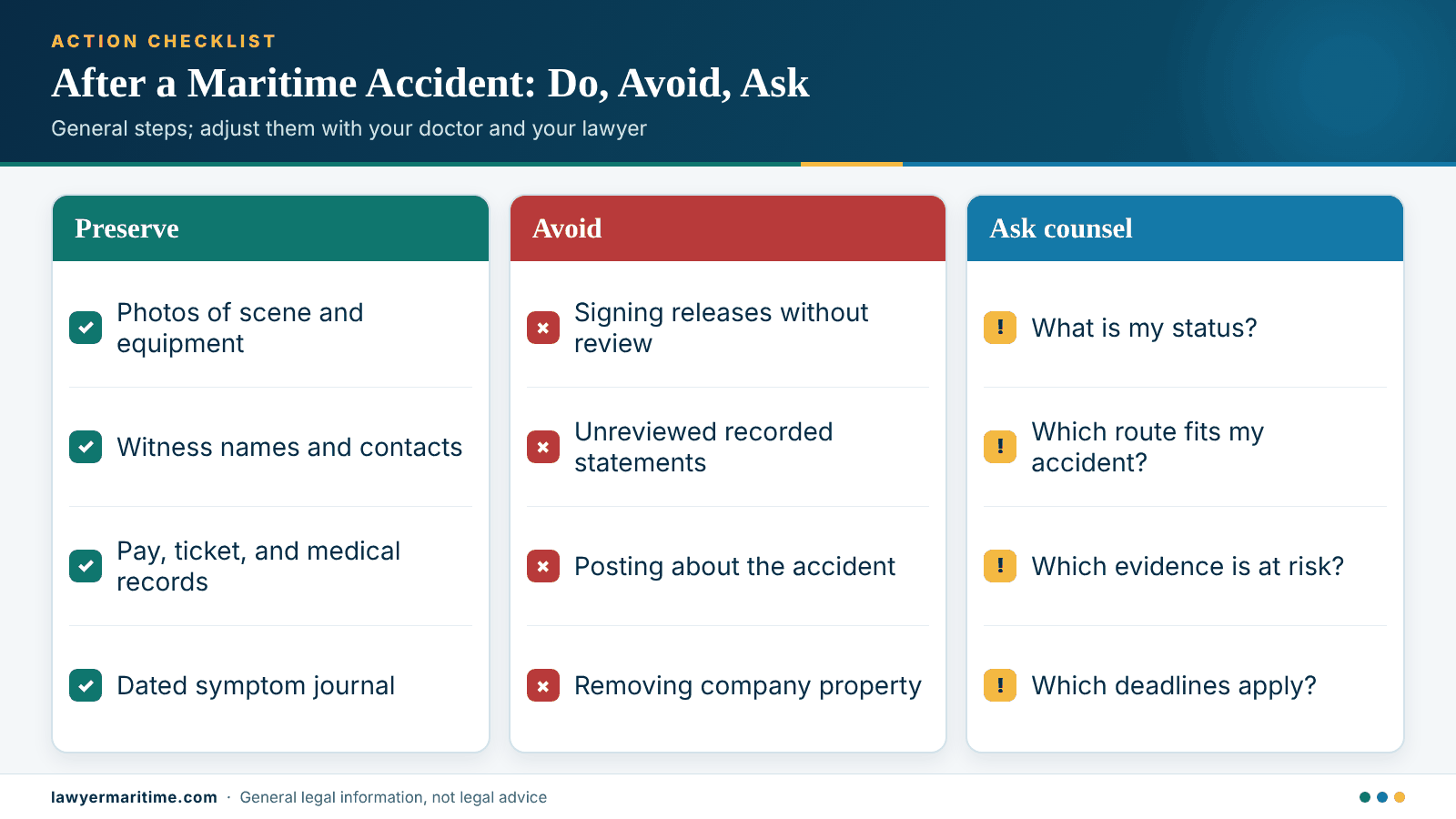
If you’ve just been hurt, or you’re helping someone who has, the next days matter more for protecting information than for anything else. These steps are general, so adjust them with your doctor and your lawyer.
What should you do in the first days?
Think in two tracks: your health and your record. Neither should be neglected for the other.
Protect your health and report the injury
Get medical care and tell providers how the injury happened, including that it was work related if it was. Report the injury to the master, supervisor, or operator, and do it in writing where you can. Keep a copy or take a photo of what you submitted.
Describe the facts you know and avoid speculating about cause or fault. If you aren’t sure of a detail, say so. For longshore and harbor workers, the written-notice rule discussed earlier makes this step especially important.
Preserve what you can lawfully preserve
- Photograph the scene, equipment, and your injuries, with date and location if possible
- Write down names and contact information for witnesses and the crew on duty
- Back up phone photos, videos, texts, and call logs without editing them
- Keep clothing, boots, gloves, and protective gear in the condition they were in
- Save your pay records, crew or employment agreement, ticket, and medical bills
- Start a dated journal of symptoms, treatment, work limits, and expenses
Do not remove company documents or equipment, and don’t confront anyone about evidence. Tell a lawyer what you believe exists and where, and let counsel make the formal request.
Which mistakes cost people the most?
Most avoidable harm in the first weeks comes from a handful of habits. Naming them helps you avoid them.
Statements, social media, and early paperwork
Insurers and employer representatives may ask for recorded statements or signatures on forms soon after an accident. Those documents can be used later. Read before you sign, and ask whether you can have counsel review them first.
A release is a different matter. Courts treat a seaman’s release with care and place the burden on the party asserting it to show the seaman signed freely and with full understanding, as in Garrett v. Moore-McCormack Co., 317 U.S. 239 (1942). That doesn’t make every release unenforceable. Read our guide to maritime settlement releases before you sign anything that closes a claim.
Waiting, assuming, and guessing deadlines
People often wait because they hope to recover quickly, or because they trust that the employer will take care of them. Both are understandable, and both can cost time. Evidence can disappear, and some notice periods run from the accident.
Others guess at their status or deadline from an online article, including this one. Status and timing depend on facts that only a full review can confirm. The better move is to get a prompt, specific answer.
| Common mistake | Why it hurts | Better action |
|---|---|---|
| Giving a recorded statement without advice | Early guesses can be used to dispute cause or fault | State facts you know, then ask to speak with counsel before further statements |
| Signing a release or settlement form quickly | May end claims before the full injury is known | Have counsel review any document that mentions release, waiver, or settlement |
| Skipping or delaying written notice | Notice rules and employer knowledge can matter to some claims | Report in writing and keep a copy |
| Posting about the accident online | Posts and photos can be read out of context | Keep accounts private and avoid describing the accident or your activities |
| Assuming status from a job title | The legal tests look at the work performed and vessel connection | Collect records showing where and how you actually worked |
Frequently Asked Questions
These answers are general. They show how the rules usually work, and your facts may change the result.
Choosing and working with a maritime accident attorney
What does a maritime accident attorney do that a general injury lawyer might not?
A maritime accident attorney works with admiralty rules, seaman and harbor-worker statutes, and vessel-specific evidence. That includes testing seaman status, choosing between federal and state court, and preserving vessel data before it is overwritten. A general injury lawyer may be capable, but these issues are specialized.
Do I need a maritime lawyer if the accident happened on a lake or river?
Possibly. Admiralty jurisdiction extends to navigable waters, including many inland waterways, not just the ocean. Whether maritime law applies turns on location and the maritime connection of the activity. A short review of the facts can answer the question quickly.
When should I contact a lawyer after an accident?
Earlier is generally better, because evidence is perishable and some notice periods are short. You don’t need to have medical answers or a complete story first. A first conversation can focus on your status, the evidence at risk, and the deadlines worth confirming.
Claims, routes, and evidence
Can I sue if the accident was partly my fault?
Often yes, though fault may reduce the damages. Under the Jones Act, a seaman’s own negligence generally reduces damages in proportion to fault rather than barring the claim. Other routes, such as a vessel-negligence suit or a passenger claim, apply comparative fault principles, and the details vary.
Can I make more than one claim for the same accident?
Sometimes. A seaman may have maintenance and cure, a Jones Act claim, and an unseaworthiness claim. A harbor worker may have LHWCA benefits and a separate suit against a negligent vessel or other third party. Recoveries can overlap, and offsets or liens may apply.
What if my employer says I’m not a seaman?
An employer’s label doesn’t decide the question. Courts apply legal tests to the work you actually did and your connection to vessels. Collect records showing where and how you worked, and ask a lawyer to evaluate status before you assume the answer.
Will the Coast Guard or NTSB investigation prove my case?
Not by itself. Agency reports can contain valuable facts, but federal law limits their use as evidence in private damages cases. Independent evidence, witnesses, and company records usually remain important.
Passengers, offshore workers, and families
I was injured on a cruise. What should I check first?
Check your ticket contract for notice-of-claim and suit periods and for a forum-selection clause, and keep your booking records. Report the injury to the ship’s staff and request a copy of the incident report. Then speak with counsel promptly because the contract’s periods may be shorter than the general three-year period.
Does the same law apply to an accident on an offshore platform and on a boat?
Not necessarily. A fixed platform may be governed by OCSLA and adjacent-state law, while a vessel accident may fall under maritime law. A worker’s status can also place a platform worker on a different route from a vessel crew member.
What can a family do after a death at sea?
The route depends on who died and where. DOHSA, the Jones Act, general maritime law, and state remedies can each play a role. Families should preserve records, avoid signing releases, and consult counsel early about who can bring a claim.
Cost, timing, and next steps
How long do I have to bring a maritime accident claim?
A three-year period under 46 U.S.C. § 30106 applies to many maritime tort suits, but ticket terms, LHWCA notice and filing rules, special defendants, and other law can shorten the time. Treat any date you read online as a prompt to confirm with a lawyer.
Should I accept an early settlement offer?
There’s no universal answer, but an early offer deserves a careful review before you sign, especially if your medical condition is still changing. A release can end claims you haven’t yet fully valued.
How much does hiring a maritime accident attorney cost?
Fee arrangements vary by firm and matter, so ask for the terms in writing, including how costs are handled. This site cannot state any firm’s fee terms.
Sources and Legal Authorities
The authorities below support the legal statements in this guide. Each should be checked against current text before you rely on it.
Statutes and regulations
Federal statutes
- 46 U.S.C. § 30104 – Jones Act personal injury and death of a seaman
- 46 U.S.C. § 30106 – Time limit on bringing maritime action for personal injury or death
- 46 U.S.C. § 30101 – Extension of admiralty jurisdiction to damage on land
- 46 U.S.C. § 30302 – Death on the High Seas Act, cause of action
- 46 U.S.C. § 30523 – Limitation of liability for vessel owners
- 46 U.S.C. § 30526 – Passenger contract provisions on notice of claim and time to sue
- 46 U.S.C. § 6101 – Marine casualty reporting
- 46 U.S.C. § 6308 – Information and reports of marine casualty investigations
- 49 U.S.C. § 1154 – NTSB reports and their use in civil actions
- 43 U.S.C. § 1333 – Outer Continental Shelf Lands Act, laws applicable
- 45 U.S.C. § 56 – FELA, limitation of actions
Longshore and Harbor Workers’ Compensation Act
- 33 U.S.C. § 905 – Exclusiveness of liability; vessel negligence suits
- 33 U.S.C. § 912 – Notice of injury or death
- 33 U.S.C. § 913 – Filing of claims
- U.S. Department of Labor – Division of Longshore and Harbor Workers’ Compensation
Regulations and rules
- 46 CFR 4.05-1 – Notice of marine casualty
- 46 CFR 4.05-10 – Written report of marine casualty (Form CG-2692)
- 46 CFR 4.06-1 – Alcohol and drug testing after serious marine incidents
- 33 CFR 83.05 – Inland Navigation Rules, Rule 5 (look-out)
Cases and agency materials
Supreme Court and federal appellate decisions
- Chandris, Inc. v. Latsis, 515 U.S. 347 (1995) – seaman-status test
- Lozman v. City of Riviera Beach, 568 U.S. 115 (2013) – floating home not a vessel
- Stewart v. Dutra Construction Co., 543 U.S. 481 (2005) – vessel definition
- Jerome B. Grubart, Inc. v. Great Lakes Dredge and Dock Co., 513 U.S. 527 (1995) – location and connection tests
- The Pennsylvania, 86 U.S. (19 Wall.) 125 (1873) – statutory-violation presumption in collisions
- United States v. Reliable Transfer Co., 421 U.S. 397 (1975) – proportionate fault
- Usner v. Luckenbach Overseas Corp., 400 U.S. 494 (1971) – isolated negligent act and unseaworthiness
- Mitchell v. Trawler Racer, Inc., 362 U.S. 539 (1960) – unseaworthiness duty
- CSX Transportation, Inc. v. McBride, 564 U.S. 685 (2011) – FELA causation
- Scindia Steam Navigation Co. v. De los Santos, 451 U.S. 156 (1981) – vessel duties to longshore workers
- Chao v. Mallard Bay Drilling, Inc., 534 U.S. 235 (2002) – OSHA authority on uninspected vessels
- Carnival Cruise Lines, Inc. v. Shute, 499 U.S. 585 (1991) – cruise ticket forum clause
- Lewis v. Lewis & Clark Marine, Inc., 531 U.S. 438 (2001) – limitation action and state-court claims
- Mobil Oil Corp. v. Higginbotham, 436 U.S. 618 (1978) – DOHSA pecuniary-loss limit
- Yamaha Motor Corp., U.S.A. v. Calhoun, 516 U.S. 199 (1996) – state remedies in territorial waters
- Miles v. Apex Marine Corp., 498 U.S. 19 (1990) – seaman wrongful-death damages
- Garrett v. Moore-McCormack Co., 317 U.S. 239 (1942) – seaman releases
- Sanchez v. Smart Fabricators of Texas, L.L.C., 997 F.3d 564 (5th Cir. 2021) (en banc) – Fifth Circuit seaman-status analysis