
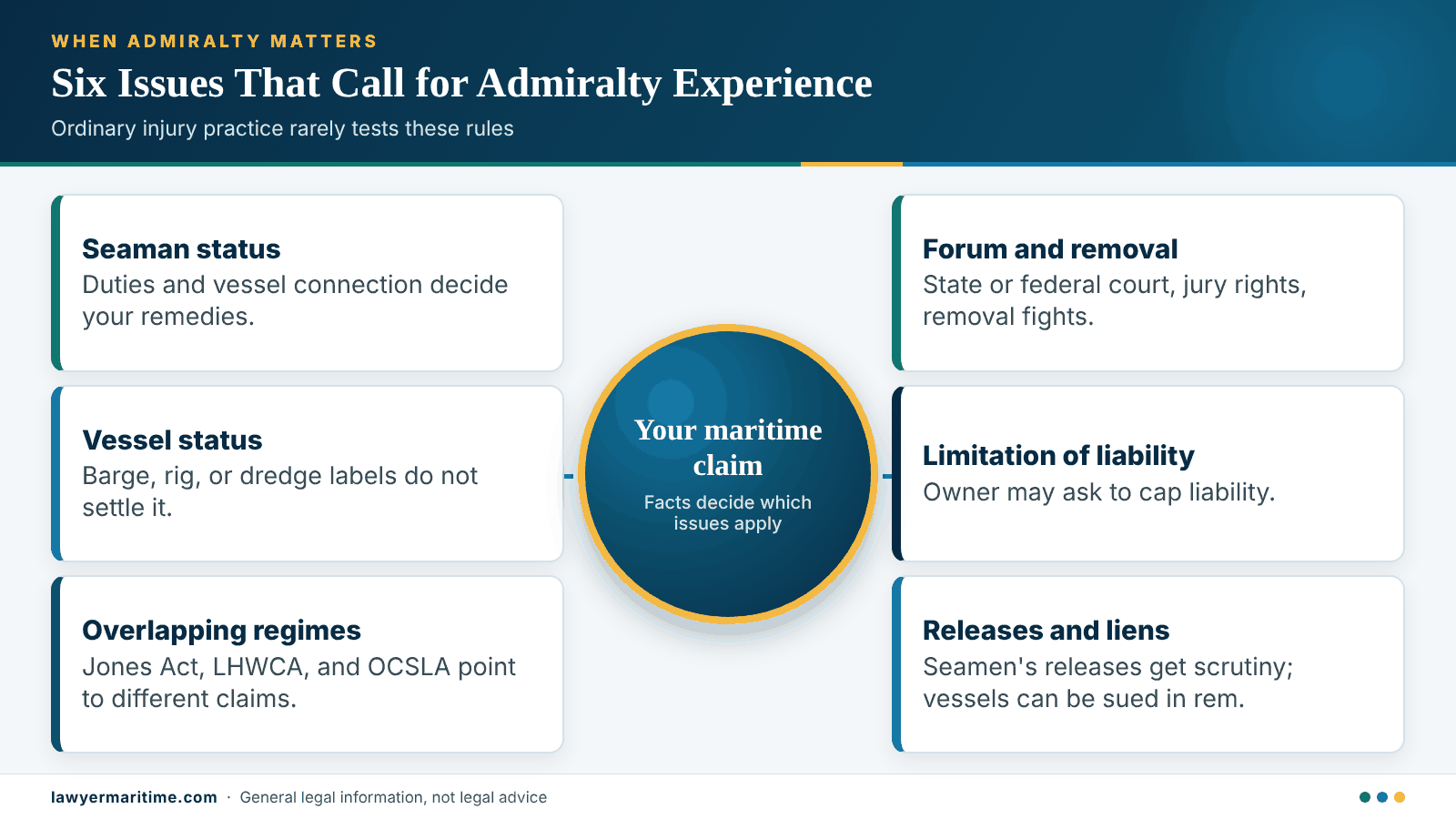
A maritime law attorney handles injury, vessel, and wage disputes that fall under federal admiralty rules instead of the ordinary state-court playbook, and some claims depend on that experience far more than others. If your case turns on whether you’re a seaman, whether a barge or rig counts as a vessel, which statute covers an offshore worker, where you can file, or whether a vessel owner can cap its liability, general personal-injury experience may not be enough. This guide explains which claims usually call for admiralty-trained counsel and why the label on your job or your paperwork doesn’t settle the question. It works through the governing framework: the Jones Act seaman remedy, the Longshore and Harbor Workers’ Compensation Act (LHWCA), the Outer Continental Shelf Lands Act (OCSLA), the saving-to-suitors clause, and the Limitation of Liability Act. It also shows how to test a lawyer’s maritime experience without relying on slogans. It is written for injured workers, families, and passengers deciding whom to call, and it describes general rules, not predictions about your case.
What Does a Maritime Law Attorney Do Differently From Other Injury Lawyers?
A maritime law attorney works in a body of federal law, covered more broadly in our guides to U.S. maritime law and admiralty law, that has its own courts, vocabulary, and procedures. Many injured people assume that a good personal-injury lawyer can simply apply the same playbook on the water. Sometimes that works. When the claim depends on a maritime doctrine, though, the first strategic decisions are different, and mistakes in those early choices are hard to undo.
Throughout this guide, “Jones Act” means the seaman personal-injury remedy in 46 U.S.C. § 30104. It does not mean the cabotage rules, found at 46 U.S.C. § 55102 and following, that govern which vessels may carry cargo between U.S. ports. News about “Jones Act waivers” nearly always concerns cabotage, not injury claims.
What makes a claim “maritime” in the first place?
Before any remedy comes into play, a court asks whether the dispute belongs in admiralty at all. The answer controls which law applies, which courts may hear the case, and which procedures are available.
The location and connection tests
For a maritime tort, which is a civil wrong such as negligence, courts generally ask two questions. First, did the incident occur on navigable waters, or did a vessel on navigable waters cause an injury on land? Second, does the incident have a potentially disruptive effect on maritime commerce, and does the activity involved bear a substantial relationship to traditional maritime activity? The Supreme Court laid out this framework in Jerome B. Grubart, Inc. v. Great Lakes Dredge & Dock Co., 513 U.S. 527 (1995), building on Executive Jet Aviation, Inc. v. City of Cleveland, 409 U.S. 249 (1972). Congress addressed the land-injury piece in the Admiralty Extension Act, 46 U.S.C. § 30101.
“Navigable waters” is broader than the open ocean. Courts have long treated waters as navigable when they are used, or are capable of being used, for commerce, and that reaches inland rivers, lakes, and canals. A fall on a dock, a fishing-tournament collision on a lake, and a barge accident on a river can all raise the question, and none has an obvious answer without the facts.
Admiralty jurisdiction versus the claim you actually plead
Federal district courts have original jurisdiction over admiralty and maritime cases under 28 U.S.C. § 1333, and that same statute preserves “all other remedies” to which claimants are otherwise entitled. The result is a menu of choices: sue in federal court on the admiralty side, sue in federal court on the ordinary civil side when another basis for jurisdiction exists, or, for many claims, sue in state court.
Rule 9(h) of the Federal Rules of Civil Procedure lets a plaintiff designate a claim as an admiralty claim when other federal jurisdiction also exists. That label can change jury rights and procedure. A lawyer who doesn’t know why the designation matters can make the choice by accident, and the consequences show up months later.
How does admiralty practice differ from an ordinary injury case?
The differences are practical, not just academic. They affect who can be sued, what the evidence must show, and what the case costs to prepare.
Different sources of law
A maritime case draws on federal statutes, such as the Jones Act, the LHWCA, and the Death on the High Seas Act, plus a large body of judge-made general maritime law. Doctrines like maintenance and cure (a seaman’s right to living expenses and medical care while recovering) and unseaworthiness (a vessel owner’s duty to supply a reasonably fit vessel) come from that tradition, not from any state’s injury code. State law still plays a role in some situations, but the Supreme Court has long limited state rules that would work material prejudice to the characteristic features of maritime law, as in Southern Pacific Co. v. Jensen, 244 U.S. 205 (1917).
That layering is why a maritime law attorney spends so much time on “which law governs” before turning to “who was at fault.” The same accident can lead to a negligence claim under one regime and a no-fault benefit claim under another.
Different procedure and vocabulary
Admiralty has its own procedural rules, including the Supplemental Rules for Admiralty or Maritime Claims, which govern actions against a vessel itself (in rem proceedings) and limitation of liability actions. An in rem claim treats the vessel as the defendant, while an in personam claim targets a person or company. Admiralty cases are generally tried without a jury unless a statute provides otherwise, and the Jones Act is one such statute.
Vocabulary matters because it signals which legal theory is in play. “Seaman,” “vessel in navigation,” “privity or knowledge,” “wards of admiralty,” and “maritime lien” each carry settled meanings. Missing one can mean missing a remedy.
| Issue | Ordinary state-law injury claim | Maritime or admiralty claim |
|---|---|---|
| Governing law | State negligence and workers’ compensation statutes | Federal statutes plus general maritime law, with state law filling gaps in limited situations |
| Suing the employer | Usually barred by workers’ compensation exclusivity | A seaman may sue the employer for negligence under 46 U.S.C. § 30104 |
| The defendant’s property | Claim runs against a person or company | Claim may also run against the vessel itself, in rem |
| Forum and jury | State court, usually with a jury right set by state law | State court, federal civil side, or federal admiralty side, with jury rights that depend on the claim |
| Liability caps | Rarely an issue | A vessel owner may seek to limit liability to the value of the vessel and pending freight |
| Time limits | State statute of limitations | Often three years under 46 U.S.C. § 30106, with exceptions and other clocks |
Which Status Disputes Call for Admiralty Experience: Seaman and Vessel?
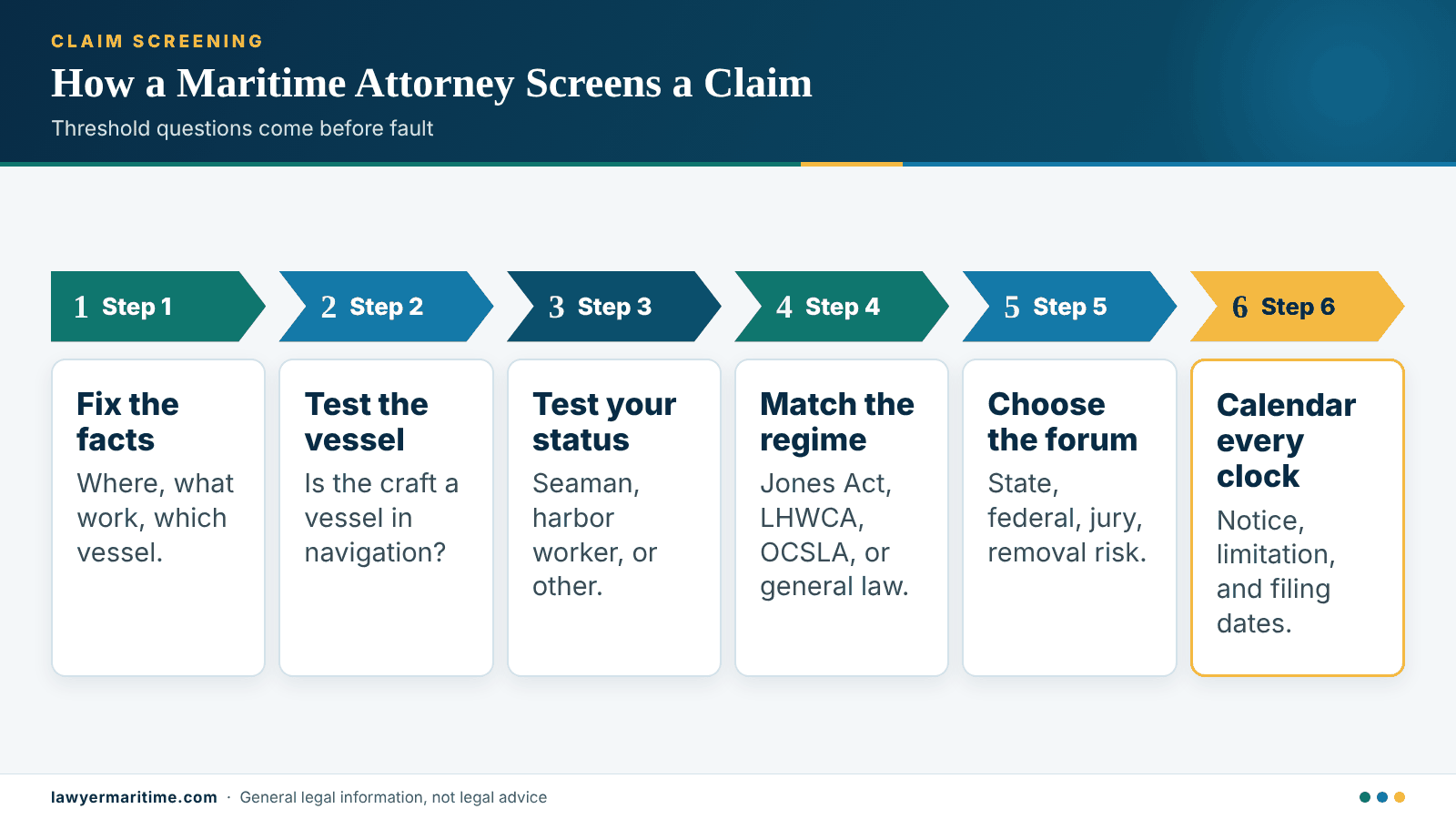
Two threshold questions can decide a maritime injury case before anyone discusses fault. Is the injured worker a seaman, and is the craft a vessel? Employers and insurers often contest both, and the answers come from case law, not from job titles or payroll categories.
When is seaman status disputed?
Seaman status is the gateway to maintenance and cure, Jones Act negligence claims, and unseaworthiness claims. Workers who don’t qualify generally fall under other systems, such as the LHWCA or state workers’ compensation. That makes the classification worth fighting over, and it is rarely obvious from the outside.
The two-part test from Wilander and Chandris
The Supreme Court has said a seaman need not help navigate the vessel; the worker must contribute to the vessel’s function or the accomplishment of its mission, as the Court explained in McDermott International, Inc. v. Wilander, 498 U.S. 337 (1991). Chandris, Inc. v. Latsis, 515 U.S. 347 (1995), added a second requirement: the worker’s connection to a vessel in navigation, or to an identifiable fleet of vessels, must be substantial in both duration and nature.
The Court also described a rule of thumb. A worker who spends less than about 30 percent of working time in the service of a vessel in navigation is unlikely to qualify, though the Court treated that figure as a guideline, not a bright line. Working out how a worker’s time was actually spent, over a career or a particular assignment, is a fact-heavy exercise that rewards experience.
Why circuit law and evidence matter
Courts apply Chandris differently. In Sanchez v. Smart Fabricators of Texas, L.L.C., 997 F.3d 564 (5th Cir. 2021) (en banc), the Fifth Circuit framed the “nature” inquiry around questions such as whether the worker’s allegiance runs to a vessel or only to a shoreside employer, whether the work is sea-based, and whether the assignment is a discrete task or includes sailing with the vessel from job to job. A welder doing repair work on jack-up rigs lost on that record. Other circuits may phrase the inquiry differently.
Proof matters as much as doctrine. Crew lists, assignment histories, time-aboard records, and employer fleet structure can all change the analysis. A lawyer familiar with these disputes knows which records to demand and which testimony will matter.
When is vessel status disputed?
Vessel status is the companion question. A person can have a long career on the water and still lose a Jones Act claim if the structure involved is not a vessel in navigation, so the dispute cuts both ways.
What the law means by “vessel”
Federal law defines a vessel broadly. Under 1 U.S.C. § 3, the term includes every description of watercraft or other artificial contrivance used, or capable of being used, as a means of transportation on water. In Stewart v. Dutra Construction Co., 543 U.S. 481 (2005), the Court read that language to cover a watercraft practically capable of maritime transportation, even if it is moored or mostly stationary at the moment.
The Court narrowed the reach in Lozman v. City of Riviera Beach, 568 U.S. 115 (2013), holding that a floating home was not a vessel. The test asks whether a reasonable observer, looking at the structure’s physical characteristics and activities, would consider it designed to a practical degree for carrying people or things over water.
Barges, rigs, floating platforms, and dredges
Real-world craft sit between those poles. Dredges, barges, work platforms, drilling rigs, and floating cranes have all generated litigation, and the outcome usually turns on design, use, and how permanently the structure is attached. Calling something a “rig” or a “platform” settles nothing, and a lawyer shouldn’t treat the label as a legal conclusion.
That is why investigators for both sides gather photographs, plans, mooring records, and movement logs early. Evidence about how the structure was built and used can disappear when it is sold, scrapped, or reconfigured.
| Question | Where the test comes from | Facts a maritime attorney tends to collect |
|---|---|---|
| Do the worker’s duties contribute to a vessel’s function or mission? | Wilander; Chandris (first prong) | Job description, daily tasks, crew agreement, and who directed the work |
| Is the connection substantial in duration? | Chandris, including the 30 percent guideline | Time-aboard records, payroll codes, assignment histories, and rotation schedules |
| Is the connection substantial in nature? | Chandris; circuit refinements such as Sanchez (Fifth Circuit) | Allegiance to the vessel, sea-based work, and discrete task versus sailing between jobs |
| Is there an identifiable fleet? | Chandris; Harbor Tug & Barge Co. v. Papai, 520 U.S. 548 (1997) | Common ownership or control of the vessels the worker served |
| Is the structure a vessel? | 1 U.S.C. § 3; Stewart; Lozman | Design, propulsion, mooring, transport function, movement history, and observer-perspective evidence |
How Do the Jones Act, LHWCA, and OCSLA Overlap, and Who Can Sue Whom?
Maritime workers live under several federal systems at once, and the system that applies decides whether a worker can sue an employer, a vessel, both, or neither. Sorting this out is one of the clearest reasons to involve a maritime law attorney early. The overlap is also where the oldest and most technical doctrines survive.
Where does the line between seamen and longshore workers fall?
Congress drew the line deliberately, and the Supreme Court has policed it for decades. Understanding why helps explain how the same job site can produce very different claims.
Two separate regimes, not overlapping choices
The LHWCA, 33 U.S.C. § 902(3), defines a covered employee as a person engaged in maritime employment, such as a longshore worker, ship repairer, shipbuilder, or ship breaker, and it expressly excludes a master or crew member of any vessel. The Jones Act protects seamen. In practice, a worker’s classification points toward one scheme or the other, which is why the status tests in the previous section carry so much weight.
The two schemes pay differently and reach different defendants. LHWCA benefits come from the employer or its insurer under a statutory formula, while a Jones Act claim is a negligence action against the employer. Our guide to maritime injury compensation compares the benefits and damages in each system.
Sieracki and the 1972 amendments
History explains much of today’s law. In Seas Shipping Co. v. Sieracki, 328 U.S. 85 (1946), the Supreme Court extended the vessel’s warranty of seaworthiness to longshore workers doing a seaman’s work. Shipowners then sought indemnity from stevedoring employers, which created a circle of litigation. Congress responded in 1972 by amending 33 U.S.C. § 905(b), which now provides that a vessel’s liability to a covered worker cannot rest on a breach of the warranty of seaworthiness.
The practical lesson is that unseaworthiness, a powerful claim for crew, is generally not available to LHWCA-covered workers. The substitute is a negligence claim against the vessel.
What does a vessel negligence claim under section 905(b) involve?
For a covered harbor worker injured by a vessel’s negligence, section 905(b) allows a lawsuit against the vessel as a third party, in addition to the compensation the employer owes. The claim is narrower than it sounds, and winning it takes precise proof.
The Scindia duties
The Supreme Court has described a vessel’s duties to stevedores and similar workers in Scindia Steam Navigation Co. v. De Los Santos, 451 U.S. 156 (1981), and Howlett v. Birkdale Shipping Co., 512 U.S. 92 (1994). In general terms, they include a turnover duty (the vessel must turn the ship over in reasonably safe condition for the work), a duty to exercise reasonable care in areas under the vessel’s active control, and a duty to intervene in certain circumstances where the vessel knows of a hazard. Each duty has limits, and the facts determine whether any applies.
Because these duties are narrow, many section 905(b) cases are won or lost on evidence of who controlled the area, what the vessel knew, and when it knew it. Experienced counsel plans discovery around those questions from the start.
Employer immunity and third-party claims
Section 905(a) makes the employer’s compensation liability exclusive, so an LHWCA worker generally cannot sue the employer in tort. The third-party claim against the vessel moves through 33 U.S.C. § 933, which also contains rules about the employer’s credit or lien against the recovery. Section 905(b) further provides that the employer cannot be made to indemnify the vessel for those damages, and it carves out special limits for stevedoring and shipyard situations.
Those interactions matter in settlement. A recovery against a vessel can affect compensation payments, and the order and form of settlements can change the net result. That is a technical area where an error in sequencing can cost real money.
How do offshore energy workers fit into these systems?
Offshore energy work adds a third federal statute, the Outer Continental Shelf Lands Act. OCSLA covers the seabed, subsoil, and fixed installations on the outer Continental Shelf, and it can change both compensation and the law that applies to an injury.
LHWCA benefits through section 1333(b)
Under 43 U.S.C. § 1333(b), compensation is payable under the LHWCA when an employee’s disability or death results from an injury occurring in operations on the outer Continental Shelf to explore for, develop, remove, or transport natural resources. The statute excludes masters and crew members from that definition of employee. A related provision, 33 U.S.C. § 905(c), lets covered offshore workers sue a negligent vessel under the section 905(b) framework.
This is why a worker on a fixed platform and a worker on a supply boat can have different rights even if they share a paycheck source. The first may receive LHWCA benefits through OCSLA, while the second may be a seaman. Neither result can be assumed from the job title.
Adjacent state law as surrogate federal law
OCSLA also provides, in section 1333(a)(2)(A), that the civil and criminal laws of the adjacent state apply as federal law on the outer Continental Shelf to the extent they are applicable and not inconsistent with federal law. That can bring state damages rules, indemnity statutes, or prescription periods into a case that looks entirely federal. Courts apply a multi-step analysis to decide when state law fills the gap, and the answer can differ by circuit and by the type of structure involved.
Because choice of law can change damages, contract enforceability, and liability theories, offshore cases reward lawyers who have worked through it before. A lawyer who is new to OCSLA may not raise the issue until the other side does.
| Category | Main legal source | Claim against the employer | Claim against the vessel | Unseaworthiness available? |
|---|---|---|---|---|
| Seaman | Jones Act (46 U.S.C. § 30104); maintenance and cure; general maritime law | Negligence under the Jones Act, with jury right | Unseaworthiness against the owner or operator | Yes |
| LHWCA-covered harbor or longshore worker | LHWCA (33 U.S.C. §§ 901-950) | Compensation benefits; tort suit generally barred | Negligence under § 905(b) | No (§ 905(b)) |
| Offshore worker covered through OCSLA | 43 U.S.C. § 1333(b); LHWCA | LHWCA compensation; other claims depend on facts and adjacent state law | Negligence under § 905(c) and (b) where applicable | Generally no |
| Passenger or recreational boater | General maritime law | Not applicable | Negligence claim against the carrier, owner, or operator | Not the usual theory |
Why Do Forum Choice, Removal, and Jury Rights Turn on Admiralty Knowledge?
Where a maritime case is heard can shape the jury pool, the procedure, the speed, and the available remedies. A claimant often has more than one option, and the defense often has tools to push the case somewhere else. Knowing the rules before filing is cheaper than fighting about them afterward.
Where can a maritime claim be filed?
The short answer is that several courts may be available, depending on the claim. The longer answer starts with a clause in the jurisdictional statute that has shaped maritime litigation for generations.
The saving-to-suitors clause
Section 1333 gives federal district courts original jurisdiction over admiralty cases, but it also “saves to suitors” other remedies they are entitled to. Courts have read the clause to preserve common-law remedies, including the right of many maritime claimants to sue in state court. The Supreme Court described the clause’s reach in Lewis v. Lewis & Clark Marine, Inc., 531 U.S. 438 (2001), where it held that a claimant’s state-court action could proceed so long as the vessel owner’s right to seek limitation of liability was protected.
For an injured seaman, the clause is a significant strategic option. A state court may offer a different jury pool, different procedural rules, and different timing than a federal court in the same city.
Federal civil side versus federal admiralty side
A maritime claim does not, by itself, arise under federal law for purposes of the general federal-question statute, as the Court held in Romero v. International Terminal Operating Co., 358 U.S. 354 (1959). A claimant who wants to be in federal court therefore needs either diversity of citizenship or admiralty jurisdiction. That choice has consequences.
Rule 9(h) allows a plaintiff to designate a claim as an admiralty claim when another basis for federal jurisdiction also exists. In an admiralty case there is generally no jury right unless a statute provides one, and the Jones Act does. Unseaworthiness and maintenance and cure claims are often joined with a Jones Act claim, and courts generally try them together. A lawyer who designates a claim without thinking about a jury demand can give up leverage, and a lawyer who fails to designate one may lose access to admiralty-only tools.
What happens when the defense tries to move the case?
Removal is the defendant’s attempt to move a case from state court to federal court. For maritime claims, removal law is unsettled in places, and the rules differ depending on the type of claim.
Jones Act claims and the bar on removal
The Jones Act incorporates the Federal Employers’ Liability Act (FELA), and 28 U.S.C. § 1445(a) says that FELA actions brought in state court may not be removed to federal court. Courts have generally carried that bar over to Jones Act claims filed in state court. A properly pleaded Jones Act case in state court therefore usually stays there.
Defendants respond by arguing that the Jones Act claim was fraudulently pleaded, because the plaintiff is not really a seaman. That argument turns removal into an early fight over the very facts discussed in the status section. A plaintiff’s lawyer needs the seaman-status evidence in hand before the notice of removal arrives.
Other maritime claims filed in state court
Not every maritime claim carries a removal bar. District courts have disagreed about whether saving-clause claims without diversity of citizenship can be removed, particularly since Congress revised the general removal statute in 2011. A claimant’s lawyer therefore checks how the chosen court and its circuit have treated the question, and sometimes plans around the answer.
Passenger claims add forum-selection terms printed in tickets. The Supreme Court enforced such a clause in Carnival Cruise Lines, Inc. v. Shute, 499 U.S. 585 (1991), so reading the ticket early can decide where a passenger claim may be filed.
| Forum | When it may be available | Jury | What to check |
|---|---|---|---|
| State court (saving clause) | Many in personam maritime claims, including Jones Act claims | Jones Act claims carry a statutory jury right; other claims depend on state procedure | Removal risk, venue rules, and any limitation proceeding that could stay the case |
| Federal court, civil side | Diversity of citizenship or another basis for federal jurisdiction | Jury available on proper demand | Diversity facts and whether a Rule 9(h) designation was avoided on purpose |
| Federal court, admiralty side | Admiralty jurisdiction under 28 U.S.C. § 1333, including Rule 9(h) designation | Generally none unless a statute such as the Jones Act provides one | Jury consequences, in rem options, and joined claims |
| Federal limitation proceeding | Vessel owner files under the Limitation of Liability Act | Typically decided by the court | Stipulations, claim deadlines, and whether the case may return to another forum |
What Is a Limitation of Liability Action, and Why Does It Need Admiralty Experience?
A limitation of liability action is a federal proceeding in which a vessel owner asks the court to cap its exposure for a casualty at the value of the vessel and its pending freight. The statute dates back to the nineteenth century, and its procedures are unfamiliar to most lawyers outside admiralty. For an injured person, receiving a limitation complaint can feel like an unexpected shutdown of the case you thought you were bringing.
How do the limitation statutes work?
Two statutes carry most of the weight, with a set of court rules supplying the procedure. Congress renumbered the chapter in December 2022, so older cases and articles may cite different section numbers.
The cap and the six-month window
The general cap appears in 46 U.S.C. § 30523. Subject to exceptions, an owner’s liability for covered losses incurred without the owner’s privity or knowledge cannot exceed the value of the vessel and pending freight, and the cap does not apply to wage claims. The procedure appears in 46 U.S.C. § 30529, which provides that the owner must file the action in federal court within six months after a claimant gives written notice of a claim. The filing allows the owner to deposit the value of its interest, or approved security, and once the owner complies, other proceedings against the owner arising from the matter are stayed. Supplemental Rule F supplies the detailed procedure.
Congress also carved certain small passenger vessels out of the chapter in 46 U.S.C. § 30502, so whether limitation is available at all can depend on the type of vessel. That is one reason a lawyer needs the vessel’s documentation early.
Privity or knowledge and the two-step inquiry
Limitation does not apply automatically. Courts generally handle the dispute in two steps. The claimants first show what acts of negligence or unseaworthy conditions caused the loss; the owner then bears the burden of proving it lacked privity or knowledge of them. For a corporate owner, what managers knew, or should have known, can become the central fact question.
That second step is why limitation cases turn on records about maintenance, safety management, crew training, and prior incidents. Claimants who can show that shoreside management knew of a hazard may defeat limitation even if a captain’s error also contributed.
What does a limitation action mean for an injured person?
For a worker, passenger, or family, the immediate effects are about forum, timing, and leverage. The proceeding changes how the case is organized, and it can be a reason to retain counsel quickly.
The injunction and the path back to your chosen forum
When the owner files and posts security, the court typically issues a notice to claimants and stays other suits. A claimant who preferred state court is not necessarily stuck. In Lewis, discussed earlier, the Supreme Court held that a district court may lift the stay so a claim can proceed in the claimant’s chosen forum if the owner’s right to limit is adequately protected. Courts have commonly protected it with stipulations, for example that the claimant is the only claimant or that claims will not exceed the fund, and that the claimant will not seek to enforce a judgment until the federal court resolves limitation.
When there are multiple claimants, stipulations are harder to agree on, and the court may keep the case. A maritime attorney who has handled these proceedings knows how to negotiate stipulations that protect the client’s forum choice without conceding rights that matter.
The practical stakes: fund size, insurance, and claim deadlines
The value of the vessel can be small compared with a serious injury or death claim. Whether the cap holds therefore matters enormously, and so does the question of which other assets, insurance policies, or defendants stand behind the owner. A lawyer will ask for the vessel’s value evidence, its insurance, and who owned, operated, or chartered it.
The court’s notice also sets a deadline for filing claims in the limitation proceeding, and missing it can be costly. Because the notice can arrive before a person has hired counsel, anyone who receives a limitation notice should treat it as time-sensitive and ask a maritime attorney to read it promptly.
| Stage | What happens | Why a claimant should care |
|---|---|---|
| Written notice of a claim | A claimant or lawyer sends a written demand to the owner | Can start the owner’s six-month filing window under § 30529 |
| Owner files in federal court | The owner files a complaint for exoneration from or limitation of liability | Starts a federal proceeding that can reshape the forum |
| Security and stay | The owner deposits the fund or approved security; other suits are stayed | Your state-court case may pause until the court lifts the stay |
| Court notice and claim deadline | The court notifies potential claimants and sets a date to file claims | Missing the date can jeopardize the claim |
| Contest over privity or knowledge | Claimants and owner litigate causation and the owner’s knowledge | Decides whether the cap holds |
| Stipulations and release of the stay | Claimants may stipulate to protect the owner’s limitation rights | May allow the claim to proceed in the preferred forum |
Which Time Limits Differ Across Maritime Claims?
No single deadline governs maritime claims. A general federal rule exists, but notice rules, statutory exceptions, court-set dates, and contract terms can shorten or reshape the time you have. Nothing here is a substitute for a deadline analysis by a lawyer who has your documents, and the safest approach is to treat every date as a question to confirm.
What are the general clocks for personal injury and death claims?
Most injured people want to know one number. In maritime law, that number is often three years, with several important qualifications.
The three-year maritime tort period and its relatives
Under 46 U.S.C. § 30106, unless otherwise provided by law, a civil action for damages for personal injury or death arising out of a maritime tort must be brought within three years after the cause of action arose. Jones Act claims incorporate the Federal Employers’ Liability Act, whose limitation period in 45 U.S.C. § 56 is also three years. Death claims under the Death on the High Seas Act (DOHSA), which covers deaths caused beyond three nautical miles from the U.S. shore under 46 U.S.C. § 30302, are generally subject to the same three-year period from section 30106. Our guide to the DOHSA claim deadline covers that question in detail.
The phrase “unless otherwise provided by law” matters, as do accrual and tolling questions. When a claim arises, whether a minor or incapacitated person’s time is paused, and how a claim for ongoing treatment is measured are all issues a lawyer evaluates for the specific facts. Claims that aren’t covered by a statute of limitations, such as some contract, cargo, or lien claims, may face other periods or the equitable doctrine of laches.
LHWCA notice and claim periods
The LHWCA runs on its own clocks. Under 33 U.S.C. § 912, written notice of an injury generally must be given within 30 days of the injury, or from the date the employee knew or should have known the injury was work related, and the statute lists circumstances that excuse a failure to give timely notice. Under 33 U.S.C. § 913, a claim for compensation generally must be filed within one year, measured from the injury or the later awareness date, with a different measure when compensation has been paid without an award.
Those periods are far shorter than three years, which is why an LHWCA-covered worker who delays reporting can create avoidable problems. The statute also has exceptions for employer knowledge and lack of prejudice, but relying on an exception is a risk, not a plan.
Which clocks are easy to miss?
The dates that cause the most trouble are often the ones nobody mentioned. Some run against the vessel owner, some arrive in the mail, and some sit in documents signed long before the injury.
The owner’s six-month limitation window and your claim date
A vessel owner’s right to file a limitation action runs six months from a claimant’s written notice of a claim. That can make a demand letter a strategic document: sending it starts a clock that benefits the owner, so counsel thinks about timing and wording first. A claimant’s own date comes from the court’s notice if a limitation proceeding is filed, which is a separate deadline that can come with little warning.
The lesson is not to avoid written claims. It is to coordinate them with the overall strategy, including forum and investigation, rather than sending a letter in frustration.
Contract, ticket, and employment terms
Passenger tickets commonly contain notice-of-claim and suit-filing provisions, and federal law restricts how short some of them may be. Crew agreements, union contracts, and employer policies may add notice or grievance steps. Contractual periods can be enforceable in some settings and invalid in others, so lawyers look at both the clause and the statute that limits it.
Keep copies of anything you signed when you were hired, boarded, or bought passage. If you can’t find them, the employer, carrier, or cruise line usually can, and a lawyer can request them.
| Claim or step | Source | General period | Caveat |
|---|---|---|---|
| Maritime tort injury or death suit | 46 U.S.C. § 30106 | Three years after the cause of action arose | Unless otherwise provided by law; accrual and tolling vary |
| Jones Act seaman claim | 46 U.S.C. § 30104; 45 U.S.C. § 56 | Three years after the claim arose | Status must be established; other claims may follow other periods |
| DOHSA death claim | 46 U.S.C. §§ 30302, 30106 | Generally three years | Confirm with counsel; see the DOHSA deadline guide |
| LHWCA notice of injury | 33 U.S.C. § 912 | Generally 30 days, from injury or awareness | Exceptions for employer knowledge and lack of prejudice |
| LHWCA claim for compensation | 33 U.S.C. § 913 | Generally one year | Measured from injury or awareness; payments can change the date |
| Owner’s limitation action | 46 U.S.C. § 30529 | Six months after written notice of a claim | Claimant deadlines come from the court’s notice |
| Ticket or contract provisions | The agreement itself, limited by federal statute | Varies | Enforceability depends on the clause and the vessel |
How Do Release Scrutiny, Maritime Liens, and In Rem Claims Change the Strategy?
Two further areas separate admiralty practice from the ordinary claims world. One protects seamen from signing away rights too cheaply; the other lets claimants proceed against the vessel itself. Both can change the value and the timing of a case.
Why do courts look closely at a seaman’s release?
A release is a document in which a person gives up claims in exchange for payment. In most civil settings, a signed release is hard to undo. Maritime law treats seamen differently, and that difference is worth understanding before anyone presents you with a form.
Wards of admiralty and the burden on the shipowner
Courts have long described seamen as “wards of admiralty,” a phrase traced to Justice Story’s early nineteenth-century decisions. In Garrett v. Moore-McCormack Co., 317 U.S. 239 (1942), the Supreme Court held that a party relying on a seaman’s release must show that it was executed freely, without deception or coercion, and with full understanding of the seaman’s rights. The Court treated the burden-of-proof rule as part of the federal right, so a state could not apply a harsher rule.
Scrutiny does not mean releases are automatically void. Many are upheld when the record shows an informed seaman who received fair value and, ideally, independent advice. The point is that the employer or insurer carries the burden, which affects how settlements are structured and documented.
What a careful release review looks for
A maritime lawyer reviewing a release asks practical questions. Was the payment adequate in light of the injury and the medical picture at the time? Did the seaman have medical or legal advice? Was the seaman still in treatment, pressured by a payroll deadline, or unaware of the full extent of the injury? Does the document waive maintenance and cure, future medical needs, or unseaworthiness claims that the seaman did not realize were in play?
Reviewing a release before signing is much easier than undoing one afterward. Our guide to maritime settlement releases covers the drafting and negotiation side in more detail, and the compensation guide explains which benefits and damages a release might give up.
What do maritime liens and in rem claims add?
Admiralty allows some claimants to treat the vessel itself as the defendant. That feature has no true parallel in ordinary injury practice, and it gives claimants options that depend on timing.
A claim against the vessel itself
A maritime lien is a claim on the vessel that exists by operation of law. Under the Commercial Instruments and Maritime Liens Act, a person who provides necessaries (supplies and services such as fuel, repairs, and provisions) to a vessel on the owner’s order, or the order of someone the owner authorizes, gets a lien on the vessel and may enforce it in rem. See 46 U.S.C. § 31342. The Supplemental Rules govern arresting a vessel and the proceedings that follow.
The law of maritime liens is broader than necessaries. Seamen’s wage claims and certain tort claims can also give rise to liens under general maritime law, with rules on priority that vary by the type of claim. That is a technical area where the type of claim and the vessel’s ownership history both matter.
Why liens and arrests matter to injured people and crews
For individuals, the in rem option matters most when a vessel is likely to leave the jurisdiction, change hands, or be sold, or when the owner of record is a thinly capitalized entity. Identifying the right defendants, such as the owner, operator, charterer, and employer, is part of the same analysis, because different parties may carry different insurance and different legal duties.
Most injured workers will never arrest a vessel. Still, a lawyer’s awareness of the option can influence early decisions about where to file, whom to name, and how quickly to move.
How Can You Tell Whether a Maritime Law Attorney Has Real Admiralty Experience?
Every law firm website claims experience, and few explain what that experience consists of. A better approach is to compare a lawyer’s answers with the issues covered in this guide. This section gives you a way to do that without needing a law degree. It does not rank or recommend any lawyer, and our guide on how to evaluate a maritime lawyer goes deeper on comparison.
What does admiralty experience look like in practice?
Experience is easiest to see in the specifics of past work. Specifics are also what an ethical lawyer can discuss without breaching client confidentiality, as long as the discussion avoids identifying anyone.
Matters and forums, not slogans
Ask which of these issues the lawyer has handled personally: contested seaman-status motions, vessel-status disputes, limitation of liability proceedings, removal fights, in rem actions, and challenges to releases. Ask which courts the lawyer has appeared in and whether any are the courts where your claim would likely be heard. A thoughtful lawyer answers in terms of the legal problem and the process, not with a promise about the result.
Be cautious about any answer that leans on large numbers or guarantees. A truthful lawyer can’t promise a result, and advertising rules in many states restrict unsubstantiated claims about results.
What labels, memberships, and directories do and don’t show
Some states formally certify specialists in particular fields, and whether one exists for admiralty varies by state. Where a certification program exists, the state’s own rules govern how a lawyer may describe it. Membership in a maritime bar association shows participation in the field, not outcomes or competence. Directory badges and “top lawyer” lists can rest on peer nominations, paid placements, or other methods, so read what the badge actually measures.
ABA Model Rule 7.1 prohibits false or misleading communications about a lawyer or the lawyer’s services, and state versions can be stricter. If a claim of expertise sounds too large to substantiate, you are entitled to ask what it is based on.
What should you ask, and how should fee talk go?
The first meeting is a two-way evaluation. You are deciding whether the lawyer understands your problem, and the lawyer is deciding whether the claim is one the firm can take. Our guide to what to expect from a maritime lawyer consultation explains the mechanics of that first conversation.
Questions that test the issues in this guide
The questions in the table below connect the topics in this article to things you can raise directly. You don’t need to ask all of them. Pick the ones that match your situation, and notice whether the answers are specific. A lawyer who explains why a question matters is usually a better sign than one who answers with reassurance alone.
| Question | A useful answer covers | Why it matters |
|---|---|---|
| Which legal regime fits my work, and why? | Seaman versus LHWCA versus OCSLA analysis tied to your facts | Status decides which claims exist |
| Is the craft involved a vessel? | The legal test and what records would support it | Vessel status can be outcome-determinative |
| Where would you file, and could the case be moved? | State versus federal options, jury rights, and removal risk | Forum shapes strategy from the start |
| Could the owner seek to limit liability? | How limitation works and what you would do if a notice arrives | A limitation filing can stay your case |
| What deadlines are you tracking? | A list of clocks with their sources, and what is still unknown | Different claims run on different timetables |
| How are fees and costs handled? | Written terms, including expenses and what happens if the case ends early | Prevents later misunderstandings |
Fees, costs, and confidentiality
Fees must be reasonable under ABA Model Rule 1.5, and a contingent fee arrangement generally should be in writing, explaining how the fee is calculated and how expenses are handled. Ask for the terms in writing, and ask about costs such as experts and filing fees, because those can be significant in a vessel case. This guide doesn’t describe any firm’s fee terms, so don’t read a general statement here as an offer.
Under Model Rule 1.18, a lawyer owes duties of confidentiality to a prospective client, even if no representation follows. That means you can discuss the facts openly in an initial conversation. Geography is a separate question: a nearby office can be convenient, but the court and the vessel’s location often matter more, and our guide to finding a maritime lawyer near you addresses that tradeoff.
What Should You Do Before You Hire a Maritime Law Attorney?
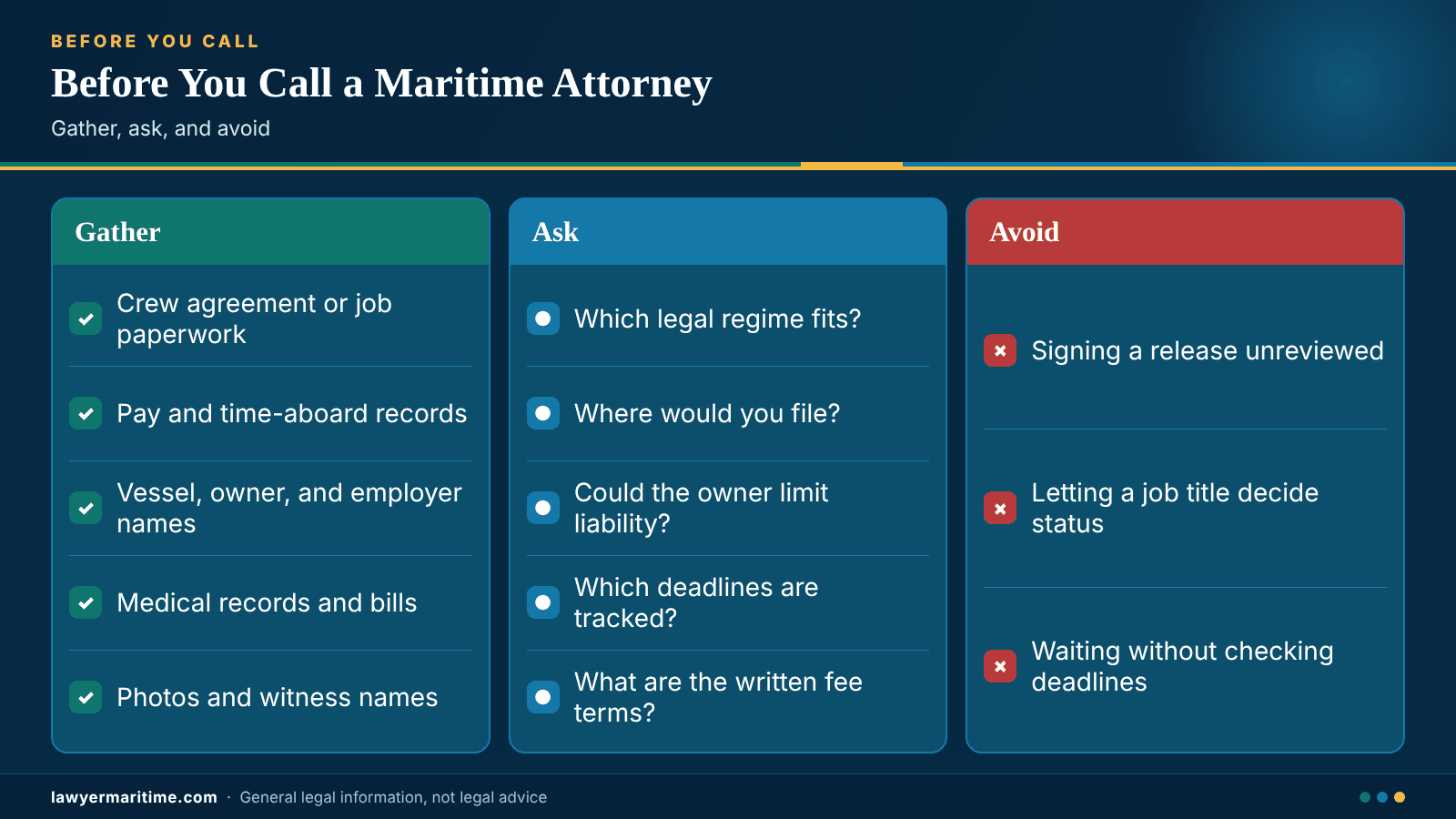
The time between an injury and your first legal consultation matters more than people expect. You can’t control everything in that window, but a few steady habits keep your options open. Here is the practical takeaway: protect your health, document the facts, and don’t sign anything that you haven’t had reviewed.
How do you protect your position in the first days?
The first days are about care and records. Neither requires legal training, and both help any lawyer you eventually choose.
Care, notice, and incident records
- Get medical care and follow it. Tell providers how the injury happened, and keep every record and appointment.
- Report the injury in writing. Give your employer, captain, or the vessel operator written notice, and keep a copy. Notice rules differ by claim, as the time-limits section explains.
- Record what you remember. Write down the date, location, vessel or structure, weather, equipment, and the names of people nearby while the details are fresh.
- Photograph what you can safely photograph. Hazards, equipment, and your injuries can change or vanish quickly.
Documents that help a lawyer screen the claim
A maritime attorney’s first screening depends on records that show who you worked for, where, and how. Gather what you can without confronting anyone:
- Your crew agreement, offer letter, or contract, plus any union paperwork.
- Pay stubs, tax forms, and anything showing days or hours spent aboard.
- The names of the vessel or structure, its owner, the operator, and your direct employer.
- Medical records, bills, and a list of treating providers.
- Messages, emails, or incident forms you received from the employer or its insurer.
Which missteps narrow your options?
Most avoidable mistakes in maritime claims come from good-faith assumptions. People assume the paperwork was handled, that their job title determines their rights, or that there will be time later.
Statements, forms, and releases
Insurers and employers often ask for recorded statements and signed forms soon after an injury. You may be asked to sign a release in exchange for a payment while treatment is still ongoing. Take the document home, ask for time, and have a maritime attorney review it, because the scrutiny courts give seamen’s releases only helps if the record shows what you were told.
Letting a label decide your rights
“Longshoreman,” “contract worker,” “offshore hand,” and “crew” are job labels, not legal conclusions. A worker who assumes the employer’s classification is correct may skip the right claim or file the wrong one. Ask a lawyer to test the status question against the facts, and don’t let anyone, including a friendly claims adjuster, decide it for you.
| Common mistake | Why it hurts | Better action |
|---|---|---|
| Signing a release quickly to get a check | May waive claims and ongoing benefits | Ask for time and have the document reviewed first |
| Assuming your job title sets your remedies | May lead to the wrong claim or a missed one | Collect records and let counsel test status |
| Waiting because the main deadline looks distant | Shorter notice and claim periods may apply | Confirm every clock early, in writing |
| Ignoring a limitation or court notice | Claim deadlines in the notice can be unforgiving | Show it to a maritime attorney promptly |
| Letting evidence about the vessel disappear | Equipment, logs, and structures can be sold or changed | Preserve photos and records; ask counsel about preservation requests |
Frequently Asked Questions About Maritime Law Attorneys
These answers are general. Your facts, your court, and the vessel involved may change the result.
Choosing and working with a maritime law attorney
When do I need a maritime law attorney instead of a regular personal-injury lawyer?
You are more likely to need one when your claim turns on seaman or vessel status, overlapping federal compensation systems, a limitation of liability filing, or a fight over forum or removal. For an ordinary car accident that has no connection to navigable water, a general injury lawyer is usually the natural choice. Many general lawyers also bring in maritime counsel when a case crosses into admiralty.
What is the difference between a maritime law attorney and a maritime injury attorney?
“Maritime law attorney” is the broader term and can include lawyers who handle cargo, collision, insurance, or lien disputes. A maritime injury attorney focuses on injury and death claims. Our guides to the maritime lawyer and the maritime injury attorney explain how those roles overlap.
Does my case need an attorney who has handled limitation of liability actions?
Not every case does, but it matters if the vessel owner has filed or may file a limitation action. Those proceedings stay other suits, set special claim deadlines, and turn on privity or knowledge. If you receive a court notice about limitation, show it to a maritime attorney promptly.
Can a lawyer outside my state handle my maritime claim?
Often yes, but the answer depends on where the case will be filed and on the lawyer’s licensure and local counsel arrangements. Maritime claims can be heard in federal courts across the country, which gives some lawyers wider reach than in state-only practice. Ask who would appear in the court, and see our guide on finding a maritime lawyer near you.
How should I think about “free consultation” and fee promises?
Treat them as claims to confirm, not as assurances. Ask for the fee agreement in writing and read how costs are handled. This guide doesn’t make fee offers for any firm; see the consultation guide for what to expect at a first meeting.
Status, forum, and deadlines
Does working on a boat automatically make me a seaman under the Jones Act?
No. Seaman status depends on legal tests about your duties and the substantial connection of your work to a vessel or fleet in navigation. A deckhand on a working boat often qualifies, while a shoreside worker who occasionally boards one may not. The facts, and sometimes the circuit, decide.
Can I sue in state court if I was hurt at sea?
Many maritime claimants can, because of the saving-to-suitors clause, though a limitation proceeding, a forum-selection clause, or a removal fight may complicate the choice. Jones Act claims filed in state court are generally not removable, but defendants can contest seaman status. A lawyer should check the specifics before filing.
Is a three-year deadline always the limit for a maritime injury claim?
No. Section 30106 sets a general three-year period for maritime torts “unless otherwise provided by law,” and the Jones Act uses a three-year FELA period, but LHWCA notice and claim periods are much shorter, and contracts or tickets can add their own terms. Confirm every clock early; for death claims, see the DOHSA claim deadline guide.
Can a vessel owner really limit what I can recover?
Sometimes the owner can ask a federal court to cap liability at the value of the vessel and pending freight, but the cap is not automatic. The owner must show it lacked privity or knowledge of the cause, and certain claims, like wage claims, are outside the cap. Whether limitation applies depends on the vessel, the facts, and the court.
What if the accident involved a collision or a serious casualty?
Collisions and casualties add investigation, evidence, and multi-party questions, including Coast Guard and NTSB reviews. Our pages on a maritime accident attorney and maritime personal injury lawyer cover those angles, and the resources above explain how admiralty experience fits in.
Sources and Legal Authorities
The authorities below support the legal statements in this guide. Check each against its current text before relying on it.
Statutes and regulations
Federal statutes
- 46 U.S.C. § 30104 – Jones Act personal injury and death of a seaman
- 46 U.S.C. § 30106 – Time limit on bringing maritime action for personal injury or death
- 46 U.S.C. § 30101 – Admiralty Extension Act
- 46 U.S.C. § 30302 – Death on the High Seas Act, cause of action
- 46 U.S.C. § 30523 – General limit of liability
- 46 U.S.C. § 30529 – Action by owner for limitation
- 46 U.S.C. § 30502 – Application of the limitation chapter
- 46 U.S.C. § 31342 – Establishing maritime liens
- 28 U.S.C. § 1333 – Admiralty jurisdiction and saving to suitors
- 28 U.S.C. § 1445 – Nonremovable actions
- 45 U.S.C. § 56 – FELA limitation of actions
- 33 U.S.C. § 902 – LHWCA definitions
- 33 U.S.C. § 905 – LHWCA exclusiveness and vessel negligence
- 33 U.S.C. § 912 – LHWCA notice of injury or death
- 33 U.S.C. § 913 – LHWCA filing of claims
- 33 U.S.C. § 933 – LHWCA compensation for injuries caused by third persons
- 43 U.S.C. § 1333 – OCSLA laws applicable to the outer Continental Shelf
Regulations and rules
- Fed. R. Civ. P. 9 – including Rule 9(h) admiralty or maritime claims
- U.S. Department of Labor – Division of Longshore and Harbor Workers’ Compensation
- ABA Model Rule 7.1 – Communications concerning a lawyer’s services
Cases and agency materials
Supreme Court and federal appellate decisions
- Jerome B. Grubart, Inc. v. Great Lakes Dredge & Dock Co., 513 U.S. 527 (1995) – location and connection tests for maritime torts
- Executive Jet Aviation, Inc. v. City of Cleveland, 409 U.S. 249 (1972) – maritime tort jurisdiction
- Southern Pacific Co. v. Jensen, 244 U.S. 205 (1917) – limits on state law affecting maritime law
- McDermott International, Inc. v. Wilander, 498 U.S. 337 (1991) – seaman status
- Chandris, Inc. v. Latsis, 515 U.S. 347 (1995) – two-part seaman status test
- Harbor Tug & Barge Co. v. Papai, 520 U.S. 548 (1997) – seaman status and fleet connection
- Sanchez v. Smart Fabricators of Texas, L.L.C., 997 F.3d 564 (5th Cir. 2021) (en banc) – Fifth Circuit seaman status analysis (no official link verified)
- Stewart v. Dutra Construction Co., 543 U.S. 481 (2005) – vessel definition
- Lozman v. City of Riviera Beach, 568 U.S. 115 (2013) – floating home not a vessel
- Seas Shipping Co. v. Sieracki, 328 U.S. 85 (1946) – historic seaworthiness extension to longshore workers
- Scindia Steam Navigation Co. v. De Los Santos, 451 U.S. 156 (1981) – vessel duties to longshore workers
- Howlett v. Birkdale Shipping Co., 512 U.S. 92 (1994) – turnover, active control, and intervention duties
- Romero v. International Terminal Operating Co., 358 U.S. 354 (1959) – maritime claims and federal-question jurisdiction
- Lewis v. Lewis & Clark Marine, Inc., 531 U.S. 438 (2001) – saving clause and limitation proceedings
- Carnival Cruise Lines, Inc. v. Shute, 499 U.S. 585 (1991) – forum-selection clauses in passage tickets
- Garrett v. Moore-McCormack Co., 317 U.S. 239 (1942) – burden on the party relying on a seaman’s release