
If you’re searching for a maritime lawyer near me after an injury on a vessel, a dock, or the water, here is the short answer: maritime experience usually matters more than the zip code. Federal maritime law, including the Jones Act, general maritime law, and the Longshore and Harbor Workers’ Compensation Act (LHWCA), follows the same basic framework in every port. A lawyer in another city can often handle a claim that arose near you. What location can change is the courthouse where the case is filed, the federal circuit whose precedent governs it, whether a lawyer is admitted to practice there, and how easy it is to meet face to face. This guide is written for injured mariners, offshore and shipyard workers, passengers, boaters, and families who want to choose counsel with their eyes open. It explains when “near me” helps, when it doesn’t, and what to verify before you sign anything. It offers general information about U.S. law, not advice about your claim.
Is a Maritime Lawyer Near Me Actually Better for Your Claim?
Typing “near me” into a search box is a sensible habit. You want someone you can reach, someone who knows the area, and someone who can sit across a table from you. The trouble is that search engines rank proximity, not the thing that matters most in a maritime case, which is whether the lawyer works with maritime doctrine day in and day out.
This page covers the choosing-counsel question for people with a possible maritime injury or death claim. If you’re still sorting out which legal route fits your job or your trip, start with our guide to who is covered by U.S. maritime law, then come back here.
One body of federal law, many courthouses
Maritime law is often called admiralty law, and the two terms overlap heavily in practice. It’s a body of federal law built on the Constitution’s grant of admiralty jurisdiction to the federal courts, on statutes passed by Congress, and on a long line of court decisions. That structure explains why a lawyer’s address is a weaker signal here than it would be in, say, a state-law fender-bender case.
Why the core remedies look the same in every port
The Constitution extends the federal judicial power to admiralty and maritime cases (U.S. Const. art. III, § 2), and Congress has given the federal district courts jurisdiction over them in 28 U.S.C. § 1333. The seaman’s negligence remedy, maintenance and cure, the unseaworthiness doctrine, and the LHWCA do not change at a state line. A deckhand hurt on a towboat in Louisiana and one hurt on a towboat in Ohio are measured against the same federal framework.
Geography does not shrink that framework either. Admiralty jurisdiction reaches navigable waters whether or not the tide ebbs and flows there, which is why the Great Lakes and inland rivers are covered. The Supreme Court said so in The Genesee Chief v. Fitzhugh (1852), and the “navigable in fact” test from The Daniel Ball remains the starting point. For a modern tort, courts ask whether the incident happened on navigable water and whether it bore a meaningful connection to maritime activity, as in Jerome B. Grubart, Inc. v. Great Lakes Dredge & Dock Co., 513 U.S. 527 (1995).
What genuinely changes from place to place
Several things do vary. Federal courts of appeals interpret the same statutes and doctrines differently, so circuit precedent can shape a seaman-status fight, a causation argument, or a damages ruling. The en banc Fifth Circuit’s decision in Sanchez v. Smart Fabricators of Texas, L.L.C., 997 F.3d 564 (5th Cir. 2021), for example, is a circuit-level treatment of how to analyze seaman status, and other circuits articulate parts of the inquiry in their own words.
State law also enters the picture in some claims. The Supreme Court has allowed state remedies to supplement maritime law in certain deaths of nonseafarers in state territorial waters (Yamaha Motor Corp. v. Calhoun, 516 U.S. 199 (1996)). On fixed offshore structures attached to the seabed, the Outer Continental Shelf Lands Act can treat the law of the adjacent state as surrogate federal law (43 U.S.C. § 1333(a)(2)(A)). In those situations, the place where the accident happened matters, though that is a different thing from where your lawyer’s office is.
| Issue | Does it change by location? | Why it matters when you choose a lawyer |
|---|---|---|
| Core federal remedies (Jones Act, maintenance and cure, unseaworthiness, LHWCA) | Same framework nationwide | Expertise in the doctrine transfers across ports, so the lawyer’s maritime track record is the better test. |
| Court of appeals precedent | Varies by circuit | Counsel should know the controlling circuit’s cases on status, causation, and damages for the court where you file. |
| State law and state-court procedure | Varies by state | Matters for state-court filings and for some nonseafarer claims, so ask who knows that court’s rules. |
| Offshore platforms on the Outer Continental Shelf | Adjacent-state law may be borrowed | The platform’s location can alter the applicable law, independent of the lawyer’s address. |
| Who may appear in a given court | Varies by court and state | Licensing and admission rules decide who can sign filings; see the licensing section below. |
What “near me” can and can’t buy you
Proximity is not worthless. It simply buys a narrower set of benefits than most people assume, and some of those benefits can be reproduced from a distance.
The real value of port-city familiarity
A lawyer who practices around a busy port may know how the local federal and state courts schedule cases, which mediators and experts local defense lawyers tend to use, and how regional employers such as towing companies, offshore service operators, and shipyards handle injury reports. That knowledge can save time. It can also help a lawyer ask better questions about the equipment, routes, and work practices common to that industry.
Port-specific context is a legitimate reason to prefer someone local, especially around large hubs. We cover two of those markets in our Houston guide and our New Orleans guide. Familiarity is an advantage only if it comes with maritime substance, though. A lawyer can know every courthouse on the Gulf Coast and still lack depth in seaman-status or limitation-of-liability disputes.
Why distance is a weaker signal than subject-matter fluency
Think about the questions that tend to decide the early course of a maritime case. Is the worker a seaman, a longshore worker, or neither? Was the craft a vessel in navigation? Which forum is available, and can the defendant move the case somewhere else? Who must be notified, and by when? None of those questions is answered by driving time to the office.
Here is the practical takeaway. Treat proximity as a tiebreaker among lawyers who clear the maritime-experience bar, not as the first filter. The next sections show how to apply that bar, starting with a topic that does depend on place: where your case can actually be filed. For the broader picture of the field itself, our hub on U.S. maritime law is a good companion.

Where Can a Maritime Injury Case Be Filed, and Why Does That Matter?
If there is one area where geography truly drives the choice of counsel, it’s the forum. Maritime plaintiffs often have more than one place to file, and defendants sometimes have tools to push the case somewhere else. A lawyer who understands those moves can protect options you may not know you have.
Federal court, state court, or an agency?
The first fork is the type of forum. Which fork is open to you depends on your claim, so the answer begins with the same status questions covered in our coverage guide.
Admiralty jurisdiction and the saving-to-suitors clause
Under 28 U.S.C. § 1333(1), the federal district courts have original jurisdiction over civil admiralty or maritime cases, “saving to suitors in all cases all other remedies to which they are otherwise entitled.” In practice, that saving clause often lets an injured person bring a maritime claim against a defendant in a state court of general jurisdiction instead of in federal court, and a plaintiff who invokes admiralty jurisdiction in federal court under Federal Rule of Civil Procedure 9(h) generally faces a trial without a jury.
This is why the choice of forum is strategic rather than clerical. Jury rights, procedural rules, and judges differ between a state district court and a federal admiralty docket. Our hub on admiralty law explains the doctrine and procedure behind that choice in more depth.
Jones Act claims: the jury right and the removal question
A seaman’s Jones Act claim is special. The statute allows the injured seaman to “elect to bring a civil action at law, with the right of trial by jury, against the employer,” and it incorporates the federal railway-employee statute (46 U.S.C. § 30104). That statute allows the action in a federal district court or in a state court, because federal and state jurisdiction under it are concurrent (45 U.S.C. § 56).
Removal is the follow-up question. Federal law bars removal to federal court of certain state-court actions against railroads under the railway-employee statute (28 U.S.C. § 1445(a)), and courts have generally treated Jones Act suits filed in state court as covered by that bar. Defendants sometimes argue that a plaintiff has no real basis for seaman status and try to remove anyway. The outcome of that fight can hinge on circuit law, which is another reason local knowledge of the controlling court helps.
LHWCA claims start with a federal agency
A longshore or harbor worker covered by the LHWCA usually begins with an administrative claim rather than a lawsuit. The U.S. Department of Labor’s Division of Longshore and Harbor Workers’ Compensation administers the program. Those claims run through district offices and administrative hearings, with court review at later stages, so the “courthouse” question looks different. A worker may also have a separate third-party suit, such as a vessel-negligence claim, in court.
Which district or county?
Once you know the type of forum, you still need the specific court. Venue rules decide which district or county is proper, and they interact with contracts and with the defendant’s options.
Venue rules in plain English
For a Jones Act suit filed in federal court, the incorporated railway-employee statute allows filing in the district where the defendant resides, where the cause of action arose, or where the defendant is doing business when the suit starts (45 U.S.C. § 56). That can open several districts in one case, which is helpful when an employer operates in many ports. Venue in state court follows each state’s own statutes, so it varies.
For other maritime claims, general venue rules and the particular defendants and contracts involved come into play. A passenger injury, a boating collision, and a shipyard accident can each point to a different set of courts. A lawyer comfortable with these rules can tell you early which courts are realistic and which are not.
Transfer motions, contract clauses, and limitation actions
Three developments can move a case away from the courthouse you picked. First, a federal court can transfer a civil action to another district for the convenience of parties and witnesses and in the interest of justice (28 U.S.C. § 1404(a)). Second, contracts can steer the forum. The Supreme Court enforced a forum-selection clause in a cruise passenger’s ticket in Carnival Cruise Lines, Inc. v. Shute, 499 U.S. 585 (1991), and some crew agreements contain forum or arbitration provisions whose enforceability depends on the contract and the governing statute.
Third, a vessel owner may file a limitation of liability action in federal court. Under 46 U.S.C. § 30529, the owner may bring that action within six months after a claimant gives written notice of a claim, and once the owner files and meets the statute’s security requirements, other proceedings against the owner arising from the matter must stop. How that interacts with your right to choose a state court is technical and has been addressed in cases like Lewis v. Lewis & Clark Marine, Inc., 531 U.S. 438 (2001). Courts have sometimes allowed claimants to proceed in their chosen forum under protective stipulations, but the details depend on the number of claimants and the facts.
Forum by waterway: Gulf, Atlantic, Pacific, Great Lakes, and inland rivers
Maritime work happens in very different settings, and those settings point toward different courts. Matching your lawyer’s regular courts to your likely forum is a more useful form of “near me” than driving distance.
Coastal regions and the circuits involved
The federal system is organized into 12 regional circuits, plus a Federal Circuit with a specialized docket, according to the federal judiciary. Each regional circuit’s decisions bind the district courts within it. A claim on the Gulf Coast may come under the Fifth or Eleventh Circuit, depending on the state, while Atlantic coast claims fall in circuits from the First through the Fourth and the Eleventh. The Pacific coast, Alaska, and Hawaii fall under the Ninth.
| Region | Federal circuits that may be involved | Why it matters | Question to ask |
|---|---|---|---|
| Gulf Coast | Fifth Circuit (Texas, Louisiana, Mississippi); Eleventh Circuit (Alabama, Florida) | Offshore energy, towing, and shipyard work are common, and circuit precedent on status and causation can differ. | Which circuit’s law will govern, and how often do you appear in those courts? |
| Atlantic Coast | First through Fourth Circuits and the Eleventh Circuit, depending on the state | Port, ferry, cruise, fishing, and recreational boating cases can span several states. | Do you regularly handle cases in the district where this one would be filed? |
| Pacific Coast, Alaska, and Hawaii | Ninth Circuit | Fishing, ferry, cruise, and port work may involve long distances between ports and courts. | How would travel and remote work be handled if the case is filed far from me? |
| Great Lakes | Second, Third, Sixth, Seventh, and Eighth Circuits, depending on the state | Lake freight, ferry, and shipyard work can cross state lines and fall under different circuits. | Which court would you choose, and why? |
| Inland rivers | Varies by stretch of river and state | Towboat and barge crews often work through several states in one trip, creating venue options. | Where did the cause of action arise, and where does the employer do business? |
Great Lakes and rivers: admiralty without an ocean
Readers who live inland sometimes assume maritime law belongs to the coasts. It doesn’t. Federal admiralty jurisdiction extends to navigable lakes and rivers, so a towboat deckhand on the Ohio or Mississippi, a lake freighter crew member, or a passenger on a river cruise may have maritime claims. Inland crews often work along stretches of river that touch several states in one trip, which can make forum options broader than the home port suggests.
For these claims, the closest courthouse is often not the only plausible one. Ask any lawyer you speak with where the case would be filed, why that court is preferred, and what the plan is if the defendant tries to transfer it. A thoughtful answer to those three questions tells you more than a mile count.
How Can You Tell Real Maritime Experience From a Local Ad?
If distance is a weak signal, what is a strong one? The best evidence is how a lawyer talks about your problem, backed by facts you can check yourself. This section gives you listening cues for the first conversation and ways to look past the polish of a website.
It doesn’t rank anyone. For a framework that compares lawyers by claim type, see our guide on how to evaluate a maritime lawyer. The focus here is narrower: separating maritime fluency from local marketing.
Signs a lawyer actually understands maritime claims
A lawyer who handles maritime work regularly tends to sound different from one who treats it as a variation on a land injury. The difference shows up in the first questions asked.
Do they ask the status and vessel questions first?
Maritime remedies depend on who you were and what you were working on when you were hurt. A seaman’s claim looks different from a longshore worker’s, and a passenger’s looks different from both. So an experienced lawyer usually asks early about your duties, your employer, the vessel or structure, how much of your work was on the water, and where the injury happened.
Those questions track the legal tests. Seaman status turns on the worker’s contribution to a vessel’s mission and a connection to a vessel, or a fleet of vessels, that is substantial in duration and nature (Chandris, Inc. v. Latsis, 515 U.S. 347 (1995)). Vessel status turns on whether a craft is practically capable of maritime transportation (Stewart v. Dutra Construction Co., 543 U.S. 481 (2005)). A lawyer who skips straight to “how much is it worth” may not be asking the questions that determine the legal route. Our guide to claims that call for specialized admiralty experience lists the situations where this matters most.
Can they explain forum and timing without hedging everything?
A good maritime lawyer should be able to explain, in plain English, which forums look available, what the defendant might try, and which deadlines they’re watching. They should do it with the qualifiers the law requires. Be wary of two opposite failures: a vague answer that says nothing, and a confident answer that guarantees something.
Notice whether the lawyer separates what is known from what must be verified. “Your deadline depends on which claim we bring, and I’ll confirm it in writing” is a stronger answer than “you have plenty of time” or “you must sign today.” For the settlement side of the conversation, see our explanation of maritime settlement releases before you sign anything.
Reading search results, directories, and ads critically
A search for “maritime attorney near me” returns a mix of law-firm sites, directories, map listings, and paid placements. They don’t all tell you the same kind of thing.
Ads, directories, and referral networks
A map pin shows where a business listing is. It doesn’t show who will work your case, how many maritime matters the office has handled, or whether the listing is a staffed office. Paid placements and directories can be useful for discovery, but they are marketing channels, and some websites exist mainly to pass inquiries to a lawyer who pays for them.
Professional-conduct rules set limits here. Under ABA Model Rule 7.2, a lawyer generally may not give anything of value to someone for recommending the lawyer’s services, subject to exceptions such as paying for advertising and participation in qualifying lawyer-referral services. State versions of the rules vary and can be stricter. If a lawyer or site receives your inquiry and then another firm calls you, it’s fair to ask how your information moved and who is responsible for your file.
“Best,” results, and guarantees
Advertising rules prohibit false or misleading communications about a lawyer’s services (ABA Model Rule 7.1). Superlatives such as “best” or “top,” claims about past results, and promises of outcomes deserve extra scrutiny. A past result says little about your facts, because every maritime case turns on its own status, fault, and medical evidence.
Use the table below as a quick translation guide. Nothing in it means a lawyer is acting improperly. It simply turns marketing language into questions that produce information.
| What you see | What it may tell you | What to ask |
|---|---|---|
| “Maritime lawyer near me” map listing | A business address, not a staffing or experience statement | Which lawyer will handle my file, and where does that lawyer practice day to day? |
| “Millions recovered” or similar result claims | Past results in other cases; no guarantee for yours | How were those cases different from mine, and what do you expect to be uncertain in mine? |
| “Best,” “top,” or “leading” labels | Self-description or a paid or peer-rated badge | What is the source of this designation, and what does it measure? |
| “We handle all injury cases” | Broad personal-injury practice, which may or may not include maritime | How many crew, longshore, or vessel cases have you handled, and how recently? |
| “Nationwide service” | A willingness to work with clients elsewhere | How do you appear in courts outside your home state, and who is local counsel? |
| “Free consultation” | A first meeting with terms that vary by firm | What is covered, what is not, and what do I owe if I hire you? |
Verifying the basics before you rely on them
Marketing is not proof, but several facts about a lawyer are easy to verify through independent sources. A short check before you sign costs little.
License, discipline, and court admission
Lawyers are licensed by state, and many state bars publish whether a lawyer is in good standing and list any public discipline. Look up the lawyer in the bar of each state where he or she is licensed. Federal district courts also maintain their own rolls of admitted attorneys, so a lawyer who plans to sue in federal court should be able to tell you which federal courts admit them.
If a lawyer says they will appear in a court where they are not admitted, ask how, and who will be local counsel. That topic gets its own section below. It’s a routine question, not an insult.
Associations, certifications, and what they do and don’t prove
Lawyers sometimes cite membership in maritime bar associations, such as the Maritime Law Association of the United States, or other professional groups. Membership in a professional association can show interest in the field, but it isn’t a credential that the lawyer has done the kind of work your claim needs.
Some states offer board certification in certain practice areas, and whether one exists for admiralty and maritime law, and how a lawyer may describe it, varies by state. Check your state bar’s own rules and listings instead of trusting a badge on a website. Any phrase like “specialist” or “certified” should be traceable to a named program you can look up.
Who Is Allowed to Handle Your Case, and How Are They Paid?
A lawyer can be brilliant at maritime law and still be unable to sign a complaint in the court where your case belongs. That is rarely a dealbreaker, because the legal system has standard ways to bridge it. You just want to know the plan before you hire anyone.
Licenses, admissions, and pro hac vice in general terms
These rules are about permission to practice, and they differ by state and by court. What follows is a general map, not a statement of any particular jurisdiction’s requirements.
A state license is not the same as permission to appear in every court
Lawyers are licensed by individual states. A state-court case generally calls for a lawyer who is licensed in that state, or who has been allowed to appear in that case. Federal district courts, in turn, have their own admission requirements, so a lawyer must be admitted to practice before that court or receive permission for the specific case.
That is why a lawyer’s home state, home courthouse, and office address are three different facts. A lawyer based in Texas who is also admitted to federal courts in several other states may be able to file in those courts without local help. A lawyer admitted only in one state’s courts generally can’t, without taking a further step.
How pro hac vice works
Pro hac vice is Latin for “for this occasion.” It describes a judge’s permission for a lawyer who isn’t admitted in that court to appear in one particular case. Courts commonly ask for proof that the lawyer is in good standing elsewhere, a formal motion or application, and sometimes an application fee. Many also require the out-of-town lawyer to associate with a lawyer who is admitted locally.
The rules are set by each court, and judges have discretion. ABA Model Rule 5.5 recognizes that a lawyer may sometimes practice temporarily in another state in connection with a proceeding where the lawyer is, or expects to be, authorized to appear, and states have adopted their own versions. Ask any lawyer from outside your state exactly how they are authorized to appear in your court, and what happens if the judge says no.
| Situation | Typical requirement (general) | What to ask a lawyer |
|---|---|---|
| Suit in a state trial court | Licensed in that state, or granted permission to appear in that case | Are you licensed here? If not, who is local counsel, and will the judge be asked to approve you? |
| Suit in a federal district court | Admitted to that court’s bar, or allowed to appear in the case | Which federal courts are you admitted to? Have you appeared in this district? |
| Administrative claim under the LHWCA | Agency procedures apply, and fees require approval | How will fees be approved, and who is handling the claim before the agency? |
| Initial advice from a lawyer in another state | Rules on advising clients located elsewhere vary | How are you authorized to advise me about a claim arising here? |
Co-counsel, referrals, and who actually works your file
Maritime litigation sometimes involves more than one firm. That’s common, legitimate, and worth understanding, because a second firm affects communication, responsibility, and cost.
Local counsel and associated counsel
Local counsel is a lawyer admitted where the case is pending who joins the case alongside the out-of-town lawyer. Some local counsel play a limited role, such as signing filings and appearing at routine hearings, while others take on substantial work. Neither arrangement is wrong, but the roles should be spelled out.
Ask who your day-to-day contact is, who makes decisions about strategy, and who will attend your deposition and any mediation. If two firms share the work, you should hear a clear answer about who answers your calls and who signs your filings.
Referral arrangements and fee division
Lawyers often refer maritime cases to colleagues who handle them regularly. Under ABA Model Rule 1.5(e), lawyers in different firms may divide a fee only if the division is proportional to the work each performs, or each lawyer assumes joint responsibility for the representation. The client must also agree to the arrangement, including each lawyer’s share, and the agreement must be confirmed in writing. The total fee must be reasonable.
The practical question for you is simple: if my case is referred, what changes? Ask whether the referral affects the total fee, who owes duties to you, and how the firms will keep you informed. State rules can add requirements, so treat the model rule as a baseline.
Fee agreements and costs
Most injury lawyers work on contingency, but the details vary and deserve attention. Our guide to the maritime lawyer free consultation covers what a first meeting usually involves. This section covers what to look for in the engagement agreement itself.
Contingent fee agreements should be in writing
Under ABA Model Rule 1.5(c), a contingent fee agreement must be in a writing signed by the client. It should state how the fee is determined, including the percentage that applies if the case settles, goes to trial, or is appealed. It should also list the litigation and other expenses that will be deducted from any recovery, and say whether they come out before or after the fee is calculated.
The same rule requires the lawyer to explain which expenses the client may owe whether or not the client wins, and to provide a written statement at the end of the matter showing the outcome and how any recovery was calculated. Those details matter most in a case far from your home, where travel and expert costs can be substantial. This site makes no statement about any firm’s terms.
LHWCA fee approval
In LHWCA claims, attorney fees follow special rules. Under 33 U.S.C. § 928, fees in covered claims are generally set or approved by the agency or a court, and a person who receives a fee for representing a claimant without the required approval can face penalties. A lawyer experienced in longshore claims will be able to explain how that approval works in practice.
Remote Consultations, Travel, and the Local-or-Not Choice
Many people hesitate to hire someone outside their area because they imagine constant travel or a lawyer they never see. The reality is more mixed. Some parts of a maritime case work well by video and email, and others still call for a person in a room or on a deck. Knowing which is which lets you judge a long-distance arrangement fairly.
What can be done remotely and what usually needs presence
The split below is a general pattern, not a rule. Courts, judges, and opposing parties can change it, and a lawyer’s own habits matter as much as the law.
Consultations, records, and remote depositions
First meetings with a lawyer are commonly held by phone or video, and many lawyers can review documents you send through secure channels. Gathering medical records, employment files, pay records, and incident paperwork is largely a matter of requests and follow-up, which can be handled from anywhere. A lawyer can also coordinate with your treating providers by phone or portal.
Some formal steps can be remote too. In federal civil cases, the parties may agree, or the court may order on motion, that a deposition be taken by telephone or other remote means (Fed. R. Civ. P. 30(b)(4)). State rules differ. Remote options can reduce travel for you, though the other side’s willingness and the judge’s preferences affect how much actually happens remotely.
Medical exams, inspections, hearings, and trial
Some steps are harder to move online. In federal court, a judge may order a party whose physical condition is in controversy to submit to an examination by a suitably licensed examiner, and the order must specify the time and place (Fed. R. Civ. P. 35(a)). Those exams happen where the examiner works. A vessel inspection, a site visit to a shipyard or terminal, and an in-person hearing may also require travel by the lawyer, an expert, or you.
Trial is the largest example. Courts can allow some remote testimony in particular circumstances, but a trial usually means being in the courtroom. Ask any distant lawyer how they would handle travel for the key events, who pays for it, and how those costs are treated in the fee agreement.
| Task | Often remote? | What to confirm with counsel |
|---|---|---|
| First consultation and intake | Usually yes | Is the first conversation private, and will anyone besides the lawyer see my information? |
| Records requests and medical coordination | Usually yes | How will I send documents, and who tracks what has been requested? |
| Mediation and settlement conferences | Depends on the mediator and court | Will I be expected to attend in person, and where? |
| Depositions | Remote by agreement or court order in federal cases; state rules vary | Where will mine likely be held, and how are travel costs handled? |
| Court-ordered medical exams | Rarely; they occur where the examiner works | Who arranges and pays for travel and lodging? |
| Vessel or site inspections | Rarely; someone must be on site | Who will inspect, and how soon can access be requested? |
| Trial | Generally in person | Who will try the case, and where will it be held? |
Three common ways to hire, and how they compare
Most readers end up choosing among three broad models. None is automatically right. Each trades something for something else, and the best fit depends on your claim, your location, and how complicated the forum questions look.
A local general practice or personal-injury lawyer
A nearby lawyer who handles a broad range of injury cases offers easy access and local court knowledge. Some of these lawyers do take maritime matters regularly, and others rarely do. The question is not whether general practitioners can be good, but whether this lawyer has handled the particular kind of maritime claim you have, and how often.
If a local lawyer is candid that your case is outside their wheelhouse and offers to refer you or work with maritime co-counsel, treat that as a sign of good judgment. A referral arrangement should be disclosed to you and handled under the fee-division rules discussed above.
A maritime-focused lawyer in or near your port
This combination offers both depth and proximity, and it’s often the first choice where such lawyers exist. Large port regions usually have more of them. The tradeoff may be conflicts of interest, since a lawyer who regularly works with or against local employers and insurers sometimes can’t take a particular case.
Smaller ports and inland stretches of river may not have such a lawyer close by, which leads to the third model. Our overview of what a maritime lawyer does and when you may need one explains the work in more detail.
A maritime-focused lawyer elsewhere, with local counsel as needed
This model puts subject-matter depth first and handles local requirements through admission, pro hac vice, or co-counsel. It can work well when the claim involves a complicated status, vessel, or forum question. The tradeoffs include travel, scheduling, and the need to be clear about who is responsible for what.
Whether this arrangement suits you depends on communication as much as law. Ask how often you’ll hear updates, how the firm will meet with you if needed, and what the process is when something urgent happens. If your preferred lawyer is far away and you want periodic in-person meetings, ask now whether they travel to clients or arrange meeting space near you.
| Model | Possible advantages | Possible drawbacks | Key question |
|---|---|---|---|
| Local general or personal-injury lawyer | Easy access; knows local courts and providers | May handle maritime matters only occasionally | How many maritime claims like mine have you handled recently? |
| Maritime-focused lawyer near your port | Depth in maritime doctrine plus local familiarity | May have conflicts; few such lawyers in smaller ports | Do you represent employers or insurers in this area? |
| Maritime-focused lawyer elsewhere with local counsel | Deep subject-matter focus; broad forum experience | Travel, scheduling, and a second firm to coordinate | Who is local counsel, and who is my day-to-day contact? |
What Can’t Wait While You Compare Lawyers?
Choosing counsel deserves care, but it shouldn’t become a reason to let important dates slide. This section is not a deadline guide. Our articles on maritime injury compensation and the DOHSA claim deadline go deeper. It’s here to remind you which clocks may be running while you search and which protective steps don’t require a lawyer at all.
Clocks that keep running during your search
Time limits in maritime law depend on the type of claim, the people involved, and sometimes a contract. Treat everything below as a prompt to ask a lawyer, not as a calculation of your own deadline.
The general three-year period
For many maritime personal-injury and death claims, a civil action for damages arising out of a maritime tort must generally be brought within three years, unless another law provides otherwise (46 U.S.C. § 30106). The railway-employee statute incorporated into the Jones Act has its own three-year period, measured from the day the cause of action accrued (45 U.S.C. § 56). When a claim “accrued” can be contested, especially in cases involving gradual or delayed-onset conditions.
Three years may sound generous, but evidence and memories do not keep as long. Vessel logs can be overwritten, crews rotate, and equipment gets repaired or sold. A search that stretches for months can cost you information even if the legal deadline is far away.
Shorter and special clocks
Some clocks are tied to events rather than to the injury date. If a vessel owner files a limitation of liability action, the statute lets the owner file within six months after a claimant gives written notice of a claim (46 U.S.C. § 30529(a)), and the court then sets its own deadline for claims in that proceeding. A letter you send or sign, even a casual one, may start a period you didn’t know existed.
LHWCA claims also have notice and filing periods, found in 33 U.S.C. §§ 912 and 913, which can be much shorter than the general maritime period. Cruise tickets and other passenger contracts may require written notice within a stated time. And employers or insurers sometimes set internal reporting rules. Each of these is a reason to ask a lawyer about timing early, since the right answer depends on documents you can show them.
| Clock | Source | Main caveat |
|---|---|---|
| General maritime tort period | 46 U.S.C. § 30106 | “Unless otherwise provided by law”; accrual can be disputed |
| Jones Act claim period | 45 U.S.C. § 56 via 46 U.S.C. § 30104 | Runs from accrual; confirm with counsel for your facts |
| Limitation of liability action by a vessel owner | 46 U.S.C. § 30529 | Tied to written notice of a claim, not the injury date |
| LHWCA notice and claim periods | 33 U.S.C. § 912 and § 913 | Can be much shorter than three years; verify before relying |
| Passenger ticket and contract notice terms | The ticket or contract itself | Terms vary; read them early |
Protective steps that don’t depend on who you hire
You can protect your position while the search continues. None of the steps below requires a lawyer, and none of them commits you to a legal strategy.
Medical care and records
Get the treatment your providers recommend and follow it. Keep copies of visit summaries, work restrictions, prescriptions, and bills, and write down dates while they are fresh. Gaps in treatment are easy for an opposing party to use, and complete records help any lawyer you eventually hire evaluate the claim.
Report the injury through whatever channel your employer or vessel requires, and keep a copy or note of what you reported and to whom. Reporting protects benefits and creates a record. It isn’t an admission that anyone was at fault. If you’re a seaman, ask your employer in writing about maintenance and cure.
Statements, social media, and papers to sign
Insurers and employers may ask for recorded statements or request that you sign forms soon after an injury. You can often decline to give a recorded statement until you’ve spoken with a lawyer, but check what your employment terms require. Don’t post details about the incident or your recovery online, since posts can be taken out of context.
Above all, don’t sign a release or settlement without independent review. Courts treat seamen’s releases with particular care, and the shipowner bears the burden of showing a release was executed freely and with full understanding (Garrett v. Moore-McCormack Co., 317 U.S. 239 (1942)). Our guide on what you may give up in a maritime release explains the stakes before you decide.
What to Do Now: A Practical Plan for Choosing Counsel
Everything above can be boiled down to a short working plan. The aim is to give you a way to decide in days rather than weeks, with the fewest regrets. It focuses on the choice of counsel and leaves consultation prep, such as the documents to bring, to our guide on the maritime lawyer free consultation.
Build a shortlist you can test
A shortlist of two or three lawyers is usually enough. More than that tends to produce confusion without adding information.
Start from your claim type, not the map
Before you search, write down in one or two sentences who you were when you were hurt: crew on a vessel, longshore or shipyard worker, offshore worker, passenger, recreational boater, or family member after a death. That description drives which legal route is likely and which lawyers have relevant experience. Our guides on the maritime personal injury lawyer by person type and the maritime accident attorney by accident type can help you match.
Then add where you were injured, where the employer or vessel operator is based, and where you live now. Those three locations often differ, and each one can point to a different court. They’re also the three facts a good lawyer will ask about.
Compare two or three lawyers on the same questions
Use the same short script with each lawyer, so the answers can be compared. The list below covers location, admission, and logistics, which is this article’s focus.
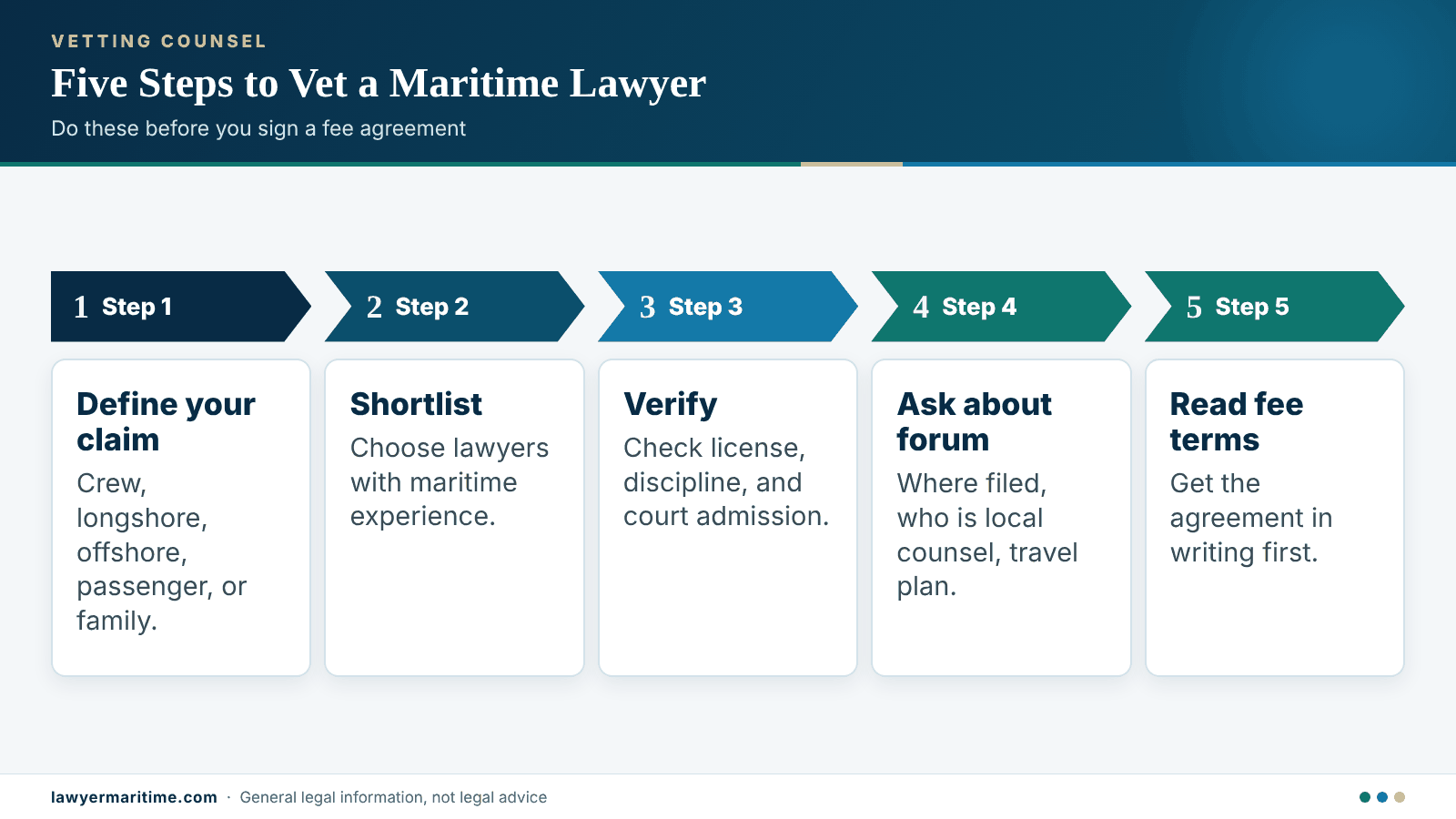
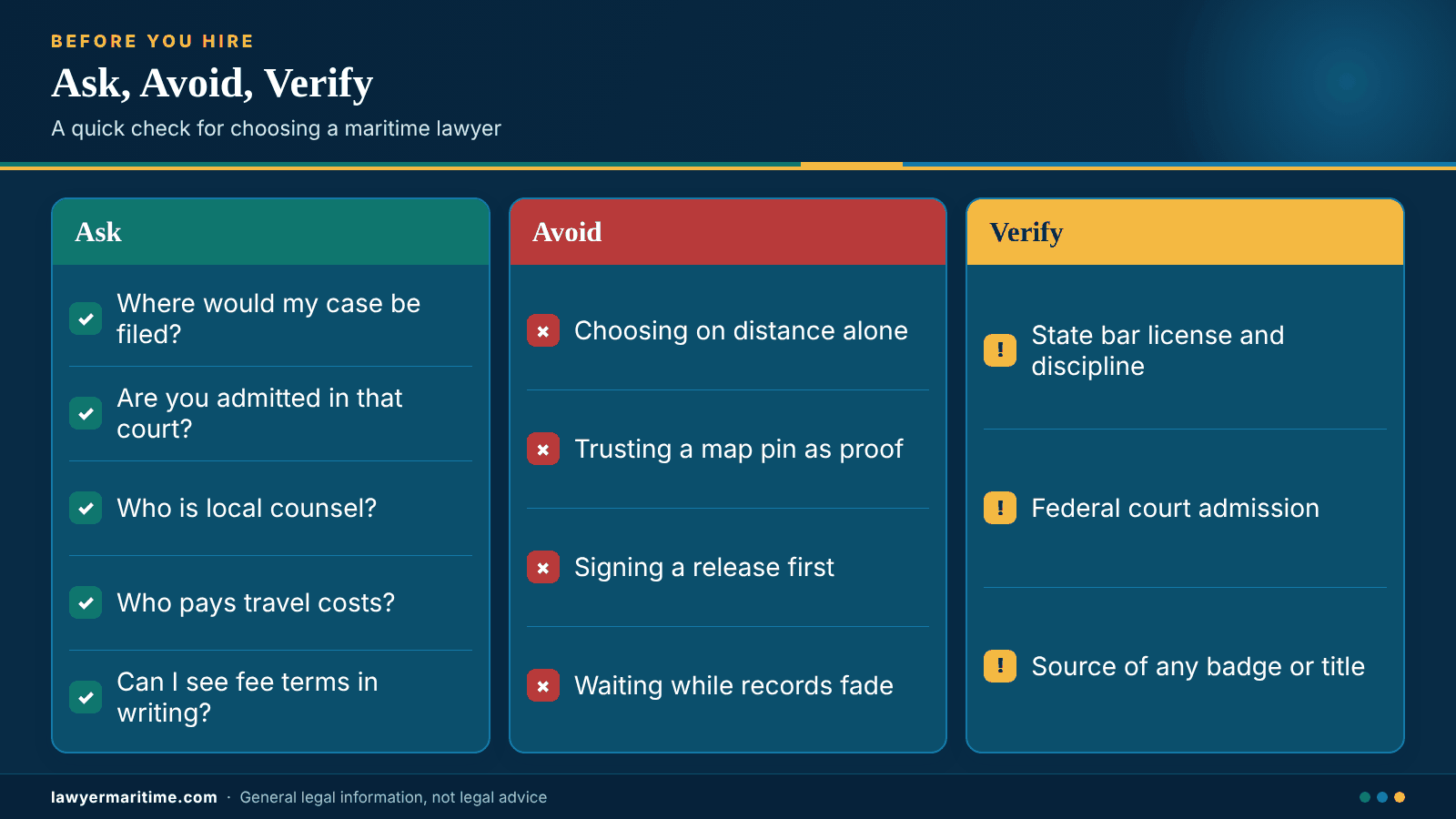
- Ask about experience. How many matters like mine have you handled, and when was the most recent one?
- Ask about forum. Where would you expect my case to be filed, and what could the other side do about it?
- Ask about admission. Are you licensed and admitted in the court where the case would be, and if not, who is local counsel?
- Ask about logistics. How would we meet, how often will I get updates, and who covers travel costs?
- Ask about money. Can I see the fee agreement in writing, including how expenses are handled?
Pay attention to how each lawyer answers as much as what they say. Clear, qualified answers and a willingness to put key terms in writing are good signs. Pressure, vague promises, or a refusal to explain the plan for the court are reasons to pause.
| Common mistake | Why it hurts | Better move |
|---|---|---|
| Choosing only on distance | A close office doesn’t show maritime fluency or court admission | Screen for maritime experience first, then use proximity as a tiebreaker |
| Choosing only on advertising volume | Ad spend is not evidence of experience or results | Verify license, discipline history, and admission independently |
| Waiting for the “perfect” lawyer | Evidence fades and clocks keep running | Set a short decision window and protect records in the meantime |
| Signing before reading the fee agreement | Expense and fee terms are hard to change later | Ask for the agreement in writing and take time to review it |
| Signing an employer’s or insurer’s papers first | A release can give up claims you haven’t fully evaluated | Have a lawyer review any release or recorded-statement request before you sign |
Avoid the mistakes that cost the most
Most regrets in this process come from a handful of avoidable choices. Some happen during the search, and some happen in the first conversation with a lawyer.
Mistakes that come from the search itself
- Treating the first listing on the page as a recommendation. Position in search results reflects many factors, not quality.
- Assuming a website’s “maritime” label means the lawyer handles crew, longshore, and vessel claims regularly.
- Rejecting a distant lawyer without asking how admission, local counsel, and remote work would be handled.
- Rejecting a nearby lawyer who is honest about limited maritime experience, when that lawyer offers a sound referral.
The reverse mistake is also common. Some readers choose the most distant, most impressive firm and later find that day-to-day contact is hard. The goal is fit, and fit includes access.
Mistakes in the first conversation
Be honest and complete about the facts, including facts that don’t help you, such as prior injuries or a conversation with an insurer. A lawyer can only plan around what the lawyer knows, and a surprise later can damage credibility. Ask the lawyer to explain the privacy of your first conversation. Under ABA Model Rule 1.18, lawyers owe duties of confidentiality to prospective clients, but you should still share the minimum needed for a first evaluation until you’ve decided to hire.
Don’t ask a lawyer to predict what the case is worth in the first call. Honest lawyers can describe categories of recovery and factors that move a case up or down, but they cannot promise results. A lawyer who names a number before reviewing your records is telling you something about their approach.
Frequently Asked Questions
These answers are general. They show how the rules usually work, and your facts, your court, and your contracts may change the result.
Choosing between local and distant counsel
Do I need a maritime lawyer who is in my city?
Not necessarily. Federal maritime law is national, so a lawyer elsewhere can often handle a claim that arose near you, provided they are allowed to appear in the right court. A nearby lawyer with real maritime experience can be a strong choice, but proximity alone does not show that experience.
Is a local personal-injury lawyer enough for a maritime claim?
It depends on the lawyer and the claim. Some local firms handle maritime matters regularly, and others rarely do. Ask how many crew, longshore, or vessel claims the lawyer has handled recently, and whether they’d work with maritime co-counsel if your case needs it.
Can a lawyer from another state represent me in my state’s court?
Often yes, but not automatically. The lawyer usually needs to be admitted in that court or receive the judge’s permission to appear in your case, commonly called pro hac vice admission, and some courts require local counsel as well. Ask any out-of-state lawyer how they would be authorized.
What if the nearest maritime lawyer is hours away?
Distance is manageable for many tasks. Consultations, records, and some depositions can be handled remotely, while court-ordered exams, inspections, and trial may require travel. Ask in advance how travel will be handled and who bears the costs.
Courts, forums, and licensing
Where can I file a maritime injury lawsuit?
It depends on the claim, the defendant, and the facts. A maritime claim may be filed in federal court, and in some cases in state court under the saving-to-suitors clause. A seaman’s Jones Act claim can be filed in either, with a jury right, subject to venue rules and to motions by the defendant.
Can my case be moved to another court?
Sometimes. A federal court can transfer a case for the convenience of parties and witnesses, forum-selection clauses in contracts may steer the forum, and a vessel owner can file a limitation of liability action in federal court. A lawyer should be able to explain which of these risks apply to your case.
Does my state’s law matter if the injury happened at sea?
It can, but less often than people think. Core maritime remedies come from federal law, though state law may matter for state-court procedure and for some nonseafarer claims in state waters. On fixed offshore platforms, the law of the adjacent state may apply as federal law under the Outer Continental Shelf Lands Act.
How do I check whether a lawyer is licensed and in good standing?
Use the lawyer-lookup tool on each relevant state bar’s website, which often shows license status and public discipline. For federal courts, ask which courts admit the lawyer. Don’t rely on a website badge without finding the program behind it.
Timing, fees, and next steps
How long do I have to hire a lawyer?
There is no single answer. A general three-year period applies to many maritime injury suits, but notice rules, contracts, benefit-claim periods, and limitation-of-liability proceedings can create shorter clocks. Ask about timing in your first conversation, and don’t let the search delay medical care or record-keeping.
How do maritime lawyers usually charge?
Many injury lawyers work on contingency, which means the fee depends on a recovery, but terms vary and must be in a signed writing under the model ethics rule. Expenses are handled differently from firm to firm. In LHWCA claims, fees generally require approval by the agency or a court.
Should I sign with the first lawyer who calls me?
Take your time, within reason. An unsolicited call after an accident deserves questions about how the lawyer got your information, whether the lawyer is licensed where your case belongs, and what the fee agreement says. Compare at least two options if you can.
What if I already gave a statement or signed a release?
Don’t panic, and don’t assume the matter is closed. What you signed, when, and what you received in return all affect what rights remain. Bring the documents to a maritime attorney quickly, since seamen’s releases receive special scrutiny and timing may matter.
Sources and Legal Authorities
The authorities below support the legal statements in this guide. Check each against its current text before you rely on it.
Statutes, rules, and professional-conduct standards
Federal statutes
- 46 U.S.C. § 30104 – Jones Act personal injury and death of a seaman
- 46 U.S.C. § 30106 – Time limit on bringing maritime action for personal injury or death
- 46 U.S.C. § 30529 – Action by owner for limitation
- 45 U.S.C. § 56 – FELA, actions, limitation, venue, and concurrent jurisdiction
- 28 U.S.C. § 1333 – Admiralty, maritime, and prize cases
- 28 U.S.C. § 1404 – Change of venue
- 28 U.S.C. § 1445 – Nonremovable actions
- 43 U.S.C. § 1333 – Outer Continental Shelf Lands Act, laws and regulations governing lands
- 46 U.S.C. § 55102 – Cabotage (coastwise shipping), distinct from the seaman’s injury remedy
LHWCA and court rules
- 33 U.S.C. § 912 – LHWCA notice of injury or death
- 33 U.S.C. § 913 – LHWCA filing of claims
- 33 U.S.C. § 928 – LHWCA attorney’s fees
- Fed. R. Civ. P. 30 – Depositions by oral examination
- Fed. R. Civ. P. 35 – Physical and mental examinations
- Fed. R. Civ. P. 9(h) and Supplemental Rules for Admiralty or Maritime Claims, Rule F
Professional conduct
- ABA Model Rule 1.5 – Fees
- ABA Model Rules 1.18 (prospective clients), 5.5 (multijurisdictional practice), 7.1 and 7.2 (communications and referrals); state versions vary, so check the version that applies to you
Cases and agency materials
Supreme Court and federal appellate decisions
- Garrett v. Moore-McCormack Co., 317 U.S. 239 (1942) – burden regarding a seaman’s release
- Carnival Cruise Lines, Inc. v. Shute, 499 U.S. 585 (1991) – forum-selection clause in a passage ticket
- Jerome B. Grubart, Inc. v. Great Lakes Dredge & Dock Co., 513 U.S. 527 (1995) – location and connection tests for maritime tort jurisdiction
- Chandris, Inc. v. Latsis, 515 U.S. 347 (1995) – seaman status
- Yamaha Motor Corp. v. Calhoun, 516 U.S. 199 (1996) – state remedies in state territorial waters
- Lewis v. Lewis & Clark Marine, Inc., 531 U.S. 438 (2001) – limitation actions and the saving-to-suitors clause
- Stewart v. Dutra Construction Co., 543 U.S. 481 (2005) – meaning of “vessel”
- Also referenced without links: The Genesee Chief v. Fitzhugh, 53 U.S. (12 How.) 443 (1852); The Daniel Ball, 77 U.S. (10 Wall.) 557 (1871); Sanchez v. Smart Fabricators of Texas, L.L.C., 997 F.3d 564 (5th Cir. 2021) (en banc)


