
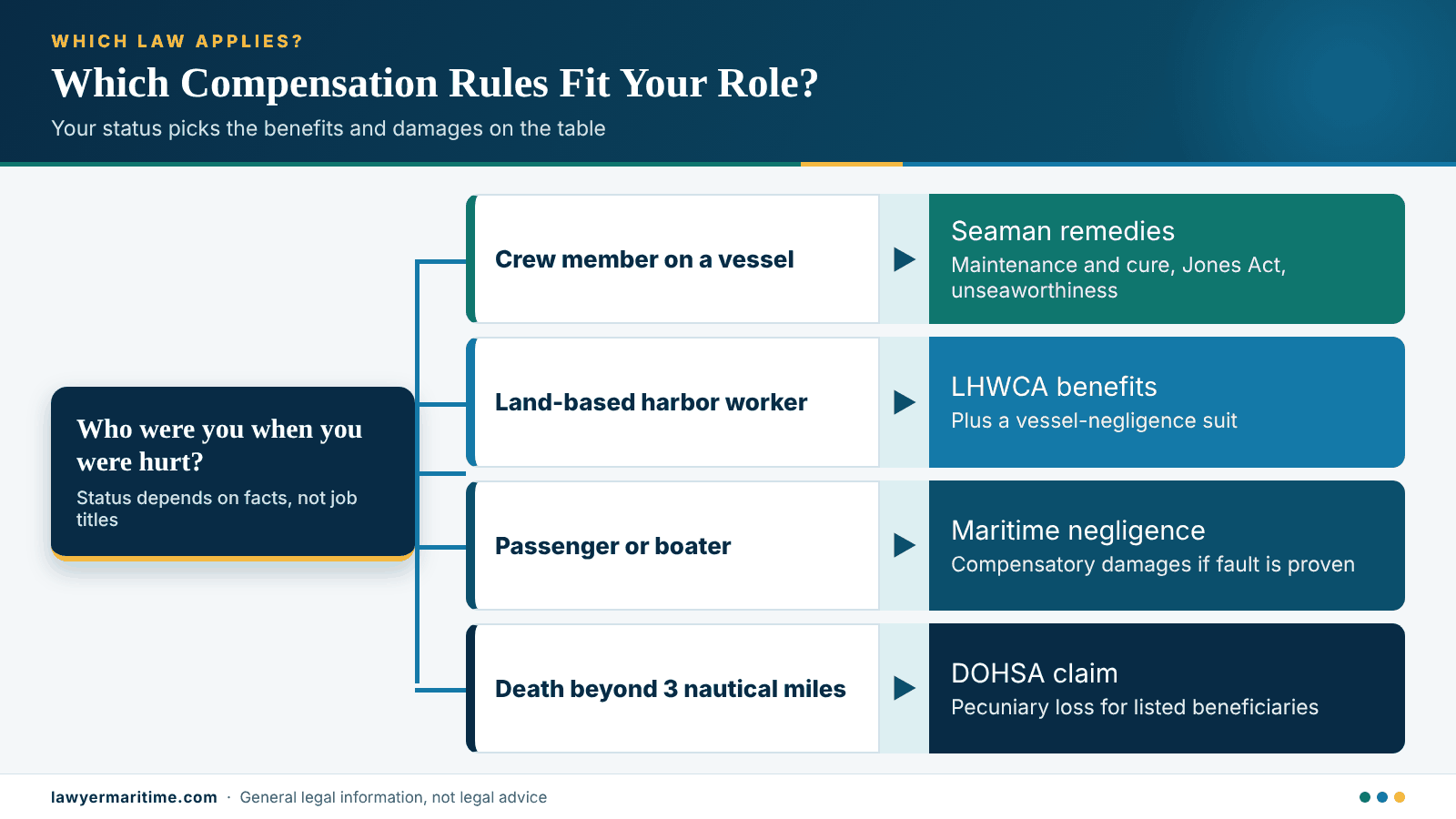
Maritime injury compensation is not one pot of money governed by one set of rules. What you may recover depends on who you were when you were hurt, because the legal regime that fits your work decides which benefits and damages are on the table. A seaman may be entitled to maintenance and cure, unearned wages, and damages under the Jones Act and the doctrine of unseaworthiness. A longshore or harbor worker usually looks to statutory benefits under the Longshore and Harbor Workers’ Compensation Act (LHWCA). A passenger or boater generally proceeds under general maritime tort law, and a death far from shore may fall under the Death on the High Seas Act (DOHSA). This guide explains each category in plain English, how fault and offsets can change the numbers, what evidence proves your losses, and where the deadlines can bite. It is written for injured maritime workers, passengers, and families who want to get their bearings before talking with a lawyer. It describes general rules, not promises or case values, because outcomes turn on the facts.
Which Legal Framework Sets Your Maritime Injury Compensation?
Most people start with a number: what is a maritime injury claim worth? The better first question is which body of law applies, because that answer decides what categories of money exist at all. A framework that allows pain and suffering produces a very different claim from one that pays a percentage of wages.
Why your role on the water determines the menu
Maritime law grew up around the people who work on and around vessels, so it sorts injured people into categories. Each category carries its own statute or doctrine, its own defendants, and its own limits on recovery.
Seaman, harbor worker, passenger, or family member
A seaman is generally a worker whose duties contribute to a vessel’s function and whose connection to a vessel, or a fleet of vessels, in navigation is substantial in duration and nature. Seamen have the richest set of remedies: maintenance and cure, unearned wages, a Jones Act negligence claim against the employer, and an unseaworthiness claim against the vessel owner.
Longshore and harbor workers who are covered by the LHWCA, 33 U.S.C. §§ 901-950, receive statutory compensation from the employer and may also sue a negligent vessel under 33 U.S.C. § 905(b). Passengers and recreational boaters usually rely on general maritime negligence law. Families of people who died look to wrongful-death rules that depend on the decedent’s status and on where the death occurred.
Why the same accident can produce different recoveries
Picture two workers hurt in the same fall on the same deck. One is a deckhand assigned to the vessel, and the other is a shore-side contractor who boards for a few hours to repair equipment. The deckhand may qualify as a seaman. The contractor may fall under the LHWCA or a state compensation system instead, depending on status and situs tests.
Here’s the practical point: two people with the same fracture can face very different paperwork, deadlines, and categories of recovery. Don’t assume the label on your job controls your status. The legal tests look at the actual work and the actual vessel.
Benefits and damages are different kinds of recovery
Lawyers use two words that readers often treat as synonyms. Benefits are payments the law requires regardless of who caused the accident. Damages are money a court awards, or parties negotiate, because someone else breached a legal duty.
No-fault benefits: maintenance and cure and LHWCA compensation
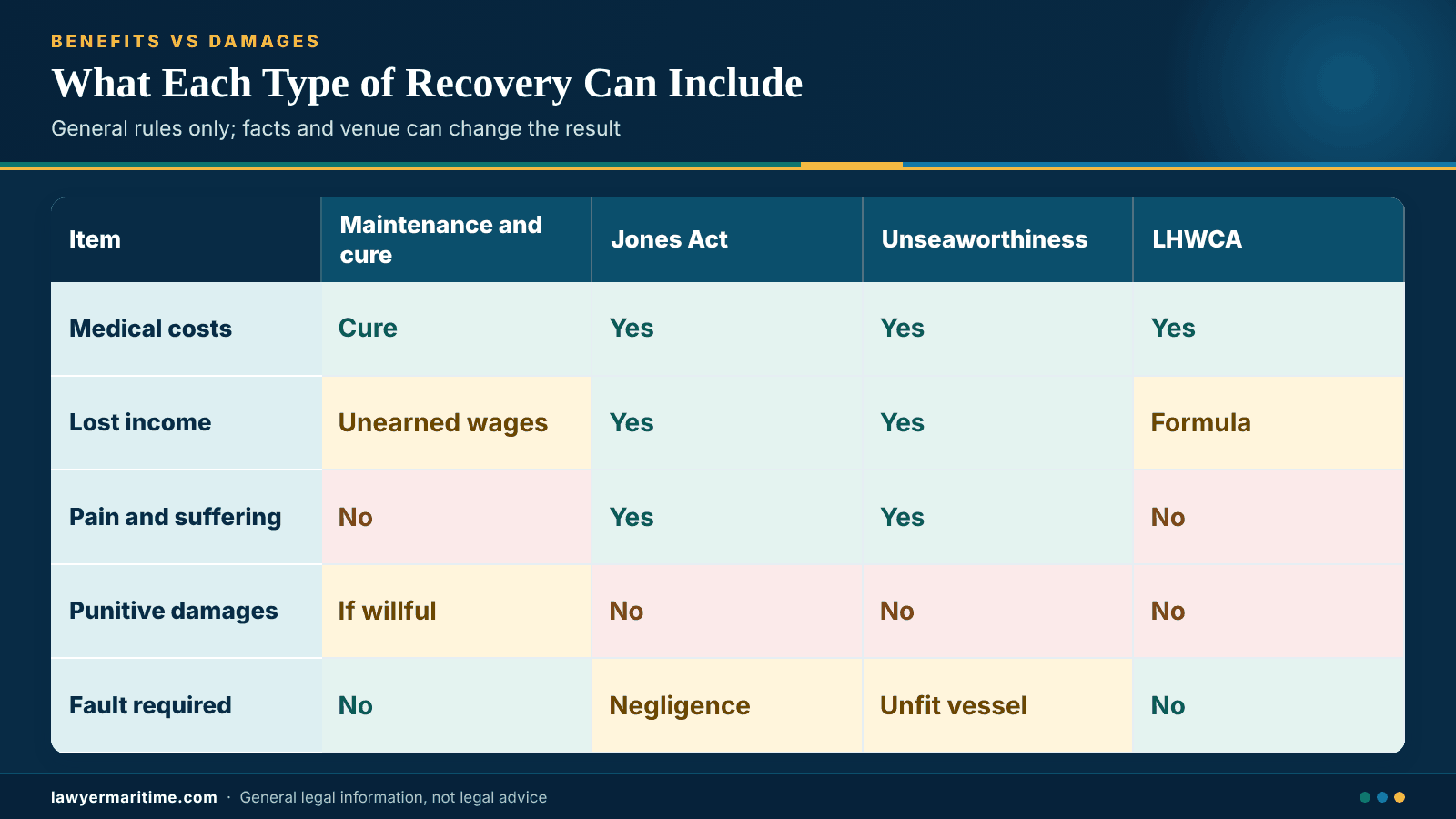
Maintenance and cure is owed to an injured or ill seaman without proof that the employer did anything wrong. LHWCA medical care and disability compensation likewise do not require proof of fault. These payments are usually steadier and faster than damages, but they follow formulas and have ceilings.
Because they are formula-driven, no-fault benefits rarely replace everything an injury takes. They don’t generally compensate for pain, lost enjoyment of life, or the full value of a lost career. That gap is why fault-based claims matter when the facts support them.
Fault-based damages: Jones Act, unseaworthiness, and tort claims
Damages claims ask a decision-maker to find that an employer was negligent, that a vessel was unseaworthy, or that another party failed to use reasonable care. If liability is proven, the law generally allows compensatory damages for both economic and non-economic harm, subject to the limits explained later in this guide. If liability is not proven, there may be no recovery on that claim, even when the injury is serious.
This is the fine print many readers miss. Benefits come with the status; damages come with proof.
| Injured person | Main legal source | No-fault benefits | Fault-based damages |
|---|---|---|---|
| Seaman | 46 U.S.C. § 30104; general maritime law | Maintenance, cure, unearned wages | Jones Act negligence; unseaworthiness |
| Longshore or harbor worker | 33 U.S.C. §§ 901-950 | Medical care and weekly disability compensation | Vessel negligence under § 905(b) only; no unseaworthiness |
| Passenger or recreational boater | General maritime law; sometimes state law | None | Negligence damages, subject to ticket terms and facts |
| Family after a death | DOHSA, Jones Act, LHWCA, general maritime or state law | Survivor benefits under the LHWCA if covered | Depends on status, location, and statute |
Maintenance, Cure, and Unearned Wages for Seamen
For a seaman, the compensation picture begins with a set of obligations that do not depend on fault. They exist because maritime law has long treated a sick or injured crew member as someone the employer must look after, much as it would a ward who cannot easily protect himself. The duty is imposed by law as part of the employment relationship, and courts have historically resolved doubts about its scope in the seaman’s favor.
What maintenance and cure actually cover
The two halves of the phrase work differently, and disputes usually concentrate on one half at a time.
Maintenance: the daily living allowance
Maintenance is meant to approximate the cost of the food and lodging a seaman would have received aboard the vessel. It is paid per day, not as a share of wages, which is why it is often much smaller than the paycheck it temporarily replaces. Some employment agreements or collective bargaining agreements set a rate, and courts look closely at whether a contract rate is reasonable for the seaman’s actual living costs.
Because the amount depends on local costs and on what the seaman can document, receipts and lease or mortgage records matter. A seaman who lives with family and pays no rent may face a different calculation than one who rents an apartment. Rates in practice vary widely, and this article does not state a figure.
Cure and the point of maximum medical improvement
Cure covers the medical care a seaman needs to recover, including hospital, physician, medication, and rehabilitation costs. It isn’t open-ended. In Farrell v. United States, 336 U.S. 511 (1949), the Supreme Court explained that the duty generally runs until the seaman has been cured as far as possible or the condition is declared permanent.
Courts and employers often call that moment maximum medical improvement. It matters enormously, because maintenance and cure generally stop there, and the seaman’s remaining losses must be addressed through other claims. A treating physician’s opinion about improvement, and whether more treatment could reasonably help, is often the most contested document in the file.
Unearned wages and the common disputes
Maintenance and cure isn’t the only no-fault item. Seamen may also have a claim to wages they would have earned, and several defenses can complicate each benefit.
Unearned wages
Under traditional maritime principles, a seaman who is injured or becomes ill in the vessel’s service may recover wages through the end of the voyage or the period for which the seaman was hired. Those wages are separate from maintenance and cure. How they are measured depends on how the seaman was paid: a salary, a day rate, a hitch rotation, or a fishing share each raises different questions.
Employment records usually answer the question. The crew agreement, the hitch schedule, and prior pay statements show what the seaman would have earned and for how long. If the engagement was open-ended or ended for another reason, the period of unearned wages may be short.
Pre-existing conditions and the concealment defense
Employers often investigate whether a seaman disclosed prior medical history on a hiring questionnaire. In the Fifth Circuit, McCorpen v. Central Gulf S.S. Corp., 396 F.2d 547 (5th Cir. 1968), allows an employer to avoid maintenance and cure when the seaman willfully concealed a known, relevant condition, and the condition is connected to the later injury. Other circuits may apply different approaches.
A pre-existing condition by itself doesn’t end the claim. A seaman may still recover if the work aggravated the condition, or if the omission was not intentional. Honest, complete answers on medical forms are worth far more than a clever explanation afterward.
When an employer withholds maintenance and cure
Maintenance and cure is supposed to be paid promptly. When it is not, maritime law provides remedies that go beyond the unpaid amounts, though each requires proof about the employer’s conduct.
Attorney’s fees for callous refusals
In Vaughan v. Atkinson, 369 U.S. 527 (1962), the Supreme Court allowed a seaman to recover attorney’s fees as damages where the shipowner’s refusal to pay had been callous and persistent. The case didn’t make fees automatic whenever a claim is disputed. An employer with a reasonable, good-faith basis to question a claim stands in a different position from one that ignores it.
Punitive damages for willful nonpayment
In Atlantic Sounding Co. v. Townsend, 557 U.S. 404 (2009), the Court held that punitive damages remain available under general maritime law when an employer willfully or wantonly fails to pay maintenance and cure. That is a narrow doorway. It concerns the withholding of this specific benefit, and later cases have treated it as resting on long historical practice rather than as a general rule for all maritime claims.
| Item | What it covers | Typical end point | Common dispute |
|---|---|---|---|
| Maintenance | Daily allowance for food and lodging | Maximum medical improvement | The daily rate and proof of actual living costs |
| Cure | Reasonable medical treatment and rehabilitation | When treatment can no longer improve the condition | Whether more treatment is curative or only palliative |
| Unearned wages | Wages through the voyage or hiring period | End of voyage or term, depending on the engagement | How to measure pay for day-rate, hitch, or share workers |
| Fees and punitive damages | Remedies for willful or callous nonpayment | Not automatic | Whether the refusal was truly willful or in good faith |
Jones Act and Unseaworthiness Damages
Maintenance and cure keeps a seaman housed and treated. It doesn’t pay for lost earning capacity, permanent impairment, or pain. Those losses are addressed through two fault-based claims that are usually pleaded together: negligence under the Jones Act and unseaworthiness under general maritime law.
The Jones Act negligence claim
The Jones Act gives a seaman injured in the course of employment the right to sue the employer, with a jury trial if the seaman elects one. If the seaman dies from the injury, the personal representative may bring the action. The statute does this by borrowing the framework of the Federal Employers’ Liability Act (FELA) for railroad workers.
The negligence standard and causation
The employer’s duty is to provide a reasonably safe place to work, and the claim can rest on the negligence of the employer’s officers, agents, or other employees. That includes unsafe procedures, inadequate staffing, defective equipment, poor training, and a crew member’s carelessness. The employer is responsible for those failures because the statute makes it so.
Causation is more forgiving than in an ordinary injury case. FELA reaches injuries that result “in whole or in part” from negligence, and in CSX Transportation, Inc. v. McBride, 564 U.S. 685 (2011), the Supreme Court described the test under FELA as whether the negligence played any part, even a small one, in bringing about the injury. Courts apply that approach to Jones Act claims through the statute’s incorporation of FELA.
The seaman’s own fault and the end of assumption of risk
A seaman’s carelessness doesn’t erase the claim. Under 45 U.S.C. § 53, contributory negligence does not bar recovery; it reduces damages in proportion to the injured worker’s share of the fault. Assumption of risk is not a defense in a seaman’s case, as the Court confirmed in Socony-Vacuum Oil Co. v. Smith, 305 U.S. 424 (1939).
Seamen still owe a duty of ordinary prudence in the circumstances. In the Fifth Circuit, Gautreaux v. Scurlock Marine, Inc., 107 F.3d 331 (5th Cir. 1997) (en banc), describes that standard. A later section of this guide explains how comparative fault can change the final figure.
The unseaworthiness claim
Unseaworthiness targets the vessel owner or operator rather than the employer as such, though they are often the same entity. It looks at the condition of the ship, not at anyone’s carelessness.
A strict duty, but not a guarantee of perfection
Unseaworthiness doesn’t require the owner to have known about a hazard. A slick deck, a defective winch, a missing guard, or an undertrained crew can each qualify if the condition made the vessel unfit and caused the injury. The standard is reasonable fitness, not accident-free operation.
The claim has limits. In Usner v. Luckenbach Overseas Corp., 400 U.S. 494 (1971), the Court explained that a single, isolated negligent act by a crew member does not by itself make a vessel unseaworthy. Lawyers therefore spend time separating a lasting condition from a momentary mistake.
No punitive damages for unseaworthiness
In Dutra Group v. Batterton, 588 U.S. 358 (2019), the Supreme Court held that a seaman cannot recover punitive damages on an unseaworthiness claim. The Court reasoned that unseaworthiness is strict liability that overlaps with the Jones Act, where punitive damages are unavailable, and that maritime law should maintain uniform remedies. The opinion distinguished Townsend, which rested on a long history of punitive damages for withheld maintenance and cure.
What categories of damages may be available
If a seaman proves a Jones Act or unseaworthiness claim, the damages are compensatory. They are meant to make up for the harm, not punish the defendant. Courts and juries generally group them into economic and non-economic losses, with a short list of items that are typically unavailable.
Economic damages
Economic damages commonly include past medical expenses not already paid as cure, future medical care, lost wages from the injury to the trial or settlement, and the loss of future earning capacity. Loss of earning capacity can be the largest item in a serious case. It asks how much the injury has reduced the seaman’s ability to earn over a working lifetime, which is why vocational and economic experts frequently appear.
An injured seaman who cannot return to a vessel may still be able to work in other jobs. Employers and insurers often argue that the seaman could earn nearly as much in a different role. The evidence on training, licenses, physical limits, and local job markets decides that argument, and the next section explains what to collect.
Non-economic damages
Non-economic damages usually include physical pain and suffering, mental anguish, and loss of enjoyment of life. The law doesn’t assign them a formula. A decision-maker considers the nature of the injury, the course of treatment, the permanence of the limitations, and how the injury changed daily life.
Two cautions are worth keeping in mind. These damages are not guaranteed in any case, and no responsible source can predict an amount. They also depend on the claim succeeding; if liability is not established, there is nothing to measure.
Items that are usually not recoverable
Punitive damages are not available on Jones Act or unseaworthiness claims, as discussed above. Courts are also cautious about additional categories such as a spouse’s loss of consortium in a non-fatal injury case, and the rules vary by claim and court. Attorney’s fees are generally not recoverable in an ordinary Jones Act case, with the maintenance-and-cure exception described earlier.
How Do You Prove What the Injury Cost You?
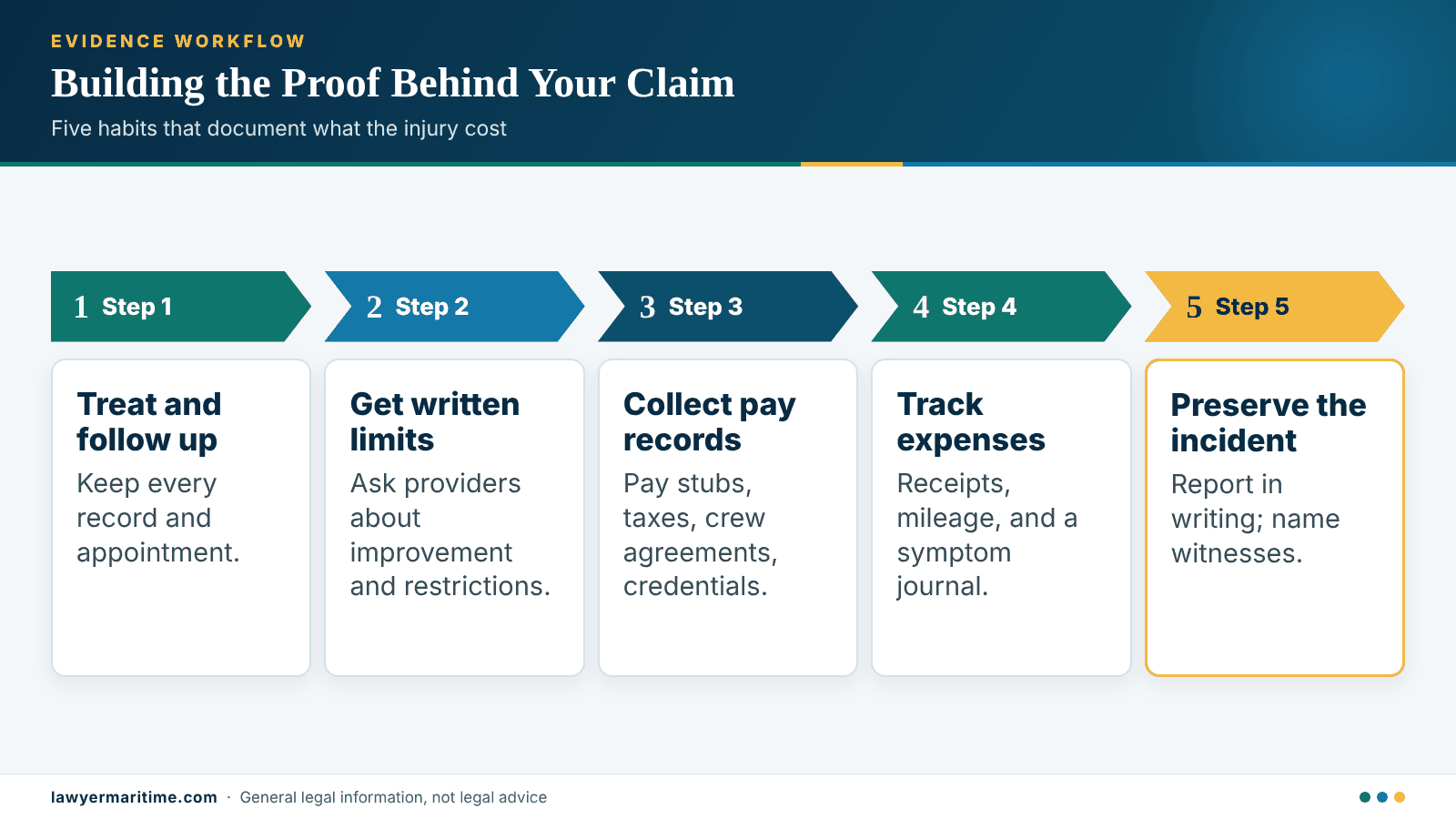
A legal right to compensation is only as useful as the proof behind it. Insurers and employers evaluate maritime injury claims on documents, and the documents that show damages are different from the ones that show fault. Both sets need attention early, while memories are fresh and records are still easy to obtain.
Medical and functional evidence
Medical records do two jobs. They establish what the injury is, and they establish what it means for the injured person’s ability to work and live.
Treatment records and the improvement question
Collect the full record: emergency or clinic notes, imaging, operative reports, therapy notes, prescriptions, and bills. Consistency matters. Gaps in treatment, missed appointments, or notes that describe the cause of injury differently can be used to question both the claim and the continuing need for cure.
Ask treating providers to state in writing whether you have reached maximum medical improvement, what further treatment is reasonably expected to help, and what permanent limitations remain. Those statements often decide when maintenance and cure end and how future damages are measured. If a provider is unsure, say so rather than letting the paperwork guess.
Work capacity and permanent limitations
Damages for lost earning capacity rest on what the injured person can and cannot do. A functional capacity evaluation, a physician’s work-restriction note, or a vocational assessment can translate medical findings into practical limits, such as lifting, climbing, standing, or working at heights and in confined spaces.
Be careful to stay accurate and consistent. Overstating limitations to a doctor, or describing activities casually on social media that contradict a restriction, can damage credibility. Candor helps your own experts and your own case.
Wage, employment, and expense records
Proving economic loss is an exercise in arithmetic backed by paperwork. The more precise the records, the less room for argument about what you would have earned.
Pay records and the structure of your earnings
Gather pay stubs, W-2 or 1099 forms, tax returns, hitch schedules, day-rate agreements, overtime records, and any bonus or per-diem documents. Seamen and offshore workers often have irregular schedules, so a clear picture of an ordinary year, rather than a single month, is what matters. The same records help calculate unearned wages and the LHWCA average weekly wage described later.
If you worked for several employers, keep records for each. If your pay rose after training or a new credential, document that too. Those facts show where your earnings were heading before the injury.
Earning-capacity and out-of-pocket evidence
Earning-capacity claims also depend on your licenses, merchant mariner credentials, certifications, and work history, because those documents show what jobs you were qualified for and what you could have advanced to. Keep receipts for medical co-pays, mileage to appointments, medication, equipment, and lodging during treatment. Small expenses add up, and a running list is easier to build while the injury is current.
A short, dated journal of how symptoms affect sleep, mobility, mood, and family life can later support a non-economic damages claim. It should be factual and in your own words, not written for a lawyer’s eyes.
| Loss to prove | Best evidence | Who can supply it | Common weak point |
|---|---|---|---|
| Medical expenses and future care | Itemized bills, treatment plans, cost estimates | Providers, billing offices, life-care planners | Unexplained gaps in treatment |
| Lost wages and unearned wages | Pay stubs, tax returns, crew agreements, hitch schedules | Employer, payroll, the worker | Irregular pay with no clear baseline |
| Lost earning capacity | Work restrictions, vocational assessment, credentials | Physicians, vocational experts, economists | Assuming no other jobs are possible |
| Pain and daily-life impact | Symptom journal, therapy notes, witness accounts | The worker, family, therapists | Social media or statements that contradict the claim |
| Maintenance owed | Rent, mortgage, utilities, food receipts | The worker, landlord, lender | Missing or undated expense records |
Evidence of liability and vessel condition
Damages follow liability. If an employer’s negligence or an unseaworthy condition is the basis of the claim, the evidence of fault is as important as the evidence of loss.
Preserving the scene and the equipment
Report the injury in writing as soon as it is safe to do so, and ask for a copy of any incident report. Photograph the area, the equipment, and your injuries when possible. Write down the names of witnesses, the task assignment, the weather and sea state if relevant, and who was in charge.
Vessel logs, maintenance records, inspection records, safety meeting notes, and crew lists are controlled by the employer or owner. A lawyer can send a written preservation demand so that evidence is not discarded in the ordinary course of business. When an accident involves a collision, fire, or serious casualty, official investigations may also generate records; see our guide to maritime collision investigations.
Statements, social media, and investigators
Employers and insurers often send adjusters or investigators within days. A recorded or written statement given before you understand your rights can be used to limit a claim later. It’s reasonable to give truthful basic facts to your employer and the Coast Guard when required, and to speak with a lawyer before giving a detailed statement to an insurer.
Assume anything you post online may be seen by the other side. A photo of a weekend outing can be read as proof of recovery regardless of how much pain you were in.
LHWCA Benefits for Longshore and Harbor Workers
The Longshore and Harbor Workers’ Compensation Act is a federal workers’ compensation system for covered land-based maritime employees, such as certain terminal, shipyard, and harbor workers. The U.S. Department of Labor administers it through the Division of Longshore and Harbor Workers’ Compensation. Whether a worker is covered depends on status and situs requirements, which this article does not resolve.
Medical care and the disability categories
Compensation under the Act is divided between medical benefits and payments that replace wages. The wage-replacement side depends on how disabled the worker is and for how long.
Medical treatment under the Act
Under 33 U.S.C. § 907, the employer must furnish medical, surgical, and other treatment and supplies for as long as the injury or the process of recovery requires. The employee generally may choose an attending physician authorized by the Department of Labor, with exceptions where immediate care is needed. The rules about changing doctors and getting treatment approved are procedural and can trip workers up.
A worker who pays for care out of pocket after the employer refused or ignored a request may later seek reimbursement, but the statute sets conditions. Written requests and good records protect that right. If your employer or its carrier refuses a medical request, ask for the refusal in writing; you’ll want proof of it.
Temporary, permanent, total, and partial disability
The statute, in 33 U.S.C. § 908, sorts disability along two lines: whether it is total or partial, and whether it is temporary or permanent. A worker who cannot work while recovering generally falls under temporary total disability. A worker whose condition has stabilized with lasting limits may be classed as permanently partially or permanently totally disabled.
For some injuries, such as the loss of an arm, a leg, a hand, or an eye, the Act lists a fixed number of weeks of compensation in a schedule. For other permanent partial injuries, compensation turns on the difference between pre-injury wages and the worker’s post-injury wage-earning capacity. Disputes over which category fits are among the most common in LHWCA practice.
How the weekly rate is set
The wage-replacement rate isn’t simply a worker’s take-home pay. It uses a statutory percentage of an average weekly wage, then applies minimum and maximum limits.
Average weekly wage and the two-thirds rule
For most total disability and many partial disability awards, weekly compensation equals 66⅔ percent of the employee’s average weekly wage. Section 910 explains how to compute that wage. It generally looks at earnings in the year before the injury, uses comparable workers when the injured worker did not work substantially the whole year, and falls back on a reasonable estimate of earning capacity when neither method fits.
That is why pay records matter so much. Overtime, second jobs, and seasonal patterns can move the average weekly wage up or down. A mistake at this stage affects every payment that follows.
Minimum and maximum limits that change each year
Section 906(b) caps weekly compensation at 200 percent of the national average weekly wage and sets a floor for total disability at 50 percent of that national figure, or the worker’s full average weekly wage if lower. The Secretary of Labor adjusts the national figure each year, and the new numbers take effect on October 1.
The Department of Labor publishes the current maximum and minimum rates, and this article does not repeat dollar amounts because they change annually. High earners may find that the cap, rather than the two-thirds formula, controls their payment. Check the Department of Labor’s current table.
Death benefits and claims against third parties
The Act does more than pay the injured worker. It provides benefits to survivors and leaves room for separate claims against parties other than the employer.
Survivor benefits
If a covered injury causes death, 33 U.S.C. § 909 provides a funeral allowance of up to $3,000 and weekly benefits for eligible survivors. A surviving spouse with no children receives 50 percent of the deceased worker’s average wages, and each child adds a further share. Total benefits to a spouse and children cannot exceed 66⅔ percent of wages and are subject to the statutory weekly maximum.
Other dependents, such as parents, grandchildren, or siblings, may qualify when no spouse or children exist or when the combined benefits fall below the cap. Dependency is generally measured as of the date of injury, so the facts at that moment matter.
Suing a negligent vessel or other third party
The LHWCA makes the employer’s liability exclusive, but it does not bar a covered worker from suing a negligent third party. Under 33 U.S.C. § 905(b), a covered worker injured by a vessel’s negligence may sue the vessel, but the vessel’s liability cannot rest on unseaworthiness. A third-party recovery can include damages that the compensation system does not, such as pain and suffering, which is why these suits can matter.
The interaction between compensation and a third-party suit is technical. Under § 933, accepting compensation under a formal award can assign the worker’s third-party rights to the employer unless suit is filed within six months, and settling a third-party claim for less than the compensation owed generally requires the employer’s and carrier’s written approval. The worker may owe credit or reimbursement to the compensation carrier from the recovery.
| Benefit | How it is measured | Duration or limit |
|---|---|---|
| Medical care (§ 907) | Treatment the injury and recovery require | For as long as the injury requires |
| Temporary total disability (§ 908(b)) | 66⅔ percent of average weekly wage | While the total disability continues |
| Permanent total disability (§ 908(a)) | 66⅔ percent of average weekly wage | While the total disability continues |
| Scheduled permanent partial loss (§ 908(c)) | 66⅔ percent of average weekly wage for a listed number of weeks | For example, 312 weeks for an arm and 288 weeks for a leg |
| Temporary partial disability (§ 908(e)) | Two-thirds of the wage-earning-capacity loss | Up to five years |
| Death benefits (§ 909) | Percentages of the worker’s average wages for survivors | Capped at 66⅔ percent in total and by the weekly maximum |
Keep in mind that LHWCA compensation does not include pain and suffering or punitive damages. Those categories appear only in a successful third-party suit, where the underlying law allows them.
Passengers, Boaters, and Fatal Claims
Not every maritime injury involves a crew member or a dock worker. People are hurt on cruise ships, ferries, charter boats, and private vessels, and families lose relatives in accidents on rivers, harbors, and the open sea. The compensation rules for these groups look different, and they deserve their own treatment.
Passengers and recreational boaters
Passengers and boaters are not seamen, so none of the seaman-specific benefits apply. They have no maintenance and cure, no Jones Act claim, and no LHWCA compensation unless they also happen to be covered workers.
Compensatory damages under general maritime law
A passenger injured by a vessel operator’s negligence generally has a tort claim under general maritime law when the incident occurred on navigable waters and has the required connection to maritime activity. That claim can seek compensatory damages for medical expenses, lost earnings and earning capacity, and pain and suffering, if negligence and causation are proven. The injured person’s own carelessness can reduce the award.
The strength of such a claim depends on facts that are specific to the vessel and the operator: the standard of care for a cruise line differs from that for a private boat owner or a rental company. State law may also play a role in some recreational cases, and courts apply rules about when it does. For a broader discussion of representation in these situations, see our guide to a maritime personal injury lawyer.
Ticket terms, notice requirements, and forum clauses
Passenger tickets and rental agreements often contain terms about where a suit must be filed, how soon written notice must be given, and how long a passenger has to sue. Courts have enforced reasonable forum-selection clauses in cruise tickets; see Carnival Cruise Lines, Inc. v. Shute, 499 U.S. 585 (1991). Other terms may be limited by statute.
Because these contract terms can shorten the time to act well below the general three-year rule, read the ticket or agreement soon after the incident. If you don’t have it anymore, request a copy from the carrier or operator.
When a death is involved
Fatal cases combine several systems, and the answer depends on the decedent’s status, where the death occurred, and which statute or doctrine applies. A family should expect the analysis to be fact-specific.
Death on the high seas under DOHSA
The Death on the High Seas Act applies when a death is caused by a wrongful act, neglect, or default on the high seas more than three nautical miles from the U.S. shore. Under 46 U.S.C. § 30302, the decedent’s personal representative may bring a civil action in admiralty for the benefit of the decedent’s spouse, parent, child, or dependent relative.
The recovery is limited. Under 46 U.S.C. § 30303, it is fair compensation for the pecuniary loss that the beneficiaries sustained, apportioned by each person’s loss. In Mobil Oil Corp. v. Higginbotham, 436 U.S. 618 (1978), the Supreme Court held that survivors could not add loss-of-society damages from general maritime law to a DOHSA claim. Congress has made a limited exception for certain commercial aviation accidents farther than 12 nautical miles from shore in 46 U.S.C. § 30307. Our article on the DOHSA claim deadline addresses timing in detail.
Deaths in state waters and the Jones Act wrongful-death claim
DOHSA doesn’t displace state remedies for deaths in state territorial waters. In Yamaha Motor Corp. v. Calhoun, 516 U.S. 199 (1996), the Court held that state wrongful-death and survival remedies remained available in a nonseafarer’s death in state waters. Earlier, Moragne v. States Marine Lines, Inc., 398 U.S. 375 (1970), recognized a general maritime wrongful-death action.
If a seaman dies, the Jones Act allows the personal representative to bring the claim. In Miles v. Apex Marine Corp., 498 U.S. 19 (1990), the Court held that loss-of-society damages are not available in a seaman’s general maritime wrongful-death claim and that a survival claim cannot include the decedent’s lost future earnings. Families often face overlapping federal and state claims, so choosing a theory takes careful review.
| Setting | Main source of law | Who brings the claim | Measure of recovery |
|---|---|---|---|
| Death beyond three nautical miles from U.S. shore | DOHSA, 46 U.S.C. § 30302 and following | Personal representative, for spouse, parent, child, or dependent relative | Pecuniary loss only; no loss of society |
| Seaman’s death | Jones Act, 46 U.S.C. § 30104; general maritime law | Personal representative | Limited by Miles; survival claim covers the decedent’s own pre-death losses |
| Nonseafarer’s death in state waters | State law; general maritime law | Depends on the state statute | Can include state-law remedies preserved by Yamaha v. Calhoun |
| Covered longshore worker’s death | LHWCA, 33 U.S.C. § 909 | Eligible survivors | Weekly survivor benefits and a funeral allowance |
What Can Reduce a Maritime Injury Recovery?
Even when the right claims are identified and the evidence is strong, several rules can shrink what ends up in the injured person’s pocket. Some operate before a judgment or settlement, such as comparative fault. Others operate afterward, such as reimbursement rights and taxes. Knowing them early prevents unpleasant surprises.
How your own fault can change the numbers
Maritime law rarely lets an injured person’s carelessness defeat a claim outright. It does, however, frequently allocate responsibility and adjust damages accordingly.
Comparative negligence in Jones Act cases
Under 45 U.S.C. § 53, which the Jones Act incorporates, an injured worker’s contributory negligence reduces damages in proportion to the worker’s share of the fault. It doesn’t bar recovery. The statute also provides that an employee is not treated as contributorily negligent when the employer’s violation of a safety statute contributed to the injury.
Fault allocation under other maritime claims
In collisions and many other maritime cases, courts divide damages according to each party’s proportionate share of fault, a principle recognized in United States v. Reliable Transfer Co., 421 U.S. 397 (1975). A passenger or boater who contributed to an accident may see a reduction under that approach. An unseaworthiness claim by a seaman is also subject to comparative fault.
No-fault benefits work differently. Maintenance and cure is owed regardless of fault, although willful misconduct or concealment can affect it. LHWCA compensation likewise does not depend on fault, and the Act contains presumptions that favor the claimant on certain questions, such as whether a claim falls within the Act. Those presumptions can be rebutted by substantial evidence.
Offsets, liens, and taxes
The amount awarded or settled is rarely the amount you’ll receive. Several parties may have rights to part of it, and the tax treatment depends on what the payment represents.
Overlapping payments, credits, and reimbursement rights
Different payment streams can overlap. A seaman may receive maintenance and cure while a damages claim is pending, and a worker may receive LHWCA compensation while pursuing a vessel. Courts and agreements address overlap in different ways, so how earlier payments are credited against later damages is a question for the lawyer handling the case rather than a rule to assume.
Under the LHWCA, a compensation carrier may have credit or reimbursement rights against a third-party recovery, and the statute includes liens on certain recoveries. Health insurers, employer-sponsored plans, and sometimes Medicare may also assert reimbursement claims for treatment they paid. Negotiating those claims is part of resolving a case.
Tax treatment of damages
Federal tax law generally excludes from gross income damages received on account of personal physical injuries or physical sickness, under 26 U.S.C. § 104(a)(2). The exclusion does not cover punitive damages, and emotional distress alone is not treated as a physical injury for this purpose. Interest and some other components may be treated differently, so ask a tax adviser about each piece.
Treat this as a pointer, not tax advice. How a payment is described in a settlement agreement can matter, and a qualified tax adviser should review it before you sign.
Deadlines and How Claims Are Resolved
Knowing what compensation might be available helps only if the claim is pursued in time and through the right channel. Maritime claims run on several clocks at once, and the clocks aren’t interchangeable. This section sketches the main ones and the ways cases usually reach an outcome.
The clocks that can run at the same time
No single deadline fits every maritime injury. The safest working assumption is that more than one period may apply and that the shortest one controls the planning.
The general three-year period for maritime injury suits
Congress set a general rule in 46 U.S.C. § 30106: unless another law provides otherwise, a civil action for damages for personal injury or death arising out of a maritime tort must be brought within three years after the cause of action arose. FELA, which the Jones Act borrows, has its own three-year period in 45 U.S.C. § 56.
“Unless another law provides otherwise” is a large exception. Contract terms in passenger tickets, notice provisions, and claim-specific statutes can change the picture, and a date that seems clear can be wrong when the cause of action arose is disputed. Treat three years as an outside planning figure to confirm, not a date to aim for.
LHWCA notice and claim periods
The LHWCA runs shorter clocks. Under 33 U.S.C. § 912, written notice of an injury is generally due within 30 days of the injury, or of when the worker knew or should have known it was work-related, with several excuses such as employer knowledge or lack of prejudice. Under § 913, a claim for compensation generally must be filed within one year, again with discovery and payment-related rules.
A third-party suit has its own timing. Accepting compensation under a formal award triggers a six-month window under § 933(b) to keep third-party rights. These periods interact, so a worker who only watches the one-year claim date can lose rights elsewhere.
| Claim or step | General period or source | Caveat |
|---|---|---|
| Maritime tort personal injury or death suit | Three years, 46 U.S.C. § 30106 | “Except as otherwise provided by law”; accrual can be disputed |
| Jones Act claim | Three years, 45 U.S.C. § 56 through FELA | Confirm how courts apply it alongside the general maritime period |
| LHWCA notice of injury | 30 days, 33 U.S.C. § 912 | Excuses exist, but late notice invites avoidable disputes |
| LHWCA compensation claim | One year, 33 U.S.C. § 913 | Discovery rule; payments can restart the period |
| Third-party suit after a formal LHWCA award | Six months, 33 U.S.C. § 933(b) | Missing it can assign third-party rights to the employer |
| Passenger ticket notice or suit terms | Set by contract, subject to law | Can be shorter than the general rule |
How maritime injury claims are usually resolved
Most claims never reach a verdict, and that’s normal. Whether through an agreement or a court decision, the path depends on the claim and on the forum.
Negotiation, settlement, and releases
Many claims resolve through negotiation with the employer, a vessel’s insurer, or a compensation carrier. A settlement usually ends with a written release. Courts have long scrutinized releases signed by seamen; in Garrett v. Moore-McCormack Co., 317 U.S. 239 (1942), the Court placed on the shipowner the burden of showing that a seaman’s release was executed freely and with full understanding of his rights.
LHWCA settlements are different: under 33 U.S.C. § 908(i), a settlement generally requires approval by the deputy commissioner or an administrative law judge. Our guide to maritime settlement releases explains what to look for before you sign anything.
Litigation, forum, and legal fees
A seaman who files a Jones Act suit may elect a jury trial, and many maritime claims can be brought in state or federal court under the saving-to-suitors principle. A shipowner may also file a limitation of liability action that affects where and how claims proceed. Our admiralty law hub covers those procedural options.
On fees, the rules differ by system. The LHWCA allows an employer to be ordered to pay a claimant’s attorney’s fee in some contested situations under 33 U.S.C. § 928. In the Jones Act setting, each side generally pays its own lawyers unless a rule such as Vaughan applies. If you are comparing representation options, see our overview of how to choose a maritime injury attorney.
What to Do Now: A Practical Checklist
Here is the practical takeaway from everything above: protect your health, protect your records, and avoid moves that are hard to undo. The steps below are general and do not replace advice about your own facts.
Steps for the first days and weeks
The order matters less than doing each of these promptly and keeping proof that you did.
Health, notice, and benefits
- Get medical care. Describe the injury accurately and tell providers it happened at work or on a vessel, so the records connect the two.
- Report the injury in writing. Give notice to your employer or the vessel operator, and keep a copy. LHWCA claims have a short written-notice period.
- Request benefits in writing. Seamen should ask for maintenance and cure; harbor workers should ask for medical authorization and compensation forms.
- Follow treatment advice. Missed appointments are used to argue that a condition is not serious or that care is no longer needed.
Records and professional advice
Start a folder, paper or digital, for pay records, medical bills, correspondence, receipts, and photos. Add a dated list of the people who saw the accident or your condition afterward. Doing this once, early, is far easier than reconstructing it later, and you’ll thank yourself.
- Pay stubs, tax returns, and crew or hitch agreements for the past several years
- Every medical record, bill, and work-restriction note you receive
- Receipts for lodging, food, mileage, medication, and equipment tied to the injury
- Photos of the scene, equipment, and your injuries, with dates
- Names and contact details for witnesses and supervisors
Consider speaking with a maritime lawyer soon, especially if benefits are delayed, you are asked to sign something, or your status is unclear. The law differs widely by claim type, and an early conversation can clarify which deadlines apply. Our maritime lawyer hub explains what experienced counsel can do and how to evaluate them.
Common mistakes and better choices
Many problems in maritime injury claims come from ordinary decisions made without full information. Most can be avoided.
Statements, forms, and releases
- Giving a recorded statement to an insurer before you have legal advice
- Hiding or downplaying a prior injury on a medical questionnaire or form
- Posting about the accident, your activities, or your recovery online
- Assuming a short phone call counts as written notice or a benefit request
Honesty is the common thread, and it’s rarely hard to see. The best cases are usually the ones where the worker’s account, medical records, and conduct all line up.
Gaps in treatment, paperwork, and follow-through
A second category of mistakes is quiet rather than dramatic. Letting a deadline pass because the benefits are arriving, stopping physical therapy because of cost, or losing receipts all weaken a claim without any single obvious error.
| Common mistake | Why it hurts | Better action |
|---|---|---|
| Verbal-only injury report | No proof of when and how notice was given | Report in writing and keep a copy |
| Stopping treatment early | Suggests recovery or weakens future-care claims | Follow the plan or document why it changed |
| Signing a quick release | May give up claims worth far more than the payment | Have a lawyer review it before you sign |
| Relying on benefit checks and waiting | Limits can expire while payments continue | Calendar every deadline from day one |
| Weak expense records | Makes maintenance and out-of-pocket losses hard to prove | Save receipts and keep a simple ledger |
Frequently Asked Questions
These answers are general. They show how the rules usually work, and your facts may change the result.
Benefits and damages
What is the difference between maintenance and cure and a Jones Act settlement?
Maintenance and cure is a no-fault duty to pay living expenses and medical costs while a seaman recovers. A Jones Act claim is a negligence claim that can seek broader damages, such as lost earning capacity and pain and suffering. A seaman may have both, and the first does not automatically resolve the second.
Can I get compensation if the accident was partly my fault?
Often yes, though the amount may be reduced. Under the Jones Act, a seaman’s contributory negligence reduces damages in proportion to fault rather than barring recovery. No-fault benefits such as maintenance and cure and LHWCA compensation generally do not depend on fault, subject to exceptions like willful concealment or misconduct.
Can I recover punitive damages in a maritime injury case?
Rarely. The Supreme Court allowed them for willful nonpayment of maintenance and cure in Townsend but rejected them for unseaworthiness in Batterton, and they are not available on Jones Act claims. Whether they are available in other maritime claims, such as those by passengers, depends on the claim and the court.
Specific worker and family situations
What can a longshore or harbor worker recover under the LHWCA?
Covered workers can receive medical treatment and weekly disability compensation measured by statutory formulas, and survivors can receive death benefits. The Act doesn’t pay for pain and suffering. A separate suit against a negligent vessel under § 905(b) may allow additional damages, but not an unseaworthiness claim.
What can a family recover after a death at sea?
It depends on where and how the death occurred and on the decedent’s status. DOHSA limits beyond-three-mile claims to pecuniary loss for listed beneficiaries, while a seaman’s death may support a Jones Act claim and a state-water death may allow state remedies. Each scenario is fact-specific and should be reviewed by counsel.
Does a passenger injured on a cruise ship have the same rights as a crew member?
No, they don’t. Passengers generally pursue negligence claims under general maritime law and are not entitled to maintenance and cure or Jones Act remedies. Ticket terms about notice and where to sue can matter significantly, so keep your ticket and read it early.
Timing, proof, and next steps
How long do I have to file a maritime injury claim?
A general three-year period applies to many maritime tort suits, but other laws and contracts can change it, and LHWCA claims have much shorter notice and filing periods. Treat any date you read online, including here, as a prompt to confirm with a lawyer, not as a calculation of your own deadline.
What evidence matters most for maritime damages?
Medical records, written work restrictions, pay and tax records, and proof of expenses usually carry the most weight. Evidence of how the injury happened also matters, including incident reports, witness names, and vessel records.
Should I accept the first settlement offer?
There is no rule that fits every case, but an early offer deserves review before you sign, especially if your medical condition is still changing. A release can end claims you have not yet fully valued, and seamen’s releases receive special scrutiny in the case law.
Will a lawyer be able to tell me what my claim is worth?
A careful lawyer can explain the categories of compensation that may apply and the factors that move a value up or down. No honest source can promise an amount at the start, because liability, medical outcome, and wage records all remain uncertain until they are developed.
Sources and Legal Authorities
The authorities below support the legal statements in this guide. Each should be checked against current text before you rely on it.
Statutes and regulations
Federal statutes
- 46 U.S.C. § 30104 – Jones Act personal injury and death of a seaman
- 46 U.S.C. § 30106 – Time limit on bringing maritime action for personal injury or death
- 46 U.S.C. § 30302 – Death on the High Seas Act, cause of action
- 46 U.S.C. § 30303 – DOHSA, recovery for pecuniary loss
- 46 U.S.C. § 30307 – DOHSA, commercial aviation accidents
- 45 U.S.C. § 51 – FELA, liability of common carriers
- 45 U.S.C. § 53 – FELA, contributory negligence
- 45 U.S.C. § 56 – FELA, limitation of actions
- 26 U.S.C. § 104 – Compensation for injuries or sickness
Longshore and Harbor Workers’ Compensation Act
- 33 U.S.C. § 905 – Exclusiveness of liability; vessel negligence suits
- 33 U.S.C. § 906 – Compensation, maximum and minimum rates
- 33 U.S.C. § 907 – Medical services and supplies
- 33 U.S.C. § 908 – Compensation for disability
- 33 U.S.C. § 909 – Compensation for death
- 33 U.S.C. § 910 – Determination of pay
- 33 U.S.C. § 912 – Notice of injury or death
- 33 U.S.C. § 913 – Filing of claims
- 33 U.S.C. § 928 – Attorney’s fees
- 33 U.S.C. § 933 – Compensation for injuries where third persons are liable
Cases and agency materials
Supreme Court and federal appellate decisions
- Calmar S.S. Corp. v. Taylor, 303 U.S. 525 (1938) – nature of maintenance and cure
- Farrell v. United States, 336 U.S. 511 (1949) – duration of maintenance and cure
- Mitchell v. Trawler Racer, Inc., 362 U.S. 539 (1960) – unseaworthiness duty
- Vaughan v. Atkinson, 369 U.S. 527 (1962) – attorney’s fees for callous nonpayment
- Moragne v. States Marine Lines, Inc., 398 U.S. 375 (1970) – general maritime wrongful death action
- Mobil Oil Corp. v. Higginbotham, 436 U.S. 618 (1978) – DOHSA damages limited to pecuniary loss
- Miles v. Apex Marine Corp., 498 U.S. 19 (1990) – seaman wrongful death damages
- Yamaha Motor Corp. v. Calhoun, 516 U.S. 199 (1996) – state remedies in state waters
- Atlantic Sounding Co. v. Townsend, 557 U.S. 404 (2009) – punitive damages for willful nonpayment of maintenance and cure
- CSX Transportation, Inc. v. McBride, 564 U.S. 685 (2011) – FELA causation standard
- Dutra Group v. Batterton, 588 U.S. 358 (2019) – no punitive damages for unseaworthiness
- Also referenced without links: Socony-Vacuum Oil Co. v. Smith, 305 U.S. 424 (1939); Garrett v. Moore-McCormack Co., 317 U.S. 239 (1942); Usner v. Luckenbach Overseas Corp., 400 U.S. 494 (1971); United States v. Reliable Transfer Co., 421 U.S. 397 (1975); Carnival Cruise Lines, Inc. v. Shute, 499 U.S. 585 (1991); Chandris, Inc. v. Latsis, 515 U.S. 347 (1995); McCorpen v. Central Gulf S.S. Corp., 396 F.2d 547 (5th Cir. 1968); Gautreaux v. Scurlock Marine, Inc., 107 F.3d 331 (5th Cir. 1997) (en banc)
Agency and official data
- U.S. Department of Labor, Division of Longshore and Harbor Workers’ Compensation – program information, claim filing, and current compensation rates