A boating injury claim deadline is rarely a single date. For most injuries on navigable water, the federal maritime statute at 46 U.S.C. § 30106 generally gives you three years to bring a civil action, but that is only the baseline. A claim against a government vessel, a rental or charter contract with its own notice clause, a dockside injury governed by state law, or a child’s or family member’s claim can run on a different clock, and some of those clocks start long before you speak to a lawyer. This guide is for injured boaters, passengers, and families who want to sort out which timing rules may reach their situation: federal admiralty law, state law, contract terms, or a mix of all three. It explains how to screen for each clock, what the main exceptions look like, and what to write down now. Until a maritime lawyer confirms otherwise, treat the earliest possible deadline as the real one.
Which Clock Applies to a Boating Injury: Maritime Law or State Law?
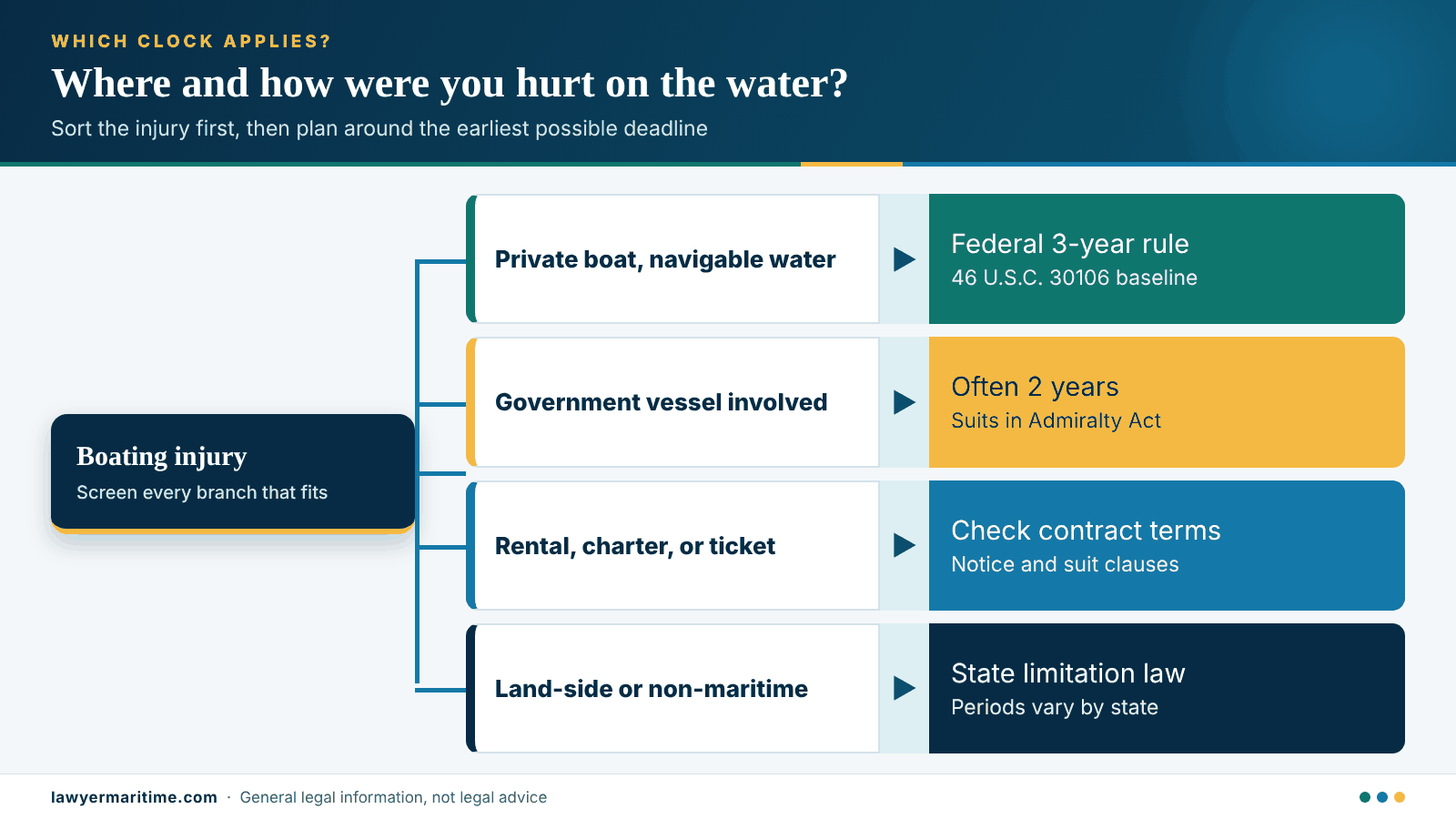
Before you can count days, you have to know whose calendar you are on. A boating injury can be a federal maritime claim, a state-law claim, or both at once, depending on where it happened, what caused it, and who you may have a claim against. The answer shapes the deadline more than almost any other single fact.
This section gives you the sorting questions. The sections that follow explain each clock in turn, and the broader background on how courts decide what counts as maritime appears in our guides to admiralty jurisdiction and maritime jurisdiction.
When does a boating injury count as a maritime claim?
Courts don’t treat every injury near water as a maritime case. They ask two practical questions about the incident, and the answers decide whether federal maritime rules, including the federal injury deadline, are in play.
The location and connection questions
For a maritime tort, which is a civil wrong committed on or connected to navigable water, the Supreme Court has described a location test and a connection test. In Jerome B. Grubart, Inc. v. Great Lakes Dredge & Dock Co., the Court framed them this way: the tort must occur on navigable water (or be caused by a vessel on navigable water), and the incident must have a potentially disruptive effect on maritime commerce and a substantial relationship to traditional maritime activity.
Navigable water generally means water that is, or can be, used for interstate or foreign commerce. That includes coastal waters, major rivers, and many large lakes, and it can include inland waterways that look quiet and private from the shore. Whether a particular creek, pond, or reservoir qualifies is a fact-specific question that can be argued either way.
Why a weekend pleasure-boat case can still be maritime
Many readers assume admiralty law is only for ships and professional crews. It’s not. In Foremost Insurance Co. v. Richardson, the Supreme Court held that a collision between two pleasure boats on navigable water fell within admiralty jurisdiction, because the activity of navigating boats on those waters has a real connection to maritime commerce.
That holding is why a jet-ski crash, a wake-boarding injury, or a collision between recreational boats is often treated as a maritime tort. When the maritime rules apply, the federal limitation period generally comes with them, even if the boat was small, privately owned, and used only for fun.
When might state law set the deadline instead?
Maritime law covers a lot, but not everything that happens at the water’s edge. Some boating-related claims belong to state law, and state limitation statutes differ widely. This article doesn’t list state periods, because they change from state to state and by type of claim.
Injuries on land, docks, and marina property
A statute called the Admiralty Extension Act, codified at 46 U.S.C. § 30101, extends admiralty jurisdiction to injury or damage on land that is caused by a vessel on navigable water. So a dock collision caused by a boat may still be a maritime matter. But a fall on a wet marina walkway, a collapsing boat-ramp railing, or a defective fuel-dock hose isn’t obviously caused by a vessel, and a court may treat it as an ordinary state premises-liability or product claim.
The practical lesson is to describe the mechanism of injury precisely. Whether the harm came from the boat itself, from the water, or from the land-side structure can flip the governing law and the governing deadline.
Filing in state court does not switch you to a state clock
Federal law preserves a plaintiff’s right to bring many maritime claims in state court. The “saving to suitors” clause in 28 U.S.C. § 1333 leaves other available remedies in place alongside the federal courts’ admiralty jurisdiction. That is a choice about where to sue, not a choice of which law governs the claim.
A state court hearing a maritime tort generally applies federal maritime law to the substance of the claim, and the federal limitation statute is written broadly enough that courts commonly apply it however the action is brought. A claim that is not maritime in the first place, such as a purely land-based injury, follows the state’s own limitation statute in whatever court it is filed. If you are unsure which category you are in, assume the shorter clock applies until you learn otherwise.
| Fact pattern | Likely framework | Where the deadline usually comes from |
|---|---|---|
| Passenger hurt in a collision between two private boats on a navigable river | Maritime tort | The general federal period in 46 U.S.C. § 30106, unless other law provides otherwise |
| Rider injured on a rented personal watercraft in coastal waters | Often maritime, with a possible contract overlay | Federal period plus any rental-agreement notice or suit terms |
| Boater hit by a Coast Guard or other federal vessel | Maritime claim against the United States | The Suits in Admiralty Act or Public Vessels Act, with a two-year period at 46 U.S.C. § 30905 |
| Guest falls on a marina walkway while boarding | May be state premises liability | The state’s limitation statute, which varies by state |
| Injury from a defective boat part or engine | Maritime or state product claim, depending on facts | Depends on the framework; confirm with counsel before assuming either period |
| Injury on a small private pond with no commercial link | Probably not maritime | The state’s limitation statute |
What Is the General Three-Year Federal Deadline for a Boating Injury?
For most maritime injury claims arising from boating, the starting point is one short federal statute. It’s simple to state and easy to misread, so this section covers what it says, what it leaves out, and how courts decide when the three years begin.
What does 46 U.S.C. § 30106 actually say?
The statute is brief enough to summarize in a sentence, but each phrase in it matters. Reading it closely helps you see why a casual assumption like “I have three years to think about it” can go wrong.
The rule in plain English
Section 30106 of Title 46 says that, unless another law provides otherwise, a civil action for damages for personal injury or death arising out of a maritime tort must be brought within three years after the cause of action arose. Congress enacted the current codification in 2006, and it traces back to a 1980 federal statute on maritime personal injury and death claims.
Two parts of that sentence carry weight. The first is the opening qualifier, “unless otherwise provided by law,” which is how shorter periods in other statutes, such as the Suits in Admiralty Act, remain in force. The second is the subject matter: the section covers personal injury and death, not every kind of boating dispute, so property damage and contract claims raise separate timing questions for counsel.
What it means to “bring” a civil action
The statute asks that a civil action be brought, which in practice means a lawsuit filed in a court with jurisdiction. A demand letter doesn’t satisfy it. Neither does a claim submitted to a boat owner’s insurer, a report to the Coast Guard or a state agency, or a complaint to a marina manager.
Negotiations are another common trap. Settlement talks can drag on for months, and an adjuster’s friendly tone isn’t a promise to extend anything. Unless there is a signed tolling agreement, which is a written agreement to pause the deadline, or a court-recognized doctrine that stops the clock, the period generally keeps running while the parties talk. Anyone who is negotiating should ask a lawyer, early, how to protect the filing date.
When does the three-year clock start?
The statute says the period runs from when the cause of action “arose.” That sounds like the day of the accident, and often it is. But courts have developed accrual rules that can matter when the harm or its cause is not obvious right away.
Accrual and the discovery idea
Accrual is the legal term for the moment a claim becomes ripe so that the limitation period begins. Federal courts commonly start the clock when a plaintiff knows, or reasonably should know, both the injury and its cause. The Supreme Court’s decision in United States v. Kubrick illustrates the approach in a related federal setting: under the Federal Tort Claims Act, the claim accrued when the plaintiff knew both the existence and the cause of his injury, even though he did not yet know the treatment might have been legally negligent.
Kubrick isn’t a boating case, and it doesn’t directly set the maritime rule, so do not read it as a promise. What it shows is the common pattern. Knowing the facts of injury and cause typically starts the clock, and not yet realizing that someone may be legally at fault typically does not.
Slow-developing injuries and later complications
Some boating harms reveal themselves slowly. Carbon monoxide exposure from a generator or an engine’s exhaust, repetitive impact injuries from rough-water travel, or a head injury whose symptoms surface weeks later can leave a person unsure when “the injury” began. A court looking at accrual will usually ask what the injured person knew and when, which is a fact question.
Later surgeries or worsening conditions don’t generally restart the period for an injury you already knew about. A better habit is to anchor your timeline to the earliest date you were aware of both the harm and its likely cause, and to treat any later discovery as a possible extension rather than something you can count on. If you are within months of the third anniversary, that’s a conversation to have with counsel now, not later.
| Situation | Possible argument about when the clock began | Cautious planning |
|---|---|---|
| Obvious injury at the scene, such as a fracture | The date of the accident | Count three years from the incident date |
| Symptoms appear days or weeks later | The date you knew, or should have known, of the injury and its cause | Use the incident date unless counsel confirms a later start |
| Exposure injury, such as carbon monoxide, with a delayed diagnosis | The diagnosis date may be argued, but a court may focus on earlier warning signs | Document the first symptoms and the diagnosis separately |
| A later surgery for an injury you already knew about | Generally the original injury date, not the surgery date | Do not treat each procedure as a fresh deadline |
| Cause of the crash unknown until an investigation finishes | The date you knew of the harm may still control, even if fault remained unclear | Do not wait for a final report before consulting counsel |
How Do Deadlines Change When a Government Vessel or Federal Property Is Involved?
If a Coast Guard cutter, an Army Corps of Engineers boat, a federal research vessel, or a federally run launch ramp played a part in the injury, the general three-year statute may not be the one that counts. Federal statutes waive the government’s immunity from suit only on stated terms, and the terms often include shorter or additional steps. The pages below cover federal vessels and federal land, and a short note on state and local government.
What rules govern claims involving federal vessels?
Two admiralty statutes handle most maritime claims against the United States: the Suits in Admiralty Act and the Public Vessels Act. They sit in chapters 309 and 311 of Title 46 and work together.
The Suits in Admiralty Act and its two-year period
The Suits in Admiralty Act, found at 46 U.S.C. § 30901 and following sections, lets a claimant bring an in personam admiralty action against the United States when a private party could have sued in admiralty had the vessel been privately owned or operated. Section 30903 provides that these cases are tried without a jury. And section 30905 says a civil action under the chapter must be brought within two years after the cause of action arose.
That is one year shorter than the general rule. It is also the example the general statute has in mind when it begins with the words “unless otherwise provided by law.” A boating injury involving a federal vessel should be screened against a two-year deadline, not three.
Public vessels and the exclusive-remedy rule
The Public Vessels Act covers damage caused by a public vessel of the United States. The statute says an action under that chapter follows the procedures of chapter 309 except to the extent they conflict, and the working assumption in practice is that the two-year Suits in Admiralty Act period carries over. Confirm that point with counsel for any claim that depends on it, because the chapters are separate and the wording is not identical.
Section 30904 adds an exclusive-remedy rule. If the chapter provides a remedy, it replaces any other action over the same subject matter against the federal employee or agent whose act or omission caused the claim. So a boater generally cannot avoid the statute’s terms by suing the individual operator of the government boat instead. And for land-side harm caused by a vessel, the Admiralty Extension Act (46 U.S.C. § 30101(c)) makes chapter 309 or 311 the exclusive remedy and bars suit until six months after a written claim has been presented to the agency that owns or operates the vessel.
What about federal land, ramps, and administrative claims?
Not every federal connection involves a vessel. A boater might be hurt at a lake marina run by a federal agency, or by a hazard at a federally maintained ramp or lock. Those facts can lead to a different statute with its own steps.
The Federal Tort Claims Act: claim first, lawsuit second
The Federal Tort Claims Act generally governs negligence claims against the United States that are not admiralty claims. Under 28 U.S.C. § 2401(b), a tort claim against the United States is forever barred unless it is presented in writing to the proper federal agency within two years after it accrues, and a lawsuit must follow within six months after the agency mails a final denial by certified or registered mail. A related provision, 28 U.S.C. § 2675(a), generally requires that the agency claim be presented and denied before suit, and it treats an agency’s failure to resolve the claim within six months as a deemed denial at the claimant’s option.
The statute also cuts out claims for which the admiralty chapters supply a remedy. Under 28 U.S.C. § 2680(d), a claim that falls under chapter 309 or 311 of Title 46 is not an FTCA claim. Choosing the wrong statute is therefore a real risk: a filing under the FTCA for what is really a vessel claim, or the reverse, can burn months of a short clock.
Courts have sometimes allowed the FTCA’s time limits to be extended on equitable grounds. In United States v. Kwai Fun Wong, the Supreme Court held that the FTCA’s deadlines are not jurisdictional and may be equitably tolled. Equitable tolling is an exception granted case by case, and the Court’s ruling doesn’t mean a late filing will be excused. Don’t plan around it.
State and local government boats and property
A county sheriff’s patrol boat, a municipal fireboat, or a state park’s dock isn’t covered by the federal statutes above. State and local government liability is governed by state law, and some states require a formal notice of claim to the government entity within a period that can be much shorter than the ordinary limitation period.
Those rules vary by state and by type of entity, and this article doesn’t list them. The safe approach is to ask, as early as possible, whether the vessel or property belongs to a public body of any kind. If it does, a missed notice requirement could end a claim before the main limitation period even matters.
| Claim type | Main statute | Timing rule to screen for | First step to confirm |
|---|---|---|---|
| Injury caused by a federal vessel on navigable water | Suits in Admiralty Act, 46 U.S.C. § 30901 et seq. | Two years after the cause of action arose (§ 30905) | Whether the vessel was owned or operated by the United States |
| Injury caused by a public vessel of the United States | Public Vessels Act, 46 U.S.C. ch. 311 | Chapter 309 procedures apply except where inconsistent; plan for two years | Whether the vessel qualifies as a public vessel |
| Land-side harm caused by a federal vessel | Admiralty Extension Act, 46 U.S.C. § 30101(c) | Written claim to the agency; no suit until six months afterward | Which agency owns or operates the vessel |
| Injury at a federally run ramp, dock, or recreation site | Federal Tort Claims Act, 28 U.S.C. §§ 2401(b), 2675 | Written agency claim within two years; suit within six months of a mailed denial | Which agency to notify and in what form |
| Injury involving a state or local government boat or property | State tort-claims law | Varies by state; may include early notice requirements | Whether the entity is a public body and what its law requires |
Which Contract Terms, Reports, and Notices Can Start a Shorter Clock?
Statutes aren’t the only source of timing rules in a boating case. A rental agreement you clicked through on a phone, a ticket for a fishing charter, or an insurance policy on the boat can each contain a deadline of its own. And some reporting duties run on a clock that has nothing to do with whether you sue. The fine print matters here, because these items often arrive before anyone thinks about a claim.
How do rental, charter, and ticket terms affect your deadline?
If you were hurt on a boat you rented, a trip you booked, or a ride you bought, a written agreement probably exists. It may have been signed on a clipboard at a dock, accepted in a booking app, or printed in small type on the back of a ticket.
Notice-of-claim and suit-limitation clauses
Two kinds of clauses commonly shorten the practical window. A notice-of-claim clause requires you to tell the operator in writing about an injury within a set period. A suit-limitation clause requires that any lawsuit be filed within a set period, which can be shorter than the statutory one.
Whether a particular clause is enforceable depends on the contract’s wording, how it was presented, the type of vessel, and federal and state law. A clause isn’t automatically valid just because you accepted it, and it isn’t automatically void either. That is why the safe move is to find the paperwork early, read the notice and suit terms, and give any required notice promptly while a lawyer reviews whether the clause will hold.
Federal minimum periods in 46 U.S.C. § 30526
Congress limited how short certain contract periods can be. Section 30526 provides that for the vessels it covers, an owner, master, manager, or agent may not, by regulation, contract, or otherwise, set the period for giving notice of or filing a personal injury or death claim at less than six months after the injury or death, or the period for bringing a civil action at less than one year. A 2022 amendment added a longer floor of two years for covered small passenger vessels, a category defined by passenger counts in 46 U.S.C. § 30501.
The section has important limits. It applies to seagoing vessels, it expressly does not apply to pleasure yachts, tugs, towboats, towing vessels, tank vessels, or fishing vessels, and the minimum periods are written for vessels carrying passengers or property between ports. A local rental or a short excursion may fall outside that language, and whether a particular boat is a “pleasure yacht” or a “covered small passenger vessel” is a question of fact and statutory definition. Read the section as a protection that may apply, not as one you can assume.
Which reports and notices run on a separate clock?
Not every time limit in a boating accident is a limit on your right to sue. Some are duties imposed on the boat operator, some are conditions of an insurance policy, and some are simply practical deadlines for keeping evidence. Mixing them up leads to either needless panic or a missed obligation.
The operator’s boating accident report
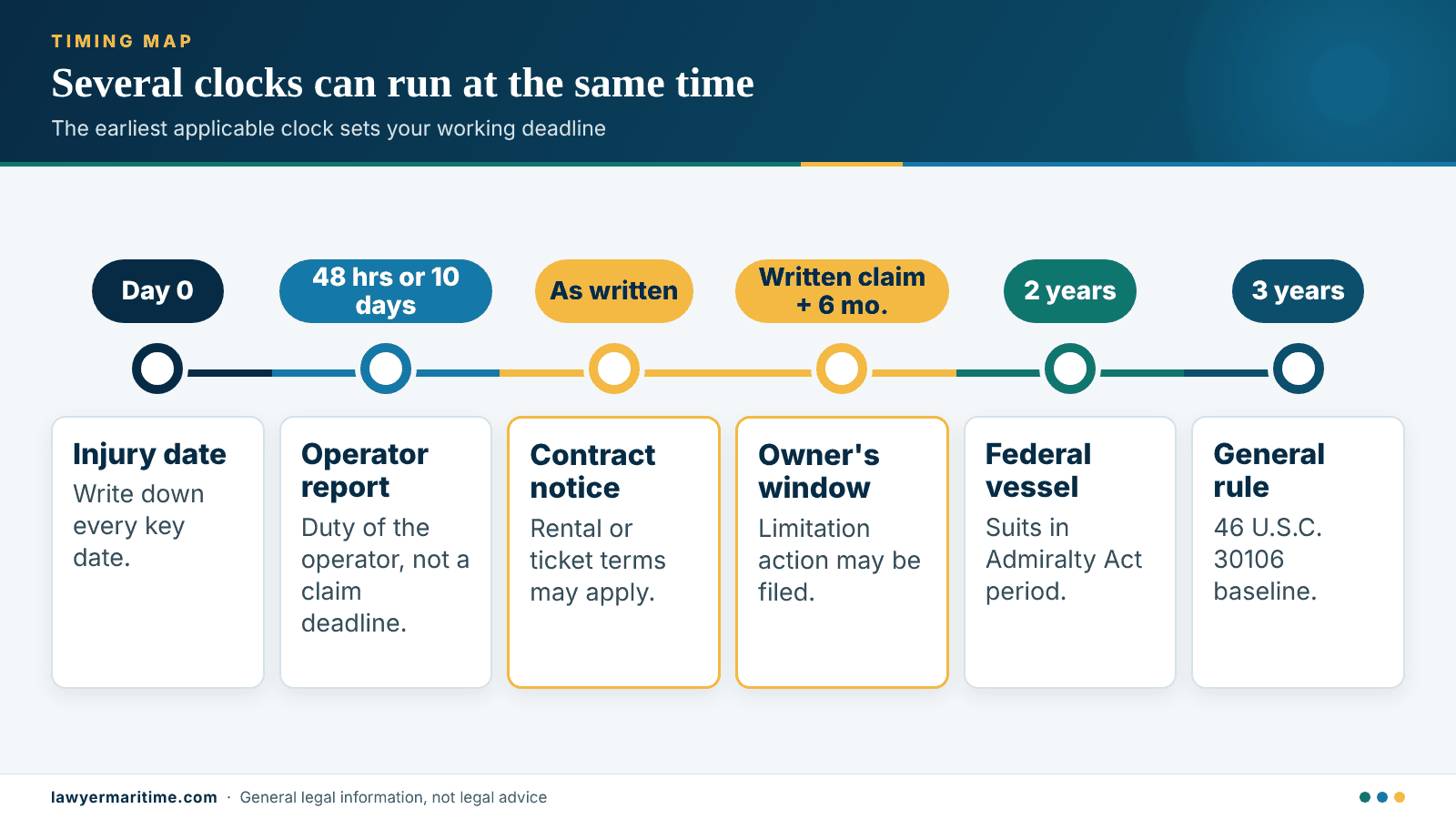
Federal regulation 33 CFR 173.55 requires the operator of a vessel, or the owner if the operator cannot file, to submit an accident report when an occurrence results in death, disappearance from the vessel under circumstances suggesting death or injury, an injury requiring medical treatment beyond first aid, or property damage or loss above the regulatory threshold. The report is due within 48 hours when a person dies within 24 hours, a person is injured and needs treatment beyond first aid, or a person disappears. For other reportable events, it is due within 10 days.
That is the operator’s duty, not the injured passenger’s, and it doesn’t set your claim deadline. But the report is worth knowing about. It often contains the operator’s first written account of what happened, and a lawyer may want to see it. Commercial vessels face a different Coast Guard casualty reporting regime under 46 CFR part 4, and the investigation that follows can generate its own records; our guides to maritime collision investigations and NTSB marine reports explain what those files contain.
Insurance notice and your own paperwork
Insurance policies commonly require prompt notice of an accident or claim. That may include the boat owner’s liability policy, your own health insurance, a medical-payments provision, or a separate policy covering a rental. Failing to give notice within the policy’s terms can create coverage disputes, even though the injury claim itself remains alive under the statute.
Policies differ, and nothing in this article describes a particular insurer’s rules. The practical advice is to read the notice section of any policy that might respond, put required notices in writing, and keep a copy. Be careful about recorded statements and early settlement offers; a release signed too soon can end a claim entirely, as explained in our guide to maritime settlement releases.
| Item | Source | Who it binds | Timing to check |
|---|---|---|---|
| Boating accident report | 33 CFR 173.55 | Vessel operator, or owner if the operator cannot | Within 48 hours for death within 24 hours, injury beyond first aid, or disappearance; 10 days for other reportable events |
| Contract notice of claim | Rental agreement, waiver, or ticket | The injured person, if the clause is enforceable | Whatever the document says; federal minimums apply only to some vessels |
| Contract suit-limitation clause | Rental agreement, waiver, or ticket | The injured person, if the clause is enforceable | Whatever the document says; compare with 46 U.S.C. § 30526 floors |
| Insurance policy notice | The policy itself | The insured | As written; read the notice and cooperation conditions |
| Written notice of a claim to a vessel owner | 46 U.S.C. § 30529 | Starts the owner’s filing window | Owner may file a limitation action within six months of written notice |
What Is the Six-Month Limitation of Liability Window, and How Does It Affect You?
One of the more surprising timing rules in a boating case belongs to the boat owner, not to you. Under the Limitation of Liability Act, a vessel owner who is facing an injury claim may ask a federal court to cap its liability at the value of the vessel and its pending freight. The owner has a short period to ask, and the request can reshape the schedule for everyone else.
This section explains how that window works and where it touches a recreational boating claim. The wider framework of admiralty procedure appears in our admiralty law guide, and this page stays on the timing consequences.
How does a limitation action work?
A limitation action is a federal court proceeding brought by the vessel owner, not by the injured person. It is a defensive filing: the owner asks the court to decide whether, and how far, its liability can be limited, and to gather all competing claims in one place.
The owner’s six-month filing window
Section 30529(a) of Title 46 provides that the owner’s action must be brought within six months after a claimant gives the owner written notice of a claim. Supplemental Rule F(1) uses similar language, allowing the owner to file a complaint in the appropriate district court within six months after receipt of a claim in writing. The owner then deposits with the court the value of its interest in the vessel and pending freight, or posts approved security.
The trigger matters to injured people because it can be set off by your own paperwork. A demand letter, an email stating that you intend to claim, or a lawyer’s notice of representation might each qualify as written notice of a claim, depending on its content. Whether any particular document starts the owner’s clock is often litigated, and a careful lawyer thinks about timing before sending anything in writing to a vessel owner.
What the filing does to your lawsuit
Once the owner files and complies with the funding requirement, section 30529(c) and Rule F(3) stop other proceedings against the owner arising from the incident, and the court enjoins further suits on the claims subject to limitation. That means a personal injury lawsuit you filed in state court may be paused, and one you were about to file may have to wait.
The court then issues a notice to claimants telling them to file their claims by a stated date. Under Rule F(4), that date may not be less than 30 days after the notice issues, and the court may extend it for cause shown. Missing the court’s claim deadline in a limitation proceeding can jeopardize your ability to share in the fund, so treat that notice as a first-priority deadline, even though it is not a statute of limitations in the ordinary sense.
Does the Limitation Act apply to recreational boats?
People are often surprised that a statute with nineteenth-century roots can reach a modern pontoon boat or runabout. Whether it does turns on the boat and on how Congress revised the Act in 2022.
Which boats can use the Act
Section 30502(a) says the limitation chapter covers seagoing vessels and vessels used on lakes, rivers, or inland waters. So the owner of a private recreational boat can generally invoke the Act, subject to its other conditions, and the owner’s potential cap is the value of the boat and pending freight, which for a small boat can be modest compared with serious injuries.
Congress changed the picture for certain commercial passenger boats in 2022. Section 30502(b) now provides that the chapter does not apply to covered small passenger vessels, a term defined in section 30501 by reference to small passenger vessel status and passenger limits. So a small for-hire passenger operation may be unable to use the Act, while the owner of a private pleasure craft may still be able to. Whether a boat fits the exclusion is a question for counsel, based on how it was used and the definition’s text.
Protecting your position inside a limitation proceeding
If a limitation action is filed, the practical goals are to read the court’s notice carefully, file a timely claim, and have a lawyer evaluate whether you can pursue your claim in the forum you prefer. Courts have addressed when claimants may return to state court, for example in Lewis v. Lewis & Clark Marine, Inc., which dealt with how the saving-to-suitors clause interacts with the Limitation Act. Those outcomes turn on details such as the number of claimants and the stipulations they give to protect the owner’s limitation rights.
Don’t assume a limitation filing ends your case. The court looks at whether the owner can show it lacked privity or knowledge of the fault, and the statute has exceptions. Our article on maritime negligence covers how fault is proven, and our maritime injury damages page explains the categories of loss that claims may seek.
| Stage | What happens | Source | Timing |
|---|---|---|---|
| Written notice of a claim | A claimant gives the vessel owner a written claim | 46 U.S.C. § 30529(a) | Starts the owner’s six-month window |
| Owner files in federal court | Owner deposits the vessel’s value or approved security | 46 U.S.C. § 30529(b); Supplemental Rule F(1) | Within six months of written notice |
| Other proceedings paused | Suits against the owner on the incident stop; injunction can issue | 46 U.S.C. § 30529(c); Rule F(3) | Once the owner complies with the funding step |
| Notice to claimants | Court directs claimants to file claims by a date | Supplemental Rule F(4) | Date set by the court; not less than 30 days after the notice issues |
| Contest of limitation | Court decides whether the owner may limit liability | 46 U.S.C. §§ 30523 and following | Schedule set by the court |
How Do Deadlines Work for Children, Incapacitated Victims, and Deaths on the Water?
The hardest boating cases involve people who cannot bring a claim for themselves: a child hurt on a family outing, an adult left unable to manage legal affairs, or a family grieving a death. Many readers hope the clock stops for these situations. Sometimes it does, but the rules vary, and no one should count on an automatic extension.
Do deadlines pause for minors and people who cannot act for themselves?
Limitation rules often include tolling, which pauses or delays a deadline for a recognized reason, such as the claimant being a minor. Whether a particular boating claim gets that benefit depends on which law supplies the deadline.
No automatic extension in the federal text
The text of 46 U.S.C. § 30106 that we read states the three-year rule and the “unless otherwise provided by law” qualifier. It doesn’t contain a built-in provision pausing the period for minors. Whether state tolling rules or other doctrines fill that gap in a maritime case is a question on which results can differ by court and by the facts.
Claims that are not maritime at all follow the limitation statute of the relevant state, and some state statutes toll for minority or incapacity while others do not, or limit the extension. The practical takeaway is not to assume that a child’s claim is safe for years. Plan as though the ordinary period applies until a lawyer tells you, in writing and with the authority, that a longer one does.
Contract notice and tolling for minors
Where contract notice periods are concerned, Congress addressed the question directly for certain vessels. Section 30526(d) provides that for claims by minors or mentally incompetent persons, or for wrongful death, a contract’s notice-of-claim period is tolled until the earlier of the appointment of a legal representative or three years after the injury or death.
That provision speaks to the notice period in a contract, not to the statute of limitations for filing suit, and it applies only within the scope of section 30526 discussed earlier. Still, it signals that Congress recognized the problem of expecting a child or a bereaved family to meet a short notice window. It doesn’t remove the need to find and read the paperwork.
What deadlines apply when a boating accident causes a death?
A death on the water raises two questions at once: how long the family has to file, and which law supplies the remedy. The first is often simpler than the second.
The general wrongful death deadline
Section 30106 covers actions for personal injury or death arising out of a maritime tort, so a three-year period generally governs a maritime wrongful death claim as well, unless other law provides otherwise. A claim is usually brought by a personal representative of the estate, and the practical step of getting that person formally appointed can take time. Starting the paperwork early protects against avoidable delay.
If the death occurred far offshore, the Death on the High Seas Act, 46 U.S.C. § 30302 and following sections, may supply the cause of action for deaths beyond three nautical miles from the shore of the United States. We cover that framework, its remedies, and its timing in our guide to the DOHSA claim deadline, so this page does not repeat it.
Deaths in state waters and state wrongful death laws
Many recreational boating deaths happen close to shore, in state territorial waters. In Yamaha Motor Corp. v. Calhoun, the Supreme Court considered the death of a twelve-year-old who rode a rented jet ski into an anchored vessel off Puerto Rico. The Court held that, in a maritime wrongful death case involving someone who was not a seaman or longshore worker, and where no federal statute sets the relief, state remedies remain available and were not displaced by the federal maritime wrongful death action recognized in Moragne.
The result is that a family may have a state wrongful death statute in play, and state law can bring its own filing period, its own list of beneficiaries, and its own damages rules. Because maritime and state remedies can overlap, a family shouldn’t rely on one period alone. Treat the shorter one as the working deadline and have a maritime lawyer map the options.
How Can You Screen Your Situation and Protect the Timeline?
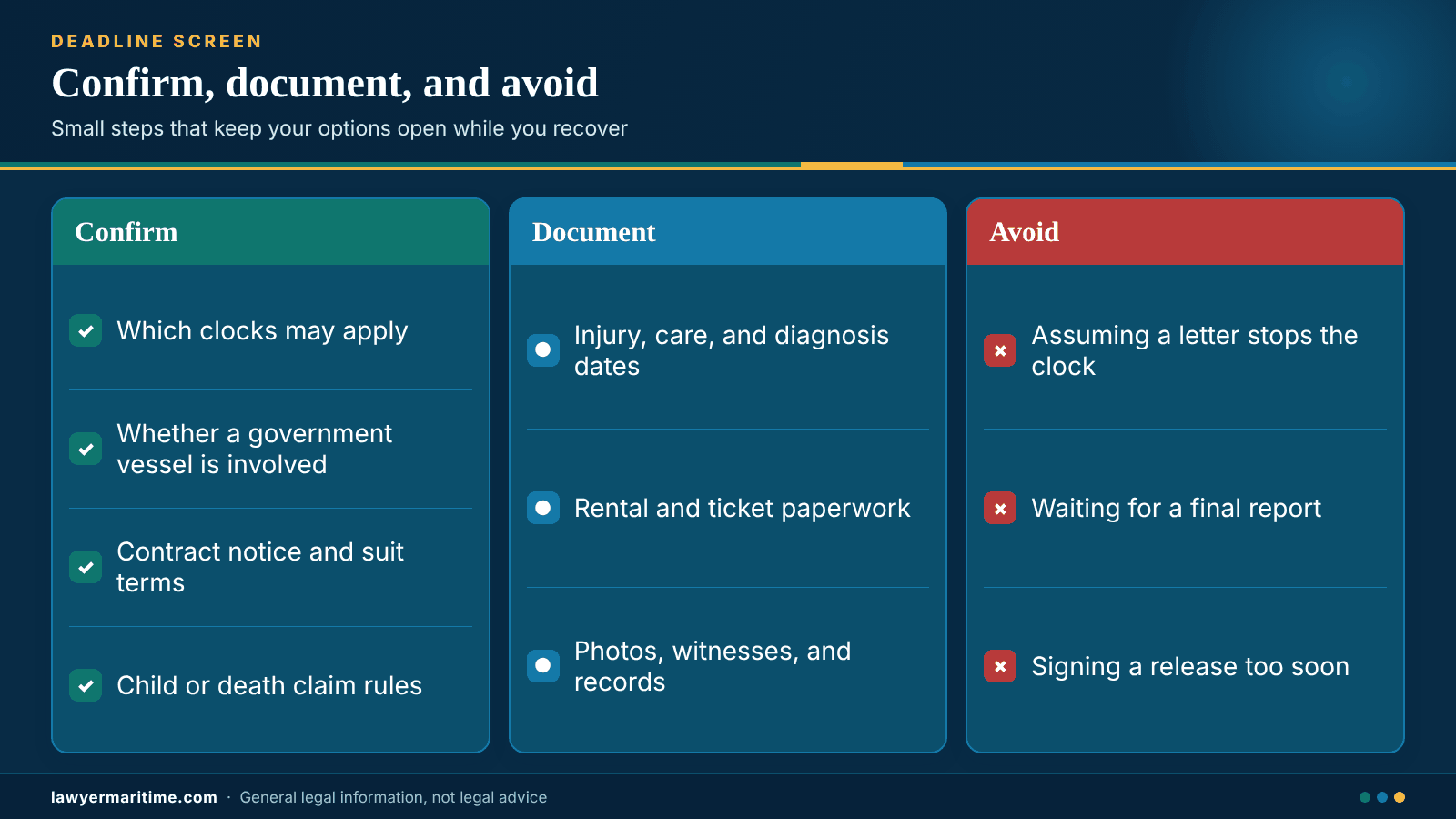
Knowing the clocks is half the job. The other half is applying them to your own facts, in an order that surfaces the shortest deadline first. This section gives you a screening sequence and a short list of habits that keep options open while you recover.
What questions should you answer first?
A good screen is simple. It asks about the boat, the people, the paperwork, and the dates, and it treats every “I don’t know” as a reason to look closer rather than to relax.
A deadline-screening worksheet
Work through the table below from top to bottom and write down the answers. If a row produces a possible clock, note the earliest date it could expire. The table is a screening aid for a conversation with counsel, not a calculator that produces a legal deadline.
| Question | If the answer is yes, the clock may be | Caveat |
|---|---|---|
| Was the injury on navigable water or caused by a vessel on it? | Three years under 46 U.S.C. § 30106 as the general baseline | Other law may shorten it; maritime status is itself a fact question |
| Was a federal vessel, agency, or federally run site involved? | Two years under 46 U.S.C. § 30905, or a two-year agency claim under 28 U.S.C. § 2401(b) | Choosing the wrong statute can waste time; confirm early |
| Was a state or local government entity involved? | A state notice-of-claim period that may be shorter than the ordinary one | Varies by state and entity; this page lists none |
| Did you sign, click, or receive a rental, charter, or ticket agreement? | A contractual notice or suit period | Enforceability depends on wording, vessel type, and law |
| Have you sent, or been sent, a written claim to a vessel owner? | The owner’s six-month limitation filing window under 46 U.S.C. § 30529 | Whether a document counts as written notice is fact-specific |
| Is the injured person a minor or unable to manage legal affairs? | Possible tolling, depending on which law supplies the deadline | Do not assume an automatic extension |
| Did the accident cause a death? | Three years under § 30106 or a state wrongful death period | Different laws and beneficiaries may overlap |
| Is the injury land-side, or arguably non-maritime? | A state limitation statute | State periods differ widely; get the specific period from counsel |
Reading the results conservatively
If two rows apply, the shorter clock sets your working deadline. If you cannot answer a row, treat the shorter possibility as live until someone with the documents and the law in front of them says otherwise. That approach feels cautious, and it’s meant to be, because an overlooked clock is much harder to fix than an unnecessary phone call.
Keep in mind that this table covers claims by or on behalf of an injured boater or passenger. A professional mariner hurt while working on a vessel has a different set of remedies, and our Jones Act claim guide takes those up. For help sorting out who should handle a boating case, see our overview of how to choose a maritime injury attorney.
What should you do now to protect the timeline?
The most valuable steps are quiet and practical. They cost little, they don’t commit you to any course of action, and they make every later conversation faster and clearer.
Document dates and preserve proof
Begin with a one-page timeline: the date and time of the accident, the dates you sought medical care, the dates of any diagnosis, and each date someone received a written or recorded statement from you. Add the names of the vessel, its owner, its operator, and any rental company, along with the registration or hull number if you have it.
- Photograph injuries, the vessel, the equipment, and the scene while they remain unchanged
- Save texts, emails, booking confirmations, and app screens that show who rented or operated the boat
- Write down the names and contact details of witnesses, and ask them for a short written account
- Request your medical records and keep a log of treatment, missed work, and symptoms
- Keep copies of any accident report, insurer letter, or agency form you receive
- Note every deadline that appears in a letter, policy, or agreement, even if it seems unrelated
Our guide to maritime injury compensation explains how documentation connects to the kinds of losses a claim may include.
Mistakes that quietly cost time
Most lost claims aren’t lost in court. They’re lost in the early weeks, through small assumptions that seem harmless when they are made. The table below pairs the most common ones with a safer alternative.
| Common mistake | Why it hurts | Better action |
|---|---|---|
| Assuming three years applies to every claim | Federal vessel claims, contract terms, and state rules can be shorter | Screen every possible clock and use the earliest as the working date |
| Waiting for an insurance settlement offer | Negotiations generally do not stop the limitation period | Ask counsel about filing or a written tolling agreement |
| Sending a written claim to the boat owner without advice | It may start the owner’s six-month limitation window | Have a lawyer decide when and how to give written notice |
| Ignoring the rental or ticket terms | A notice or suit clause may be in play | Save the agreement and review the notice and suit terms promptly |
| Waiting for the final investigation report | Reports can take a long time and do not toll the deadline | Consult counsel while the investigation is open |
| Signing a release or recorded statement quickly | It may limit later claims | Read it carefully and get advice before signing |
If you think a deadline may already have passed, don’t stop there. Our guide to hiring a maritime injury deadline lawyer explains what can still be examined after a possibly missed deadline, and the maritime lawyer hub explains what to expect from a first conversation.
Frequently Asked Questions About Boating Injury Claim Deadlines
Timing basics
How long do I have to file a boating injury claim?
For a maritime personal injury claim, 46 U.S.C. § 30106 generally allows three years from when the cause of action arose, unless other law provides otherwise. Claims against federal vessels, contract-based claims, and non-maritime claims can follow shorter or different periods, so the answer depends on the facts.
Does a demand letter or insurance claim stop the deadline?
Generally no. The statutes ask for a civil action to be brought, and negotiations do not usually pause the period unless there is a written tolling agreement or a recognized legal doctrine. A written claim to a vessel owner can also start that owner’s separate six-month window.
When does the clock start if my symptoms appeared later?
Courts commonly look at when you knew, or reasonably should have known, of your injury and its cause. That is a fact question, and a later start date is not guaranteed, so plan around the earliest plausible date and consult counsel.
Is the deadline different in state court?
Not for a maritime tort. Filing in state court under the saving-to-suitors clause is a choice of forum, and the state court generally applies maritime law to the claim. A non-maritime claim follows the state’s own limitation statute.
Special situations
What if a Coast Guard or other government boat was involved?
A claim against the United States over a vessel is governed by the Suits in Admiralty Act or the Public Vessels Act, and the Suits in Admiralty Act sets a two-year period. Land-side harm and federal-property claims can involve administrative claims first, so confirm the right statute early.
Can a rental agreement shorten my time to sue?
It may try to. Whether a notice or suit clause is enforceable depends on its terms and the law, and 46 U.S.C. § 30526 sets minimum periods for certain passenger vessels, but not for pleasure yachts or many local excursions.
Do deadlines pause for a child?
Not automatically under the federal text we reviewed. Some state laws toll for minors, and the federal statute on contract notice periods includes tolling for minors for the vessels it covers, so do not assume a child’s claim can wait.
What if someone died in the accident?
A three-year period under § 30106 generally applies to maritime wrongful death claims, but state wrongful death laws may also apply in state waters, and the Death on the High Seas Act may apply far offshore. Our DOHSA guide covers that framework.
Next steps
What is the Limitation of Liability Act, and why does it matter to timing?
It lets a vessel owner ask a federal court to limit its liability to the value of the vessel and pending freight. The owner generally must file within six months of receiving written notice of a claim, and the filing can stay other suits and set a claim deadline for you.
Should I wait for the Coast Guard or NTSB report before talking to a lawyer?
No. Investigations can take a long time, and they don’t extend your filing deadline. A lawyer can start protecting your timeline and evidence while the investigation continues.
What if I think the deadline has already passed?
Don’t assume the claim is gone. Different rules, tolling arguments, and other defendants may change the picture, and a maritime lawyer can review the dates and documents. Our guide on missed maritime injury deadlines explains what can still be examined.
Sources and Legal Authorities
The authorities below support the statutory and regulatory points on this page; confirm current text before relying on any of them for a specific deadline.
Statutes and regulations
Federal statutes and court rules
- 46 U.S.C. § 30106 – Time limit on maritime personal injury and death actions
- 46 U.S.C. § 30905 – Period for bringing action (Suits in Admiralty Act)
- 46 U.S.C. § 30903 – Waiver of immunity (Suits in Admiralty Act)
- 46 U.S.C. § 30904 – Exclusive remedy (Suits in Admiralty Act)
- 46 U.S.C. § 31103 – Applicable procedure (Public Vessels Act)
- 46 U.S.C. § 30101 – Extension of jurisdiction to injury on land (Admiralty Extension Act)
- 46 U.S.C. § 30501 – Limitation of Liability Act definitions
- 46 U.S.C. § 30502 – Application of the limitation chapter
- 46 U.S.C. § 30523 – General limit of liability
- 46 U.S.C. § 30526 – Provisions requiring notice of claim or limiting time for bringing action
- 46 U.S.C. § 30529 – Action by owner for limitation
- 28 U.S.C. § 2401 – Time for commencing action against the United States
- 28 U.S.C. § 2675 – Disposition by federal agency as prerequisite
- 28 U.S.C. § 2680 – Exceptions to the Federal Tort Claims Act
- 28 U.S.C. § 1333 – Admiralty, maritime, and prize cases
- Supplemental Rule F – Limitation of liability
Regulations
- 33 CFR 173.55 – Reports of casualties and accidents
- 46 U.S.C. § 30302 – Cause of action under the Death on the High Seas Act
Cases and agency materials
Supreme Court decisions
- Jerome B. Grubart, Inc. v. Great Lakes Dredge & Dock Co., 513 U.S. 527 (1995) – location and connection tests for maritime torts
- Foremost Insurance Co. v. Richardson, 457 U.S. 668 (1982) – pleasure-boat collision within admiralty jurisdiction
- United States v. Kubrick, 444 U.S. 111 (1979) – accrual under the Federal Tort Claims Act
- United States v. Kwai Fun Wong, 575 U.S. 402 (2015) – FTCA time limits and equitable tolling
- Yamaha Motor Corp. v. Calhoun, 516 U.S. 199 (1996) – state remedies in a maritime wrongful death case
- Lewis v. Lewis & Clark Marine, Inc., 531 U.S. 438 (2001) – limitation actions and the saving-to-suitors clause