An NTSB marine report is the National Transportation Safety Board’s written account of a marine accident it chose to investigate: what happened, what investigators found, the Board’s probable cause determination, and any safety recommendations. Reading one well means knowing which pages are fact, which are analysis, and which are safety conclusions rather than a finding of legal fault. A probable cause statement explains why an accident happened so it can be prevented; it does not decide who is liable. The governing framework is federal. The Board’s marine authority sits in 49 U.S.C. § 1131, its investigations are described in 49 CFR Part 831, and 49 U.S.C. § 1154(b) limits how its reports may be used in civil damages lawsuits. Coast Guard casualty investigations run on a separate track under 46 CFR Part 4. This guide is for injured mariners, passengers, families, safety professionals, and anyone who has just been handed a report and wants to cut through the jargon. It covers report types, the anatomy of a final report, recommendation statuses, where to find reports and dockets, and what a report can and cannot do in a claim.
What Is an NTSB Marine Report, and When Does One Exist?
Before you can read an NTSB marine report, it helps to know where it comes from and what else the agency publishes about the same event. People often search for “the NTSB report” on an accident and find a short brief, a docket full of exhibits, and a set of recommendation letters instead. Each document has a different job, and the differences matter once you start relying on one of them.
Who the NTSB is and which marine accidents it investigates
The National Transportation Safety Board is an independent federal agency. It investigates transportation accidents across several modes, and marine casualties are one of them. Understanding its mandate explains both what a report contains and what it leaves out.
The statutory mission: facts, circumstances, and probable cause
Congress told the Board to investigate, or have investigated, and to determine the facts, circumstances, and “cause or probable cause” of listed transportation events. For marine accidents, 49 U.S.C. § 1131(a)(1)(E) reaches a “major marine casualty” on or under U.S. navigable waters, internal waters, or the territorial sea, as described in a 1988 presidential proclamation, and casualties involving U.S. vessels. Casualties that involve only public vessels are carved out of that paragraph.
The same section requires the Board to report the facts and circumstances of the accidents it investigates and to make those reports available to the public electronically. That public-availability rule is why you can read most final reports online without filing a request. The statute tells you what the report is for: finding facts and cause so that others can act on them.
Why many casualties never get an NTSB report
The Board’s own marine page describes its work as covering “selected” marine accidents, which is a meaningful word. Most reportable casualties, including many deaths and serious injuries aboard working vessels, are handled by the Coast Guard alone or never receive a public investigation at all. The Board picks cases where it expects its work to produce safety lessons, and an injury that is important to you may not meet that bar.
If you can’t find a report on your accident, that isn’t a sign that something was hidden. It usually means the Board didn’t open an investigation, so your evidence sits with the Coast Guard, the operator, the insurer, and the people who were there. Our guide to working with a maritime accident attorney explains how those records are gathered when no federal report exists.
The documents the NTSB produces about one accident
The Board’s marine investigation page describes a family of products rather than one document. Knowing which one you hold tells you how much analysis to expect and how final the conclusions are.
Final reports and accident briefs
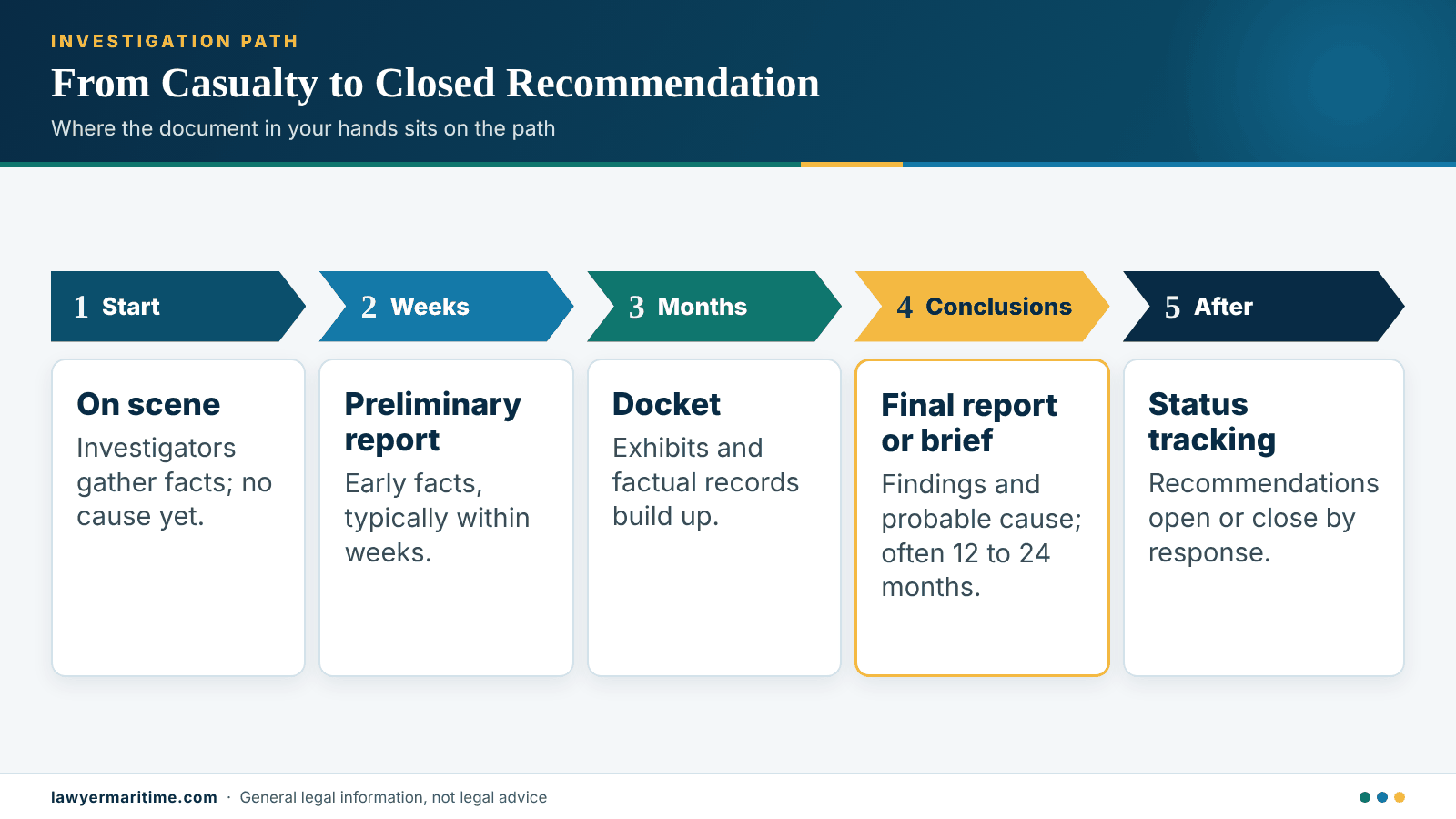
According to the NTSB’s marine page, a final report covers the relevant facts, analysis, findings, probable cause, and safety recommendations. An accident brief is a shorter product: a short narrative, the probable cause, and any recommendations. The page says a brief is normally limited to facts but may include some analysis, and that it replaces the preliminary report, typically 12 to 24 months after the accident.
The practical difference is depth. A brief tells you the Board’s conclusion without showing the full reasoning, so you can’t judge how confident the Board was or which alternatives it ruled out. If the stakes are high, look for the docket, because the brief is a summary of a larger file.
Preliminary reports, dockets, and safety recommendation letters
The preliminary report summarizes facts gathered on scene and, per the Board, typically appears a few weeks after the accident. It deliberately avoids cause; the page notes that the Board will not determine the cause of an accident while on scene. Treat it as a snapshot that later work may correct.
The docket holds the factual information gathered during the investigation, made available at an appropriate time. Safety recommendations and safety alerts can be issued at any point in the process, so a recommendation letter may appear long before the final report. Our digest of NTSB Safer Seas Digest lessons shows how the Board turns clusters of marine investigations into broader safety messages.
| Document | What it contains | Timing described by the NTSB | How to treat it |
|---|---|---|---|
| Preliminary report | Facts from the on-scene phase | Typically a few weeks after the accident | Early snapshot; no cause, may be corrected |
| Final report | Facts, analysis, findings, probable cause, recommendations | Investigations often take 12 to 24 months | Fullest account of the Board’s reasoning |
| Accident brief | Short narrative, probable cause, any recommendations | Replaces the preliminary report, typically 12 to 24 months after the accident | Conclusion without the full analysis |
| Docket | Factual information gathered in the investigation | Released at an appropriate time | Best source for underlying facts and exhibits |
| Safety recommendation or alert | A proposed safety action aimed at a named recipient | Can issue at any point | Shows a concern, not a finding of fault |
How a Final Marine Report Is Organized, Section by Section
The NTSB doesn’t publish one rigid template for every marine report, and layouts shift over the years. Still, most final reports move from a summary, through the facts, into analysis, and then to findings, probable cause, and recommendations. Reading them in that order, and noticing where one layer ends and the next begins, keeps you from treating an analytical opinion as a recorded fact.
The factual layers: summary, narrative, and analysis
The first half of a report is where most readers spend their time, and it’s also where the line between observation and inference is easiest to miss. The Board’s own description of a final report separates facts from analysis, and you should too.
The summary and the “what happened” narrative
Reports usually open with a short summary of the event: the vessel or vessels, the date and place, the outcome, and the Board’s headline conclusion. Read it as a map of the report, not as its substance. A summary is written last, compresses disputed points, and can’t carry the qualifications that the body supplies.
The narrative that follows tells the story in time order, often with times drawn from voyage data recorders, alarm logs, radio recordings, and interviews. Check what each timeline entry rests on. A time taken from a recorder is a measurement, while a time reconstructed from a crew member’s memory is an estimate, and good reports usually say which is which.
Factual information versus analysis
The factual sections describe the vessel, the crew, the waterway, the weather, the equipment, and the company’s operations. These are the parts a docket can usually back up with exhibits such as certificates, logs, and maintenance records. If a fact matters to your question, trace it to its exhibit instead of relying on the sentence in the report.
The analysis section is different in kind. Here the Board explains how it weighed the evidence, which hazards it considered, and why it accepted some explanations and discarded others. Words such as “likely,” “could have,” and “consistent with” signal reasoning under uncertainty, and they are honest signals. A reader who flattens them into certainty has changed what the Board said.
The conclusion layers: findings, probable cause, and recommendations
The back half of a report distills the analysis into statements designed to be quoted. That makes it the most useful part for safety work and the part most often misunderstood by people involved in a claim.
Findings and contributing factors
Many recent NTSB marine reports list numbered findings, which are short conclusions drawn from the analysis. Some identify factors that contributed to the accident, some identify safety issues that were not causal but still worth fixing, and some record that a suspected factor did not contribute. Each category tells you something different.
A finding that something “did not contribute” can be as valuable as one that did. It removes a theory, such as engine failure or an impaired crew member, from the list of explanations. Reading both kinds of findings together shows how the Board narrowed the field.
The probable cause statement and the recommendations section
The probable cause statement is usually brief, often a sentence or two, and it names the Board’s determination of why the accident happened. We take it apart in the next section. For now, note that it is a distillation of the findings, not an additional finding, and that its wording is chosen with care because it is the sentence most often quoted.
The recommendations section lists what the Board asked specific recipients to do, and often notes earlier recommendations that apply to the same hazard. Check the recipient on each one. A recommendation to a regulator, a vessel operator, or a classification society points to a different part of the system, and that tells you where the Board saw the weak link.
| Report layer | What it tells you | What to check |
|---|---|---|
| Summary | A compressed view of the event and conclusion | Read the body before relying on a summary sentence |
| Narrative and factual information | Sequence of events, vessel, crew, waterway, equipment, weather | Which facts come from recorders or documents and which come from recollection |
| Analysis | How the Board weighed evidence and ruled theories in or out | Hedge words such as “likely” and “could have” |
| Findings | Numbered conclusions, including factors that did and did not contribute | The difference between a contributing factor and a safety issue |
| Probable cause | The Board’s distilled statement of why the accident occurred | Whether it names an action, a condition, or a system gap |
| Recommendations | Requested safety actions and their recipients | Recipient, topic, and current status |

What Probable Cause Means and What It Does Not
“Probable cause” is the phrase readers carry away from a report, and it is easy to hear it as a verdict. In legal settings the words suggest a standard of proof or a judgment about responsibility. At the NTSB the phrase has a narrower, safety-oriented meaning, and the difference is the single most important thing to understand before you quote a report to anyone.
What the Board is actually deciding
The Board’s regulations explain what kind of proceeding an investigation is. That description frames every sentence in the report, including the probable cause statement.
Probable cause as a safety determination
Under 49 CFR § 831.4, the Board investigates accidents to establish the relevant facts and circumstances, uses those findings to determine probable causes, and recommends measures that could prevent or reduce the effects of similar accidents. The goal is prevention. A probable cause statement answers the question “what went wrong, in a way we can learn from?” rather than “who should pay?”
Because the goal is prevention, the Board often looks past the last person to touch the controls. A statement may name a decision, but it frequently also names the conditions that made the decision likely: fatigue, unclear procedures, missing equipment, or weak oversight. That systemic focus is useful for safety and sometimes surprising to people who expected a single culprit.
Why probable cause is not fault or liability
The same regulation says investigations are fact-finding proceedings with no adverse parties, and that they are not adjudications determining fault or what rights or liabilities exist. A companion rule, 49 CFR § 835.3, explains the policy behind the civil-case limits: the bar on using accident reports as evidence in damages suits is meant to keep the Board out of that litigation and prevent it from influencing the outcome.
So when a report says a deckhand’s action “contributed” to an accident, it hasn’t found him negligent in the legal sense. Negligence, causation, comparative fault, and damages are questions a court or a negotiated settlement resolves under maritime law. Our overview of maritime negligence shows the elements a claimant would actually have to prove.
Reading traps that change the meaning
Even careful readers misread probable cause statements, usually by skipping a qualifier or by assuming the statement lists every cause. Two habits prevent most of the errors.
Contributing factors, “did not contribute,” and “could not determine”
A report may list several contributing factors and rank none of them. It may also say that a factor was examined and ruled out, or that the evidence could not settle a question. “Could not determine” is an honest admission, not a hidden conclusion in either direction.
Suppose a report states that investigators could not determine why a towing winch brake slipped. That sentence doesn’t clear the equipment and doesn’t blame it. It tells you the question remains open, which is exactly where independent testing of the preserved equipment, if it still exists, may matter.
Hedged wording and the difference between a cause and the causes
Probable cause statements are short, but accidents rarely have one cause. When a statement begins “the probable cause was” and lists one item, check the findings for other contributing factors that the sentence did not have room to repeat. The findings carry the nuance; the statement carries the headline.
Watch for verbs of inference as well. “Likely,” “probably,” and “consistent with” tell you the Board reasoned from patterns instead of from direct observation. That is normal in accident investigation, but it means a second analyst could weigh the same evidence differently, and nothing in the report prevents that.
| Question | NTSB probable cause | Legal fault in a civil claim |
|---|---|---|
| Purpose | Prevent similar accidents through safety learning | Decide who bears responsibility and what compensation, if any, follows |
| Standard and process | Fact-finding with no adverse parties; not an adjudication | Adversarial process with burdens of proof and rules of evidence |
| Who is examined | People, equipment, organizations, and regulatory systems | Parties whose duty, breach, and causation are alleged |
| Result | Findings, probable cause, recommendations | Verdict, judgment, or settlement |
| Allocation of percentages | Not done | Comparative fault can be apportioned in many maritime claims |
How to Read Safety Recommendations and Their Status
The recommendations are the part of a report designed to change something. They also have the most moving parts, because a recommendation keeps a life of its own after the report is published: recipients respond, the Board evaluates the response, and the status changes. A report you read today may describe recommendations whose status has since moved.
Who receives recommendations and how they answer
A recommendation is a request, not an order. The Board is an investigative agency rather than a regulator, so its influence depends on the quality of its reasoning and on public tracking of what recipients do.
Recipients and what a recommendation asks for
Each recommendation names a recipient and a requested action, such as a rule change, a new inspection practice, a training standard, or a change to a company’s safety management system. The recipient tells you where the Board located the fix. A recommendation to a vessel operator points at company practice; one to a government agency points at regulation or oversight; one to an industry body points at standards.
Each recommendation carries its own identifier, and the Board’s searchable database lets you pull up the recommendations tied to an investigation. When a report mentions that a similar hazard was flagged in an earlier accident, follow that thread. Repeated hazards across several investigations tell you more than any single case.
The 90-day response rule for the Transportation Secretary
Under 49 U.S.C. § 1135, when the Board sends the Secretary of Transportation a safety recommendation, the Secretary must give a formal written response within 90 days. The response must say whether the Secretary will adopt the recommendation fully, adopt part of it, or decline it, and each choice carries a duty to explain: a timetable for acceptance, reasons for partial adoption, or reasons for refusal. The Board must make recommendations and responses publicly available.
That statutory clock is written for recommendations to the Secretary of Transportation. This article doesn’t describe how other recipients, such as vessel operators, industry groups, or other agencies, are required to respond. What you can rely on is the Board’s own public tracking, which assigns a status to every recommendation regardless of who received it.
What a status code tells you
The Board classifies each recommendation with an open or closed status. The labels look bureaucratic, but they answer a simple question: did the recipient do what the Board asked, and does the Board consider that adequate?
Open versus closed statuses
According to the Board’s status explanation page, “open” statuses mean the matter is still being tracked. A recommendation starts as Open–Await Response, and becomes Open–Acceptable Response when the recipient has a planned action that would comply once completed. It is Open–Unacceptable Response when the recipient disagrees or proposes something the Board finds inadequate, or when action isn’t timely.
“Closed” statuses mean the Board has stopped tracking, but closed does not always mean success. Closed–Acceptable Action means completed action complies with the recommendation. Closed–Unacceptable Action means the recipient disagrees with the need and further correspondence wouldn’t change that, and a recommendation can also close because events overtook it or a newer recommendation superseded it.
What status does not tell you
A status says nothing about whether the original accident was anyone’s fault. It describes the recipient’s response to a safety proposal. A closed–unacceptable status for an operator suggests the Board disagreed with the operator’s response, but it isn’t a finding of negligence in the legal sense.
Status also isn’t a guarantee of what is happening on the water today. A closed recommendation can reflect a rule change that took years, and an open one can reflect a fix already underway. If current practice matters to your question, look at the underlying correspondence in the database and at current Coast Guard requirements, not at the label alone.
| Status | Meaning in plain English | What it signals |
|---|---|---|
| Open–Await Response | Issued; no response received yet | Too early to judge |
| Open–Acceptable Response | Recipient has a planned action that would comply once completed | Progress promised, not finished |
| Open–Unacceptable Response | Recipient disagrees or proposes something the Board finds inadequate, or action is untimely | Board is pressing for more |
| Closed–Acceptable Action | Completed action complies with the recommendation | Board considers it done |
| Closed–Unacceptable Action | Recipient disagrees with the need and further correspondence would not change that | Closed without the fix the Board wanted |
| Closed–Superseded | A newer, more appropriate recommendation replaced it | Follow the replacement |
NTSB Reports Versus Coast Guard Investigations
Readers often assume that the NTSB and the Coast Guard produce the same document under different letterheads. They don’t. The two agencies investigate under different statutes, ask different questions, and publish different products, and a serious casualty can involve both. Sorting out which agency wrote what keeps you from citing a Coast Guard finding as an NTSB conclusion, or the reverse.
Two agencies with different jobs
Both agencies care about causes, but each uses what it finds differently. The NTSB’s output is a public safety analysis, while the Coast Guard’s output feeds a regulatory system that includes mariner credentials and vessel compliance.
What the NTSB does and does not do
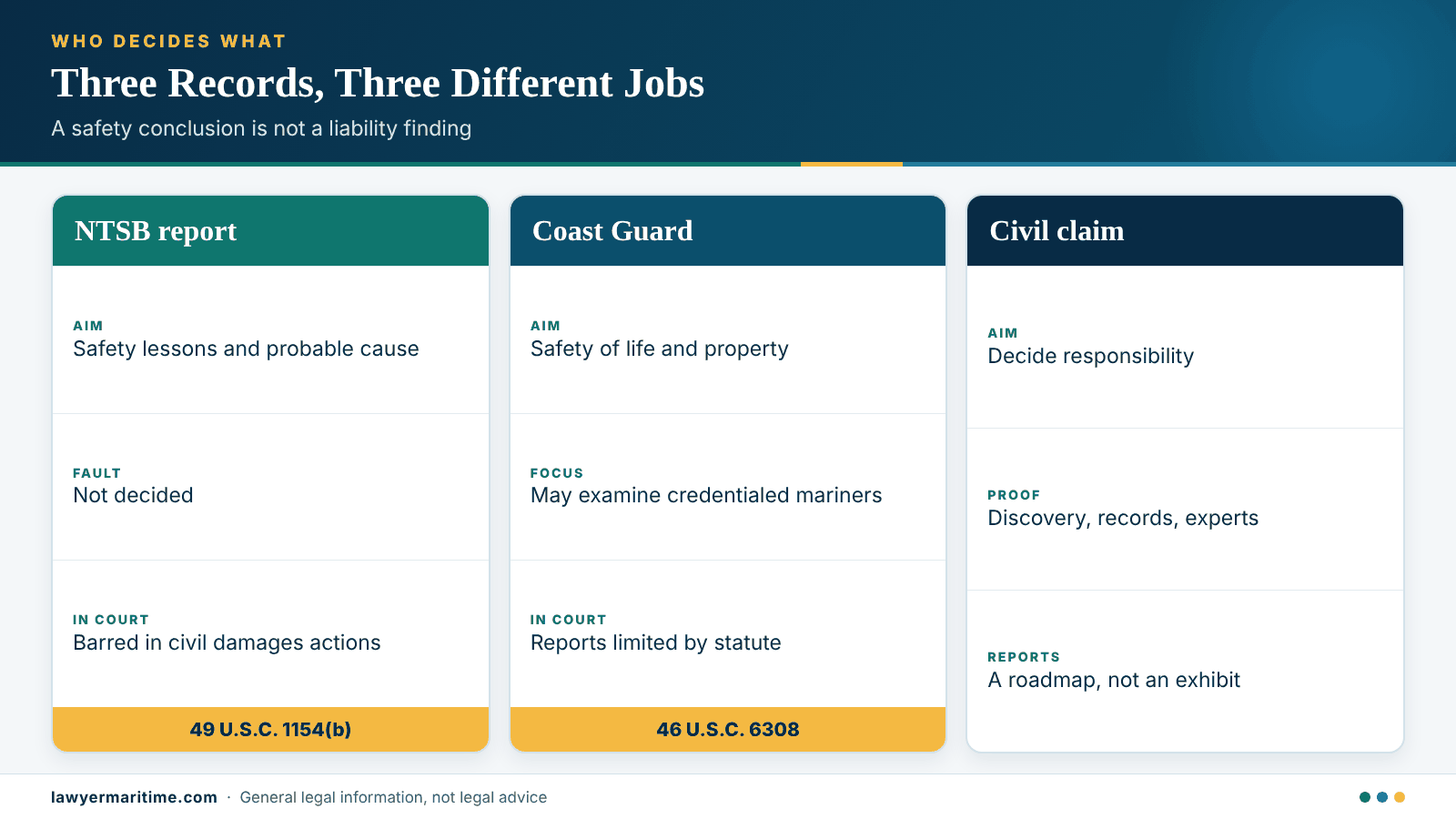
The NTSB investigates selected accidents, determines probable cause, and issues recommendations. As the earlier sections explained, its regulations describe investigations as fact-finding proceedings that don’t determine fault or liability. It doesn’t suspend a mariner’s license, fine a company, or order a vessel detained.
That narrow role is also why NTSB reports are comparatively readable. Investigators aren’t writing to survive an enforcement appeal, so they can explain systems and human factors in plain terms. The tradeoff is that the Board’s reports rarely resolve questions of individual accountability.
What a Coast Guard marine casualty investigation is for
The Coast Guard’s investigation rules sit in 46 CFR Part 4. Under § 4.07-1, the investigation’s purpose is to improve the safety of life and property at sea, not to assign civil or criminal fault. The rule lists what an investigation should examine: the cause of the accident, whether equipment failure contributed, whether misconduct, inattention, negligence, or willful violation by a credentialed mariner contributed, whether Coast Guard personnel or another person contributed, and whether a Marine Board of Investigation should be convened.
The third item is where the Coast Guard differs most from the NTSB. Findings about a credential holder can lead to proceedings against that mariner’s credential. A Coast Guard report may therefore name individuals and examine their conduct in a way an NTSB probable cause statement usually does not.
How the two investigations interlock
A casualty doesn’t arrive labeled for one agency. The rules that sort out roles are a mix of Coast Guard notice requirements, joint Coast Guard and NTSB regulations, and statutory authority for one agency to help the other.
Notice, preliminary inquiry, and formal investigation
Under 46 CFR § 4.05-1, an owner, agent, master, operator, or person in charge must notify the nearest Coast Guard unit immediately after addressing resulting safety concerns when a vessel is involved in a defined marine casualty. The listed events include certain groundings and bridge strikes, loss of propulsion or steering that reduces maneuverability, events that materially harm seaworthiness, a death, an injury needing more than first aid, property damage above a regulatory dollar threshold, and significant environmental harm. Reporting duties and thresholds change, so check the current text.
From there the Commandant or a District Commander orders the investigation that Part 4 requires, and a Marine Board of Investigation under subpart 4.09 is one option for serious cases. The joint rules in 49 CFR Part 850 deal with this handoff; its section titles cover a Coast Guard preliminary investigation, a Board marine casualty investigation, and Board probable cause determinations.
When the Coast Guard investigates for the Board
Under 49 U.S.C. § 1131(c), the Board can ask the Coast Guard’s parent department to investigate certain marine accidents where government misfeasance or nonfeasance is not alleged and to report the facts to the Board. The Board then uses that factual report in determining cause or probable cause. The Part 850 section titles also refer to a Coast Guard marine casualty investigation conducted for the Board.
For a reader, the consequence is that some NTSB conclusions rest partly on Coast Guard fact-gathering, while the Coast Guard’s own report can reach different conclusions on a different record. If you have both documents, compare them line by line. Differences in timeline, equipment findings, or causal emphasis are worth noting. Our guides to maritime collision investigations and vessel fire investigations show how this plays out in two common casualty types.
| Feature | NTSB | Coast Guard |
|---|---|---|
| Legal source | 49 U.S.C. § 1131; 49 CFR Parts 831 and 850 | 46 CFR Part 4, including §§ 4.05-1 and 4.07-1 |
| Which casualties | Selected marine accidents, including major marine casualties | Reportable marine casualties; investigation level set by the Coast Guard |
| Stated purpose | Facts, probable cause, and safety recommendations | Safety of life and property at sea; not civil or criminal fault |
| Focus on individuals | Can describe human actions as part of the safety analysis | Examines credentialed mariners’ conduct and may lead to credential proceedings |
| Main products | Preliminary report, final report, brief, docket, recommendations | Investigation reports, including formal board proceedings in serious cases |
| Civil-case use limit | 49 U.S.C. § 1154(b) and 49 CFR Part 835 | 46 U.S.C. § 6308 |
How to Find NTSB Reports, Dockets, and Related Records
Finding the right document is often harder than reading it. The NTSB runs several overlapping tools, the Coast Guard keeps its own records elsewhere, and the names people use for an accident rarely match the names in a database. This section lays out the main official routes as they were described on the agencies’ pages when we wrote this guide, so you can plan a search before you start clicking.
The official search tools
Search tools change, and the Board has rebuilt its interfaces before. Treat the descriptions below as a starting map and confirm what the current pages offer.
The investigations page and CAROL
The NTSB’s investigation reports page lets you browse by mode, including marine. Its Case Analysis and Reporting Online tool, known as CAROL, searches NTSB investigation data and safety recommendations. The CAROL help page we read says marine investigations in CAROL go back to 2010, that it holds more than 15,000 recommendations, and that results can be downloaded as CSV or JSON files.
CAROL offers a basic search, a custom search builder, and published searches. A custom search is the best way to isolate marine cases by date, vessel type, or recommendation status. The same page says CAROL does not currently search dockets, which is a detail that trips up many first-time users.
The Marine Safety Data Dashboard and the docket
The NTSB’s Marine Safety Data Dashboard summarizes marine investigations from 2012 to the present, according to its page. It has a map view and a case summary view, and you can filter by event date, vessel name, case status, vessel group, and casualty category. A data table links to each investigation’s page and docket, which makes the dashboard a convenient front door when you know the vessel name.
The docket is where the factual record lives. Under 49 CFR § 835.11, the Board’s accident reports, factual accident reports, and docket files can be requested through its regulations or its website, and the rule notes that the Board’s public inquiries branch handles requests. If an exhibit you need isn’t posted, ask for it instead of assuming it doesn’t exist.
Planning a search that actually finds the case
Most failed searches fail on identifiers. A little preparation before you query saves hours.
Gather the identifiers databases use
Start with the vessel’s official name and any former names, the date of the event, the waterway or nearest port, and the type of casualty. Vessels are sometimes renamed, and databases may spell a name differently than you do. Try several spellings, and search by vessel group or date range instead of an exact name.
If you already hold a Board document, the investigation number printed on it is the most reliable key. It lets you jump straight to the record, the docket, and the recommendations without guessing. Without it, search by date range and location, then confirm by reading the summary.
Related Coast Guard sources and the question of formal requests
Coast Guard investigation information is a separate search. The Coast Guard’s CGMIX site hosts incident investigation reports, and the Coast Guard also publishes marine casualty report material through its own pages. Coverage, completeness, and format may differ from the NTSB’s, so don’t assume one source mirrors the other.
If the public sources fall short, an agency records request may help, and a lawyer can often frame one more precisely than a first-time requester can. Our guide to preparing for a maritime law consultation lists the documents worth gathering before you ask for help. For a broader look at how investigation records sit alongside claims, see the pages on maritime injury compensation and fatigue-related maritime accidents.
Limits on Using Investigation Reports in Civil Damages Cases
Many people read an NTSB or Coast Guard report hoping it will settle a claim. Congress anticipated that hope and limited it. The rules below are general descriptions of the statutes and regulations, and courts and parties can disagree at the edges, so use this section to understand the landscape and ask counsel how it applies to a specific case.
The NTSB side: 49 U.S.C. § 1154 and 49 CFR Part 835
Two layers of federal law govern NTSB material. One is a statute about reports and recorder materials; the other is a set of Board regulations about employee testimony and the handling of reports.
What 49 U.S.C. § 1154(b) says about Board reports
Section 1154(b) provides that no part of a Board report about an accident, or about an investigation of one, may be admitted into evidence or used in a civil action for damages arising from a matter covered in the report. The text is short and broad. It speaks of the report, which covers the findings, analysis, and probable cause statement as well as the factual narrative.
Subsection (a) of the same section separately limits discovery of certain unreleased recorder materials, such as transcripts and recordings from cockpit or surface vehicle recorders, and sets conditions and protective orders when a court allows them. Whether a particular vessel recording falls inside that subsection depends on the type of recorder and the facts, which is a question for counsel.
What 49 CFR Part 835 adds about testimony and use of reports
Part 835 deals with Board employees in civil litigation. Under § 835.3, employees may testify to facts they learned in an investigation, but they must decline opinion or expert testimony, and they generally may not testify about other staff members’ reports or Board analysis documents. The regulation also says accident briefs are not part of factual reports and can’t be admitted into evidence or used in a deposition the Board approves. No employee testifies without advance approval from the General Counsel.
Section 835.4 addresses use of reports during testimony: an employee may use the factual accident report as a testimonial aid to refresh memory, but may not use the Board’s accident report for any purpose while testifying. The split between factual accident reports and Board accident reports is intentional, and its edges are a legal question. The takeaway for readers is that the Board’s analysis and conclusions are treated differently from its factual record.
The Coast Guard side and the practical reality
The Coast Guard has its own statute, and the two regimes are not identical. Neither one makes the underlying events disappear.
46 U.S.C. § 6308 and Coast Guard investigation reports
Section 6308(a) provides that reports from marine casualty investigations, including findings, opinions, recommendations, deliberations, and conclusions, are not admissible as evidence or subject to discovery in civil or administrative proceedings, with an exception for administrative proceedings conducted by the United States. Subsection (b) limits deposition and testimony of Coast Guard investigators without the Secretary’s permission, but the Secretary can’t refuse permission for purely factual testimony in the circumstances the statute describes.
Subsection (d) adds that the covered information is not an admission of liability by the United States or by anyone named in the report’s conclusions. Compared with § 1154(b), § 6308 expressly reaches discovery and administrative proceedings, and it contains a United States exception. The two statutes are different tools, and a report from one agency doesn’t borrow the other’s rules.
What remains usable, and why that matters
These provisions speak to reports and, in some cases, testimony. They don’t say that the vessel, its logs, its voyage data recorder, the maintenance history, the crew, or independent witnesses are off limits. Evidence that exists outside the report is generally gathered through ordinary civil discovery, subject to the court’s rules.
That is why the most useful thing a report often gives a claimant is a roadmap. It tells you which records exist, who was on watch, which equipment was examined, and which questions the Board raised. A claim then builds its own proof through its own discovery and experts. For how those claims are framed, see our overview of how a Jones Act claim works, and note that a settlement or release can affect what you may pursue later, as explained in our guide to maritime settlement releases.
| Source | Authority | General limit described in the text | Practical note |
|---|---|---|---|
| NTSB accident report | 49 U.S.C. § 1154(b) | No part of a Board report may be admitted into evidence or used in a civil damages action arising from a matter covered in it | The report is a roadmap, not a trial exhibit |
| Unreleased NTSB recorder materials | 49 U.S.C. § 1154(a) | Discovery limited; court may allow after in-camera review under conditions, with protective orders | Depends on recorder type and the facts; ask counsel |
| NTSB employee testimony | 49 CFR §§ 835.3, 835.4 | Factual testimony only, with General Counsel approval; no expert or opinion testimony | Experts must come from elsewhere |
| Coast Guard investigation report | 46 U.S.C. § 6308(a) | Findings, opinions, recommendations, deliberations, and conclusions not admissible or discoverable in civil or administrative proceedings, except proceedings initiated by the United States | Covers discovery as well as admission |
| Underlying vessel records and witnesses | Ordinary civil discovery rules | Not addressed by the report-limit provisions | Preserve them early |
Reading Checklist, Glossary, and What to Do Now
Everything above comes down to habits you can apply to any report. This section turns them into a short method, a glossary for the terms that cause the most confusion, and a practical set of steps if the casualty touched you or your family.
A two-pass method for reading any report
Reading twice, with a different purpose each time, catches more than reading once carefully. The first pass builds the picture; the second tests it.
First pass: orient yourself
Start by confirming what you hold: a preliminary report, a brief, a final report, or a docket excerpt. Note the date, the vessel, and the event type, then read the summary and the probable cause statement. Don’t stop there. Skim the findings and the recommendation list so you know the shape of the Board’s conclusions before you read the evidence behind them.
- Identify the document type. A brief or preliminary report carries less analysis than a final report.
- Read the probable cause statement. Treat it as a headline, not a verdict.
- Scan the findings. Separate contributing factors from safety issues and ruled-out theories.
- List the recommendations. Note each recipient and its current status.
Second pass: test the conclusions against the evidence
Now return to the narrative and analysis with specific questions. Which times come from recorders? Which statements come from interviews? Where does the analysis use words like “likely”? Which exhibits in the docket support the facts you care about?
Write down the facts that matter to your situation, with the page or exhibit that supports each one. This turns a long report into a short working list you can hand to a lawyer, an insurer, or a safety committee. It also shows you the gaps, such as an equipment test the Board did not run, that your own investigation might fill.
Glossary and common mistakes
Report language borrows terms from engineering, law, and regulation. The same word can mean different things in each, so a short glossary pays off.
Terms that cause the most confusion
Several words look familiar but carry narrower meanings in a safety report. “Cause” is not “legal cause,” “finding” is not a court finding, and “contributing factor” is not “negligence.” The table below pairs each term with what it usually means in an NTSB report and the trap to avoid.
| Term | What it means in a report | Trap to avoid |
|---|---|---|
| Probable cause | The Board’s determination of why the accident occurred, based on its investigation | Reading it as a finding of fault or liability |
| Finding | A conclusion drawn from the analysis, sometimes numbered | Treating it as a court finding of fact |
| Contributing factor | A condition or action that played a part in the accident or its outcome | Assuming it is the only cause or that it equals negligence |
| Safety issue | A hazard worth fixing that may not have caused this accident | Mistaking it for a cause |
| Docket | The factual materials gathered in the investigation | Assuming the report repeats everything in it |
| Safety recommendation | A request to a named recipient to take a safety action | Reading an open status as proof of wrongdoing |
| Major marine casualty | The statutory category that brings the Board’s marine authority into play | Assuming every serious injury qualifies |
Common reading mistakes and better habits
Most mistakes come from compressing a nuanced report into a slogan. A quote that sounds clean in a demand letter or social post can contradict the paragraph it came from. The table pairs frequent errors with a more reliable habit.
| Common mistake | Why it causes trouble | Better habit |
|---|---|---|
| Quoting the summary alone | Summaries drop qualifiers that the analysis supplies | Cite the analysis and the findings together |
| Equating probable cause with blame | The Board’s proceedings are not adjudications of fault | Describe it as the Board’s safety conclusion |
| Ignoring “did not contribute” findings | Ruled-out theories shape the narrative | Read excluded factors as carefully as included ones |
| Treating a status code as a verdict | Status reflects a recipient’s response, not the accident’s cause | Read the correspondence behind the code |
| Assuming no report means no problem | The Board investigates only selected accidents | Look to Coast Guard records and your own evidence |
What to do now if the casualty involved you or your family
A report arrives months or years after the event. Evidence, memories, and employer attention all fade faster. If you or a loved one was hurt or killed in a marine casualty, the most helpful steps don’t wait for a report.
Protect your own record while you wait
Write down what you remember while it is fresh, including who was on watch, what equipment was in use, and what you were told afterward. Keep medical records, pay records, texts, photographs, and any paperwork the employer or insurer sends. Avoid signing releases or giving recorded statements before you understand what they cover.
- Write a dated account of the event and keep it private.
- Photograph injuries, equipment, and the scene if you can do so safely.
- Save emails, texts, pay stubs, and medical bills.
- Note the names of coworkers and anyone who saw what happened.
- Ask which agencies were notified and keep any case or reference numbers.
Questions to bring to a maritime lawyer
If you decide to talk with counsel, bring the report, the docket exhibits you have found, and your own notes. Ask how the use limits in 49 U.S.C. § 1154(b) and 46 U.S.C. § 6308 apply to your claim, what independent evidence you will need, and which deadlines apply. Our guide to what a maritime lawyer does explains fees and how to compare lawyers, and our overview of maritime law and admiralty law give the wider legal background.
Frequently Asked Questions
These are the questions readers most often ask when they first hold an NTSB marine report. The answers are general and can change with the facts, the vessel, and the court.
Questions about what the report is
Is an NTSB marine report the same as a Coast Guard report?
No. The NTSB writes its own reports under 49 U.S.C. § 1131 and describes them as safety-focused products with probable cause determinations. The Coast Guard investigates under 46 CFR Part 4 and uses its investigations for safety, compliance, and, where warranted, action involving mariner credentials.
A casualty can produce both, and the two documents may cover the same facts with different emphasis. Read them side by side and note where the timelines, equipment findings, or causes differ.
How long does it take for the NTSB to publish a marine report?
The NTSB’s marine page says a preliminary report typically appears a few weeks after the accident and that investigations often take 12 to 24 months. It also says an accident brief typically replaces the preliminary report at that later stage. These are the agency’s general descriptions, not promises for any one case.
Complex casualties, litigation, and the need for lab or recorder analysis can stretch the schedule. If a report is still pending, the docket or a preliminary report may be the only public record for some time.
Why can’t I find an NTSB report on my accident?
The most common reason is that the Board didn’t investigate. It looks at selected marine accidents, and many injuries and even some deaths are handled by the Coast Guard alone. A second reason is a search problem: a vessel name, date, or spelling that doesn’t match the database.
Try CAROL, the Marine Safety Data Dashboard, and a Coast Guard search before concluding there is nothing. If nothing turns up, your own records and witnesses become the foundation of the claim. Our guide to maritime accident attorneys explains how counsel gathers them.
Questions about probable cause and fault
Does an NTSB probable cause finding mean someone is legally liable?
No. NTSB regulations describe investigations as fact-finding proceedings that do not decide anyone’s rights or liabilities. A court applies maritime negligence, unseaworthiness, or other doctrines to the evidence before it, which is a separate analysis.
A probable cause statement can still be useful context. It may point to equipment, procedures, or staffing questions that a claimant’s lawyer then investigates through discovery and experts.
Can I use an NTSB marine report as evidence in my lawsuit?
Generally not in a civil action for damages. 49 U.S.C. § 1154(b) says no part of a Board report may be admitted into evidence or used in such an action arising from a matter covered in the report. How the rule applies to related materials, such as dockets or recorder data, can be more nuanced.
The report remains valuable as a roadmap to the underlying evidence. Ask counsel how to obtain that evidence through ordinary discovery rather than relying on the report itself.
Can an NTSB investigator testify in a civil case?
Only within narrow limits. Under 49 CFR § 835.3, Board employees may testify to facts they learned during an investigation but not give expert or opinion testimony, and testimony requires advance approval from the General Counsel. Other regulations in Part 835 set the procedure for requests.
Lawyers who need expert opinions generally retain their own experts. The Board’s role is to investigate for safety, not to supply expert witnesses.
Questions about finding and using reports
Where can I find NTSB marine reports and dockets?
Start with the NTSB’s investigation reports page, the CAROL search tool, and the Marine Safety Data Dashboard. The dashboard links to each investigation’s page and docket, while CAROL searches investigations and safety recommendations but, according to its help page, not dockets.
For Coast Guard material, try the CGMIX incident investigation reports site. Search interfaces change, so confirm what each official page offers on the day you search.
What do the open and closed recommendation statuses mean?
Open means the Board is still tracking a response; closed means it has stopped, for reasons that range from completed action to disagreement to replacement by a newer recommendation. The Board’s status explanation page defines each code.
A status describes the recipient’s response to a safety proposal. It says nothing about who caused the accident, so don’t use it as a stand-in for fault.
Should I wait for the report before I talk to a lawyer?
Usually no. Deadlines for claims run on their own schedules, and evidence on the vessel can be changed, repaired, or lost while an investigation continues. A report may not be published for a year or more, and it can’t be used as evidence in a civil damages action in the ways many people expect.
An early consultation can clarify which deadlines apply and what to preserve. Our page on preparing for a maritime law consultation explains what to bring.
Sources and Legal Authorities
The authorities below support the statements in this guide. Agency pages and search tools change, so check each against its current version before relying on it.
Statutes and regulations
Federal statutes
- 49 U.S.C. § 1131 – NTSB general authority and marine casualty investigations
- 49 U.S.C. § 1135 – Secretary of Transportation responses to NTSB recommendations
- 49 U.S.C. § 1154 – Discovery and use of NTSB reports
- 46 U.S.C. § 6308 – Information barred in legal proceedings (Coast Guard marine casualty investigations)
Federal regulations
- 49 CFR § 831.4 – Nature of NTSB investigations
- 49 CFR § 835.3 – Scope of permissible testimony
- 49 CFR § 835.4 – Use of reports
- 49 CFR § 835.11 – Obtaining Board accident reports, factual accident reports, and supporting information
- 49 CFR Part 850 – Coast Guard and NTSB marine casualty investigations
- 46 CFR § 4.05-1 – Notice of marine casualty
- 46 CFR § 4.07-1 – Coast Guard investigations, purpose and scope
Cases and agency materials
Supreme Court and federal appellate decisions
- This guide discusses statutes and regulations rather than case law. Courts have addressed the use of investigation material in individual disputes, and the outcome can depend on the court and the facts, so ask counsel about decisions in your jurisdiction.