The NTSB Safer Seas Digest 2025 is the National Transportation Safety Board’s annual roundup of lessons from the 49 marine investigations its Office of Marine Safety completed in 2025, and the agency announced it on September 15, 2026. It sorts those casualties by type, from contacts with fixed objects and vessel fires to groundings and collisions, and closes with recurring lessons that operators and crews can apply. The digest is a safety publication, not a legal ruling: it doesn’t decide who owes whom money, and federal law limits how NTSB and Coast Guard investigation reports can be used in civil damages suits. This guide is written for mariners, safety managers, injured maritime workers, and families. It explains what the digest says, which parts we confirmed directly, how marine casualty investigations work under U.S. maritime law, and how the lessons connect to Jones Act, LHWCA, DOHSA, and general maritime claims. Where we could not confirm something, we say so.
What the NTSB Safer Seas Digest 2025 Is and What Was Verified
Time-sensitive news pages go wrong when they repeat a headline number nobody checked. So this section starts with what we confirmed on ntsb.gov on October 10, 2026, and where the confirmation stops. Everything else in the guide builds on it.
What NTSB actually released
The digest is a publication of the NTSB Office of Marine Safety. Its job is to turn a year of finished investigations into short, readable lessons for the marine community.
The release, the date, and the number
NTSB’s press release, “NTSB Releases Safer Seas Digest Detailing Lessons to Improve Maritime Safety,” is dated September 15, 2026. It states that the digest covers 49 marine investigations completed in 2025 and links to the digest PDF. The Chairwoman’s message inside the digest, signed by Jennifer L. Homendy, repeats the count of 49.
The digest text we read carries no printed release date, so the September 15, 2026 date rests on the press release and on NTSB’s Safer Seas Digest page, which lists the new edition and shows a last-updated date of September 15, 2026. Trade press, including gCaptain and Marine Insight, reported the release on September 16, 2026.
One naming point trips people up. “2025” refers to the year the investigations were completed, not the year the digest came out. A casualty from 2023 or 2024 can appear in the 2025 edition because NTSB finished its report in 2025.
What the 49 investigations cover
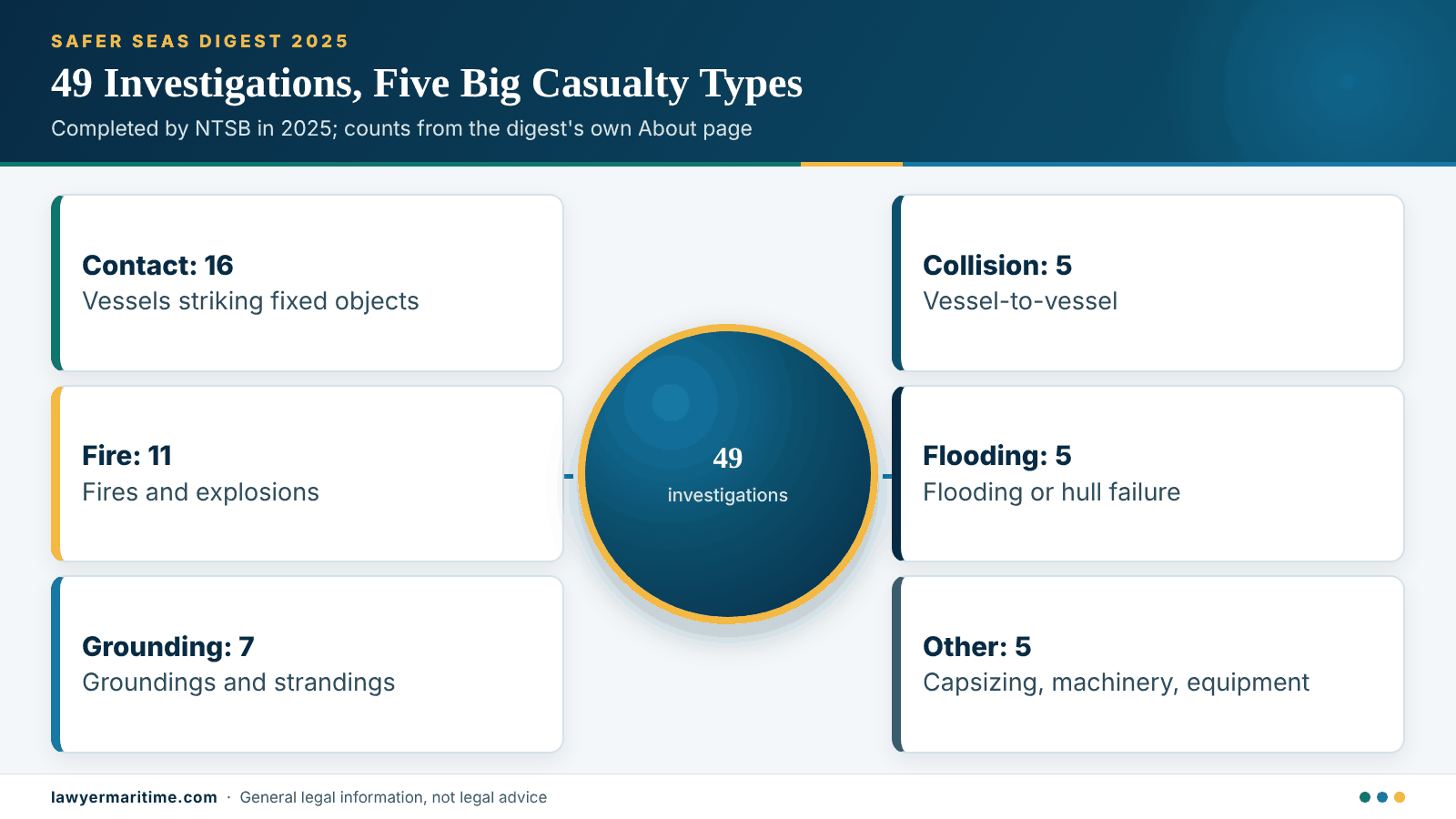
The digest sorts casualties into nine types. A contact means a vessel struck something fixed, such as a bridge, dock, or lock gate. Maritime lawyers often use the older word allision for that kind of event, and the two terms describe the same basic fact pattern. The counts below come from the digest’s “About” page and add up to 49.
| Casualty type | Investigations | Examples listed in the digest’s table of contents |
|---|---|---|
| Contact | 16 | Containership Dali and the Francis Scott Key Bridge; Nickelena tow and the Mackinac Bridge; Hafnia Amessi and a Navy pier |
| Fire or explosion | 11 | Grande Costa D’Avorio; towing vessel Johnny M; yacht Flagship; dredging vessel Stuyvesant |
| Grounding or stranding | 7 | Bulk carrier John J Boland; towing vessel City of Louisville; recreational vessel 6 Saturdays |
| Collision | 5 | William B Klunk tow; BBC Africa and Common Faith; offshore supply vessel Jack Edwards and cargo vessel Julie C |
| Flooding or hull failure | 5 | Submersible Titan; industrial vessel Cape Douglas; towing vessel Uncle Blue |
| Capsizing or listing | 2 | Towing vessel Baylor J. Tregre; yacht Lovebug |
| Machinery damage | 1 | Passenger vessel Ocean Navigator |
| Ship, equipment, or cargo damage | 1 | Containership President Eisenhower |
| Other | 1 | Collapse of a dock section during docking of the Ovide J tow |
Contacts and fires make up 27 of the 49 investigations, which is a useful reminder that most marine casualties are not dramatic mid-ocean events. They happen in channels, at docks, and under bridges, close to people who work ashore.
How this edition fits the annual series
A single edition is easier to judge when you can see the ones before it. NTSB’s own pages let us do that, with one important limit on what the numbers mean.
Earlier editions and how the counts compare
NTSB describes the digest as an annual publication that summarizes the previous year’s completed investigations by casualty type, and its Safer Seas page lists editions going back to a 2013 edition. The two most recent earlier editions give a baseline.
| Edition | NTSB announcement | Investigations covered | Examples or themes NTSB highlighted |
|---|---|---|---|
| 2025 | September 15, 2026 | 49 | Dali bridge strike, Titan implosion, Grande Costa D’Avorio fire; twelve recurring lessons |
| 2024 | May 21, 2025 | 34 casualties | Sandy Ground ferry engine room fire; Spirit of Boston fire; safety management systems for passenger vessels |
| 2023 | June 27, 2024 | 31 (stated in the digest; the press release gave no count) | Coast Guard cutter and center-console boat collision off Puerto Rico; Spirit of Norfolk fire; anchor strike on a pipeline in San Pedro Bay |
The 2025 edition covers more finished investigations than either of the two before it. The digest text we read does not explain why, and a higher count of completed investigations says nothing by itself about whether marine operations got more dangerous. It may reflect when reports were finished.
What the digest is, and what it is not
The digest is a lessons-learned summary. It repeats each casualty’s circumstances, NTSB’s probable cause finding, and the lesson the agency wants readers to take away. NTSB’s press release encourages marine operators and other stakeholders to review the safety issues it identifies, and the Chairwoman’s message encourages voluntary adoption of the lessons.
It is not a new investigation, and it does not allocate civil liability. A probable cause finding answers a safety question: what caused the casualty so that it can be prevented. A court answers a different question: who is legally responsible, and for what damages, under the law that governs the claim.
That distinction matters later in this guide. Readers who are weighing a claim often assume an NTSB conclusion works like a verdict. It doesn’t, and the statutes covered below explain why.
Featured Casualties and the Twelve Recurring Lessons
The Chairwoman’s message does two things. It singles out three casualties as the edition’s headline cases, and it lists twelve themes that show up again and again across the year’s investigations. This section covers both, using NTSB’s own investigation pages for the three headline cases.
The three featured casualties
These cases differ in vessel, place, and cause, but each ended with deaths and each led to new NTSB recommendations. Together they show how far the lessons reach beyond the vessels involved, from bridge owners to fire departments to regulators.
Dali and the Francis Scott Key Bridge
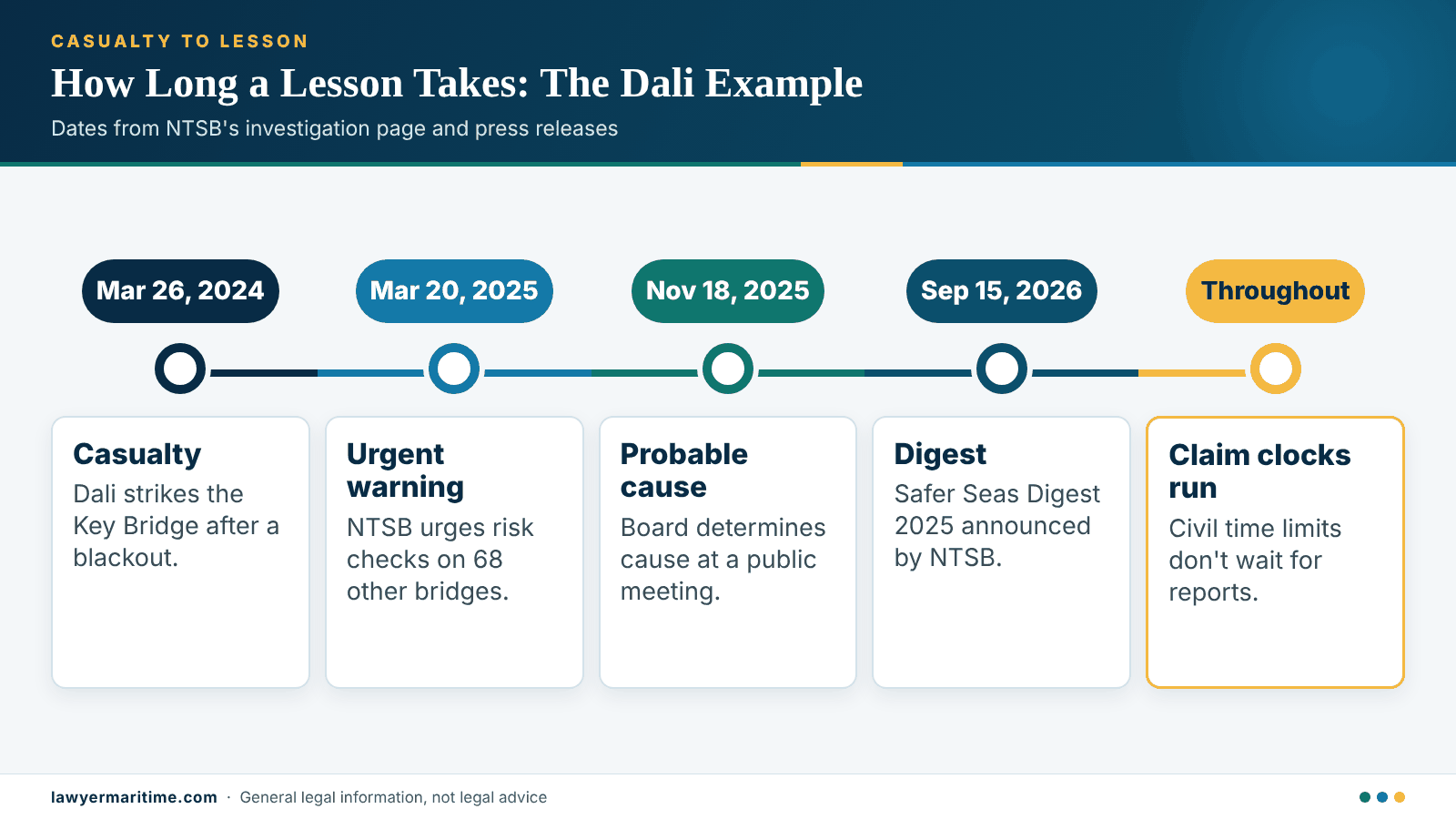
On March 26, 2024, the containership Dali was leaving Baltimore Harbor when it struck the Francis Scott Key Bridge, and the bridge collapsed. NTSB’s investigation page attributes the contact to a loss of electrical power, a blackout, that began with a loose signal wire connection to a terminal block caused by improperly installed wire-label banding. The blackout cost the ship propulsion and steering near the bridge. Six highway workers died.
NTSB found that limited time before the ship reached the bridge contributed to the crew’s inability to restore propulsion. It also found that the lack of countermeasures against vessel impact contributed to the collapse, and that a vulnerability assessment of the kind AASHTO recommends could have supported those countermeasures. The board determined probable cause at a public meeting on November 18, 2025.
The earlier urgent recommendation report, MIR-25-10, concerned 68 other bridges. In a March 20, 2025 press release, NTSB recommended that 30 bridge owners in 19 states assess those bridges for collapse risk from vessel strikes, and stated that its report “does not suggest that the 68 bridges are certain to collapse.” The Chairwoman’s message in the digest refers to nearly two dozen recommendations from the investigation.
The Titan submersible
The submersible Titan imploded on June 18, 2023, on dive 88 to the Titanic wreck site, killing all five people aboard. In report MIR-25-36, NTSB’s investigation page attributes the failure to OceanGate’s flawed engineering process, which never established the actual strength and durability of the carbon fiber pressure vessel, and to the company’s continued operation of a hull with delamination damage.
NTSB also found that OceanGate’s analysis of its pressure-monitoring data was flawed, so the company did not recognize that the hull needed to come out of service after dive 80. Contributing factors included weak voluntary guidance and small passenger vessel regulations that do not adequately address pressure vessels for human occupancy. The board found that following existing Coast Guard emergency-response guidance would likely have put rescue assets on standby, and it said the Coast Guard’s search and rescue coordination was effective.
NTSB issued four recommendations to the Coast Guard. They ask it to commission an expert panel on pressure vessels for human occupancy, implement regulations informed by that study, update its small passenger vessel guidance, and propose that the International Maritime Organization make a related circular mandatory.
The Grande Costa D’Avorio fire
On July 5, 2023, a fire broke out in an interior garage deck of the roll-on/roll-off container vessel Grande Costa D’Avorio while it was docked at Berth 16 in the Port of Newark. NTSB’s investigation page attributes the fire to Ports America’s use of a passenger vehicle as a pusher vehicle in an industrial application for which it was not intended. The vehicle’s transmission fluid overheated, boiled over, and ignited on a hot engine surface.
The fire became deadly for reasons beyond its start. A fire-boundary garage door had no operating controls outside the space, so the crew could not close it, which made the fixed carbon dioxide extinguishing system ineffective. NTSB also found that the Newark Fire Division’s lack of marine firefighting training contributed to an ineffective response. Two land-based firefighters died, six other responders were injured, and NTSB estimated vessel damage above $23 million.
The board issued 11 recommendations to a long list of recipients, including the Coast Guard, OSHA, the Newark Fire Division, the Port Authority of New York and New Jersey, and Grimaldi Deep Sea. Later, on September 10, 2025, NTSB issued a safety alert for land-based firefighters who respond to vessel fires in port, and the digest’s table of contents lists Marine Safety Alert SA-101.
For fire investigation specifics beyond this digest, see our guide to maritime fire investigations.
The twelve commonalities NTSB lists
Twelve themes appear in the Chairwoman’s message and in NTSB’s press release, in the same order. The table pairs each with a related example we could confirm, and says plainly where we could not.
| Lesson as NTSB lists it | Related example we could confirm | Practical question |
|---|---|---|
| Performing maintenance effectively | American Mariner: debris in steering hydraulic oil locked the rudder; Columbia Gorge: no life-cycle program for mooring lines | Does planned maintenance cover the parts whose failure would cost us control? |
| Voyage planning and management | Nickelena tow: a crane was about 10 feet too high for the Mackinac Bridge | Did we verify clearances and hazards from current data before departure? |
| Detecting and containing vessel fires | Grande Costa D’Avorio: a fire door could not be closed from outside the space | Can the crew isolate a space and make the fixed system work? |
| Assessing the condition of waterfront infrastructure | Dali: bridge vulnerability and the 68-bridge urgent recommendations | Who has assessed what a vessel strike would do to this structure? |
| Maintaining watertight integrity | Not confirmed in the pages we read; trade press reported an open watertight door on a yacht | Are watertight closures kept as designed? |
| Accounting for bank effect | Hafnia Amessi: the pilot’s rudder and engine orders could not overcome bank effect | Does the transit plan allow for hydrodynamic forces near banks and shoals? |
| Managing fatigue and distraction | Klunk tow and Amber Brittany tow: phone use before the casualty | Do we have a phone-use rule for people in safety-critical roles? |
| Securing and monitoring lithium-ion batteries | Not confirmed in the pages we read | Where are batteries stored and charged, and who watches them? |
| Mitigating the risks of a loss of electrical power | Dali: a blackout cost propulsion and steering | What is the plan if power fails near a hazard? |
| Planning and training for emergencies | Titan: no standby rescue assets; BBC Africa: delayed emergency override after steering failure | Have we drilled the failure we think is unlikely? |
| Operating in strong currents or heavy weather | Amber Brittany: dam outdraft; Cocodrie: sudden strong beam winds | What are our go and no-go limits in these conditions? |
| Operating equipment and machinery as designed | Grande Costa D’Avorio: a passenger vehicle used as a pusher vehicle | Is anyone using equipment outside its intended purpose? |
Planning, infrastructure, and the water itself
Five of the twelve lessons concern the world around the vessel: voyage planning, waterfront infrastructure, bank effect, currents and weather, and the condition of structures the vessel might hit. Bank effect describes the hydrodynamic forces on a hull that is close to a bank or shoal, which can push it off its intended track and overpower rudder and engine orders. NTSB used that idea in the Hafnia Amessi finding.
These lessons share a feature: the information needed to avoid the casualty usually existed before departure. Charts, clearance data, and local knowledge were available. What failed was the step that connected them to the plan.
People, procedures, and preparedness
Fatigue, distraction, emergency training, and equipment misuse are the human-factors lessons. They are also the ones that tend to matter most in injury litigation, because they point to decisions that people made and systems that employers set up.
Readers who want the fatigue angle in depth can read our guide to maritime fatigue accidents. The short version is that fatigue is a recurring cause, and the Chairwoman’s list pairs it with distraction rather than treating it alone.
Fire, flooding, and power
Detection and containment of fires, watertight integrity, lithium-ion batteries, and loss of electrical power are the lessons about what happens once something goes wrong aboard. They share a design question as well as an operating one: whether the ship’s own systems can still protect the crew when a failure spreads.
Dali and Grande Costa D’Avorio both show how a small initiating fault, a loose wire connection or an overheated transmission, can grow when protective systems don’t work as intended.
What the Smaller Casualties Teach
The headline cases draw the attention, but most of the digest is made of everyday towing, bulk carrier, and ferry casualties. We read these summaries directly in the digest text, and the lessons are often more transferable than the big three. Each “Lessons Learned” box below is paraphrased, not quoted.
People and procedures
Three of the digest’s lesson boxes in the pages we read concern what people did, or didn’t do, in the minutes and weeks before a casualty.
Phones and distraction on watch
The digest describes a pilot on the William B Klunk tow who was on a phone call and using a personal phone before the April 17, 2024 collision. The lesson box says that phone use by on-duty crew in safety-critical roles is a distraction and that companies should set protocols for personal and work phone use.
The same theme appears in the Amber Brittany tow, which struck a vane dike on the Ohio River at Louisville on March 8, 2024 (report MIR-25-14, estimated damages $1.3 million). NTSB’s probable cause points to the pilot not effectively offsetting a dam outdraft, likely because of inexperience on that stretch and cell phone distraction. The digest notes text messaging just before the contact.
Distraction is rarely the whole story. Both summaries pair it with another condition, a particular channel or a particular current, which is how causation usually works in a real investigation.
Reporting problems and following written procedures
On March 17, 2024, the offshore supply vessel Jack Edwards and the cargo vessel Julie C collided. The digest says steering degradation on the Jack Edwards had been normalized and not reported. The lesson box urges prompt reporting of maintenance problems and adherence to manufacturer manuals, the safety management system, and the planned maintenance system.
Normalized deviance is a common thread in casualty analysis. A defect that crews live with for weeks stops looking like a defect, until the day it fails at the worst moment.
For injury claims, the point is practical. A record that shows who knew about a problem, and when, can matter more than the failure itself.
Training for steering and control failures
The multi-purpose carrier BBC Africa and the bulk carrier Common Faith collided on August 25, 2023. The digest ties the casualty to a steering component failure and a delayed emergency override response. Its lesson box calls for scenario-based drills, with bridge and engine teams practicing steering recovery before a failure happens in a channel.
Drills only help if they match how failures actually unfold. A drill that assumes a calm sea and a clear head tests less than one that adds traffic and time pressure.
Water, structures, and equipment condition
The other group of lessons concerns the physical setting: what is above the vessel, what the water is doing beneath it, and whether the gear holding it in place is sound.
Air draft and overhead hazards
Air draft is the height from the waterline to the highest point of a vessel or its load. On May 7, 2023, the towing vessel Nickelena was towing the deck barge BMI 209, which carried a crane, and the crane was about 10 feet too high to pass under the Mackinac Bridge. The lesson box says to use accurate crane and bridge height data and to check charts or the U.S. Coast Pilot before departure.
A different overhead hazard appears in the January 4, 2024 Royal Engineer casualty at North Charleston (report MIR-25-09, estimated damages $4.5 million). NTSB’s probable cause is that the towing vessel’s mate failed to recognize a ship-to-shore crane as an overhead hazard while maneuvering through a confined area between a dredge and a containership. The lesson: a lowered terminal crane can reach well past a ship’s side.
Currents, banks, and wind
On January 14, 2024, the tank vessel Hafnia Amessi struck a pier near Joint Base Charleston on the Cooper River (report MIR-25-11, estimated damages $8.1 million). NTSB found that the pilot navigated too close to the east bank on the approach to a turn, exposing the tanker to bank effect that his rudder and engine orders could not overcome. The digest’s lesson box tells planners to account for bank effect, squat, and shallow-water effects, and to consider tugs, speed changes, or timing.
The towing vessel Cocodrie shows a weather version of the same problem. On March 15, 2024, near Norco, Louisiana, sudden strong beam winds made an undocking maneuver with an empty barge harder, and the tow contacted a refinery dock walkway (report MIR-25-17, estimated damages $663,000).
Mooring lines and steering hydraulics
Equipment condition is the quietest category. The small passenger vessel Columbia Gorge broke away and contacted a pedestrian bridge on January 13, 2024. The digest says no life-cycle program existed for mooring lines, and its lesson box says lines should be examined regularly for wear and damage regardless of their age.
On March 28, 2024, the bulk carrier American Mariner hit the Munuscong Channel Junction Light on the St. Marys River (report MIR-25-18, estimated damages $2 million). NTSB’s probable cause is that O-ring-type debris in the steering hydraulic oil lodged in a control motor, which seized and locked the rudder. A contaminant small enough to go unnoticed took away the ship’s ability to steer.
| Casualty | Date | Cause or key factor as stated | Lesson heading |
|---|---|---|---|
| William B Klunk tow | April 17, 2024 | Pilot on a phone call and using a personal phone | Distraction due to cell phones |
| BBC Africa and Common Faith | August 25, 2023 | Steering component failure; delayed emergency override | Training for steering control system failures |
| Jack Edwards and Julie C | March 17, 2024 | Steering degradation normalized and not reported | Reporting issues and adhering to written procedures |
| Nickelena and BMI 209 | May 7, 2023 | Crane about 10 feet too high for the bridge | Verifying navigation risks when voyage planning |
| Columbia Gorge | January 13, 2024 | No life-cycle program for mooring lines | Assessing condition of mooring lines |
| Royal Engineer tow | January 4, 2024 | Mate did not recognize crane as overhead hazard | Identifying that STS cranes may be an overhead hazard |
| Hafnia Amessi | January 14, 2024 | Too close to the bank; bank effect overcame helm and engine orders | Planning for hydrodynamic forces in areas subject to shoaling |
| Amber Brittany tow | March 8, 2024 | Dam outdraft not offset; inexperience and phone distraction | Preparing for dam outdrafts; maintaining awareness in restricted areas |
Who Investigates a Marine Casualty?
Every digest entry begins with an investigation, and investigations in U.S. waters involve two federal agencies with different jobs. Knowing who does what helps you read a digest entry, and it helps you find the right records if you or a family member were involved in a casualty.
Reporting duties and the Coast Guard’s role
The process usually starts with a notice to the Coast Guard, not to NTSB. The Coast Guard is the agency that receives the casualty notice, and the division of work between it and NTSB follows from there.
Who has to report, and what triggers a report
Under 46 U.S.C. § 6101, the Coast Guard’s reporting rules must cover marine casualties involving deaths, serious injuries, significant property loss, damage that affects seaworthiness or operating capability, and significant environmental harm. The regulation that puts this into practice, 46 C.F.R. § 4.05-1, requires the owner, agent, master, operator, or person in charge to notify the nearest Coast Guard unit immediately after addressing any resulting safety concerns.
The regulation lists the triggers. They include an unintended grounding or bridge strike, loss of main propulsion or primary steering, an occurrence that materially affects seaworthiness such as a fire or flooding, loss of life, an injury that needs professional medical treatment beyond first aid, and property damage above $75,000. Several of the 2025 digest casualties, from the Dali blackout to the Cocodrie contact, fit more than one trigger.
What the Coast Guard does with a casualty
The Coast Guard conducts marine casualty investigations under 46 U.S.C. chapter 63. The NTSB regulation at 49 C.F.R. part 850 sets out how the two agencies divide the work, with sections titled for a preliminary Coast Guard investigation and for Coast Guard investigations conducted for the Board.
The Coast Guard’s reports of investigation also feed administrative actions. Section 6308(e) refers to proceedings under 46 U.S.C. § 7701, which covers actions against mariner credentials. Those administrative cases are separate from NTSB’s safety work and from any civil lawsuit.
When NTSB leads
NTSB does not investigate every casualty. Congress gave it authority over a defined set, and the Coast Guard handles the rest.
Major marine casualties
By statute, NTSB investigates a “major marine casualty” on or under U.S. navigable waters, internal waters, or the territorial sea, or involving a U.S. vessel, other than casualties involving only public vessels. The authority is in 49 U.S.C. § 1131(a)(1)(E), and the Board and the Coast Guard’s department head jointly prescribe the regulations.
NTSB’s regulation, 49 C.F.R. § 850.5, defines a major marine casualty as one involving a non-public vessel that meets any one of four conditions: six or more deaths, loss of a self-propelled vessel of at least 100 gross tons, initially estimated property damage of $500,000 or more, or a serious hazardous-materials threat as determined by the Commandant with the NTSB Chairman’s concurrence.
When the Board may or must investigate
Under 49 C.F.R. § 850.15, the Board may choose to investigate any major marine casualty, as well as any casualty involving both public and nonpublic vessels. It must investigate in three situations: a casualty involving a Coast Guard vessel and a nonpublic vessel that causes at least one death or $75,000 or more in property damage; a public-and-nonpublic vessel casualty with the same thresholds where the Commandant and the Board agree; and a major casualty raising significant safety issues tied to Coast Guard safety functions, where the Commandant and the Board agree.
The digest includes a section titled “Who Has the Lead: USCG or NTSB?” on page 130. We could not read it.
Where the findings go
An investigation ends in documents that different audiences use in different ways. Mixing them up is a common source of confusion.
Reports, dockets, and recommendations
According to the digest’s “About” page, full reports and dockets are on ntsb.gov and can be searched by report number or accident ID. The digest itself gives report numbers such as MIR-25-14 for Amber Brittany, which makes the underlying report easy to find. NTSB’s investigation reports page is the starting point.
Recommendations are addressed to specific recipients. For Grande Costa D’Avorio, NTSB sent them to federal agencies, a fire department, a port authority, a classification society, trade and firefighter organizations, and companies. NTSB recommendations ask others to act; the digest’s own framing is that NTSB encourages voluntary adoption of its lessons.
Parallel proceedings
A single casualty can produce several proceedings at once: an NTSB investigation, a Coast Guard investigation and administrative action, civil claims by injured people and families, and, in rare cases, criminal inquiries. The statute provides that if the Attorney General determines an accident may have been intentionally criminal, NTSB yields investigative priority to the FBI while keeping its authority to continue.
Timing rarely lines up. Dali struck the bridge on March 26, 2024, the board determined probable cause on November 18, 2025, and the digest summarizing it came in September 2026. Any civil filing deadlines, covered later in this guide, kept running the whole time.
| Question | NTSB | Coast Guard | Main source |
|---|---|---|---|
| Who receives the first notice? | Not the usual first recipient | Nearest Coast Guard unit, immediately after safety concerns are addressed | 46 C.F.R. § 4.05-1 |
| Which casualties does it investigate? | Major marine casualties, plus cases the regulation says it may or must take | Marine casualties generally, including many NTSB does not take | 49 U.S.C. § 1131; 49 C.F.R. §§ 850.5, 850.15; 46 U.S.C. ch. 63 |
| What is the main product? | Facts, circumstances, probable cause, and safety recommendations | Investigation reports that can support administrative action | 49 U.S.C. § 1131(a)(1); 46 U.S.C. § 6308(e) |
| Can its report be used in a civil damages suit? | No part of a Board report may be admitted or used in a civil damages action | Report generally not usable as evidence or in discovery in civil proceedings | 49 U.S.C. § 1154(b); 46 U.S.C. § 6308(a) |
Can a Digest or Investigation Report Be Used in a Claim?
People read a probable cause finding and reasonably wonder whether it settles fault. In civil litigation it generally doesn’t, and Congress built that limit into the statutes. This section explains the rules in plain English, with the caveat that how they apply to a particular document is a question for a lawyer.
Two statutory limits on investigation reports
Two federal statutes address how investigation reports may be used in civil suits. They are different laws with different wording, so it helps to keep them apart.
NTSB reports and 49 U.S.C. § 1154(b)
Under 49 U.S.C. § 1154(b), no part of an NTSB report related to an accident or its investigation may be admitted into evidence or used in a civil action for damages resulting from a matter mentioned in the report. The bar is aimed at civil damages cases. It does not stop anyone from reading NTSB reports, citing them in a safety program, or using them in public policy debates.
NTSB’s own regulation, 49 C.F.R. § 835.2, draws a distinction. It describes Board accident reports as barred from use in damages suits, while saying the Board does not object to the admission of factual accident reports and that no statute prohibits it. How that line applies to a given investigation document can be contested.
Coast Guard reports and 46 U.S.C. § 6308
Section 6308 deals with Coast Guard marine casualty investigations. In general, a report of a marine casualty investigation under § 6301, including its findings, opinions, recommendations, deliberations, and conclusions, may not be used as evidence or obtained through discovery in civil or administrative proceedings. The exception is an administrative proceeding conducted by the United States.
The same section limits the testimony of Coast Guard investigators without the Secretary’s permission and says the covered information is not an admission of liability by any person named in the findings. A 2025 amendment, which is reflected in the current text on Cornell’s site, changed the word “initiated” to “conducted” in the exception and added a subsection explaining which proceedings count.
Notice what these laws do not say. Neither one makes a casualty unlitigable, and neither one erases the underlying facts.
What remains available
A claimant or defendant still has to prove its case with admissible evidence. The investigation reports can point the way to that evidence even when they cannot be offered themselves.
Independent evidence of what happened
The physical and documentary record exists apart from any report: logbooks, maintenance and inspection records, electronic navigation and engine data, crew agreements and training records, emails and text messages, photographs, and the memory of witnesses. Parties can generally seek these through ordinary discovery, subject to the usual rules, and a good lawyer will send preservation requests early because such records can be overwritten or lost.
Investigation reports often list what investigators examined. That list can serve as a roadmap for the sources a legal team will want. It is not a substitute for obtaining them.
Standards of care and legal duties
Maritime claims turn on legal standards, not on NTSB’s safety language. A seaman’s Jones Act claim asks whether the employer’s negligence played any part, even a small one, in causing the injury. An unseaworthiness claim asks whether the vessel and its equipment, crew, and appurtenances were reasonably fit for their intended use. A shoreside worker’s claim against a vessel under 33 U.S.C. § 905(b) asks about the vessel’s own negligence.
Written rules can matter. Under The Pennsylvania, 86 U.S. (19 Wall.) 125 (1874), a vessel that violates a statutory safety rule intended to prevent collisions generally bears the burden of showing the violation could not have caused it. That rule comes from statutes and regulations, not from an NTSB lesson, and whether a given lesson reflects any enforceable duty is a legal question.
The digest as a map of recurring hazards
The safest way to think about the digest in legal terms is as a catalog of hazards that the industry has been told about. It can help a lawyer or expert frame which practices were widely understood, such as checking clearances, drilling for steering failure, or reporting degraded equipment.
Whether any of that is admissible, and for what purpose, depends on the rules of evidence, the claim, and the court. An expert witness may rely on published safety literature in forming opinions, but that is a decision for counsel and the expert, not something this article can resolve.
| Source | What it is | Statutory or regulatory limit | Practical use |
|---|---|---|---|
| NTSB Board accident report | Probable cause, findings, and recommendations | 49 U.S.C. § 1154(b) bars admission or use in a civil damages action | Roadmap to evidence and to the people and records involved |
| Factual accident report or docket material | Investigators’ collected facts and exhibits | 49 C.F.R. § 835.2 says the Board doesn’t object to admission; courts may differ | Source documents to request; ask counsel how your court treats them |
| Safer Seas Digest entry | Summary and lesson aimed at the marine community | Unclear whether it counts as a “report of the Board”; flagged for review | Background reading and issue-spotting |
| Coast Guard investigation report | Findings and conclusions of a marine casualty investigation | 46 U.S.C. § 6308(a) generally bars use as evidence or in discovery in civil proceedings | Identifies witnesses and records to pursue independently |
| Original records and witness testimony | Logs, maintenance files, electronic data, statements | Ordinary rules of evidence and discovery | Core proof in most claims |
How the Lessons Connect to Injury and Death Claims
A digest lesson becomes legally relevant only when it meets a claim that someone has a right to bring. Which claim that is depends mostly on who the injured or deceased person was and where the casualty happened. This section sketches the main routes and leaves the detailed rules to our guide on maritime injury compensation.
Crew members and seaman remedies
Many of the digest’s casualties involve tugs, towboats, bulk carriers, and ferries with professional crews. If a crew member is hurt aboard such a vessel, the seaman’s remedies come into play. Whether a particular worker is a seaman is a fact-intensive question that the label on the job does not answer.
Jones Act negligence and unseaworthiness
The Jones Act, 46 U.S.C. § 30104, lets an injured seaman sue an employer for negligence, using the framework of the Federal Employers’ Liability Act. The causation standard is generous to the worker: under CSX Transportation, Inc. v. McBride, 564 U.S. 685 (2011), the FELA question is whether the employer’s negligence played a part, even a small one, in producing the injury. A seaman’s own negligence can reduce damages but does not bar the claim.
A separate general maritime claim, unseaworthiness, asks whether the vessel, its equipment, or its crew were reasonably fit for their purpose. Mitchell v. Trawler Racer, Inc., 362 U.S. 539 (1960), describes that duty as one that does not depend on negligence, while Usner v. Luckenbach Overseas Corp., 400 U.S. 494 (1971), holds that an isolated negligent act does not by itself make a vessel unseaworthy.
Maintenance and cure, regardless of fault
A seaman who is injured or becomes ill in the ship’s service is generally owed maintenance and cure: a daily living allowance and medical care until maximum medical improvement. This duty does not depend on who caused the casualty, so a seaman hurt in a no-fault event, such as a sudden wind-driven contact like the Cocodrie casualty, is not shut out.
The details, including unearned wages and what happens when benefits are withheld, are in the compensation guide linked above. Don’t read the digest’s cause findings as deciding whether maintenance and cure is owed. Fault is largely irrelevant to that obligation.
Longshore, terminal, and other non-seamen
Several digest casualties happened at docks, refineries, terminals, and bridges. Workers there are often not seamen.
LHWCA benefits and vessel negligence suits
Covered longshore, harbor, and shipyard workers receive compensation from their employers under the Longshore and Harbor Workers’ Compensation Act, 33 U.S.C. §§ 901-950, without proving fault. They may also sue a vessel for its own negligence under 33 U.S.C. § 905(b). That section bars an unseaworthiness claim and sets limits on suits against certain employers.
The Supreme Court has described the vessel’s duties to harbor workers in Scindia Steam Navigation Co. v. De Los Santos, 451 U.S. 156 (1981), and Howlett v. Birkdale Shipping Co., 512 U.S. 92 (1994). In general terms, they involve turning the ship over in reasonably safe condition, duties while the ship is under the stevedore’s control, and a duty to intervene in limited situations. Hazards such as an open fire door or a damaged mooring line can matter under those categories, depending on the facts.
Responders, bridge workers, and others outside these categories
The digest’s most serious human losses include firefighters who died aboard the Grande Costa D’Avorio and highway workers who died on the Key Bridge. People in those roles are not seamen, and the answer to “what remedies exist” depends on who employed them, what compensation system covers them, where the casualty occurred, and who else may owe a legal duty.
We don’t analyze those cases here. The point is narrower: a digest lesson about fire response or bridge protection may explain why a casualty happened, but it doesn’t tell a worker or family which claims are available.
Families, deadlines, and limitation of liability
Fatal casualties raise their own questions, and so do the time limits that apply to every claim.
When a casualty is fatal
The Death on the High Seas Act, 46 U.S.C. § 30302, applies when a death occurs on the high seas more than three nautical miles from the U.S. shore, and it allows a suit by the decedent’s personal representative for the benefit of certain relatives. Deaths closer to shore, including most of the inland and harbor casualties in the digest, are not governed by DOHSA, and the remedies depend on the decedent’s status and the location. A seaman’s death may support a Jones Act claim.
The Supreme Court limited DOHSA damages to pecuniary loss in Mobil Oil Corp. v. Higginbotham, 436 U.S. 618 (1978), and allowed state remedies to supplement the remedy for nonseafarer deaths in state territorial waters in Yamaha Motor Corp. v. Calhoun, 516 U.S. 199 (1996). Our DOHSA claim deadline guide covers the timing questions.
Time limits and limitation of liability proceedings
Deadlines are where reading about a casualty and acting on a claim diverge. The table lists commonly cited periods and the reasons not to rely on them without review.
| Claim or step | Period commonly cited | Authority | Caveat |
|---|---|---|---|
| Maritime tort suit for personal injury or death | Three years after the claim accrued | 46 U.S.C. § 30106 | Applies “except as otherwise provided by law”; accrual can be disputed |
| Jones Act suit | Three years | 46 U.S.C. § 30104 via 45 U.S.C. § 56 | Confirm how courts apply the period to your facts |
| DOHSA death claim | Generally treated as three years | 46 U.S.C. § 30106 | Confirm with counsel; do not assume a date |
| LHWCA notice of injury or death | Within 30 days, measured from injury or from when the work connection was or should have been known | 33 U.S.C. § 912(a) | Lack of notice is not always fatal if the employer knew or was not prejudiced |
| LHWCA claim for compensation | One year, generally from injury or death, or from last payment if paid without an award | 33 U.S.C. § 913(a) | Starts running when the connection to work is or should be known; exceptions exist |
| Employer, insurer, ticket, or contract notice terms | Varies by document | The contract and applicable law | Can be shorter than statutory periods; read your documents early |
One more proceeding often follows a major casualty. A vessel owner may file a limitation of liability action, asking a federal court to cap its exposure at the value of the vessel and pending freight, as described in the general limit in 46 U.S.C. § 30523. The cap applies to claims arising without the owner’s “privity or knowledge,” excludes wage claims, and is subject to other provisions in the limitation chapter, including those for personal injury and death and amendments enacted after 2022. Lewis v. Lewis & Clark Marine, Inc., 531 U.S. 438 (2001), addresses how such a proceeding interacts with injured claimants’ right to choose their forum.
How Operators and Crews Can Use the Digest
The digest was written for the people who run vessels, not for lawyers. Used well, it is a low-cost way to test your own operation against casualties that have already happened to someone else. Used badly, it becomes another document that sits in a shared folder.
Turn the lessons into an internal review
The most practical approach is to compare your own operation with the pattern in each lesson. That works for a towing company, a ferry operator, a terminal, or a single-vessel owner.
Run a gap review against the twelve themes
Start with the table earlier in this guide and ask the practical question next to each theme. Where the honest answer is “we don’t know,” you’ve found a gap. Assign each gap to a named person with a date, and record what was decided.
Pick the casualty types that match your trade. A towing operator might begin with the contact casualties on rivers and the steering-failure collisions, while a passenger vessel operator might start with the Columbia Gorge mooring lines and the fire lessons. Fit the review to your actual hazards rather than reading every summary.
A review that is documented and followed through is also a sign of a serious safety program. That is good for crews, and it is the kind of record a lawyer on either side would want to see after an incident.
Safety management systems and a reporting culture
A safety management system, or SMS, is a documented set of procedures for operating safely and for finding and fixing problems. NTSB’s 2024 edition press release identified SMSs for passenger vessels as a recurring safety issue and said, in a sentence it quoted directly, “The NTSB encourages operators to act now and implement an SMS today.”
The 2025 edition’s Jack Edwards summary shows why such a system matters in practice: steering degradation that went unreported. A system only works if crews feel able to report defects and managers act on the reports. The best-written manual can’t fix a culture in which small problems are tolerated.
Read an entry critically
Short summaries are easy to over-read. A few habits keep you accurate.
What a lesson box can and cannot tell you
A lesson box states a general principle drawn from one casualty. It doesn’t tell you whether your vessel’s equipment, route, or crew composition makes the same failure likely or unlikely. It also compresses a long investigation into a few sentences, so contributing factors and NTSB’s findings that did not make the summary may matter to your situation.
The digest says estimated damages reflect the report’s issue or adoption date, so a dollar figure can differ from later estimates. Treat the figures as NTSB’s estimates at that time.
Go to the underlying report
Each digest entry points to a full report by number, such as MIR-25-14 or MIR-25-25. The report contains the analysis, the findings, and the list of recommendations and recipients. For anything that affects a legal, safety, or business decision, read the report and the docket rather than relying on the digest’s summary.
For collisions in particular, our guide to maritime collision investigations goes further into how those inquiries work.
| Common mistake | Why it causes trouble | Better habit |
|---|---|---|
| Treating a probable cause as a legal verdict | Safety findings and civil liability are decided under different standards | Use the finding to understand what happened; get legal advice on fault |
| Reading only the lesson box | Contributing factors and limits of the finding are left out | Open the full report by its number and read the findings |
| Comparing edition counts as a safety trend | The number is investigations completed, which depends on workload and timing | Use counts to understand coverage, not to rank years |
| Reviewing once and filing it | New digests and reports keep arriving, and your operation changes | Set a recurring review with an owner and a date |
| Quoting secondary summaries | Trade press can compress or misstate a finding | Cite NTSB’s own pages and quote only text you checked |
What to Do Now After a Marine Casualty
If you were hurt in a marine casualty, or you lost a family member, the digest is probably not your first concern. These steps are general, and the right sequence for you depends on your injuries, your job, and where the casualty happened. Medical safety comes first.
The first days
The first days decide how much of the record survives. Most of what matters later is created in the first few hours and weeks, before anyone knows a claim will exist.
Safety, medical care, and notice
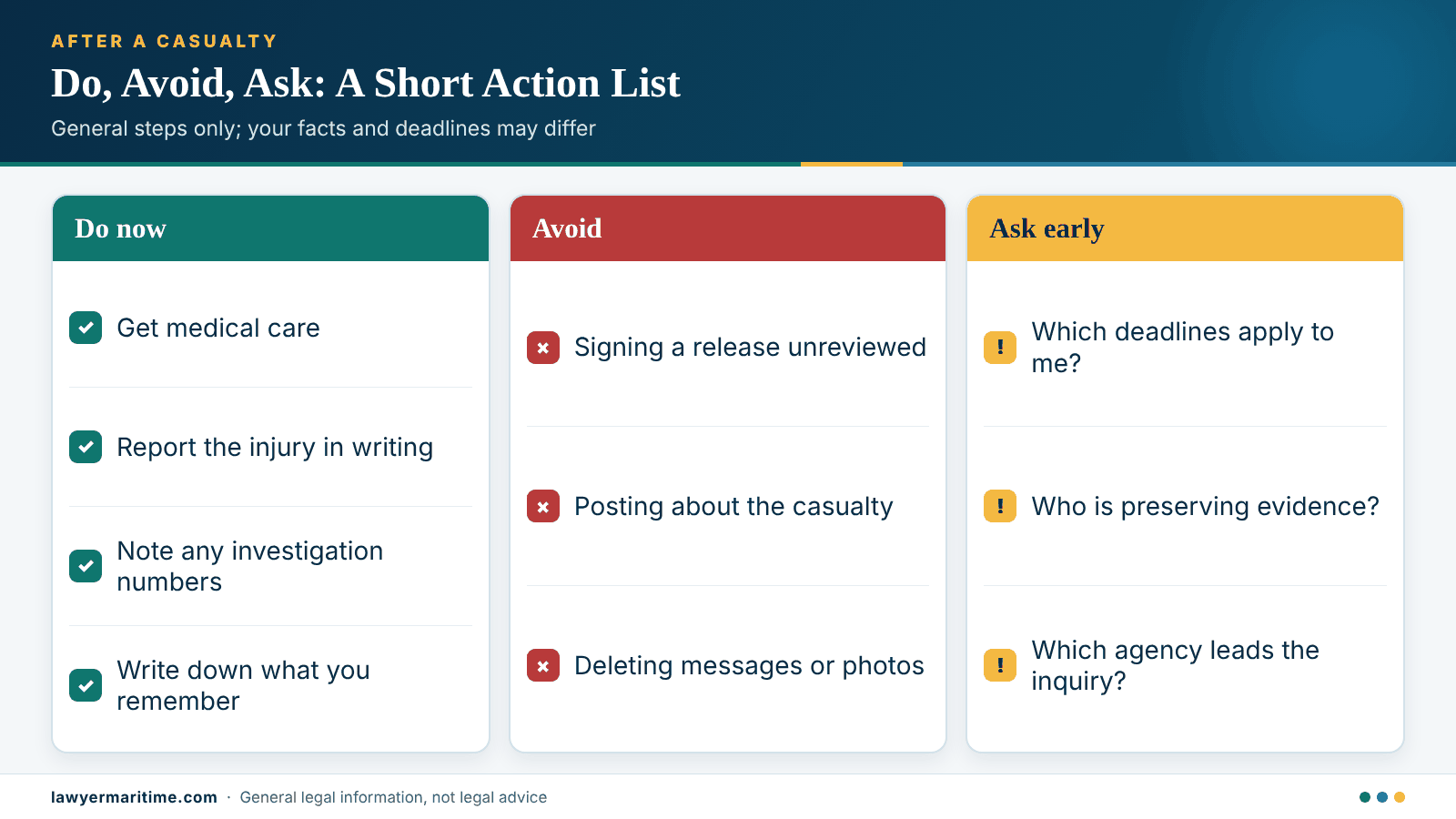
- Get medical care and follow it. Tell providers how the injury happened, and keep every discharge paper and appointment record.
- Report the injury in writing. Give written notice to your employer or the vessel’s master and keep a copy. Short notice periods can apply to some claims, such as under the LHWCA.
- Ask whether a Coast Guard or NTSB investigation is open. Note the agency, the case number, and the name of any investigator who contacts you.
- Write down what you remember. Do it while it’s fresh, with times, locations, names, and conditions.
Families after a death should also request copies of the death certificate and any autopsy or incident documentation, and should keep notes of every conversation with the employer or insurer.
Preserving evidence before it disappears
Vessels move, crews rotate, and records get overwritten. The sooner evidence is identified, the better the chance it will still exist. A lawyer can send preservation requests to the operator and others, which is one of the most useful early steps.
| Evidence | Why it matters | Who may hold it |
|---|---|---|
| Your own notes, photos, and messages | Capture what you saw before memory fades | You and your family |
| Medical records and work restrictions | Tie the injury to the event and show its effects | Hospitals, clinics, and providers |
| Maintenance, inspection, and repair records | Show what was known about equipment condition | Operator, owner, and contractors |
| Logs, voyage plans, and electronic navigation or engine data | Reconstruct what the vessel did and when | Operator, master, and manufacturers |
| Training, drill, and procedure records | Show whether the crew was prepared for the failure that happened | Operator and company safety department |
| Investigation numbers and public reports | Point to the facts and witnesses investigators examined | NTSB, Coast Guard, and agency dockets |
Dealing with investigators, employers, and insurers
After the first days, the work shifts to conversations. Each one has a purpose and a risk.
Statements and paperwork
Investigators and company representatives may ask for interviews or written statements. Answer truthfully and consider asking for legal advice before giving a recorded or signed statement, especially if you are injured, medicated, or worried about your job. An accurate, careful statement helps everyone; a rushed one given in pain may not reflect what happened.
- Don’t sign a release or settlement paper until you understand what rights it ends. Our guide on maritime settlement releases explains why seamen’s releases get special scrutiny.
- Don’t post about the casualty or your injuries on social media.
- Don’t delete messages, photos, or notes, even if they seem unhelpful.
Expect a long investigation and a short filing clock
Final NTSB findings can arrive more than a year after a casualty, as the Dali timeline shows. Your own time limits may be much shorter than the investigation, and some begin running on the injury date. Ask about deadlines in your first conversation with a lawyer, not after the report is published.
When to talk with a maritime attorney
It makes sense to speak with a maritime attorney when you are unsure of your status, when a death is involved, when a company asks for a signed statement or release, or when investigators have contacted you. A lawyer can explain which remedies might apply, protect evidence, and track deadlines. Our page on working with a maritime accident attorney goes into that in more detail.
If you are comparing options, our maritime lawyer hub is the broader starting point. This page can’t tell you whether you have a claim or what it would be worth.
Frequently Asked Questions
These answers are general and reflect what we could verify on October 10, 2026. Your facts, and the current text of the sources, may change the answer.
About the digest
What is the NTSB Safer Seas Digest?
It’s an annual publication of NTSB’s Office of Marine Safety that summarizes, by casualty type, the marine investigations the office completed in the previous year. Each summary gives the circumstances, NTSB’s probable cause finding, and lessons for the marine community.
When was the 2025 digest released, and how many investigations does it cover?
NTSB announced it on September 15, 2026, and says it covers 49 marine investigations completed in 2025. The year in the name refers to when the investigations were completed.
What are the main lessons in the 2025 digest?
NTSB lists twelve commonalities: effective maintenance, voyage planning and management, detecting and containing vessel fires, assessing waterfront infrastructure, watertight integrity, bank effect, fatigue and distraction, lithium-ion batteries, loss of electrical power, emergency planning and training, strong currents or heavy weather, and operating equipment as designed. The Dali, Titan, and Grande Costa D’Avorio investigations are featured.
Where can I read the full digest?
The PDF is linked from NTSB’s press release and from its Safer Seas Digest page, along with earlier editions. Full investigation reports and dockets are available on ntsb.gov by report number or accident ID.
Legal questions
Does the digest prove who was at fault in a casualty?
No. It’s a safety document, and probable cause is not a civil verdict. Fault in a damages case is decided under the law that governs the claim, using admissible evidence, and federal statutes limit the use of investigation reports in civil damages suits.
Can I use an NTSB report in my lawsuit?
Under 49 U.S.C. § 1154(b), no part of an NTSB report may be admitted into evidence or used in a civil action for damages. The statute and NTSB’s regulations draw distinctions among types of documents, so ask a lawyer how your court treats a particular one. Original records and witness testimony remain the core of most claims.
How long do I have to bring a claim after a marine casualty?
A general three-year period under 46 U.S.C. § 30106 applies to many maritime personal injury and death suits, but other laws and contracts can change it, and LHWCA notice and claim periods are much shorter. Check your own deadline early and don’t wait for an investigation to finish.
Does the digest change my rights under the Jones Act or LHWCA?
No. It reports on investigations and doesn’t amend a statute, create a claim, or alter a deadline. Your rights depend on your status, your employer, the vessel, and the location of the casualty.
Sources and Legal Authorities
The sources below support the statements in this guide. Each should be checked against its current text before you rely on it, and broader background is available in our guides to U.S. maritime law and admiralty law.
Statutes and regulations
Federal statutes
- 49 U.S.C. § 1131 – NTSB investigations, including major marine casualties
- 49 U.S.C. § 1154 – Use of NTSB reports in civil actions for damages
- 46 U.S.C. § 6101 – Marine casualty reporting
- 46 U.S.C. § 6308 – Information and reports of Coast Guard marine casualty investigations
- 46 U.S.C. § 30104 – Jones Act personal injury and death of a seaman
- 46 U.S.C. § 30106 – Time limit on bringing maritime action for personal injury or death
- 46 U.S.C. § 30302 – Death on the High Seas Act, cause of action
- 46 U.S.C. § 30523 – Limitation of liability, general limit
- 45 U.S.C. § 56 – FELA, limitation of actions
- 33 U.S.C. § 905 – LHWCA exclusiveness of liability; vessel negligence suits
- 33 U.S.C. § 912 – LHWCA notice of injury or death
- 33 U.S.C. § 913 – LHWCA filing of claims
Regulations and rules
- 46 C.F.R. § 4.05-1 – Notice of marine casualty
- 49 C.F.R. § 850.5 – Definitions, including major marine casualty
- 49 C.F.R. § 850.15 – Marine casualty investigation by the Board
- 49 C.F.R. § 835.2 – Definitions of Board accident reports and factual accident reports
Cases and agency materials
Supreme Court decisions
- Chandris, Inc. v. Latsis, 515 U.S. 347 (1995) – seaman status test (cited from the editorial authority matrix; not re-fetched)
- CSX Transportation, Inc. v. McBride, 564 U.S. 685 (2011) – FELA causation standard
- Mitchell v. Trawler Racer, Inc., 362 U.S. 539 (1960) – unseaworthiness duty
- Usner v. Luckenbach Overseas Corp., 400 U.S. 494 (1971) – isolated negligent act and unseaworthiness
- The Pennsylvania, 86 U.S. (19 Wall.) 125 (1874) – statutory violation and burden of causation
- Scindia Steam Navigation Co. v. De Los Santos, 451 U.S. 156 (1981), and Howlett v. Birkdale Shipping Co., 512 U.S. 92 (1994) – vessel duties to harbor workers
- Mobil Oil Corp. v. Higginbotham, 436 U.S. 618 (1978), and Yamaha Motor Corp. v. Calhoun, 516 U.S. 199 (1996) – DOHSA and state-law remedies
- Lewis v. Lewis & Clark Marine, Inc., 531 U.S. 438 (2001) – limitation proceedings and the saving-to-suitors clause
Agency and official materials
- NTSB press release, September 15, 2026 – Safer Seas Digest release
- NTSB Safer Seas Digest 2025 (SPC-26-01), PDF
- NTSB Safer Seas Digest page, with earlier editions
- NTSB press release, May 21, 2025 – Safer Seas Digest (2024 edition)
- NTSB press release, June 27, 2024 – Safer Seas Digest (2023 edition)
- NTSB Safer Seas Digest 2023 (SPC-24-05), PDF
- NTSB investigation page – Dali and the Francis Scott Key Bridge
- NTSB press release, March 20, 2025 – 68 bridges and vessel-strike risk
- NTSB investigation page – Titan submersible
- NTSB investigation page – Grande Costa D’Avorio fire
- NTSB press release, September 10, 2025 – safety alert for land-based firefighters
- NTSB investigation reports
- U.S. Department of Labor – Division of Longshore and Harbor Workers’ Compensation
Trade press (gCaptain, Marine Insight, and Seatrade Maritime) was used only to cross-check the release date and count. It is not cited as authority.